Casino Strategy Guide
Casino Strategy Guide 2026: How to Play Smarter (Without Chasing Losses)
Most players think strategy means “winning more.”
That’s not how it works.
In reality, casino strategy is about control. Control over money, decisions, and behavior. The players who last longer—and avoid the worst mistakes—don’t rely on luck. They follow structure.
This guide breaks down how experienced players actually approach casinos.
You will understand:
- how different games require different approaches
- why bankroll control matters more than “systems”
- where strategy helps (and where it doesn’t)
- how to avoid the most expensive mistakes
If you’ve already explored platforms in the Best Online Casinos section, this guide will help you use them more effectively instead of playing blindly.
What Casino Strategy Actually Means
Strategy Is Not About Beating the Casino
Every casino game includes a built-in house edge.
That means the system always favors the casino over time.
However, strategy still matters.
Not because it removes the edge, but because it helps you:
- reduce unnecessary losses
- extend your playtime
- avoid critical mistakes
- control risk
The Real Goal
The goal is simple:
Stay in control for as long as possible.
Players who lose control:
- chase losses
- increase bets emotionally
- ignore limits
Players who follow structure:
- stay consistent
- manage risk
- stop when needed
That difference defines the outcome.
Understanding Game Types Before Strategy
Not all casino games behave the same way.
Therefore, strategy changes depending on the game.
If you haven’t already, understanding the differences in the Casino Game Types Guide is essential before applying any approach.
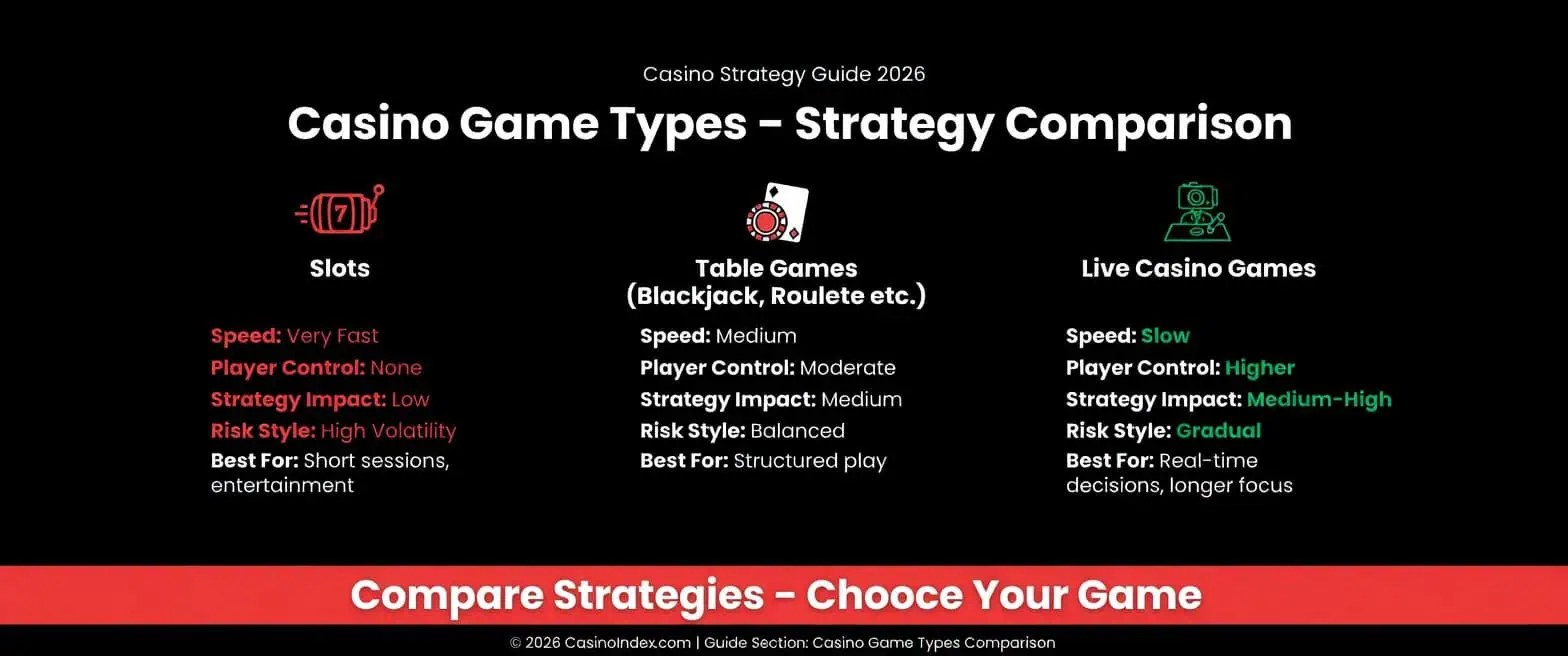
Slots (High Variance, Low Control)
Slots are simple.
You press spin, and the result appears.
However, that simplicity hides volatility.
Slots:
- offer no control over outcomes
- rely fully on RNG systems
- vary heavily in volatility
If you want a deeper breakdown, the Slot Games Guide explains how RTP and volatility affect results.
Table Games (Moderate Control)
Games like blackjack and roulette offer more structure.
For example:
- blackjack allows decision-making
- roulette offers different bet types
Because of this, strategy plays a slightly larger role.
However, randomness still dominates outcomes.
Live Casino Games (Real-Time Interaction)
Live games combine real dealers with online play.
They feel more controlled.
However, the math remains the same.
You can explore this further in the Live Casino Guide.
The Foundation of Every Casino Strategy
Bankroll Management (Most Important Rule)
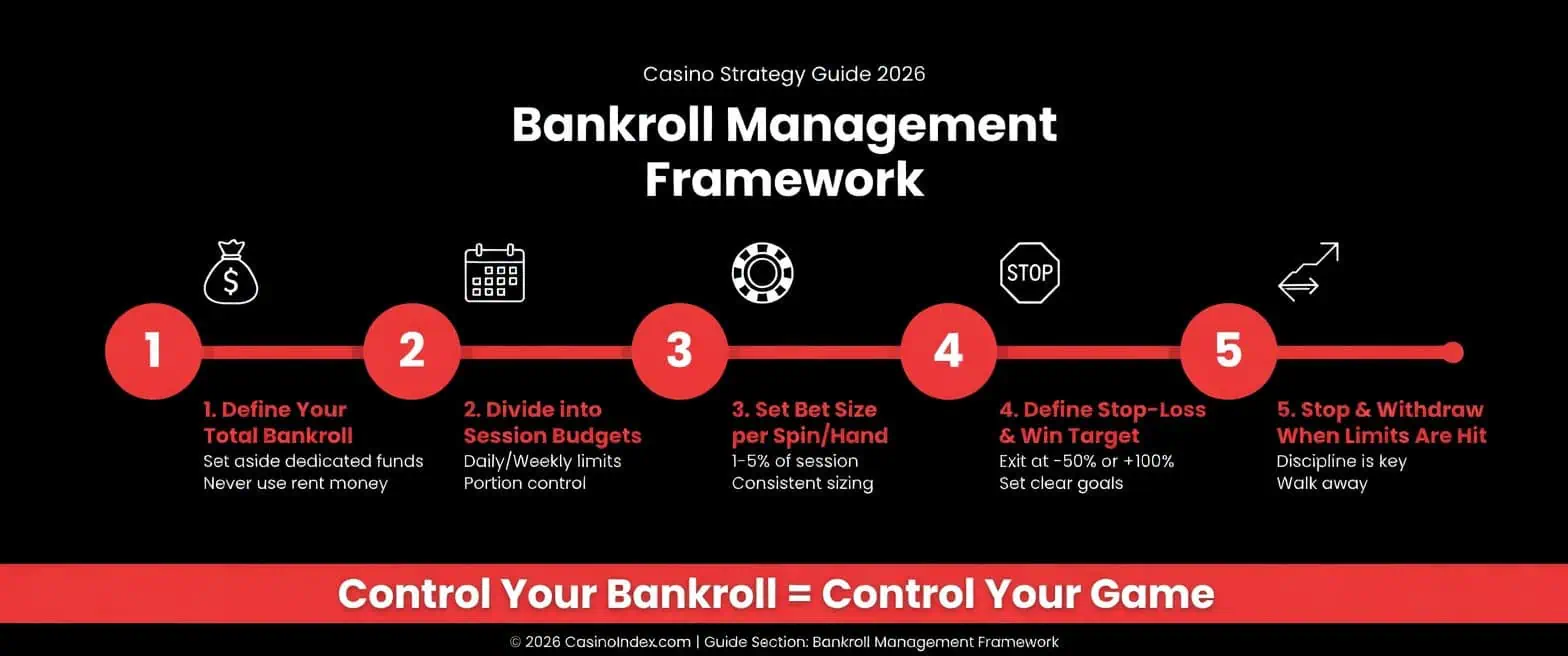
Before thinking about games or tactics, you need structure.
Bankroll management defines everything.
What Is a Bankroll?
Your bankroll is the amount you are prepared to use.
It is not your total money.
It is your allocated session budget.
The Basic System
A simple structure works best:
- define a fixed bankroll
- divide it into smaller session amounts
- set a stop-loss limit
- set a win target
Example:
- bankroll = $200
- session = $20
- stop-loss = $20
- win target = $40
Once you hit either limit, you stop.
Why This Works
Without limits, players react emotionally.
With limits, players act deliberately.
This removes impulsive decisions.
The Biggest Strategy Mistakes
Chasing Losses
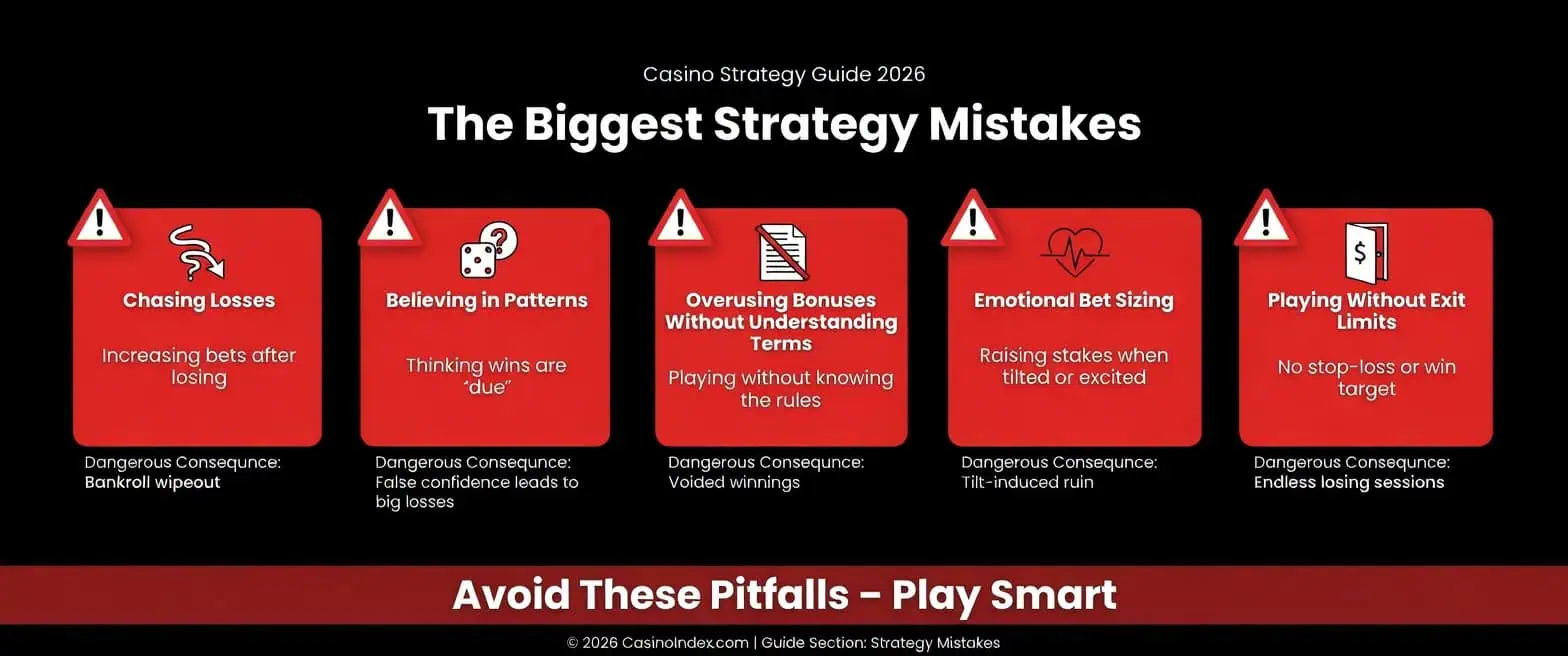
This is the most common mistake.
After losing, players try to recover quickly.
They:
- increase bet size
- play longer
- ignore limits
As a result, losses accelerate.
Believing in Patterns
Players often believe:
- a win is “due”
- a losing streak will end soon
- outcomes follow cycles
However, games do not remember past results.
Each outcome is independent.
This is explained clearly in the Casino RTP Guide.
Overusing Bonuses Without Understanding Them
Bonuses seem helpful.
However, complex conditions increase risk.
Without understanding wagering rules, players lose control.
The Casino Bonus Guide explains how these conditions affect gameplay.
Strategy for Slot Players
Accept the Nature of Slots
Slots do not reward skill.
Therefore, strategy focuses on control, not prediction.
Choose the Right Slot Type
Slots differ in volatility.
- low volatility → smaller, frequent wins
- high volatility → larger, rare wins
Choosing the wrong type creates frustration.
Set Fixed Bet Sizes
Changing bet sizes frequently increases risk.
Instead:
- choose a consistent bet
- match it to your bankroll
- avoid sudden increases
Limit Session Length
Long sessions increase exposure.
Short sessions reduce risk.
That is why experienced players:
- play in controlled intervals
- take breaks
- stop early
Strategy for Table Games
Focus on Simplicity
Complex systems rarely help.
Simple approaches work better.
Blackjack Basics
In blackjack:
- follow basic strategy charts
- avoid emotional decisions
- stay consistent
Even then, the house edge remains.
Roulette Approach
In roulette:
- avoid high-risk betting patterns
- focus on consistent bets
- accept randomness
No system guarantees profit.
Crypto Casino Strategy (Important Difference)
Crypto introduces new variables.
Unlike traditional systems, it adds volatility.
The Crypto Casino Guide explains how crypto changes gameplay conditions.
Use Stablecoins When Possible
Crypto value can change.
To reduce risk:
- use stablecoins
- avoid holding funds long-term
Withdraw Frequently
Leaving large balances increases exposure.
Experienced players:
- withdraw profits regularly
- keep minimal funds inside the casino
Understand Payment Flow
Crypto transactions are irreversible.
Therefore:
- double-check addresses
- use correct networks
- avoid rushed transfers
The Role of Discipline
Strategy only works with discipline.
Without it, even the best structure fails.
What Discipline Looks Like
- stopping at limits
- avoiding emotional bets
- staying consistent
- following predefined rules
What Happens Without It
Players:
- ignore limits
- chase outcomes
- increase risk
As a result, losses grow faster.
Why Most “Casino Strategies” Fail
The Illusion of Systems
Many players search for systems that promise consistent wins.
You will see strategies like:
- Martingale
- Reverse Martingale
- Fibonacci
- Pattern tracking
At first glance, they look logical.
However, they all share one problem:
They assume the game reacts to your previous bets.
It does not.
Every spin, hand, or round is independent.
Therefore, no betting system can change long-term outcomes.
Why These Systems Still Attract Players
Even though they don’t work long-term, players still use them.
That happens because:
- short-term wins feel like proof
- patterns seem real in small samples
- losses are explained away as “bad timing”
As a result, players continue using systems that increase risk instead of reducing it.
The Only Strategy That Actually Works
Control Over Prediction
Instead of trying to predict outcomes, experienced players focus on:
- controlling exposure
- controlling session length
- controlling bet size
This approach removes unnecessary risk.
The Core Principle
You cannot control results.
You can control decisions.
That distinction changes everything.
Understanding Risk Properly
Risk Is Not Just Losing
Most players think risk equals losing money.
However, risk has multiple layers:
- speed of loss
- volatility of results
- emotional impact
- decision pressure
Understanding these factors improves control.
Fast vs Slow Loss
Different games lose money at different speeds.
For example:
| Game Type | Loss Speed | Player Control |
|---|---|---|
| Slots | Fast | None |
| Roulette | Medium | Low |
| Blackjack | Slower | Moderate |
This is why game choice matters.
Why Speed Changes Behavior
Faster games create pressure.
You make more decisions in less time.
As a result:
- mistakes increase
- emotional reactions grow
- control decreases
Slower games give more time to think.
Session Control (Most Underrated Strategy)
Why Session Length Matters
Long sessions increase exposure.
More time means:
- more bets
- more variance
- higher probability of loss
Therefore, limiting session length improves control.
The Structured Session Model
Instead of playing continuously, use structured sessions.
Example:
- 20–30 minute sessions
- fixed budget per session
- mandatory breaks
This creates separation between decisions.
Why Breaks Are Important
Breaks reset your mindset.
Without breaks:
- decisions become automatic
- awareness decreases
- discipline weakens
Short pauses improve clarity.
Emotional Control (Where Most Players Fail)
The Two Critical Moments
Players lose control at two points:
- after losses
- after big wins
Both situations create emotional pressure.
After Losses
After losing, players try to recover quickly.
They:
- increase bets
- play faster
- ignore limits
This leads to bigger losses.
After Wins
Winning also creates risk.
Players often:
- become overconfident
- increase bet size
- extend sessions
As a result, they give back profits.
The Balanced Approach
Experienced players treat both situations the same.
They:
- stick to limits
- avoid sudden changes
- maintain consistency
This protects both sides.
The Concept of “Controlled Loss”
Accepting the Reality
Losses are part of the system.
Trying to avoid them completely creates more problems.
What Controlled Loss Means
Controlled loss means:
- losing within predefined limits
- avoiding emotional reactions
- protecting the overall bankroll
Instead of fighting losses, you contain them.
Why This Works
This approach prevents escalation.
Small losses stay small.
Large losses are avoided.
Game Selection Strategy (Advanced Layer)
Choosing Based on Behavior, Not Hype
Many players choose games based on:
- popularity
- visuals
- recommendations
However, experienced players choose based on behavior.
Matching Game to Player Type
Different players need different environments.
For example:
- risk-tolerant players → high volatility slots
- conservative players → lower variance games
- control-focused players → table games
This alignment improves experience.
Why Mismatch Causes Problems
If the game does not match your style:
- frustration increases
- decisions become emotional
- losses feel worse
Choosing correctly reduces these issues.
The Role of Environment
Platform Quality Affects Strategy
Strategy is not only about the game.
The casino environment matters too.
Key factors include:
- payout speed
- payment options
- bonus structure
- interface quality
You can compare these differences in platforms like the BC.Game Casino Review or the BitStarz Casino Review, where usability and features directly affect gameplay experience.
Why This Matters
Even with good strategy, a poor platform creates friction.
That includes:
- delayed withdrawals
- unclear terms
- inconsistent behavior
Choosing the right environment supports better decisions.
Advanced Mistakes That Cost More Than Expected
Playing Without a Defined Exit
Many players start without knowing when to stop.
As a result:
- sessions continue too long
- losses accumulate
- discipline breaks down
Increasing Stakes Without Structure
Sudden bet increases create risk spikes.
Instead:
- use consistent bet sizing
- adjust slowly if needed
Ignoring External Factors
Factors like:
- fatigue
- stress
- distractions
affect decision quality.
Experienced players avoid playing under poor conditions.
Strategy Is a Framework, Not a Trick
Why This Matters
Many players look for shortcuts.
However, casino strategy is not a trick.
It is a framework.
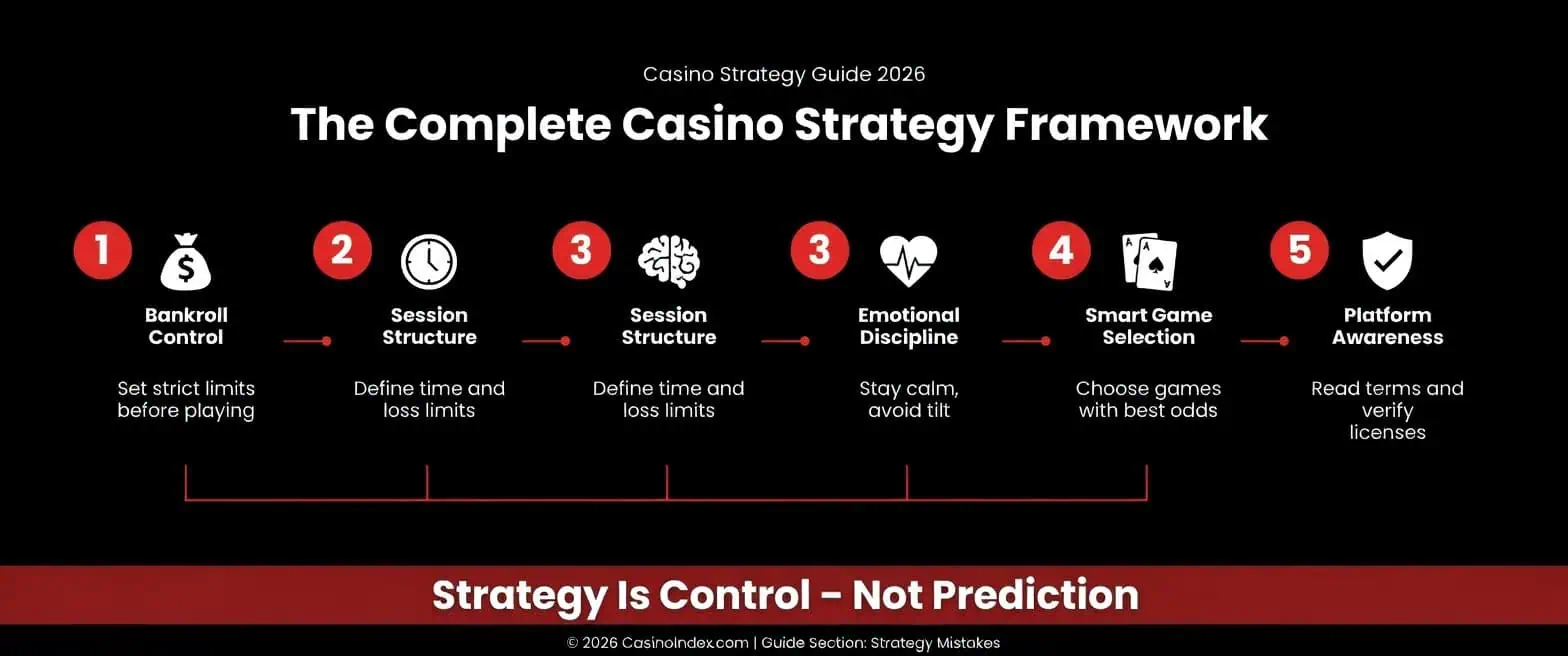
The Framework Includes
- bankroll control
- session structure
- emotional discipline
- game selection
- platform awareness
When combined, these elements create stability.
The Complete Casino Strategy Framework
At this point, everything comes together.
A real casino strategy is not one trick or system. Instead, it is a combination of small decisions that work together.
When you apply them consistently, your entire approach changes.
The 5 Core Elements
Every effective approach includes:
- bankroll control
- session structure
- emotional discipline
- game selection
- environment awareness
If one of these fails, the whole system weakens.
How They Work Together
For example:
- good bankroll control prevents large losses
- structured sessions limit exposure
- emotional discipline avoids impulsive decisions
- correct game selection reduces frustration
- strong platforms remove unnecessary friction
Each element supports the others.
That is why experienced players treat strategy as a system, not a shortcut.
The Practical Do’s and Don’ts
What to Do
- set limits before starting
- use fixed bet sizes
- take regular breaks
- stop at predefined points
- stay consistent
These actions create stability.
What to Avoid
- chasing losses
- increasing bets emotionally
- playing for too long
- switching strategies constantly
- ignoring limits
These behaviors create risk.
Why Simplicity Wins
Simple systems are easier to follow.
Complex systems fail under pressure.
When emotions increase, simplicity keeps you grounded.
The “Before You Play” Checklist
Before every session, run through a quick check.
1. Define Your Budget
Decide how much you are willing to use.
Once set, do not change it.
2. Choose Your Game Type
Pick a game that matches your style.
If you want:
- fast action → slots
- more control → table games
- real interaction → live casino
3. Set Your Exit Points
Define both:
- stop-loss
- win target
This removes emotional decisions later.
4. Check the Environment
Make sure the platform is reliable.
This includes:
- clear rules
- smooth gameplay
- stable payment systems
If needed, you can compare structured platforms like TrustDice Casino or Shuffle Casino Review, where system consistency supports better control during gameplay.
The “During Play” Rules
Stay Within Structure
Once you start, follow your plan.
Do not adjust based on emotion.
Avoid Rapid Decisions
Fast decisions increase mistakes.
Take a moment between actions.
Watch for Behavior Changes
If you notice:
- frustration
- impatience
- impulsive thinking
it is time to stop.
The “After Play” Routine
Review the Session
Ask yourself:
- did I follow my limits?
- did I stay consistent?
- did I make emotional decisions?
This improves future sessions.
Separate Outcome from Process
Winning does not mean good decisions.
Losing does not mean bad decisions.
Focus on process, not results.
The Biggest Myth About Casino Strategy
“Good Players Win More”
This is not accurate.
Good players:
- lose more slowly
- avoid large mistakes
- control their behavior
That is the real difference.
Long-Term Perspective
Why Time Changes Everything
Over time:
- randomness evens out
- house edge applies
- emotional mistakes accumulate
Therefore, long-term thinking is essential.
What Experienced Players Do Differently
They:
- limit session frequency
- avoid long play periods
- withdraw regularly
If you are playing on crypto platforms, understanding payment flow in the Crypto Casino Guide 2026 helps maintain better control over funds.
The Strategy That Actually Protects You
There is no winning system.
However, there is a protective system.
The Protective System
- control your bankroll
- limit your sessions
- avoid emotional decisions
- choose the right games
- use reliable platforms
This system reduces risk significantly.
Casino Strategy FAQ (Advanced Player Questions)
Can you actually develop a winning casino strategy?
No strategy can remove the house edge.
However, a structured approach can reduce unnecessary losses and improve overall control. Over time, this creates a more stable and predictable experience compared to random play.
Why do most casino strategies fail in the long run?
Most strategies fail because they rely on patterns that do not exist.
Casino games operate on independent outcomes. Therefore, no previous result influences the next one. Systems that assume otherwise eventually break down.
Is bankroll management really that important?
Yes, it is the foundation of everything.
Without bankroll control, even the best decisions lose value. A structured bankroll allows you to:
- control session length
- avoid emotional decisions
- prevent large losses
How much of your bankroll should you use per session?
A common approach is to use around 5–20% of your total bankroll per session.
For example:
- bankroll = $200
- session = $10–$40
This keeps losses manageable and prevents rapid depletion.
What is the biggest mistake beginners make?
The most common mistake is chasing losses.
After losing, players increase bets or extend sessions. As a result, losses grow faster and control disappears.
Does changing bet size improve your chances?
No, it does not.
Changing bet size only affects volatility and session length. It does not influence the probability of winning.
Are short sessions really better than long sessions?
Yes, in most cases.
Short sessions reduce exposure and help maintain focus. In contrast, long sessions increase fatigue and lead to more mistakes.
How do experienced players handle winning sessions?
They treat wins carefully.
Instead of increasing bets, they often:
- lock in profits
- reduce risk
- stop early
This prevents giving back winnings.
Why is emotional control so important?
Emotions affect decision-making.
When players feel:
- frustrated
- overconfident
- impatient
they make impulsive decisions. These decisions usually increase risk.
Should you always follow the same strategy?
Yes, consistency matters.
Constantly changing strategy leads to confusion and poor decisions. A simple and consistent approach works better over time.
Does the choice of game really matter?
Yes, it has a significant impact.
Different games create different experiences:
- slots → fast and volatile
- table games → slower with more control
- live games → structured and interactive
Choosing the right game improves overall stability.
Can casino bonuses improve your strategy?
Bonuses can help, but only if used correctly.
However, complex wagering conditions often create additional risk. Therefore, understanding the terms before playing is essential.
How important is the casino platform itself?
The platform plays a major role.
A reliable casino offers:
- fast and consistent payouts
- clear rules
- stable performance
This reduces friction and supports better decision-making.
What is the safest way to approach gambling overall?
The safest approach is structured and controlled.
This includes:
- setting limits
- managing bankroll
- avoiding emotional decisions
- playing in short sessions
This reduces risk significantly.
Can discipline really outperform luck?
Yes, over time it does.
Luck may affect short sessions. However, discipline controls long-term outcomes by preventing major mistakes.
Why do some players seem to win more often?
In most cases, it is perception.
Players remember wins more than losses. Over time, the house edge still applies to everyone.
Is it better to play multiple games or stick to one?
Sticking to one game is usually better.
Switching frequently creates inconsistency and increases emotional decision-making.
When should you stop playing?
You should stop when:
- you reach your loss limit
- you hit your win target
- you feel emotional pressure
Stopping at the right time is one of the most important skills.
What separates professional players from casual players?
The difference is not skill in winning.
It is discipline and structure.
Experienced players:
- plan sessions
- control bankroll
- follow rules
Casual players react instead of planning.
Can strategy make casino play “safe”?
No system makes gambling safe.
However, strategy reduces unnecessary risk and helps you stay in control.
Final Conclusion
Casino strategy is often misunderstood.
It is not about winning more.
It is about losing smarter.
Players who understand this:
- avoid major mistakes
- control their sessions
- protect their bankroll
Players who ignore it:
- rely on luck
- react emotionally
- lose faster
The difference is not in the game.
It is in the approach.
Explore More Casino Guides
To strengthen your overall understanding:
- Learn how probabilities work in the Casino RTP Guide
- Understand bonuses in the Casino Bonus Guide
- Compare platforms in the Best Online Casinos