Casino RTP Guide 2026: Return to Player, House Edge and Game Versions
RTP, short for Return to Player, is one of the most useful numbers in online gambling. It is also one of the most misunderstood.
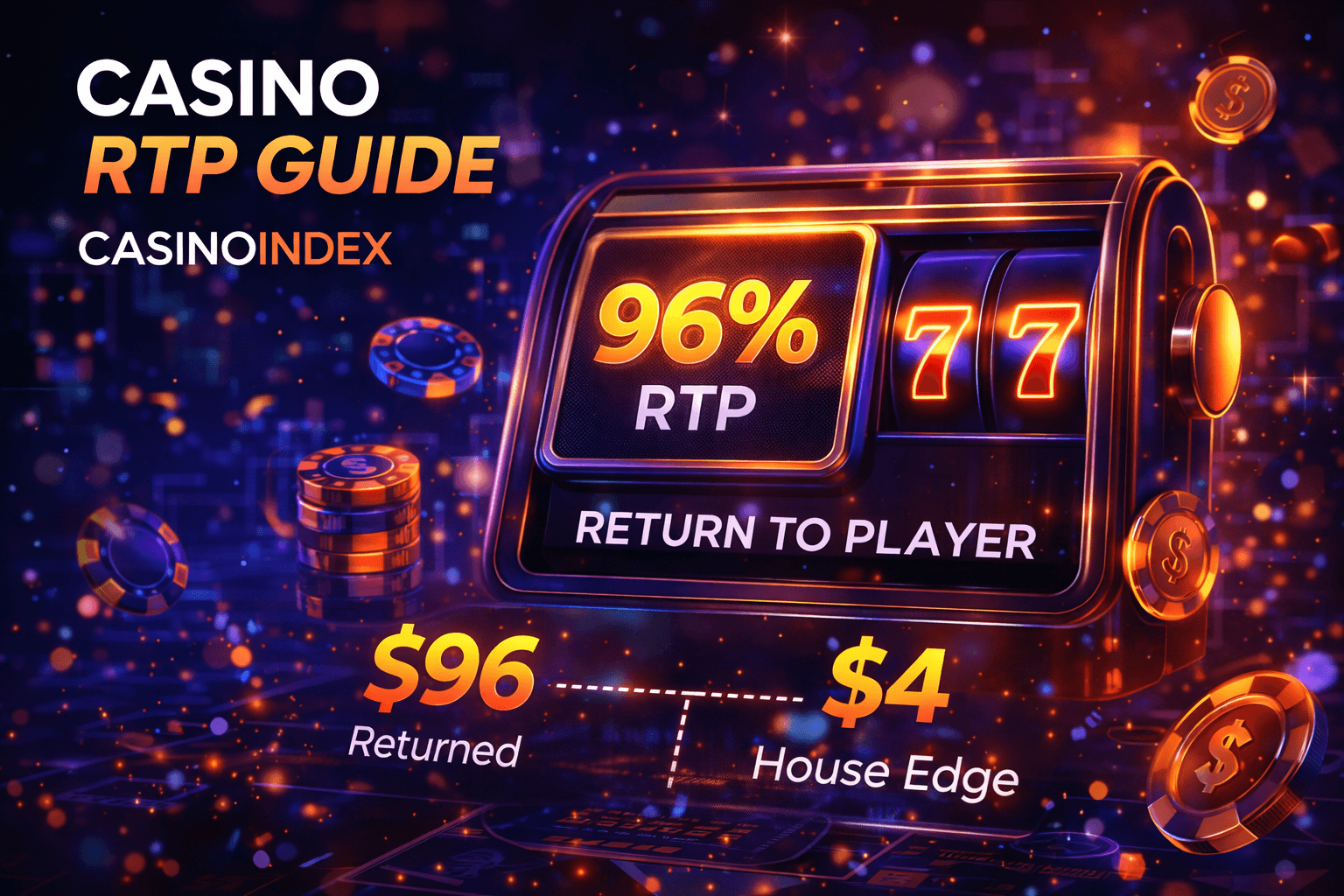
For example, a game with 96% RTP theoretically returns about $96 for every $100 wagered across a very large number of rounds. Therefore, the remaining $4 represents the theoretical casino advantage.
However, that does not mean a player who deposits $100 should expect to withdraw $96. In practice, providers calculate RTP across long-term wagering, not one account, one balance or one session. Short-term results can sit far above or below the published percentage because variance still controls individual outcomes.
RTP becomes useful when players understand what the number can and cannot explain. It can help compare games, identify weaker mathematical configurations and estimate the theoretical cost of repeated wagering. It cannot predict the next result, guarantee profit or prove that the casino hosting the game is trustworthy.
CasinoIndex therefore treats RTP as a game-value signal, not a complete safety signal. Therefore, players should consider the number alongside volatility, provider identity, bonus rules, withdrawal reliability, licensing, complaint history and the exact game version that the casino offers.
As a result, this guide explains how casino RTP works, how it relates to house edge, why different versions of the same title can exist and how players can check whether an advertised percentage reflects the real game they are using.
Casino RTP Explained in One Minute
| Question | Practical Answer |
|---|---|
| What does RTP mean? | The theoretical percentage of total wagers returned to players over the long run |
| Does 96% RTP return $96 from a $100 deposit? | No. It applies to long-term wagering across a very large number of rounds |
| Is higher RTP usually better? | Yes, when comparing similar games under similar conditions |
| Can one game have several RTP versions? | Yes. Some providers supply multiple approved configurations |
| Does high RTP prove casino quality? | No. Withdrawals, terms, support and account controls remain separate |
| Where should RTP be checked? | Players should check the active game information or paytable and compare it with provider documentation |
RTP Research Shortlist: Casinos Where Game Value Is Easier to Check
First, players should never judge RTP without examining the casino behind it. A visible provider library, accessible game information, clear bonus rules and reliable withdrawals all affect whether a good mathematical return has practical value.
Therefore, the table below serves as a research shortlist rather than a claim that every game at these casinos has a higher RTP. Players still need to check the exact title, provider, country availability and active configuration in their own account.
| Casino | RTP Research Angle | Main Strength | What Still Needs Checking |
|---|---|---|---|
| BitStarz | Established multi-provider slot library | Longer crypto casino history | Game version, country access and bonus eligibility |
| BC.Game | Provider games plus crypto-native originals | Large game ecosystem | Difference between third-party RTP and provably fair originals |
| TrustDice | Crypto games and reward-led play | Useful comparison between game math and reward value | RTP, wagering rules and withdrawal conditions |
| Shuffle | Modern crypto casino structure | Clean provider and originals mix | Volatility, promotion eligibility and account checks |
| Duelbits | Casino, originals and sportsbook crossover | Several game types in one account | Game-specific rules, bonus contribution and payout handling |
Use this shortlist as a starting point, not a shortcut. A strong RTP figure only becomes useful when the casino also offers transparent terms and a credible cashout process. CasinoIndex explains the wider evaluation in its trust and payout risk methodology.
What RTP Actually Means
RTP stands for Return to Player. It represents the theoretical percentage of total wagers that a game returns to players over its long-run mathematical cycle.
For example, consider a slot with 96% RTP:
- Theoretical player return: 96%
- Theoretical house edge: 4%
- Theoretical loss across $10,000 wagered: approximately $400
However, the word theoretical is essential. The percentage describes a mathematical expectation across an enormous number of rounds. It does not describe one evening of play or one individual account.
Deposit size and total wagering are not the same
For instance, a player may deposit $100 but wager far more than $100 if they repeatedly recycle wins. For example, a balance can move up and down through hundreds of spins before the session ends.
Therefore, RTP applies to the total amount wagered. It does not apply only to the original deposit.
What RTP can help explain
- how one game compares mathematically with a similar alternative
- how theoretical cost rises as wagering volume increases
- whether a title appears weak for its category
- why bonus wagering can become expensive
- why small percentage differences matter during repeated play
What RTP cannot explain
- whether the next spin will win
- how much one session will return
- when a bonus feature will appear
- whether a casino will approve a withdrawal
- whether the game suits the player’s bankroll
Ultimately, the most common mistake is treating RTP as a promise. It is not a promise. It is a long-run measurement that becomes useful only when applied in the correct context.
RTP vs House Edge
By contrast, RTP and house edge describe the same mathematical relationship from opposite sides.
House edge = 100% − RTP
| RTP | House Edge | Theoretical Cost per $1,000 Wagered | General Context |
|---|---|---|---|
| 98% | 2% | $20 | Strong mathematical value |
| 97% | 3% | $30 | Good value in many categories |
| 96% | 4% | $40 | Common reference point for online slots |
| 94% | 6% | $60 | More expensive during repeated play |
| 92% | 8% | $80 | Weak unless another feature justifies the cost |
Although these figures show theoretical averages rather than session predictions, they still clarify the long-run cost. Nevertheless, the difference between a 2% and 8% edge becomes meaningful when players wager thousands of dollars over time.
Consequently, that difference matters most during long sessions, bonus wagering and fast games that generate a high volume of bets in a short period.
Why RTP Alone Does Not Prove Casino Quality
However, a high-RTP game can operate correctly inside a casino that handles player accounts poorly.
Although the provider may control the game mathematics, the casino operator controls:
- the player account
- country eligibility
- bonus rules
- KYC and payment checks
- withdrawal limits
- complaint handling
- the release of funds
Therefore, CasinoIndex separates game value from casino trust.
| Signal | What It Helps Evaluate | What It Does Not Prove |
|---|---|---|
| RTP | Long-run mathematical value | Withdrawal reliability |
| Provider reputation | Game origin and software credibility | Fair casino terms |
| License | Legal and regulatory accountability | Perfect support or automatic payouts |
| Provably fair verifier | Integrity of supported game outcomes | Whole-platform safety |
| Completed withdrawals | Evidence that payments can work | Identical treatment at every value |
CasinoIndex explains the wider distinction in why RTP alone does not prove casino quality.
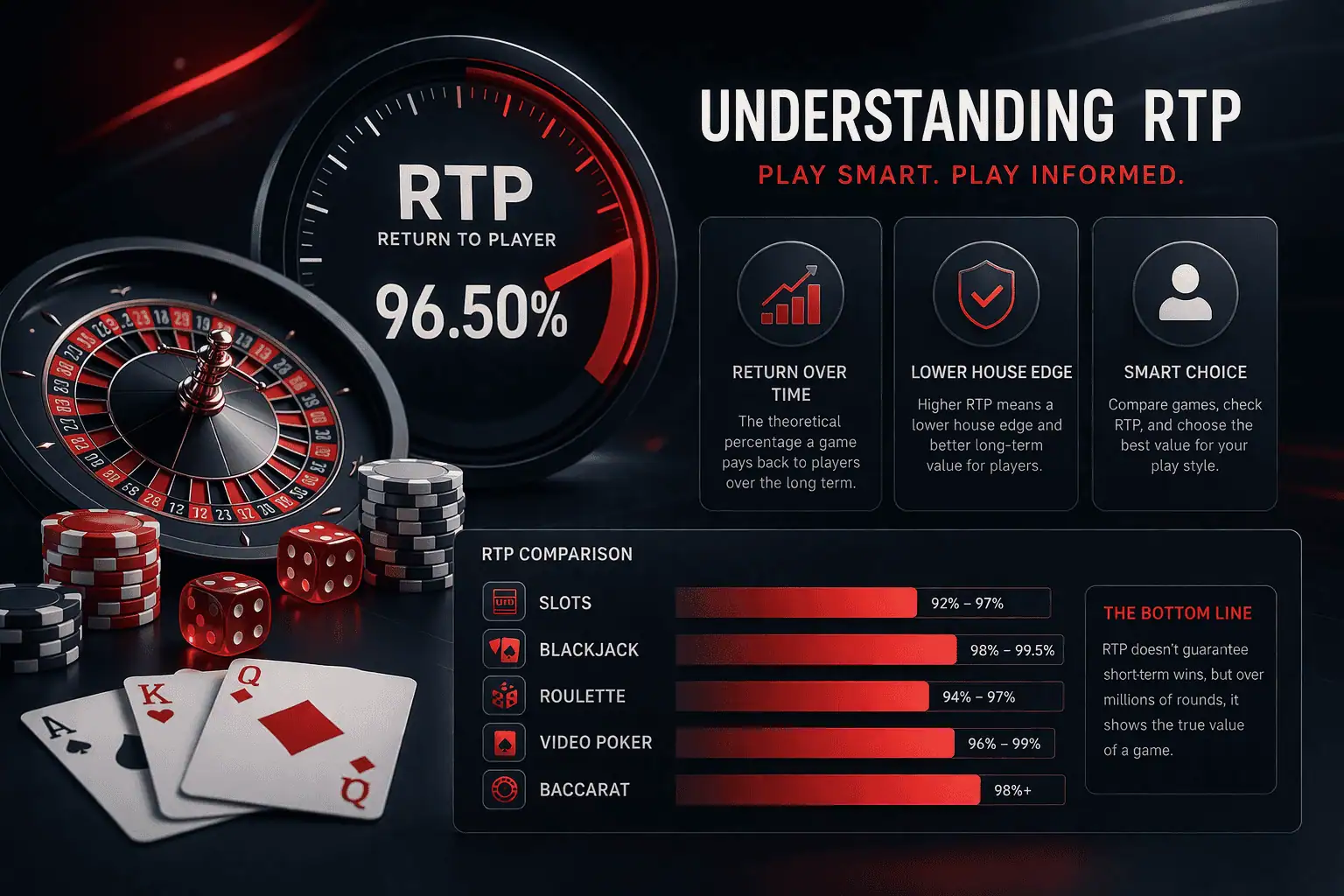
RTP by Casino Game Type
Meanwhile, different casino categories use different rules, mathematical structures and payout models. Use the ranges below for context, but do not apply them blindly to every game.
| Game Type | Common Theoretical Range | Main Variable | Player Risk |
|---|---|---|---|
| Online slots | Often around 92%–97% | Provider, title and selected version | Volatility varies heavily |
| Blackjack | Can exceed 99% with favourable rules | Table rules and player decisions | Poor strategy increases the effective edge |
| Baccarat | Often above 98% on core bets | Bet selection | Side bets may carry a much larger edge |
| Roulette | Depends on wheel and rule set | Single-zero, double-zero or special rules | American roulette generally costs more |
| Crash, dice and originals | Varies by game settings | House-edge configuration | Fast rounds increase total wagering quickly |
Therefore, players comparing categories can use the casino game types guide. Slot-focused users can also review the slot games guide for volatility, paylines, bonus features and provider differences.
What Is Considered a Good RTP?
Still, no universal percentage makes every game attractive. The correct benchmark depends on the category, rules, volatility and purpose of play.
Online slots
For online slots, many players use 96% as a practical reference point. A figure above 97% can be mathematically strong, while a game below 94% deserves closer review, especially if it is also highly volatile.
Blackjack and table games
For table games, providers may calculate the published return under favourable rules and correct decisions. A blackjack game can show strong theoretical value while poor strategy creates a much higher effective house edge.
Jackpot games
In jackpot games, providers may connect part of the total RTP to a progressive prize. The base game can therefore feel weaker than the headline number suggests, particularly when the largest prize is extremely rare.
Crash and instant games
For crash and instant games, even a relatively low house edge can become expensive when the player completes many rounds quickly. Therefore, players should consider session speed alongside the percentage.
| RTP Range | General Slot Context | Player Note |
|---|---|---|
| 97%+ | Strong | Still requires volatility and version checks |
| 96%–97% | Good common range | Often reasonable for repeated slot play |
| 94%–96% | Average | Needs stronger context before longer sessions |
| Below 94% | Weak to average | Review carefully before frequent play |
Where to Find RTP in Casino Games
Usually, the active game inside the casino provides the strongest source.
Specifically, check:
- the game information menu
- the paytable
- the rules or help section
- provider documentation
- the casino’s game-detail page
- official testing or certification information where available
However, a demo version can provide useful context, but players should not automatically assume it uses the same configuration as the real-money game.
Why provider identity matters
In addition, a visible provider name allows players to confirm the game’s origin and research whether several versions exist. Unknown or hidden providers make proper verification harder.
The casino providers guide explains how software studios, aggregators and operator settings affect game trust.
Real RTP vs Fake RTP Explained
In practice, “fake RTP” can describe several different problems. However, it does not always mean that someone secretly manipulated the underlying game.
For example, possible issues include:
- a casino quoting the default RTP while offering a lower configuration
- a review page copying an outdated number
- a demo game showing information that differs from the real-money version
- an imitation game using the name or appearance of a recognised title
- a casino displaying a percentage without supporting information
- marketing that presents theoretical return as an expected personal result
Therefore, the safest approach is to match three pieces of evidence:
- Game identity: title and provider
- Active game information: RTP shown inside the real-money version
- Supporting documentation: provider or casino information that matches the game
For deeper context, CasinoIndex provides a breakdown in real RTP vs fake RTP explained.
Can Casinos Change RTP?
Legitimate casinos should not change a player’s game mathematics dynamically in response to wins, losses or account behaviour.
Instead, some providers offer several approved RTP configurations before they release the game. The casino may then select which version to run.
For example, providers might offer visually identical versions at:
- 96.5% RTP
- 95% RTP
- 94% RTP
Although the theme, symbols and bonus features may look the same, The long-run return does not.
Therefore, transparency matters. A casino that clearly displays the selected version is easier to evaluate than one that leaves the game mathematics hidden.
RTP vs Volatility
By contrast, Return to Player and volatility describe two different parts of a casino game.
Specifically, the return percentage shows the game’s theoretical long-term value. Volatility, by contrast, explains how often wins may occur and how large those payouts can be.
For example, two slots can both show 96% RTP while creating completely different sessions:
- one may produce frequent small wins
- the other may produce long losing stretches with occasional larger payouts
| Volatility | Typical Win Pattern | Bankroll Effect |
|---|---|---|
| Low | More frequent smaller wins | Usually smoother short-term balance movement |
| Medium | Mixed frequency and payout size | Moderate swings |
| High | Fewer wins with larger upside | Long losing sequences can occur |
Even so, a high-RTP, high-volatility slot can still exhaust a small bankroll quickly. The percentage does not show whether the player can tolerate the short-term swings.
RTP and Casino Bonuses
In addition, RTP becomes especially important when a bonus requires a large amount of wagering before players can withdraw.
However, bonuses introduce additional rules. Casinos may exclude high-RTP games, reduce their contribution or direct players toward titles that protect the operator’s promotional margin.
Before using bonus funds, therefore, check:
- which games contribute toward wagering
- whether high-RTP titles are excluded
- whether contribution is full or reduced
- which maximum stake applies
- whether a maximum cashout limits the final value
- whether KYC is required before bonus winnings are paid
Therefore, the casino wagering guide explains how turnover requirements change practical bonus value. Likewise, players should check restricted games in casino bonus terms before assuming a high-RTP title can be used.
RTP and Crypto Casinos
Meanwhile, crypto casinos often promote transparency, fast payments and provably fair games. However, those features can be useful, but crypto support does not automatically produce a better RTP.
Therefore, the important factors remain:
- provider identity
- visible game mathematics
- RTP version clarity
- fairness verification
- withdrawal reliability
- bonus restrictions
Players should not treat third-party slots and crypto-native originals as the same verification model. A slot may rely on an RNG, provider certification and a published RTP. A crypto-native dice or crash game may use cryptographic seeds and a verifier.
Even so, both models can support game trust when operators implement them clearly. Neither one proves that the wider casino is safe.
How Provably Fair Systems Fit Into Game Trust
Similarly, crypto-native games such as dice, crash, mines and plinko may use provably fair systems instead of relying only on traditional RNG certification.
For example, a typical system can combine:
- a server seed
- a client seed
- a nonce
- a cryptographic hash
- a verifier for completed rounds
As a result, players can confirm whether a completed outcome matches the committed inputs.
However, it does not prove:
- that the house edge is low
- that the next result is predictable
- that bonus terms are fair
- that the account will avoid KYC
- that withdrawals will be approved quickly
Therefore, CasinoIndex explains how provably fair systems fit into game trust and why result verification must remain separate from whole-platform safety.
RTP and Fast Withdrawals
Importantly, RTP has no direct relationship with withdrawal speed.
For example, a game can offer excellent theoretical value while a casino applies slow or unclear payment reviews. By contrast, RTP belongs to the game layer, while withdrawal reliability belongs to the operator layer.
Even so, a casino may still apply:
- manual withdrawal approval
- KYC or source-of-funds checks
- wallet ownership reviews
- weekly or monthly payment limits
- bonus-rule investigations
- country and account eligibility checks
Moreover, the blockchain can only confirm a crypto transaction after the casino sends it.
Therefore, players should use the casino withdrawal guide to understand approval time, limits, KYC and payment-stage risk.
RTP and No-KYC Casinos
Meanwhile, some privacy-focused players look for casinos that combine reduced verification with transparent game mathematics.
However, that combination is possible, but the no-KYC label does not prove:
- that the active RTP is visible
- that the provider is legitimate
- that lower configurations are disclosed
- that withdrawals will remain document-free
- that bonus restrictions are fair
In practice, a casino can avoid requesting documents at registration and still apply account, wallet or identity checks later.
CasinoIndex explains the difference between these models in no-KYC vs low-KYC casinos.
RTP Myths Players Should Ignore
Myth 1: RTP guarantees profit
However, that claim is false. Providers calculate RTP across an enormous number of rounds. A player can lose quickly on a high-RTP game.
Myth 2: RTP predicts the next session
Instead, variance dominates short sessions.
Myth 3: Higher RTP means lower short-term risk
Not always. In fact, a highly volatile game can create severe bankroll swings despite a strong percentage.
Myth 4: RTP is the only factor that matters
However, that claim is false because provider quality, volatility, bonus terms, withdrawals and casino trust also matter.
Myth 5: All casinos offer the same RTP version
By contrast, some providers supply several approved configurations.
Myth 6: A game is due to pay after a losing streak
Instead, game systems generate independent rounds, so previous losses do not make a future win more likely.
Myth 7: Provably fair means profitable
However, verification can support result integrity without removing the house edge.
How Smart Players Use RTP
Ultimately, RTP works best as one filter inside a broader decision process.
| Step | What to Check | Why It Matters |
|---|---|---|
| 1 | Choose the casino first | Good game math has little value on a weak platform |
| 2 | Confirm the provider | Helps verify the game and available documentation |
| 3 | Find the active RTP | The same title may have several configurations |
| 4 | Understand volatility | Explains short-term bankroll swings |
| 5 | Check bonus rules | Restrictions can erase the apparent RTP advantage |
| 6 | Match stakes to bankroll | A strong game can still be unsuitable for the session budget |
As a result, this process is more useful than choosing games from themes, streamer clips, maximum-win claims or homepage placement.
When RTP Matters Most
Moreover, RTP does not matter equally in every situation. In particular, it becomes more important as wagering volume increases.
| Situation | RTP Importance | Why |
|---|---|---|
| Long slot sessions | Very high | Small differences compound across repeated wagering |
| Bonus wagering | Very high | Required playthrough can be substantial |
| Comparing similar games | High | Helps identify the mathematically stronger option |
| Short casual sessions | Medium | Variance dominates the short term |
| Jackpot chasing | Mixed | Part of the return may sit inside a very rare prize |
| Fast crash or dice play | High | Many bets can create a large wagering volume quickly |
Therefore, RTP becomes a stronger value filter when players make the same type of decision repeatedly over weeks or months.
RTP Red Flags
Still, one missing detail does not prove manipulation. However, several connected transparency problems deserve caution.
- RTP cannot be found in the game or supporting documentation
- the provider is hidden or unverifiable
- different casino pages show conflicting figures
- the demo and real-money versions appear to use different information
- the casino advertises a return without identifying the exact game
- the title imitates a known game without clear provider details
- support cannot explain where the active version is shown
- the casino repeatedly promotes lower-value games without disclosing the math
When RTP concerns appear alongside withdrawal or complaint issues, use the CasinoIndex guide to reading casino complaint patterns before depositing.
How CasinoIndex Evaluates RTP
Importantly, CasinoIndex does not assign trust from one percentage.
Specifically, the evaluation considers:
- Provider identity: Is the game connected to a recognisable studio?
- RTP visibility: Can players find the active value?
- Version risk: Are several configurations known or possible?
- Rules and volatility: Does the headline percentage hide a difficult session profile?
- Bonus treatment: Is the game excluded or reduced during wagering?
- Operator quality: Are withdrawals, KYC and complaints handled credibly?
As a result, this approach prevents a common review mistake: praising a casino because it lists recognised providers while ignoring game versions, bonus conditions and withdrawal behaviour.
For additional context, CasinoIndex explains the wider editorial standard in what makes a casino review reliable.
RNGs, Testing Labs and RTP Certification
At the same time, RTP only has practical value when legitimate providers use real game mathematics and testing labs verify those models.
Typically, traditional casino games rely on random number generators and external or regulatory testing. Crypto-native originals may add cryptographic verification.
Therefore, useful game-trust signals include:
- known and verifiable providers
- visible RTP or paytable information
- clear rules inside the game
- references to recognised testing or certification
- provably fair verification for supported originals
By contrast, a lobby filled with unknown games, hidden providers or unsupported return claims provides a weaker signal.
Nevertheless, strong certification does not prove that the casino will manage player accounts perfectly. It supports confidence in the game layer, not every part of the operator.
RTP and Bonus Wagering Example
For example, RTP becomes more practical when players calculate how much wagering a bonus requires.
Consider the following example:
- Bonus amount: $100
- Wagering requirement: 35x bonus
- Total required wagering: $3,500
| Game RTP | House Edge | Theoretical Cost on $3,500 Wagering |
|---|---|---|
| 97% | 3% | $105 |
| 96% | 4% | $140 |
| 94% | 6% | $210 |
| 92% | 8% | $280 |
Although the table remains theoretical, it shows why game selection matters when the required wagering volume is high.
In addition, the apparent bonus value can fall further when the casino adds reduced contribution, maximum stakes, restricted games, maximum cashout limits or short expiry periods.
Therefore, players should read casino terms before depositing rather than relying only on the headline percentage.
How to Compare Two Games With Similar RTP
Likewise, two games with nearly identical RTP values are not automatically equal.
| Comparison Point | Why It Matters |
|---|---|
| Volatility | Shows whether wins are frequent and small or rare and larger |
| Stake range | Determines whether the game fits the bankroll |
| Provider quality | Helps verify game origin and documentation |
| Bonus eligibility | Changes whether the game can be used during wagering |
| Feature frequency | Affects how often bonus mechanics appear |
| Maximum win | May matter for high-volatility players but does not predict likelihood |
For example, a 96.2% low-volatility slot and a 96.2% high-volatility slot can feel completely different during one session. The better choice depends on bankroll, session length and risk tolerance.
RTP, Bankroll Management and Responsible Play
Finally, a higher RTP does not justify a larger deposit or a longer session.
Therefore, better habits include:
- using fixed stakes that fit the bankroll
- setting deposit, loss and time limits
- avoiding recovery bets after losses
- checking volatility before playing
- treating theoretical return as comparison data rather than reassurance
However, the main danger is false confidence. A 97% game still carries a theoretical house edge, and one session can lose far more than the long-run percentage suggests.
For broader guidance, the responsible gambling guide provides a wider framework for bankroll limits and safer play.
Final Verdict: Use RTP as a Filter, Not a Promise
Ultimately, RTP is valuable because it gives players a consistent way to compare long-run game mathematics.
In particular, it can help identify:
- stronger and weaker game configurations
- the theoretical cost of repeated wagering
- why bonus playthrough becomes expensive
- when a game deserves closer scrutiny
However, RTP does not prove that a casino is trustworthy, that a session will be profitable or that a withdrawal will be approved smoothly.
Therefore, a stronger decision order is:
casino trust → provider identity → active RTP → volatility → bonus rules → bankroll fit.
Above all, RTP should improve the quality of the decision. It should never create the illusion that gambling risk has disappeared.
Frequently Asked Questions About Casino RTP
What does RTP mean in an online casino?
RTP means Return to Player. It shows the theoretical percentage of total wagering a game returns to players over the long run.
Does 96% RTP mean I get $96 back from $100?
No. The percentage applies across a very large number of rounds and total wagering. One player can receive much more or much less during a short session.
Is a higher RTP always better?
It usually provides better long-run mathematical value when comparing similar games. Volatility, rules, bonus eligibility and bankroll fit still matter.
What RTP is considered good for slots?
Many players use 96% as a practical benchmark. A figure above 97% can be strong, while games below 94% deserve closer review.
Can casinos offer different RTP versions of the same game?
Yes. Some providers supply several approved configurations, allowing operators to select a version for their casino.
Can a casino change RTP during my session?
A legitimate casino should not change the game mathematics in response to one player’s results. The more common issue is that the operator selected a different approved version before the session began.
Where can I find the active RTP?
Check the game information, paytable, help menu and provider documentation. The active real-money game is usually more relevant than a generic third-party list.
Does mobile play change RTP?
The same game version should normally use the same mathematics across desktop and mobile. Players should still confirm that the casino has not loaded a different title or configuration.
Do crypto casinos offer better RTP?
Not automatically. RTP depends on the game and configuration. Crypto casinos may offer provably fair originals, but that is a separate verification model.
Does provably fair replace RTP?
No. Provably fair systems can help verify completed outcomes. RTP or house edge still describes the long-run mathematical cost.
Does high RTP make a casino safe?
No. Casino safety also depends on licensing, ownership, withdrawals, KYC, security, support and complaint handling.
Why does RTP matter more during bonus wagering?
Bonuses can require thousands of dollars in total wagering. Small differences in house edge become more important as the required volume increases.
Is volatility more important than RTP?
They answer different questions. RTP measures long-run return, while volatility describes how wins are distributed during play.
Can previous results predict when a game will pay?
No. A losing sequence does not mean that a win is due when the rounds are independently generated.
Final Expert Tip
Finally, the most informed players do not choose games from themes, stream clips or maximum-win claims alone.
Instead, they choose the casino first, confirm the provider, check the active game version, understand volatility and read the bonus and withdrawal rules before increasing exposure.
Use RTP to compare value. Do not use it to justify more gambling.

Nina Kanu has worked in cryptocurrency content and blockchain research since 2016. She is also known within parts of the crypto community through CryptoMutant, where her work has covered emerging projects, market trends and developments across the blockchain ecosystem. At CasinoIndex, Nina focuses on crypto casino reviews, platform comparisons, player experience, game ecosystems and bonus fairness. Her research examines how casino products perform beyond their marketing, including usability, payment options, promotional terms and the overall experience players receive after signing up.