Casino Game Types Explained: Slots, Table Games, Live Dealer, Crash & Instant Games
Article OverviewCasino games can be grouped into five main categories: slots, table games, live dealer games, crash games, and specialty or instant games. These categories describe how games work, not which games are most likely to win. RTP, house edge and volatility depend on the exact game and rules rather than the category alone. This guide also explains how game types differ from providers, mechanics such as jackpots, and verification methods such as provably fair.
Casino game libraries can look chaotic because the same lobby may mix game types, providers, mechanics, delivery formats, and marketing labels in a single menu. A player may see “Slots,” “Live Casino,” “Originals,” “Crash,” “Jackpots,” “Game Shows,” and “Provably Fair” presented as if they were all equivalent categories.
They are not.
This guide organizes casino games into a clearer educational taxonomy. The five main categories used here are slots, table games, live dealer games, crash games, and specialty or instant games. From there, secondary labels such as jackpot, Megaways, game show, provably fair, RNG, or casino original describe a subtype, feature, delivery method, or verification layer rather than a completely separate top-level game family.
The goal is classification, not prediction. This page does not promise that one category is “best to win,” does not rank games by profit potential, and does not turn game choice into a strategy system. CasinoIndex covers mathematical comparison separately in Best Casino Games to Win, while betting systems, decision-making, and session management belong in the Casino Strategy Guide.
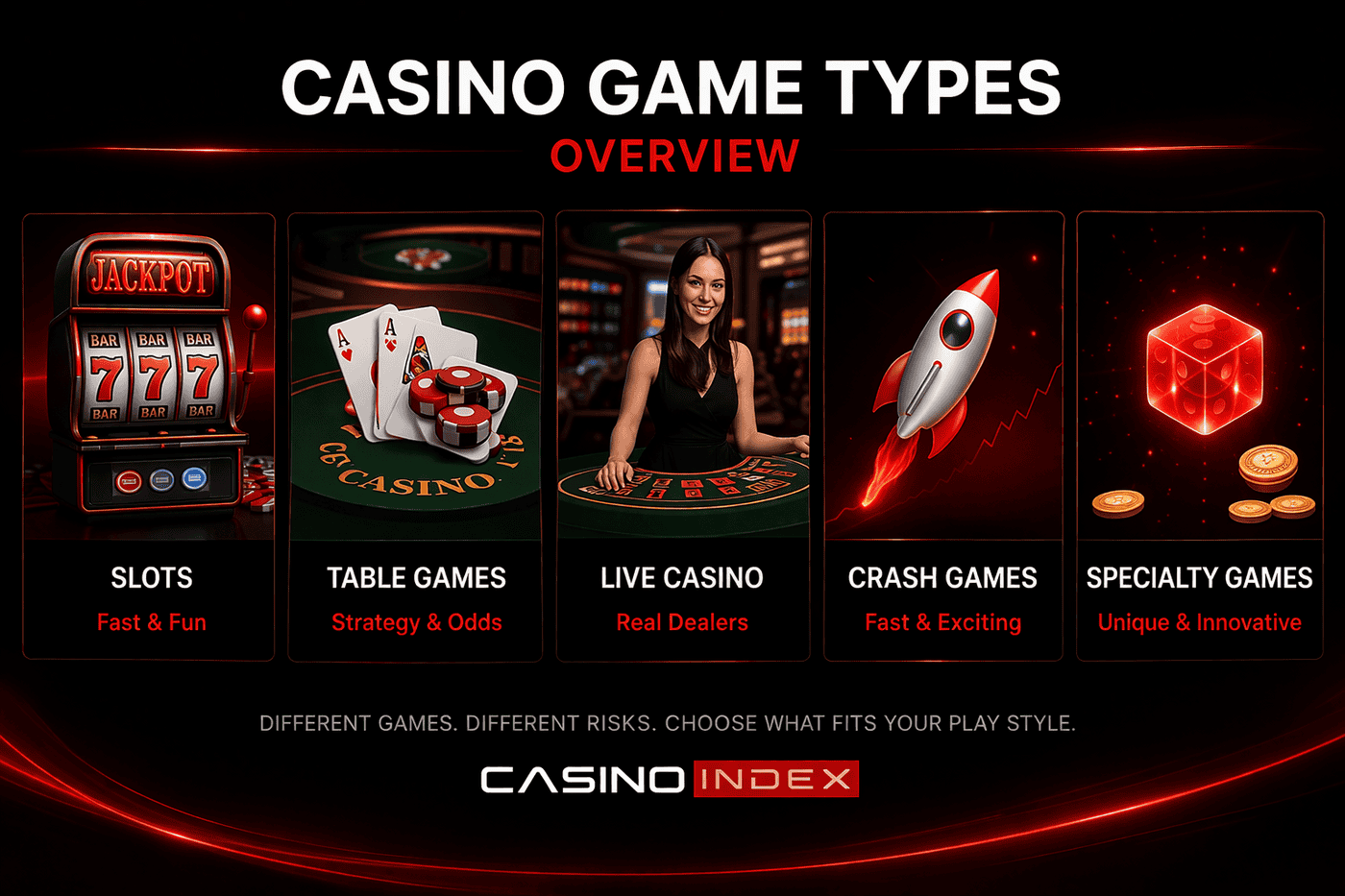
Casino Game Types at a Glance
A useful taxonomy starts with the game’s core structure rather than its theme or provider name.
| Game category | Core structure | Typical examples | Main variables inside the category |
|---|---|---|---|
| Slots | RNG-based reel, grid, cluster, or symbol games | Classic slots, video slots, Megaways, cluster pays, jackpot slots | RTP, volatility, hit frequency, features, paylines or win mechanics |
| Table Games | Rule-based card, wheel, or dice games | Blackjack, roulette, baccarat, casino poker, Sic Bo | Rules, bet types, house edge, side bets, decision influence |
| Live Dealer | Real-time streamed games with human dealers or presenters | Live blackjack, roulette, baccarat, poker, game shows | Rules, table limits, speed, studio, side bets, provider |
| Crash | A rising multiplier that ends at an unpredictable crash point | Crash-style casino originals and multiplier games | House edge, cashout settings, round speed, verification model |
| Specialty / Instant | Short-form formats that do not fit neatly elsewhere | Mines, Plinko, Dice, Limbo, Keno, scratch cards, wheel games | Probability model, pace, volatility, payout table, player controls |
These are broad organizing categories. They do not determine the exact RTP, house edge, volatility, or fairness of a game by themselves. Those properties belong to the exact title, rules, paytable, configuration, and provider implementation.
How Casino Game Taxonomy Actually Works
Many casino menus mix several different classification layers. Separating those layers makes almost every lobby easier to understand.
| Layer | Example | What it describes |
|---|---|---|
| Game type | Slot, roulette, crash, Mines | The core format or rules of the game |
| Subtype / mechanic | Megaways, jackpot, cluster pays | A specific feature or variation within a game family |
| Delivery format | Live dealer | How the game is presented to the player |
| Provider | Evolution, Pragmatic Play, Hacksaw Gaming | The studio or company supplying the game |
| Verification layer | Provably fair | How some digital outcomes can be independently verified |
| Lobby label | Originals, Crypto Games, Arcade | A casino-specific navigation or marketing category |
That is why “Evolution” is not a game type, “provably fair” is not automatically a game category, and “live blackjack” can belong to both the table-game family and the live-dealer delivery format at the same time.
1. Slot Games
Slots are digital casino games built around symbols, reels, grids, clusters, or other automated payout structures. The player normally chooses a stake and starts a round. The mathematical model then determines whether the resulting symbol combination produces a payout.
Today, modern online slots are much broader than the old three-reel machine model. A slot can use fixed paylines, ways-to-win systems, cluster pays, cascading symbols, expanding reels, collectors, multipliers, free-spin modes, bonus buys, mystery features, jackpots, or a combination of several mechanics.
What makes them part of the same category is not the visual design. It is the underlying structure: the player starts an automated game round and the game’s programmed probability model determines the result.
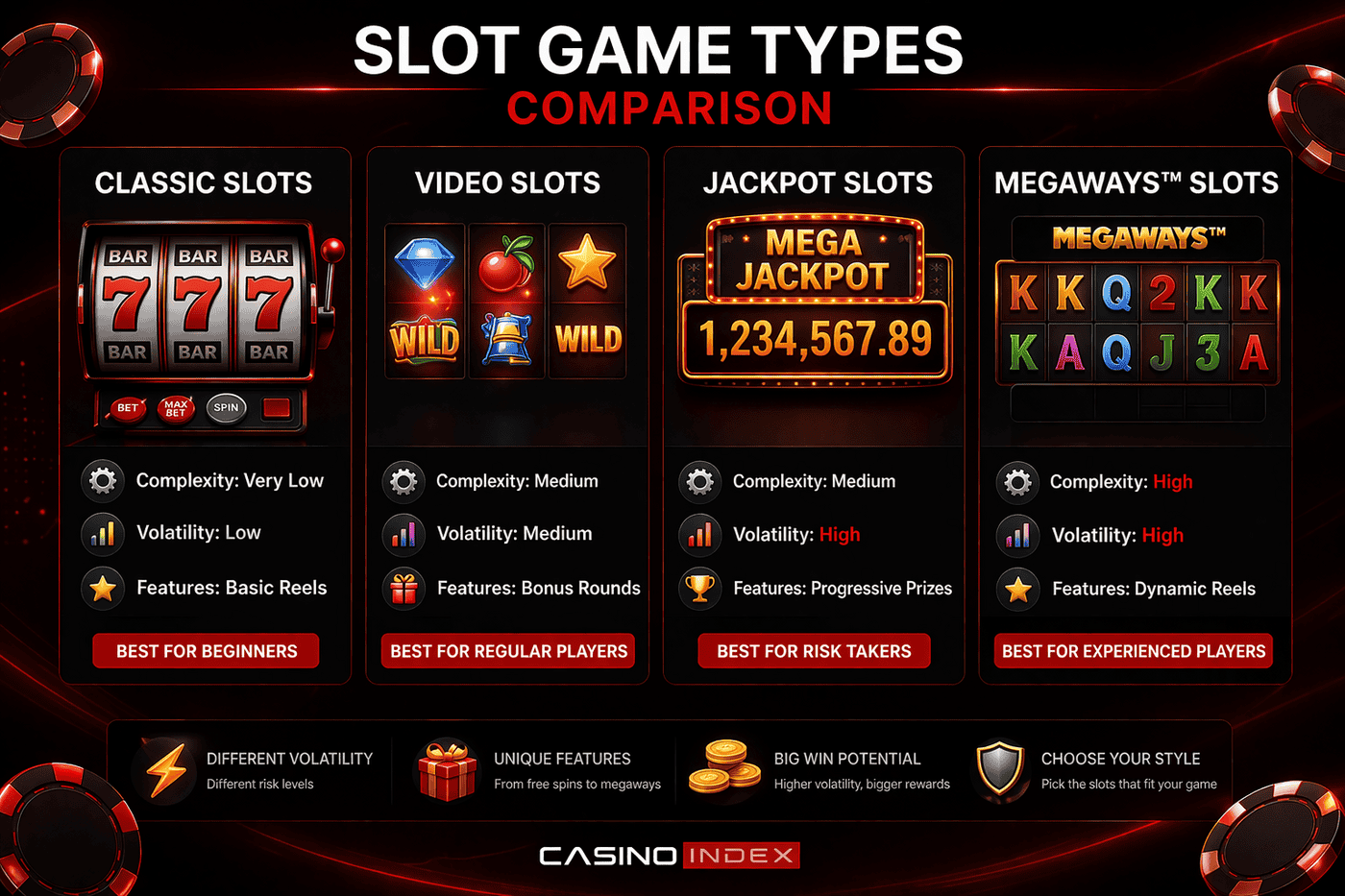
Classic slots
Classic slots imitate the simpler structure of early mechanical machines. They often use three reels, a limited number of paylines, familiar fruit or bar symbols, and fewer bonus features.
“Classic” does not mean that the game has a particular RTP or volatility. Some simple games can still be volatile, while other designs produce smaller payouts more frequently. The label describes presentation and mechanical simplicity, not one fixed risk profile.
Video slots
Video slots are the modern mainstream format. They usually use five or more reels, richer animation, multiple bonus features, and more complex pay systems.
For example, a video slot may include free spins, multipliers, expanding symbols, wild transformations, persistent features, respins, random modifiers, or several bonus modes. These features change the experience, but the title is still a slot.
Because video slots are so broad, two games that look similar can behave very differently mathematically. One can distribute returns relatively evenly, while another may concentrate a large part of its payout potential in rare bonus rounds.
Grid and cluster games
Meanwhile, some modern slots move away from traditional paylines entirely. Grid or cluster games pay when matching symbols connect in groups rather than across a fixed line.
Cascading mechanics can remove winning symbols and replace them with new ones inside the same round. That creates a different visual rhythm, but it does not change the fact that the game belongs to the slot family.
Megaways and variable-reel formats
Megaways-style games use changing symbol counts or reel structures that alter the number of possible winning combinations from one spin to the next. Developers popularized the mechanic because it creates more dynamic reel layouts.
Therefore, Megaways belongs under slot mechanics or subtypes, not as a top-level casino game category.
Jackpot slots
By comparison, jackpot slots add a large prize mechanism to a slot. Depending on the design, a jackpot can stay fixed, run locally within one casino or game, or grow progressively across a wider network.
The important taxonomic point is that “jackpot” describes a payout feature. It does not transform the game into a new category. A progressive jackpot slot remains a slot.
RTP and volatility in slots
RTP and volatility are particularly useful when discussing slots. However, analysts should attach both metrics to the exact game rather than the whole category.
In practice, RTP represents a long-run theoretical return calculated across a very large number of wagers. By contrast, volatility shows how that return is distributed: some games tend to produce smaller outcomes more often, while others concentrate more value in less frequent larger outcomes or bonus features.
Even so, neither metric predicts what happens in one short session.
Some providers also distribute the same slot in more than one approved RTP configuration. As a result, broad claims such as “slots usually pay X%” are less useful than checking the exact title and version a casino offers.
CasinoIndex goes deeper into reels, pay systems, hit frequency, volatility, features and slot-specific math in the Slot Games Guide. For the broader statistical meaning of RTP, see the Casino RTP Guide.
2. Table Games
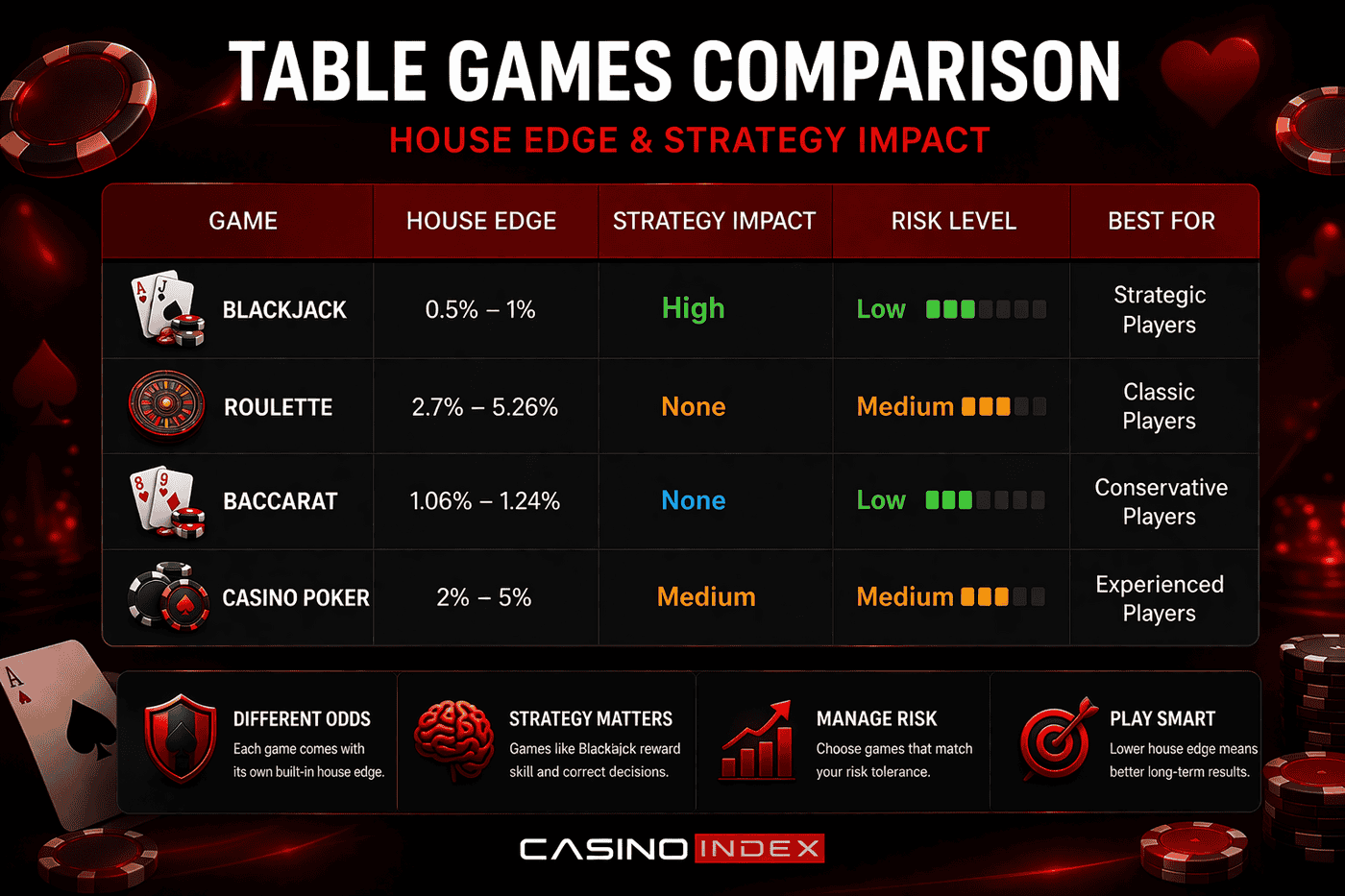
Table games use defined rules built around formats such as card tables, dice layouts, or roulette wheels. Today, online versions can run fully digitally or through a live dealer.
The main table-game family includes blackjack, roulette, baccarat, casino poker variants, Sic Bo, and several regional or provider-specific card and dice games.
For that reason, the category is useful because table games usually have clearly defined rules and bet structures. However, the mathematical conditions can vary significantly between games and even between versions of the same game.
Blackjack
Blackjack is a card game where the player competes against the dealer’s hand rather than directly against other players. The goal is to finish with a stronger valid hand than the dealer without exceeding 21.
Unlike many casino games, player decisions can affect the mathematical outcome. Hit, stand, double, split, surrender, table rules, dealer rules, deck count, and blackjack payout terms can all matter.
That is why “blackjack” is not one universal mathematical product. A digital blackjack title, a live blackjack table, and a special side-bet version may all sit inside the same game family while carrying different rule sets.
Roulette
Roulette is a wheel game based on fixed number and color outcomes. Players can place straight number bets, group bets, even/odd bets, red/black bets, or other combinations depending on the wheel and table layout.
However, version matters. A standard European single-zero wheel has different mathematics from an American double-zero wheel. Some live and digital roulette variants also add special rules, multipliers, or bonus features that alter the game.
This is one of the clearest cases where house edge is useful at the exact-rule level rather than the broad category level. For standard roulette, the zero structure materially changes the casino advantage.
Baccarat
Baccarat revolves around Player, Banker, and Tie outcomes. Most of the card-drawing procedure is automatic rather than chosen by the player.
More importantly, the available bet types create the key distinction. Banker, Player, Tie, and side bets do not all carry the same mathematical cost. Treating “baccarat” as one house-edge number therefore hides useful detail.
Casino poker variants
Casino poker differs from ordinary player-versus-player poker. In casino variants such as Three Card Poker, Caribbean Stud, or Casino Hold’em, the player generally competes against the house according to a fixed paytable and rule structure.
Even when decisions matter, the format remains a house-banked table game. Side bets can also have very different mathematics from the main wager.
Sic Bo and other dice tables
Sic Bo and similar dice games use fixed bet areas covering totals, combinations, triples, and other outcomes. They belong to the table-game category because a traditional betting layout structures the experience, rather than a slot-style or instant-game interface.
| Table game | Core mechanic | Decision influence | What varies most |
|---|---|---|---|
| Blackjack | Card total versus dealer | Meaningful | Rules, payouts, side bets, player decisions |
| Roulette | Wheel and fixed betting layout | Bet selection only | Zero count, special rules, multipliers |
| Baccarat | Player / Banker / Tie hands | Limited | Bet type, commission rules, side bets |
| Casino Poker | Player versus house poker structure | Varies | Paytables, decision rules, side bets |
| Sic Bo | Three-dice outcome betting | Bet selection only | Bet types and payout table |
Why House Edge Must Stay Game-Specific
For example, it is common to hear that table games “have better odds than slots.” That can be true for some specific tables and bets, but it is too broad as a category statement.
A low-edge blackjack game played under favorable rules is very different from a high-cost side bet. A standard single-zero roulette even-money bet is different from a roulette variant with added multipliers. Baccarat Banker is different from Tie or side bets.
Therefore, house edge becomes useful only after you identify the exact game, bet type, and rule set.
3. Live Dealer Games
Live dealer is best understood as a delivery format layered on top of casino game rules.
A live blackjack table is still blackjack. Roulette follows the same principle: a live wheel is still roulette. Likewise, streamed baccarat remains baccarat. The delivery changes: a real dealer or presenter runs the game in real time while players watch a video stream and place bets through the interface.
As a result, this overlap matters because casino menus often make “Live Casino” look like a completely separate mathematical category. In reality, the live format can contain several different game families.
Traditional live tables
Most live sections stream classic table games such as:
- live blackjack
- live roulette
- live baccarat
- live casino poker
- live Sic Bo or dice games
In each case, the core rules come from the underlying game. Live delivery adds operational details such as table limits, seats, dealer pace, studio language, side bets, camera presentation, and table-specific rule variations.
4. Crash Games
Unlike most lobby labels, crash games have a distinct enough structure to justify their own category.
A round begins near a 1x multiplier. The multiplier rises over time until an unpredictable crash point ends the round. Players who cash out before the crash receive the multiplier shown at exit. A player still in the round at the crash loses that wager.
In other words, the visible cashout decision during the round separates crash from a slot.
That decision does not allow the player to predict the crash point. It simply determines when the player exits the current round.
| Crash feature | What it means |
|---|---|
| Rising multiplier | The possible payout increases while the round continues |
| Crash point | An unpredictable event ends the round |
| Manual cashout | The player chooses when to leave before the crash |
| Auto cashout | An exit multiplier can be set in advance |
| Fast repeat cycle | Rounds can repeat rapidly compared with many table formats |
Crash became popular in crypto casinos. Still, its rising-multiplier mechanic defines the category—not the currency used to deposit or withdraw.
5. Specialty and Instant Games
Specialty and instant games are the broadest top-level group because they collect short-form formats that do not fit neatly into slots, classic table games, live dealer, or crash.
For example, the category often includes casino originals and arcade-like games. Common examples are Mines, Plinko, Dice, Limbo, Keno, scratch cards, wheel games, number draws, and other one-screen probability games.
However, these games do not share one mathematical model. It is that the games use compact, direct mechanics outside the traditional reel, table, or live-dealer structure.
Mines
Mines uses a grid of hidden safe tiles and mines. The player reveals tiles and can usually cash out as successful reveals increase the payout multiplier.
Even though the interface creates a sequence of player choices, the underlying mine placement or probability model still determines the risk. Different Mines versions can allow different numbers of mines, grid sizes, or cashout mechanics.
Plinko
Plinko sends a ball or token through a field of pegs toward multiplier slots. Many versions allow the player to select a risk level, number of rows, or other settings before the drop.
As a result, Plinko looks very different from a slot even though a predefined probability model still drives the outcome.
Dice
Digital Dice games usually let the player choose a target range or probability. Increasing the chance of winning normally lowers the payout multiplier; choosing a rarer outcome increases it.
Because the probability control is visible, Dice can be useful for understanding the relationship between hit probability and payout. It is still a casino game with a built-in house advantage.
Limbo
Limbo is a multiplier-target game where the player selects a target multiplier before the game generates the result. If the game result reaches the chosen target, the wager wins according to that multiplier.
Although Limbo also uses multipliers, it differs structurally from crash because there is no rising real-time curve or cashout decision during the round.
Keno and number-draw games
Keno uses selected numbers and a random draw. The payout depends on how many selected numbers match the result.
Online casinos may place Keno under specialty, lottery, instant, or arcade menus depending on the lobby design. Taxonomically it fits best under specialty because it does not behave like a slot, table game, live dealer title, or crash game.
Scratch cards and instant-reveal games
Scratch cards reveal a pre-determined or randomly generated outcome immediately. They borrow their presentation from physical scratch tickets but deliver the result digitally.
In this context, “Instant” describes the fast resolution. It does not imply better odds or lower risk.
Wheel and arcade-style originals
Some casino originals use prize wheels, target boards, towers, cards, paths, or other arcade-style interfaces. Unless the mechanic clearly fits another main family, these titles belong under Specialty / Instant.
| Game | Primary category | Why |
|---|---|---|
| Mines | Specialty / Instant | Grid-based reveal game with progressive cashout decisions |
| Plinko | Specialty / Instant | Probability-based multiplier drop |
| Dice | Specialty / Instant | Direct probability-range betting |
| Limbo | Specialty / Instant | Target-multiplier result without a live crash curve |
| Keno | Specialty / Instant | Number-draw format outside the classic table structure |
| Scratch cards | Specialty / Instant | Immediate reveal format |
Why “Crypto Games” Is Usually a Lobby Label
Casino lobbies often use labels such as “Crypto Games,” “Originals,” or “Provably Fair” to group products for navigation. These labels do not describe one shared game mechanic.
For taxonomy purposes, classify the title by how it works first. After that, describe payment method, ownership, and verification technology as separate attributes.
Game Type vs Game Provider
A game type explains what the player is playing. A provider explains who built or supplies it.
For example, one provider can span several categories. A large studio may supply slots, live dealer games, game shows, roulette variants, blackjack, or instant products. Another provider may specialize almost entirely in high-volatility video slots.
Therefore, the distinction matters when reading casino lobbies because many platforms give providers their own filter alongside game-type filters.
| Question | Game type | Provider |
|---|---|---|
| What is it? | Slot, live roulette, Crash, Mines, blackjack | The studio supplying the game |
| What does the label describe? | Core mechanics or delivery format | Software source and portfolio |
| Can it span several categories? | Usually no | Yes |
| Does it determine exact RTP? | No | No; the exact game and version still matter |
So “Evolution” is a provider; “live roulette” is a game type. “Pragmatic Play” is a provider; a Pragmatic Play slot and a Pragmatic Play live game belong to different categories.
Meanwhile, CasinoIndex covers the studio side separately in the Casino Providers Guide.
RTP, House Edge and Volatility Are Properties, Not Categories
RTP, house edge, and volatility describe mathematical properties of casino games. Therefore, avoid using them as category labels or applying them too broadly.
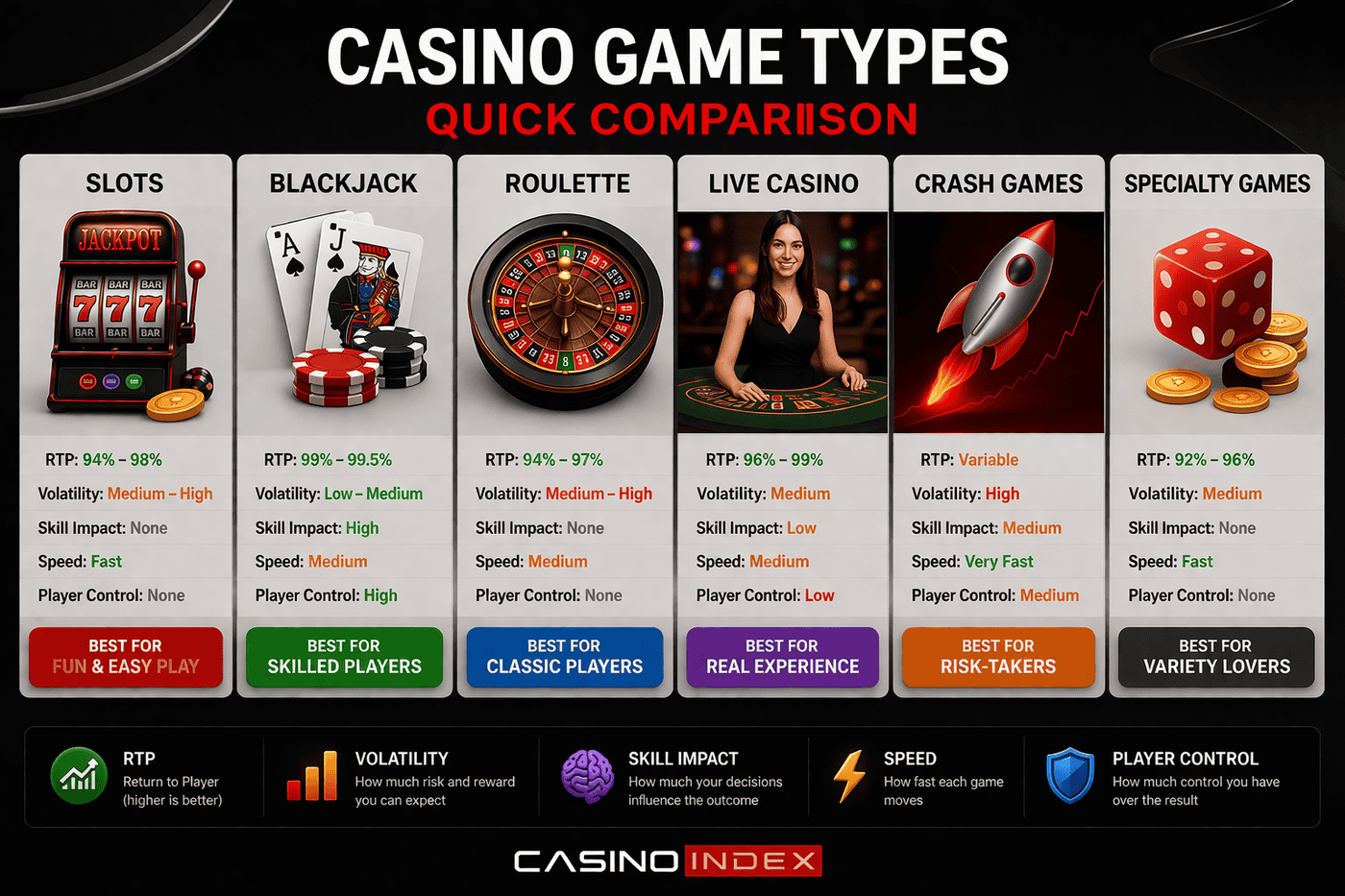
| Term | What it describes | Where it is most useful |
|---|---|---|
| RTP | Theoretical long-run return from total wagering | Comparing exact digital games or configurations |
| House edge | The casino’s theoretical mathematical advantage | Table games, bet types, and clearly defined probability models |
| Volatility | How returns are distributed across outcomes | Especially useful for slots and games with selectable risk profiles |
Why RTP should not be assigned by category
For example, two slots from the same provider can have different RTP settings. Meanwhile, live games can use different table rules, and instant titles can carry different house edges. A single category-wide number therefore creates false precision.
In practice, RTP becomes most useful when you know the exact title and configuration.
Why volatility is useful but easy to misuse
However, volatility is often discussed as if “high volatility” means “better for big wins” and “low volatility” means “safer.” That is an oversimplification.
Volatility describes the distribution of results, not whether a player will win in one session and not whether the game has a favorable expectation.
It is especially relevant to slots because providers often publish or imply volatility profiles, but similar concepts can also appear in instant games with selectable risk settings.
Why house edge belongs to exact rules and bets
House edge is particularly useful for games such as roulette, baccarat, blackjack, and Dice because their probabilities and payouts allow direct comparison.
Even within one game family, though, different bets can have very different edges. That is why a generic “baccarat house edge” or “roulette house edge” can be incomplete without specifying the bet or version.
RNG, Live Dealer and Provably Fair Describe Different Layers
Casino terminology becomes much clearer when you separate outcome generation and verification from the game category itself.
RNG
RNG stands for random number generator. It is an outcome-generation system used by many digital casino games, including slots, digital table games, and instant games.
For example, an RNG does not automatically mean “slot.” A digital blackjack game can use RNG. A Dice game can use RNG. A slot can use RNG. The technology sits underneath several categories.
Live dealer
Live dealer describes real-time streamed play with a human dealer or presenter. It changes the delivery format, not the underlying identity of blackjack, roulette, or baccarat.
Provably fair
Provably fair describes a cryptographic verification method used by some crypto-oriented games. Depending on the implementation, players can verify that game inputs or results were not changed after the fact.
That makes provably fair important for transparency, but it does not create a separate top-level game family. The same verification approach can appear across several digital formats.
How Casino Lobbies Organize Game Libraries
Casino navigation is not a formal industry taxonomy. Operators design menus for discovery, merchandising, and user behavior, so the same title can appear in several sections.
A single game might appear under:
- New Games
- Popular
- Slots
- Jackpots
- Originals
- Live Casino
- Game Shows
- Instant Games
- Provably Fair
- a provider-specific filter
In practice, those menu labels overlap because they answer different questions.
“Slots” tells you the game family. “New” tells you recency. “Jackpots” tells you the prize mechanic. “Provably Fair” tells you something about verification. “Evolution” tells you the supplier.
Understanding this removes much of the confusion in large casino libraries.
Common Classification Mistakes
Several labels are commonly mistaken for standalone game categories when they are better understood as something else.
| Label | What it really describes | Better classification |
|---|---|---|
| Jackpot | A prize mechanism | Usually a slot subtype or feature |
| Megaways | A variable-reel slot mechanic | Slot subtype |
| Provably Fair | A verification method | Verification layer across several game types |
| Crypto Game | Usually a lobby or platform label | Classify the underlying mechanic first |
| Originals | Games built or branded by the casino or platform | Can contain Crash, Mines, Dice, Plinko, Limbo, and more |
| Live | A real-time delivery format | Live Dealer, with the underlying table or game-show subtype |
Game Categories vs Strategy: Why the Separation Matters
A taxonomy page should answer “what is this game?” before it answers “how should I play it?”
Those are different questions, so the distinction matters.
For example, explaining that blackjack belongs to the table-game category is taxonomy. Explaining basic strategy, bet sizing, session management, or card-counting theory is strategy.
Describing a game’s structure is taxonomy. Recommending a betting pattern, cashout target, or session plan is strategy.
Explaining that Plinko offers different risk settings is taxonomy. Recommending a specific setting to maximize session length would be strategy.
Therefore, keeping those intents separate prevents this page from competing with CasinoIndex’s specialist strategy and game-comparison guides.
What This Guide Does Not Claim
This page does not claim that:
- one game category is “best to win”
- all table games have a low house edge
- all slots fall into one RTP range
- live dealer games are automatically fairer than digital games
- provably fair means a game has a low house edge
- crypto-native games pay more than traditional casino games
- high volatility means a game has better long-term value
- one provider is inherently better because it offers more categories
Ultimately, those conclusions require game-specific evidence, not a category label.
Casino Game Categories: The Clean Taxonomy
For most CasinoIndex content, this five-part structure is the cleanest way to organize casino games without mixing mechanics, providers, and marketing labels:
| Primary category | Includes | Usually not a separate top-level category |
|---|---|---|
| Slots | Classic, video, grid, Megaways, jackpot slots | Jackpots, Megaways, feature buys |
| Table Games | Blackjack, roulette, baccarat, casino poker, Sic Bo | Every ruleset or side bet as a separate category |
| Live Dealer | Live tables and live game shows | “Real dealer” as a mathematical category |
| Crash | Rising-multiplier crash formats | All crypto casino originals |
| Specialty / Instant | Mines, Plinko, Dice, Limbo, Keno, scratch cards, wheels, arcade originals | Crypto-native or provably fair as separate game families |
Final Takeaway
A casino game category tells you what kind of game you are looking at. It does not tell you whether that game will be profitable, whether it has the strongest odds, or whether the casino itself is trustworthy.
Slots use automated reel, grid, or symbol-based mechanics. Table games use classic card, wheel, or dice structures. Live dealer adds human real-time presentation to table games and game-show formats. Crash games use a rising multiplier and unpredictable crash point. Specialty and instant games collect shorter formats such as Mines, Plinko, Dice, Limbo, Keno, scratch cards, and arcade-style originals.
Providers, RTP, volatility, RNG, jackpots, provably fair systems, and lobby labels add useful information, but they belong on top of that basic taxonomy rather than replacing it.
From there, the next question becomes easier to send to the right specialist guide: slot mechanics, live casino formats, RTP, provider identity, strategy, or mathematical game comparison.
FAQ — Casino Game Types
What are the main types of casino games?
A practical online casino taxonomy uses five main groups: slots, table games, live dealer games, crash games, and specialty or instant games. Individual casinos may use different menu names, but this five-part structure still covers most titles.
Are live dealer games a separate type from table games?
They overlap. Blackjack, roulette, and baccarat remain table games by their underlying rules, while “live dealer” describes the real-time streamed delivery format. Live game shows also sit under the live-dealer umbrella even though their mechanics differ from classic table games.
Are crash games the same as instant games?
No. Crash has a specific rising-multiplier structure that ends at an unpredictable crash point. Instant games are a broader group that can include Mines, Plinko, Dice, Limbo, scratch cards, and other short-form games.
Is provably fair a casino game type?
No. Provably fair is a verification method. Crash, Mines, Dice, Plinko, and other casino-original formats can all use it without turning provably fair into a separate game category.
Are “crypto games” a separate category?
Not in a clean taxonomy. “Crypto” usually describes the payment environment, platform positioning, or a lobby label. Instead, classify the underlying title by its actual mechanics.
What is the difference between a slot and an instant game?
Slots use reel, grid, symbol, or cluster-based payout systems. Instant games use other direct mechanics such as hidden tiles, target multipliers, probability sliders, drops, draws, or reveal formats.
What is the difference between a casino provider and a game type?
A provider is the studio or company that builds or supplies the game. A game type describes the format. One provider can create slots, live games, roulette, game shows, or instant games across several categories.
Do all slots have similar RTP?
No. RTP is game-specific, and providers can release some titles in multiple approved configurations. Therefore, check the exact version instead of assuming one RTP range applies to all slots.
Do all table games have a lower house edge than slots?
No. House edge depends on the exact game, bet, rules, and paytable. Some table-game options can have relatively low theoretical edges, while certain side bets or variants can be much more expensive.
Does live dealer mean better odds?
No. Live dealer changes how the player experiences the game. The mathematical conditions still come from the underlying rules, paytable, bet type, and provider configuration.
What is the difference between RTP and volatility?
RTP describes theoretical long-run return from total wagering. Volatility describes the distribution of results, such as more frequent smaller outcomes versus less frequent larger ones. Neither metric predicts one short session.
Is a jackpot a separate casino game category?
Usually not. Jackpot describes a prize mechanism. A progressive jackpot slot is still a slot, while other casino formats can also include jackpot-style prizes.
Is Megaways a casino game type?
Megaways is better treated as a slot mechanic or subtype. It changes the reel or ways-to-win structure, but the game remains part of the slot category.
Are casino originals their own category?
“Originals” is usually a lobby or ownership label rather than one mathematical category. A casino’s Originals section can contain Crash, Mines, Dice, Plinko, Limbo, wheel games, and other formats.
Which casino game type is best to win?
There is no universal winning category. Exact games differ in house edge, RTP, volatility, rules, and player decision influence. CasinoIndex handles that question separately in its mathematical game-comparison content so this page can remain a neutral taxonomy.

Talha Aydin has been active in cryptocurrency since 2017 and is a co-founder of Freecoins24 and CryptoMutant. Over the years, he has worked with crypto projects on community growth, giveaways, user acquisition and digital strategy while gaining hands-on experience across blockchain platforms and crypto markets. At CasinoIndex, Talha focuses on crypto casinos, withdrawals, payment systems, platform trust and the risks players face when moving funds between wallets and gambling platforms.