Slot Games Guide 2026: How Slots Work, RTP, Volatility and Bankroll Risk

How Online Slot Games Really Work
This Slot Games Guide 2026 explains what happens behind the reels, why short sessions often feel disconnected from the mathematics and which game details matter before the first real-money spin.
Slots are easy to operate. The player chooses a stake, presses spin and receives a result within seconds. However, that simple interface hides a probability system built around an RNG, symbol weighting, payout distribution, volatility and bonus mechanics.
Most players focus first on the visible parts:
- the theme and graphics
- the maximum advertised win
- how often a bonus appears
- whether small wins arrive regularly
- how popular the game appears
Those details shape the entertainment value, but they do not explain the real cost of the game.
A stronger slot evaluation looks at:
- RTP and the active game configuration
- volatility
- hit frequency
- minimum and maximum stake
- feature dependence
- bonus-buy risk
- session speed
- the casino environment around the game
A slot can produce frequent wins while steadily reducing the balance. Another may show long dry periods but distribute occasional larger payouts. Neither pattern tells the player what will happen in the next session.
The purpose of this guide is not to present a winning strategy. Slots retain a mathematical advantage for the casino. Instead, the goal is to help players understand the product, choose games that fit their bankroll and avoid common assumptions that increase risk.
Slot Casinos Compared by Game Depth, Usability and Player Fit
A slot does not exist in isolation. Provider access, platform stability, payment rules, bonuses and withdrawal handling all affect the real-money experience.
The casinos below suit different slot-playing preferences. A large library is useful, but it should never be treated as proof of reliable payments or fair account handling.
| Casino | Slot Strength | Best Fit | Main Caution |
|---|---|---|---|
| BitStarz | Broad provider selection and a casino-first game environment | Players who prioritize slot variety | Keep promotional balances separate from the first withdrawal test |
| Vavada review for slot-focused players | Accessible slot browsing with a familiar casino layout | Users who want a straightforward slot session | Payment, bonus and withdrawal conditions still need separate checks |
| Voodoo Casino review | Modern slot-focused presentation and game discovery | Players comparing less established slot environments | Test the cashier and support before keeping a larger balance |
| BC.Game | Large crypto ecosystem with slots, originals and several product layers | Experienced crypto casino users | The wider platform can make rewards and account rules more complex |
| Bitcasino | Crypto-first cashier combined with a broad casino lobby | Players who already understand wallet payments | Crypto speed does not remove verification or casino-side approval |
How to use this comparison
Choose the casino environment first, then evaluate the individual game.
A strong slot lobby should make providers, stakes, game information and account tools easy to find. In addition, the withdrawal route should remain clear before the player begins building a balance.
CasinoIndex explains the payment side separately in its guide to how casino withdrawals and approval checks work.
What a Slot Game Actually Is
The basic structure
A slot is a digital gambling game in which an RNG selects an outcome and the game displays that result through reels, symbols or a grid.
A modern slot normally contains:
- a reel or grid layout
- a symbol system
- a paytable
- an RNG
- weighted outcomes
- a volatility profile
- bonus and feature rules
- a predefined payout distribution
The reels are the visual layer. Behind them sits the mathematical model that determines which outcomes can appear and how frequently different prize levels are expected to occur.
Why the games feel simpler than they are
The player usually makes only three visible decisions:
- which game to open
- how much to stake
- when to press spin
Unlike blackjack or poker, there is normally no decision after the spin begins. That lack of visible strategy can make slots feel harmless or predictable.
In reality, the player is repeatedly buying independent chances from a system with a built-in casino advantage.
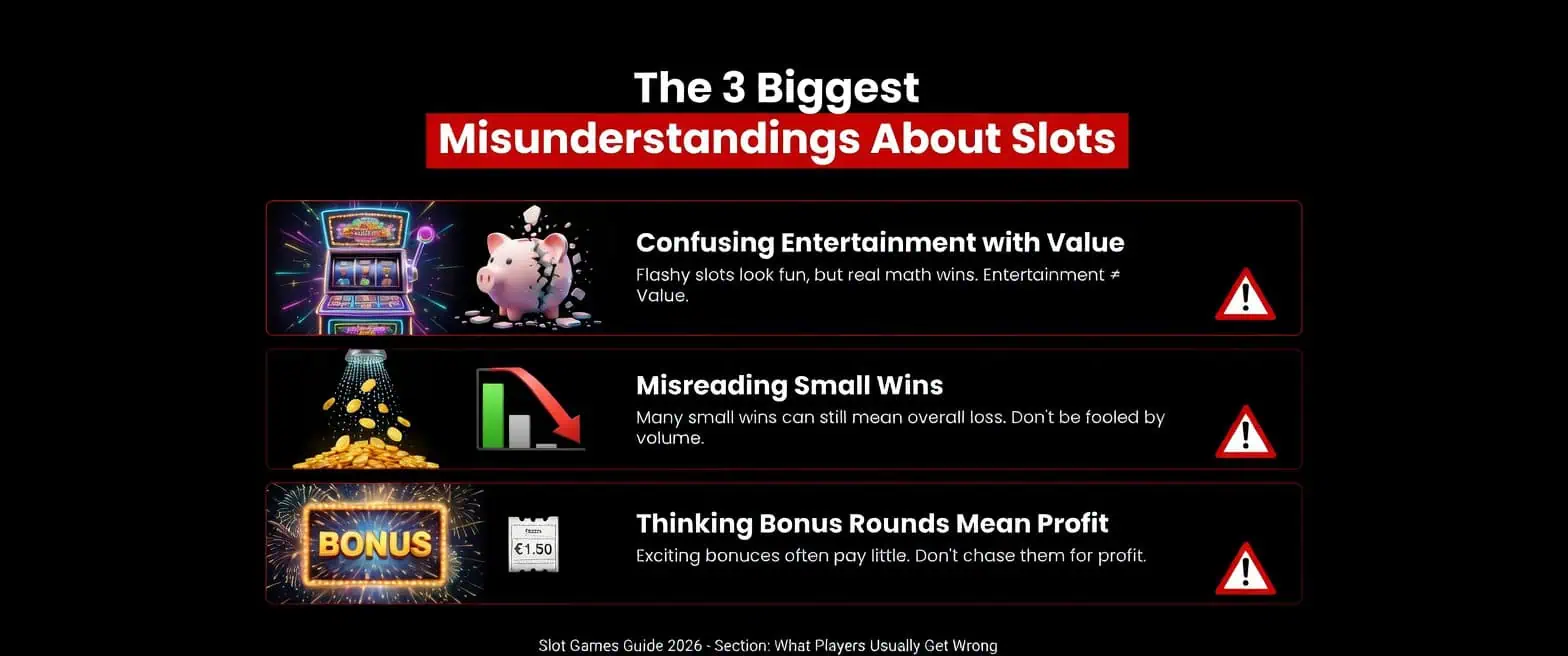
Three common misunderstandings
Entertainment is confused with value. A polished slot can provide an enjoyable experience while still being poorly suited to the player’s bankroll.
Small wins are interpreted as profit. A result can be displayed as a win even when it returns less than the original stake.
Bonus rounds are treated as guaranteed value. A feature can feel important while producing a modest return relative to the cost of reaching it.
How the Random Number Generator Works
Each spin is independent
Online slots use a random number generator to produce the outcome of each spin.
Previous results do not make a particular symbol or bonus more likely to appear next. A long losing sequence does not create a mathematical debt that the game must repay.
Therefore:
- a bonus is not “due” after a dry period
- a large win does not make the next spin automatically worse
- changing stake does not reset a hidden cycle
- leaving and reopening the game does not improve the odds
- another player’s recent win does not change your next result
The game may produce streaks, but streaks are not proof that the RNG remembers previous outcomes.
Visible reels do not show the full probability model
The symbols shown on screen are not always equally likely to appear.
Behind the visible reels, the game can use weighted virtual positions. Common symbols may have many mapped positions, while premium symbols and feature triggers appear less often.
This is why two slots with similar artwork and reel layouts can behave very differently.
Paylines, ways and clusters
Older slots often use fixed paylines. Modern games may instead use:
- adjustable or fixed paylines
- 243 or more ways to win
- Megaways systems
- cluster pays
- cascading grids
- symbol collection mechanics
These formats change how results are displayed and how features develop. However, the underlying outcome still comes from the game’s probability model.
Slot RTP: What the Percentage Really Means
RTP is a long-run theoretical measure
RTP means Return to Player.
A slot with a theoretical RTP of 96% is designed to return approximately 96% of total eligible wagers across a very large sample. The remaining percentage represents the theoretical house edge.
That does not mean an individual player receives $96 back after wagering $100.
In a short session, the result may sit far above or below the published percentage. The mathematical rate only becomes meaningful across an enormous volume of play.
What RTP does not tell you
RTP does not predict:
- the result of the next spin
- how long a losing sequence can last
- whether a bonus will appear during the session
- how violently the balance may move
- whether the casino itself handles withdrawals reliably
A higher RTP normally means a lower theoretical loss rate when the other conditions are equal. However, volatility, bet speed and session length often have a stronger short-term effect on the player’s experience.
For the broader mathematical explanation, read the CasinoIndex RTP guide.
How RTP claims can mislead players
Not every RTP number shown online necessarily describes the version currently available at a particular casino.
Possible problems include:
- a provider offering several approved RTP configurations
- a casino using a lower configuration than the default promotional figure
- an affiliate page copying outdated RTP data
- a game-information panel that is difficult to locate
- an imitation or unverified game using unsupported claims
- marketing language presenting theoretical RTP as a personal return
For example, a provider may release the same title in several configurations. A review site may list the highest or default version, while the casino offers another approved setting.
Players should check the in-game information panel where available and avoid assuming that one number copied across several websites proves the active configuration.
CasinoIndex explains how RTP claims can mislead players, including configurable rates, unsupported figures and copied game risks.
Volatility: The Risk Profile Players Feel Most
What volatility changes
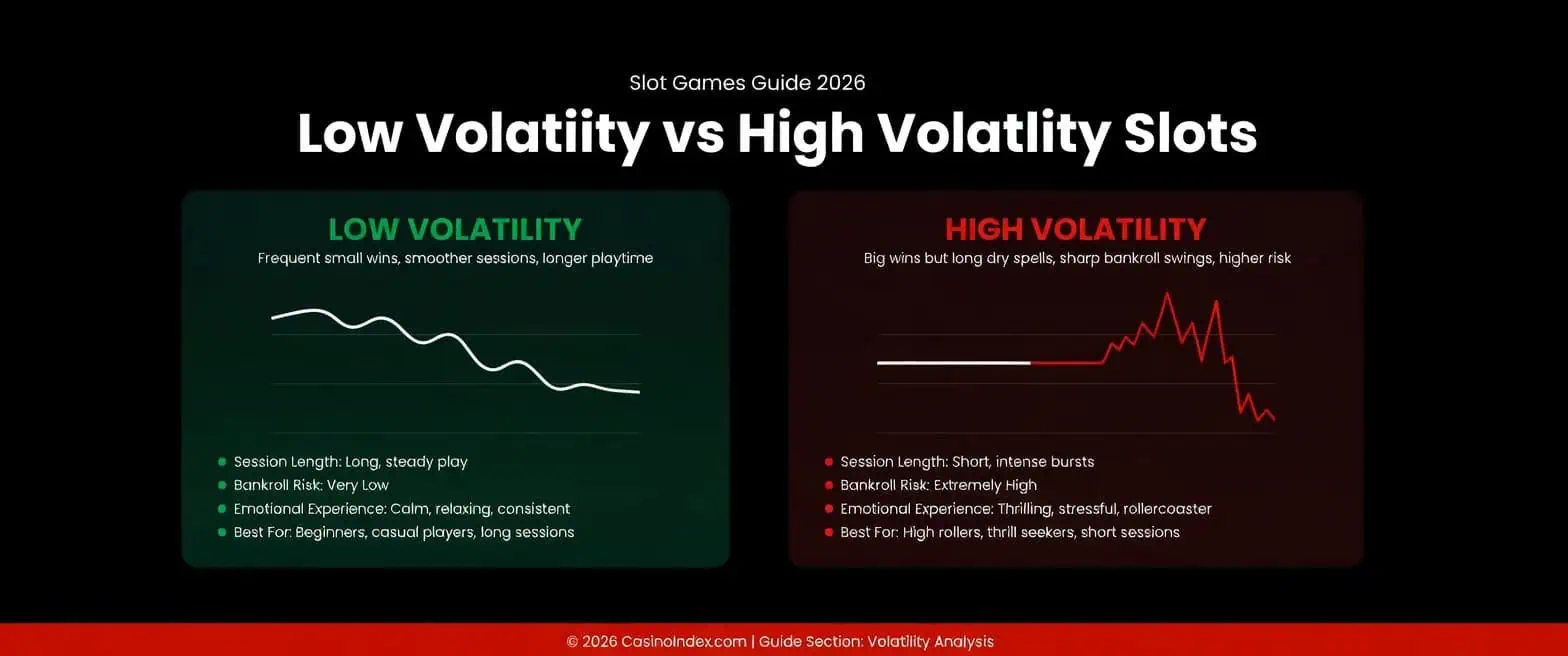
Volatility describes how a slot distributes its payouts.
A lower-volatility game tends to produce more frequent but smaller returns. A higher-volatility title generally concentrates more of its value into less frequent, larger outcomes.
Volatility influences:
- session length
- balance swings
- feature dependence
- the likelihood of long dry periods
- the bankroll needed to tolerate normal variance
Low-volatility slots
Lower-volatility games often feel smoother because they return small amounts more regularly.
They may suit players who want:
- longer sessions on a fixed budget
- smaller balance movements
- less dependence on one large feature
- more frequent visible activity
Still, frequent returns can create false comfort. Many displayed wins may be lower than the amount staked, so the balance can decline even while the game appears active.
High-volatility slots
Higher-volatility titles may include long periods with limited meaningful returns.
They often rely more heavily on:
- rare bonus rounds
- large multipliers
- premium symbol combinations
- cascading feature chains
- high maximum-win potential
The upside may look more exciting, but the balance can disappear quickly when the game does not connect.
Match volatility to the session
A player with a small bankroll and a short entertainment goal should not automatically select a highly volatile game because its maximum win looks attractive.
Likewise, someone who dislikes many small returns may find a low-volatility title frustrating despite its smoother balance profile.
There is no universally superior volatility level. The correct choice depends on the budget, stake size, session length and tolerance for losing sequences.
Hit Frequency and the Illusion of Constant Winning
Hit frequency describes how often a slot produces any qualifying win.
A high hit frequency can make a game feel generous. However, it does not show whether the return exceeds the original stake.
For example, a player may stake $1 and receive $0.30 back. The game records and displays a win, but the balance still falls by $0.70.
Why frequent small wins change behaviour
Regular visual and audio feedback creates a sense of progress. The session feels active, and the player may continue spinning longer than intended.
Consequently, a higher hit frequency can increase total wagering even when the balance trend remains negative.
The more useful questions are:
- How large are the typical returns?
- How much is being wagered per minute?
- Does the game depend on one rare feature?
- Can the current bankroll tolerate the volatility?
A game that keeps the player engaged is not automatically a good fit for the budget.
Understanding the Main Types of Slot Games
Classic slots
Classic slots usually have three reels, limited paylines and simple symbols such as fruits, bars and numbers.
Their main advantages are clarity and lower feature complexity. However, simple presentation does not automatically mean lower volatility or a better RTP.
Video slots
Video slots are the modern standard.
They often include:
- five or more reels
- multiple paylines or ways to win
- free-spin features
- multipliers
- wild and scatter symbols
- animated themes
- several feature stages
This format provides more entertainment depth, but it can also make the underlying cost harder to notice.
Megaways and variable-reel slots
Megaways games change the number of symbols on the reels between spins, creating a variable number of ways to win.
These games often combine:
- cascading reels
- high volatility
- multiplier progression
- strong bonus dependence
They can produce dramatic rounds, but long dry periods are common in many high-variance versions.
Cluster-pay and grid slots
Cluster games remove traditional paylines. Winning symbols form connected groups on a grid.
Cascades can produce several consecutive outcomes from one paid spin. That creates visible momentum, although every chain remains part of the predetermined game mechanics.
Jackpot slots
Progressive jackpot games contribute part of eligible wagers to a growing prize pool.
These prizes can become extremely large, but the qualifying outcome is correspondingly rare. In addition, some jackpot titles use a lower base-game RTP because part of the theoretical return is assigned to the jackpot.
Fixed jackpots offer predefined prizes. They are usually easier to understand, although they remain rare outcomes rather than realistic session targets.
Players comparing slots with other products can use the broader casino game types guide.
Slot Bonus Features: Appearance vs Real Value
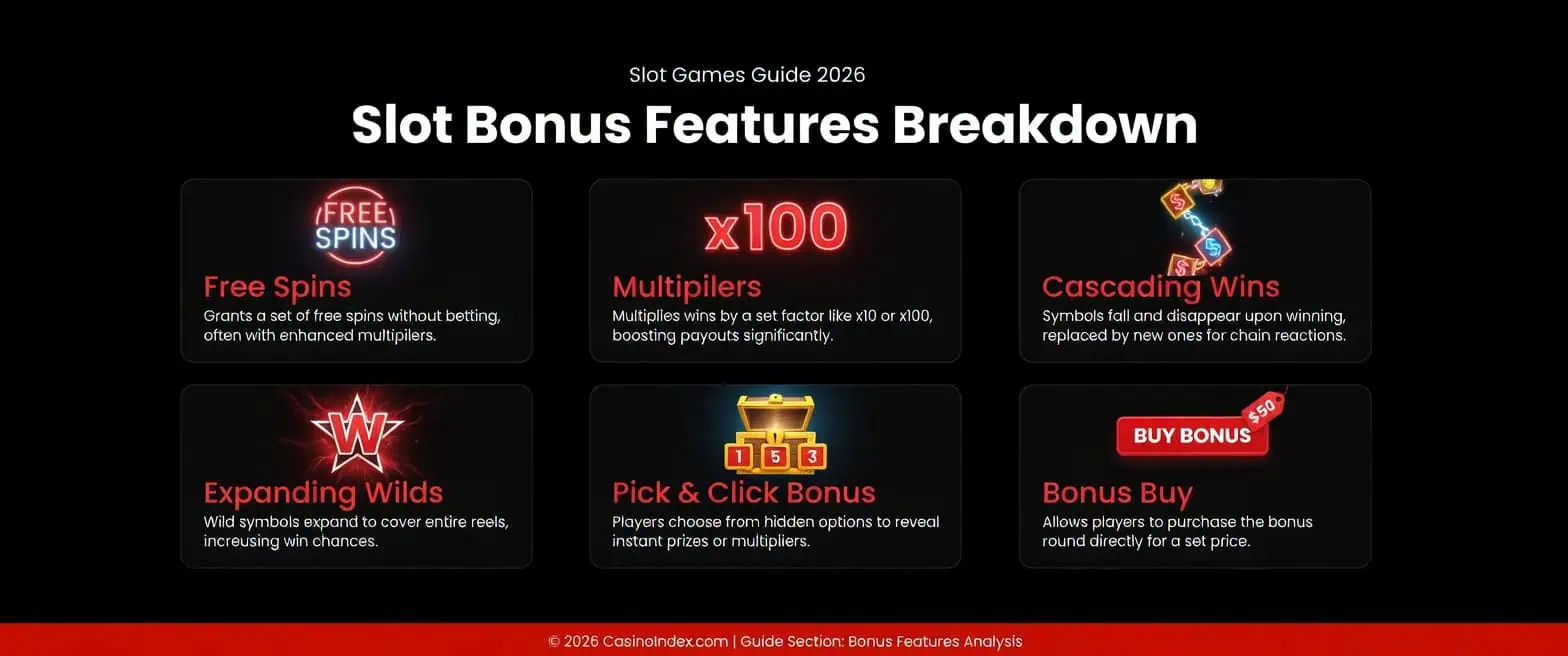
Free spins
Free spins are the most common slot feature, but the word “free” can be misleading.
The player normally pays for the chance to trigger the feature through ordinary spins. Once activated, the round may add multipliers, upgraded symbols or extra reels.
A useful free-spin feature needs more than an attractive animation. Its value depends on:
- how often it triggers
- how many spins it provides
- whether multipliers can grow
- whether premium symbols appear more often
- how the feature contributes to the game’s total RTP
Multipliers
Multipliers increase the size of a qualifying payout.
A game advertising 1,000x or 5,000x potential may attract attention, but the existence of a maximum win does not show how realistic the route to that result is.
Experienced evaluation focuses on normal feature behaviour rather than the rarest possible outcome.
Cascades and expanding mechanics
Cascading wins remove symbols after a payout and replace them with new ones. Expanding wilds, collection features and progressive multipliers can then build across the sequence.
These mechanics make the game feel more active. However, additional animations do not change the overall theoretical payout assigned to the game.
Bonus buys
A bonus buy allows the player to pay a large multiple of the normal stake to enter a feature immediately.
This concentrates risk into one expensive event.
For example, a bonus priced at 100 times the base stake exposes the same amount as many ordinary spins at once. The feature can still return far less than its purchase cost.
Bonus buys are especially unsuitable for players with limited bankrolls or anyone tempted to repeat the purchase after a poor result.
Casino promotions can create another layer of restrictions around slot play. The casino bonus guide explains wagering, restricted games, maximum bets and withdrawal effects.
How to Evaluate a Slot Before Playing
A quick pre-play check cannot predict the result, but it can reveal whether the game fits the intended session.
| Factor | What It Shows | Common Mistake |
|---|---|---|
| RTP | Theoretical long-run return | Treating it as a session guarantee |
| Volatility | How payouts are distributed | Choosing high variance with a small bankroll |
| Hit frequency | How often qualifying wins may occur | Assuming frequent wins mean profit |
| Minimum stake | How long the bankroll may support play | Selecting a stake based on the maximum win |
| Bonus structure | How dependent the game is on features | Chasing a bonus because it feels due |
| Bonus buy | How much risk is concentrated into one event | Repeating expensive features after a weak result |
| Provider | Typical design style and available game information | Assuming every title from one provider behaves the same |
Check the game information screen
Where available, review:
- the active RTP
- the paytable
- the minimum and maximum stake
- feature rules
- jackpot eligibility
- bonus-buy pricing
Use demo mode for mechanics, not prediction
Demo play can help the player understand controls, paylines and features without risking money.
It cannot show what the next real-money session will produce. In addition, players should confirm that the real-money version uses the same listed configuration.
Understand the provider’s role
Providers build the mathematical model, interface and feature structure. Casinos decide which approved games and configurations appear on the platform.
The CasinoIndex provider guide explains how software suppliers influence game style, availability and technical confidence.
Why Slot Sessions Drain Bankrolls So Quickly
Speed creates hidden exposure
A slot can process dozens of paid outcomes within a few minutes.
Even a modest stake becomes significant when repeated rapidly.
For example:
- $0.50 per spin
- 300 completed spins
- $150 in total wagering volume
The player may not lose the full $150 because some spins return money. Still, total wagering shows how quickly the balance is repeatedly exposed to the house edge.
Autoplay reduces natural pauses
Autoplay can remove the short decision point between spins.
That makes it easier to:
- lose track of completed spins
- underestimate total wagering
- continue through a negative balance trend
- miss the original stopping point
Fast or turbo modes create the same problem by compressing more exposure into less time.
Small stakes can still produce large totals
The phrase “I am only betting small” focuses on one spin rather than the complete session.
A more useful calculation is:
stake × estimated number of spins = total potential wagering volume.
This number does not predict the final loss, but it makes the scale of the session easier to understand.
Practical Bankroll Management for Slot Players
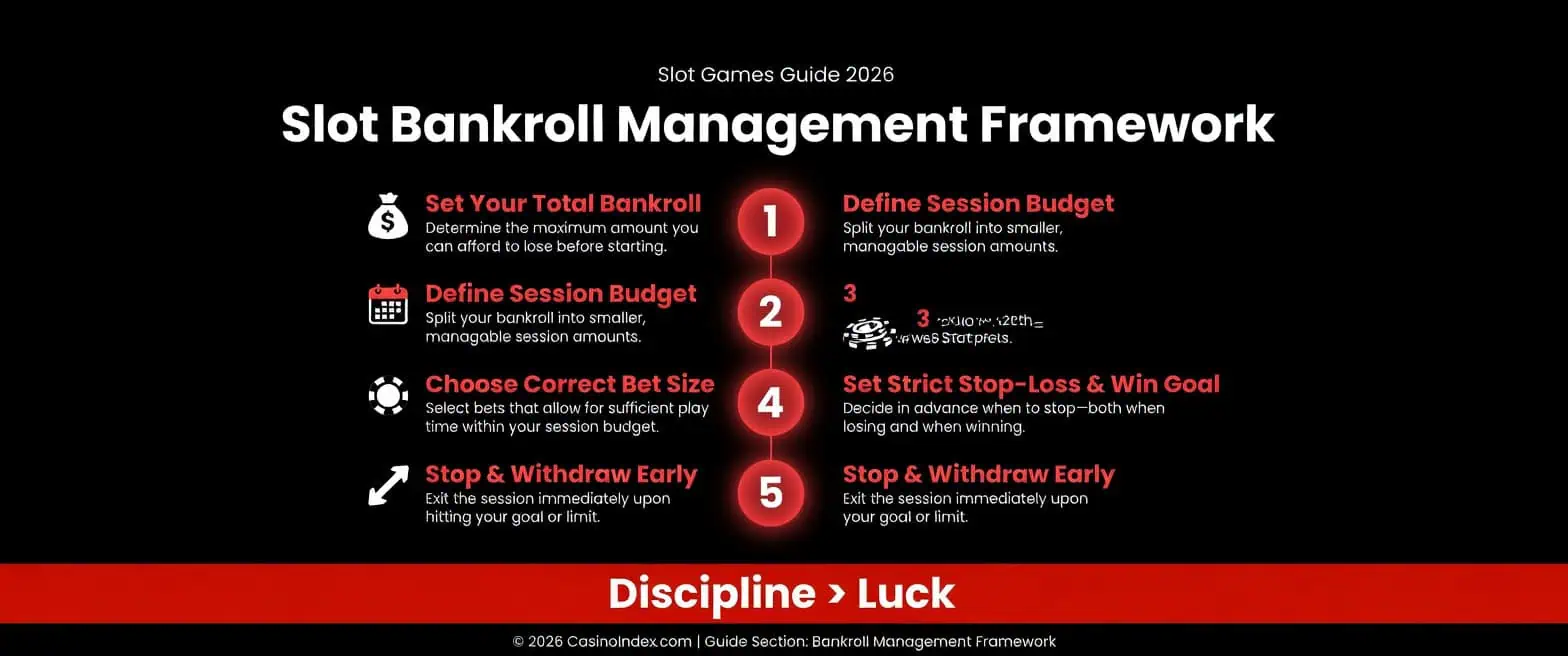
Set the full session budget first
Choose the amount before opening the game.
The budget should consist only of money that can be lost without creating pressure to deposit again, recover losses or extend the session.
Match the stake to the number of spins
A player planning a longer session needs a smaller stake relative to the available balance.
For example, a $50 bankroll with a $2 stake provides very little room for normal volatility. The same balance at $0.20 offers more attempts, although it still carries a negative expectation over time.
Use one deposit as the boundary
Repeated small deposits can hide the true cost of the session.
Once the original budget is used, the session should end. Adding more money because a feature did not appear converts a planned session into loss chasing.
Withdraw rather than treating the casino as storage
A casino balance remains under the operator’s control until a withdrawal is approved.
Players do not need to keep unnecessary funds inside the account merely because they expect to play again later.
Anyone finding it difficult to stop, reduce deposits or avoid chasing can use the responsible gambling guide for practical limits and support options.
The Main Psychological Traps in Slot Play
The “bonus is due” assumption
A long period without a feature can make the next spin feel more promising.
The RNG does not recognize that expectation. Unless the game explicitly uses a disclosed collection or guaranteed-feature mechanic, previous misses do not make the next bonus more likely.
Near misses
Two bonus symbols followed by a third symbol landing just outside the required position can feel close to a win.
Emotionally, the result may encourage another spin. Mathematically, it remains a loss unless the paytable awards something.
Chasing losses
Increasing stakes after a negative run does not force the game to recover the balance.
Instead, it exposes more money to the same house advantage while the player is under greater emotional pressure.
Overconfidence after a large win
A strong result can make the player feel that the game or provider has become understandable.
Future spins remain independent. Returning the entire win to the game can turn a positive session into a loss without changing the underlying odds.
How Experienced Players Approach Slots
They do not treat slots as an income source
No selection system can remove the built-in casino advantage.
An experienced approach treats the session as paid entertainment with a known maximum budget.
They choose for fit rather than hype
Popular games, streamer results and maximum-win clips show rare outcomes more often than ordinary sessions.
A better choice considers:
- bankroll size
- preferred session length
- tolerance for dry periods
- minimum stake
- feature dependence
- whether bonus buys are present
They define the exit before entering
A session boundary should be decided before play begins.
That can include:
- a maximum financial loss
- a time limit
- no additional deposits
- no stake increases after losses
- withdrawing a meaningful remaining balance
They accept that stopping is the only real control
The player cannot control the result of a spin.
The controllable decisions are the game, stake, speed, budget and moment of exit.
Slots Compared With Other Casino Games
Slots vs live casino games
Game Slots are usually faster and require fewer decisions. Live dealer games move at a slower pace because the dealer, betting window and table process create natural pauses.
However, slower play does not make a game profitable. Table rules and strategy can reduce errors in some games, but the casino advantage remains.
Slots vs strategy-based table games
Blackjack and some poker formats involve meaningful player decisions. Slots generally do not offer a way to improve the mathematical result after the stake is placed.
This makes game selection and bankroll limits more important than in-game strategy.
When slots may fit
Slots may suit players who want:
- simple controls
- short entertainment sessions
- a wide choice of themes
- small adjustable stakes
- no need to wait for a table
They are a poor fit when the player expects predictable returns, guaranteed session length or a reliable way to recover losses.
Final View: Understanding the Game Matters More Than Chasing Features
Slots are simple to operate but complex in how they distribute value.
RTP describes a long-run theoretical return. Volatility shapes the balance swings. Hit frequency affects how active the game feels. Bonus mechanics concentrate attention and, in some cases, risk.
None of these elements predicts the next spin.
The most useful approach is to:
- verify the game information where possible
- match volatility to the bankroll
- keep the stake proportionate to the planned session
- avoid treating small wins as profit
- use bonus buys cautiously or avoid them
- set the budget before playing
- stop without adding another deposit
The slot cannot be controlled. The amount, speed and duration of exposure can.
FAQ: Slot Games
How do online slots decide the result of a spin?
An RNG selects the outcome. The game then displays that result through reels, symbols or a grid. Each ordinary spin is independent of previous outcomes.
Can a player predict when a slot will pay?
No. Losing streaks, previous bonuses and near misses do not reliably predict the next result. A feature may feel due, but independent RNG outcomes do not work that way.
What is a good RTP for an online slot?
A higher RTP generally means a lower theoretical house edge when other factors are equal. Many players compare games around the 96% range, but the active configuration, volatility and session speed also matter.
Can the same slot have different RTP versions?
Yes. Some providers release several approved configurations of one game. Players should check the information panel rather than assuming that a figure shown on another website matches the active casino version.
Are high-volatility slots better?
No volatility level is universally better. Higher-volatility games concentrate value into fewer outcomes, while lower-volatility games tend to return smaller amounts more frequently.
Does a high hit frequency mean the slot pays well?
No. Hit frequency counts qualifying wins, including results that return less than the amount staked. It does not measure profit or overall session value.
Are free-spin features actually free?
In the base game, the player normally pays for the chance to trigger them through previous spins. Promotional free spins may also carry wagering, maximum-win or game restrictions.
Are bonus buys worth using?
Bonus buys concentrate a large amount of risk into one feature. They can return less than their purchase price and are generally unsuitable for limited bankrolls or repeated chasing.
Can casinos control individual slot outcomes?
A legitimate provider-based slot should use its approved RNG and game configuration. The casino can decide which games and available configurations it offers, but it should not manually choose individual player results.
Can slot players make consistent profit?
Slots have a built-in house advantage, so consistent long-term profit cannot be expected. A large win is possible, but it does not remove the negative mathematical expectation.

Nina Kanu has worked in cryptocurrency content and blockchain research since 2016. She is also known within parts of the crypto community through CryptoMutant, where her work has covered emerging projects, market trends and developments across the blockchain ecosystem. At CasinoIndex, Nina focuses on crypto casino reviews, platform comparisons, player experience, game ecosystems and bonus fairness. Her research examines how casino products perform beyond their marketing, including usability, payment options, promotional terms and the overall experience players receive after signing up.