Casino Terms & Conditions Guide
Casino Terms & Conditions Guide 2026: How to Read Casino Rules Without Getting Trapped
Most players do not lose money only because of bad luck.
Instead, they often lose money because they ignore the rules that control bonuses, withdrawals, verification and account behavior.
That is the uncomfortable part of online gambling.
Casino Terms and Conditions are not just legal text. They define how your money moves, how bonuses work, when verification starts and whether your winnings can actually be withdrawn. However, many players skip them completely. Others scroll quickly and assume everything is standard.
As a result, problems usually appear later, often at the worst possible moment.
This Casino Terms Guide 2026 breaks down casino rules in a practical way. It focuses on the parts that affect real money, not the legal wording that most players will never use.
You will learn:
- what casino terms actually control
- which clauses matter before you deposit
- where players usually get caught off guard
- how bonuses, withdrawals and KYC checks connect
- what casinos may treat as bonus abuse
- how to spot red flags early
- how to protect your withdrawals before the problem starts
If you already compare platforms through CasinoIndex’s trusted casino rankings, this guide helps you understand what those operators expect from players behind the scenes. The most important rules usually appear before the problem starts: bonus terms, withdrawal limits, KYC timing, payment matching rules and account restrictions.
For a focused pre-deposit checklist, CasinoIndex also explains how to read casino terms before depositing. This page goes broader and shows how those rules affect bonuses, withdrawals, verification and account safety after real money is involved.
What Casino Terms and Conditions Actually Are
The real purpose of casino terms
Casino Terms and Conditions act as the rulebook for your entire account.
They define:
- how deposits work
- how bonuses are applied
- when verification can happen
- how withdrawals are processed
- which payment rules apply
- what actions can void your winnings
- when the casino can restrict, review or close an account
In simple terms:
Casino terms control whether your balance can become withdrawable money.
That is why experienced players treat T&Cs as part of the casino product, not as background text.
Why players ignore them
Most players skip casino terms for simple reasons.
First, they look long and complicated. Second, they feel like standard legal text. Finally, they do not seem important when the deposit and gameplay experience feels smooth.
However, that assumption creates risk.
Players usually check the rules only after a problem appears. At that point, the casino is already enforcing those rules.
The key mindset shift
Instead of thinking:
“I will check later if something happens.”
Think:
“These rules decide how my money moves.”
Once you adopt that mindset, your entire approach changes. You stop treating the casino like a game lobby and start treating it like a financial platform with rules, limits and enforcement triggers.
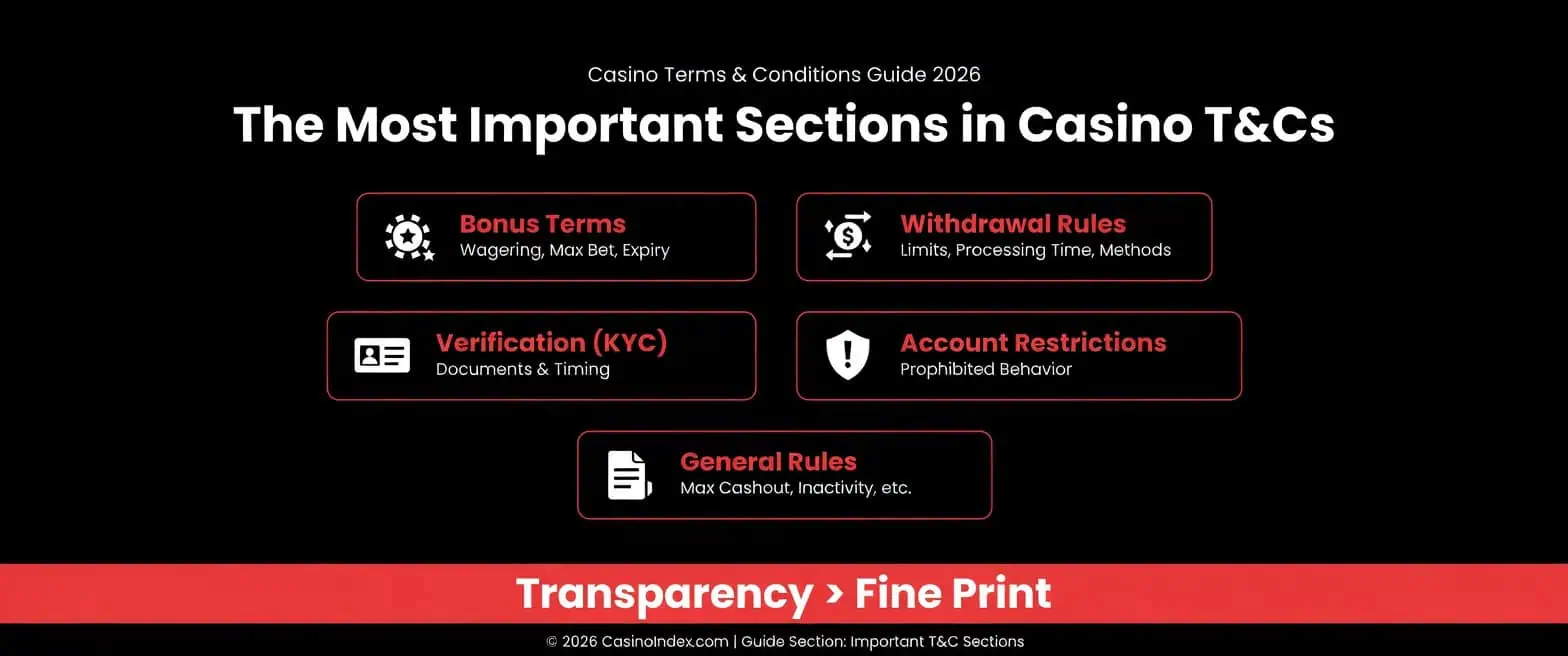
The Most Important Sections Inside Casino Terms
Not all sections matter equally
Casino terms can be long.
However, you do not need to read every line with the same attention. Instead, focus on the sections that directly affect money movement, withdrawals, account reviews and bonus eligibility.
That approach saves time and reduces risk.
The critical sections you must always check
Bonus terms
Bonus terms create many of the most expensive player mistakes.
They explain:
- wagering requirements
- max bet limits
- game contribution rates
- restricted games
- expiry rules
- max cashout limits
- withdrawal restrictions while a bonus is active
If you misunderstand this section, you risk losing winnings later.
Therefore, always review bonus conditions before claiming any offer. For a deeper breakdown, use the casino bonus guide to assess wagering, max bet limits, expiry rules and payout caps before you commit.
Withdrawal rules
Withdrawal rules define how and when you receive your money.
They usually include:
- minimum withdrawal amounts
- daily, weekly or monthly limits
- processing times
- pending periods
- supported payout methods
- extra checks before approval
Many delays happen because players ignore this section.
For example, a casino may allow large balances but only release withdrawals in weekly stages. In that case, the casino may not be refusing payment, but the payout experience can still feel slow. CasinoIndex explains this wider payout logic in its casino withdrawal guide.
Verification and KYC requirements
Verification rules explain when and how casinos confirm your identity.
They usually cover:
- required documents
- verification triggers
- source-of-funds checks
- payment ownership checks
- processing time
Many players assume verification happens at sign-up. However, most casinos can trigger it during withdrawal.
Preparing early can prevent delays. Use the verification process guide to understand document triggers, timing and the account checks that often happen before payout.
Account restrictions and prohibited behavior
This section defines what you are not allowed to do.
It often includes:
- multi-accounting
- bonus abuse
- VPN or restricted-country access
- payment manipulation
- third-party payment use
- collusion or abnormal play patterns
If you break these rules, the casino may restrict your account, cancel a bonus or remove winnings connected to the violation.
Casino Terms That Affect Withdrawals Most
Not every rule has the same impact. Some terms only affect account setup, while others decide whether a withdrawal is approved, delayed or reduced.
| Terms Section | What It Controls | Real Player Risk | What to Check First |
|---|---|---|---|
| Bonus terms | Wagering, max bet, expiry, game contribution and max cashout | Winnings can be voided if the bonus is used incorrectly | Wagering type, max bet and restricted games |
| Withdrawal rules | Limits, pending time, payout methods and processing conditions | Large wins may be paid slowly or reviewed before release | Daily, weekly and monthly payout caps |
| KYC rules | Identity checks, document requests and verification timing | Withdrawals can pause until verification is complete | When KYC starts and which documents are required |
| Payment rules | Deposit and withdrawal method matching | Cashouts can be delayed if the payout route does not match the deposit route | Whether withdrawals must return to the original method |
| Account restrictions | Multi-accounting, VPN use, restricted countries and prohibited play | Accounts may be blocked or winnings removed after review | Country rules, duplicate-account rules and prohibited behavior |
This is why casino terms should be read before depositing, not after a withdrawal gets stuck.
A player does not need to read every legal sentence. However, they should understand the sections that control deposits, bonuses, verification, payment routes and cashout approval.
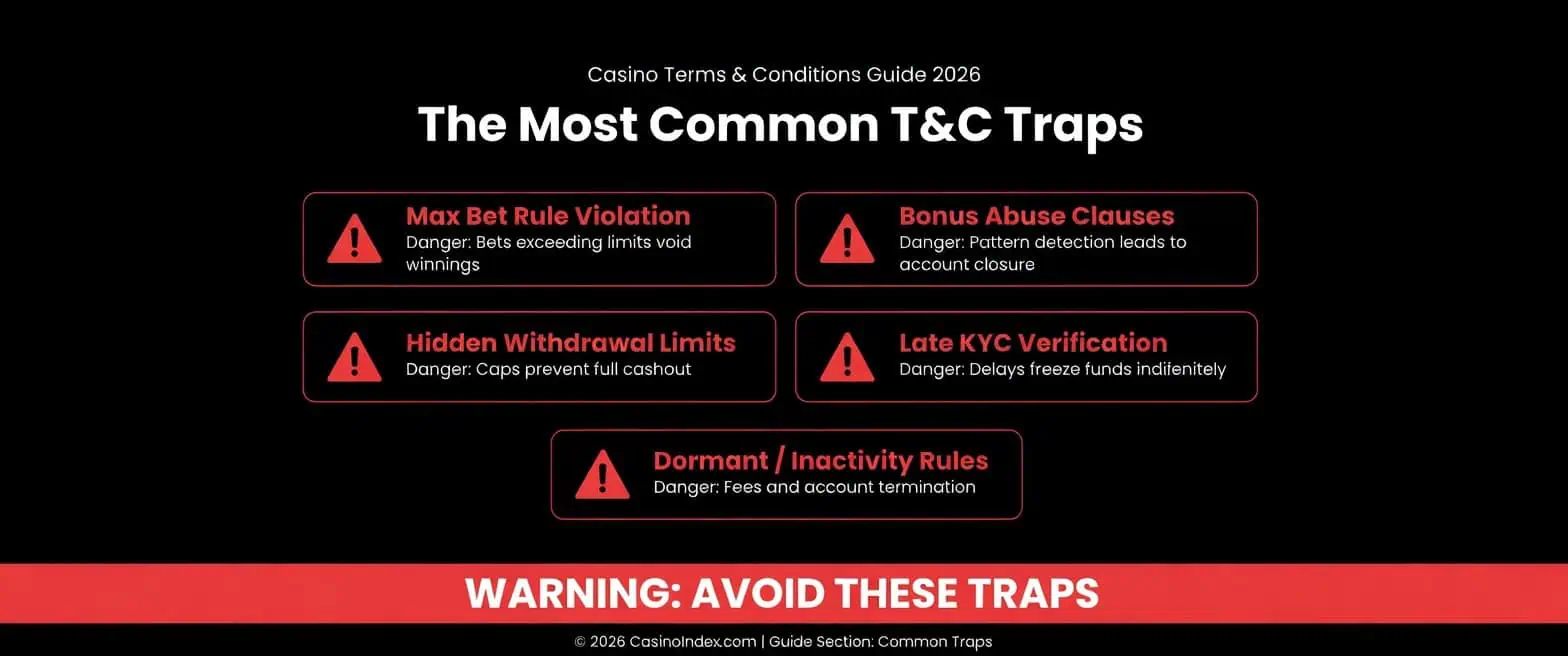
The Most Common T&C Traps Where Players Lose Money
Why these traps exist
Not every strict rule is unfair.
In fact, many rules exist to prevent fraud, protect payment systems and follow regulations. Still, some conditions can easily catch inexperienced players.
That is where problems start.
Trap 1 — Max bet rule
The max bet rule causes many bonus disputes.
Example:
- you activate a bonus
- you place higher bets after a few wins
- you exceed the allowed max bet
At first, nothing may happen.
However, when you withdraw, the casino checks your activity. If the system detects a violation, the casino may void bonus-related winnings.
Therefore, always check the max bet rule before playing with any active promotion.
Trap 2 — Bonus abuse clauses
Casinos often define certain behavior as “bonus abuse.” This is one of the most important sections to read before claiming any promotion.
Bonus abuse clauses can include:
- switching games strategically during wagering
- using very low-risk betting patterns
- exploiting contribution rates
- using multiple accounts or shared household accounts
- claiming promotions in a way the casino considers unnatural
The problem is that the wording can be broad. A player may think they are using a careful strategy, while the casino may treat the same behavior as restricted bonus play.
That does not mean every bonus abuse clause is unfair. Casinos need rules to prevent fraud and promotion manipulation. However, vague clauses create risk when players cannot clearly see where normal play ends and prohibited behavior begins.
CasinoIndex explains this in more detail in its guide to what casinos may call bonus abuse.
Trap 3 — Withdrawal limits
Withdrawal limits often surprise players.
Example:
- maximum withdrawal: $2,000 per week
- player balance: $10,000
In this case, the player may receive payments over several weeks.
This is not automatically a scam. It may simply be how the casino’s payout system works. However, many players expect instant access to the full balance because they did not check the limit before depositing.
Trap 4 — KYC trigger timing
Verification timing creates confusion.
A player may deposit easily, play without restrictions and win money. Then, once the withdrawal is requested, verification begins.
That can mean:
- identity documents are required
- proof of address is requested
- payment ownership must be confirmed
- withdrawals pause until review is complete
Therefore, preparing early avoids frustration.
Trap 5 — Dormant account rules
Some casinos apply inactivity rules.
If you stop playing for a long period, fees may apply or balances may be reduced under dormant account clauses.
This is not common everywhere, but it still exists. That is why players with unused balances should check inactivity rules before leaving money inside an account.
When Casinos Actually Check the Rules
Most checks happen at the worst moment
At the beginning, everything can feel smooth.
You deposit, you play and sometimes you even win. Nothing interrupts your session. No warnings appear. The system works exactly as expected.
However, the situation changes when you request a withdrawal.
At that point, casinos may review your account in detail.
They can check:
- bonus compliance
- betting patterns
- verification status
- payment method ownership
- country restrictions
- account history
As a result, many players face problems only when they try to cash out.
This is also where withdrawal approval matters. Casinos may review bonus compliance, KYC status, payment ownership, country rules and account behavior before releasing funds. CasinoIndex breaks this down in its guide to what casinos check before approving withdrawals.
Why this feels unexpected
From the player’s perspective, deposits worked instantly, gameplay had no restrictions and the balance increased normally.
Therefore, a delayed withdrawal feels like something went wrong.
In reality, the casino may simply be applying rules at the exit stage. That is why experienced players prepare before reaching that point.
Real Scenarios Where Players Lose Winnings
Scenario 1 — Max bet violation
This is one of the most common mistakes.
A player typically:
- activates a bonus
- starts playing normally
- increases the bet size after a few wins
At first, nothing happens.
However, the casino is tracking every bet in the background. When the player later requests a withdrawal, the system performs a full activity check.
If the max bet limit was exceeded at any point, the casino can void bonus-related winnings.
As a result, even a small oversight can invalidate a significant win.
Scenario 2 — Late KYC verification
Another common situation involves verification.
A player deposits funds, plays without restrictions and builds a balance. Then, at withdrawal, the casino requests identity documents.
Processing stops until verification is complete.
This does not automatically mean the casino is acting unfairly. However, it does mean the player should have known when KYC could appear and which documents might be required.
What causes additional delays
Verification delays usually increase because of avoidable inconsistencies:
- documents are unclear or low quality
- names do not match payment methods
- addresses are outdated or inconsistent
- payment method ownership is unclear
- account details changed shortly before withdrawal
Because of this, verification often requires extra review.
Preparing accurate documents in advance reduces friction and helps withdrawals move faster.
Scenario 3 — Withdrawal limits
This situation surprises many players.
Example:
- balance: $12,000
- withdrawal limit: $2,000 per week
As a result, the player receives funds over several weeks.
Players often expect instant access to winnings. However, terms define payout structure in advance. Checking limits before playing prevents unrealistic expectations.
Scenario 4 — Bonus abuse interpretation
This scenario is more complex.
A player may try to reduce risk while clearing wagering, switch games strategically or optimize betting patterns.
However, the casino may interpret this behavior as abuse.
The definition of “abuse” is often broad. Because of that, players cannot always predict what triggers it.
Therefore, aggressive strategies increase risk unnecessarily.
Scenario 5 — Payment method mismatch
Another issue appears when payment methods differ.
A player may deposit using one method and request a withdrawal to another.
In many cases, casinos enforce a closed-loop system. That means withdrawals may need to return to the original deposit method before another route becomes available.
This rule exists to prevent fraud, improve traceability and meet payment compliance requirements. However, players often overlook it until the withdrawal stage.
CasinoIndex explains this deeper in its guide to why payment matching rules can delay withdrawals.
Hidden Clauses Most Players Miss
Vague language clauses
Some terms include flexible wording.
Examples include:
- “at the casino’s discretion”
- “suspicious activity”
- “unusual gameplay patterns”
- “irregular betting behavior”
- “commercial use of bonuses”
These phrases allow casinos to interpret behavior.
Not all vague clauses are unfair. However, they create uncertainty. Therefore, understanding them helps you avoid risky situations.
Maximum cashout limits
Some bonuses include payout caps.
Example:
- bonus amount: $100
- maximum cashout: $500
Even if you win more, the casino may limit how much can be withdrawn from that bonus.
This is why max cashout is not a minor detail. It changes the real value of the offer.
Expiry clauses
Bonuses and balances can expire.
For example:
- wagering must be completed within a set time
- free spins must be used within a short window
- inactive balances may decrease after long inactivity
Therefore, timing matters.
Game contribution differences
Not all games count equally toward wagering.
Example:
- selected slots: 100%
- table games: lower contribution
- live dealer games: often excluded or reduced
As a result, switching games can slow progress significantly. In some cases, playing restricted games can also breach the promotion terms.
How Casinos Interpret “Unfair Play”
What casinos look for
Casinos monitor patterns such as:
- low-risk betting during wagering
- sudden bet changes
- unusual gameplay sequences
- multiple account activity
- shared household promotion use
- payment method mismatch
Why this is complicated
The definition of unfair play is not always precise.
Casinos want to protect their systems. Players want to reduce risk. Therefore, conflicts can happen.
A player may see a strategy as careful bankroll management. A casino may see the same behavior as bonus manipulation.
How to stay safe
Instead of pushing limits, follow normal gameplay patterns.
That means:
- use consistent bet sizes
- avoid extreme strategies
- do not exploit unclear contribution gaps
- avoid account sharing
- do not use someone else’s payment method
- skip promotions that require risky play to clear
This reduces the chance of triggering account review or bonus-related disputes.
Advanced Red Flags in Casino Terms
Low withdrawal limits
If a casino restricts withdrawals heavily, access to funds slows down.
Therefore, avoid platforms with very low payout limits unless you are comfortable with staged withdrawals.
Overly complex bonus rules
If bonus terms are difficult to understand, risk increases.
Clear rules usually indicate a better environment. Confusing rules often shift risk onto the player.
Lack of transparency
If key rules are hard to find, that is a warning sign.
Reliable casinos present important terms clearly, especially around withdrawals, bonuses and verification.
Inconsistent information
If different sections contradict each other, confusion follows.
Therefore, consistency is essential. If the promotion page says one thing and the terms page says another, treat the stricter rule as the one most likely to be enforced.
How to Protect Yourself Before Depositing
The pre-deposit checklist
Before using any casino, check the rules that affect money first.
- review bonus terms
- check withdrawal limits
- confirm verification requirements
- understand payment rules
- check restricted countries
- look for vague bonus abuse language
- review account closure clauses
This is not about reading every legal sentence. It is about checking the terms that can block, delay or reduce a payout.
Test the system early
Experienced players usually test first.
They:
- deposit a small amount
- play briefly
- request a small withdrawal
- observe support response quality
- check whether verification appears
As a result, they understand how the system behaves before committing larger funds.
Why this step matters
Testing early allows you to detect delays, identify hidden rules and evaluate payout reliability.
Therefore, you reduce risk before committing larger funds.
How Terms Connect to Casino Safety
T&Cs reflect casino quality
Strong casinos usually explain rules clearly, maintain transparency and avoid hidden conditions.
Weak casinos often rely on vague language, hide important clauses or create confusion around payout rules.
That does not mean every strict term is unfair. It means the quality of the wording matters.
Why this matters for players
Understanding terms helps you:
- avoid risky platforms
- choose better casinos
- protect your money
- avoid unnecessary bonus disputes
- prepare for verification earlier
Use the safe online casino guide to evaluate platforms properly, especially when terms are vague, restrictive or built around weak withdrawal transparency.
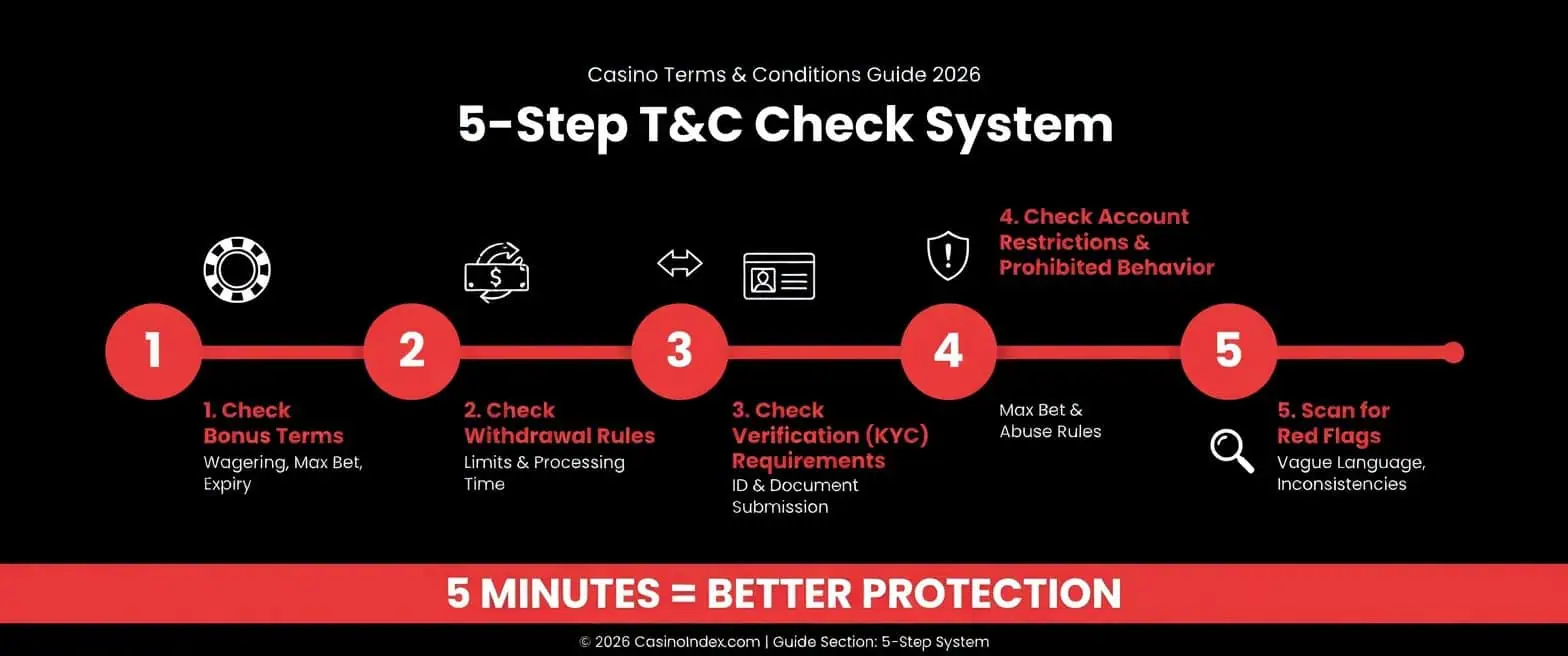
The 5-Minute System to Read Casino Terms Properly
Most players either skip terms completely or try to read everything. Neither approach works well.
Instead, experienced players use a fast and structured system focused only on high-impact areas.
Step 1 — Scan bonus conditions first
Focus on wagering, max bet limits, expiry, game contribution and max cashout.
If something feels unclear or overly complex, treat it as a warning sign.
Step 2 — Check withdrawal limits and timing
Review payout limits, processing times and pending periods.
This defines how fast you can access your money after a win.
Step 3 — Review verification rules
Understand when KYC is triggered, what documents are required and how long the process normally takes.
Unclear verification rules usually lead to delays later.
Step 4 — Identify restricted behavior
Check rules about multiple accounts, payment methods, VPN use and bonus strategy.
This section defines what can invalidate winnings.
Step 5 — Look for red flags
Watch for vague wording, unclear limits and inconsistent information.
If multiple issues appear, avoid the platform or test it only with small amounts.
The Red Flag Checklist
Before depositing, run through this checklist.
Red flag 1 — Vague language
Terms like “at our discretion” or “suspicious activity” allow flexible interpretation.
Some usage is normal, but excessive use increases risk.
Red flag 2 — Unclear withdrawal limits
If payout limits are hard to find, that is a strong warning sign.
Transparent casinos present this clearly before the player deposits.
Red flag 3 — Overly complex bonus rules
If bonus terms feel confusing, they usually carry more risk.
Simple structures are safer because the player can understand the real cost before playing.
Red flag 4 — Hidden or hard-to-find terms
Important rules should not be buried deep inside long documents.
If the casino makes key rules difficult to find, the player carries more uncertainty.
Red flag 5 — Inconsistent sections
If different sections contradict each other, expect problems later.
Inconsistent rules make support disputes harder to resolve because both sides may point to different pages.
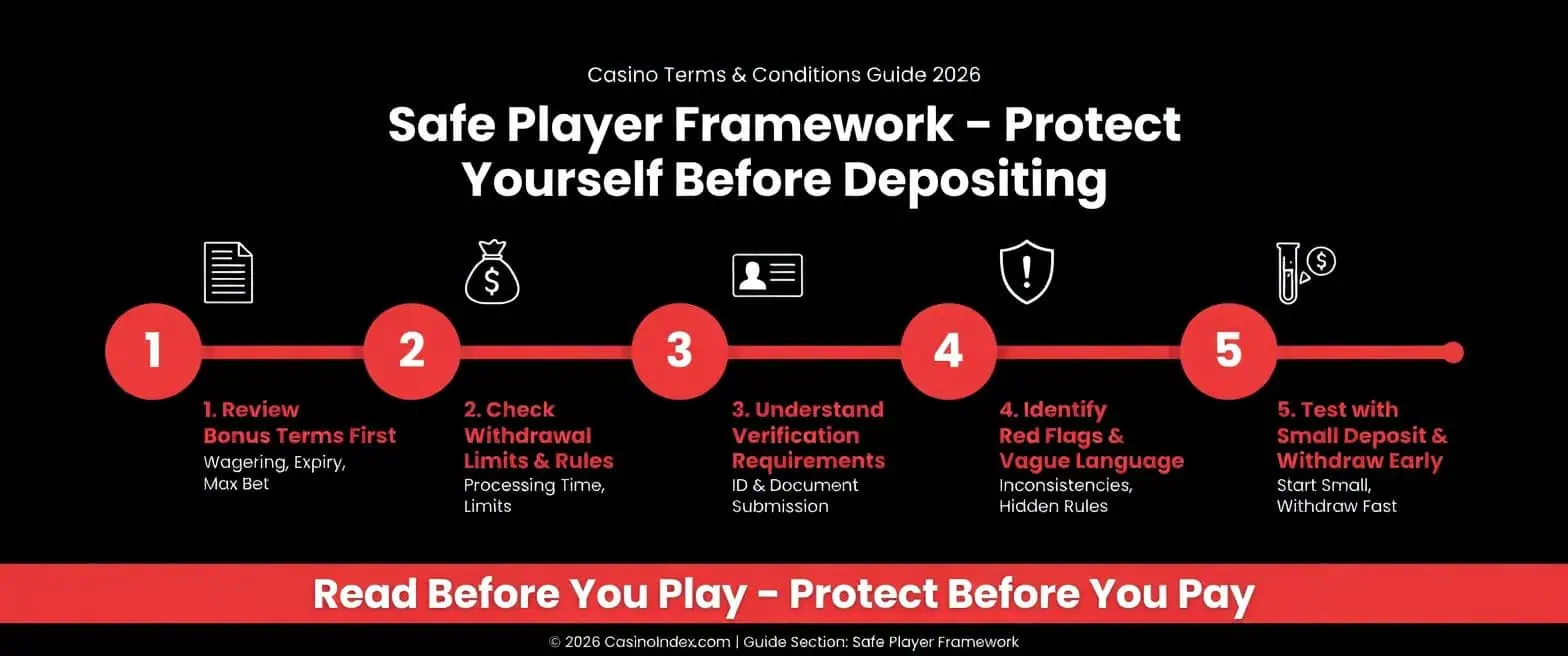
The Safe Player Framework
Understanding terms is only the first step.
The real advantage comes from how you act on them.
Step 1 — Start small
Test the platform with small deposits before committing larger amounts.
Step 2 — Avoid complex bonuses
Complicated bonus structures increase the chance of mistakes.
If the terms require a calculator, the risk is already higher.
Step 3 — Keep payment methods consistent
Use the same method for deposits and withdrawals where possible.
This reduces payment ownership questions and closed-loop payout friction.
Step 4 — Verify early
Complete verification before requesting a larger withdrawal.
This removes one of the most common cashout delays.
Step 5 — Withdraw regularly
Do not leave large balances inside a casino unnecessarily.
Regular withdrawals reduce platform exposure and help you understand how the cashier behaves.
This framework reduces risk before problems appear instead of reacting afterward.
Why Most Players Still Ignore Terms
Even after problems appear, many players repeat the same mistakes.
Reason 1 — Overconfidence
Players believe they understand the system.
As a result, they skip important details.
Reason 2 — Focus on winning
When players win, they focus on the outcome.
They do not think about the conditions attached to those winnings.
Reason 3 — Complexity avoidance
Long documents feel overwhelming.
Therefore, players avoid them completely.
The reality
Ignoring terms does not simplify the system.
It only increases risk.
The Biggest Difference Between Casual and Experienced Players
The difference is not luck.
It is preparation.
Casual players
- skip terms
- react to problems
- chase outcomes
- learn after losses
Experienced players
- scan terms early
- understand key rules
- avoid unnecessary risks
- control their payment setup
- verify before large withdrawals
Why this matters
Both groups may use the same casinos.
However, one group avoids problems before they happen. The other deals with them later.
Casino Terms FAQ
How long should it take to check casino terms properly?
In most cases, a focused review should take around 5–10 minutes.
You do not need to read every line. Instead, concentrate on the sections that directly affect your money, such as bonuses, withdrawals, verification and payment rules.
Can casinos legally remove winnings?
Yes, they can remove winnings if the player violates terms that apply to the account, bonus or payment method.
This includes situations like exceeding max bet limits, breaking bonus conditions, using restricted payment methods or creating multiple accounts.
Therefore, understanding the rules before playing is essential.
Are all strict casino terms unfair?
No.
Many strict rules exist for valid reasons, such as preventing fraud, complying with regulation and protecting payment systems. Problems arise when rules are unclear, hidden, inconsistent or applied in a way that gives players no realistic way to understand them before deposit.
What is the most dangerous clause in casino terms?
The most common issues come from max bet rules, wagering requirements, max cashout limits and bonus abuse definitions.
These rules are easy to overlook and often lead to denied withdrawals if misunderstood.
Should players always avoid bonuses?
Not necessarily.
Bonuses can add value if the terms are clear and reasonable. However, complex bonuses with high wagering, strict max bet rules and vague abuse clauses increase the risk of mistakes.
If a bonus feels confusing, it is often better to skip it.
Why do withdrawals get delayed so often?
Withdrawals usually get delayed because of identity verification, payment ownership checks, bonus review, internal security checks or payout limits.
In many cases, those delays are already described in the terms. Understanding them early helps set realistic expectations.
Can casinos change their terms after you start playing?
Casinos can update their terms.
However, changes usually apply going forward rather than retroactively. Even so, players should check the latest version of the terms before claiming bonuses, depositing larger amounts or requesting major withdrawals.
What happens if you break a rule by accident?
In most cases, intent does not matter much.
If a player violates a rule, even by mistake, the casino can still enforce its terms. That may result in bonus removal, confiscated winnings, account restrictions or withdrawal delays.
Are crypto casinos safer in terms of rules?
Not automatically.
Crypto casinos may offer faster transactions, but most still enforce rules around verification, withdrawals, payment ownership, wallet checks and bonus conditions.
The main difference is the payment method, not the fact that terms are enforced.
Why do casinos require verification only during withdrawal?
Casinos often delay verification to keep registration and deposits smooth.
However, they still need to verify identity, payment ownership and account legitimacy before releasing funds. As a result, verification often appears during withdrawal rather than during registration.
What is a closed-loop payment system?
A closed-loop system means withdrawals must usually go back to the original payment method used for deposits.
For example, if you deposit with a card, you may need to withdraw to the same card first before using another method.
This helps prevent fraud and improves transaction traceability.
How can players avoid most T&C-related problems?
The safest approach is simple:
- read bonus terms before claiming offers
- check withdrawal limits before depositing
- verify the account early
- use consistent payment methods
- avoid vague or complicated bonuses
- test withdrawals with small amounts
- avoid strategies that may look like bonus abuse
Most problems start when players wait until withdrawal to understand the rules.
Final Conclusion
Casino terms are not background text.
They decide how deposits, bonuses, verification, account reviews and withdrawals work once real money is involved.
The safest players do not wait until something goes wrong. They check the rules before deposit, understand the bonus structure before claiming, verify early and keep payment methods consistent.
That does not remove every risk.
However, it removes the most avoidable ones.
The key lesson is simple:
Casino terms matter most when you want to withdraw.
If you understand them before you play, you are far less likely to be surprised after you win.