Casino Verification Guide 2026
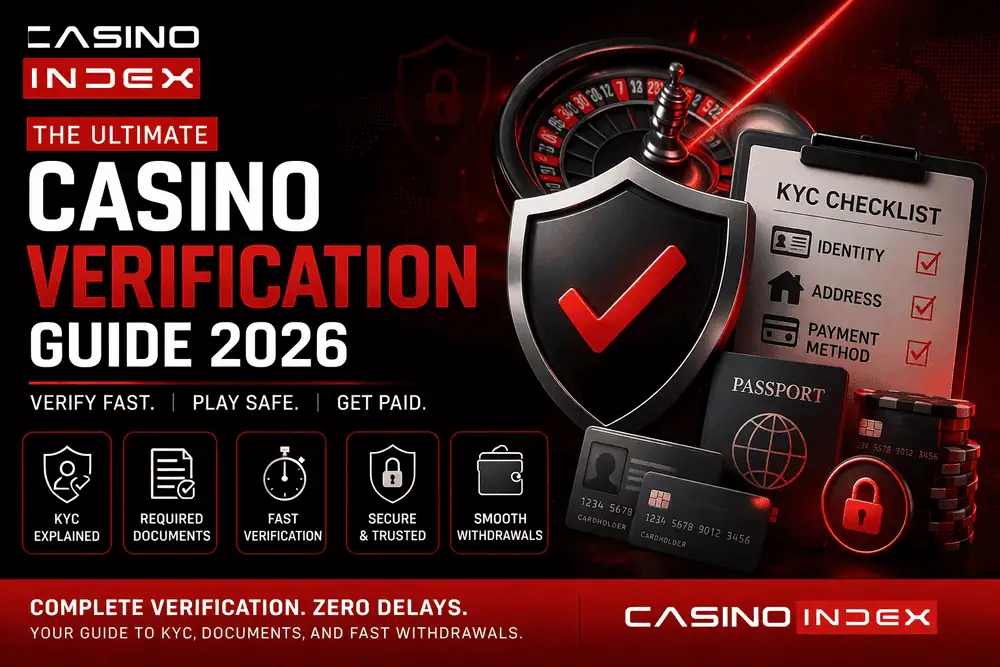
Casino Verification Guide 2026: Why Casinos Require KYC and How to Pass Verification Without Delays
Casino verification is one of the most misunderstood parts of online gambling. Many players only discover verification requirements when they request their first withdrawal. This often leads to frustration, delays, and confusion about why casinos require personal documents.
In reality, verification is not optional for regulated casinos. It is a legal requirement connected to licensing, anti-money laundering regulations, and player protection rules. Understanding how verification works before playing can prevent almost all withdrawal problems.
This guide explains:
• What casino verification (KYC) means
• Why casinos legally require documents
• When verification happens
• What documents are required
• How to avoid verification delays
• Common mistakes players make
• How verification affects withdrawals
By understanding the verification process early, players can avoid the most common issue in online casinos:
Withdrawal delays caused by missing documents.
If you want to understand how licensing rules force casinos to verify players, you can also review the Casino Licensing Guide which explains regulatory compliance requirements.
What Casino Verification (KYC) Actually Means
KYC stands for:
Know Your Customer
This is a legal identity verification process required by financial regulations. Casinos must confirm that players are real individuals, meet legal gambling age requirements, and are not using illegal funds.
Verification usually checks three things:
Identity
Address
Payment ownership
This ensures:
Players are legal age
Accounts are not stolen
Payments are legitimate
Fraud is prevented
Without verification, casinos risk losing licenses.
This is why regulated casinos treat verification seriously.
Why Casinos Require Verification (Legal Reasons)
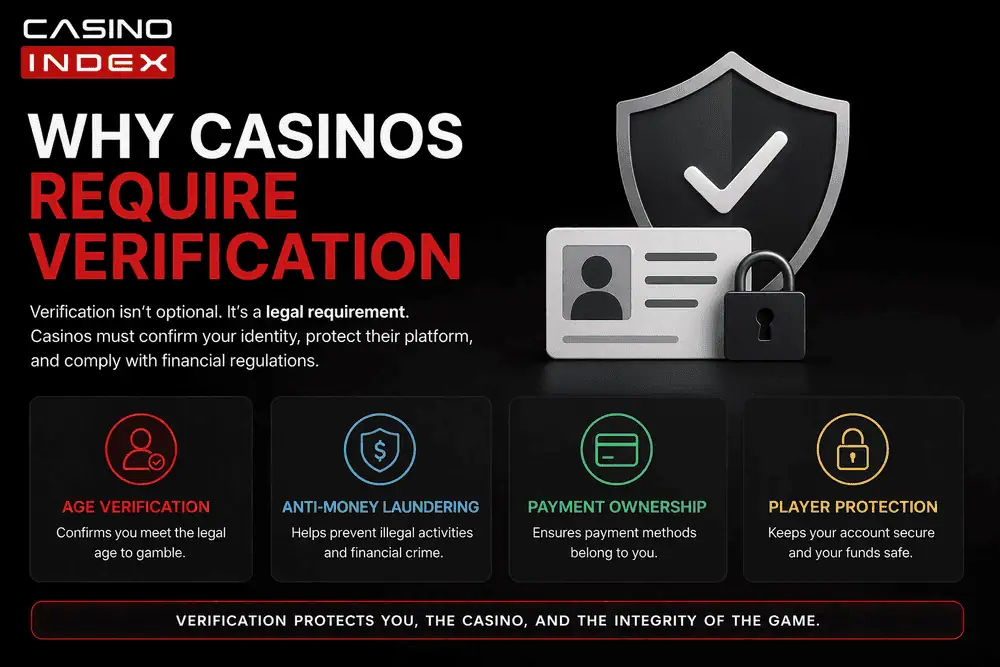
Many players believe casinos verify accounts to delay withdrawals.
In reality, verification exists mainly because of regulatory laws.
The main reasons include:
Age Verification Requirements
Casinos must confirm players are legally allowed to gamble.
This prevents:
Underage gambling
Identity fraud
Parental payment misuse
Age checks usually happen through ID verification.
Anti Money Laundering (AML) Rules
Casinos must ensure funds are not linked to illegal activities.
This includes:
Money laundering prevention
Fraud prevention
Terror financing checks
This is why large transactions often trigger additional checks.
Payment Ownership Verification
Casinos must confirm the payment method belongs to the player.
This prevents:
Stolen card use
Account sharing
Payment disputes
Chargeback abuse
Verification ensures:
Deposits and withdrawals match the same person.
This is sometimes called:
Closed loop payment verification
Player Protection Requirements
Verification also protects players.
Examples include:
Preventing identity theft
Preventing account takeover
Blocking suspicious activity
Ensuring responsible gambling compliance
Security checks are also discussed in the Casino Security Guide which explains how operators detect fraud risks.
When Casino Verification Happens
Verification timing depends on casino policy and regulation level.
Most casinos verify at one of three points:
Before First Withdrawal (Most Common)
Most casinos request verification when players request their first withdrawal.
This is the most common scenario.
Why?
Because:
Deposit friction must stay low
Regulation allows delayed verification
Withdrawals require stronger checks
This is why many players only see KYC during withdrawal.
During Account Creation (Stricter Casinos)
Some highly regulated casinos verify immediately during signup.
This is common in:
UK licensed casinos
European regulated operators
Highly compliant platforms
Advantages:
No withdrawal delays later
Higher trust environment
Disadvantage:
Slower registration.
Trigger Based Verification (Risk Monitoring)
Some casinos verify when risk indicators appear.
Triggers may include:
Large deposits
Large withdrawals
Multiple payment methods
VPN use
Account changes
Bonus abuse patterns
This is called:
Risk based verification
Modern casinos use behavioral monitoring systems to detect unusual activity.
Documents Required for Casino Verification
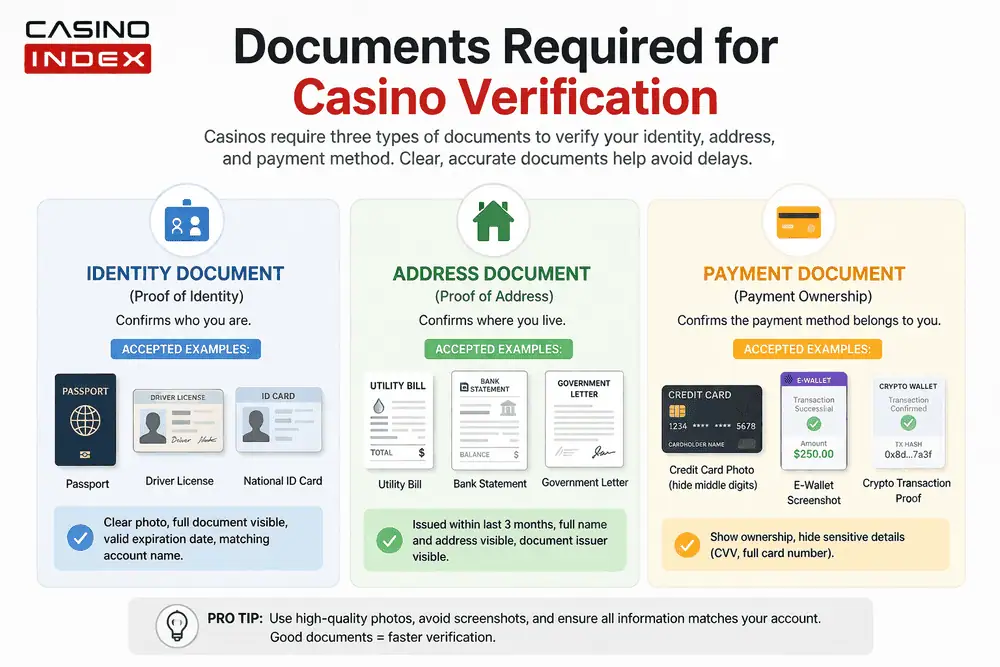
Verification normally requires three document types.
Identity Document (Proof of Identity)
This confirms who you are.
Accepted documents usually include:
Passport
Driver license
National ID card
Requirements usually include:
Clear photo
Full document visible
Valid expiration date
Matching account name
Most casinos reject:
Blurry images
Edited images
Expired IDs
Partial photos
Professional tip:
Use natural lighting and avoid flash reflections.
Address Verification (Proof of Address)
This confirms where you live.
Typical documents include:
Utility bill
Bank statement
Government letter
Tax document
Requirements usually include:
Issued within last 3 months
Full name visible
Full address visible
Document issuer visible
Casinos usually reject:
Screenshots
Partial documents
Old documents
Handwritten papers
Payment Method Verification
This confirms payment ownership.
Common requirements:
Credit card photo (partially hidden numbers)
Crypto wallet transaction proof
E-wallet screenshot
Bank account proof
Typical rules:
Hide middle card digits
Show first and last digits
Hide CVV code
Crypto verification may require:
Transaction hash
Wallet address match
Deposit confirmation
Understanding payment verification also helps avoid withdrawal issues explained in the Casino Payment Methods Guide.
Why Verification Delays Withdrawals (Most Common Causes)
Verification itself is usually fast.
Delays usually happen because of:
Incorrect documents
Low quality photos
Name mismatches
Address mismatches
Unverified payment methods
The biggest mistake players make:
Waiting until withdrawal to prepare documents.
Responsible players prepare verification before depositing large amounts.
How to Pass Casino Verification Faster
Experienced players follow a simple process:
Step 1:
Verify account before first withdrawal.
Step 2:
Upload clear documents immediately.
Step 3:
Use matching personal information.
Step 4:
Avoid multiple payment methods.
Step 5:
Respond quickly to support requests.
Following this usually reduces verification time from days to hours.
Common Casino Verification Mistakes Players Make
Most delays come from simple mistakes.
The most common include:
Uploading edited documents
Using different names
Using family member payment methods
Using VPN during verification
Submitting cropped documents
Casinos reject documents if any data looks inconsistent.
Consistency matters more than speed.
Verification and No KYC Casinos (Important Reality Check)
Some casinos advertise “No KYC”.
This usually means:
Verification delayed
Verification reduced
Verification required only at high limits
It rarely means:
Verification never required.
Most platforms still verify if:
Withdrawals become large
Suspicious patterns appear
Regulation requires checks
This is why even players using platforms listed in the No KYC Casinos category should understand verification may still happen.
Why Verification Protects Players
Although often viewed negatively, verification protects players from:
Account theft
Fraud withdrawals
Payment disputes
Unauthorized access
Without verification, anyone with login access could withdraw funds.
Verification ensures only the real account owner can withdraw.
How Long Casino Verification Takes (Realistic Timeframes Explained)
Verification time depends on three main factors:
• Casino regulation level
• Document quality
• Verification workload
Typical verification times:
Basic verification: 1–24 hours
Standard review: 24–72 hours
Complex checks: 3–7 days
Highly regulated casinos often verify faster because they use automated verification systems.
Unregulated casinos may take longer because verification is handled manually.
The biggest factor affecting speed is document quality.
Clear documents often pass within hours.
Poor quality documents can delay verification for days.
How Casinos Review Verification Documents
Most players imagine verification as manual document checking. Modern casinos actually use layered verification systems.
These include:
Automated document scanning
AI verification tools
Manual compliance review
Risk scoring systems
The process usually follows this order:
Step 1:
Automated system checks document authenticity.
Step 2:
System checks name match with account.
Step 3:
Address match verification.
Step 4:
Payment ownership validation.
Step 5:
Manual review if risk detected.
Most accounts pass automatically if documents are clean.
Manual reviews usually happen only when inconsistencies appear.
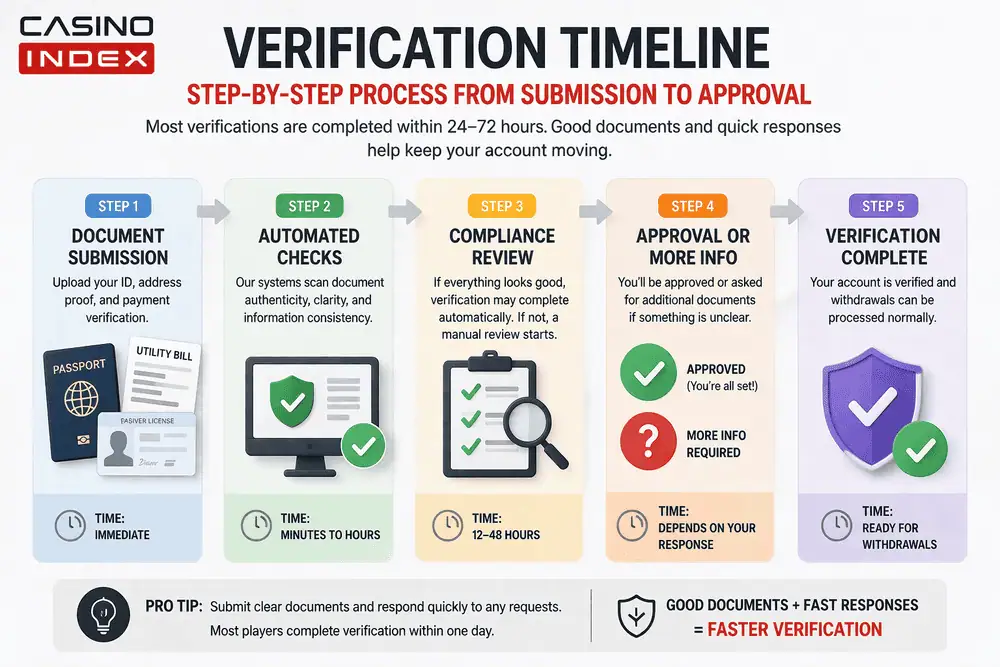
Verification Timeline: Step-by-Step Process From Submission to Approval
Understanding the exact verification timeline helps players avoid unnecessary stress. Most verification processes follow a predictable structure.
Typical process flow:
Step 1 — Document submission
Player uploads ID, address proof, and payment verification.
Time: Immediate.
Step 2 — Automated checks
Casino systems scan document authenticity, text clarity, and data consistency.
Time: Usually minutes to a few hours.
Step 3 — Compliance review
If no issues appear, verification may complete automatically. If inconsistencies appear, manual review starts.
Time: 12–48 hours.
Step 4 — Approval or request for additional documents
If documents pass, account becomes verified. If something is unclear, casino requests clarification.
Time depends on response speed.
Step 5 — Account verification completed
Withdrawals now process normally without additional identity checks.
Most delays happen because players submit incomplete documents or respond slowly to requests.
Players who respond quickly usually complete verification within one day.
What Triggers Additional Verification Checks
Some players receive additional verification requests. This usually happens because of risk triggers.
Common triggers include:
Large withdrawals
High deposit volume
Multiple payment methods
Frequent account changes
Bonus abuse patterns
Unusual login locations
This does not mean wrongdoing. It means the account reached a review threshold.
Casinos use risk scoring systems similar to financial institutions.
Source of Funds Verification (Advanced KYC)
Some players encounter additional checks called:
Source of Funds verification
This usually happens when transaction volume becomes significant.
Examples of possible requests:
Bank statements
Salary proof
Crypto transaction history
Business income proof
This is required by Anti Money Laundering laws.
Casinos must confirm funds come from legitimate sources.
This is standard practice in regulated environments.
Affordability Checks (New Regulatory Trend)
Some regulators now require affordability checks.
These are used when gambling activity appears high compared to typical spending behavior.
This may include requests for:
Income confirmation
Employment status
Spending verification
This protects players from excessive gambling risk.
These checks are more common in strongly regulated markets.
Why Multiple Payment Methods Cause Verification Problems
Using multiple payment methods increases verification complexity.
Example risky behavior:
Deposit with card
Deposit with crypto
Deposit with e-wallet
Withdraw to different method
This may trigger review because casinos must verify all payment ownership.
Responsible players usually follow a simple rule:
Use one payment method when possible.
This reduces verification friction.
The Closed Loop Withdrawal Rule
Many regulated casinos apply:
Closed loop payments
This means withdrawals must return through the same method used for deposits.
Example:
Deposit with card → withdraw to same card
Deposit with crypto → withdraw to same wallet
This prevents fraud and money laundering.
Understanding this rule prevents many withdrawal frustrations.
Why Name Mismatches Cause Verification Failure
One of the most common problems is mismatched names.
Examples include:
Nickname account names
Missing middle names
Different spelling
Using family member accounts
Casinos require exact name matching.
Responsible setup rule:
Account name must match ID exactly.
This prevents rejection.
VPN Use During Verification (Major Risk Factor)
Using VPNs can trigger verification issues.
Casinos may detect:
Different IP locations
Country mismatches
Risk flags
This may lead to:
Temporary suspension
Additional checks
Delayed verification
Responsible practice:
Avoid VPN use during:
Verification
Withdrawals
Account changes
Consistency builds trust signals.
Crypto Verification Differences
Verification for crypto transactions usually differs from traditional fiat payments.
Typical requirements include:
Wallet ownership confirmation
Transaction history
Deposit address match
Using cryptocurrency can reduce some friction, but it does not remove verification requirements completely.
This becomes especially relevant when playing on platforms discussed in the Best Crypto Casinos guide.
Why Some Accounts Get Manual Review
Manual review usually happens when automated systems cannot confirm legitimacy.
Examples include:
Unclear documents
High value withdrawals
Account risk flags
Regulatory requirements
Manual review usually includes:
Compliance team review
Document authenticity review
Transaction analysis
This may take longer but protects both player and casino.
How to Avoid Verification Delays Completely
Experienced players follow preparation rules.
Best practices include:
Verify account early
Use real personal data
Upload high quality images
Use matching payment methods
Avoid multiple deposits before verification
Preparation is the biggest difference between instant withdrawals and delays.
Verification Preparation Checklist (Professional Approach)
Before depositing significant funds:
✔ Verify account early
✔ Upload ID immediately
✔ Upload address proof
✔ Confirm payment ownership
✔ Enable security features
This approach removes most risk.
Professional players treat verification like account setup, not withdrawal preparation.
Casino Verification Red Flags Players Should Watch
Some casinos misuse verification to delay payments.
Warning signs include:
Repeated document requests
Changing requirements
Long unexplained delays
Poor support communication
These risks are more common in poorly regulated casinos.
This is why choosing regulated platforms discussed in the Safe Online Casino Guide is important.
How Long Withdrawals Take After Verification
Once verification completes, withdrawals usually process normally.
Typical times:
Crypto withdrawals: minutes to hours
E-wallet withdrawals: hours to 24 hours
Bank transfers: 1–5 days
Most delays occur only during first verification.
After that, withdrawals usually speed up.
This is why experienced players verify early.
Why Verification Improves Account Security
Verification also protects players from:
Unauthorized withdrawals
Account theft
Payment fraud
Identity misuse
Without verification, account safety would be weaker.
Verification ensures only the real account owner can move funds.
How to Pass Casino Verification on the First Attempt
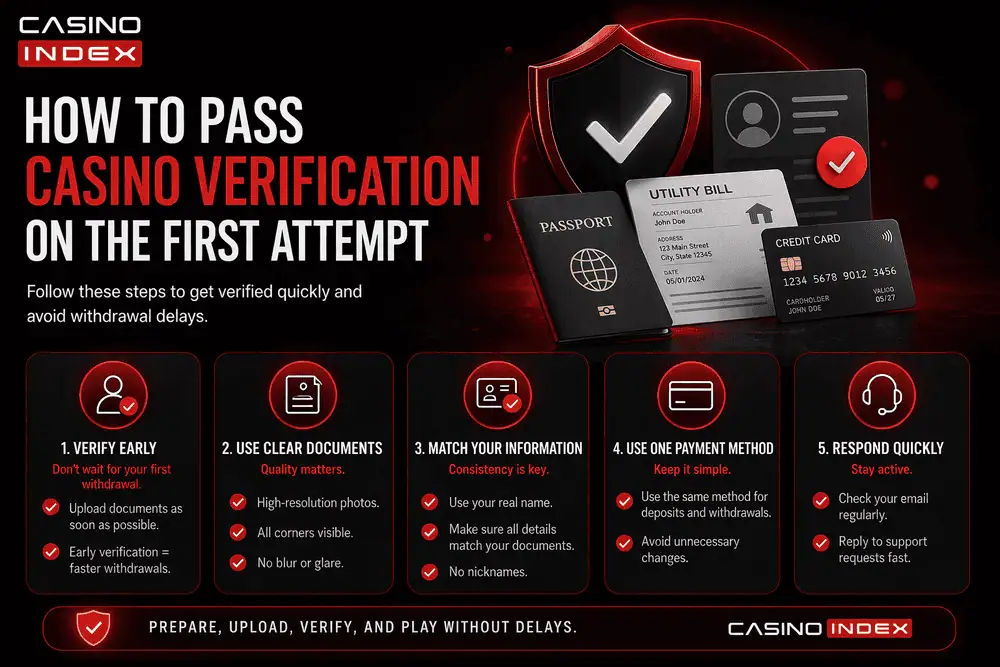
Most verification delays are preventable. Players who understand what compliance teams look for can usually pass verification on the first submission.
Verification success depends on three factors:
Document clarity
Information consistency
Preparation timing
The simplest professional approach is:
Prepare verification before large deposits.
This removes pressure during withdrawals.
Document Quality Rules Casinos Expect
Compliance teams review thousands of documents daily. They follow strict rejection criteria.
Documents usually get rejected if:
Image is blurry
Corners are cut off
Text is unreadable
Reflections hide details
Information is edited
To avoid rejection:
Use natural lighting
Place document on flat surface
Use high resolution camera
Capture full document
Avoid filters
Professional tip:
Take photos during daylight instead of artificial light.
This improves acceptance rates significantly.
Name Matching Rules Players Often Miss
Casino accounts must match identification exactly.
Common problems include:
Missing middle name
Different spelling
Using shortened names
Using partner payment accounts
Correct example:
ID name:
Michael Jonathan Smith
Casino account:
Michael Jonathan Smith
Incorrect example:
Mike Smith
M.J. Smith
Michael Smith
Consistency is critical.
Address Verification Mistakes to Avoid
Address documents must match account details.
Common rejection reasons:
Old address
Incomplete address
PO box mismatch
Missing postal code
Professional setup rule:
Make sure account address matches document format exactly.
Even small differences can cause review delays.
When Casinos Can Legally Refuse Verification
Casinos can refuse verification when:
Documents are fake
Identity cannot be confirmed
Payment ownership unclear
Regulatory rules violated
Terms and conditions breached
This usually happens when:
Multiple accounts exist
Bonus abuse detected
False personal data used
This is why reading casino rules explained in the Casino Bonus Guide is important before claiming promotions.
Player Rights During Verification
Players also have rights during verification.
These include:
Right to clear requirements
Right to reasonable review time
Right to explanation of rejection
Right to data protection
Licensed casinos must communicate verification requirements clearly.
Unregulated casinos may not.
This is why licensing matters.
Casino Verification Myths That Cause Confusion
Many players misunderstand verification.
These myths create unnecessary fear.
Myth: Casinos verify to avoid paying players
Reality:
Verification is legally required.
Casinos risk license loss if they skip verification.
Myth: Crypto casinos never require KYC
Reality:
Most crypto casinos still verify large withdrawals.
Myth: Verification only happens if you win
Reality:
Verification often triggers at first withdrawal regardless of result.
Myth: Verification means something is wrong
Reality:
Verification is standard procedure.
Understanding these realities prevents frustration.
Common Verification Problems and How to Solve Them
Even legitimate players sometimes experience verification problems. Most issues have simple solutions.
Problem: Document rejected for quality issues
Cause:
Blurry image
Cut edges
Low resolution
Solution:
Retake photo with good lighting
Use original camera instead of screenshots
Ensure full document visibility
Problem: Name mismatch
Cause:
Different spelling
Missing middle name
Nickname use
Solution:
Update casino profile to match ID exactly.
Problem: Address verification rejected
Cause:
Old document
Wrong address format
Missing postal code
Solution:
Use recent utility bill or bank statement matching account details.
Problem: Payment verification failed
Cause:
Using someone else’s card
Using shared wallet
Different payment name
Solution:
Use only personal payment methods matching account name.
Problem: Verification taking too long
Cause:
Support backlog
Missing documents
Manual review triggered
Solution:
Contact support politely and confirm required documents.
Most verification problems come from small inconsistencies rather than serious issues. Careful preparation usually prevents them.
Verification and Responsible Gambling Connection
Verification also connects to responsible gambling policies.
Casinos may review accounts showing:
High spending patterns
Unusual activity
Financial risk behavior
This may trigger:
Affordability checks
Responsible gambling alerts
Deposit limits
This protects players and ensures regulatory compliance.
Responsible gambling practices are explained further in the Responsible Gambling Guide.
How Verification Affects Withdrawal Speed Long Term
After verification, most accounts experience faster withdrawals.
Benefits include:
Fewer delays
Faster processing
Higher trust level
Reduced review triggers
Experienced players treat verification as a long-term convenience rather than a barrier.
Advanced Verification Tips Used by Experienced Players
Players with experience follow simple preparation strategies.
Best practices include:
Verify account before large play
Use same payment method
Avoid account changes
Maintain consistent login location
Respond quickly to requests
These habits prevent most compliance friction.
The Professional Casino Verification Strategy
A complete verification strategy includes three stages.
Stage 1 — Before Playing
Create account with correct data
Verify email and phone
Upload ID early
Upload address proof
Stage 2 — During Play
Use one payment method
Avoid large sudden deposits
Avoid account changes
Stage 3 — Before Withdrawal
Confirm documents approved
Confirm payment method verified
Request withdrawal after verification
This approach removes almost all problems.
Casino Verification FAQ
Do all casinos require verification?
Licensed casinos must verify players. Unregulated platforms may delay it.
Can I withdraw without verification?
Usually no. Verification is required before withdrawals.
How long does verification normally take?
Most verification completes within 24–72 hours.
Why do casinos ask for documents again?
This usually happens after:
Large transactions
Account changes
Risk triggers
Can verification fail?
Yes, if documents are invalid or inconsistent.
Can I use someone else’s payment method?
No. Payment methods must belong to the account owner.
Do No KYC casinos skip verification?
Most only delay it. Large withdrawals usually still require checks.
Key Casino Verification Rules Every Player Should Remember
Casino verification becomes simple when following five basic rules:
Use real personal information
Verify early instead of waiting
Use one payment method
Submit clear documents
Avoid account inconsistencies
Following these removes most problems players experience.
How Casino Verification Improves Industry Safety
Verification exists because online gambling involves financial risk.
Without verification:
Fraud would increase
Account theft would increase
Payment abuse would increase
Underage gambling would increase
Verification improves safety for both casinos and players.
This is why strong casinos enforce it strictly.
Explore More Casino Safety Guides
If you want to understand casino safety deeper, you can also review:
How casinos protect players inside the Casino Security Guide
How withdrawal speed works in the Fast Withdrawal Casinos guide.
These guides expand how CasinoIndex evaluates safety and payment reliability.
Final Conclusion
Casino verification is not a barrier. It is part of the financial safety system behind regulated gambling.
Players who understand verification avoid nearly all withdrawal problems.
The difference between smooth withdrawals and delayed withdrawals usually comes down to preparation.
Players who:
Prepare documents
Use consistent information
Verify early
Follow payment rules
Rarely experience verification issues.
Casino verification therefore follows one simple principle:
Preparation removes friction.
When verification is handled correctly, online gambling becomes smoother, safer, and more predictable.