Casino Security Guide
Article OverviewCasino security covers the systems that protect player accounts, payments, game integrity and sensitive data. Strong signals include secure account access, protected payment systems, credible game testing and serious platform controls. However, HTTPS, 2FA or RNG testing do not automatically prove reliable withdrawals, fair terms or good complaint handling. Technical security is one important layer of casino trust, not a complete safety guarantee.

Online casino security is the set of technical and operational controls that protect accounts, payment data, game systems, personal information and the platform itself.
That is narrower than asking whether a casino is broadly “safe.” A casino can use HTTPS, offer two-factor authentication and run independently tested games while still having poor withdrawal rules, unfair terms or weak complaint handling. Technical security reduces specific risks. It does not prove that the operator will behave fairly in every money-related dispute.
This guide therefore focuses on four areas: Account Security, Payment Security, Game Integrity, and Operator/Platform Security. Players who are trying to decide whether a casino is worth trusting before a deposit should use CasinoIndex’s broader guide to how to evaluate a casino before depositing.
Casino security at a glance
| Security area | What it protects | Main player risk | What to look for |
|---|---|---|---|
| Account Security | Login access and account control | Account takeover, unauthorised changes or withdrawals | 2FA, secure recovery, session controls, useful alerts |
| Payment Security | Payment data and transaction handling | Payment misuse, ownership conflicts, unsafe payment flows | Clear payment routes, ownership checks, protected card handling, transaction records |
| Game Integrity | Game outcomes and software fairness | Unreliable RNG, incorrect game maths or unverified software | Recognised providers, regulatory testing where applicable, clear game/RTP information |
| Operator / Platform Security | Infrastructure, data and internal systems | Data exposure, service compromise, weak access controls | HTTPS/TLS, security governance, data controls, audited systems where applicable |
These layers overlap, but they answer different questions. Keeping them separate prevents a common mistake: treating one visible feature, such as a padlock icon, as proof that the entire casino is trustworthy.

What security proves — and what it does not prove
| Security signal | What it can show | What it does not prove |
|---|---|---|
| HTTPS / TLS | The connection between the browser and the site is encrypted when configured correctly | That withdrawals are reliable, terms are fair or the operator is honest |
| Two-factor authentication | An additional login barrier can reduce account-takeover risk | That the casino has fair KYC, payment or account-closure rules |
| Independent RNG or game testing | A tested game can meet defined technical fairness requirements | That the casino will approve withdrawals quickly or handle complaints well |
| Payment-security standards | Relevant payment data may be handled under defined technical controls | That winnings cannot be delayed, voided or disputed by the casino |
| Regulatory security audit | The operator may be required to demonstrate compliance with specific security controls | That every aspect of the casino, every term or every player outcome is safe |
This distinction should run through the entire security review. Security controls reduce defined technical or operational risks. They are not a substitute for withdrawal analysis, terms review, licensing analysis or complaint research.
1. Account Security: protecting control of the player account
Account security is the part players interact with most directly. If an attacker gains access to the account, the casino’s game library and payment speed become irrelevant. The first security objective is keeping an unauthorised person from taking control of the login, changing recovery details or attempting a withdrawal.
Two-factor authentication
Two-factor authentication adds another authentication step beyond the password. It is useful because a stolen password alone may no longer be sufficient to access the account.
However, not all second factors provide equal protection. Current NIST digital-identity guidance distinguishes stronger phishing-resistant authentication from methods based on manually entering one-time codes. The practical lesson for casino players is simple: enable the strongest authentication option the platform supports, but do not treat the presence of “2FA” as proof that every other security control is strong.
Useful account controls can include:
- two-factor or multi-factor authentication
- login or new-device alerts
- session management and the ability to revoke sessions
- secure password-reset procedures
- confirmation for sensitive account changes
- withdrawal or address-change confirmations
- rate limiting or controls against repeated login attempts
A player may not be able to inspect the casino’s backend protections. The visible question is whether the account offers meaningful controls and whether recovery is designed to verify the real account owner rather than simply whoever has temporary access to an email inbox.
Account recovery is part of security
Password reset and account recovery are often weaker than the normal login flow. A casino can have strong 2FA but still create risk if support can remove it too easily after a basic chat request.
Players should therefore look at what happens when an email address changes, a phone is lost or 2FA must be reset. Strong recovery should require enough evidence to protect the account without turning every legitimate recovery into an endless verification dispute.
KYC can become part of that process, but identity verification deserves its own treatment. CasinoIndex explains how casino verification works and when documents may be requested.
Session security matters after login
Logging in securely is only the first part of account protection. Once the casino creates an authenticated session, that session becomes valuable because it tells the platform that the user has already proved access to the account.
OWASP’s current session-management guidance treats the session token as a sensitive security object and recommends controls such as secure session handling, invalidation after logout, renewal after important authentication changes and reauthentication after higher-risk events.
Players cannot inspect the casino’s session architecture directly, but they can look for useful visible controls:
- the ability to log out other devices or sessions
- reauthentication before changing a password, email address or other sensitive profile details
- extra confirmation before changing withdrawal destinations
- alerts after suspicious or new-device logins
- sessions that do not remain active indefinitely without another check
This matters because account takeover does not always require an attacker to know the password again. A stolen or hijacked authenticated session can also create risk if the platform does not manage sessions correctly.
The strongest casinos therefore protect both authentication and what happens after authentication. A good 2FA screen is useful, but it should not be undermined by weak session handling or easy changes to recovery settings.
Phishing and casino impersonation are account-security problems
Some of the most damaging casino security incidents begin outside the casino platform itself.
A fake login page, copied support account or malicious message can persuade a player to hand over credentials even when the real casino has strong infrastructure. This is why phishing resistance belongs inside Account Security rather than inside a generic scam checklist.
NIST’s current authentication guidance distinguishes phishing-resistant cryptographic authentication from methods that rely on manually entering a one-time code. A normal OTP can still add useful protection, but a player can be tricked into entering that code on an impostor page. That is one reason the authentication method alone should never replace basic domain checks.
Useful player habits include:
- open the casino from a saved or independently verified domain rather than an unexpected message
- check the domain before entering a password or 2FA code
- treat unsolicited Telegram, Discord or social-media support messages as unverified until confirmed through the casino’s own site
- never share a password-reset code, seed phrase or private key with support
- do not approve a wallet signature or login prompt unless you understand what initiated it
A technically strong operator should also reduce the impact of phishing by protecting account recovery, monitoring unusual sessions and requiring stronger confirmation for sensitive changes.
This section is about credential and account compromise. Whether the casino itself is deceptive is a separate question for the scam and operator-trust guides.
2. Payment Security: protecting the payment route
Payment security is often confused with withdrawal reliability. They are related, but they are not the same.
Payment security asks whether deposits, card data, bank information, crypto addresses and transaction records are handled through protected systems. Withdrawal reliability asks whether the operator approves legitimate cashouts predictably and applies its rules fairly.
A technically secure payment page can still sit inside a casino with poor withdrawal behaviour.
Card and fiat-payment security
For card environments, the PCI Data Security Standard provides baseline technical and operational requirements for organisations that store, process or transmit payment-card data. That can include access controls, cryptography and other protections around the cardholder-data environment.
PCI-related controls matter for payment-data protection. They do not certify casino fairness, payout speed or bonus terms.
Players should also avoid assuming that the casino directly handles every card detail. Payment processing may involve third-party processors, acquirers and other providers. That can reduce the amount of sensitive data the casino itself handles, but it also creates a chain of systems that needs to be secured.
Crypto-payment security
Crypto removes some traditional payment intermediaries but creates different risks.
Important controls include:
- clear display of the supported coin and network
- correct deposit-address generation
- clear warning around irreversible transfers
- transaction history and TXID visibility
- withdrawal-address confirmation where supported
- controls around wallet or payment ownership
The blockchain confirming a transaction does not prove that the casino has approved a withdrawal. Network settlement and casino approval remain separate stages.
Payment matching is a security control, not proof of payout quality
Casinos may compare the account holder with the payment source or withdrawal destination. The purpose can include fraud prevention, third-party-payment controls and compliance checks.
This becomes especially important when a player deposits through one route and later tries to withdraw through an unrelated method or wallet. CasinoIndex explains how payment matching can affect deposits and withdrawals.
A matching rule can be legitimate. What it does not prove is that the casino will apply the rule clearly or proportionately in every case. That judgment belongs to withdrawal and dispute analysis rather than technical security alone.
3. Game Integrity: what RNG and software testing can establish
Game integrity is the security layer most likely to be oversimplified.
A provider logo is not proof that every game instance is fair. An RTP number is not proof that withdrawals are safe. And “RNG certified” should not be accepted as a meaningful claim unless there is a real testing or regulatory framework behind it.
RNG requirements under regulated frameworks
Regulatory requirements vary by jurisdiction. As one clear example, the UK Gambling Commission’s Remote Gambling and Software Technical Standards require random outcomes to be acceptably random and prohibit adaptive behaviour that changes game probabilities during play. Its testing strategy also sets circumstances in which independent approved test houses must test RNG-driven products before release.
That is a much stronger statement than saying that “well-known providers use certified RNGs.” The useful question is:
Which testing requirement applies to this operator, game or software supplier, and can the claim be traced to a regulator or recognised test process?
Under the UK testing process, RNG testing can include review of the RNG implementation, source code, statistical output and game maths. Game testing can also verify theoretical RTP and whether the implemented game behaves according to its design.
Game integrity does not equal operator integrity
A technically fair slot can be hosted by an operator with weak withdrawals. A live-dealer game can be operated correctly while the casino applies poor account rules. Conversely, a withdrawal dispute does not automatically show that the RNG was manipulated.
Keep the layers separate:
- Game integrity: did the game produce results under the expected rules?
- Casino trust: did the operator handle balances, withdrawals and disputes fairly?
For crypto-native games, players may also see provably fair systems. Those systems can let a player verify aspects of outcome generation, but they still do not prove operator solvency, good KYC or reliable cashouts. CasinoIndex covers that distinction in the provably fair casino guide.
4. Operator and Platform Security: the systems players cannot fully see
Platform security covers the underlying infrastructure that keeps the casino online, protects information and controls access to internal systems.
Some controls are visible from the outside. Many are not.
Possible platform-security measures include:
- TLS-protected web traffic
- segmented access to sensitive systems
- security logging and monitoring
- vulnerability and patch management
- backup and recovery procedures
- controls around administrator privileges
- incident-response procedures
- protection against denial-of-service and automated attacks
- security reviews or external audits where required
Players should be careful with claims such as “military-grade encryption,” “bank-level security” or “advanced AI protection” when the casino provides no useful evidence. Marketing language is not a technical standard.
HTTPS matters, but the padlock is not a trust badge
HTTPS is a basic requirement for a site handling logins, personal data or payments. Modern HTTPS uses TLS to protect data in transit between the browser and the server.
That matters because credentials or payment information should not travel openly across the network.
However, HTTPS answers a limited question: is the connection to this domain encrypted?
It does not answer:
- whether the operator is honest
- whether the license is valid
- whether winnings will be paid
- whether bonus rules are fair
- whether complaint handling is effective
- whether the casino’s internal systems are well managed
Fraudulent websites can also use valid TLS certificates. Treat encryption as necessary infrastructure, not as proof of trustworthiness.
Security audits can provide stronger evidence
Some regulatory frameworks require more than a visible certificate. For example, the UK Gambling Commission’s current remote-gambling security requirements are based on relevant sections of ISO/IEC 27001:2022, and its testing strategy requires a third-party annual security audit against the applicable security requirements.
That gives players a more meaningful security signal than a homepage claim such as “secure platform.” It still needs context. An audit covers a defined scope and standard; it does not guarantee every withdrawal decision, bonus term or support outcome.
Data protection belongs inside platform security
Online casinos may process highly sensitive information: identity documents, addresses, payment records, login history, device data and, in some cases, source-of-funds evidence.
The security question is not simply whether the privacy policy exists. It is whether the platform appears to collect data for a defined purpose, protect access to it and avoid unnecessary exposure.
Players cannot inspect the casino’s databases, but they can still look for operational clues:
- documents are uploaded through an authenticated account area rather than casual email where possible
- the casino explains why documents are requested
- sensitive recovery details are not requested in open chat
- support never asks for wallet seed phrases or private keys
- privacy information identifies the relevant operator and data-handling framework
- account access is protected before identity documents become available
A platform can have strong data security and still run an aggressive KYC policy. Those are different questions. Data protection concerns how information is protected; verification fairness concerns when and why the casino asks for it.
Incident response: what should happen after a security event?
Security is not only about preventing incidents. It is also about how the operator responds when prevention fails.
A credible incident-response process should move from detection to containment, investigation and recovery. The exact internal process will not be public, but player-facing behaviour can still reveal whether the casino has a structured response.
After a suspected account compromise, a strong process may involve:
- temporarily restricting sensitive account actions
- invalidating active sessions
- forcing password or authentication resets where appropriate
- requiring fresh verification before changing withdrawal details
- preserving login and transaction records for investigation
- explaining which actions the player needs to take
- communicating material security information to affected users when required
The operator should not confuse containment with punishment. Temporarily stopping a withdrawal after credible account-takeover signals can protect the real owner. The quality question is whether the casino can explain the security reason, identify the next step and restore normal access or reach a documented decision once the risk is resolved.
Incident response also shows why technical security and complaint handling should remain separate. A security team may contain the event correctly while support communicates poorly. That is a service-quality problem layered on top of the original security issue, not proof that the technical response itself was wrong.
Hot wallets, cold wallets and casino treasury claims
Crypto casinos sometimes describe hot-wallet and cold-wallet systems as proof of security.
The basic distinction is useful. Hot wallets remain connected to online systems so they can support routine transactions. Cold-storage arrangements keep keys or signing capability away from continuously exposed online infrastructure.
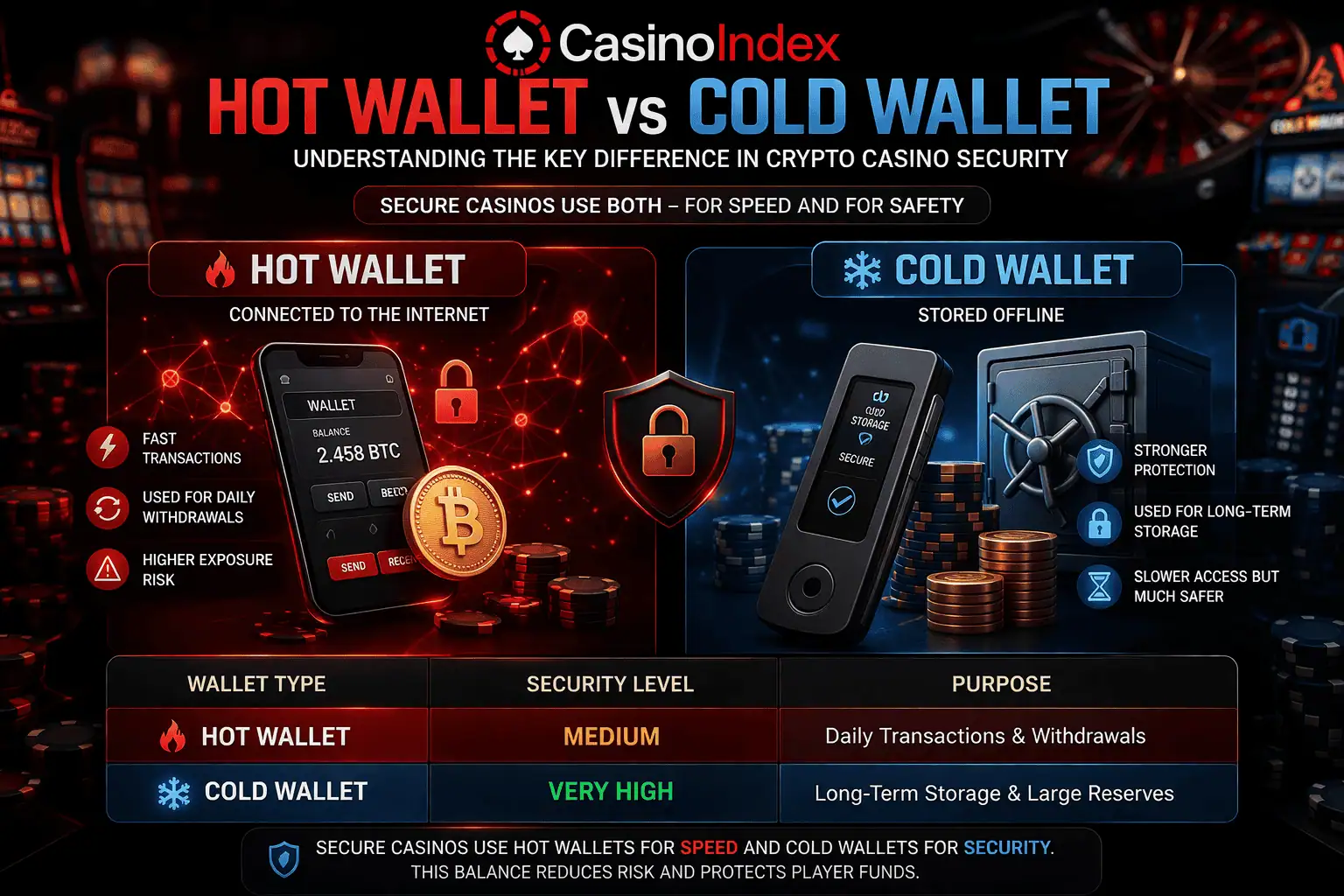
What should be removed is the simplistic idea that “hot wallet = medium security” and “cold wallet = very high security.” Real security depends on implementation, key management, access controls, signing policies, operational procedures and recovery design.
Players also rarely have enough information to verify a casino’s full treasury architecture. A claim that “most funds are in cold storage” should therefore be treated as an operator statement unless independent evidence supports it.
Cold storage can reduce certain online key-exposure risks. It does not prove that the casino has enough reserves, will approve withdrawals promptly or applies fair terms.
Fraud detection and automated security controls
Online casinos use automated controls to detect activity that may indicate account takeover, payment fraud, multi-accounting or other abuse. The exact systems are usually private, and casinos should not be expected to publish every fraud rule.
Signals may include:
- unusual login locations or device changes
- repeated failed login attempts
- payment details that do not fit the account
- rapid account changes followed by withdrawal attempts
- linked-account patterns
- unusual transaction or bonus activity
Do not label all such systems “AI fraud detection” unless the operator actually documents the technology. “Automated risk controls” is usually more accurate.
These systems can protect legitimate accounts, but they can also create false positives. Whether the casino handles a false positive fairly is no longer a pure technical-security question. It becomes an account-review, KYC and dispute-handling question.
Licensing and security are connected, but they are not the same topic
Licensing can create enforceable technical requirements, audit duties and testing standards. That makes regulation relevant to security.
However, this guide should not turn into a licensing comparison.
The security question is:
What technical or operational controls does the applicable framework require?
The regulatory question is broader:
Who licensed the operator, what consumer protections apply, and what recourse exists when something goes wrong?
For that second question, use CasinoIndex’s casino licensing guide and regulator comparison.
Technical security does not prove good withdrawals
This is the most important boundary in the article.
A casino can be technically secure and still be a poor place to hold a large balance.
For example, the operator may:
- protect logins well but impose unclear withdrawal limits
- use encrypted payment pages but delay payout approval
- offer independently tested games but enforce aggressive bonus terms
- have strong infrastructure but communicate badly during KYC
- pass a security audit but still receive legitimate complaints about operational decisions
None of those situations makes the security controls meaningless. It shows why security must be evaluated as one layer of trust rather than as a complete trust verdict.
The same principle works in reverse. A slow withdrawal does not automatically mean a data breach, compromised RNG or weak encryption. Diagnose the correct layer before making a claim.
Security evidence has different levels of strength
Casino security claims become more useful when the evidence behind them becomes harder for the operator to invent or selectively present.
| Evidence level | Example | How much weight to give it |
|---|---|---|
| Marketing claim | “Bank-grade security” or “advanced protection” | Very little without supporting detail |
| Visible control | 2FA, secure account recovery, protected payment page | Useful for the specific control you can observe |
| Published technical policy | Documented security, payment or privacy process | More useful, but still largely operator-supplied |
| Regulatory requirement | A regulator requires defined technical controls or testing | Strong evidence that a standard applies to the licensed scope |
| Independent test or audit | Qualified third-party testing against a known standard | Strongest when the scope, date and standard are clear |
This hierarchy prevents two opposite mistakes.
The first is giving too much weight to a visible badge. The second is demanding public proof of every internal control when a regulator or qualified auditor is the party designed to inspect it.
A serious review should therefore ask three questions: What is the claim? Who verified it? What exactly was within scope?
Even strong external evidence has limits. An independent RNG test speaks to the tested game implementation. A security audit speaks to the controls and systems within its defined scope. Neither becomes a blanket guarantee for every future payment, term or support decision.
What players can realistically verify themselves
Players cannot perform a penetration test or audit a casino’s source code. A useful security guide should therefore separate observable checks from controls that require independent assurance.
| Player can check directly | Usually needs external evidence |
|---|---|
| HTTPS is active on login and payment pages | Server hardening and network segmentation |
| 2FA and recovery controls are available | Internal administrator-access controls |
| Payment history and transaction information are visible | Payment-system security architecture |
| Game provider and game information are disclosed | RNG/source-code testing |
| License and regulator claims can be checked | Security-audit scope and internal findings |
| Privacy and document-upload processes are visible | Database encryption and internal data-access policies |
A professional review should not pretend to have verified invisible controls without evidence. If a casino does not publish enough information, the correct conclusion is “not independently confirmed,” not “secure by default.”
Player-side security: what the casino cannot do for you
Platform security only works if the player also protects the account.
Good personal-security habits include:
- use a unique password for the casino account
- enable the strongest 2FA option available
- secure the email account used for recovery
- avoid logging in through links from unexpected messages
- check the domain before entering credentials
- review active sessions after suspicious activity
- protect crypto seed phrases and private keys offline
- confirm wallet addresses and networks before crypto transfers
- keep transaction and important account-change records
One rule deserves emphasis: casino support should never need a wallet seed phrase or private key. Anyone with those credentials can control the wallet.
Security warning signs that belong on this page
The broader scam guide covers deceptive operators and scam patterns. This page should only flag warning signs that directly relate to security controls.
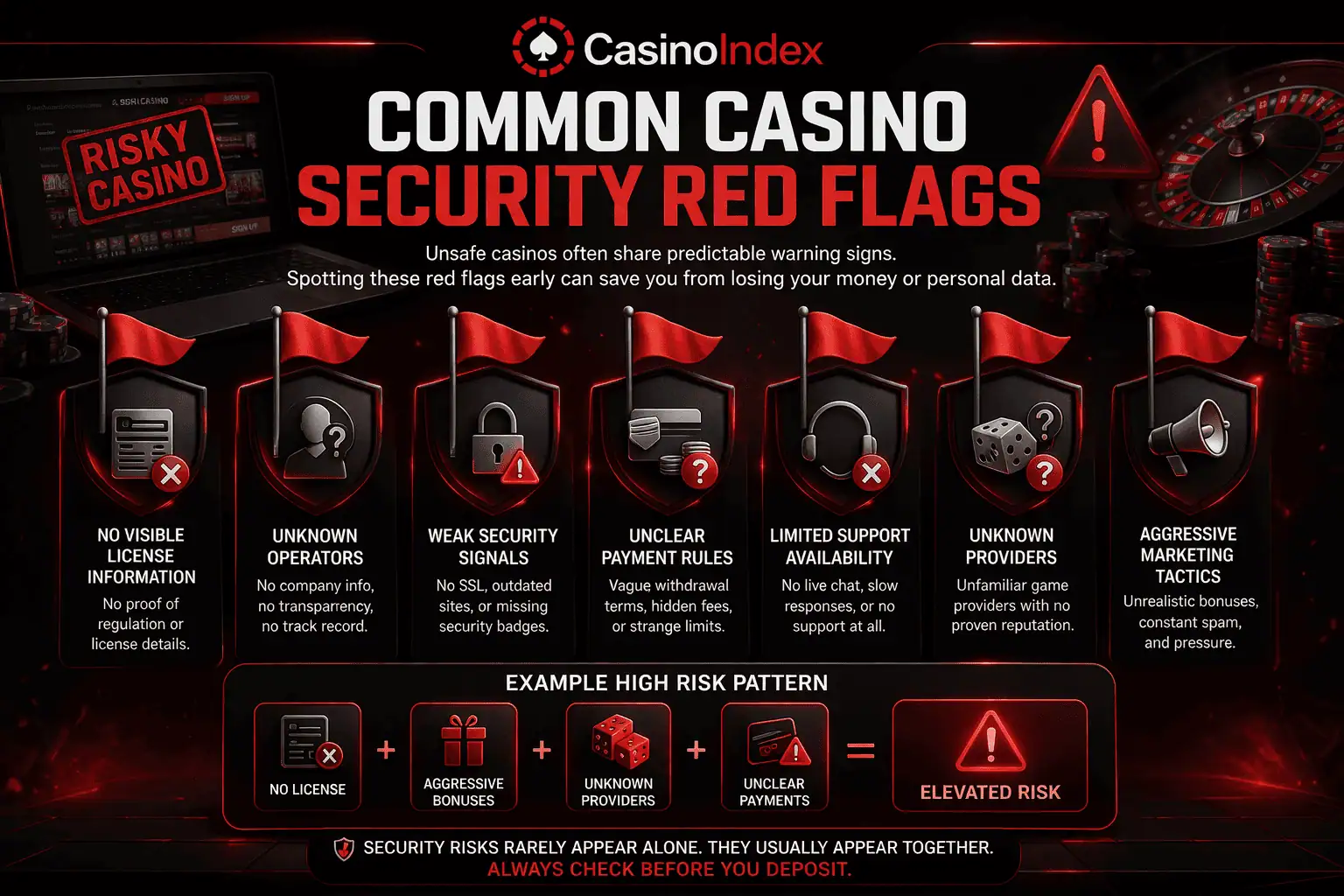
Relevant security warning signs include:
- login or payment pages that are not protected by HTTPS
- no meaningful account-recovery protection
- support willing to disable security controls without adequate verification
- payment pages that request sensitive information through unusual channels
- claims of RNG certification with no identifiable testing or regulatory basis
- unsupported “bank-grade,” “military-grade” or “AI security” marketing claims
- requests for crypto seed phrases or private keys
- provider or game information that cannot be reconciled with the actual software shown
Those are security-specific signals. Aggressive bonuses, weak complaint history, unverifiable ownership and suspicious licensing may still be serious concerns, but they belong primarily to the Safe Casino, Licensing or Scam clusters.
Casino security checklist
| Area | Question | Strong evidence | Do not over-interpret |
|---|---|---|---|
| Account | Can the player protect and recover access safely? | 2FA, session control, protected recovery | 2FA does not prove payout fairness |
| Payment | Are payment data and routes handled clearly? | Protected payment flow, records, ownership controls | Secure processing does not guarantee approval |
| Games | Is there credible fairness evidence? | Applicable testing, disclosed provider, traceable standards | Fair RNG does not prove operator trust |
| Platform | Is there evidence of security governance? | Relevant regulatory requirements, audits, protected systems | Audit scope is not a blanket guarantee |
| Data | Are sensitive documents handled responsibly? | Secure upload, clear purpose, protected account access | A privacy policy alone proves little |
Technical standards and sources used for this update
This guide uses technical standards as examples of what verifiable security evidence looks like rather than treating marketing claims as proof.
- UK Gambling Commission — Remote gambling security requirements: current security requirements are based on relevant sections of ISO/IEC 27001:2022.
- UK Gambling Commission — RTS 7, generation of random outcomes: defines requirements around acceptable randomness for applicable remote products.
- UK Gambling Commission — testing procedure: explains approved test-house processes for RNG and game testing.
- NIST Digital Identity Guidelines — authenticators: current guidance on authenticator strength and phishing resistance.
- PCI Security Standards Council — PCI DSS: baseline technical and operational requirements for payment-card account data.
- OWASP — Session Management Cheat Sheet: practical guidance on session lifecycle, reauthentication, session invalidation and session-hijacking risk.
These sources describe specific technical or regulatory controls. They should not be read as endorsements of any particular casino.
Final assessment: security is one layer of casino trust
A strong casino-security review should answer four separate questions:
- Can the player protect access to the account?
- Are payment data and transaction routes handled through appropriate controls?
- Is there credible evidence that game software behaves fairly?
- Does the operator have a serious platform-security framework rather than visible marketing features alone?
Those questions are important, but they are not the whole casino decision.
HTTPS does not prove reliable withdrawals. A tested RNG does not prove fair terms. Payment security does not prove that a disputed withdrawal will be approved. A security audit does not prove strong complaint handling.
The correct conclusion is narrower and more useful: technical and operational security show how well specific systems are protected. Trust still has to be judged separately through withdrawals, terms, licensing, reputation and real operator behaviour.
FAQ: online casino security
Does HTTPS mean an online casino is safe?
No. HTTPS protects the connection between the browser and the website when configured correctly. It does not prove that the casino has fair terms, reliable withdrawals, a valid license or good complaint handling.
What is the most important casino account-security feature?
No single feature is enough. A strong account setup combines a unique password, additional authentication, protected account recovery, session controls and confirmation for sensitive changes.
Does two-factor authentication make a casino trustworthy?
No. 2FA can reduce account-takeover risk, but it says little about payout behaviour, bonus terms, licensing quality or how the operator handles disputes.
How can players tell whether casino games are fair?
Look for traceable provider information, applicable regulatory requirements and credible testing evidence. In regulated frameworks such as the UK, RNG-driven products can be subject to defined technical standards and independent testing requirements.
Does a well-known game provider guarantee casino safety?
No. Provider quality and game integrity are separate from operator behaviour. A legitimate game can still be offered by a casino with poor withdrawals or unfair account rules.
What does payment security prove?
Payment security can show that payment data and transaction systems use defined protections. It does not prove that the casino will approve every withdrawal or settle every dispute fairly.
Are crypto casinos technically safer than fiat casinos?
Not automatically. Crypto changes the payment risk model. It can reduce reliance on traditional payment intermediaries but introduces irreversible-transfer, wallet and network risks. The operator’s internal controls still matter.
Are cold wallets always safer than hot wallets?
Cold-storage designs can reduce some online key-exposure risks, but security depends on implementation, key management, access controls and recovery procedures. A simple hot-versus-cold label is not enough to rate a casino.
Can a security audit prove that a casino will pay withdrawals?
No. A security audit assesses defined technical or organisational controls within its scope. Withdrawal approval, terms enforcement and complaint handling are separate operational questions.
What security checks can a player perform personally?
Players can check HTTPS, account-security options, recovery controls, payment information, provider disclosures, privacy processes and verifiable regulatory claims. Internal server, source-code and security-audit controls usually require independent evidence.

Maria Hoffmann has worked in cryptocurrency content and digital publishing since 2017. She is a co-founder of Freecoins24 and CryptoMutant and has covered blockchain projects, crypto platforms and emerging industry trends for several years. She has also been active as a cryptocurrency investor since 2019. At CasinoIndex, Maria combines content research and SEO experience with a focus on casino trust, platform security, withdrawal processes, payment risks and user protection. Her work looks beyond bonuses and product features to examine how gambling platforms handle player funds, verification and account-related risks.