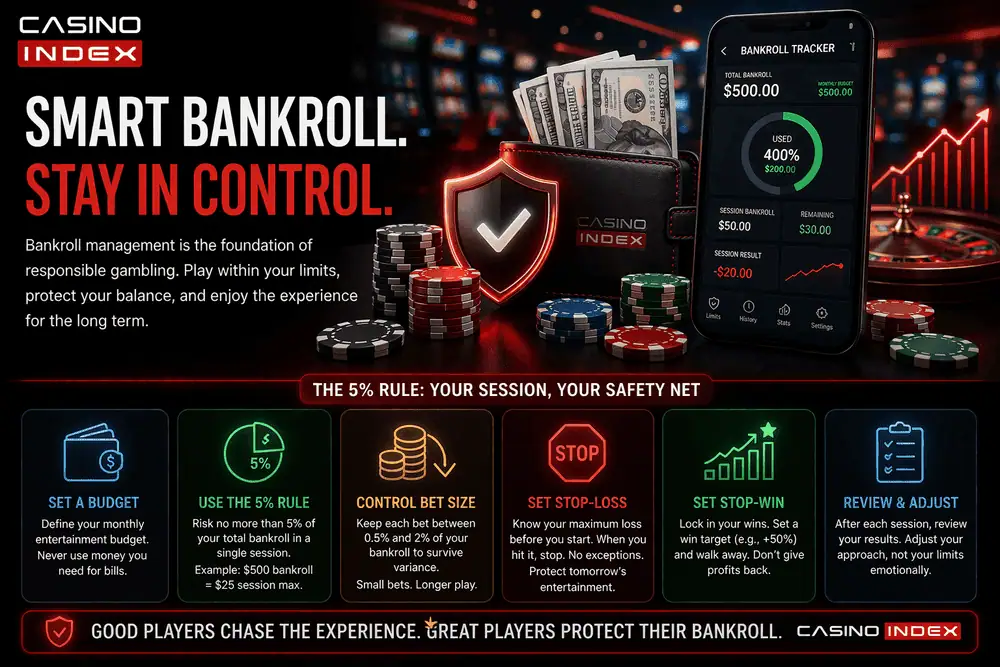


Responsible Gambling Guide 2026

Responsible Gambling Guide 2026: How to Stay in Control When Playing Online Casinos
Responsible gambling is not just a regulatory requirement. It is one of the most important factors separating safe casino entertainment from risky financial behavior. While online casinos are designed to provide entertainment, they also operate on mathematical systems that guarantee a long-term house advantage. Understanding this reality is the foundation of responsible gambling.
This guide explains how responsible gambling works, how casinos implement player protection tools, and how players can build their own control systems before problems ever develop. Unlike many simplified explanations, responsible gambling is not only about “playing less.” It is about understanding risk, managing expectations, and building personal limits before emotions become involved.
Modern regulated casinos must follow strict player protection rules. Licensing authorities require operators to offer tools such as deposit limits, reality checks, self-exclusion programs, and behavioral monitoring systems. These are not marketing features. They are safety mechanisms designed to reduce financial harm and promote sustainable play.
If you want to understand how regulators enforce player protection, review the casino licensing overview. It breaks down how licensed operators are required to apply responsible gambling rules, intervention systems, and compliance standards.
At the same time, responsible gambling is not only the casino’s responsibility. The most effective protection always comes from the player’s own preparation. This includes setting financial boundaries, understanding volatility, avoiding emotional decision making, and treating gambling as a controlled entertainment expense rather than an income opportunity.
This guide covers:
• What responsible gambling really means
• Early warning signs of problem gambling
• Practical methods to control risk
• Casino protection tools explained
• Financial management strategies
• Self-exclusion systems
• Help resources and support organizations
By the end of this guide you will understand how to approach online casinos with a professional risk-management mindset instead of relying on luck or impulse decisions.
What Responsible Gambling Actually Means
Responsible gambling means maintaining full control over three key areas:
• Time
• Money
• Emotional decisions
If any of these become uncontrolled, gambling stops being entertainment and starts becoming risk exposure.
Professional casino analysts define responsible gambling through three core principles:
Gambling Should Always Be Entertainment
Gambling should never be treated as:
• Income source
• Investment strategy
• Debt recovery method
• Emotional escape
Casinos operate on statistical advantage. Every regulated casino publishes RTP values showing expected return over millions of rounds. Even high RTP games still maintain a house edge.
You can learn how these payout mechanics work in the RTP breakdown, which explains why short-term wins never change long-term probabilities.
Responsible players accept:
Winning is possible. Long-term profit is not guaranteed.
This mindset removes the biggest psychological trap: chasing losses.
Responsible Gambling Means Accepting Losses Before You Start
One of the most important mental rules used by experienced players is:
Never gamble money you are not prepared to lose completely.
This rule sounds simple, but it eliminates most harmful behavior patterns.
Responsible players define a gambling budget the same way they would define spending for:
• Movies
• Restaurants
• Gaming subscriptions
• Travel
It becomes a controlled entertainment cost.
Irresponsible behavior starts when gambling money comes from:
• Rent funds
• Bills
• Loans
• Credit cards
• Emergency savings
Financial separation is one of the strongest protective behaviors.
Responsible Gambling Means Maintaining Decision Clarity
Loss of control rarely starts with money. It usually starts with decision fatigue.
Signs include:
• Playing longer than planned
• Increasing bet size emotionally
• Ignoring limits
• Trying to recover losses quickly
Responsible gambling requires stopping before emotional thinking replaces logical thinking.
Professional risk management thinking applies one simple rule:
When emotions increase, control decreases.
That is why experienced players use fixed systems instead of improvisation.
Why Responsible Gambling Matters More Than Ever in 2026

Online gambling accessibility has increased dramatically in recent years. Mobile platforms, crypto payments, and instant access make it easier than ever to start playing within minutes.
While this improves convenience, it also increases the importance of personal discipline.
Modern risk factors include:
- 24/7 accessibility
- Instant deposits
- Fast crypto transfers
- High volatility games
- Continuous bonus exposure
Because access is frictionless, control must be intentional.
That is why modern regulators require operators to implement active protection systems. These systems monitor behavioral patterns such as:
- Sudden deposit increases
- Long uninterrupted sessions
- Repeated failed withdrawals
- Aggressive loss-chasing behavior
Casinos operating under strict licenses must intervene when these signals appear. This is part of the platform trust analysis and the account safety structure, where real protection standards and intervention mechanisms are evaluated.
Responsible gambling operates on two layers:
- Casino protection systems
- Player self-control systems
The strongest protection exists when both layers work together consistently.
Early Warning Signs of Problem Gambling
Problem gambling does not start suddenly. It develops gradually through behavioral changes.
Recognizing early signs is critical because early intervention is much easier than recovery after major losses.
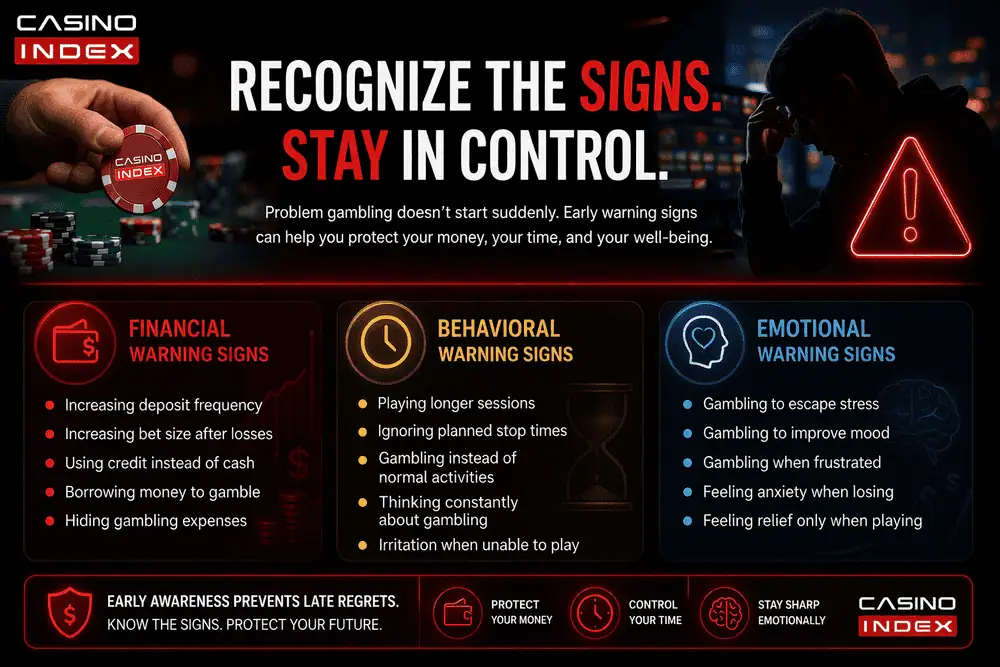
Financial Warning Signs
Financial risk indicators often appear first:
• Increasing deposit frequency
• Increasing bet size after losses
• Using credit instead of cash
• Borrowing money to gamble
• Hiding gambling expenses
A critical red flag is:
Depositing more after losses instead of stopping.
This behavior is called loss chasing. It is one of the strongest predictors of financial harm.
Behavioral Warning Signs
Behavioral changes often include:
• Playing longer sessions
• Ignoring planned stop times
• Gambling instead of normal activities
• Thinking constantly about gambling
• Irritation when unable to play
Another major sign is abandoning normal routines.
Examples include:
• Skipping sleep
• Missing responsibilities
• Reduced productivity
• Social withdrawal
These changes show gambling shifting from entertainment to priority behavior.
Emotional Warning Signs
Emotional indicators are often overlooked but extremely important.
These include:
• Gambling to escape stress
• Gambling to improve mood
• Gambling when frustrated
• Feeling anxiety when losing
• Feeling relief only when playing
Healthy gambling should not regulate emotional state.
If gambling becomes emotional regulation, risk increases significantly.
The Psychology Behind Loss Chasing
Loss chasing is the most dangerous behavioral pattern in gambling.
It happens when a player increases bets trying to recover previous losses instead of accepting them.
This behavior is driven by cognitive bias rather than logic.
The most common biases include:
The Gambler’s Fallacy
This is the belief that previous outcomes influence future results.
Example thinking:
“I lost five times, so a win must come soon.”
This is mathematically incorrect.
Casino games operate on independent probability events. Previous results do not change future outcomes.
The Sunk Cost Fallacy
This is the belief that money already lost must be recovered.
Example thinking:
“I already lost $500, I cannot stop now.”
Responsible thinking replaces this with:
“The $500 is already gone. Continuing increases risk.”
Emotional Escalation
After losses, stress increases. Stress reduces rational thinking.
This often causes:
• Larger bets
• Faster decisions
• Ignoring limits
Responsible players counter this with strict stop rules instead of emotional reactions.
Building a Personal Responsible Gambling System
Casinos provide tools. Professional players build systems.
The strongest responsible gambling strategy is creating a personal framework before playing.
This system includes:
Fixed Budget Rules
Define:
Monthly gambling budget
Session budget
Maximum loss limit
Example structure:
Monthly budget: $200
Session budget: $50
Stop loss: $50
When the session budget is gone, play stops.
No exceptions.
Time Control Rules
Time limits prevent fatigue decisions.
Example:
Maximum session length: 90 minutes
Break every 30 minutes
Fatigue reduces decision quality. Structured breaks maintain control.
Win Limits (Often Ignored)
Responsible gambling also includes stopping after wins.
Example:
Session win target: +50%
If session bankroll grows from $50 to $75:
Stop.
Many players only use stop-loss rules. Professional control also includes stop-win rules.
This prevents giving winnings back through extended play.
The Reality of Casino Mathematics
Understanding math removes unrealistic expectations.
All casino games are based on:
House edge
Variance
Probability distribution
House edge guarantees long-term casino profitability.
Variance explains short-term results.
High volatility games can produce large wins but also long losing periods.
Low volatility games produce smaller swings but more stable results.
Understanding these differences helps responsible bankroll planning.
For a deeper breakdown of these mechanics, review the RTP explanation and the game payout structure guide. Those sections explain how variance, return-to-player models, and session volatility affect real bankroll expectations.
Casino Responsible Gambling Tools Explained (How Player Protection Systems Work)

Modern regulated online casinos are required to provide responsible gambling tools. These tools are not optional features. They exist because licensing authorities require operators to actively reduce gambling harm and monitor risky behavior patterns.
Understanding these tools is important because many players either ignore them or misunderstand how they work. Professional players treat these systems as part of their risk management strategy, not as restrictions.
The most important responsible gambling tools include:
• Deposit limits
• Loss limits
• Session time limits
• Reality checks
• Cooling-off periods
• Self-exclusion systems
• Behavioral monitoring alerts
Used correctly, these tools can completely eliminate the most common loss-of-control scenarios.
Deposit Limits (The Most Important Protection Tool)
Deposit limits are the strongest first line of protection because they prevent financial damage before it happens.
A deposit limit allows you to define the maximum amount you can deposit within a specific time period.
Most casinos allow limits such as:
• Daily limits
• Weekly limits
• Monthly limits
Example:
Daily deposit limit: $50
Weekly deposit limit: $200
Monthly deposit limit: $500
Once the limit is reached, further deposits are blocked automatically.
Why Deposit Limits Work Better Than Loss Limits
Loss limits depend on behavior after money is already deposited.
Deposit limits stop risk at the source.
This is why regulators consider deposit limits the most effective prevention tool.
Responsible players typically set limits slightly below their planned budget to prevent emotional increases.
Example:
Real monthly budget: $300
Set deposit limit: $250
This creates a safety buffer.
Important Rule About Increasing Limits
Most licensed casinos apply delay periods for increasing limits.
Typical rules:
Limit decreases → immediate
Limit increases → delay (24–72 hours)
This prevents impulsive increases.
If a casino allows instant increases without delay, that often points to weaker player protection standards. This is one of the risk signals covered in the player protection guide and the regulatory framework breakdown.
Loss Limits (Financial Damage Control)
Loss limits define how much money you can lose before the system stops gameplay.
Example:
Session loss limit: $100
If losses reach $100:
Play stops automatically.
While helpful, loss limits are considered secondary protection compared to deposit limits because they apply after money enters the system.
Responsible players often combine:
Deposit limits
Loss limits
Session limits
This creates layered protection.
Session Time Limits (Fatigue Prevention)
Decision quality drops significantly after long gambling sessions.
Time limits help prevent this.
A session limit defines how long you can play before forced logout.
Example:
Maximum session: 120 minutes
After reaching the limit:
Automatic logout occurs.
Some casinos allow reminder warnings instead of forced logout.
Example reminders:
30 minute notification
60 minute notification
90 minute notification
Responsible players treat these reminders seriously rather than ignoring them.
Reality Checks (Behavior Awareness Alerts)
Reality checks are notification systems reminding players how long they have been playing and how much they have spent.
These notifications usually show:
Session duration
Money wagered
Net result
Time spent
Example notification:
“You have been playing for 60 minutes. Net result: -$42.”
This interrupts automatic behavior and restores awareness.
Reality checks are effective because many risky behaviors happen when players lose track of time.
Professional players often enable frequent reminders such as:
Every 30 minutes
Every 60 minutes
Not every casino enables this by default, but regulated operators usually offer it.
Cooling-Off Periods (Short-Term Pause System)
Cooling-off periods allow temporary account breaks.
Typical durations:
24 hours
48 hours
7 days
30 days
During cooling-off:
Login may be blocked
Deposits blocked
Promotions disabled
Cooling-off periods are ideal when players feel control decreasing but do not need permanent exclusion.
Example situations where cooling-off is useful:
After large losses
After emotional sessions
During stressful life periods
When gambling becomes frequent
Responsible players use cooling-off proactively rather than waiting for problems.
Self-Exclusion (Full Protection System)
Self-exclusion is the most powerful player protection mechanism available.
It allows players to completely block access to gambling for a defined period, removing the ability to act on impulse decisions.
Typical durations include:
- 6 months
- 1 year
- 5 years
- Permanent exclusion
During an active self-exclusion period:
- Account access is fully blocked
- Marketing communication is stopped
- Deposits are disabled
- New account creation is restricted
Strict regulators require operators to enforce these restrictions without exceptions. This is part of the broader regulatory framework that defines how licensed platforms must apply player protection systems.
Self-exclusion should be considered when:
- Control starts to feel unstable
- Losses become financially significant
- Gambling begins affecting daily responsibilities
- Emotional dependency starts to develop
This is not a penalty. It is a controlled safety mechanism designed to prevent further harm before it escalates.
Behavioral Monitoring Systems (Invisible Protection Layer)
Modern casinos also use internal risk detection systems.
These systems monitor behavioral indicators such as:
Deposit escalation
Rapid deposits after losses
Long continuous sessions
Night activity patterns
Repeated cancellations of withdrawals
If risk signals appear, casinos may:
Send warnings
Suggest limits
Freeze accounts
Require affordability checks
Restrict promotions
These interventions exist to meet regulatory protection requirements.
While some players see this as interference, it actually indicates stronger regulatory compliance.
Casinos without behavioral monitoring often operate under weaker oversight.
How Professional Players Use Responsible Gambling Tools
Experienced players approach responsible gambling differently from casual players.
They treat gambling as controlled risk exposure rather than emotional entertainment.
Common professional habits include:
Setting limits before first deposit
Never increasing limits mid-session
Tracking session performance
Using stop-win and stop-loss rules
Avoiding fatigue sessions
They also follow a strict rule:
Limits must never change during emotional states.
Changes only happen during neutral conditions.
The Most Common Responsible Gambling Mistakes
Many players misunderstand responsible gambling and make preventable mistakes.
The most common include:
Ignoring Limits Until Needed
Many players set limits only after losses.
Responsible behavior sets limits before playing.
Setting Unrealistic Limits
Example mistake:
Monthly income: $2000
Deposit limit: $1000
Responsible limits should always reflect entertainment spending, not income percentage.
Disabling Protection Tools
Some players disable reality checks or limits because they feel restrictive.
This removes safety systems.
Professional players do the opposite.
They increase protection tools, not remove them.
Trying to Recover Losses
This remains the most common mistake.
Responsible players accept losses immediately rather than attempting recovery.
How Casinos Promote Responsible Gambling
Licensed casinos must actively promote responsible gambling through:
Player education pages
Protection tools
Help center resources
Responsible gambling teams
Risk intervention systems
Many casinos also partner with independent organizations offering support services.
This is part of licensing compliance rather than voluntary policy.
Casinos ignoring these obligations usually operate under weak or offshore regulation.
Building a Responsible Gambling Routine
Instead of reacting to problems, responsible players build routines.
Example routine structure:
Before playing:
Define budget
Set deposit limit
Define session time
Define stop-loss
During play:
Track time
Track spending
Take breaks
Stay aware of emotions
After play:
Review results
Stop after limits
Avoid immediate redeposit
This creates structured behavior rather than impulsive play.
The Responsible Gambling Control Checklist
A simple professional checklist includes:
Before first deposit:
✔ Set deposit limits
✔ Define monthly budget
✔ Set session time limits
✔ Enable reality checks
Before each session:
✔ Define session bankroll
✔ Define stop-loss
✔ Define stop-win
✔ Set time goal
After each session:
✔ Stop after limits
✔ Do not redeposit immediately
✔ Review behavior
This approach mirrors financial risk management strategies rather than gambling habits.
Why Responsible Gambling Improves Long-Term Experience
Many players think responsible gambling reduces enjoyment.
In reality, it improves sustainability.
Benefits include:
Lower stress
Controlled spending
Better decision quality
Reduced regret
Longer entertainment lifespan
Players who use limits typically gamble longer over time because they avoid burnout.
Irresponsible players often quit after heavy losses.
Responsible players maintain control and consistency.