Casino Licensing Guide 2026: How to Verify Licenses and Compare Regulatory Risk
What a Casino License Really Tells Players
A casino license is one of the first trust signals players should check before depositing. It identifies the legal framework behind the operator and shows whether an outside authority can impose rules on ownership, payments, verification, responsible gambling and complaint handling.
Still, a license badge is not a safety guarantee. A casino may hold a valid authorization and still have slow withdrawals, weak support or repeated account disputes. Another site may display a regulator logo that does not cover the legal company or the exact domain being used.
The useful question is not simply:
Does this casino claim to be licensed?
The better question is:
What practical protection does the license create when a withdrawal, KYC review or account dispute goes wrong?
A meaningful licensing check should cover:
- the regulator and legal jurisdiction
- the company named in the official record
- the exact casino domain
- the current authorization status
- complaint and enforcement options
- withdrawal, KYC and payment rules
- the operator’s public payment history
Unlicensed casinos can still look polished. They may offer known games, crypto deposits, large bonuses and fast registration. The weakness often appears later, when a player needs money released or wants to challenge an account decision.
This Casino Licensing Guide 2026 explains how licensing works, how major and offshore frameworks differ, how to verify a claim and why the regulator name should always be checked against real operator behavior.
For the broader safety framework, read how to evaluate an online casino before depositing. CasinoIndex also explains how trust, withdrawals and real casino risk are evaluated.
Licensed Casino Examples: What Players Should Check First
The casinos below show why licensing research must go beyond the regulator name. Each brand has a different operating history, market focus and payment model.
The table is a research shortcut, not a claim that every listed casino offers the same protection. Players should confirm the current legal entity, domain coverage and authorization status before depositing.
| Casino | Licensing Check Priority | Trust Context | Main Risk to Review | Review |
|---|---|---|---|---|
| BitStarz | Current operator and license visibility | Longer market history than many crypto-first brands | Crypto and fiat withdrawal rules | BitStarz review |
| Stake | Jurisdiction, legal entity and regional access | Large international platform with market-specific availability | Verification triggers and account restrictions | Stake review |
| TrustDice | Crypto licensing and payout rules | Crypto-first account and payment model | No-KYC expectations versus later withdrawal checks | TrustDice review |
| BC.Game | Licensed entity and product coverage | Large casino, sportsbook and rewards ecosystem | Terms and account rules across several products | BC.Game review |
| Bitcasino.io | Current legal structure and authorized domain | Established Bitcoin casino brand | Payment matching, KYC and withdrawal limits | Bitcasino review |
| Shuffle | Crypto licensing model and entity details | Modern crypto-first platform with a growing public footprint | VIP terms and risk-based account reviews | Shuffle review |
A useful review should connect the license with withdrawal behavior, KYC timing, complaint patterns and treatment of legitimate balances. CasinoIndex explains that editorial standard in what makes a casino review reliable.
What Is a Casino License?
An online casino license
is a legal authorization issued by a gambling regulator. It allows an operator to offer gambling services under specific rules. Those rules may cover corporate ownership, anti-money-laundering controls, game testing, payment procedures, responsible gambling tools, advertising standards, and complaint handling.
A license is not just a logo in the footer. A real license should connect to official records, a legal company, and the casino domain where the player deposits money.
Licensing usually requires operators to maintain:
- registered company details
- identity and ownership records
- anti-fraud and AML procedures
- game testing or certified software
- responsible gambling controls
- payment and withdrawal policies
- complaint procedures
Strong regulators do more than issue licenses. They also monitor operators, publish registers, require reporting, investigate complaints, and take action when rules break down.
As a result, licensing creates regulatory accountability. Without accountability, the player depends almost entirely on the casino’s own promises.
Why Casino Licensing Matters for Players
Casino licensing affects the most important parts of real-money gambling. It becomes especially important after registration, after deposit, during verification, and during withdrawal.
Licensing can influence:
- withdrawal reliability
- payment safety
- game fairness
- bonus enforcement
- account security
- KYC standards
- complaint rights
Therefore, players should evaluate licensing before bonuses, crypto support, game count, VIP programs, or free spins. Those features only matter if the casino remains accountable when something goes wrong.
Licensing should be compared with payment behavior, complaint handling and the rules that apply after a player deposits.
Key Player Protections Created by Licensing
Licensed casinos usually need operational standards across several areas. These standards do not make every licensed casino perfect. However, they create a framework that unlicensed operators often lack.
| Protection Area | Why It Matters |
|---|---|
| Fair game testing | Helps verify RNG systems and game fairness |
| Payment transparency | Reduces hidden withdrawal rules and unclear fees |
| KYC controls | Helps prevent fraud, duplicate accounts, and payment abuse |
| Complaint process | Creates a clearer path when a dispute happens |
| Responsible gambling | Supports limits, self-exclusion, and player control tools |
These protections work best when the casino also uses strong account, payment and data-security controls. Licensing creates accountability, while technical security protects the systems players use every day.
Licensing without security creates incomplete protection. Security without licensing leaves weak accountability. Therefore, both layers matter together.
MGA, Curaçao and Anjouan: Regulatory Risk Compared
Not all casino licenses create the same level of protection. The table below compares three common international frameworks by verification quality, practical oversight and the amount of extra operator research a player should complete.
| License | Public Verification | Practical Protection | CasinoIndex Risk Level |
|---|---|---|---|
| Malta Gaming Authority | Searchable register by company, status, URL and gaming service | Established compliance, enforcement and player-protection structure | Lower baseline risk |
| Curaçao Gaming Authority | Current authorization should be checked under the CGA and LOK framework | Oversight has strengthened, but operator quality and complaint outcomes remain mixed | Medium risk |
| Anjouan | Public register shows company, status, license number and domains | Formal licensing exists, but practical protection for international players is less established | Higher risk |
These levels describe the regulatory starting point, not the final quality of every casino. A strong license can sit behind a weak operator, while an offshore casino may build a better payment record than its jurisdiction alone suggests.
For a dedicated side-by-side analysis, see MGA, Curaçao and Anjouan casino licenses compared.
What Makes a Casino License Actually Trustworthy?
A license becomes useful when it creates accountability that the player can verify.
The strongest signs include:
- a public license register
- a named legal company
- coverage for the correct brand or domain
- an active authorization status
- clear player-protection rules
- visible enforcement powers
- a complaint or dispute route
The license is weaker when the casino displays only a logo, hides its operating entity or links to a certificate that does not prove domain coverage.
The regulator should also show that it can do more than issue licenses. Published sanctions, suspensions, revocations or enforcement notices provide evidence that rules can be applied in practice.
CasinoIndex breaks down the full test in what makes a casino license actually trustworthy.
Major Casino Regulators and Offshore Models in 2026
Why Public License Registers Matter
A footer badge is easy to copy. A public register is harder to fake because it connects the operator to a regulator-controlled record.
The strongest registers allow players to confirm several details at once:
- the licensed company
- the current authorization status
- the license or certificate number
- the approved brand or domain
- regulatory action where published
The Malta Gaming Authority allows searches by licensee, status, URL and gaming service. The UK Gambling Commission publishes licensed businesses and regulatory actions. Curaçao and Anjouan also provide public licensing information, although the practical protection behind those frameworks differs.
Use the register as proof of the legal claim, then continue with withdrawal, ownership and complaint checks.
UK Gambling Commission (UKGC)
The UK Gambling Commission operates one of the strictest gambling frameworks.
UK-facing operators must work within detailed rules covering consumer protection, safer gambling, identity controls, advertising, financial crime and complaints. The regulator also publishes a public register and enforcement information.
Players can search the official UK Gambling Commission public register.
The strength of this framework comes with stricter verification. UKGC casinos are not designed for anonymous play, and players should expect identity, age and payment checks.
For users who prioritize formal protection over low-friction access, that trade-off can be reasonable.
Malta Gaming Authority (MGA)
The Malta Gaming Authority is one of the best-known international gambling regulators.
Its licensee register can be searched by company name, authorization status, URL and gaming service. The MGA also publishes an enforcement register and information about unauthorized URLs using false licensing claims.
Players can verify a brand through the official MGA licensee register.
MGA licensing generally offers stronger accountability than flexible offshore models. Still, it does not guarantee fast payments or perfect support. The operator’s withdrawal record and complaint history remain relevant.
Curaçao Gaming Authority and Offshore Licensing
Curaçao remains a major licensing jurisdiction for crypto casinos and international gambling brands.
The framework has changed. Current checks should focus on the Curaçao Gaming Authority and the National Ordinance on Games of Chance, known as the LOK, rather than relying on old master-license or sublicense wording.
When researching a Curaçao casino, confirm:
- the current authorization status
- the licensed legal company
- the exact domains connected to that company
- whether the footer still uses outdated licensing language
- recent withdrawal and complaint behavior
- KYC, wallet and payment rules
The official Curaçao Gaming Authority website and licensing portal provide the starting point.
Curaçao licensing can support legitimate operators, but the regulator name alone does not separate established brands from newer casinos with limited public evidence.
CasinoIndex compares Curaçao casinos ranked by real risk, including authorization quality, withdrawals, KYC and complaint patterns.
Anjouan Casino Licensing
Anjouan licenses have become common among newer offshore and crypto-focused casinos.
The Anjouan Gaming Authority maintains a public register that can show the company, status, license number, issue and expiry dates, and listed domains. That makes a basic certificate check possible.
However, register visibility does not place Anjouan at the same protection level as MGA or UKGC licensing.
Players should examine:
- whether the exact domain appears in the register
- whether the company in the casino terms matches the license holder
- how long the operator has been active
- whether a practical complaint route exists
- how the casino handles larger withdrawals
- whether blocked-account or KYC complaints repeat
Anjouan should be treated as a higher-risk regulatory baseline. That does not prove every licensed brand is unsafe. It means the operator needs stronger supporting evidence before the player trusts it with a significant balance.
For direct brand comparisons, see Anjouan casinos ranked by real risk.
Brazil Licensing and Local Authorization
Why Brazil Needs a Separate Licensing Check
Brazil shows why players must check the market being targeted, not only an international regulator name.
Operators offering nationally regulated fixed-odds betting and online gaming in Brazil need prior authorization from the Secretariat of Prizes and Bets under the Ministry of Finance. Authorized national brands use approved domains, including the .bet.br structure.
Players can review the official framework and authorized operators through the Ministry of Finance page for fixed-odds betting regulation in Brazil.
Why Local Authorization Still Needs Verification
Local approval improves accountability, but it does not remove the need for basic research.
A Brazil-facing operator should still be checked for:
- the exact approved domain
- the legal company behind the brand
- the current authorization status
- payment and withdrawal rules
- KYC and account-name matching
- recent complaint patterns
A locally authorized site can still provide poor support or unclear payment communication. Licensing confirms the legal framework; operator behavior determines the real experience.
How CasinoIndex Connects Brazil, Licensing and Player Risk
CasinoIndex’s Portuguese research hub focuses on practical trust signals rather than regulator logos alone.
Its launch was announced as Brazil increased oversight of online betting.
The licensing question matters because it changes how players should judge domain legitimacy, payment rules, verification, complaint rights and withdrawal risk before depositing.
Four Checks for Brazil-Facing Casino Sites
Before using a Brazil-facing casino or betting platform, ask:
- Who operates the site? The legal company should be clearly named.
- Is the authorization verifiable? The operator and domain should appear in an official source.
- Are withdrawal rules visible? Limits, payment routes and internal approval stages should be clear before deposit.
- Are KYC and payment matching explained? Players should know when documents or account-name checks can appear.
Licensing rules can change, so an old regulator reference should never be treated as permanent proof. The current company, domain and status matter most.
Tier 1 vs Tier 2 vs Offshore Licenses
License tiers are a practical shortcut, not a legal classification used by every regulator.
They help players estimate how much weight the license should carry before operator-level research begins.
| License Tier | Typical Framework | Examples | Player View |
|---|---|---|---|
| Tier 1 | Strict local regulation and visible enforcement | UKGC and selected US state regulators | Stronger protection with stricter KYC and market limits |
| Tier 2 | Established international oversight | MGA and comparable frameworks | Good baseline, but operator behavior still matters |
| Market-specific | National authorization for local-facing sites | Brazil SPA and other regulated markets | Verify the approved company and exact local domain |
| Offshore medium risk | More flexible international licensing | Curaçao under the current CGA framework | Can support legitimate casinos, but requires deeper payment research |
| Offshore higher risk | Formal licensing with less established practical protection | Anjouan and similar models | Use strict operator, withdrawal and complaint checks |
| Weak or unclear | False, expired or unverifiable claims | Unknown authorities and copied badges | High risk; avoid depositing |
One strong and verifiable authorization is usually more useful than several weak badges.
How to Verify a Casino License Properly
Risky casinos depend on players trusting footer text without checking it.
A proper license check should happen before the first deposit.
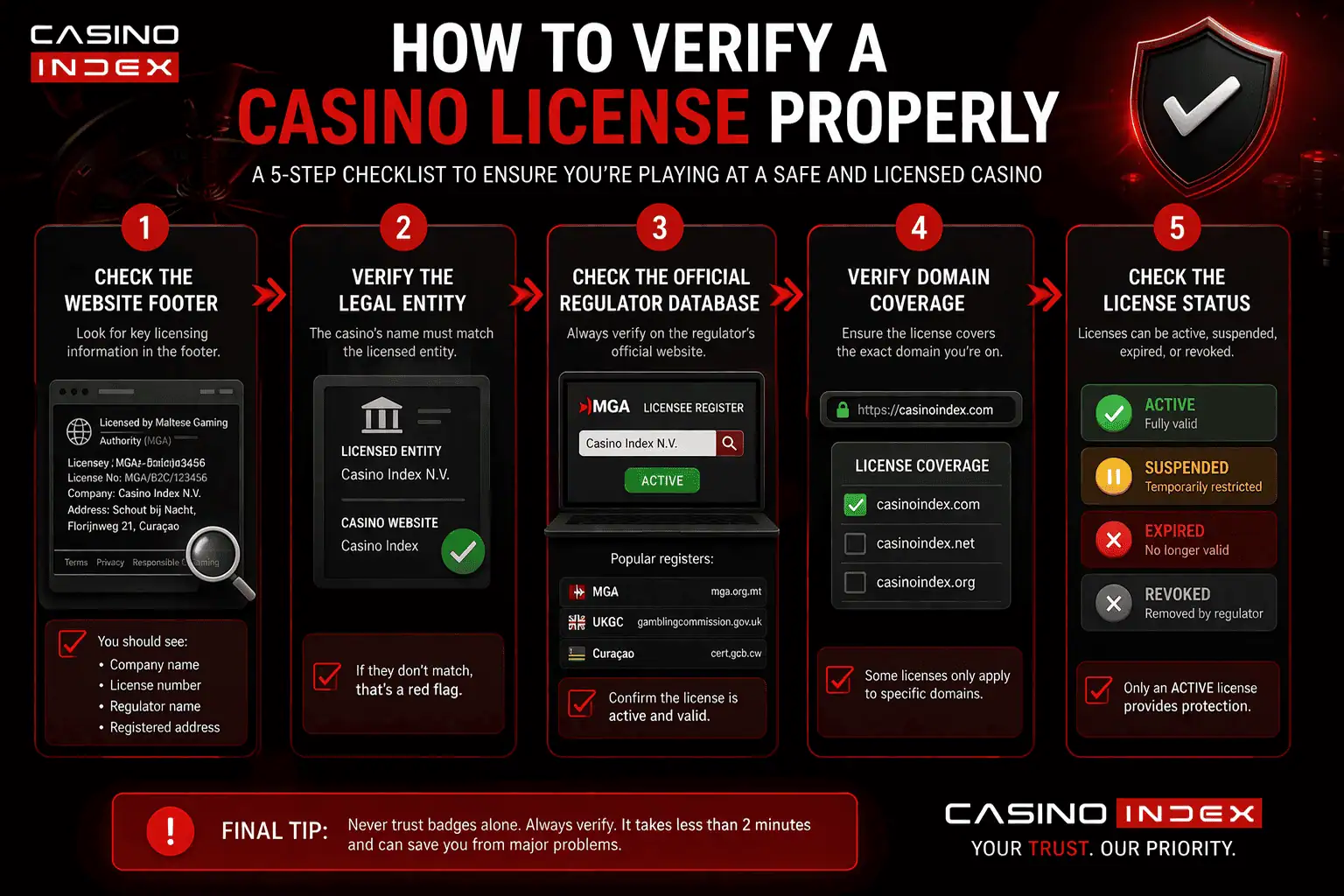
1. Find the legal details
Check the footer, terms and privacy policy for:
- the legal company name
- the regulator
- the license or certificate number
- the registered address
- restricted countries
Generic wording such as “internationally licensed” proves very little.
2. Match the legal company
The company in the casino terms should match the entity shown in the regulator’s register. An unexplained mismatch may mean the license belongs to another operator or related brand.
3. Search the official regulator database
Open the regulator’s own website independently. Search by company, brand, license number and domain where those options are available.
4. Confirm domain coverage
A valid license for one website does not automatically cover every mirror, regional domain or sister brand. Check the exact URL where the account will be opened.
5. Check the current status
| Status | Meaning | Player Action |
|---|---|---|
| Active | The authorization is currently valid | Continue with ownership, payment and reputation checks |
| Suspended | The authorization is temporarily restricted | Avoid new deposits until the position is resolved |
| Expired | The authorization is no longer current | Do not treat the casino as actively licensed |
| Revoked | The regulator has removed the authorization | Avoid the casino |
6. Look for enforcement and complaint information
A register becomes more meaningful when the regulator also publishes sanctions, warnings, suspensions or complaint procedures.
For the focused walkthrough, read how to verify an online casino license.
Fake and Weak Casino License Warning Signs
Fake licensing claims are more common than many players expect. The trick usually works because most users do not verify footer badges.
| Red Flag | Why It Matters |
|---|---|
| No license number shown | Hard to verify the claim |
| Logo without official source | May be decorative only |
| Generic regulation language | Often used to mislead |
| No company name | No clear accountability |
| Register mismatch | Possible false claim |
| Expired or inactive record | The protection may no longer apply |
These signs rarely appear alone. However, when several appear together, players should treat the casino as high risk.
Fake licensing rarely appears alone. Missing ownership details, copied legal text and unclear withdrawal rules usually strengthen the warning pattern.
Common Tricks Used by Risky Casinos
Fake Badge Display
Some casinos write “licensed” in the footer but provide no license number, company entity, or public register match. This is one of the most common tricks.
Copy-Paste Licensing Text
Some operators copy legal wording from other brands. If the company name does not match the regulator’s record, players should not trust the claim.
Expired License Usage
Some casinos keep outdated licensing details after an authorization expires or changes. Therefore, players should always check the current status themselves.
Unknown Regulator Claims
If a casino references a regulator that is hard to identify, impossible to verify, or not recognized in the market, that claim deserves caution.
Fake Regulator Websites
Some high-risk operators use official-looking websites that imitate regulators or licensing authorities. A real regulator should have public history, official contact details, public registers, and independent references beyond one casino’s own footer.
How Licensing Affects Withdrawals and Verification
Withdrawal procedures and payout accountability
Licensing becomes most useful when the player tries to cash out.
A licensed casino does not need to approve every withdrawal instantly. It may review identity, payment ownership, bonus activity, account security or source-of-funds risk.
The difference is that a stronger framework usually expects documented procedures and a traceable decision.
A safer withdrawal review should make clear:
- which stage the request has reached
- whether the player must take action
- which document or payment issue remains open
- which rule applies
- what happens after the check is completed
Concern rises when explanations change, the same documents are requested repeatedly or the casino gives no realistic route to completion.
CasinoIndex explains the operational stage in what happens before a casino approves a withdrawal.
Payment matching and ownership checks
Payment matching is one area where licensing, AML controls, and withdrawal rules overlap. Many regulated casinos require players to withdraw using the same method, card, bank account, or wallet used for the deposit whenever possible.
This is not always a trick. It often exists to reduce fraud, money laundering, payment abuse, and third-party funding. However, problems appear when the casino does not explain the rule before deposit.
Players should check:
- whether the deposit and withdrawal method must match
- whether third-party payments are allowed
- whether crypto wallet ownership can be reviewed
- what happens if a payment method becomes unavailable
- whether bonus terms affect the withdrawal route
This topic is explained in more detail in how casino payment matching rules can delay cashouts.
KYC requirements and verification timing
Licensing usually requires some form of identity and risk control.
KYC can help prevent:
- underage gambling
- fraud and account takeover
- duplicate accounts
- third-party payments
- money laundering
Stricter frameworks normally create stricter verification. UKGC and MGA environments often require early identity and payment checks. Offshore and crypto-first models may use more flexible, risk-based reviews.
| License or Model | Typical KYC Level | Player Expectation |
|---|---|---|
| UKGC | Very strict | Expect full identity and account checks |
| MGA | Strict | Expect identity, address and payment verification |
| Brazil local authorization | Market-specific | Expect regulated identity and payment controls |
| Curaçao | Variable | Lower-friction signup can still lead to later review |
| Anjouan or low-KYC offshore models | Risk-based and operator-dependent | Verification may appear during withdrawal |
The important test is whether the request is relevant, explained and proportionate. CasinoIndex outlines the standard in what a fair casino KYC process looks like.
Source-of-funds checks
Source-of-funds checks are another area where licensing affects player experience. These checks can appear when withdrawals are large, activity looks unusual, or the casino needs to satisfy AML requirements.
Common source-of-funds review triggers include:
- large withdrawals after short account history
- high deposit volume
- rapid deposit-withdraw cycles
- payment activity that does not match account behavior
- wallet or bank activity that raises compliance questions
A fair casino explains these checks clearly. A weak casino introduces vague requirements only after a player wins. Therefore, players who expect larger withdrawals should read how source-of-funds checks work at online casinos.
How Licensing Affects Complaints and Account Restrictions
Complaint handling and escalation
Complaint handling is one of the most practical reasons licensing matters.
A stronger framework may create several layers:
- ordinary customer support
- the operator’s formal complaints team
- an alternative dispute-resolution service where available
- regulator contact or enforcement review
Not every regulator decides individual cases or orders direct repayment. Still, formal oversight can force the operator to document its reasoning and preserve records.
Weaker offshore frameworks may offer fewer practical options, especially for an international player disputing a large balance.
Players should preserve transaction records, terms, KYC messages and support replies before escalating.
The full process is explained in how online casino dispute resolution usually works.
Account restrictions and balance treatment
Casinos may restrict accounts for security, duplicate accounts, payment concerns, prohibited locations, bonus review or responsible gambling reasons.
A restriction can be legitimate. The quality of the process depends on what the operator explains next.
A stronger process should clarify:
- whether the restriction is temporary or permanent
- which type of review is taking place
- what documents or actions are required
- whether withdrawals are paused
- what happens to a legitimate remaining balance
- how the player can appeal
Concern rises when access disappears after a large win and support refuses to explain the status of the funds.
CasinoIndex explains what happens when casinos block accounts.
What Licensing Covers — and What It Does Not Prove
Bonus terms and enforcement
Licensing also affects how bonuses are advertised and enforced. Stronger regulators usually expect clearer promotional terms, fairer disclosures, and less misleading bonus presentation.
Licensed casinos should clearly publish:
- wagering requirements
- maximum bet rules
- maximum cashout limits
- restricted games
- bonus expiry rules
- withdrawal restrictions
Unlicensed casinos may change terms suddenly, hide restrictions, or use broad “bonus abuse” wording during withdrawal disputes. As a result, players should review how to read casino terms before depositing
and understand when casinos can reverse winnings after rule issues.
Game providers and technical standards
Licensing also affects software quality. Top game providers usually prefer to work with operators that meet basic compliance standards. That does not make every licensed casino excellent, but provider quality often supports the licensing picture.
If a casino offers mostly unknown software with no fairness transparency, risk rises. Players should check whether the casino works with known studios, whether RTP values are visible, and whether fairness testing is explained.
Known providers can support technical confidence, but they do not prove that the operator handles withdrawals or disputes fairly.
and how casino RTP should be interpreted.
Provably fair games and crypto casinos
Crypto casinos often rely on provably fair technology to improve transparency. This can help players verify certain game outcomes, especially in crypto-native games such as dice, crash, plinko, mines, and originals.
However, provably fair systems do not replace licensing. They can verify game outcomes, but they do not prove that the casino has strong withdrawals, fair KYC behavior, good support, or a reliable complaint process.
In other words: Provably fair can support game transparency. Licensing supports operational accountability.
Players should understand what provably fair actually proves and what it does not protect.
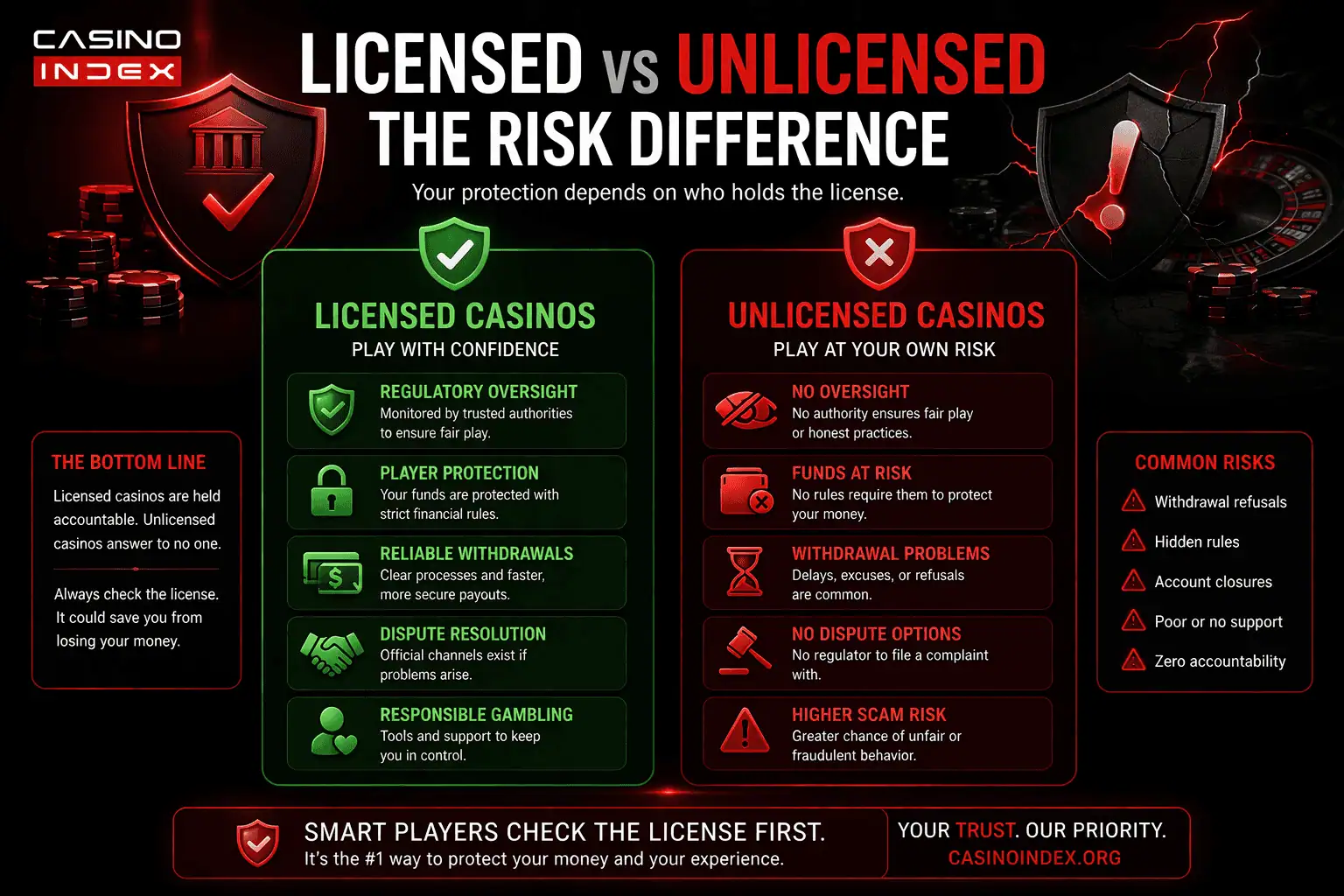
Licensed vs Unlicensed Casinos: Practical Risk Comparison
The difference between licensed and unlicensed casinos becomes most obvious when the player has a problem. Before deposit, both can look similar. Both can use modern design, crypto logos, big promotions, and large game libraries.
However, the real difference appears when a player needs a payout, a document review, a complaint response, or a clear explanation.
| Situation | Licensed Casino | Unlicensed Casino |
|---|---|---|
| Withdrawal delay | Usually has a defined internal process and escalation path | May delay without formal accountability |
| KYC request | Should follow documented verification rules | May introduce unclear requirements after a win |
| Bonus dispute | Terms should be documented and reviewable | Rules may be vague or changed aggressively |
| Game fairness | More likely to use tested providers or certified RNG systems | Fairness claims may be harder to verify |
| Complaint handling | May provide regulator or ADR escalation options | Often depends only on the casino’s support team |
This does not mean every licensed casino is automatically excellent. It means licensed casinos usually operate within a more visible framework. That framework gives players more signals before deposit and more structure when something goes wrong.
Unlicensed casinos remove that layer. Some may still process withdrawals normally. However, the player carries far more risk because no independent authority stands behind the operator’s promises.
The practical risk of unlicensed casinos
An unlicensed casino places more of the risk directly on the player.
Some unlicensed sites may process routine withdrawals for a time. However, the player has little formal protection when a larger payout, account restriction or terms dispute appears.
The main risks include:
- no independent complaint route
- unclear company ownership
- withdrawal rules controlled entirely by the operator
- verification demands with no external standard
- limited enforcement when funds are withheld
- uncertain game and software oversight
Licensed casinos answer to a regulatory framework. Unlicensed casinos usually answer only to themselves.
This does not prove that every licensed casino behaves well. It shows why an unlicensed operator requires a much higher level of caution.
Why reputation still matters
Licensing is a legal signal. Reputation shows how the operator behaves in practice.
A valid authorization should be checked against:
- withdrawal complaints
- KYC and payment disputes
- account restriction reports
- support responses
- visible resolutions
- changes in ownership or licensing
One negative review does not prove misconduct. The stronger warning appears when several independent reports describe the same unresolved problem at the same stage of the player journey.
Use the CasinoIndex framework for reading complaint patterns rather than relying on a public rating alone.
Why a valid license is not the final verdict
A license is the first filter, not the final verdict.
Two casinos can operate under similar regulatory frameworks and still provide very different real-money experiences.
The final assessment should include:
- license quality and status
- operator ownership
- domain coverage
- withdrawal behavior
- KYC timing
- payment matching rules
- complaint patterns
- bonus enforcement
- support during account reviews
A stronger license can reduce uncertainty, but repeated payout problems should still affect the trust judgment.
Players comparing real payment performance can review casinos assessed for smoother withdrawal handling.
Licensing Myths Players Still Believe
Myth 1: All Licenses Are Equal
False. A strict license and a weak offshore authorization do not provide the same level of oversight, enforcement, or dispute protection.
Myth 2: Crypto Casinos Do Not Need Licenses
False. Crypto payment support does not remove the need for legal structure. Players should judge crypto casinos by ownership, payment rules, verification risk and payout behavior—not only by supported coins.
Myth 3: No KYC Means No Regulation
False. Reduced verification models can still exist in different regulatory environments. However, players must understand that “no KYC” is often conditional rather than permanent.
Myth 4: Multiple Licenses Always Mean Better Protection
Not necessarily. One strong, verifiable license may be worth more than several weak offshore badges.
Myth 5: Big Bonuses Prove Legitimacy
False. Bonuses are marketing. Licensing is accountability. Bonus size should never replace legal verification.
How CasinoIndex Evaluates Licensed Casinos
CasinoIndex does not award a strong rating simply because a regulator name appears in the footer.
The licensing review checks:
- whether the authority is identifiable
- whether the authorization is active
- whether the legal company matches the casino terms
- whether the domain appears covered
- whether meaningful enforcement or complaint procedures exist
- how the operator handles withdrawals and verification
- whether public reports show a repeated problem
More weight goes to systems with public verification, clear enforcement and practical player-protection rules.
Operational evidence can still change the result. A strongly licensed casino may score lower when payment behavior, support or complaint handling is consistently weak.
The wider scoring model is explained in how CasinoIndex ranks online casinos.
What experienced players check beyond the badge
Experienced players do not stop after finding a badge or license number. They test whether the legal structure improves their position when money is at risk.
A deeper review asks:
- Who owns and operates the casino? The legal company should be visible and verifiable.
- Does the company match the license record? The names should align or have a clear legal connection.
- Is the domain covered? A license for one brand does not automatically cover every mirror or sister site.
- Is the status current? Suspended, expired and revoked records materially change risk.
- Is there a useful complaint route? The player should know where a formal dispute can go after support fails.
- Do payment and KYC rules match the legal framework? The actual cashier should reflect the published regulatory position.
- Do public complaints repeat? Similar unresolved cases matter more than isolated comments.
Ownership checks are especially important for white-label groups and casinos sharing the same operator. Use how to check who owns an online casino when the company structure is unclear.
The better question is not only whether a casino has a license. It is how much practical protection the complete legal and operating structure creates.
How licensing affects CasinoIndex review scores
Licensing should influence a review score without controlling it on its own.
A stronger authorization improves the legal baseline. However, the final score should also reflect:
- real withdrawal behavior
- payment method reliability
- KYC fairness
- source-of-funds handling
- provider quality
- bonus terms
- complaint patterns
- long-term brand stability
This is why two casinos with similar licenses can receive different ratings. One may have clearer payments, better support and fewer unresolved disputes.
Players can see how these factors combine in the CasinoIndex online casino rankings.
Casino License Verification Checklist
Before depositing, players should run through a simple verification checklist.
| Check | What To Confirm |
|---|---|
| License number | Is it shown clearly and searchable? |
| Regulator | Is it a real authority with a public register? |
| Company name | Does it match the casino operator? |
| Domain coverage | Does the license apply to the exact casino URL? |
| Status | Is the license active, not expired or suspended? |
| Complaint path | Is there any formal escalation route? |
| Payments | Are withdrawal rules, limits, and fees clear? |
| KYC | Are verification rules explained before cashout? |
If several answers are unclear, players should not treat the casino as fully trustworthy.
FAQ: Casino Licensing
What is a casino license?
A casino license is legal authorization from a gambling regulator. It allows an operator to offer gambling services under defined rules covering ownership, payments, compliance and player protection.
Does a license make a casino completely safe?
No. A license reduces uncertainty and creates accountability, but players should still check withdrawals, KYC, terms, support and complaint history.
Which casino licenses provide stronger protection?
UKGC and selected regulated US state frameworks are generally strict. MGA also provides an established international structure with public verification and enforcement information.
Are MGA casinos automatically trustworthy?
No. MGA licensing provides a stronger starting point, but the individual operator can still have payment, support or account-handling problems.
Are Curaçao casinos safe?
Some Curaçao casinos have long histories and stable payment records. Others are newer or less proven. Verify the current CGA authorization and evaluate the operator separately.
Is an Anjouan license enough to trust a casino?
No. The public register can confirm a listed license, but the framework offers a weaker trust baseline than stricter regulators. Ownership, withdrawals and complaint behavior need closer review.
How can I check whether a casino license is real?
Find the legal company and license number, search the regulator’s official register, match the company, verify the exact domain and confirm that the status remains active.
Can a licensed casino still delay withdrawals?
Yes. Identity, payment, bonus, security or source-of-funds checks can delay a payout. The operator should provide a relevant reason and a clear route to completion.
Can a real license be used to promote an unlicensed domain?
Yes. A company may hold authorization for one website while another related domain is not covered. Always verify the exact URL.
What does a suspended casino license mean?
A suspension means the authorization is temporarily restricted. Avoid new deposits until the regulator confirms that the issue has been resolved.
Can crypto casinos be licensed?
Yes. Crypto payment support does not replace legal oversight. A crypto casino can be strongly licensed, offshore-licensed or unlicensed.
Is an unlicensed casino always a scam?
Not every unlicensed operator will refuse payments. However, the player has substantially less formal protection when a dispute, restriction or unpaid balance appears.
Final View: Verify the Protection Behind the Badge
A casino license is not decoration.
Its value depends on whether the authorization can be verified, whether the correct company and domain are covered and whether the regulator creates meaningful accountability.
MGA usually provides a stronger international baseline. Curaçao requires more operator-level research even under its newer framework. Anjouan should be approached with higher caution because practical protection remains less established.
The safest process is:
Check the regulator → verify the company → confirm the domain → review the status → investigate withdrawals and complaints.
A valid license can reduce uncertainty. It cannot replace evidence of fair payment behavior.
If the casino cannot clearly prove who licenses it and which company controls the player’s money, it has not earned the deposit.

Maria Hoffmann has worked in cryptocurrency content and digital publishing since 2017. She is a co-founder of Freecoins24 and CryptoMutant and has covered blockchain projects, crypto platforms and emerging industry trends for several years. She has also been active as a cryptocurrency investor since 2019. At CasinoIndex, Maria combines content research and SEO experience with a focus on casino trust, platform security, withdrawal processes, payment risks and user protection. Her work looks beyond bonuses and product features to examine how gambling platforms handle player funds, verification and account-related risks.