


Which Casinos Pay Out the Fastest

Where Most Casino Guides Get It Wrong
Most casino rankings focus on bonuses, game selection, or design.
None of that matters once you try to withdraw.
The real test starts after a winning session. That’s when payout speed, system stability, and internal controls decide whether a casino is usable long-term or not.
You will not notice weak payout systems immediately. They usually appear after:
- repeated withdrawals
- higher balances
- increased activity
At that point, the difference becomes obvious.
Some casinos process withdrawals within minutes, consistently.
Others introduce delays the moment your activity becomes profitable.
This is not random. It is built into the system.
If you look at how platforms are structured across environments focused on consistent withdrawal speed across crypto casinos, a clear pattern appears: the fastest casinos are designed around payout efficiency first, not bonuses.
This guide isolates the only layer that matters once money is involved: withdrawal performance.
It breaks down how casinos behave after deposits, after wins, and across repeated withdrawals. It focuses on what actually happens inside the system when pressure increases, not what casinos promise upfront.
That includes:
- how fast transactions are triggered
- how often withdrawals get interrupted
- how systems react when players become profitable
Because at that point, you are no longer testing a casino.
You are testing its limits.
Top Casinos With the Fastest Payouts
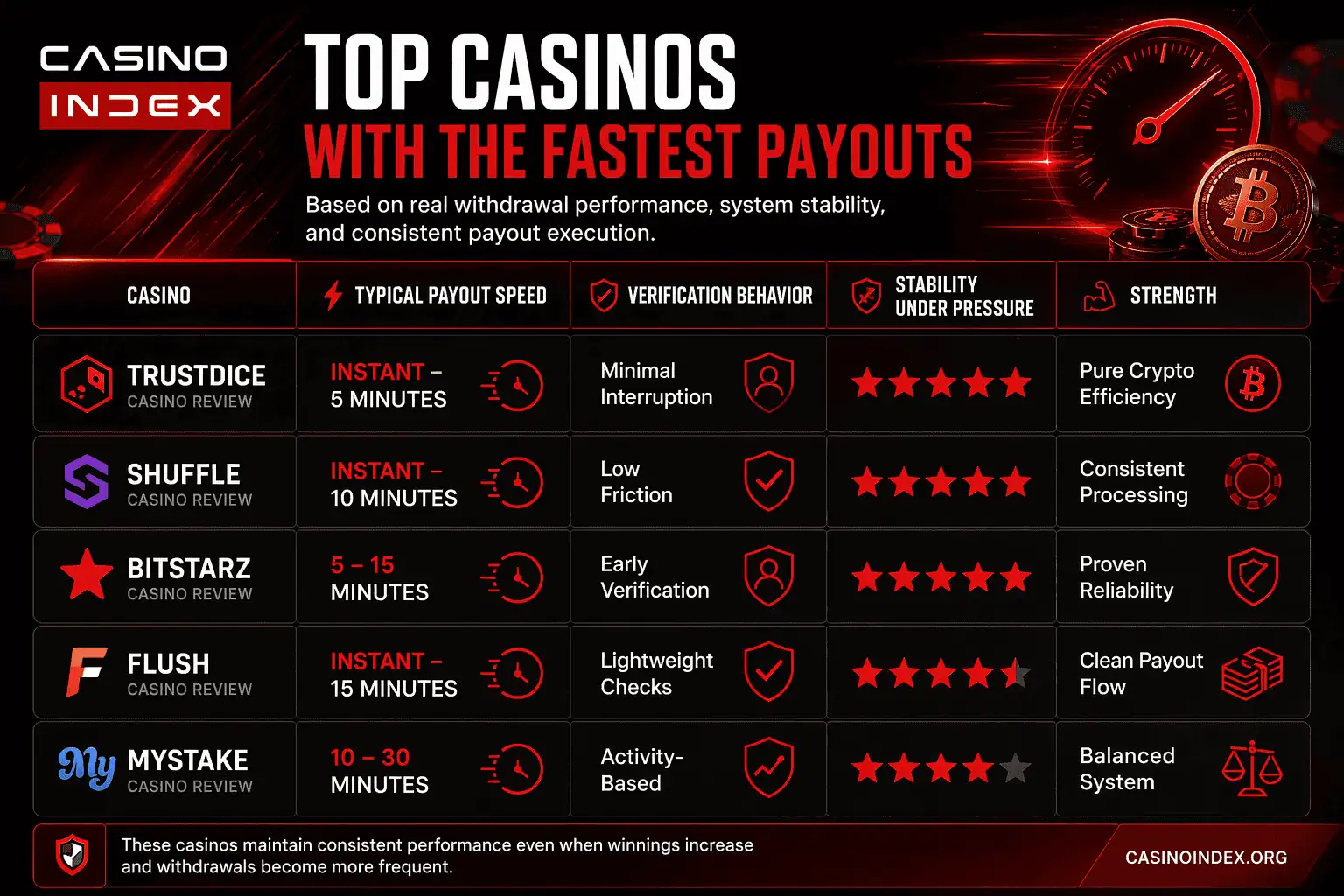
The following platforms consistently perform well under real withdrawal conditions. This is based on repeated usage patterns, not promotional claims, and reflects how these casinos behave once withdrawals become frequent.
| Casino | Typical Payout Speed | Verification Behavior | Strength |
|---|---|---|---|
| TrustDice Casino Review | Instant – 5 minutes | Minimal interruption | Pure crypto efficiency |
| Shuffle Casino Review | Instant – 10 minutes | Low friction | Consistent processing |
| BitStarz Casino Review | 5 – 15 minutes | Early verification | Proven reliability |
| Flush Casino Review | Instant – 15 minutes | Lightweight checks | Clean payout flow |
| MyStake Casino Review | 10 – 30 minutes | Activity-based | Balanced system |
More importantly, they do not change behavior once you start winning. That is where most casinos fail.
That alone separates them from most platforms.
What Actually Makes a Casino Pay Out Fast
Fast withdrawals are not determined by a single factor. They come from multiple systems interacting cleanly under real conditions.
Withdrawal Speed vs Withdrawal Reliability
Speed alone is easy to fake.
Reliability is not.
Many casinos can process a single withdrawal quickly. That does not make them fast. It only means their system worked once.
The real benchmark is repeatability.
A reliable payout system:
- processes multiple withdrawals without delay
- behaves the same after wins as after losses
- does not change conditions mid-session
Unreliable systems behave differently:
- fast first withdrawal
- slower second withdrawal
- friction appears once profit is detected
This is where most players misjudge casinos.
They test once, assume speed, and only notice problems later.
Payment Infrastructure — Where Speed Is Created
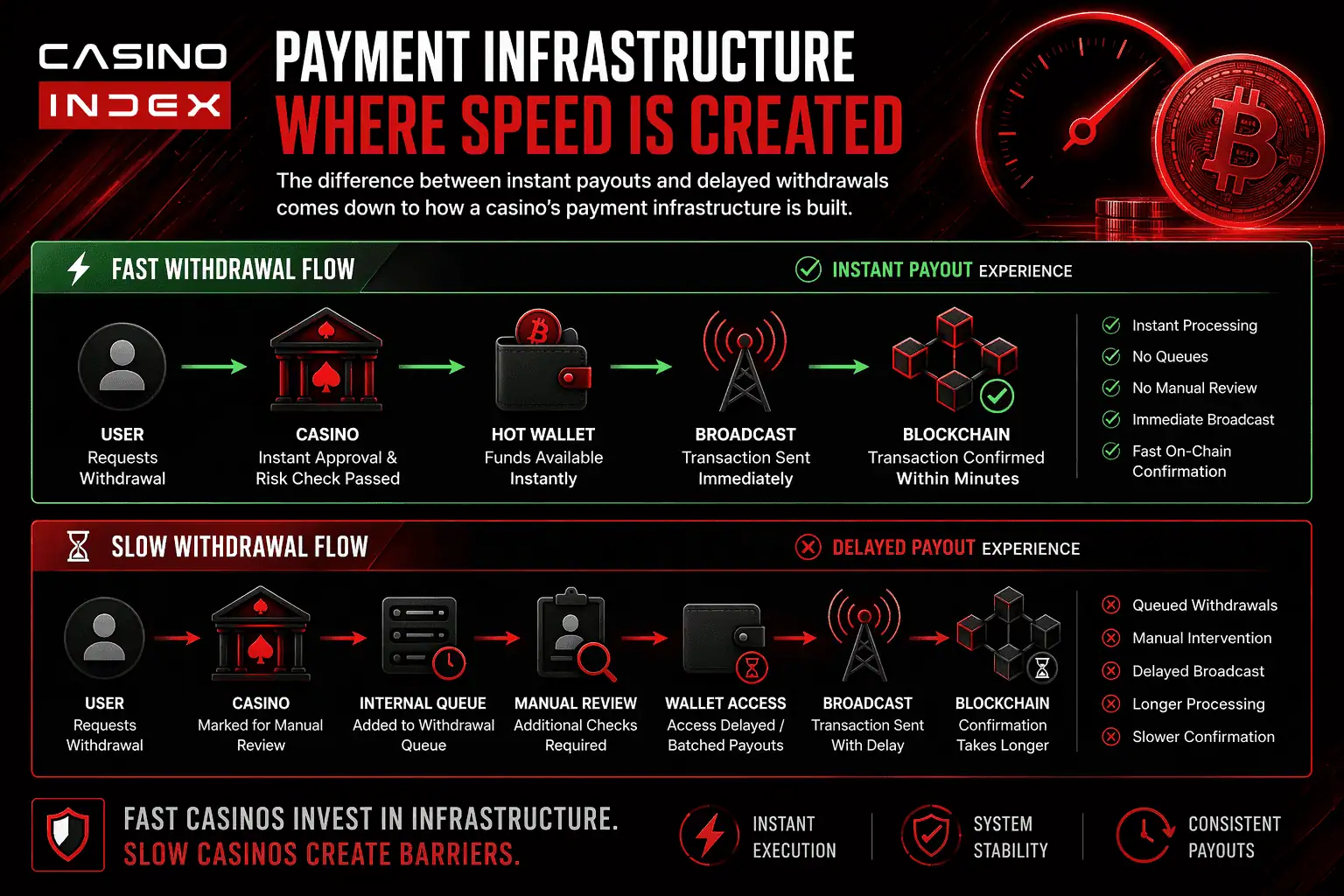
Crypto payments make fast withdrawals possible, but they do not guarantee them.
The difference is in execution.
Fast platforms:
- process withdrawals instantly
- broadcast transactions without delay
- avoid internal queues
Slower platforms:
- batch withdrawals
- introduce artificial pending states
- delay transaction broadcasting
This is why casinos operating within high-performance crypto gambling environments consistently outperform traditional setups.
The technology is not new.
There is also a structural difference between hot wallet systems and delayed wallet systems.
Fast casinos usually operate with:
- automated hot wallets
- real-time transaction signing
- immediate broadcast to the network
Slower casinos often rely on:
- internal approval layers
- delayed wallet access
- manual transaction batching
This is why two crypto casinos can feel completely different, even when using the same coins.
The backend determines the speed, not the currency.
Why Crypto Alone Is Not Enough
Many players assume crypto automatically means fast payouts.
That assumption is wrong.
Crypto removes banks, but it does not remove internal delays.
A casino can still:
- hold transactions
- delay broadcasting
- apply manual approval
The fastest casinos are not fast because they use crypto.
They are fast because they remove internal friction.
Internal Risk Systems — The Hidden Delay Trigger
Every casino monitors risk.
The difference is how aggressively that system reacts.
Slower casinos:
- trigger checks during withdrawals
- pause transactions after wins
- require manual approval
Faster casinos:
- process risk signals in advance
- automate approvals
- allow withdrawals to complete without interruption
This is why delays appear in real usage. Winning activity triggers internal controls, not the payment method itself.
Most players underestimate how sensitive these systems are.
Risk engines track:
- betting patterns
- withdrawal frequency
- profit ratios
- session behavior
If a platform is not optimized, these triggers stack.
That’s when delays appear.
Stronger casinos reduce false positives. They allow normal winning behavior without treating it as a risk signal.
That difference determines whether a casino feels smooth or restrictive once real money is involved.
Verification Timing — The Critical Mistake Most Casinos Make
Verification itself is not the issue. The real problem is when the casino chooses to apply it.
Common issue:
- player deposits and plays without restriction
- withdrawal request triggers identity verification
- payout gets delayed
Better structure:
- verification happens early
- account is cleared before withdrawal
- payouts remain smooth
This is why many players prefer casinos with lighter verification structures, especially when payout speed matters as much as access, as seen in low-verification casino environments built for faster withdrawals.
Why Verification Feels Random (But Isn’t)
From a user perspective, verification often feels inconsistent.
One player withdraws instantly. Another gets blocked.
This is not random.
It depends on:
- account age
- transaction history
- deposit methods
- betting patterns
Casinos with optimized systems:
- standardize verification timing
- reduce surprise checks
- keep withdrawal flow predictable
Casinos without that structure:
- trigger verification inconsistently
- interrupt payouts mid-process
- create uncertainty for the user
In reality, the system is not slow. It is reacting unpredictably.
Withdrawal Behavior Under Real Conditions
A casino is not fast because one withdrawal was quick.
It is fast if it remains consistent.
Real test conditions:
- multiple withdrawals
- larger amounts
- repeated sessions
Weak platforms:
- slow down after wins
- introduce limits
- increase verification pressure
Strong platforms:
- maintain speed
- process consistently
- scale without friction
That is why payout issues surprise most players. Most casino guides never examine what happens after a player starts withdrawing regularly.
Key Insight From Real Usage
Fast payouts are predictable.
Once you understand:
- how payments are processed
- when risk systems activate
- how verification is handled
you can identify which casinos will remain reliable.
The fastest casinos are not just quick once.
They stay fast even when it matters.
Real Examples — How Fast Casinos Behave Under Pressure
Speed claims mean nothing without consistency.
The real difference appears after repeated withdrawals, not the first one. Below is how the top-performing platforms behave when usage becomes realistic.
TrustDice — Pure Execution Speed
TrustDice operates with a straightforward crypto-first structure.
Withdrawals are typically processed instantly because:
- transactions are triggered immediately
- there is no visible batching layer
- risk checks rarely interrupt payouts
In practice, this creates a predictable pattern. You request a withdrawal, it gets processed, and funds move on-chain without delay.
That behavior aligns with what you see in casino environments optimized for fast crypto cashouts, where infrastructure is built around speed rather than control layers.
The key advantage is consistency. It does not change after multiple sessions.
Shuffle — Stability Across Repeated Withdrawals
Shuffle is not just fast. It is stable.
The difference becomes clear when:
- withdrawals are repeated
- amounts increase
- sessions extend over time
Where many platforms begin to introduce friction, Shuffle remains predictable.
- withdrawals process quickly
- no visible slowdown after wins
- minimal interference from internal checks
This places it among platforms often referenced when evaluating reliable payout systems with long-term consistency, not just short-term speed.
BitStarz — Slightly Slower, Significantly More Controlled
BitStarz does not aim for the absolute fastest execution.
It prioritizes control and reliability.
- withdrawals are processed quickly, but not instantly
- verification tends to happen early
- larger withdrawals remain stable
This approach reduces risk interruptions during withdrawals.
From a system perspective, BitStarz aligns more closely with structures explained in regulated casino environments with strict licensing frameworks, where stability is prioritized over raw speed.
The result is predictable payouts, especially for higher amounts.
Flush — Clean Flow With Minimal Friction
Flush focuses on simplicity.
There are fewer layers between request and execution:
- withdrawal process is straightforward
- minimal verification friction
- no unnecessary delays
This creates a smooth user experience, especially for mid-range withdrawals.
It performs consistently in scenarios where players expect fast processing without complexity.
MyStake — Balanced but Not Pure Instant
MyStake performs well under normal usage.
However, behavior changes slightly under pressure.
- smaller withdrawals are fast
- larger volumes may introduce slight delays
- system reacts more actively to player activity
This is not unusual.
Many platforms optimize for balance between speed and control rather than pure speed.
What All Fast Casinos Have in Common
Despite different designs, these platforms share structural similarities.
They:
- process withdrawals immediately after request
- avoid manual intervention in normal scenarios
- separate risk checks from payout execution
- maintain consistent behavior across sessions
This is not accidental.
It is the result of systems designed for payout flow first, not restriction.
That is why these casinos feel predictable over time.
Why Some Casinos Feel Fast at First (But Aren’t)
This is one of the most common traps.
Many casinos appear fast during the first session.
Reasons:
- low withdrawal volume
- no profit detection yet
- minimal system triggers
Everything works smoothly.
Then behavior changes.
Second or third withdrawal:
- processing slows down
- additional checks appear
- payout timing becomes inconsistent
This is where the illusion breaks.
Fast casinos do not change behavior after the first session.
Slow casinos always do.
Mid-Level Comparison — Speed vs Reliability
| Category | Strongest Performer | Why It Stands Out |
|---|---|---|
| Raw Speed | TrustDice | Instant processing with minimal interruption |
| Consistency | Shuffle | Stable across repeated withdrawals |
| High-Amount Reliability | BitStarz | Handles larger payouts without breakdown |
| Low Friction | Flush | Clean and simple withdrawal process |
| Balanced System | MyStake | Adapts to different usage levels |
The key takeaway:
Speed alone is not enough.
Consistency under pressure is what defines a top-tier payout system.
What Happens When Withdrawal Pressure Increases
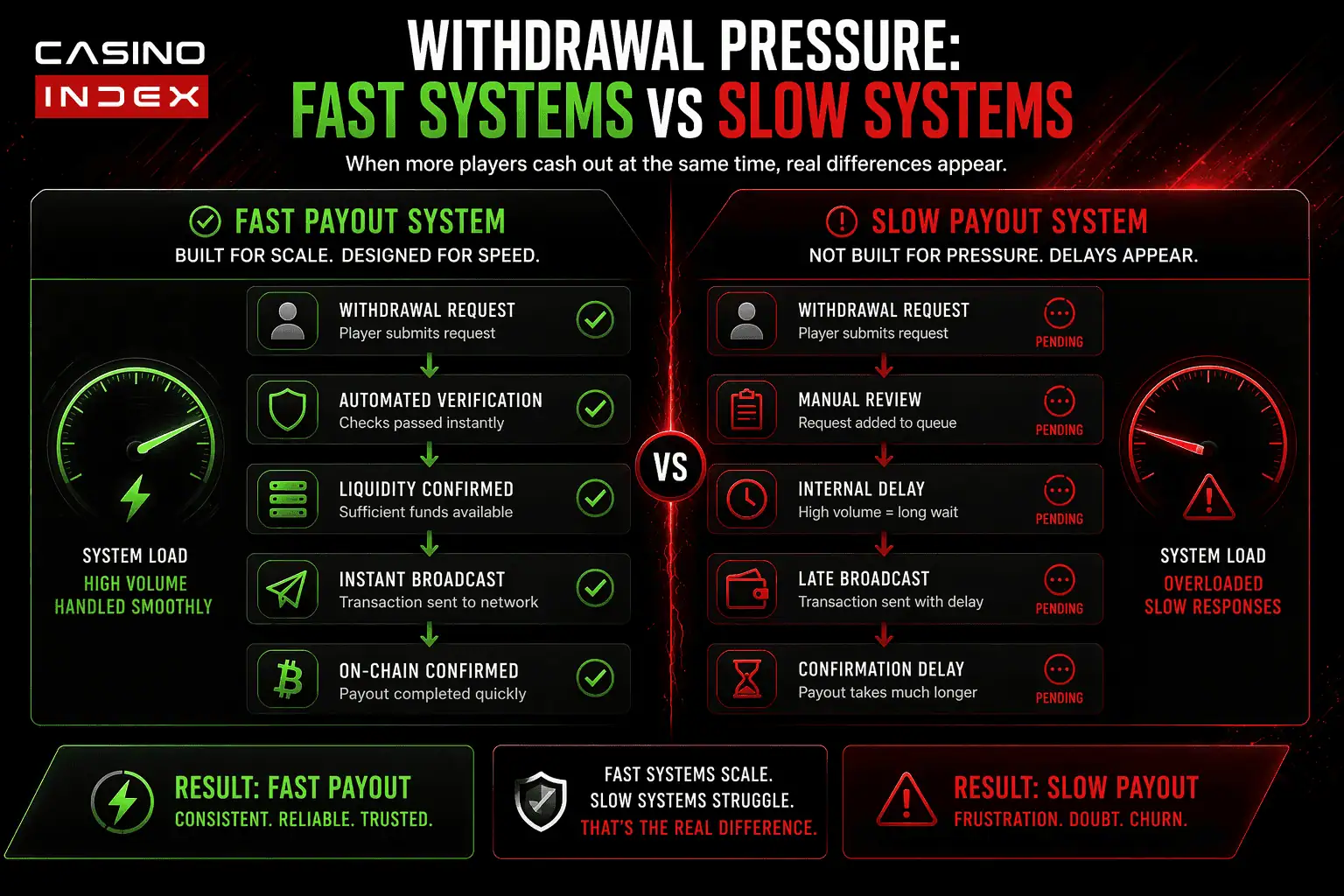
This is where most casinos fail.
As soon as:
- withdrawal frequency increases
- profits grow
- sessions extend
internal systems start reacting.
Typical reactions from weaker platforms:
- withdrawals move to pending
- additional checks appear
- processing time increases
This is exactly the pattern you see in detailed breakdowns of payout delays and system-triggered verification issues, where internal risk models start overriding user experience.
Strong platforms behave differently.
They:
- process withdrawals consistently
- avoid sudden verification triggers
- maintain speed across sessions
This is what creates long-term trust.
Another important factor is withdrawal stacking.
When players:
- withdraw multiple times per day
- increase stake size
- maintain consistent profit
weaker systems begin to degrade.
Stronger systems remain stable because they are built to handle volume, not just isolated transactions.
This difference becomes obvious within a few sessions.
The Role of Liquidity in Payout Speed
Liquidity is rarely discussed, but it matters.
Casinos with strong liquidity:
- process withdrawals without delay
- handle large payouts without restructuring
- maintain stable flow regardless of volume
Casinos with weaker liquidity:
- introduce limits
- slow down large withdrawals
- split payments into smaller parts
This is one of the hidden reasons why some casinos feel slower over time.
Why Withdrawal Limits Matter More Than Most Players Think
Payout speed is only one part of the picture.
Withdrawal limits matter just as much.
A casino can process a payout quickly and still create a poor experience if:
- daily limits are too low
- large balances have to be split
- repeated withdrawals trigger extra review
This is where the difference between small-session players and regular winners becomes obvious.
For a casual player, a quick $200 cashout may feel excellent.
For a player withdrawing four figures or more, the real question changes:
- how much can be withdrawn at once
- whether limits change after wins
- whether the casino stays predictable across larger amounts
The fastest casinos are usually not just quick.
They are also structured in a way that allows players to move funds without artificial bottlenecks.
That matters because a casino with strong speed but weak limits still creates friction.
And friction is exactly what serious players try to avoid.
Pattern Recognition — How to Identify Fast Casinos Yourself
After enough usage, patterns become obvious.
Fast and reliable casinos share these traits:
- withdrawals process immediately or within minutes
- no sudden delays after wins
- verification is handled early, not during payout
- system behavior stays consistent
Slow or unreliable casinos show the opposite:
- fast deposits, slow withdrawals
- delays after profitable sessions
- unpredictable verification requests
- inconsistent payout timing
Understanding this difference removes guesswork.
Key Insight From Real Behavior
The fastest casinos are not just fast once.
They remain stable when:
- money increases
- activity increases
- pressure increases
That is the only metric that matters.
Comparison — What Actually Separates the Fastest Casinos
At a surface level, most casinos look similar.
They all offer fast payouts, crypto support, and smooth withdrawal promises.
The difference only becomes visible when you compare how they behave under real conditions.
Speed vs System Stability
| Casino | Speed | Stability Under Pressure | Typical Behavior |
|---|---|---|---|
| TrustDice | Very high | High | Immediate payouts, minimal interruption |
| Shuffle | High | Very high | Consistent across repeated withdrawals |
| BitStarz | Medium–high | Very high | Slightly slower, but extremely reliable |
| Flush | High | High | Clean execution, minimal friction |
| MyStake | Medium | Medium–high | Fast initially, slight variation at scale |
This comparison highlights one important point:
The fastest casino is not always the most reliable one.
The strongest platforms combine both.
Where Most Players Make the Wrong Choice
Players often choose based on:
- bonuses
- game variety
- design
None of these factors influence payouts.
The correct decision comes down to:
- withdrawal consistency
- system behavior after wins
- verification timing
If you break down how trusted casino platforms handle player funds and payout security, the same pattern repeats: systems designed for efficiency outperform systems designed for marketing.
Why Bonus-Focused Rankings Often Mislead Players
This is where many comparison pages fail.
They rank casinos by:
- welcome bonus size
- number of games
- promotional offers
That creates a distorted picture.
A casino can look excellent in a bonus-driven ranking and still perform badly where it matters most: withdrawals.
The problem is simple.
Bonuses are easy to advertise. Withdrawal quality is harder to measure.
That is why many rankings overvalue surface-level features and undervalue payout reliability, verification timing, and system behavior under pressure.
For players who actually plan to deposit, win, and withdraw, that approach is backwards.
A strong payout system has more real value than a large welcome bonus with slow or inconsistent cashouts.
Decision Section — Choosing the Right Casino for Your Situation
Different players need different payout behavior.
The right choice depends on how you use the platform, not how it is marketed.
Best for Beginners
Flush
- simple withdrawal flow
- minimal friction
- predictable processing
Beginners benefit from a system that does not introduce complexity during payouts.
Best for Fast Withdrawals
TrustDice / Shuffle
- instant or near-instant processing
- minimal system interruption
- consistent execution
These platforms are built around speed first.
They perform best if fast access to funds is the priority.
Best for High-Stakes Players
BitStarz
- strong payout reputation
- stable handling of larger withdrawals
- fewer issues under pressure
For larger balances, stability matters more than raw speed.
Best Overall Balance
Shuffle
- combines speed and consistency
- handles repeated withdrawals well
- minimal performance drop under pressure
This makes it the most reliable option across different usage types.
Best for Consistent Long-Term Use
Shuffle / BitStarz
- stable across repeated sessions
- predictable system behavior
- minimal payout disruption over time
This category matters for players who:
- play regularly
- withdraw often
- want long-term reliability
Speed matters.
Consistency matters more.
Why the Best Fast-Payout Casinos Usually Feel Different Immediately
Players often notice the difference early, even before the first withdrawal.
The best payout systems usually feel cleaner from the start:
- fewer interruptions
- clearer withdrawal rules
- less uncertainty around verification
- more predictable account behavior
That matters because speed is not only about the final cashout.
It also affects how confident a player feels using the platform in the first place.
A casino with a strong payout structure tends to feel more stable overall. The experience is smoother, the rules feel more consistent, and the system does not suddenly change once money needs to leave the platform.
That is often the first real sign that the backend is built properly.
Final Insight — What “Fast Payout” Really Means
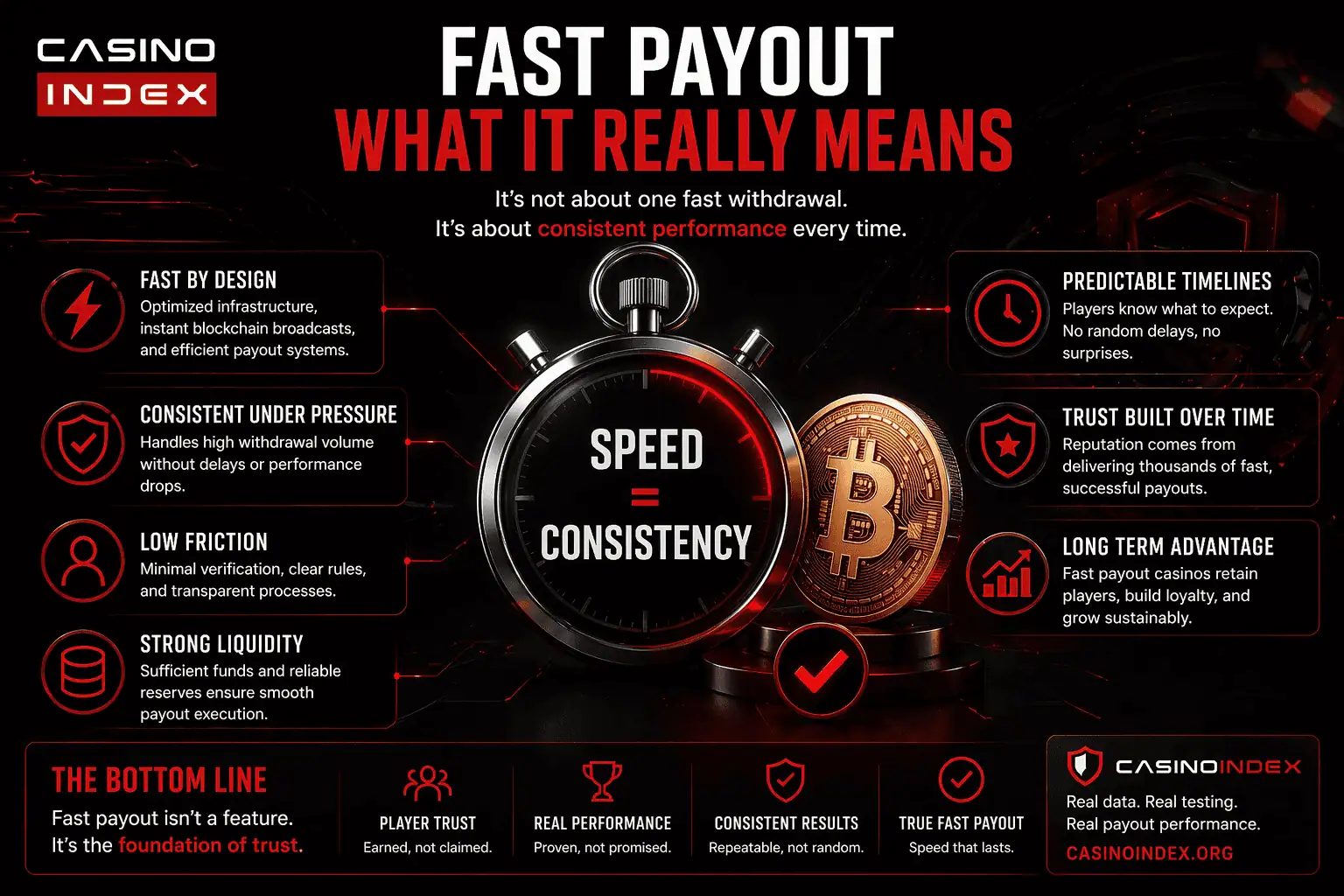
Fast payouts are not about one transaction.
They are about system behavior over time.
A casino is only truly fast if:
- withdrawals remain consistent
- no delays appear after wins
- verification does not interrupt payouts
If any of these conditions fail, speed becomes irrelevant.
That is why experienced players focus on platforms with proven payout reliability and consistent withdrawal execution, not just advertised speed.
The real difference is simple:
Fast casinos process withdrawals.
Weak casinos process restrictions.
And more importantly, you avoid the platforms that only appear fast until it actually matters.
That is the difference between a casino that looks good on paper and a casino that actually works when real money is on the line.
FAQ — Fast Payout Casinos
Which casinos pay out instantly?
Crypto-first casinos like TrustDice and Shuffle often process withdrawals instantly for standard amounts. The exact speed still depends on the internal system, not just the coin being used.
Why do some casinos delay withdrawals after wins?
Because internal risk systems react to profitable behavior. Once a player wins consistently or starts withdrawing more often, weaker systems begin adding checks, pending stages, or manual review.
Are fast payout casinos always safe?
No. Speed alone does not make a casino trustworthy. A platform also needs consistent behavior, clear rules, and a stable payout record over time.
What is the safest way to improve payout speed?
The safest approach is simple:
- verify your account early
- use crypto when available
- avoid platforms with inconsistent withdrawal history
- check how the casino behaves after repeated payouts, not just the first one
Do higher withdrawals take longer?
They often do on weaker platforms. Stronger casinos usually maintain similar processing behavior even when amounts increase.
Why does the first withdrawal sometimes feel faster than later ones?
Because many casinos allow the first transaction to pass easily. Friction often starts later, once the account becomes more active or more profitable.
Can a casino be fast for deposits but slow for withdrawals?
Yes. In fact, that is common. Deposits are designed to be frictionless. Withdrawals are where internal limits, verification systems, and risk controls begin to affect the experience.
Do payout speeds stay the same during busy periods?
Not always.
Weaker platforms often slow down when withdrawal volume increases or when internal review queues get longer. Stronger casinos usually maintain the same payout behavior even when activity on the platform rises.
Is crypto always the fastest payout option?
Usually, yes. But crypto only removes the banking layer. It does not remove internal delays created by the casino itself.
What should players look at besides speed?
They should also look at:
- payout consistency
- verification timing
- withdrawal limits
- behavior after wins
- whether the casino remains stable across repeated sessions