How Max Cashout Rules Really Hurt Players
Article OverviewMax cashout rules limit how much of your bonus-related winnings you can actually withdraw or keep. They are different from general withdrawal limits, wagering requirements and max-bet rules. A large bonus percentage can still offer weak real value when the cashout ceiling is low, especially when high wagering and game restrictions apply. This guide explains the differences, shows simple calculations and helps you identify the real payout potential before claiming a bonus.
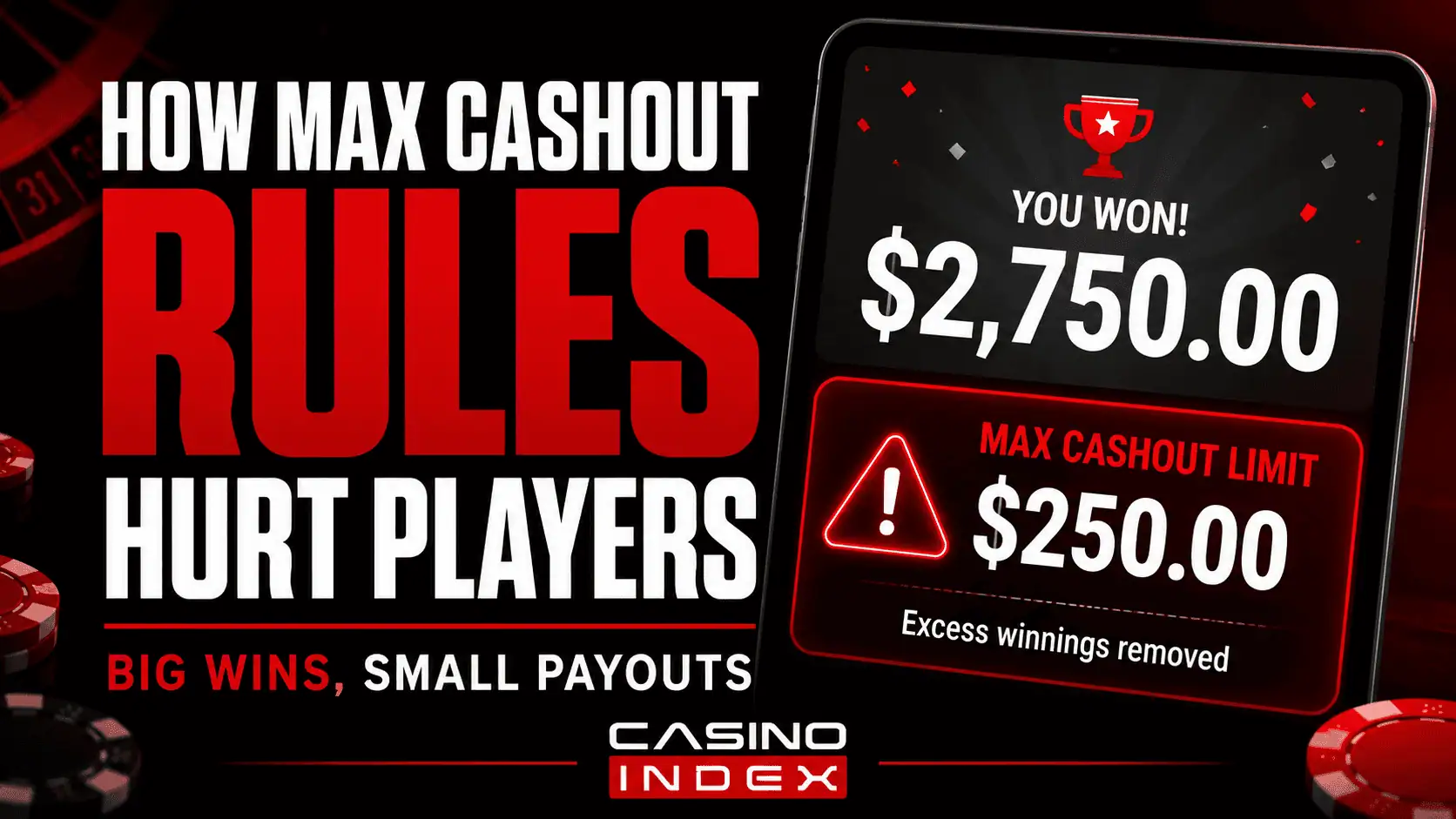
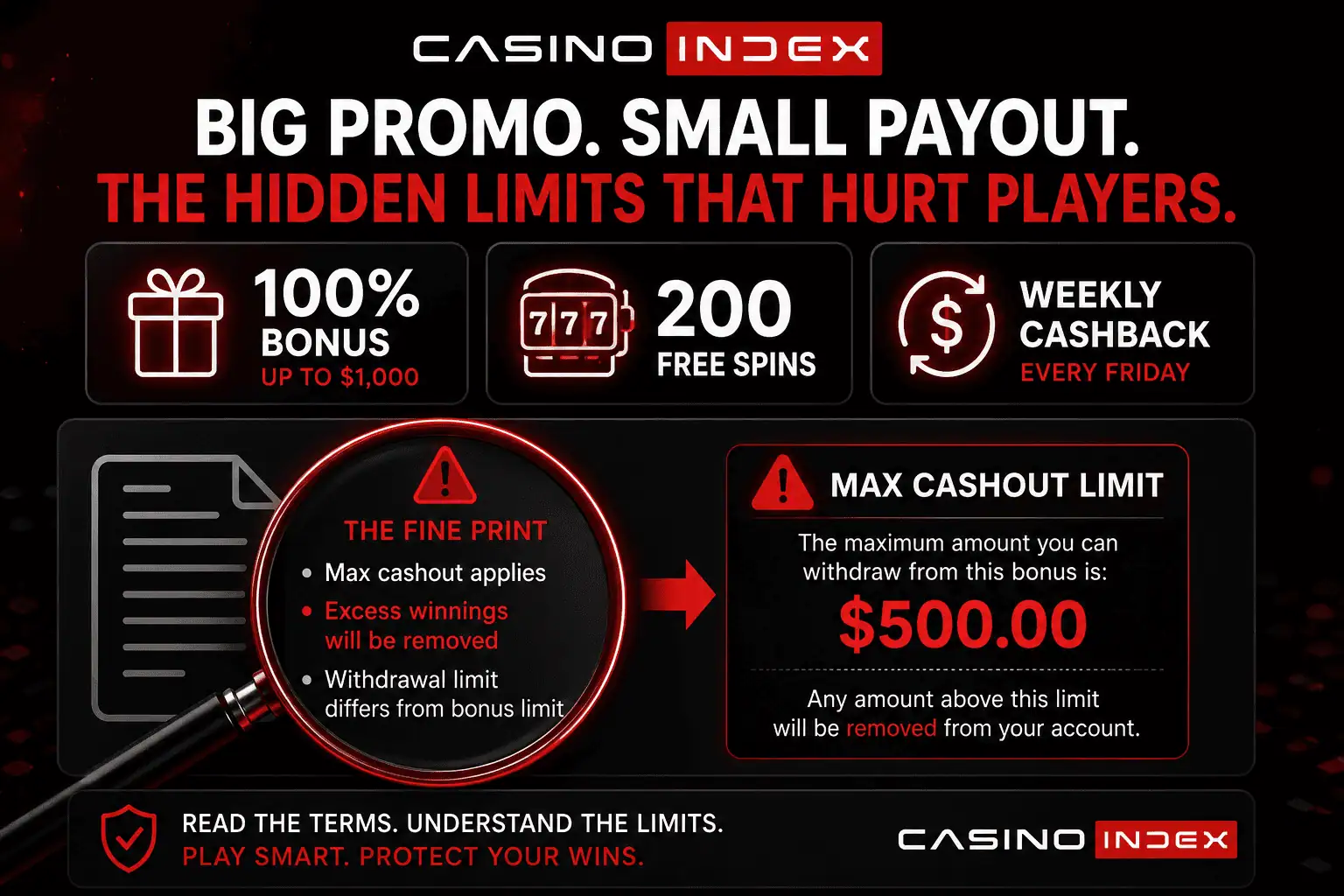
A max cashout rule answers one narrow question: how much of your bonus-related winnings are you actually allowed to withdraw or keep?
That is not the same as a normal withdrawal limit, a max-bet rule, or a wagering requirement. Those rules can all appear in the same promotion, but they control different parts of the bonus.
This distinction matters because a bonus can look generous at the start and still offer weak real value. A 200% or 500% headline says how much promotional balance you receive. It does not tell you how much of a successful run can eventually leave the casino.
The practical rule is simple: before judging the percentage, find the cashout ceiling.
Max cashout vs withdrawal limit vs wagering vs max bet
These four terms are often mixed together. They should not be.
| Rule | What it controls | What happens when it applies |
|---|---|---|
| Max cashout | The maximum amount of bonus-related winnings you may withdraw or retain | Money above the cap may be removed if the promotion terms say excess winnings are forfeited |
| Withdrawal limit | How much you can take out per transaction, day, week, or month | The remaining balance normally stays in the account and must be withdrawn later |
| Wagering requirement | How much turnover must be completed before bonus funds or bonus winnings become withdrawable | The bonus remains locked until the required wagering is completed |
| Max bet | The largest stake allowed while a bonus is active or wagering is incomplete | Breaking the limit can invalidate the promotion or winnings under the applicable terms |
There is also a fifth rule that often matters: restricted games. A casino may exclude certain games from bonus play or give them a lower contribution toward wagering. That is a separate issue again. CasinoIndex covers those rules in the guide to restricted games in casino bonuses.
The rest of this article stays focused on max cashout. For the broader structure of promotions, use the casino bonus guide. For cashier-level caps that apply to ordinary balances rather than a promotion, see the casino withdrawal limits guide.
What a max cashout rule actually does
A max cashout clause puts a ceiling on the value that can come out of a bonus.
The wording varies. Casinos may call it:
- maximum cashout
- maximum withdrawal from the bonus
- maximum win after wagering
- maximum winnings from free spins
- cashout cap
- bonus winnings limit
The effect can be the same: once the permitted amount has been reached, the player cannot keep or withdraw the excess bonus-derived winnings.
That is why a max cashout clause is more severe than a normal withdrawal limit.
If your casino allows only $2,000 per day from a $10,000 cash balance, the remaining $8,000 may simply require more withdrawals over several days. A max cashout rule can work differently: if the bonus permits only $2,000 of winnings to be retained, the amount above that ceiling may be removed altogether.
Withdrawal limit = how fast you can move the money.
Max cashout = how much of the bonus result you may keep.
A simple max cashout example
Consider a hypothetical promotion with these terms:
- $100 bonus
- 20x wagering on the bonus
- 10x maximum cashout based on the bonus amount
- excess bonus winnings removed at withdrawal
The maths is straightforward.
| Step | Calculation | Result |
|---|---|---|
| Bonus received | — | $100 |
| Required wagering | $100 × 20 | $2,000 turnover |
| Maximum cashout | $100 × 10 | $1,000 |
| Balance after completing wagering | Example outcome | $1,600 |
| Amount above cashout cap | $1,600 − $1,000 | $600 |
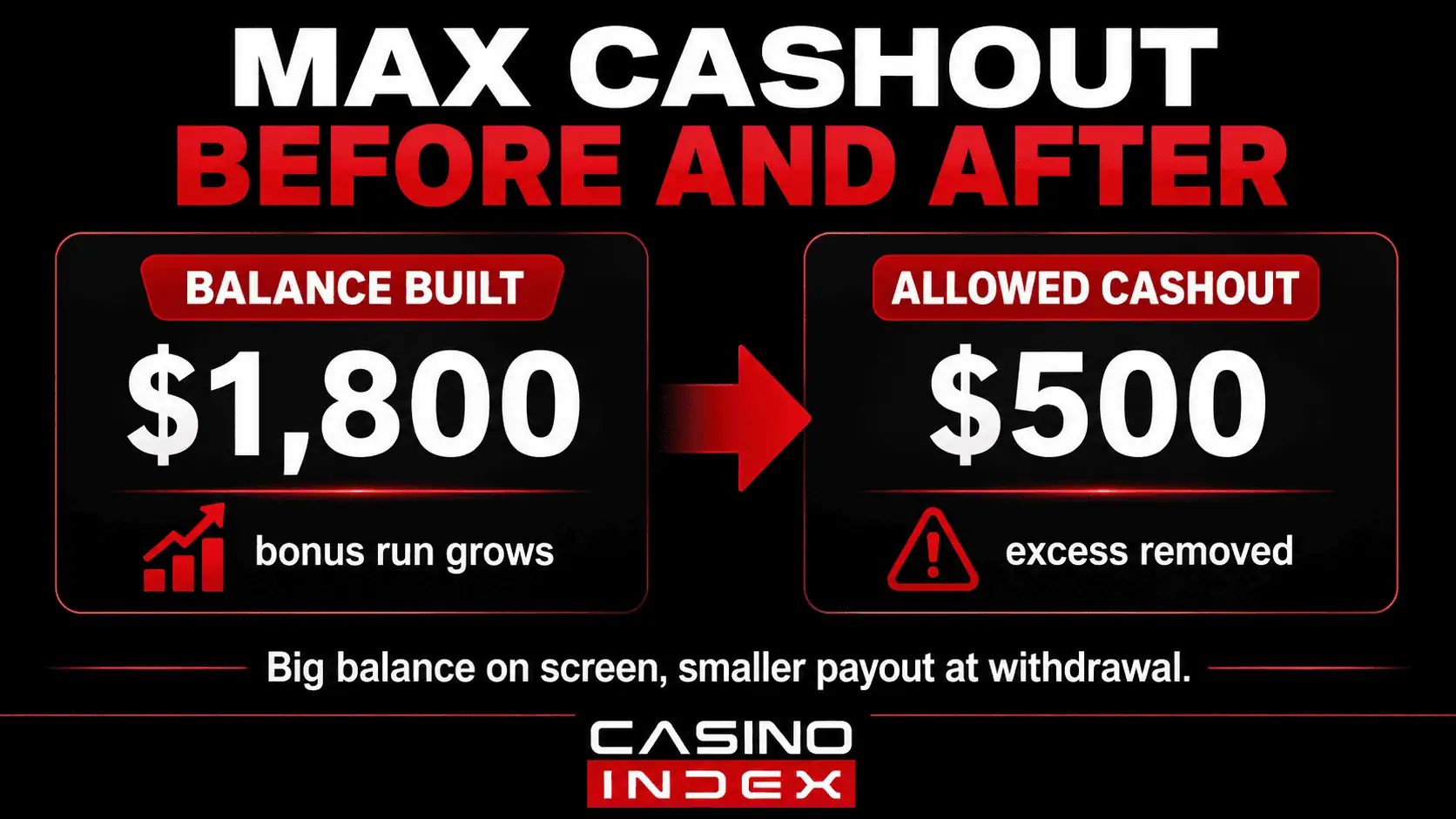
If the promotion terms say excess winnings are deducted, the player may have completed $2,000 of required wagering and still be allowed to cash out only $1,000. The additional $600 shown in the account does not become withdrawable.
This is the core problem with max cashout rules: the player can experience the variance required to build a large balance without having the same upside as an unrestricted cash balance.
Max cashout is not the same as a withdrawal limit
This is the most important distinction in the article.
A general withdrawal limit belongs to the cashier or account rules. It may say, for example, that a player can withdraw only a certain amount per day or month. That changes the schedule of the payout.
A bonus max cashout changes the ownership of the excess result under the promotion. When the terms say winnings above the cap are deducted, there is nothing left to withdraw later.
That difference becomes much easier to see with two balances:
| Situation | Balance | Limit | What happens |
|---|---|---|---|
| General withdrawal limit | $10,000 cash balance | $2,000 per day | Player may need several withdrawals; balance is not automatically erased by the limit itself |
| Bonus max cashout | $10,000 bonus-derived result | $2,000 max cashout | If terms say excess is forfeited, only $2,000 survives the cap |
Players researching large cashouts should therefore read both rules. A casino can have a generous bonus cashout cap but restrictive account-level withdrawal limits, or the opposite.
Max cashout is not the same as max bet
A max-bet rule controls the size of an individual wager while the promotion is active.
For example, a bonus might say:
Maximum bet while wagering: $5.
That rule does not tell you how much you can eventually withdraw. It tells you how large each qualifying bet may be.
A promotion can therefore contain both:
- a $5 max bet during wagering
- a $1,000 maximum cashout after wagering
They create different risks.
Breaking the max bet can trigger a bonus-rule violation. Staying inside the max bet does not remove the cashout cap. A player can follow every stake-size rule perfectly, finish the wagering requirement, and still lose winnings above the max cashout ceiling.
Wagering is a different problem again
Wagering controls how much betting activity is required before the bonus result becomes eligible for withdrawal.
Max cashout controls how much of that eligible result can survive.
Think of the sequence like this:
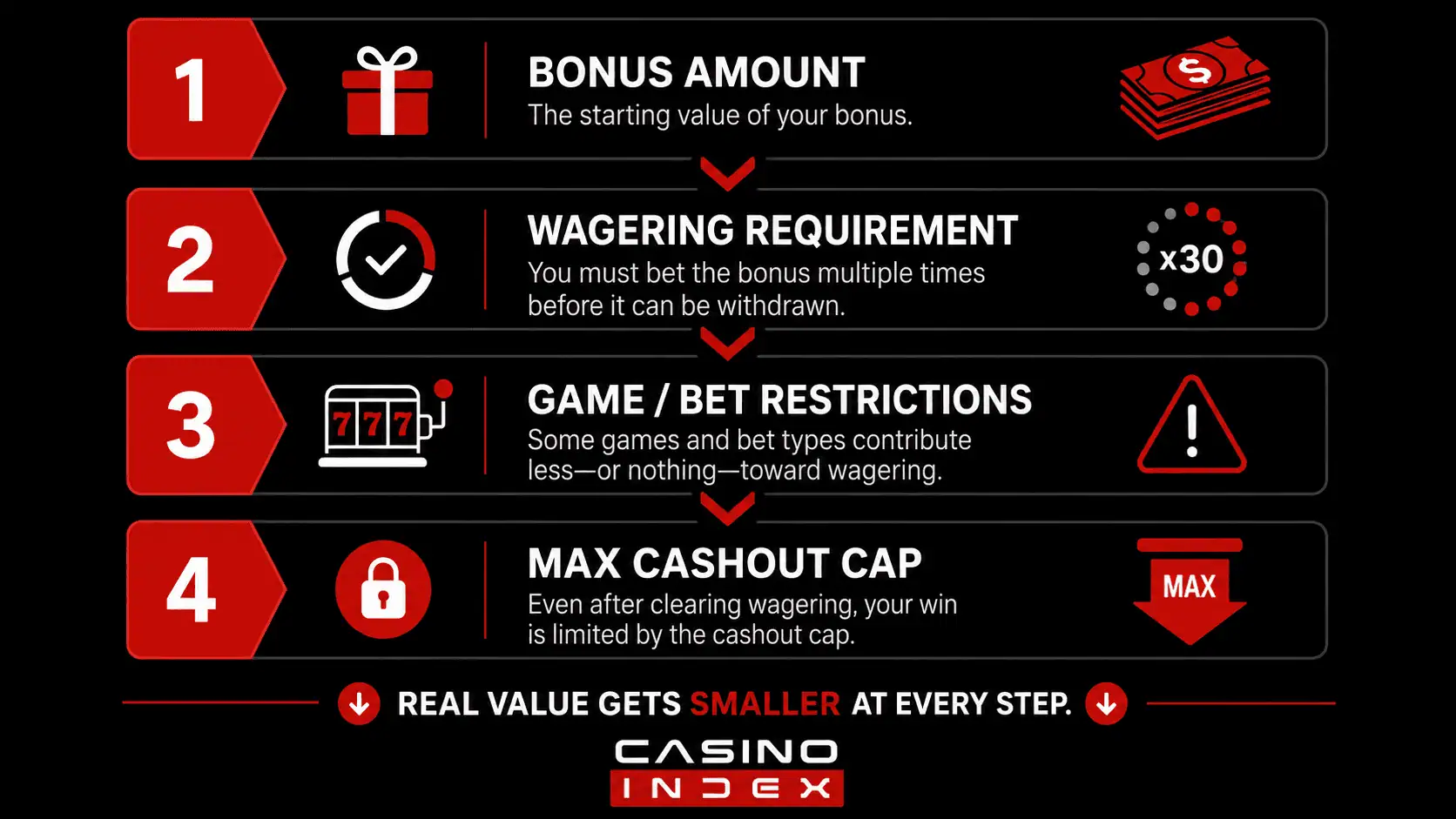
Bonus → Wagering → Eligible Balance → Max Cashout
A player can therefore complete the entire wagering requirement and still hit a cashout ceiling afterward.
That is exactly why the cap can feel especially harsh: the player has already finished the difficult part, yet the final value remains restricted.
CasinoIndex explains the turnover calculation separately in how casino wagering really works. This article does not repeat that full topic because wagering and max cashout answer different questions.
Current operator example: MyStake’s 10x bonus cashout rule
A current MyStake promotion provides one of the clearest examples of an explicit max cashout structure.
The operator’s promotion terms state that only 10 times the bonus amount can be withdrawn from the account, even if the player continues playing after the wagering requirement has been completed. The same terms state that excess winnings are deducted when the withdrawal is requested.
So if the relevant promotion gives a $100 bonus, the maximum withdrawal generated under that 10x rule is $1,000.
This is useful because the rule leaves little room for confusion:
- the wagering requirement is one condition
- the 10x cashout ceiling is another
- finishing wagering does not remove the ceiling
Source: MyStake promotion terms.
Operator promotions can change, so the live promotion page should always be checked before opting in.
Current operator example: Bitz shows how wagering and a win cap can coexist
Bitz currently publishes a no-deposit promotion connected to Kate Bitz streams where several reward tiers have both a wagering requirement and a stated maximum win after wagering.
For example, the current page lists a no-deposit free-spin reward worth 10 USDT with 45x wagering on bonus funds and a maximum win amount after wagering of 200 USDT. Other reward tiers on the same page also use a 200 USDT maximum win after wagering.
That is a clean example of why the two concepts must stay separate:
45x wagering tells the player how much turnover is required.
200 USDT maximum win tells the player the ceiling after that requirement is met.
Source: Bitz no-deposit bonus promotion.
The older version of this article used Bitz’s Tuesday’s Loot as the main example. The current public Rewards Center still lists Tuesday’s Loot, but the page available during this update did not expose the same max-cashout wording clearly enough to keep that old claim. The article therefore uses a current Bitz promotion where the cap is visible in the published terms.
Bitcasino shows why a general withdrawal limit is a different question
Bitcasino provides a useful contrast.
Its current help centre says cryptocurrency withdrawals have no maximum withdrawal amount.
That statement describes the general crypto withdrawal limit. It does not prove that every promotion has no separate bonus restrictions, and it should not be used that way.
What it demonstrates is the category difference:
A casino can answer “unlimited” to the cashier-level question while a promotion elsewhere on the market may still impose a separate cap on bonus-derived winnings.
Source: Bitcasino maximum withdrawal help page.
That is why players should never use a general withdrawal-limit page as a substitute for the terms of the specific bonus they are claiming.
When a huge bonus percentage has very little real upside
The match percentage is only the first number.
Imagine a hypothetical offer:
- 500% bonus up to $500
- 40x wagering on the $500 bonus
- $5 max bet while wagering
- 2x bonus max cashout
The headline looks enormous: 500% bonus.
But the actual structure is much less impressive.
| Headline | Real condition |
|---|---|
| $500 bonus | $20,000 wagering required at 40x |
| Large promotional balance | $5 maximum stake during wagering |
| Potentially large winning session | Only $1,000 max cashout at 2x bonus |
The player is being asked to generate $20,000 of turnover while the promotion caps the permitted result at $1,000.
That does not automatically make the offer illegitimate. It does make the 500% headline a poor measure of its real value.
A smaller bonus with low wagering and no harsh cashout cap can offer a more useful payout profile than a giant percentage with a narrow ceiling.
How to calculate the real maximum value of a bonus
Before claiming a promotion, identify the cashout formula.
Common structures include:
- Fixed cap: maximum cashout $500
- Multiple of bonus: maximum cashout 10x bonus
- Multiple of deposit: maximum cashout 5x qualifying deposit
- Maximum win after wagering: bonus winnings capped at a stated amount
- Free-spin cap: only a fixed amount of free-spin winnings can convert to cash
If the promotion says “10x bonus” and the bonus is $75:
$75 × 10 = $750 maximum cashout.
Then compare that $750 ceiling with the wagering, max-bet and game restrictions required to reach it.
The percentage headline matters much less once that calculation is visible.
Why restricted games can make a low cashout cap even worse
Restricted-game rules do not create the max cashout, but they can make the path to the cap harder.
A promotion may:
- exclude table games entirely
- allow some games but give them low wagering contribution
- exclude high-RTP games
- void bonus winnings if a restricted title is played
If the maximum possible cashout is already small, a narrow eligible-game list further reduces the attractiveness of the promotion.
Again, these are separate mechanics. The player should not combine them into one vague idea of “bad bonus terms.” Each rule should be checked independently.
Why the terms page matters more than the bonus banner
A bonus banner tells you what the operator wants you to notice.
The terms tell you what controls the payout.
Before depositing for a promotion, search the terms for:
- maximum cashout
- maximum withdrawal
- maximum winnings
- excess winnings
- max bet
- wagering requirement
- eligible games
- restricted games
CasinoIndex’s guide to reading casino terms before depositing covers the broader pre-deposit process. For max cashout specifically, the most important wording is what happens to money above the cap.
“Maximum withdrawal” wording can be ambiguous
One reason max cashout rules confuse players is that casinos do not always use the same label.
A promotion may say “maximum withdrawal” when it really means the maximum amount that can be converted from that specific bonus.
A cashier page may also say “maximum withdrawal” when it means a general account-level limit.
The wording is identical. The scope is different.
To tell them apart, ask:
- Does the rule appear inside one promotion?
- Is the cap calculated from the bonus or free spins?
- Does the term say excess winnings are deducted?
- Or does the rule apply to every withdrawal from the account?
If it applies only to one promotion and excess winnings disappear, you are dealing with a bonus cashout cap.
If it controls how much ordinary cash can leave per day or month, it is a withdrawal limit.
UK rules provide a useful benchmark, not a universal rule
The UK Gambling Commission framework is useful for understanding how different bonus and withdrawal concepts are separated in a stricter regulated market.
From 19 January 2026, UKGC licensees must not apply wagering requirements above 10x bonus funds. The Commission also requires operators to allow players to withdraw their deposit balance, subject only to necessary regulatory checks, and says operators must not impose a maximum withdrawal limit on the amount a player may withdraw from the deposit balance.
Those requirements do not apply to every offshore casino worldwide.
They are useful as a transparency benchmark because they demonstrate the same separation this article makes:
- bonus wagering is one rule
- bonus funds are distinct from deposit funds
- withdrawal restrictions on real deposit balances are another issue
Sources: UKGC 10x wagering rule, UKGC guidance on withdrawing deposit balances, and UKGC maximum withdrawal guidance.
When does a bonus stop being worth it?
A high max cashout is not automatically good, and a low cap is not automatically unacceptable. The question is whether the permitted upside is reasonable for the restrictions the player must accept.
Before claiming a bonus, ask four things:
- What is the exact maximum cashout?
- Does the cap still apply after wagering is complete?
- What happens to winnings above the cap?
- How difficult is the wagering, max-bet and game-restriction path required to reach that cap?
A bonus becomes much less attractive when the answer looks like this:
high wagering + low max bet + restricted games + low cashout ceiling.
The headline percentage cannot compensate for a structure where the player takes substantial variance but most of the upside is contractually unavailable.
Quick pre-deposit max cashout checklist
| Question | Good sign | Warning sign |
|---|---|---|
| Is there a max cashout? | No cap, or a clearly stated reasonable cap | Cap is difficult to locate |
| What happens above the cap? | Clearly explained | Excess winnings are removed but this is buried |
| Does the cap survive wagering? | Terms make the post-wagering status explicit | Player assumes completing wagering removes the cap |
| Is there also a max bet? | Stake rule is prominent and easy to follow | Small violation can void the entire result |
| Are games restricted? | Eligible list is clear | Rules are vague or difficult to check |
| Is a “maximum withdrawal” actually a bonus cap? | Scope is clearly defined | Same wording is used for different types of limits |
Final verdict
Max cashout rules hurt players when they create a large gap between the balance shown during play and the amount the player is actually entitled to withdraw.
The key is not to confuse that problem with other restrictions.
Wagering determines when bonus winnings become eligible.
Max bet determines how large a qualifying wager may be.
Withdrawal limits determine how quickly ordinary withdrawable funds can leave the account.
Max cashout determines how much of the bonus result can survive at all.
That final distinction is the one players should understand before accepting any high-percentage bonus.
FAQ — Max Cashout Rules
What is a casino max cashout rule?
A max cashout rule limits how much of the winnings generated from a bonus, free spins, cashback, or another promotion can be withdrawn or retained. The exact scope depends on the promotion terms.
Is max cashout the same as a withdrawal limit?
No. A withdrawal limit normally controls how much can be withdrawn over a period of time. A bonus max cashout can permanently cap how much of the promotional result the player is entitled to keep.
Is max cashout the same as max bet?
No. Max bet limits the size of individual wagers while the bonus is active. Max cashout limits the amount that can ultimately be withdrawn from bonus-related winnings.
Does completing wagering remove the max cashout?
Not necessarily. Some promotions explicitly state that the cashout cap continues to apply even after wagering has been completed. The MyStake promotion cited in this article is a current example.
Can a casino remove winnings above the max cashout?
If the applicable promotion terms clearly state that excess bonus winnings are forfeited or deducted, the casino may apply that rule under its terms. Players should check the exact wording before claiming the promotion.
How do I calculate a 10x max cashout?
If the cap is 10x the bonus amount and the bonus is $100, the maximum cashout is $1,000. Always confirm whether the multiplier is based on the bonus, deposit, or another figure.
Can a casino have no general withdrawal limit but still use bonus caps?
Yes. General cashier limits and promotion-specific bonus caps are different rules. Always check the specific promotion even when the casino has generous standard withdrawal limits.
Why can a 500% bonus still be poor value?
Because the percentage only describes the promotional credit. High wagering, a low max bet, restricted games and a low max cashout can make the actual payout opportunity much smaller than the headline suggests.
What wording should I search for in bonus terms?
Search for “max cashout,” “maximum withdrawal,” “maximum winnings,” “maximum win after wagering,” “excess winnings,” “max bet,” and “wagering requirement.”

Maria Hoffmann has worked in cryptocurrency content and digital publishing since 2017. She is a co-founder of Freecoins24 and CryptoMutant and has covered blockchain projects, crypto platforms and emerging industry trends for several years. She has also been active as a cryptocurrency investor since 2019. At CasinoIndex, Maria combines content research and SEO experience with a focus on casino trust, platform security, withdrawal processes, payment risks and user protection. Her work looks beyond bonuses and product features to examine how gambling platforms handle player funds, verification and account-related risks.