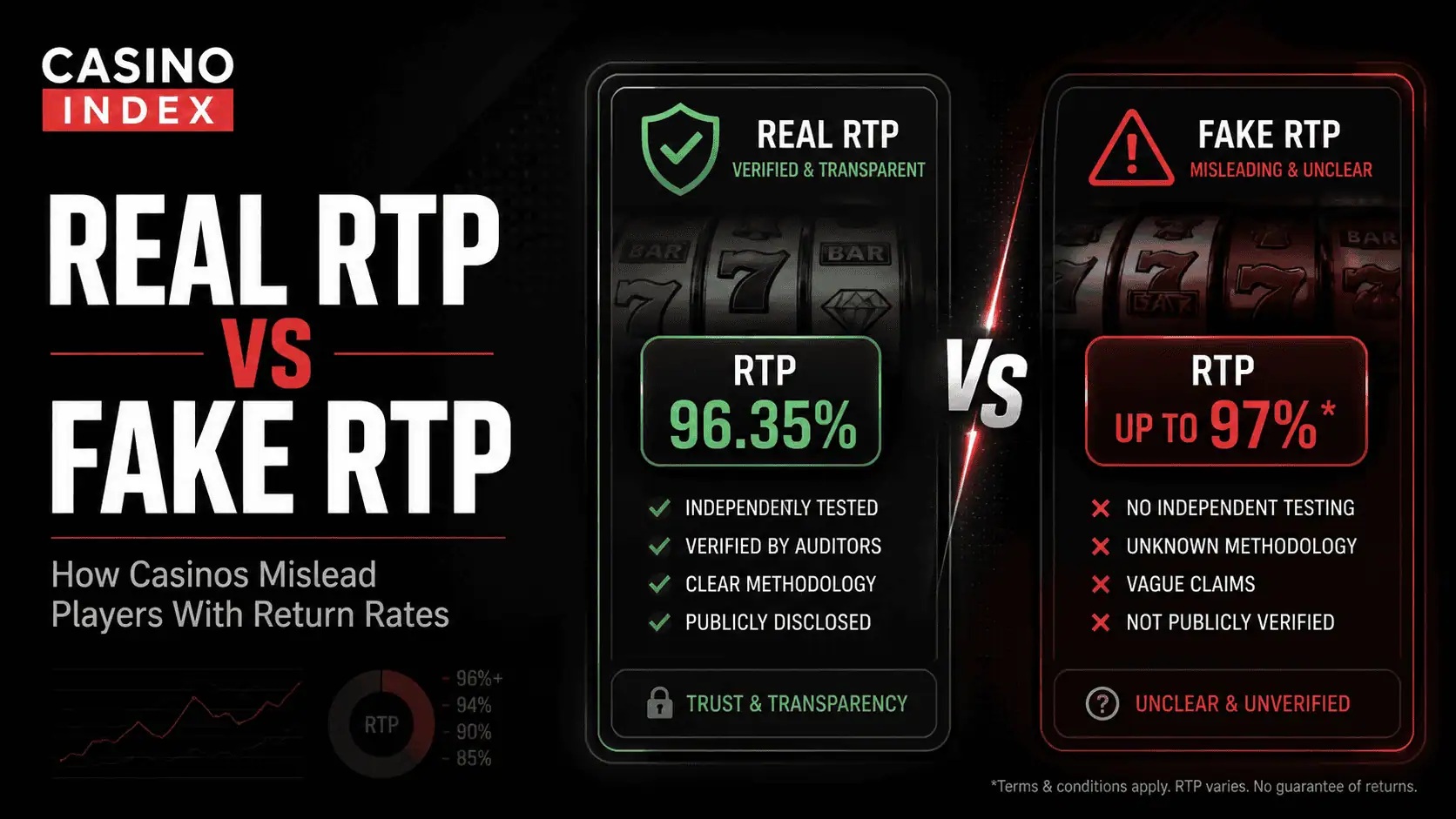
Real RTP vs Fake RTP: How Casinos Mislead Players With Return Rates
RTP is one of the most quoted numbers in online gambling. It is also one of the easiest numbers to misuse.
Casinos use return percentages to make games look transparent. Review pages use exact figures to make comparisons look precise. Meanwhile, players rely on RTP because a percentage feels objective, technical and easy to trust.
That is exactly why the number deserves more scrutiny.
A genuine RTP figure can help players compare long-term game value. However, a borrowed, outdated or context-free percentage can make a weak game or casino look safer than it is. In many cases, the number is not completely invented. Instead, it belongs to another game version, comes from an old provider sheet, reflects a demo environment or appears without enough evidence to connect it to the real-money title on screen.
Therefore, players should ask more than, “What is the RTP?” The stronger question is:
Does this return rate belong to the genuine game, match the active version and come from a source that the player can verify?
Therefore, a useful RTP figure needs three things:
- a genuine game from an identifiable provider
- a return rate that matches the exact version in use
- clear context about long-run mathematics, volatility and operator risk
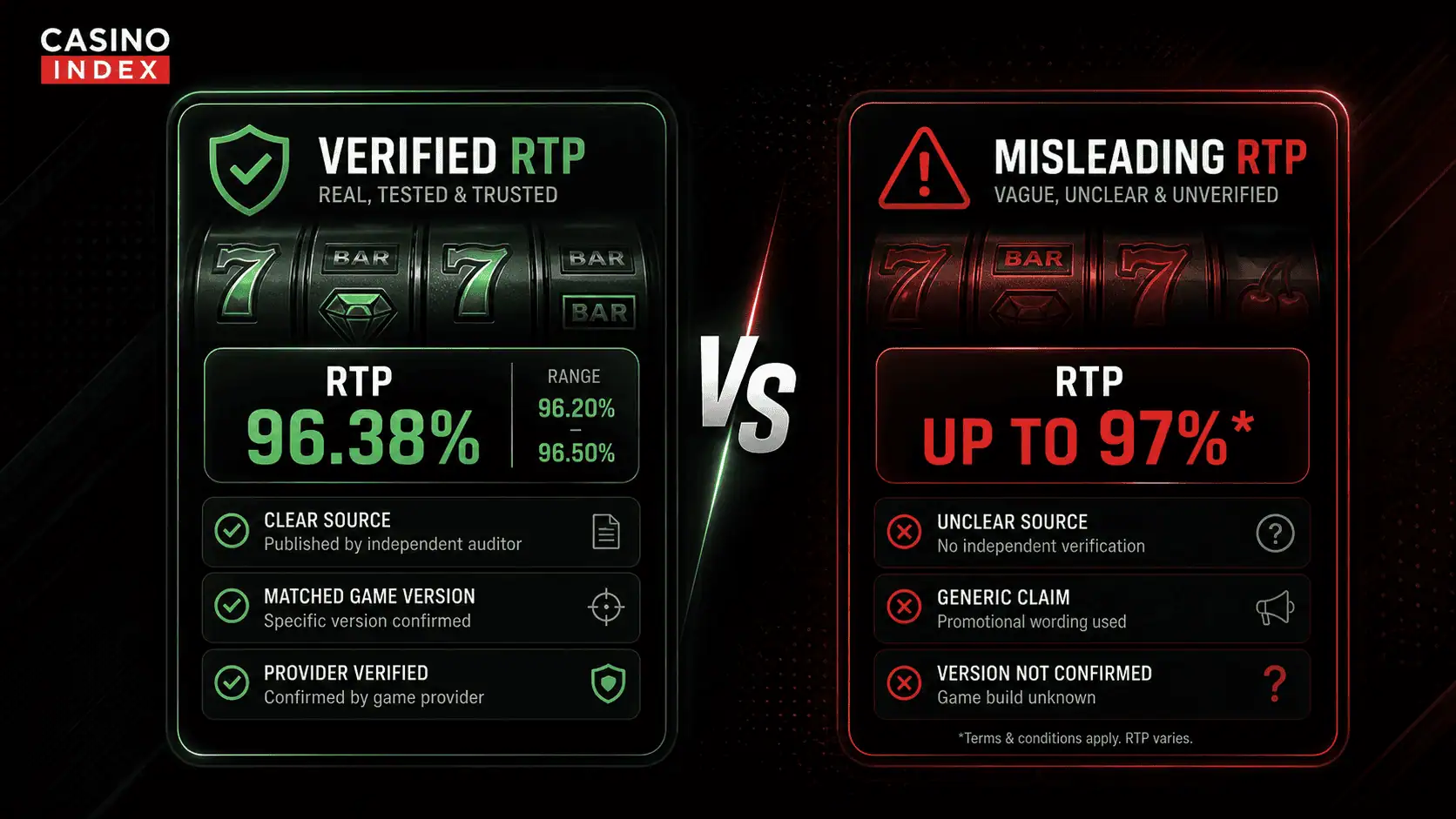
In addition, this guide explains the difference between real RTP and misleading RTP, how casinos and weak review pages create false confidence, why multiple configurations matter and how players can verify return claims before depositing.
For the mathematical background, start with how casino RTP works. This page focuses on the next question: whether the published figure genuinely applies to the game the player is about to use.
Real RTP vs Misleading RTP at a Glance
| Check | Real, Useful RTP | Misleading or Weak RTP |
|---|---|---|
| Game identity | Clear title and provider | Clone, reskin or hidden provider |
| Version | Matches the active real-money configuration | Uses a default, older or more attractive version |
| Source | In-game file, provider documentation or verifiable testing material | Copied table, vague casino badge or unsupported review claim |
| Context | Explained as a long-run theoretical return | Presented as a personal payout expectation |
| Casino trust | Treated as one part of a wider assessment | Used as proof that the entire operator is safe |
Ultimately, the central difference is verification. A strong figure survives basic checks. By contrast, a weak claim loses credibility as soon as the player asks which game version, source and real-money environment it describes.
Why RTP Gets Misunderstood So Easily
On the surface, RTP sounds simple.
For example, a player sees 96% RTP and assumes that every $100 wagered should return about $96. However, casino games do not settle that calculation inside one short session.
RTP describes a theoretical long-run return across a very large number of rounds. It forms part of the game’s mathematical design. Therefore, it does not promise a result for one deposit, one day or one individual account.
That gap between mathematical theory and personal experience creates the first misunderstanding.
The second problem comes from presentation. Casinos and affiliate-style pages often use RTP as a quick trust shortcut because the number sounds technical enough to stop players asking harder questions.
A player may see:
- a recognised provider logo
- a high return percentage
- a polished game tile
- a “best payout” label
- a ranked list with exact decimal figures
Those elements can look reassuring. Nevertheless, they do not confirm whether the game version matches the published figure, whether the source remains current or whether the casino behaves fairly when the player requests a withdrawal.
As a result, RTP should never act as a complete trust signal on its own.
What Real RTP Actually Means
In practice, a reliable RTP figure usually has four characteristics.
1. It belongs to a genuine game
First, the number should refer to a real game from an identifiable provider.
If the casino offers a suspicious clone, an unlicensed copy or a reskinned title with unclear ownership, the published return becomes difficult to trust. A polished percentage cannot compensate for a game whose identity remains uncertain.
Therefore, players should confirm the provider inside the game window rather than relying only on the casino lobby tile.
2. It matches the exact version in use
This is one of the largest blind spots in slot research.
A title may exist in more than one approved RTP configuration. A player then searches online, finds the most widely quoted figure and assumes that every casino uses it.
That assumption can be wrong.
For example, the same visual game may exist at 96.5%, 95% and 94%. The theme, symbols and bonus round may look identical. Nevertheless, the long-run cost changes.
Consequently, a review page that quotes the best-known version without checking the active casino configuration gives the player a cleaner picture than the real-money game supports.
This does not always prove deliberate fraud. However, it still creates misleading information.
3. It comes from a credible source
Moreover, a useful RTP figure should come from a source with a direct connection to the game.
Stronger sources include:
- the in-game help file or paytable
- official provider documentation
- a regulated game-information screen
- recognised testing or certification material
- a research page that clearly explains its source and limitations
By contrast, many RTP pages simply copy one another. They recycle old percentages, repeat provider defaults and publish neat tables without explaining whether the figures match current live versions.
Precision alone does not create reliability. In fact, an unsupported figure shown to two decimal places can create more false confidence than a cautious range with a clear source.
4. It includes the right context
Nevertheless, even an accurate figure can mislead when the explanation removes important limits.
A trustworthy description should make clear that:
- RTP is theoretical
- short-term results can vary heavily
- volatility affects the session experience
- hit frequency affects how wins appear
- total wagering matters more than the original deposit
- a strong percentage does not prove operator quality
In other words, honest RTP content explains both the number and the limits of the number.
What “Fake RTP” Usually Means
Importantly, fake RTP does not always mean that a casino typed a random percentage into the lobby.
Sometimes outright invention may occur. More often, misleading RTP appears through softer methods that remain easier to defend and harder for casual players to notice.
| Type | How It Works | Why It Misleads |
|---|---|---|
| Wrong-version RTP | A real figure from another configuration appears beside the active game | The percentage does not describe the version the player uses |
| Outdated RTP | An old database or provider sheet remains in circulation | The source may no longer match the live product |
| Generic “high RTP” marketing | The casino promotes a category without naming games or sources | The claim creates trust without evidence |
| Clone-game RTP | A copied or reskinned title uses the reputation of a known game | The original provider’s math may not apply |
| Context-free RTP | A real figure appears as if it predicts personal returns | The player mistakes long-run design for a session promise |
Therefore, the word “fake” should not become a careless accusation. The more useful distinction is whether the claim remains accurate, relevant and verifiable in the exact environment where the player wagers real money.
Fake RTP Type 1: A Real Number Used in the Wrong Place
For example, this is one of the most common patterns.
The percentage may be accurate somewhere. For example, it may belong to:
- the provider’s default configuration
- the highest-return version
- an older release
- a demo environment
- a public database entry without casino-level detail
However, the casino or review page then presents that number as if it automatically applies to the live real-money game.
That is where the information stops being reliable.
The figure looks legitimate because the underlying number exists. Nevertheless, the connection between that figure and the active product remains unproven.
Fake RTP Type 2: “High RTP” Marketing Without Evidence
Similarly, casinos often use phrases such as:
- high RTP games
- top payout slots
- best return titles
- high-paying casino library
That language sounds useful. However, it often functions as ordinary promotional copy.
A credible claim should identify the relevant games, show the actual percentages and explain the source. In addition, it should make clear whether the figures apply to the versions currently available in the casino.
When a page remains generic and never becomes game-specific, players should treat it as marketing rather than evidence.
Fake RTP Type 3: Precise Review Tables Without Verifiable Sources
Moreover, this problem appears frequently in gambling SEO.
A page filled with exact percentages looks authoritative. It appears researched and objective. However, the presentation may hide weak sourcing.
Many RTP lists rely on copied databases, old provider values or recycled affiliate content. Some pages display decimal-level precision while never checking whether the number matches a current real-money version.
As a result, the table creates certainty that the research process did not earn.
A precise number is not automatically a trustworthy number.
CasinoIndex therefore treats RTP as part of a wider trust structure rather than a standalone ranking shortcut. The CasinoIndex ranking methodology places operator trust and payout behaviour ahead of surface metrics.
Fake RTP Type 4: Interface-Led Trust Manipulation
By contrast, some casinos do not prove return rates well. Instead, they present them well.
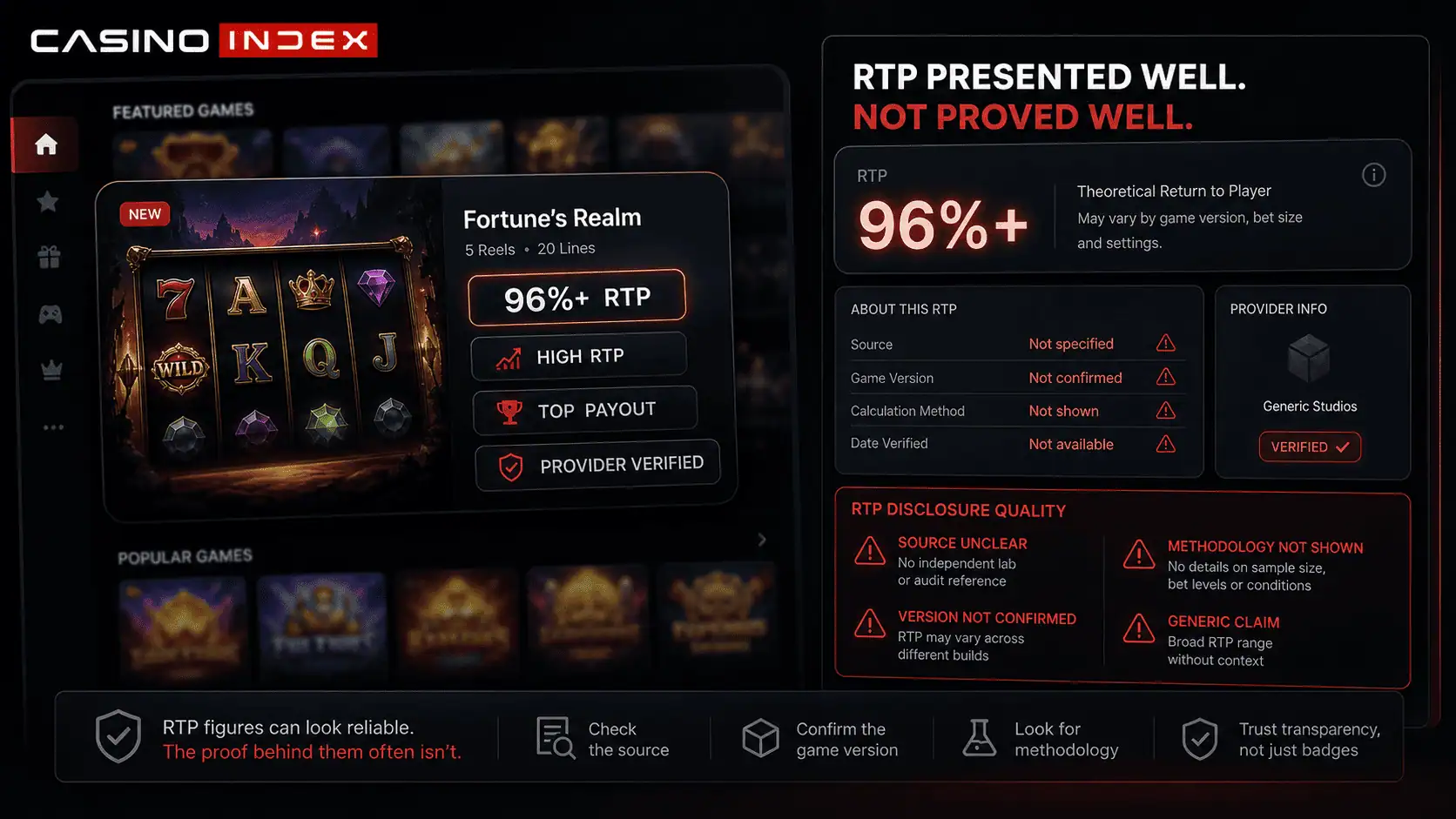
The interface may include:
- clean RTP badges beside game tiles
- polished “best payout” sections
- floating percentages without a source
- provider logos beside vague return claims
- filtered high-RTP pages without a published methodology
A strong interface can make weak information feel reliable. Consequently, visual order may reduce hesitation before the player deposits.
However, interface quality and data quality are different things. A professional layout should guide the player toward the source, not replace the source.
Multiple RTP Versions: The Problem Most Players Miss
Meanwhile, many players still treat RTP as a permanent property of a slot title.
In practice, some providers distribute the same game with several mathematical settings. The operator may then select one configuration for its lobby.
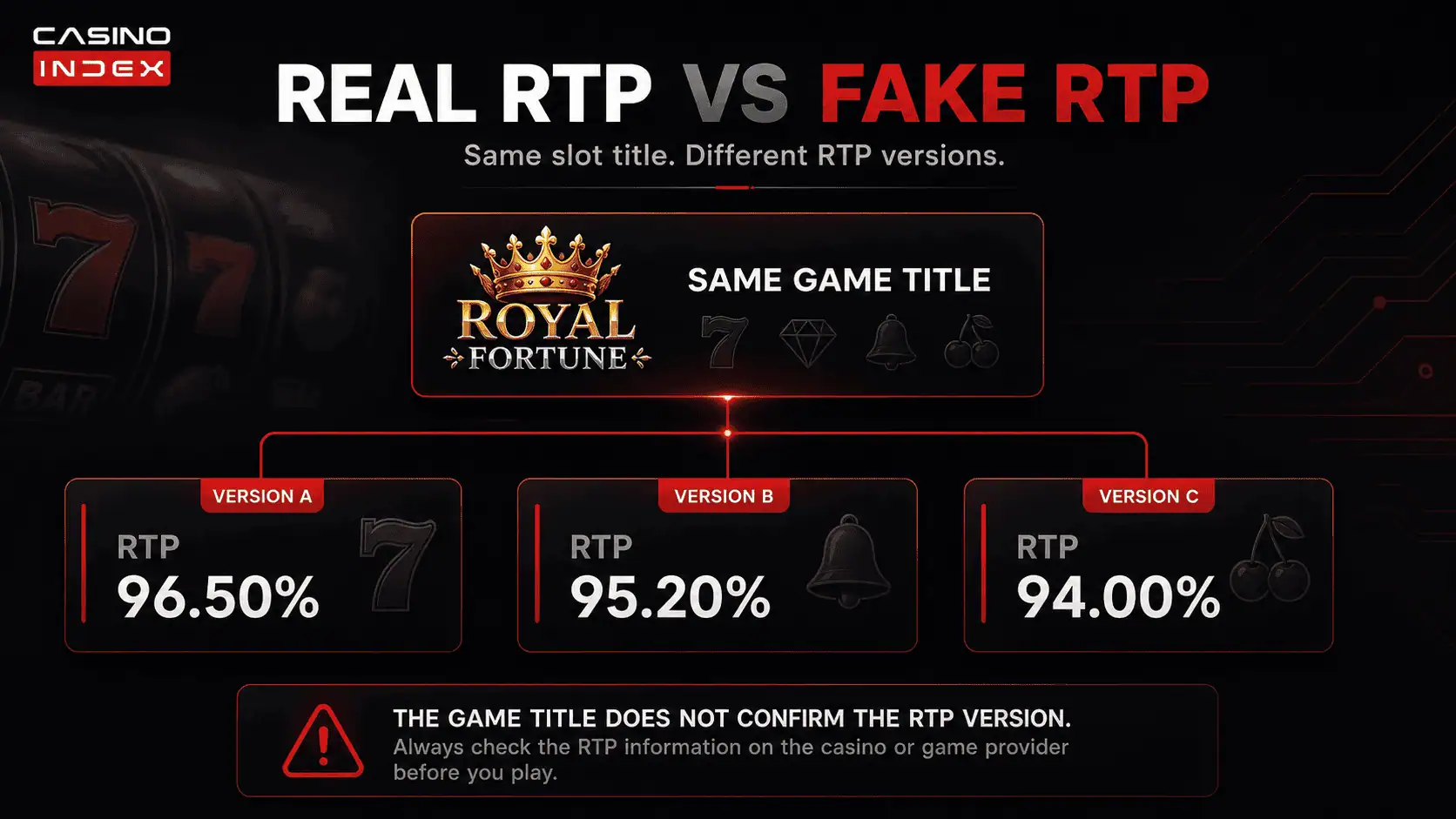
This creates a major research problem. Once players assume that one public percentage belongs to the game everywhere, casinos and weak review pages can keep quoting the most attractive version without proving that it matches live use.
If a title has several configurations, then:
- the game name alone is not enough
- an old review table is not enough
- a provider logo is not enough
- a lobby badge is not enough
- a search-result snippet is not enough
Players need version-level confidence.
Without that link, the figure may remain mathematically real somewhere while becoming practically misleading on the player’s screen.
Why Provider Reputation Still Matters
Although provider reputation cannot prove the exact RTP version on its own. Nevertheless, it remains an important part of game verification.
Established studios usually give players more ways to confirm:
- the game’s identity
- available rules and paytables
- possible RTP configurations
- testing or certification references
- official support documentation
By contrast, an unknown provider with hidden ownership and no accessible game information gives the player fewer verification routes.
Therefore, the provider acts as a starting point rather than final proof. CasinoIndex explains why provider reputation still matters, especially when players need to separate genuine titles from clones, reskins and unsupported lobby claims.
Real RTP vs Misleading RTP: The Practical Difference
Ultimately, the simplest distinction is this:
A real and useful RTP figure survives verification. A misleading figure does not.
Real RTP is:
- tied to a genuine game
- linked to the exact version in use
- supported by a credible source
- explained as theoretical rather than guaranteed
- treated as one factor within a wider trust assessment
Misleading RTP usually breaks one or more of those conditions.
Sometimes the percentage is false. More often, it is borrowed, generalised, outdated or displayed without enough context to remain useful.
Therefore, the dividing line is not whether a number appears on the page. The dividing line is whether the number still holds up once the player checks it.
Why a Real RTP Number Still Does Not Make a Casino Safe
Nevertheless, even when the game figure is accurate, the operator can still create serious player risk.
A mathematically reasonable game inside a weak casino can lead to problems through:
- withdrawal delays
- selective verification
- unclear payment limits
- vague bonus restrictions
- weak support
- poor complaint handling
- unclear ownership or licensing
That is why CasinoIndex never places RTP above operator trust.
A credible operator gives the game figure a stronger environment through clear ownership, recognised providers, transparent terms and predictable payout procedures. Conversely, a weak operator reduces the practical value of even accurate game mathematics.
CasinoIndex explains why RTP is only one trust signal. Players should also review how casino licensing affects player protection before treating a technical game metric as proof of platform safety.
The Other Trap: Real RTP, Wrong Expectations
In some cases, the number is correct, but the player’s expectation is not.
A player sees 97% RTP and assumes:
- the game is safe in the short term
- losses should remain small
- a bad session indicates manipulation
- the balance should return toward the percentage quickly
- the game offers protection against volatility
None of those conclusions follows automatically.
RTP measures long-run return. Meanwhile, volatility, hit frequency, feature structure, stake size and session length shape the short-term experience.
A high-RTP game can still produce a severe losing session. Likewise, a lower-RTP title can feel smoother for a short period. The smoother result does not make the second game mathematically better; it simply shows why one number cannot describe the entire session.
Weak marketing benefits when players confuse RTP with short-term safety. Once a percentage appears to prove fairness, the operator faces less pressure to explain the rest of the risk.
How Casinos Make RTP Look Stronger Than It Is
Selective highlighting
The casino promotes only the most attractive return rates while leaving the rest of the library unclear. As a result, players may assume the highlighted games represent the entire platform.
Provider borrowing
The casino leans on the reputation of recognised studios without making the exact game version easy to verify. Although the provider may be genuine, the operator still needs to disclose the active configuration.
Mixing RTP with rewards
Casinos sometimes blend RTP with cashback, reloads, loyalty points and bonus value.
These features are not the same.
RTP belongs to the game mathematics. Cashback and bonuses are separate promotional mechanics with their own limits, wagering rules and eligibility conditions. Therefore, a reward programme does not change the underlying return rate unless the operator can demonstrate a separate calculation clearly.
“Best payout” language without a method
A claim about the best-paying games needs a method, source and time frame. Without those elements, the phrase remains sales copy.
Using category averages as game-specific proof
A casino may describe a provider or game category with an average return, then allow players to assume that the figure applies to every included title. However, category-level data cannot replace the exact information for one active game.
How to Check Whether RTP Is Real Before You Trust It
Fortunately, players do not need to turn every session into a forensic investigation. However, they do need a repeatable process.
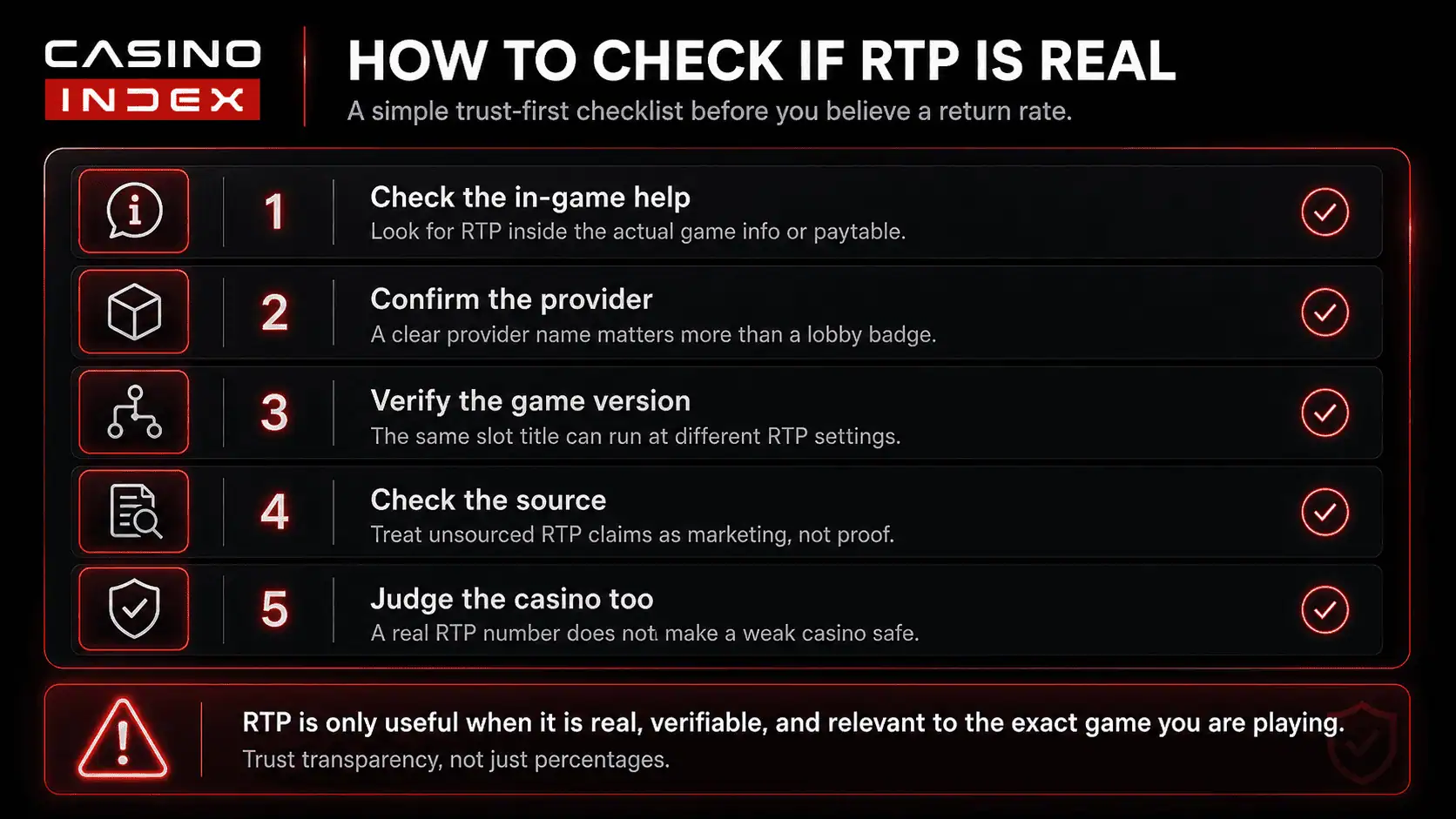
- Open the in-game help file. Look for RTP, rules, paytable and provider information inside the real-money version.
- Confirm the provider. Make sure the studio name matches the genuine title rather than a clone or reskin.
- Check for multiple versions. Search official documentation or reliable provider-level references.
- Compare credible sources. A provider page, in-game file and well-sourced guide should not contradict one another without explanation.
- Separate game math from casino trust. Review ownership, licensing, withdrawals, terms and complaint patterns.
- Save evidence when the difference matters. A screenshot of the in-game information can help if a later dispute concerns the advertised version.
Check the in-game information first
The active game file usually gives more useful evidence than a floating casino badge. Therefore, players should start inside the product rather than on the promotional page.
Use provider documentation carefully
Provider information can confirm that several configurations exist. However, it may list possible versions rather than identify the one selected by a particular casino.
Treat generic “high RTP” pages as promotion
When a page never names the game, version or source, it does not provide enough information for verification.
Ask whether the casino deserves trust anyway
This is the final filter. Even a correct figure cannot repair a weak operator environment.
Red Flags Behind Weak RTP Claims
Of course, no single warning sign proves fraud. However, several signals together create a pattern that players should not ignore.
- percentages displayed without a source
- exact-looking RTP tables copied across unrelated sites
- game titles shown without clear provider information
- “high payout” claims without version transparency
- casino interfaces that display return rates but explain nothing
- provider reputation used as a substitute for exact verification
- weak operators leaning heavily on RTP as a trust shortcut
- cloned or suspicious game environments
- return percentages described as short-term payout expectations
- support unable to identify the source of the advertised number
Several connected warning signs justify a smaller deposit, an early withdrawal test or avoiding the casino entirely.
RTP Only Works Inside a Trustworthy Environment
In short, RTP is not useless. It is simply limited.
A reliable percentage can help players compare games, understand long-run cost and avoid clearly weaker versions. However, it cannot decide whether the casino deserves a deposit.
That wider decision requires:
- genuine providers
- clear ownership
- credible licensing
- transparent terms
- predictable withdrawals
- accountable support
- complaint patterns that the operator addresses consistently
Without those factors, RTP becomes another technical-looking number that the player is expected to admire before depositing.
That is why return-rate research belongs beside the casino scams and misleading trust signals guide, not only beside slot mechanics.
A Practical RTP Verification Checklist
| Step | Question | Stronger Signal |
|---|---|---|
| 1 | Is the game genuine? | Clear title and identifiable provider |
| 2 | Does the figure match the active version? | RTP visible inside the real-money game |
| 3 | Can the source be checked? | Provider, paytable or recognised testing reference |
| 4 | Does the explanation include context? | Long-run return, volatility and limits explained |
| 5 | Is the casino itself credible? | Clear ownership, rules and withdrawal process |
As a result, if the page fails several steps, the RTP claim should not influence a deposit decision.
Final Verdict: RTP Helps Only When Players Can Verify It
In conclusion, the difference between real RTP and fake RTP is not simply whether a percentage is technically correct somewhere.
The real standard is whether the figure remains accurate, verifiable and relevant to the exact game the player opens with real money.
A reliable RTP figure:
- belongs to a genuine game
- matches the active version
- comes from a credible source
- includes the correct long-run context
- sits inside a broader operator assessment
Conversely, a misleading figure usually fails at least one of those tests.
Occasionally, the percentage is invented. More often, it is borrowed, simplified, outdated or wrapped in enough polished design to feel stronger than the evidence behind it.
Therefore, serious players should treat RTP as a useful filter rather than a full trust signal.
Therefore, a good figure can help evaluate a game. It cannot decide whether the casino itself deserves the player’s money.
Frequently Asked Questions About Real and Fake RTP
What is real RTP?
Real RTP is a return percentage that belongs to a genuine game, matches the active version and comes from a source the player can verify.
What does fake RTP mean?
It can mean an invented figure, but it more often describes a real percentage used for the wrong version, an outdated source or a claim presented without enough context.
Can the same slot have different RTP versions?
Yes. Some providers release several approved mathematical configurations for the same visual title.
Where should players check RTP?
The active in-game help file or paytable usually provides the strongest starting point. Provider documentation can then add context.
Does a provider’s default RTP apply at every casino?
No. The provider may offer several configurations, and the operator may select a different version.
Can a high RTP game still lose quickly?
Yes. RTP describes long-run return, while short sessions remain exposed to volatility and random outcomes.
Does real RTP prove that a casino is safe?
No. Players must still assess ownership, licensing, terms, withdrawals, support and complaint handling.
Are polished RTP badges reliable?
Only when the badge connects to a verifiable game version and credible source. Design alone does not prove data quality.
Should players trust RTP tables on review sites?
Only when the page explains its sources, version limitations and update process. Exact numbers without verification can create false confidence.
What should a player do when the casino and provider figures differ?
The player should pause before wagering, check the active game file and ask the casino to explain which configuration it uses.

Nina Kanu has worked in cryptocurrency content and blockchain research since 2016. She is also known within parts of the crypto community through CryptoMutant, where her work has covered emerging projects, market trends and developments across the blockchain ecosystem. At CasinoIndex, Nina focuses on crypto casino reviews, platform comparisons, player experience, game ecosystems and bonus fairness. Her research examines how casino products perform beyond their marketing, including usability, payment options, promotional terms and the overall experience players receive after signing up.