How Casino Payment Matching Rules Work
Payment matching is one of the least understood parts of casino withdrawals.
Most players only notice it when a payout stops feeling simple. They deposit with one method, try to cash out through another, and suddenly the casino starts asking questions. At that point, the withdrawal route stops looking like a simple cashier choice and starts looking like part of the account’s payment history. That is why support keeps pointing back to the original deposit instead of treating every available method as freely interchangeable.
This is where payment matching becomes important.
In practice, it means the casino wants the withdrawal route to make sense compared with the deposit trail already attached to the account. Sometimes that means sending funds back to the same card or e-wallet. Sometimes it means using the same crypto route. In other cases, it means checking ownership, name consistency, and whether the selected payout method fits the account’s verified payment history.
This is not just a cashier preference. It sits at the intersection of fraud prevention, anti-money laundering controls, chargeback risk, and payout compliance. That is why why casinos want the same payment method is not really about convenience. It is about risk.
For players, the practical issue is simple. A mismatch between deposit and withdrawal method can turn a normal payout into a manual review. The balance may be real, the win may be legitimate, and the account may still get slowed down because the payment trail no longer looks clean enough.
This guide breaks down payment matching rules explained in plain English, including same-method rules, card reversals, e-wallet and crypto wallet checks, and the most common card and wallet withdrawal restrictions players run into when they try to cash out.
Best Picks for Players Who Want Cleaner Payment Routing
If you care about smoother payment handling, these three are useful reference points for this topic.
| Casino | Best for | Why it fits this topic | Best next step |
|---|---|---|---|
| Rainbet | Players who want a more crypto-native payment flow | Better fit for users who prefer cleaner crypto routing over older banking friction | Read the Rainbet casino review |
| BetFury | Players who want broad crypto usability with lower traditional payment friction | Useful for users who expect wallet-based cashout logic to feel more natural | Read the BetFury casino review |
| Gamdom | Players who want a modern crypto-first environment with simpler method expectations | Stronger fit for players who are less dependent on mixed fiat-and-wallet payment chains | Read the Gamdom casino review |
These are not identical recommendations.
Rainbet makes the most sense for players who want the cleanest crypto-style routing logic. BetFury is useful for users who care about broader crypto usability but still want payment structure to feel practical. Gamdom fits players who prefer a modern crypto-first account flow where payment matching usually feels more straightforward than older fiat-heavy setups.
If you want the wider cashier framework behind this topic, compare this guide with why casinos want the same payment method and how payout methods are checked.
What Payment Matching Actually Means
Payment matching is the rule that a withdrawal should return through the same method, or through a method clearly linked to the same player, as the deposit.
The cleanest example is simple. A player deposits with an e-wallet in their own name and later withdraws to the same e-wallet. That is easy for the casino to understand. The funding source and the payout destination align.
The messy version is also simple. A player deposits with one card, another card appears later, an e-wallet gets added, then the withdrawal request goes to a different route entirely. Even if the player is honest, the account now looks harder to verify.
That is why payment matching rules explained always comes back to one principle: the casino wants a traceable path between the money that entered the account and the money leaving it.
This does not always mean the exact same payment tool must be used. But it does mean the casino wants the route to make sense.
Why Casinos Want the Same Payment Method
Casinos usually defend same-method rules for four reasons:
- fraud prevention
- chargeback control
- anti-money laundering compliance
- account ownership verification
The first issue is fraud. If anyone could deposit with one route and withdraw to another unrelated route without checks, stolen payment instruments would be much easier to abuse.
The second issue is chargebacks, especially with cards. Cards create reversal risk in a way crypto does not. That is one reason casinos often want card-related flows to stay tightly controlled.
The third issue is AML. A casino does not want to look like a payment-washing layer where funds move in through one route and out through another without a clear ownership trail.
The fourth issue is identity. The more consistent the payment pattern looks, the easier it is for the casino to confirm that the account belongs to one real person using their own money.
This is the real answer to why casinos want the same payment method. It is not because the cashier was designed to annoy players. It is because mixed payment flows create more risk for the operator.
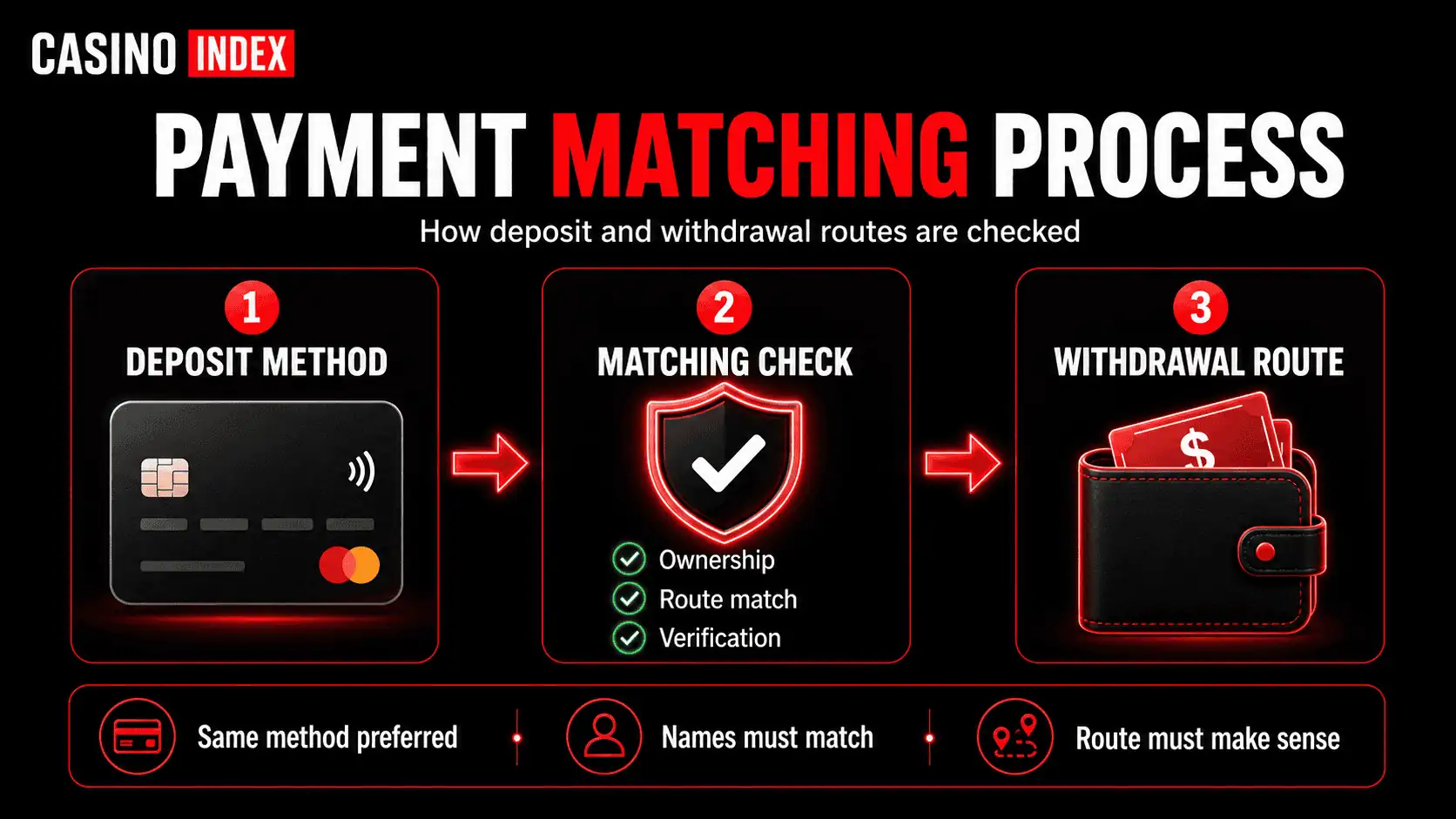
The Same-Method Rule: What It Usually Looks Like
The exact rule varies by casino and method, but the structure is usually familiar.
A player deposits with method A. The casino expects at least part of the withdrawal to return through method A first, before alternative methods are allowed.
That often means:
- deposit by card, then withdraw back to that card if possible
- deposit by e-wallet, then withdraw to that same e-wallet
- deposit by bank transfer, then withdraw to the linked bank account
- deposit by crypto wallet, then withdraw to the verified crypto route or wallet destination
Sometimes the casino will allow a different method later, but only after the original deposit value has been returned or after the original method is shown to be unavailable for withdrawals.
That is why players who mix methods often run into friction. The problem is not only KYC. The problem is the payment path no longer looks clean enough.
Card Reversals: Why Cards Are the Most Restrictive Case
Cards create the most confusion because deposits and withdrawals do not behave the same way.
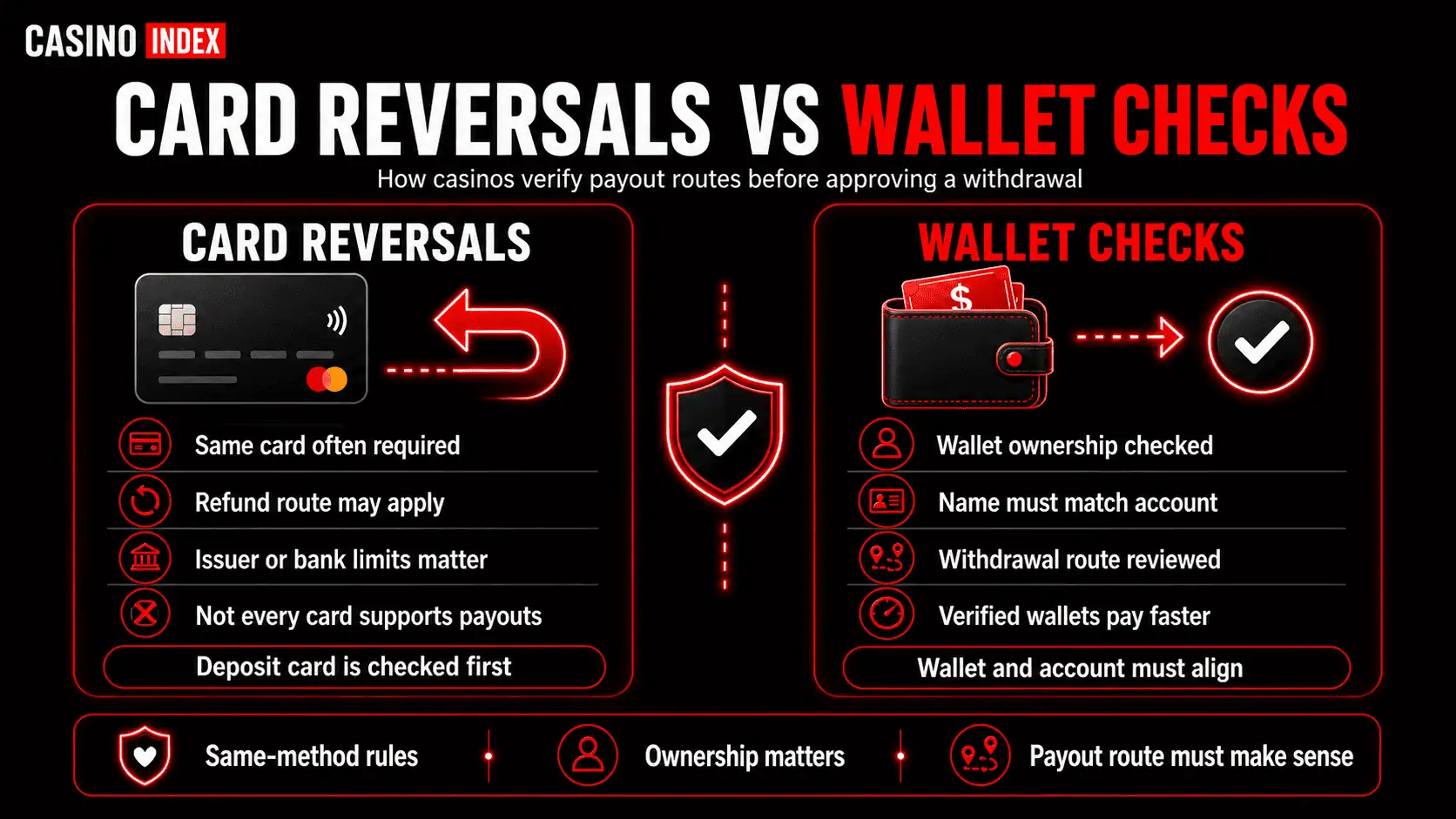
In many cases, casinos try to send funds back to the same card first. This is commonly called a card reversal or refund-style return. The idea is that the original deposit route is used to move money back to the same source before any alternative payout method is offered.
This is where many card and wallet withdrawal restrictions start.
A player may deposit with a card and assume they can later cash out to an e-wallet or bank account of their choice. The casino may say no. It may insist that the card deposit value be returned first, or it may block alternative methods until card-route checks are completed.
Why card reversals exist
Card reversals exist because cards are one of the highest-risk payment tools for chargebacks and third-party misuse.
If a casino lets a card deposit come in, then sends winnings straight to another route with no matching logic, it creates a much weaker payment trail. That makes fraud and compliance control harder.
Why card payouts are often awkward
Cards are restrictive because a smooth deposit does not guarantee an equally smooth withdrawal path. A card may accept casino deposits without friction, while refunds or return payments are limited by issuer policy, banking rules, or the way gambling transactions are handled.
That is why players often hit this pattern:
- deposit by card
- try to withdraw by wallet or bank
- casino asks for proof of card ownership
- casino attempts a card return or insists on a matching route first
- only after that does another method become available
This is normal from the casino side, even if it feels frustrating from the player side.
E-Wallet Matching: Cleaner Than Cards, Still Strict
E-wallets usually feel smoother than cards, but casinos still treat them as ownership-sensitive payout tools.
If a player deposits with an e-wallet, the casino usually wants to see the withdrawal go back to that same wallet, or at least to a wallet under the same verified identity.
That means the casino may check:
- wallet account ownership
- registered name
- linked email
- payment history on the account
- whether the wallet is available for both deposit and withdrawal
This is where how payout methods are checked becomes practical. The casino is not only looking at the wallet itself. It is checking whether the wallet fits the verified player profile.
Same-name verification matters
Many casinos require the wallet name and the casino account name to match. If the e-wallet is under another person’s name, even for innocent reasons, the withdrawal can be blocked.
This is one of the simplest payment matching rules and one of the most common reasons honest players still get delayed.
Crypto Wallet Matching: Less Banking Friction, Not No Review
Crypto reduces banking friction, but it does not remove payment matching logic.
A crypto casino may feel more flexible because blockchain transfers are cleaner than card and bank rails. But that does not mean the casino ignores payout route checks. It may still review:
- which coin was used to deposit
- whether the withdrawal request fits the account’s funding pattern
- whether the destination wallet raises risk concerns
- whether the account suddenly switched from one route to another
- whether source-of-funds or account ownership questions appear
Crypto matching is often softer than card matching, but it is not absent.
That is why players should not confuse crypto-friendly with review-free. The casino still wants the transaction path to make sense.
When Casinos Allow a Different Withdrawal Method
Casinos do sometimes allow a different withdrawal method, but usually under conditions.
The most common cases are:
- the original payment route cannot receive withdrawals
- the card only supports deposits, not payout returns
- the e-wallet is unavailable for regulatory or provider reasons
- the player has already satisfied a return-to-source rule
- the alternative method is verified in the same player name
- the casino’s terms explicitly allow a fallback payout route
This is where support often tells players to provide extra documents. The casino wants proof that the new method still belongs to the same verified person and does not break the payment trail logic.
A different method is possible in many cases. But it usually becomes a controlled exception, not a free choice.
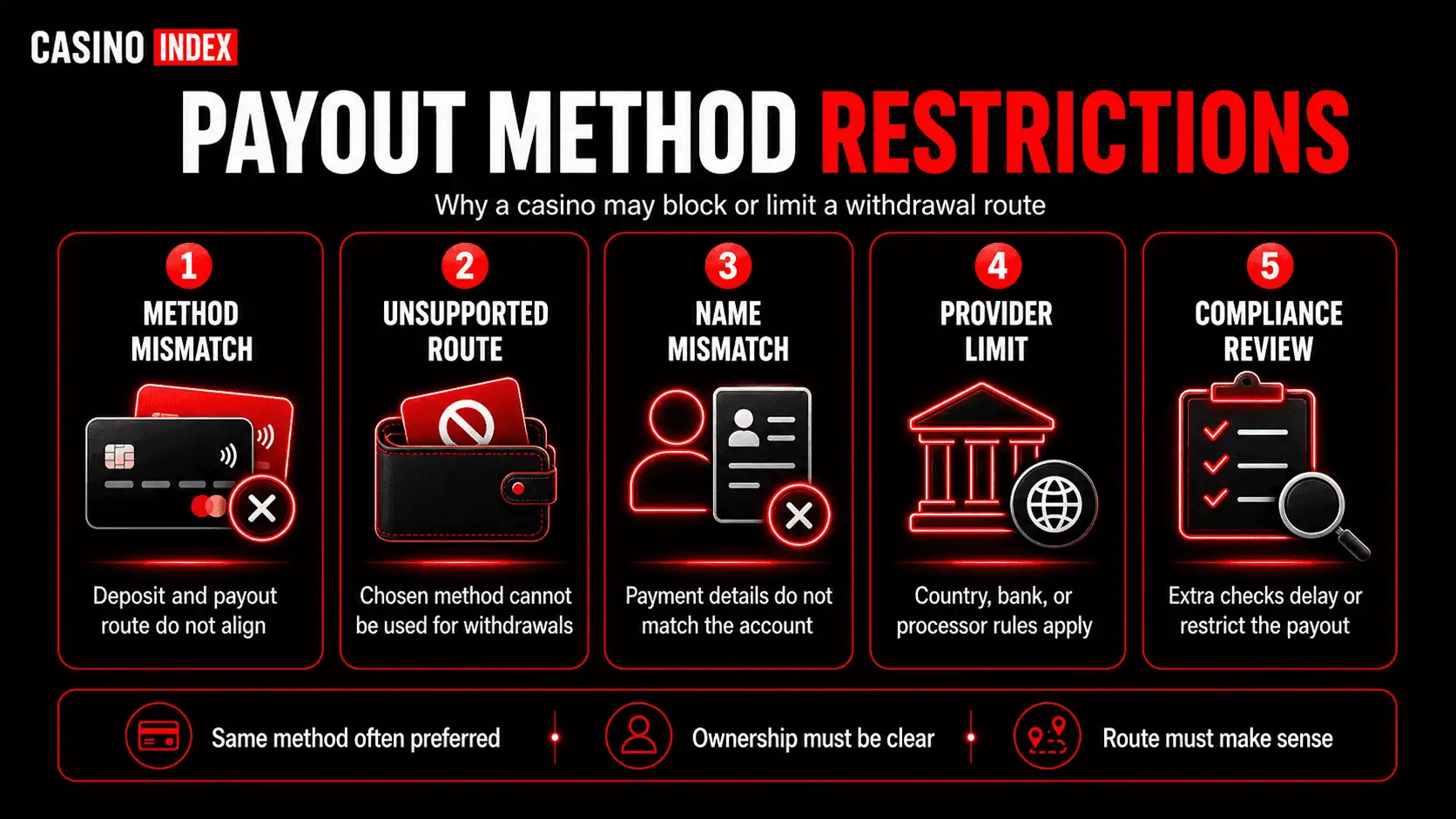
Common Card and Wallet Withdrawal Restrictions
The most common card and wallet withdrawal restrictions are more predictable than players think.
Here are the ones that appear most often:
| Restriction | What it means in practice | Why the casino applies it |
|---|---|---|
| Same-method preference | Withdrawal is expected to return through the deposit route first | Keeps the payment trail cleaner |
| Same-name rule | Payment account must match casino account name | Prevents third-party payment use |
| Card reversal first | Deposit amount may need to go back to the card before another method is used | Reduces chargeback and AML risk |
| Wallet ownership proof | The casino may ask for screenshots or account proof | Confirms the wallet belongs to the player |
| Different-method block | A new payout route may be rejected until verified | Stops mixed-route abuse |
| Return-to-source logic | The casino prioritizes sending funds back through the original funding route | Keeps compliance and fraud controls stronger |
None of these rules are rare. They are standard parts of payment control at many casinos.
How Payout Methods Are Checked in Practice
Players often imagine one simple cashier check. Real payout review is usually more layered.
When the casino checks a payout method, it may review:
- whether the method belongs to the verified account holder
- whether the deposit and withdrawal route align
- whether the payment account name matches
- whether the original route supports withdrawals
- whether a fallback method is allowed under the terms
- whether the account activity makes the method change look unusual
- whether the payout route creates extra compliance risk
This is the real answer to how payout methods are checked. It is not one box-tick. It is a mix of identity, payment history, method capability, and risk control.
That is why how payout methods are checked connects directly with verification, not just cashier design.
Why Mixed Payment Methods Create Problems
Players create more payout friction when they mix too many methods too quickly.
A clean account might look like this:
- one deposit route
- one verified owner
- one clear withdrawal destination
A messy account might look like this:
- deposit by card
- second deposit by crypto
- third deposit by e-wallet
- withdrawal request to bank transfer
- different names or unclear payment ownership across methods
Even if all of it is honest, the payment trail becomes harder to read. That makes manual review more likely.
This is why players who care about speed should usually keep payment flows simple.
Review Table: Three Casinos Worth Checking
These three casinos are useful examples for players who care about payment-route logic.
| Casino | Payment-flow fit | Best for | Main watchpoint |
|---|---|---|---|
| Rainbet | Cleaner for players who prefer a more crypto-native payout path | Users who want less old-school banking friction | Mixed-method changes can still trigger review |
| BetFury | Good for broader wallet-focused crypto usability | Players who want stronger crypto payment practicality | Always verify the exact payout route before cashing out |
| Gamdom | Better suited to modern crypto-first payment expectations | Users who want a more straightforward wallet-style flow | Speed still depends on account checks and route consistency |
The practical takeaway is simple.
Rainbet is the best fit for players who want the cleanest crypto-style payment flow. BetFury suits users who value broader wallet usability. Gamdom works well for players who want a more modern payout setup but still need to respect route consistency.
How to Avoid Payment Matching Problems Before You Withdraw
Most payment matching issues are avoidable.
The easiest way to reduce friction is to keep the account payment trail simple from the start.
1. Use your own payment methods only
Do not deposit from cards, wallets, or bank accounts that belong to someone else.
2. Avoid mixing too many methods
The more routes you use, the more review logic you create.
3. Check whether the deposit method also supports withdrawals
Some methods look easy on the deposit side but create complications later.
4. Verify the method early
If the casino supports wallet or card verification before withdrawal, do it early.
5. Read the fallback payout rules
Do not assume you can choose any withdrawal method just because it appears in the cashier.
6. Keep names consistent
Mismatch between the casino account and the payment account is one of the fastest ways to trigger delay.
This is why players should connect payment matching rules explained with how payout methods are checked.
What Good Payment Matching Looks Like
A strong casino does not hide payment rules until the player wins.
Good payment matching policy usually has these traits:
- clear return-to-source wording
- clear same-name requirements
- visible explanation of fallback methods
- reasonable document requests when a method change is needed
- support answers that match the cashier logic
- faster repeat withdrawals once the route is already verified
The key is predictability. Players do not mind rules as much when the rules are explained early and applied consistently.
What Bad Payment Matching Looks Like
Bad payment matching policy usually shows up as vagueness, not just strictness.
The warning signs are:
- the casino accepts deposits freely but explains payout restrictions only later
- support gives inconsistent answers about which method can be used
- method rules change after a larger win
- fallback routes are technically possible but never explained clearly
- the player is asked for one document after another without a full checklist
- the cashier shows a method as available, then support says it is not allowed
This is where payment matching stops feeling like normal compliance and starts feeling like avoidable friction.
Final Verdict
Why Payment Matching Rules Matter
Casino payment matching rules are not random cashier friction. They exist because casinos want to control fraud risk, payment abuse, chargeback exposure, and anti-money laundering pressure before money leaves the platform.
That is the clean explanation.
The practical reality is that these rules matter most after a player wins. That is when deposit method history, card ownership, wallet control, same-name checks, and withdrawal route consistency stop being background compliance and become a real payout condition.
This is why why casinos want the same payment method matters so much. The casino is not only asking where to send the money. It is checking whether the payout route makes sense compared with the deposit trail already attached to the account.
What Good Payment Matching Looks Like
A strong casino handles that clearly. The player understands which method has priority, when a card reversal applies, when a crypto wallet may be reviewed, and what happens if the original deposit route cannot be used. A weaker casino turns the same process into vague support replies, inconsistent cashier logic, and payout friction that only becomes visible once the withdrawal is requested.
That is the real dividing line.
The safest way to judge payment matching rules explained is simple: can the player understand the payout route before depositing, and does the casino apply those rules consistently after a win?
If the answer is yes, payment matching is just part of a normal withdrawal process. If the answer is no, it starts looking less like compliance and more like unnecessary payout resistance.
The Practical Rule for Real-Money Players
For real-money players, the useful rule is straightforward. Deposit with a method you control, keep your account details consistent, verify early, and never assume the casino will let you freely choose any withdrawal route at the end.
That is how card and wallet withdrawal restrictions become manageable instead of stressful.
In the end, how payout methods are checked tells you a lot about the quality of the casino behind the cashier. A casino that handles payment matching cleanly usually handles withdrawals more cleanly too. A casino that becomes confusing at this stage usually creates bigger problems once the payout amount starts to matter.

Maria Hoffmann has worked in cryptocurrency content and digital publishing since 2017. She is a co-founder of Freecoins24 and CryptoMutant and has covered blockchain projects, crypto platforms and emerging industry trends for several years. She has also been active as a cryptocurrency investor since 2019. At CasinoIndex, Maria combines content research and SEO experience with a focus on casino trust, platform security, withdrawal processes, payment risks and user protection. Her work looks beyond bonuses and product features to examine how gambling platforms handle player funds, verification and account-related risks.