Do Crypto Casinos Really Pay Out?
Do Crypto Casinos Really Pay Out? The Real Withdrawal Test
Crypto casinos do not all fail at the same point.
Most of them work perfectly at the beginning.
The site loads fast. Registration takes seconds. Deposits arrive almost instantly. Games open without friction. The platform feels cleaner than many traditional online casinos.
That early experience is real.
It is also where many players make the wrong judgment.
A crypto casino should not be judged by how easy it is to deposit.
It should be judged by what happens when money needs to come back out.
That is the real question behind this topic.
The issue is not whether a crypto casino looks modern, offers thousands of games, advertises instant withdrawals, or promises no KYC, bigger bonuses and total privacy.
The real question is much simpler:
Do crypto casinos really pay out when the player wins and requests a withdrawal?
Sometimes yes.
Sometimes no.
And the difference usually has less to do with crypto itself than with the structure of the operator behind the site.
That is where most low-quality content gets this wrong. They treat “crypto casino” as if it were one category with one payout reality. It is not.
Some crypto casinos pay fast, consistently and with minimal friction. Others pay small withdrawals smoothly, then become slower, more defensive or more selective once balances rise. Others are built to feel efficient at deposit stage and difficult at payout stage.
This guide looks at the subject through a trust-first lens.
The priority is simple: Trust > Withdrawals > Reputation > Product > Bonus.
If a crypto casino cannot handle withdrawals predictably, it does not matter how clean the UI looks or how attractive the reward system feels. That is also why this topic connects directly to broader guides on how to tell whether an online casino is actually safe, why some casinos delay withdrawals, and how casino withdrawals really work.
Quick Picks: Crypto Casino Reviews Worth Checking First
If you want to compare real brands before reading the full guide, start with review pages that are useful for payout-focused checking.
This table is not a shortcut to trust. It is a better starting point than random homepage marketing.
| Casino | Best for | Why it is worth checking |
|---|---|---|
| Stake review | Bigger brand-scale reference point | Useful for comparing how a large crypto-first platform handles trust, product depth and withdrawal expectations. |
| Bitcasino.io review | Cleaner crypto-casino baseline | Good reference for players who want a more direct crypto-gambling structure without too much front-end noise. |
| Shuffle review | Modern crypto-first environment | Helps compare cleaner UX and reward logic against the more important payout and verification questions. |
| BC.Game review | Broad ecosystem and heavy promo environment | Useful when checking the difference between product scale and actual payout confidence. |
| TrustDice review | Reward-heavy crypto positioning | Strong comparison point if you want to see whether aggressive crypto rewards are backed by reliable structure. |
The point of this table is not to tell you which casino to trust blindly.
It is to give you a better starting point than brand claims, bonus pages or homepage slogans.
The Short Answer
Yes, some crypto casinos really do pay out.
But they do not all pay out in the same way, at the same speed or under the same conditions.
That distinction matters.
A small crypto withdrawal that clears in minutes does not automatically prove that the casino handles larger payouts well. A platform that works smoothly for low-stakes players can still create heavy friction once the account balance becomes meaningful.
A site that markets “instant withdrawals” may still apply manual review, wallet checks, source-of-funds questions, delayed verification or payout limits when the liability gets bigger.
So the better version of the question is not:
“Do crypto casinos pay out?”
It is:
“Which crypto casinos pay out consistently, under pressure, and without changing the rules once the player wins?”
That is where the real separation begins.
Why Crypto Casinos Feel More Trustworthy Than They Sometimes Are
Crypto casinos often create a stronger first impression than fiat casinos.
That is not accidental.
Crypto deposits are fast. Sign-up is light. Payment rails feel direct. The platform looks modern. Wallet-based play feels cleaner than older card-based flows. For many users, the whole system appears more efficient and more transparent.
Some of that is true.
The problem is that fast onboarding can be confused with overall trust.
Those are not the same thing.
A crypto casino can look smoother than a traditional casino while still being weaker where it matters most:
- withdrawal accountability
- verification logic
- legal clarity
- support quality
- terms enforcement
- complaint handling
This is one reason weaker operators are attracted to crypto presentation. It lets them look modern and efficient very quickly.
A polished crypto-first front end can create trust before the player has checked ownership, licensing, payout limits, KYC rules or complaint history.
That is why deposit experience should never be used as proof of payout quality.
In fact, the opposite is often more useful.
The smoother the front-end story sounds, the more carefully the payout side should be checked.
What “Paying Out” Actually Means
Many players use the phrase too loosely.
A crypto casino paying out does not only mean that some withdrawals happen.
It means the payout system remains fair and predictable when the player account stops being low-risk to the operator.
That includes several layers.
Small withdrawals
A lot of crypto casinos can handle these.
That is the easy part.
Small cashouts often clear quickly because the amount is not large enough to create meaningful resistance.
Mid-sized withdrawals
This is where more variation starts to appear.
Some casinos stay smooth.
Others begin to slow down, request documents, move the withdrawal into manual review or check the account more closely.
Larger withdrawals
This is where the real test begins.
A strong crypto casino should still have a clear process here, even if approval is slower than with small withdrawals.
A weaker one often becomes vague, defensive or inconsistent at exactly this stage.
This is also where withdrawal limits can matter once crypto balances get larger. A platform may technically pay out, but still restrict timing, split payments, slow down review or apply limits that change the player’s real experience.
So when players ask whether crypto casinos really pay out, they are usually not asking whether a site can send back a small balance.
They are asking whether the casino still behaves fairly once the money matters.
That is a much harder question.
And it is the only one worth asking.
The Main Difference: Crypto Payments vs Casino Behavior
A lot of confusion in this space comes from mixing up two different things:
- the speed of crypto as a payment method
- the behavior of the casino as an operator
Crypto itself can be fast.
That part is usually not the issue.
If a casino takes hours or days to process a crypto withdrawal, that delay is often not because blockchain payments are inherently slow. It is usually because the casino has placed the withdrawal into an approval process before the payment ever reaches the wallet.
That difference matters.
A casino may advertise:
- instant crypto withdrawals
- same-day payouts
- fast blockchain cashouts
- no banking delays
That can still be misleading if the actual friction happens before the transaction is sent.
Players often think the payment rail is the whole story.
It is not.
The real payout chain looks more like this:
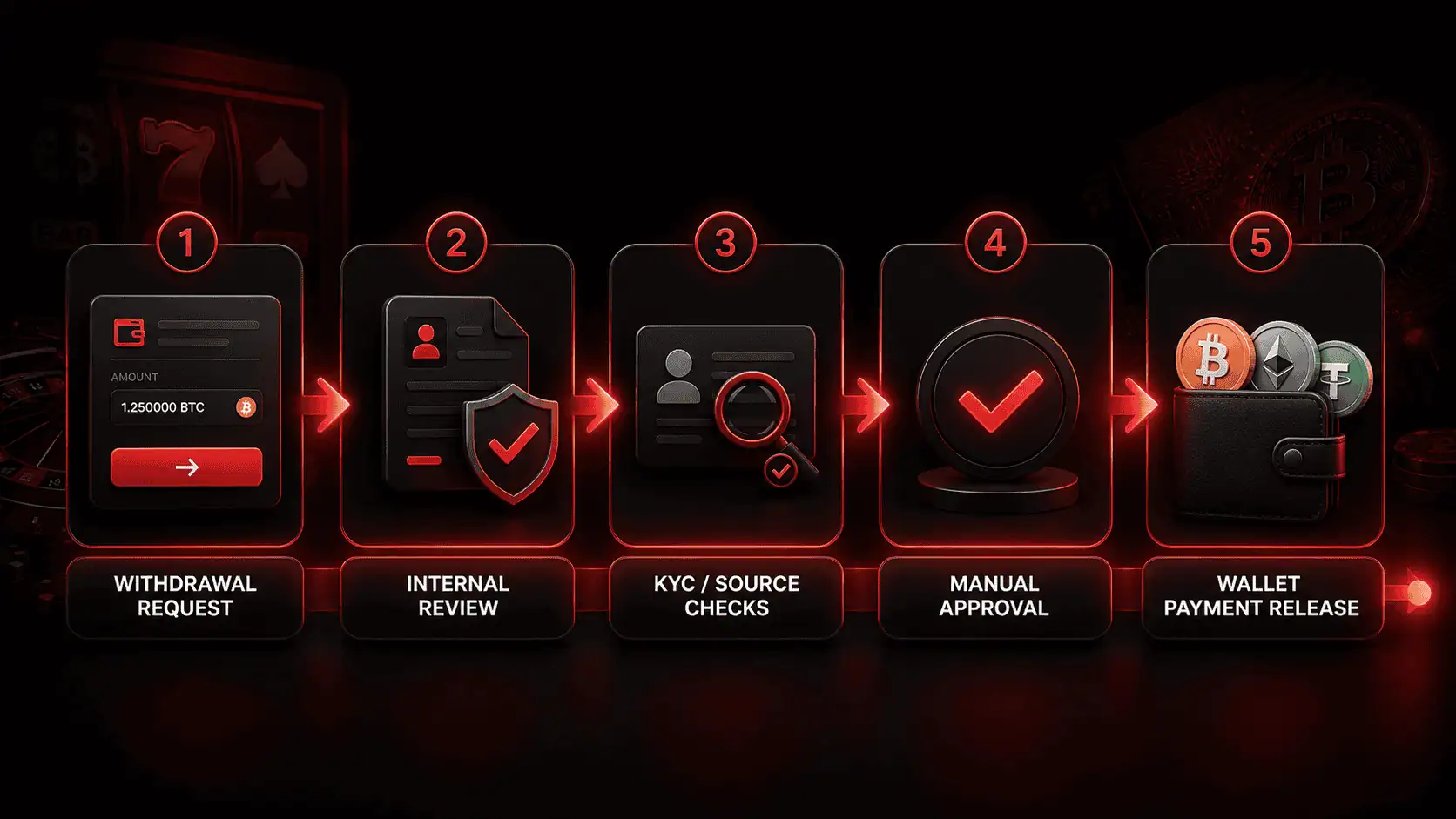
- withdrawal request
- internal review
- possible KYC or source checks
- possible manual approval
- wallet payment release
Crypto helps with step five.
Most payout problems happen in steps one to four.
That is why players should understand what happens before a crypto cashout is approved. The blockchain may be fast, but the casino still controls the approval stage before funds are released.
This is also why players should never confuse crypto efficiency with operator reliability. If you want the broader payment framework behind that distinction, the casino payment methods guide and how to deposit crypto in online casinos are useful supporting reads.
Why Some Crypto Casinos Pay Fast
A good crypto casino usually pays fast for a few clear reasons.
First, the operator is built around crypto from the start.
That means the wallet infrastructure, treasury management and payment flow are part of the product, not an afterthought.
Second, the casino understands that payout speed is part of brand trust.
In crypto gambling, players watch withdrawals closely. A platform that pays well gains reputation faster. A platform that delays payouts starts losing trust quickly, especially in public player communities.
Third, there is often less banking friction.
Traditional casinos dealing with cards, banks, regional payment methods and fiat settlement can face more external processing layers. Crypto removes some of that complexity.
But none of this guarantees safety.
A crypto casino can be built around efficient wallet payouts and still be weak on accountability.
Speed helps.
Structure matters more.
Why Some Crypto Casinos Become Problematic at Withdrawal Stage
This is where the conversation gets real.
A crypto casino usually becomes risky at payout stage in one of five ways.
1. It markets speed, then uses vague review language
This is common.
The site promises instant withdrawals. But once the request is submitted, the balance goes into pending status. Support says the finance team is checking. No clear timeline appears.
Nothing is technically denied, but nothing moves cleanly either.
That is not always a scam signal on its own.
But repeated vagueness around withdrawals is one of the strongest early warnings in the industry.
2. It introduces KYC only when the player wins
This is one of the biggest reasons players distrust crypto casinos.
The onboarding feels light. The deposit flow is instant. The casino may even advertise “no KYC” or low-friction play.
Then the player wins, requests a withdrawal, and the verification process suddenly becomes serious.
Again, the issue is not that KYC exists.
The issue is whether the logic was explained clearly before deposit, or whether verification starts functioning like a payout filter.
That is why this topic connects directly to how casino verification really starts before payout and what to check before trusting a no KYC casino.
3. It handles small payouts well, but larger ones differently
This is another common pattern.
Early withdrawals are smooth. That creates confidence. Then a larger cashout gets delayed, split, capped or subjected to enhanced review.
This is where many players say, “But they paid me before.”
Yes.
That does not always mean they pay reliably under real pressure.
4. It uses broad terms to justify payout resistance
Weak casinos often protect themselves through vague clauses such as:
- irregular play
- bonus abuse
- security review
- compliance concerns
- account investigation
- risk management
Not every use of those terms is dishonest.
But when they appear only once the player tries to withdraw meaningful money, the pattern becomes more revealing.
5. It gives support motion, not progress
The support team replies.
That sounds good.
But the replies do not resolve anything.
The case is escalated. Another team is checking. An email will follow. The review is still ongoing. The player should wait.
That is not always support.
Sometimes it is delay management.
The Most Common Payout Patterns Players See
If you strip away the branding and look at behavior, crypto casinos usually fall into one of these payout profiles.
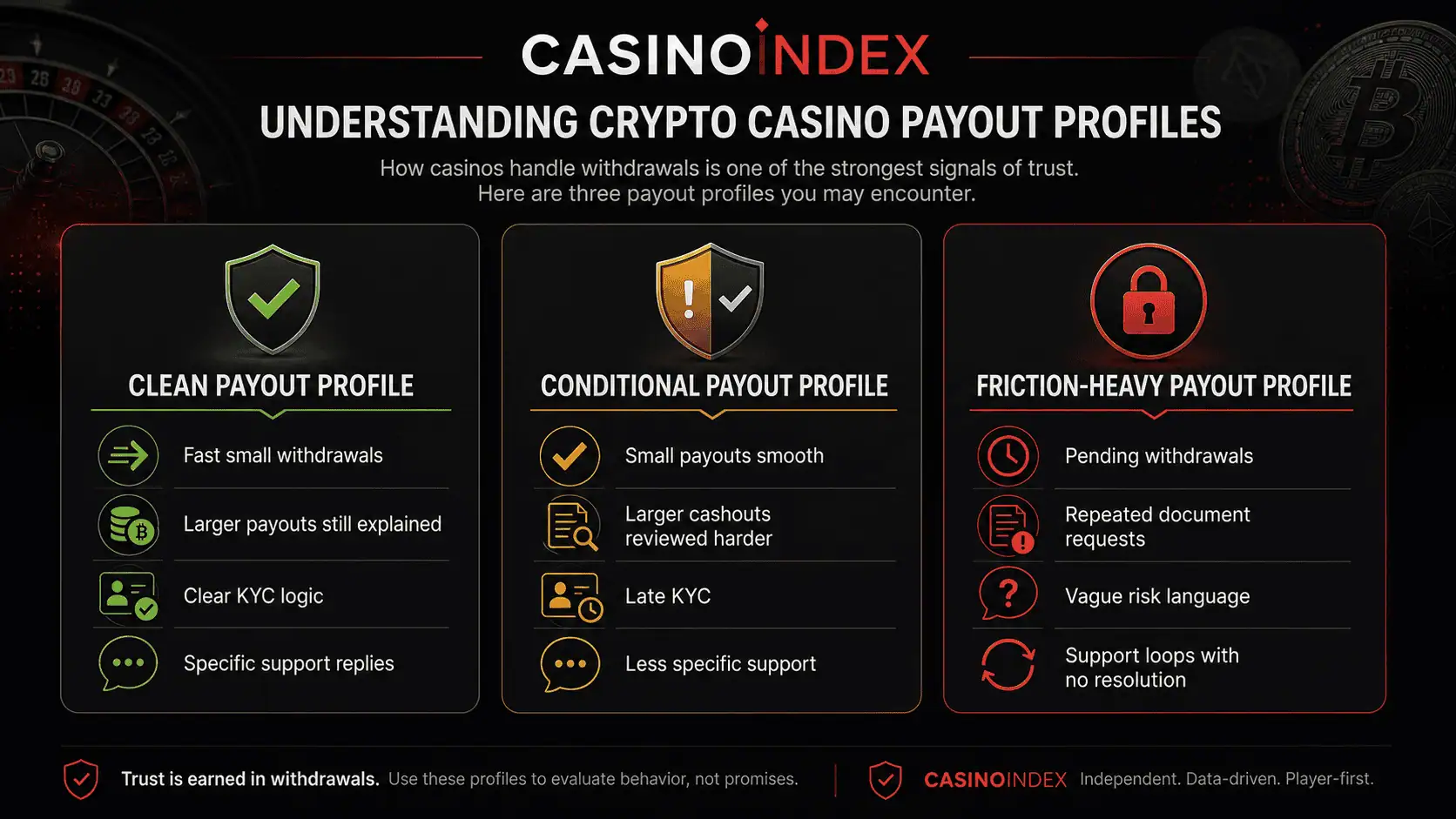
Clean payout profile
- small withdrawals processed fast
- larger withdrawals slower but still explained clearly
- KYC logic understandable
- support answers stay specific
- no major gap between marketing and reality
This is the strongest kind of crypto casino.
Conditional payout profile
- smaller withdrawals smooth
- larger ones reviewed more aggressively
- KYC appears late
- support stays polite but less specific
- terms begin to matter more under pressure
This type can still be usable, but it needs more caution.
Friction-heavy payout profile
- pending withdrawals without clear timeline
- repeated document requests
- support loops with no resolution
- vague risk language
- payout behavior changes once the player wins
This is where the real danger starts.
Do “No KYC” Crypto Casinos Really Pay Out?
Sometimes.
But that phrase causes more confusion than clarity.
“No KYC” usually means low-friction entry, not guaranteed zero verification forever.
That difference is critical.
A crypto casino can market itself as no KYC and still request documents later because:
- withdrawal size increased
- account activity triggered review
- source-of-funds checks became relevant
- jurisdiction rules changed the risk level
- internal compliance flagged the account
Wallet behavior can also affect payout friction. A withdrawal may be reviewed more closely if the casino sees unusual wallet movement, unclear ownership, exchange-wallet confusion or activity that looks like pass-through payment behavior. This is why players should understand why wallet checks can affect crypto payouts before assuming every crypto cashout is automatic.
So the real issue is not whether the site uses “no KYC” in its marketing.
The real issue is whether the player understands what that claim actually means before depositing.
If the phrase is used as a promise of unlimited anonymous withdrawals, the player is being set up for disappointment at best and payout friction at worst.
That is why strong crypto casino analysis should never stop at labels. It should ask how those labels behave once money is moving out.
Do Provably Fair and Crypto Branding Make Payouts Safer?
Not automatically.
Provably fair can help with game trust.
Crypto branding can help with payment speed.
Neither one automatically guarantees payout integrity.
A casino can use provably fair language, modern wallet tools and clean UX, then still behave poorly when withdrawal liability rises.
That is why players should treat game fairness, payment rails and operator trust as related but separate layers.
This is where weaker review content often breaks down. It treats “provably fair,” “instant crypto” and “anonymous play” as if they add up to full trust.
They do not.
They are supporting signals.
The payout test still sits above them.
If the casino cannot remain predictable at withdrawal stage, the rest becomes secondary.
If you want the deeper game-trust side of that discussion, provably fair casinos and the crypto casino guide 2026 are better supporting pages. What matters here is not whether the branding sounds advanced. It is whether the operator stays accountable when money needs to leave.
How to Tell if a Crypto Casino Really Pays Out Before You Deposit
This is the practical part.
Players do not need perfect certainty.
They need a better filter.
For a simpler crypto-first example, the Crypto-Games payout review can help players compare how a more focused casino structure differs from larger ecosystem-style platforms.
Check the withdrawal language first
Before reading the bonus page, check:
- withdrawal limits
- approval windows
- manual review wording
- whether same-method payout rules apply
- whether KYC may be triggered before payout
If that information is vague, scattered or buried, risk is already rising.
Check for payout pattern, not just sentiment
Do not ask only whether the casino has complaints.
Ask what kind.
A useful complaint pattern often includes:
- withdrawal delays
- repeated document requests
- vague support replies
- changing explanations
- smooth deposits but messy cashouts
That tells you much more than a raw review score.
Check whether the casino explains verification honestly
A trustworthy operator should make the withdrawal-side logic understandable before the player is exposed.
If verification is treated like a hidden second stage of the product, caution is justified.
Check whether the operator itself is clear
Crypto-first branding can make legal transparency feel less important.
That is a mistake.
You still need to understand:
- who runs the casino
- what license applies
- what jurisdiction matters
- what terms govern disputes
- how support and payout accountability are structured
The less clear the operator looks, the harder it becomes to trust the payout story later.
Check whether the platform seems stronger on deposits than on withdrawals
This is one of the cleanest filters.
If the site puts huge energy into:
- crypto logos
- instant deposit claims
- fast sign-up
- welcome offers
- reward systems
but remains vague on:
- withdrawal timelines
- verification triggers
- payout stages
- larger cashout behavior
that imbalance tells you something important.
The Biggest Mistake Players Make
Most players ask whether a crypto casino pays out only after something has already gone wrong.
By then, the question has become defensive.
That is too late.
The better approach is to treat payout research as a pre-deposit process, not a rescue strategy.
That means asking:
- does this casino explain how withdrawals actually work
- does it explain when KYC starts
- does it stay clear on larger payouts
- does support sound accountable or evasive
- does the operator itself look transparent enough to trust
That process is less exciting than chasing the biggest crypto bonus or the fastest sign-up flow.
It is also far more useful.
If you want the wider trust filter behind that mindset, how to spot a scam casino belongs directly beside this article, not after the damage is already done.
The Real Answer Players Should Use
So, do crypto casinos really pay out?
The honest answer is:
The better ones do. The weaker ones usually do until the payout becomes meaningful.
That is the line most players need to understand.
Crypto casinos are not fake by default.
They are not safe by default either.
Some are genuinely strong at payouts because the infrastructure, brand incentives and internal processes are built around fast and repeatable withdrawal handling.
Others are good at looking frictionless until the player balance becomes large enough to create resistance.
That is the real separation.
The real separation is not between crypto and fiat, modern and old, or anonymous and verified models.
The real separation is between casinos that stay predictable under payout pressure and casinos that stop being clean once money needs to leave.
Final Verdict
Crypto casinos can absolutely pay out.
Many do.
But the fact that a casino uses crypto does not answer the question on its own.
The useful version of the question is not whether withdrawals are possible.
It is whether the operator stays clear, consistent and accountable when a real withdrawal matters.
That means looking at:
- payout process
- verification logic
- support behavior
- legal clarity
- complaint patterns
- whether the casino behaves differently once the player wins
A real crypto casino strength is not that deposits are instant.
It is that withdrawals remain predictable when the easy part of the user journey is over.
That is where trust is tested.
And that is where the weaker platforms usually reveal themselves.
A crypto casino is not proven by how fast it takes your money. It is proven by how cleanly it sends your money back.
FAQ: Do Crypto Casinos Really Pay Out?
Are crypto casino withdrawals usually faster than fiat withdrawals?
They can be, but only after internal approval is complete. The payment rail is often fast. The real delays usually happen before the transaction is sent.
Why do some crypto casinos ask for KYC after saying they are no KYC?
Because “no KYC” often refers to onboarding, not guaranteed lifetime anonymity. Some operators still request documents once withdrawal size, account activity or internal review thresholds are triggered.
Is a fast small withdrawal enough to trust a crypto casino?
No. Small payouts are the easiest part of the system to keep smooth. The more important test is how the casino behaves on larger withdrawals or when the account becomes more meaningful financially.
Does provably fair mean the casino will pay out reliably?
Not by itself. Provably fair can support game trust, but payout integrity depends on the operator, not only the game math.
What is the biggest red flag with crypto casino payouts?
The strongest warning sign is usually vague withdrawal friction: pending status, repeated review language, document requests that keep expanding and support replies that create motion without progress.
How can I tell if a crypto casino is likely to pay out before depositing?
Look at withdrawal wording, verification logic, operator transparency and complaint patterns. A casino that explains deposits clearly but stays vague on payouts deserves more caution.
Can wallet checks delay crypto casino payouts?
Yes. Wallet checks can delay payouts when the casino reviews ownership, source-of-funds risk, exchange-wallet use, pass-through behavior or unusual transaction patterns.
What happens before a crypto cashout is approved?
The casino may review the account, check KYC status, verify bonus use, assess wallet activity, inspect payment history and confirm whether the withdrawal fits its internal risk rules.
Do all crypto casinos pay larger withdrawals reliably?
No. Larger withdrawals are where payout behavior separates stronger casinos from weaker ones. Some remain clear and predictable, while others become slower, vague or more aggressive with checks.

Maria Hoffmann has worked in cryptocurrency content and digital publishing since 2017. She is a co-founder of Freecoins24 and CryptoMutant and has covered blockchain projects, crypto platforms and emerging industry trends for several years. She has also been active as a cryptocurrency investor since 2019. At CasinoIndex, Maria combines content research and SEO experience with a focus on casino trust, platform security, withdrawal processes, payment risks and user protection. Her work looks beyond bonuses and product features to examine how gambling platforms handle player funds, verification and account-related risks.