How Casino Wagering Really Works
Most players think of wagering in a very shallow way.
They see a number like 20x, 35x, or 40x, assume it is just another bonus condition, and move on.
That is where the mistake begins.
Because wagering is not a small technical detail. It is one of the main systems that decides whether a casino bonus adds real value, creates withdrawal friction, or turns a good-looking offer into dead weight.
If you do not understand wagering, you do not really understand the bonus.
And if you do not understand the bonus, it becomes much easier to deposit into the wrong casino for the wrong reason.
That is why this topic matters more than most casino sites admit.
They put the reward first.
What players see first is the headline offer: extra spins, a deposit match, cashback, or a percentage that makes the deal look stronger than it may actually be. The wagering terms usually sit much lower in the fine print, where fewer people stop to read them properly.
But that is where the real value of the offer is decided.
Wagering determines how much betting activity the casino requires before bonus-linked funds can become eligible for withdrawal.
That sounds simple at first.
In practice, this is where most players start losing clarity.
A 20x wagering requirement can mean very different things depending on the structure behind it. One casino may apply it only to the bonus amount. Another may calculate it on the deposit and bonus combined. Some reduce how much certain games contribute. Others add max-bet limits or lean more on long-term reward systems than on one large first-deposit offer.
That is why experienced players do not ask only:
What is the bonus?
They ask:
What exactly has to be wagered, on which games, under which limits, before I can actually use the money like real money?
That is the real frame for this article.
And it is also why casinos with cleaner reward systems, realistic bonus structures, or stronger long-term retention models deserve more attention than giant headline offers with weak practical value.
Quick answer: how casino wagering really works
Casino wagering is the playthrough requirement attached to a bonus or bonus-linked winnings.
It tells you how much betting volume you need to generate before the bonus balance, or winnings connected to it, can become eligible for withdrawal.
A simple example:
- You deposit $100
- The casino gives you a 100% bonus
- You now have $200 total
- The bonus has a 20x wagering requirement on the bonus amount
That means you must wager:
$100 x 20 = $2,000
before the bonus condition is completed.
That does not mean you will have $2,000 left at the end.
It means the casino wants $2,000 in total betting turnover before the locked bonus condition is cleared.
That is the part many new players misunderstand.
Wagering is not a final balance target.
It is a required betting volume target.
Best casino examples for understanding wagering properly
For this topic, the best examples are not just the casinos with the biggest offers. The best examples are the ones that show how different wagering structures create different realities.
Here are the strongest fits for this article:
| Casino | Why it fits this article | Bonus / rewards angle | Wagering takeaway |
|---|---|---|---|
| Winz.io | Strong example because it markets 0x wagering bonuses and cashback-style flexibility | Up to $10,000, Wheel of Winz, 0x wagering bonuses, cashback offers | Useful for showing how lower-friction bonus models differ from standard playthrough-heavy offers |
| Stake | Best example of a platform where ongoing rewards matter more than classic welcome wagering traps | VIP rewards, rakeback, reloads, activity-based bonuses | Good for explaining why some players are better off avoiding traditional welcome bonus logic |
| BitStarz | Strong mainstream example with a big welcome offer but better overall trust weight | Up to 5 BTC + 180 free spins | Good for showing how a bonus can still be worth considering when the platform is strong outside the offer |
| MyStake | Useful flexible example with a classic deposit-bonus structure | 300% casino bonus up to $1,500 | Good for explaining how players often overfocus on percentage size instead of wagering practicality |
| TrustDice | Strong contrast example because the offer is very large | 500% max 3 BTC + 100 free spins | Good for showing how huge bonuses often demand harder scrutiny on wagering logic |
| CoinCasino | Useful contrast case for high headline value versus real practical value | 200% deposit bonus + free spins + VIP cashback | Good for explaining how bigger numbers can look better than they actually perform in practice |
This mix works best because it does not force one simplistic conclusion.
It shows the reader something more useful:
- some casinos still use classic bonus wagering
- some shift value into rakeback, reloads, or VIP
- some use giant bonus numbers that need more caution
- some make lower-friction bonus structures part of the appeal
That is exactly how this keyword should be handled if the goal is real trust rather than generic affiliate copy.
What wagering actually means in practice
Most bonus terms use the language of turnover, playthrough, or wagering requirements.
All three usually point to the same core idea:
You must place a required amount of bets before the bonus stops being locked by conditions.
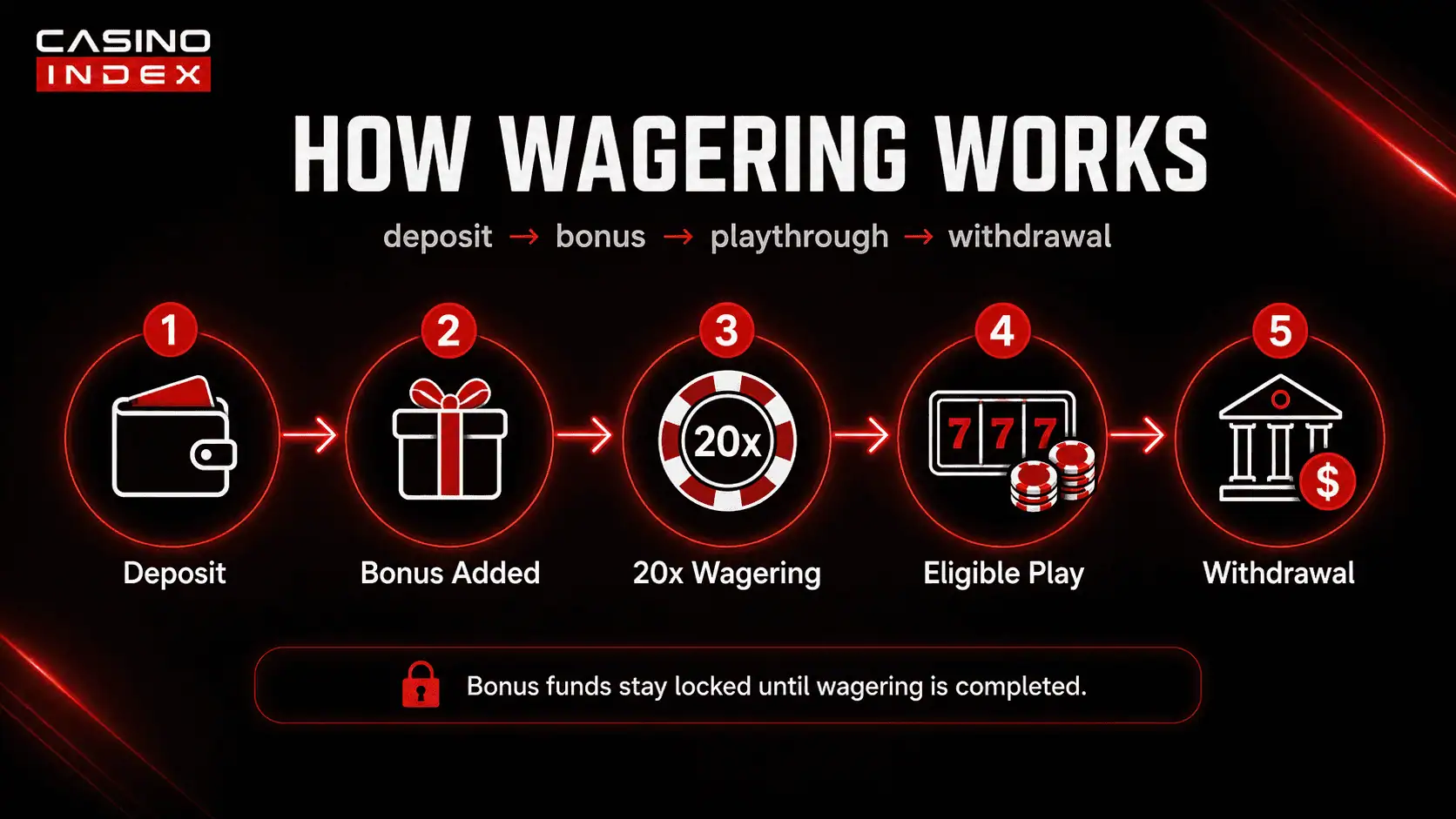
That required amount is usually calculated from one of these bases:
1. Wagering on the bonus amount only
This is the cleaner version.
If you deposit $100 and get a $100 bonus with 20x wagering on the bonus only, the required playthrough is:
$100 x 20 = $2,000
2. Wagering on deposit + bonus
This is much heavier.
If you deposit $100 and get a $100 bonus with 20x wagering on deposit + bonus, the required playthrough is:
($100 + $100) x 20 = $4,000
That is double the turnover from the first example.
The headline offer may look identical. The real workload is not.
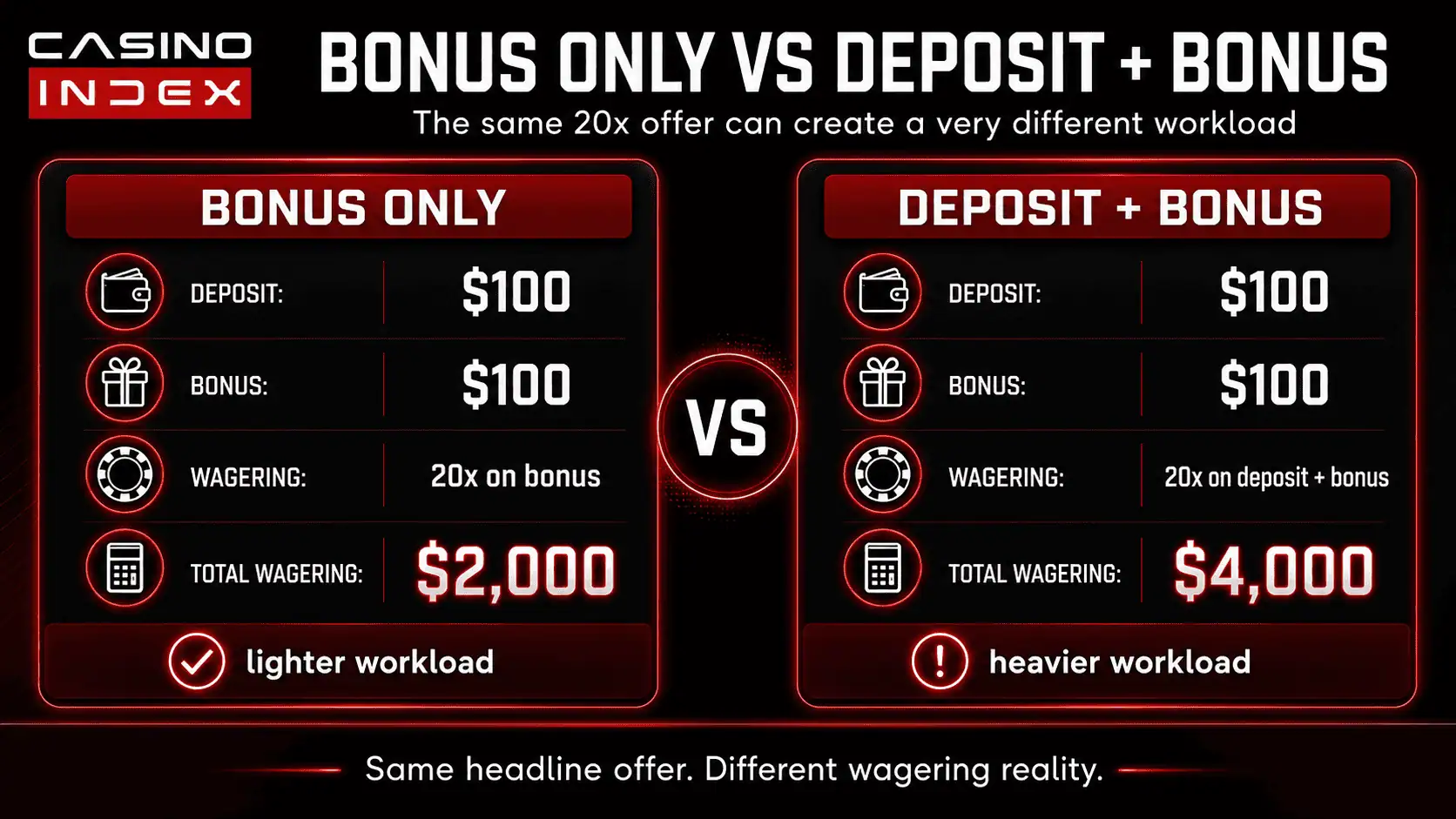
That is why reading the calculation base matters so much.
3. Wagering on bonus winnings
This can happen with free spins or special no-deposit structures.
The casino may allow you to receive winnings from the promotional round, but only after those winnings go through a separate playthrough cycle.
That sounds lighter at first. Sometimes it is. Sometimes it is not.
The only smart move is to check the exact structure.
Why players misunderstand wagering
There are a few recurring reasons.
The bonus looks bigger than the condition feels
A 200% or 300% deposit bonus creates emotional impact instantly.
A line in the terms about 35x or 40x wagering does not.
The reward is visual. The cost is abstract.
That imbalance is exactly why casinos lead with the offer and not the turnover math.
Players confuse wagering with time
Some people assume wagering means “play for a while.”
That is too vague.
A wagering requirement is a turnover target. You can technically reach it fast or slowly depending on stake size, volatility, game type, and bankroll survival.
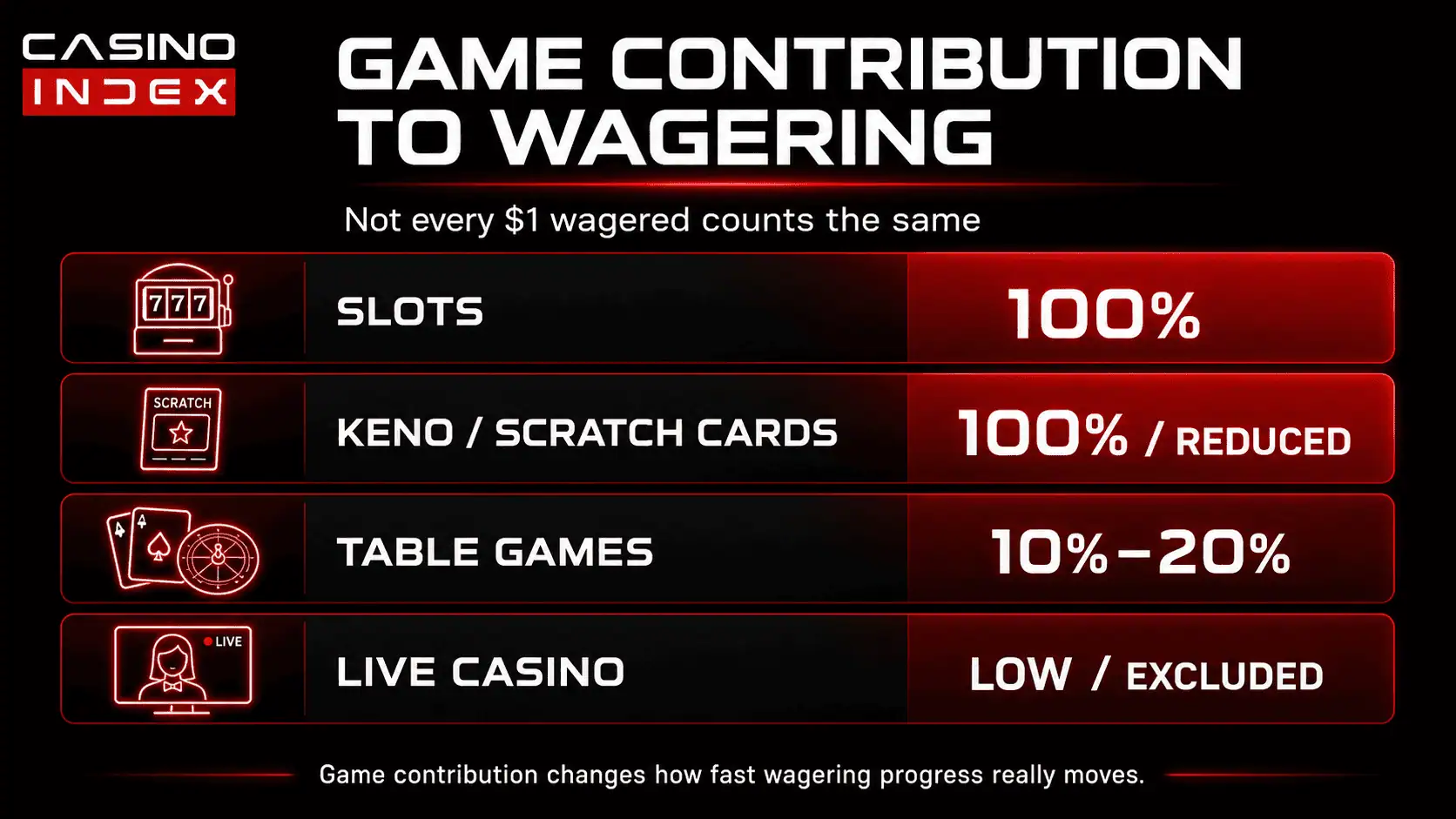
Players assume every $1 wagered counts the same
It often does not.
Different games usually contribute differently.
Slots often contribute the most or count in full. Table games may count partially or at a much lower rate. Some games may be excluded completely.
That changes everything.
A player may think they are making progress toward the requirement while actually moving far slower than expected.
Players ignore max-bet rules
This is one of the most common bonus mistakes.
A casino may say the bonus is active, but also limit the maximum allowed bet size while wagering is in progress. If the player exceeds that threshold, the casino may void the bonus or even related winnings.
That is why what fair bonus terms actually look like matters more than the headline number alone.
A simple wagering example most players can understand
Let’s break it down cleanly.
You deposit $100.
The casino gives you a 100% welcome bonus, so you receive another $100.
The total balance becomes $200.
Now the bonus terms say:
- 30x wagering
- calculated on the bonus amount
- slots count 100%
- table games count less or may not count fully
- max bet while wagering: $5
Your required turnover is:
$100 x 30 = $3,000
That means you must place a total of $3,000 in eligible bets before the bonus terms are completed.
Important:
- you do not need to win $3,000
- you do not need to still hold $3,000
- you do not automatically survive long enough to complete it
You only need to generate that amount of eligible betting volume.
But that last point is the hidden difficulty.
A wagering target can be mathematically clear and still be practically hard.
Because the real question is not just “How much must be wagered?”
It is:
Can your bankroll survive the process?
That is where volatility, game choice, and restrictions start mattering.
The 5 factors that decide whether wagering is fair or painful
A wagering requirement is never just one number.
It has a structure around it.
These are the five factors that matter most.
1. What the multiplier applies to
This is the base calculation issue.
Bonus-only wagering is lighter than deposit-plus-bonus wagering.
Always check that first.
2. Which games contribute
A 25x requirement on slots can be much easier than a 25x requirement where your preferred games only count partially.
This is why slot-focused players and table-game players should not evaluate bonuses the same way.
3. Max-bet limits
If the casino caps betting size during bonus play, you need to know it early.
A bonus can look playable until one over-limit spin or one oversized blackjack hand creates a dispute later.
4. Max cashout rules
Some bonuses, especially free spin or no-deposit structures, may cap how much can actually be withdrawn even after successful wagering.
That changes the value of the entire offer.
5. Withdrawal and verification friction after completion
Finishing the wagering requirement does not automatically mean the money becomes effortless to access.
This is where many players get frustrated.
They assume:
completed wagering = clean withdrawal
Not always.
The casino may still apply identity checks, source-of-funds reviews, or payout processing controls. That is why this topic connects directly to how casino verification really works and why some casinos delay withdrawals.
Why slots usually dominate wagering discussions
Slots are the standard bonus engine for a reason.
Casinos usually want bonus funds wagered on games with faster cycle speed, clearer edge control, and stronger contribution toward turnover requirements.
That is why slot play often counts fully toward wagering.
From the player’s perspective, that creates two realities:
- slots make bonus completion more possible
- slots also increase volatility and bankroll pressure
That second point matters.
A bonus may technically be designed for slot players, but that does not mean it becomes easy to clear.
It just means the casino has chosen the game type where bonus cycling works best for the system.
That is why “playable bonus” and “good bonus” are not the same thing.
Why table-game players often get less bonus value
A lot of players who prefer blackjack, roulette, baccarat, or lower-variance play assume the same bonus should work fine for them.
That is often not true.
Many casinos either:
- exclude certain table games from bonus contribution
- reduce their contribution heavily
- set terms that make bonus clearance much slower on those games
This is one reason some experienced players stop caring about traditional welcome bonuses entirely and move toward ongoing rewards instead.
That is also why casinos like Stake, Shuffle, and Gamdom are useful examples in the wider reward discussion. Their value is often easier to frame through rakeback, VIP progression, reloads, and ongoing activity-based systems than through one classic welcome bonus headline.
That does not mean welcome offers are useless.
It means not every player should treat them as their main source of value.
When wagering is actually reasonable
Casino wagering can be fair enough.
But only under the right conditions.
A wagering structure is usually reasonable when:
- the multiplier is not excessive for the type of offer
- the base is clear
- game contribution is transparent
- max-bet limits are fair and visible
- the platform is good enough even without the bonus
- the bonus matches the player’s real style
- the casino does not turn the whole experience into a withdrawal obstacle later
That is why BitStarz works as one of the better examples for this article.
It has a large welcome offer, which naturally brings wagering into the decision. But the reason it belongs near the top is not just the offer size. It is that the platform still has broader trust weight outside the bonus itself.
That matters.
A difficult bonus at a weak casino is a bad combination.
A structured bonus at a stronger casino is a much more realistic conversation.
When wagering becomes a red flag
A wagering model should make you slow down when the promotion relies too heavily on one of these patterns:
Huge headline offer, vague practical detail
This is classic acquisition bait.
The size is visible. The real work is not.
Heavy turnover attached to a flashy percentage
A 300%, 500%, or multi-stage welcome package can look powerful, but the larger the marketing pitch, the more carefully the turnover logic needs to be checked.
This is exactly why TrustDice, CoinCasino, and similar high-headline examples are useful in this article. They show how a bigger offer can force tougher analysis, not easier trust.
Low clarity around eligible games
If the casino does not make the practical play conditions easy to understand, that is already a problem.
Aggressive bonus combined with weaker payout confidence
This is where bonus logic becomes dangerous instead of merely complicated.
A player gets pulled in by the offer, then later faces friction around withdrawal or terms enforcement.
That is why good bonus analysis has to stay connected to fast withdrawal logic, how to spot a scam casino, and whether crypto casinos really pay out.
Which casino types usually create the best wagering experience
Not the biggest-bonus casinos.
That is the first thing to say clearly.
The best wagering experience usually comes from one of three models.
1. Lower-friction bonus models
This is where Winz.io becomes especially relevant.
If a casino genuinely offers 0x wagering bonuses in certain promotions, that changes the conversation completely. It means the value of the promotion may be far closer to real usable value than the usual playthrough-heavy model.
That is why Winz.io is one of the strongest CTA fits for this article.
Not because it has the biggest number.
Because it gives the article a cleaner contrast point.
2. Ongoing rewards instead of classic welcome dependence
This is where Stake is the best fit.
Stake’s positioning around VIP rewards, rakeback, reloads, and activity-based rewards makes it useful for explaining that some players should stop chasing traditional welcome bonus wagering and focus instead on recurring reward flow.
For regular users, that can be the better long-term model.
3. Stronger mainstream platforms with a welcome bonus that is not the only story
This is where BitStarz and MyStake fit well.
They are useful because many searchers still expect traditional welcome bonuses to be part of the experience. These casinos let you explain that the bonus is only one part of the value case.
That is a healthier way to teach this topic.
Best casino examples for different wagering mindsets
Here is the practical version readers actually need:
| Player type | Better fit | Why |
|---|---|---|
| Wants lower-friction bonus logic | Winz.io | Good example for 0x wagering style offers and lower-friction bonus thinking |
| Wants long-term rewards, not classic welcome traps | Stake | VIP, rakeback, reloads, and activity-based rewards matter more than one traditional bonus |
| Wants a strong mainstream crypto bonus example | BitStarz | Big welcome offer, but still easier to justify as a platform outside the bonus |
| Wants flexible crypto/fiat bonus value | MyStake | Useful classic deposit-bonus example with broader platform flexibility |
| Wants to compare giant bonus offers carefully | TrustDice | Good example of why very large bonus claims need close wagering analysis |
| Wants a cautionary big-offer contrast | CoinCasino | Good for showing how big marketing numbers can outshine practical value |
This is the kind of table that actually helps search users.
It gives them structure instead of just “top bonus casinos” filler.
The biggest mistake players make with wagering
They calculate the bonus upside and ignore the survival problem.
A player may see:
- large percentage
- extra free spins
- bigger starting balance
and think the value is obvious.
But the real challenge is not receiving the bonus.
It is clearing the bonus without destroying the bankroll first.
That depends on:
- stake sizing
- game selection
- volatility
- contribution rates
- max-bet compliance
- discipline during the wagering cycle
This is why a smaller, cleaner, lower-friction promotion can easily beat a giant welcome bonus in real value.
How to evaluate wagering before you deposit
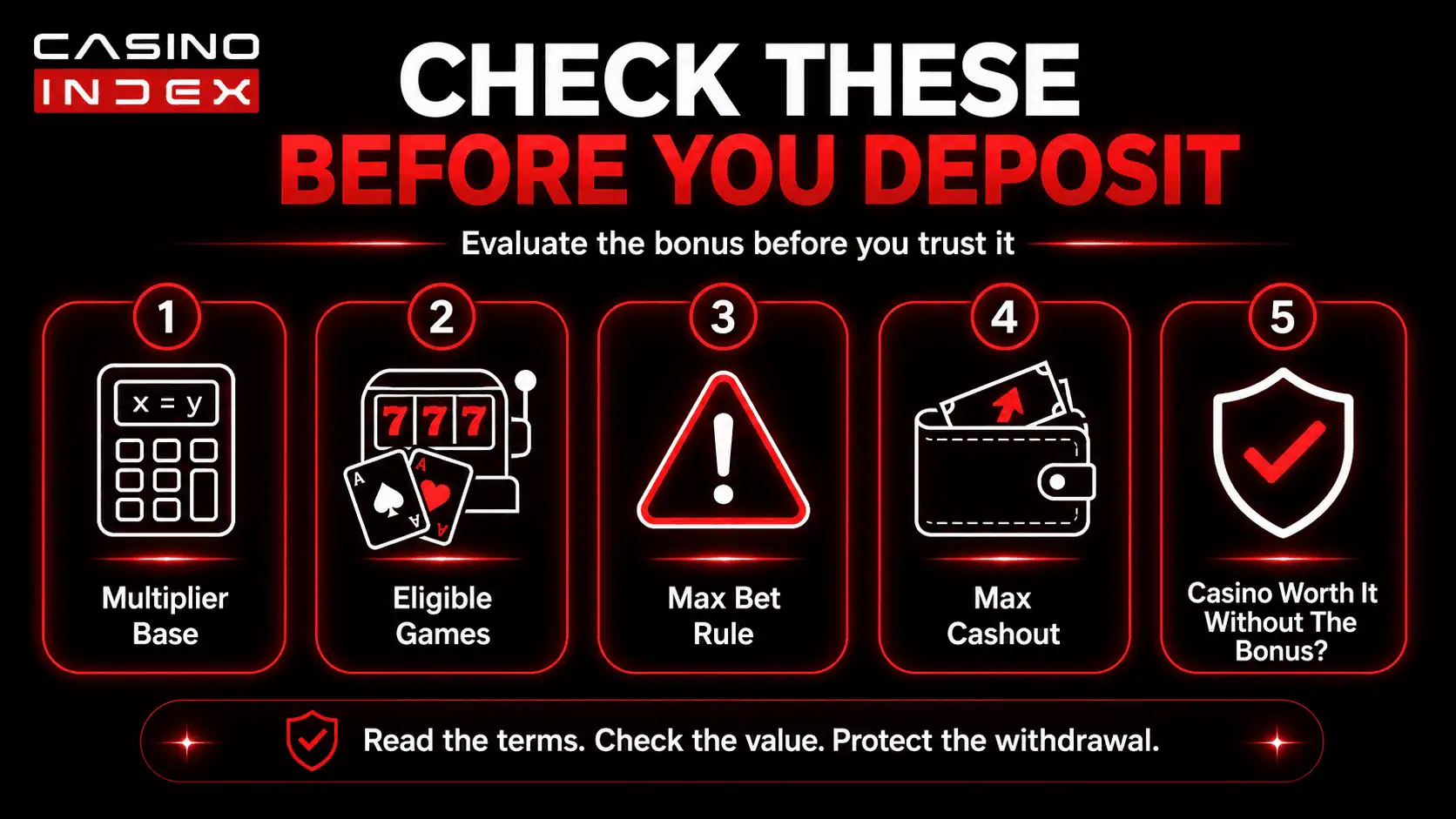
Use this checklist.
Ask what the multiplier applies to
Bonus only or deposit plus bonus?
That changes everything.
Ask which games count fully
If you do not play the games that drive full contribution, the offer may already be a bad fit.
Ask whether the casino caps bet size
This is one of the easiest ways to make an expensive mistake.
Ask whether there is a max cashout
Especially for free spins and no-deposit style rewards.
Ask whether the casino is worth using without the bonus
This is the most important question of all.
If the answer is no, the bonus is probably doing too much of the selling.
How casino wagering really works in one sentence
If this article had to reduce everything to one line, it would be this:
Casino wagering is the volume of eligible betting the casino requires before bonus-linked money becomes realistically withdrawable.
That is the clean explanation.
But the better version, the one that actually protects players, is this:
Casino wagering is where the real value of a bonus is either confirmed or exposed as weaker than it looked.
That is why this topic matters so much.
Because most bonus marketing happens before the player understands the trade-off.
Final verdict
Casino wagering is not complicated because the formula is hard.
It is complicated because the formula is only one part of the system.
The number matters. But the structure around the number matters more.
A 20x bonus can be reasonable or painful depending on:
- whether it applies to bonus only or deposit plus bonus
- which games count
- what the max-bet rules look like
- whether winnings are capped
- whether the casino stays clean at withdrawal stage
- whether the platform is strong enough even without the promo
That is why the smartest players do not chase the biggest bonus.
They look for the best overall fit between:
trust, withdrawals, clarity, product quality, and only then the bonus itself.
For this keyword, that means the strongest review examples are not random.
They are chosen for what they teach:
- Winz.io for lower-friction bonus logic
- Stake for ongoing reward systems
- BitStarz for a stronger mainstream bonus example
- MyStake for flexible classic deposit-bonus logic
- TrustDice for big-offer scrutiny
- CoinCasino for high-headline caution
That is the better way to explain how casino wagering really works.
Not as a technical footnote.
But as the system that decides whether the bonus is actually worth taking in the first place.

Talha Aydin has been active in cryptocurrency since 2017 and is a co-founder of Freecoins24 and CryptoMutant. Over the years, he has worked with crypto projects on community growth, giveaways, user acquisition and digital strategy while gaining hands-on experience across blockchain platforms and crypto markets. At CasinoIndex, Talha focuses on crypto casinos, withdrawals, payment systems, platform trust and the risks players face when moving funds between wallets and gambling platforms.