Casino Withdrawal Guide 2026: Approval Checks, Delays and Payout Times

Casino withdrawals reveal more about an operator than deposits do.
Deposits usually move quickly because the casino wants the funds to enter the account without friction. Withdrawals work differently. Before money leaves the platform, the operator may review identity, payment ownership, bonus use, account activity, location, withdrawal limits and fraud risk.
Therefore, a “fast payment method” does not automatically create a fast payout. The casino must approve the request first. Only after approval does the bank, e-wallet or blockchain determine the final settlement speed.
This distinction explains many common complaints. A player may see a crypto withdrawal marked as pending and assume the blockchain is slow. In reality, the casino has not released the transaction yet. Likewise, a card payout may pass the casino review quickly but still take longer because the card network needs additional time.
However, normal review procedures should not become an excuse for endless delays. A credible casino explains what it needs, gives the player a realistic time frame and keeps the request moving. By contrast, repeated document requests, unexplained cancellations and changing conditions can signal a deeper payout problem.
This guide explains the full withdrawal process, the checks that happen before approval, normal and suspicious pending periods, payment matching, KYC, limits, crypto settlement, rejected payouts and the steps players can take before depositing.
The central rule is simple:
Judge a casino by what happens after a withdrawal request, not only by how quickly it accepts a deposit.
Casino Withdrawals Explained in One Table
| Stage | Who Controls It? | What Happens? | Main Risk |
|---|---|---|---|
| Request submitted | Casino account system | The balance moves into pending status | The player cancels and re-gambles the funds |
| Internal approval | Casino | The operator checks KYC, bonuses, payment ownership and account risk | Unclear or repeated review requests |
| Payment release | Casino and payment processor | The casino creates and sends the payment instruction | Processor rejection or wrong payment route |
| Settlement | Bank, e-wallet or blockchain | The external network delivers the funds | Banking delays, network congestion or address errors |
| Completion | Player and payment provider | The money reaches the player’s account or wallet | Incorrect wallet, closed card or unsupported destination |
A useful withdrawal comparison must separate casino approval time from external settlement time. Otherwise, a fast blockchain can hide a slow operator, while a slower bank transfer can make a responsive casino look worse than it is.
How Casino Withdrawals Actually Work
A standard withdrawal moves through several stages:
Request → Pending review → Approval checks → Payment release → External settlement → Completion
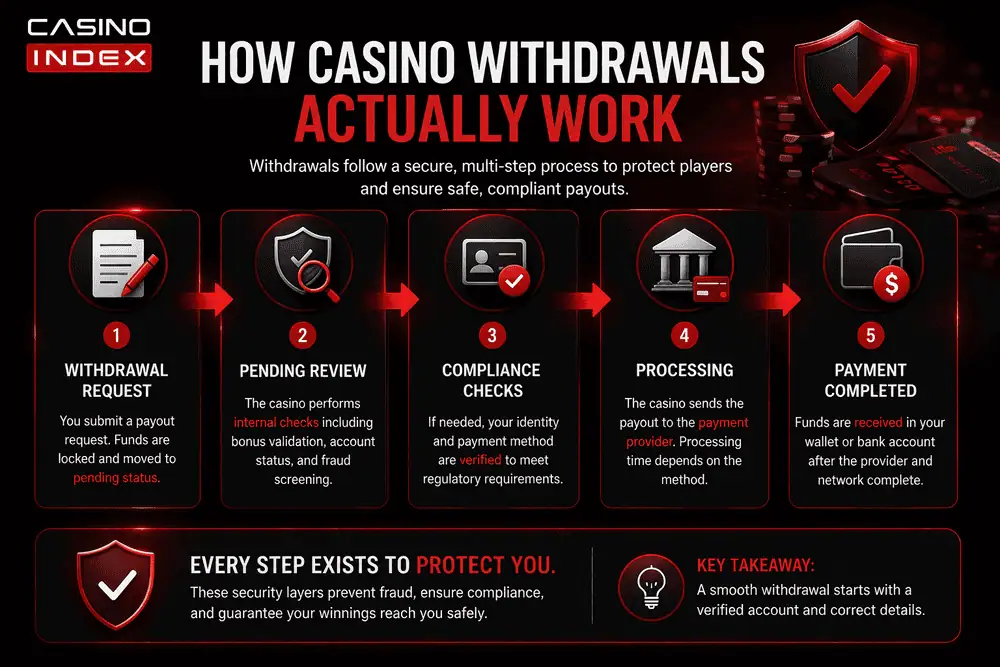
Each stage answers a different question.
- Request stage: Did the player submit valid payment details?
- Approval stage: Does the account meet the casino’s payout rules?
- Release stage: Can the selected payment route accept the transfer?
- Settlement stage: How long does the external network need?
As a result, the total withdrawal time is the combined result of several systems. Players who look only at the advertised payment speed miss the most important part: the operator’s internal approval process.
Step 1 — The player submits a withdrawal
The player selects a payment method, enters the amount and confirms the request. The casino then reserves the requested balance.
At this point, the funds should no longer remain available for normal gameplay. Some casinos still allow reversal during the pending period. Although that feature appears convenient, it can encourage players to cancel a payout and continue gambling.
Therefore, players should treat a submitted withdrawal as final unless the payment details contain an actual error.
Step 2 — The casino reviews the request
The pending period begins before the operator releases the money. During this stage, the casino may check:
- identity and address information
- payment ownership
- deposit and withdrawal method consistency
- bonus and wagering status
- duplicate or linked accounts
- restricted-country access
- unusual transaction activity
- source-of-funds concerns for larger values
- security changes made shortly before the request
For a deeper breakdown, CasinoIndex explains what casinos check before approving withdrawals.
Step 3 — The casino approves or pauses the payout
If the account passes the review, the casino sends the request to its payment system. However, when something does not match, the operator may pause the payout and ask for documents or clarification.
A pause is not automatically suspicious. The quality of the explanation matters more. A credible operator identifies the issue, requests relevant evidence and resumes the process after the player responds.
By contrast, vague messages such as “under review” for an unlimited period provide little accountability.
Step 4 — The payment provider receives the transfer
After internal approval, the casino passes the payment to a bank, card network, e-wallet or blockchain.
From this point, the external infrastructure becomes more important. For example, a bank may need business days, while a blockchain transaction can settle at any time. Nevertheless, the casino may still control when it broadcasts a crypto transaction or submits a bank instruction.
Step 5 — The player receives the funds
The payout completes when the money appears in the player’s bank account, e-wallet or self-custody wallet.
If the casino marks the request as paid but the funds do not arrive, the player should request a transaction ID, blockchain hash or payment reference. That evidence helps determine whether the problem sits with the casino or the external provider.
Casino Approval Time vs Payment Settlement Time
Many withdrawal articles combine two separate time periods. That creates confusion.
| Time Period | Starts When | Ends When | Main Controller |
|---|---|---|---|
| Approval time | The player submits the request | The casino releases the payment | Casino |
| Settlement time | The casino sends the payment | The funds arrive | Bank, processor, e-wallet or blockchain |
This separation matters most with crypto. A blockchain may confirm a payment within minutes, but it cannot confirm a transaction that the casino has not sent.
Therefore, phrases such as “instant crypto withdrawals” should mean that the operator approves and broadcasts the transaction quickly. They should not refer only to the speed of the blockchain after release.
Why Casino Withdrawals Are Not Instant
Deposits and withdrawals create different risks for an operator.
A deposit brings money into the casino. A withdrawal moves value out. Consequently, the casino usually performs more checks before a payout than before a deposit.
Common review reasons include:
- fraud prevention
- anti-money-laundering controls
- identity and age verification
- payment ownership checks
- bonus-rule enforcement
- account security
- restricted-country checks
- chargeback risk
However, compliance does not justify indefinite delay. Strong operators build these checks into a predictable process. They also explain the expected time frame before the player deposits.
What players should do before depositing
- read the withdrawal limits
- check which methods support payouts
- confirm whether KYC may occur
- review bonus and maximum-bet rules
- avoid using another person’s card, wallet or e-wallet
- confirm that the account country matches the actual location
In addition, players should check the operator’s review page rather than relying only on the cashier. For example, the Bitcasino payout review shows how CasinoIndex places payment terms and withdrawal risk inside a broader brand assessment.
How Long Casino Withdrawals Usually Take
No universal time applies to every casino. The operator, payment route, account status, value and country can all change the result.
The ranges below describe broad expectations after the casino has completed any required review. They are not guarantees.
| Method | Typical External Settlement | Common Additional Risk |
|---|---|---|
| Crypto | Minutes to several hours | Casino approval, network choice, wallet checks |
| E-wallet | Several hours to about one day | Ownership verification and provider availability |
| Card payout | One to several business days | Cards may not support incoming gambling payouts |
| Bank transfer | Two to several business days | Intermediary banks, weekends and compliance review |
Again, these ranges start to matter only after the casino releases the payment. A pending request remains under operator control.
Players comparing payment routes can also use the casino payment methods guide for a broader view of deposits, payout support and settlement differences.
Crypto vs Fiat Withdrawals
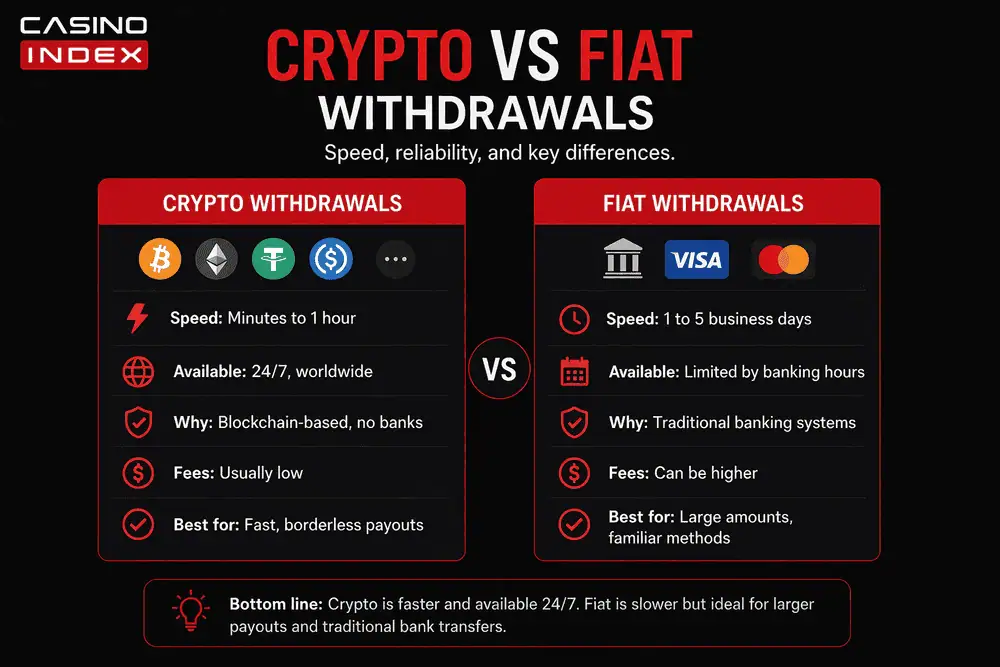
Crypto often provides faster settlement because it avoids card networks and interbank clearing. It also operates outside traditional banking hours.
However, crypto removes only part of the friction.
Potential advantages of crypto payouts
- 24/7 network settlement
- direct delivery to a wallet
- transparent transaction records
- fewer traditional banking intermediaries
- support for cross-border payments
Crypto-specific risks
- incorrect wallet addresses
- wrong network selection
- unsupported smart-contract deposits
- wallet ownership checks
- exchange deposit restrictions
- network fees or minimum withdrawal amounts
Therefore, crypto can shorten settlement without removing casino approval, KYC or account review.
Fiat-specific risks
Cards and bank transfers often provide more familiar consumer infrastructure. However, they can also involve weekends, intermediary institutions, rejected incoming payments and slower reconciliation.
Players should choose a method for its withdrawal compatibility, not only for deposit convenience.
Why Payment Matching Can Delay Cashouts
Many casinos use a closed-loop or payment-matching rule. The operator tries to return funds through the same route used for the deposit, where possible.
For example:
- a card deposit may need a card refund before another method becomes available
- an e-wallet deposit may need a payout to the same verified account
- a crypto deposit may need a payout to a compatible wallet or network
The rule helps reduce payment fraud, chargeback abuse and third-party funding.
Problems often appear when a player:
- uses several deposit methods
- uses a card that cannot receive payouts
- deposits from another person’s account
- changes e-wallet details
- deposits on one crypto network and requests another
- uses an exchange address that cannot receive the selected asset
CasinoIndex explains why payment matching can delay cashouts and why the safest route usually starts with a payment method the player owns and can use for both directions.
Withdrawal Limits: Daily, Weekly and Monthly Caps
Many casinos cap the amount a player can withdraw within a specific period.
Common structures include:
- per-transaction limits
- daily limits
- weekly limits
- monthly limits
- special jackpot or VIP exceptions
For example, a casino might show:
| Limit Type | Example | What the Player Should Check |
|---|---|---|
| Daily | $5,000 | Whether the clock uses calendar days or rolling 24-hour periods |
| Weekly | $20,000 | Whether daily payouts also count toward the weekly cap |
| Monthly | $50,000 | Whether pending amounts remain inside the limit |
Limits do not automatically make a casino unsafe. However, very low caps can turn a large win into months of operator exposure.
Therefore, high-stakes players should calculate the time needed to withdraw the maximum likely balance before depositing.
Do not split payouts merely to avoid review
Players should follow the published limit structure rather than trying to manipulate monitoring systems. Artificially splitting a payment can create more questions, not fewer.
The stronger approach is to request the allowed amount, keep records and confirm the schedule with support when the balance exceeds the cap.
Why Withdrawals Get Delayed
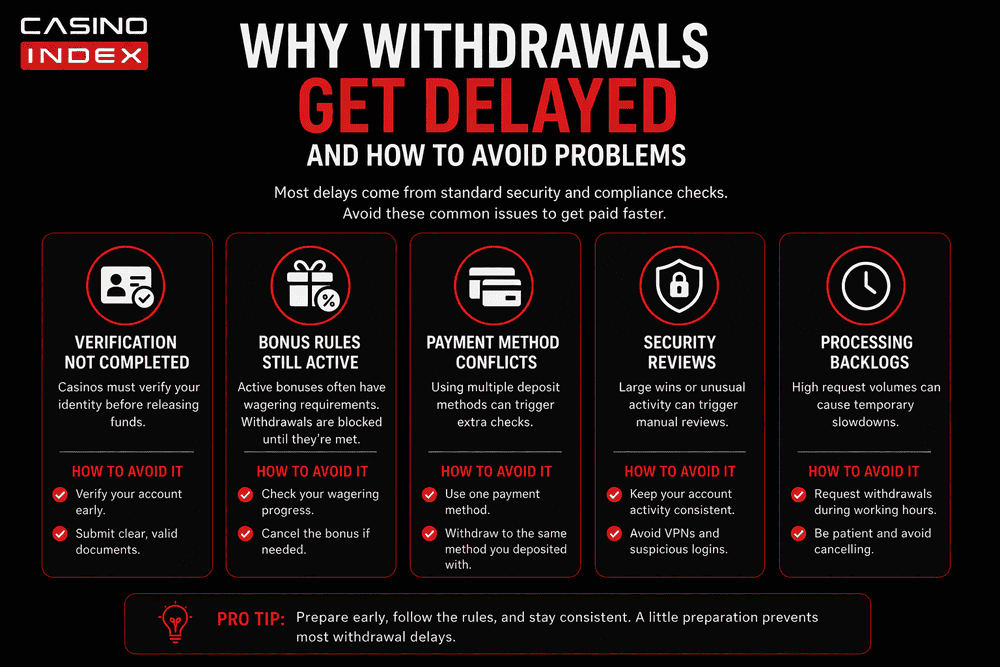
Withdrawal delays usually fall into several categories.
Verification is incomplete
The casino may ask for identity, address or payment ownership documents. Players can reduce this delay by keeping clear, current documents ready.
However, players should not upload sensitive documents through unofficial channels. They should use the casino’s secure verification system or an authenticated support route.
Bonus conditions remain active
A bonus can block or reduce a withdrawal when the player has not completed wagering, exceeded a maximum stake, used a restricted game or triggered a maximum cashout clause.
Therefore, the player should check the bonus status before requesting funds. The casino should also identify the exact rule rather than issuing a generic rejection.
The payment method does not match
The casino may need to refund deposits to the original route or verify ownership of every method used.
Using fewer payment methods usually simplifies the review. Nevertheless, the player should not assume that one method always works for both deposits and withdrawals.
The withdrawal is unusually large
A large payout may trigger enhanced review, source-of-funds questions or manual approval.
That does not automatically indicate bad faith. However, the operator should explain the required evidence and avoid asking for irrelevant documents in repeated stages.
The account shows security changes
Password resets, email changes, new devices, location changes or unusual login patterns can trigger a temporary hold.
As a result, players should avoid changing important account information immediately before a planned withdrawal unless security requires it.
The casino has a processing backlog
Operational delays can occur during weekends, holidays or payment-provider outages. A short delay can be understandable. Silence and shifting explanations are less acceptable.
Pending Withdrawals: Normal Review or Red Flag?
Pending status is normal at the beginning of a withdrawal. It means the casino has received the request but has not released the payment.
The status becomes more concerning when the operator stops providing a clear process.
| Situation | More Likely Normal | More Concerning |
|---|---|---|
| Time frame | Still inside the published review window | Far beyond the stated time without explanation |
| Communication | Support identifies the current step | Only generic or contradictory replies |
| Documents | One relevant request with clear instructions | Repeated new requests after each submission |
| Withdrawal status | Request remains visible and reserved | Request disappears, resets or returns without reason |
| Terms | The casino applies a published rule | The operator introduces a new condition after the win |
CasinoIndex explains when pending withdrawals become a red flag, including the difference between a reasonable review and an open-ended delay.
What to do when a withdrawal remains pending
- Check the published processing window.
- Confirm that no verification request sits in email or the account dashboard.
- Save screenshots of the request, status and balance.
- Ask support for the exact review stage and required next step.
- Keep communication factual and use one support thread where possible.
- Escalate only after the casino misses its stated time or stops responding meaningfully.
Submitting many tickets rarely speeds the same internal review. Instead, it can split the evidence across several support threads.
How Casinos Review Withdrawal Requests
Casinos do not evaluate every request in the same way. Many routine payouts pass automatically, while risk signals send other requests to manual review.
A typical review may ask:
- Does the account belong to the verified player?
- Does the payment method belong to that player?
- Did the player comply with bonus terms?
- Does the account show linked or duplicate activity?
- Does the country match the permitted market?
- Does the transaction pattern require enhanced review?
- Does the requested amount exceed an account or VIP limit?
Players should not confuse automated speed with guaranteed safety. An automated payout can still come from a weak operator, while a manual review can occur at a credible casino.
The real test is whether the operator applies the process consistently and resolves legitimate requests within a reasonable period.
How to Speed Up Casino Withdrawals
Use accurate account details
Names, addresses and dates of birth should match the verification documents. Small inconsistencies can create unnecessary review.
Verify before a large balance develops
Early verification does not guarantee instant payouts. However, it can remove one major source of delay before the first meaningful withdrawal.
The casino verification guide explains common document requests and approval issues.
Use a payment method you own
Third-party cards, wallets and e-wallets create ownership problems. Therefore, the player should use personal payment routes and keep evidence of ownership available.
Avoid unnecessary payment switching
Multiple methods can create several refund and ownership obligations. A consistent route is usually easier to review.
Check bonus status before requesting funds
The player should confirm wagering completion, maximum-bet compliance, restricted games and maximum cashout terms.
Do not cancel the payout to continue playing
Reversing a withdrawal increases the chance that secured winnings return to the casino balance. Therefore, players should avoid cancellation unless the payment details are wrong.
Respond clearly to relevant document requests
Send readable files, follow the requested format and ask support to confirm receipt. However, do not send unrelated personal information merely because the first answer did not resolve the case.
Withdrawal Mistakes Players Should Avoid
Waiting until the first large win to read the rules
Withdrawal limits, verification and bonus clauses matter before the deposit. Reading them after a win gives the player fewer options.
Using another person’s payment method
This creates one of the clearest payment-ownership conflicts. Even when the other person gave permission, the casino may still reject the route.
Assuming “no KYC” means no checks
A casino may allow registration without documents but still review identity, wallet ownership or source of funds before a large payout.
Believing crypto removes casino approval
Crypto removes some banking friction. It does not remove the operator’s internal controls.
Ignoring maximum withdrawal limits
A large balance can remain exposed to the casino for months when the monthly cap is low.
Opening several accounts
Duplicate-account rules can affect withdrawals even when the player did not use a bonus. Shared households should also check whether the operator permits several accounts from one address or network.
Using a VPN in a restricted market
A location mismatch can trigger an account review and create a dispute over eligibility.
Large Wins, Source of Funds and Enhanced Review
Larger withdrawals often receive more scrutiny because the financial and fraud risk increases.
The casino may ask for:
- identity and address documents
- proof that the payment method belongs to the player
- evidence of the source of the deposit
- transaction histories
- an explanation of unusual account activity
A legitimate request should relate to a real compliance concern. The casino should explain how to provide the evidence securely.
By contrast, repeated requests that move beyond the original issue without explanation can become a red flag.
What players should record
- deposit transaction IDs
- wallet addresses and networks
- bonus acceptance or rejection
- withdrawal confirmation emails
- document-submission confirmations
- support case numbers
Good records make a legitimate review easier and strengthen the player’s position during a dispute.
Real Withdrawal Scenarios
Scenario 1 — A small routine crypto payout
A player deposits $300 in Bitcoin, plays without a bonus and requests $450 to a compatible personal wallet.
The account details match, the wallet route is clear and the amount falls within the normal limit. Therefore, the casino may approve the request automatically or after a brief review.
However, the player should still distinguish approval time from blockchain confirmation time.
Scenario 2 — A large win above the daily limit
A player wins $8,000, while the casino limits daily withdrawals to $2,000.
The player should follow the published schedule and document each payout. The casino should not require the player to re-wager the remaining balance.
If the operator introduces a new limit after the win, the case becomes more concerning.
Scenario 3 — Card deposit but card payout unavailable
The player deposits by card, but the card cannot accept the return payment.
The casino may first attempt a refund or request an alternative verified route. Therefore, the player should not assume that an immediate crypto payout will be available.
Scenario 4 — Bonus conflict
The player accepts a bonus, exceeds the maximum allowed stake and then requests a withdrawal.
The casino may review or remove bonus-derived winnings if the published rule clearly applies. However, the operator should identify the exact transaction and clause.
Scenario 5 — Verification after a large win
The casino allowed deposits and normal play without documents. After a large win, it requests KYC.
The timing can feel unfair, but the request is not automatically illegitimate. The key questions are whether the terms disclosed the possibility, whether the request remains relevant and whether the casino processes the payout after successful verification.
Withdrawal Red Flags Players Should Recognize
Normal checks and bad-faith delay can look similar at the beginning. Therefore, players should focus on patterns.
Stronger warning signs include:
- the casino changes the withdrawal conditions after the win
- support refuses to identify the reason for the hold
- the operator repeatedly requests documents already approved
- the casino cancels the withdrawal without player instruction
- the balance returns with pressure to keep playing
- the casino asks for a new deposit or fee to release winnings
- the operator removes access to the account while withholding funds
- different support agents provide contradictory explanations
- the casino misses its own time frame repeatedly
One delayed payment does not always prove systemic risk. However, repeated complaints with the same unresolved pattern deserve more weight than isolated frustration.
How to Identify Casinos With Better Withdrawal Systems
A stronger withdrawal system usually shows:
- clear minimums and maximums
- separate approval and settlement estimates
- published KYC and payment-matching rules
- secure document submission
- consistent support explanations
- visible payout routes before deposit
- fair treatment of jackpot and large-win balances
- no pressure to reverse pending withdrawals
Marketing phrases such as “instant,” “automatic” or “no verification” matter less than the real account process.
Therefore, CasinoIndex evaluates withdrawal behaviour as part of the wider trust-first casino ranking system.
The CasinoIndex Withdrawal Safety Checklist
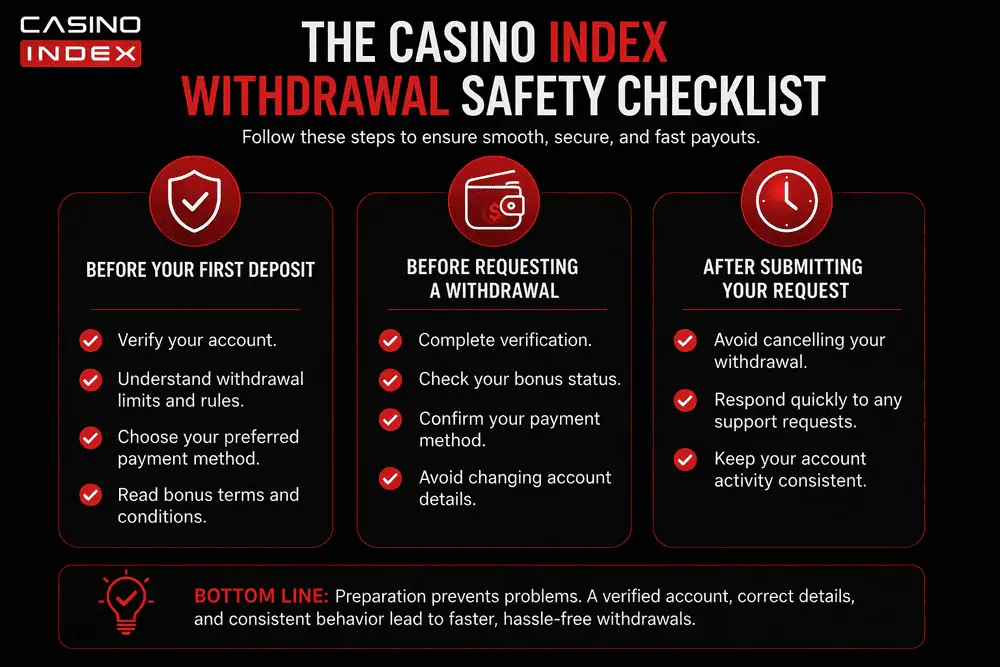
Before the first deposit
- confirm country eligibility
- read withdrawal limits
- check which deposit methods support payouts
- review KYC triggers
- check bonus and maximum-bet terms
- use a payment route owned by the player
Before requesting a withdrawal
- confirm the destination address or account
- check bonus status
- review the payment-matching rule
- avoid changing key account details
- save the balance and transaction history
After submitting the request
- do not cancel without a real payment error
- watch the account and email for requests
- respond through secure channels
- keep one organised support thread
- save all confirmations and payment references
This checklist cannot guarantee a fast payout. Nevertheless, it removes many avoidable conflicts and makes genuine operator problems easier to identify.
Common Withdrawal Problems and How to Respond
The withdrawal remains pending
First, check the published review time and account messages. Next, ask support which exact stage remains incomplete.
When the casino provides a specific answer, follow the relevant step. When it gives only generic replies beyond its own time frame, preserve the evidence and prepare to escalate.
The casino rejects the request
Ask for the exact reason and the term that applies. Common causes include incomplete verification, payment mismatch, bonus violations or an unsupported method.
Do not simply resubmit the same request repeatedly. Instead, fix the stated issue or challenge the decision with evidence.
The original method cannot receive payouts
Ask the casino which verified alternative it accepts. The operator may first need to refund the deposit amount through the original route.
The casino requests verification after the win
Use the secure document channel and ask for a complete list of requirements. In addition, request confirmation when the operator approves each item.
The casino marks the payment as sent, but it does not arrive
Request a transaction hash or payment reference. Then check the relevant bank, e-wallet or blockchain.
The account becomes restricted
Keep communication factual. Ask which security issue triggered the restriction and what evidence will resolve it. Avoid opening duplicate accounts or making repeated login attempts.
Casino Withdrawal Myths
Myth: Every delay means the casino will not pay
Not necessarily. Verification, payment matching and external settlement can create legitimate delays. However, the casino should explain the process and complete it.
Myth: Most delays are always the player’s fault
No. Players can create avoidable problems, but casinos can also use poor systems, vague terms or unreasonable review practices. Each case needs evidence.
Myth: Crypto withdrawals are instant
The network can settle quickly after release. The casino may still take time to approve and send the transaction.
Myth: Large withdrawals always get blocked
Large values often trigger more review, but a credible casino should still pay valid winnings under the published limits.
Myth: Verification proves the withdrawal will be fast
Verification removes one possible obstacle. It does not remove bonus checks, payment matching, limits or operator backlogs.
Myth: VIP status guarantees priority
Some casinos offer higher limits or dedicated support to VIP players. However, the written rules and actual payment behaviour matter more than the label.
Final Verdict: Withdrawal Quality Is the Real Casino Test
A casino withdrawal has two separate parts: operator approval and external settlement.
The operator controls the first part. Therefore, a fast bank, e-wallet or blockchain cannot repair a slow or unreasonable casino review.
Before depositing, players should check:
- approval time
- payment compatibility
- KYC triggers
- bonus restrictions
- daily, weekly and monthly limits
- large-win treatment
- support quality
Pending status can be normal. Verification can be legitimate. Payment matching can protect both parties. However, these procedures need clear rules, relevant evidence and a reasonable end point.
The strongest casino is not the one that promises the fastest withdrawal. It is the one that explains the process before deposit and follows that process consistently after a win.
Casino Withdrawal FAQ
How long do casino withdrawals take?
The total time combines casino approval and payment settlement. Crypto and e-wallet settlement can be fast, while cards and banks often need longer. However, the operator’s review may add time before any method begins processing.
Why is my casino withdrawal pending?
The casino may still be reviewing identity, bonus status, payment ownership, account security or transaction risk.
Is a pending withdrawal automatically a red flag?
No. Pending status is normal during the stated review window. It becomes more concerning when the casino exceeds its time frame, changes requirements or stops providing meaningful updates.
Can I cancel a casino withdrawal?
Some casinos allow cancellation during the pending stage. However, cancelling can return the funds to the playable balance and increase the risk of losing them.
Which casino withdrawal method is fastest?
Crypto and e-wallets often settle faster after approval. Nevertheless, the casino’s internal release time remains the most important variable.
Why do casinos ask for KYC after a win?
The payout value or account activity may trigger a verification threshold. The operator should request relevant documents and continue the payout after approval.
Can a casino reject a withdrawal permanently?
A casino may reject a method or dispute winnings under its terms. However, it should provide a specific reason. Players can challenge unclear or unfair decisions through formal complaints and relevant dispute channels.
Do crypto withdrawals require verification?
They can. Crypto changes the payment rail but does not remove identity, location, wallet or account-risk checks.
Why are large withdrawals slower?
Large payouts may require manual approval, source-of-funds review or staged payments under the published limits.
What happens when my deposit method cannot receive a payout?
The casino may use a verified alternative after handling any closed-loop or refund obligation connected to the original deposit.
Do bonuses delay withdrawals?
They can. The casino may review wagering completion, maximum stakes, restricted games and maximum cashout terms.
Can multiple payment methods slow the payout?
Yes. The operator may need to verify ownership and determine how much must return through each method.
Should I verify before depositing?
Players should at least understand the verification requirements before depositing. Completing verification early can remove one source of later delay.
Does changing account information affect a withdrawal?
It can. Email, password, device, address or location changes may trigger security review.
What is the safest withdrawal habit?
Use payment details you own, keep records, avoid unnecessary bonuses, withdraw profits regularly and do not leave more money in a casino account than you need for the planned session.

Maria Hoffmann has worked in cryptocurrency content and digital publishing since 2017. She is a co-founder of Freecoins24 and CryptoMutant and has covered blockchain projects, crypto platforms and emerging industry trends for several years. She has also been active as a cryptocurrency investor since 2019. At CasinoIndex, Maria combines content research and SEO experience with a focus on casino trust, platform security, withdrawal processes, payment risks and user protection. Her work looks beyond bonuses and product features to examine how gambling platforms handle player funds, verification and account-related risks.