Restricted Countries and Geoblocking at Online Casinos
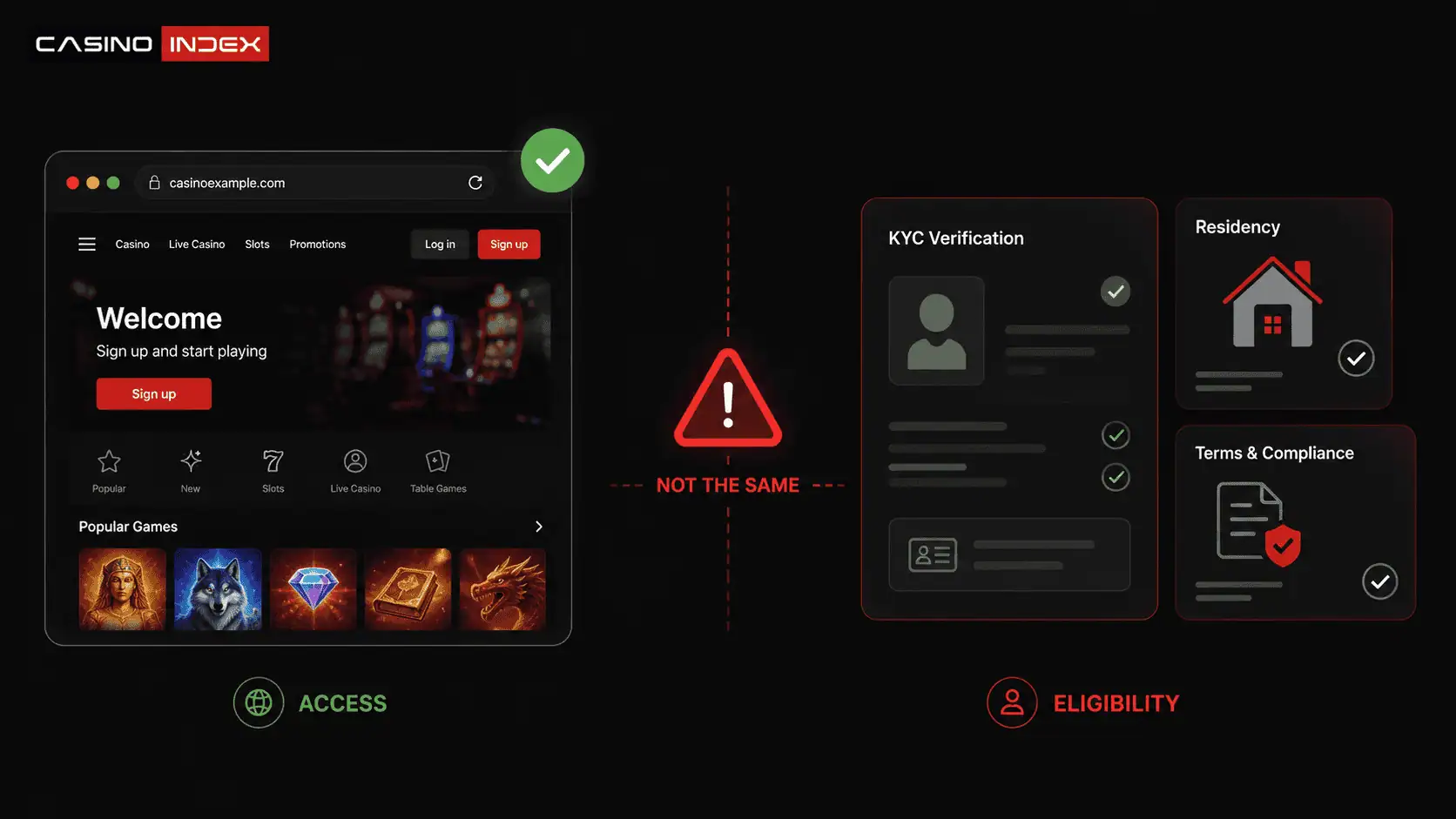
Access is not eligibility.
That is the rule many players learn too late.
An online casino may load in your browser. The signup form may accept your details. The cashier may even process a deposit. However, none of that proves you are allowed to play from your country, residence, payment location, or temporary travel location.
Restricted-country problems often appear later.
They appear during KYC. They appear when the casino checks proof of address. They appear when a payment method points to a different country. They appear when a player travels, moves abroad, uses a VPN, or requests a withdrawal after winning.
At that stage, the player may feel the casino should never have accepted the deposit. The casino may argue that the player breached the restricted-country rules.
This guide explains how restricted countries and geoblocking work at online casinos, why access does not prove permission, how residence and payment checks affect withdrawals, and what players should verify before depositing real money.
Quick answer: how do restricted countries affect online casinos?
Restricted countries affect whether a player can register, deposit, play, claim bonuses, complete verification, and withdraw winnings from an online casino.
A casino may restrict a country because of licensing rules, local gambling laws, payment limitations, sanctions risk, provider restrictions, responsible gambling obligations, or internal business policy.
The main risk is timing.
Some casinos block restricted locations before registration. Others only detect the issue during verification or withdrawal review.
| Risk area | Where it appears | What it means | What players should check | Main payout risk |
|---|---|---|---|---|
| Restricted-country list | Terms and Conditions | Your country may not be allowed | Residence, location, citizenship wording | Account closure or voided winnings |
| Geoblocking | Homepage, signup, app access | The casino blocks access by location signal | Whether the block matches the terms | Unsafe workarounds such as VPN use |
| KYC residence check | ID, address proof, source-of-funds review | Your real residence may be reviewed later | Proof of current address | Withdrawal delay or rejection |
| Payment-country mismatch | Bank, card, e-wallet, crypto exchange records | Payment source may not match account country | Payment ownership and country consistency | Extra payment review |
| VPN or proxy signal | Login, play, bonus use, withdrawal review | Location data may look masked | Casino VPN rules before play | Account restriction risk |
| Country change | Travel, relocation, new documents | Eligibility may change after signup | Updated residence and support confirmation | Fresh KYC or blocked cashout |
| Bonus country rules | Bonus terms | Some countries may be excluded from offers | Bonus eligibility by country | Bonus winnings may be voided |
| Game provider blocks | Game lobby or live casino tables | Some games may be unavailable by region | Provider and game restrictions | Bonus wagering confusion |
The safest rule is simple: check eligibility before depositing, not after winning.
How CasinoIndex evaluates restricted-country risk
CasinoIndex does not treat country restrictions as a simple access issue.
A player may open the site and still fail eligibility checks later. That gap creates the real risk.
CasinoIndex looks at restricted-country risk through six layers.
First, the legal layer. This includes the casino’s license, target markets, restricted-country list, and whether the operator clearly explains who may play.
Second, the access layer. This includes geoblocking, IP checks, signup restrictions, app availability, and provider-level game blocks.
Third, the verification layer. This includes proof of address, ID country, residence checks, source-of-funds documents, and account-country consistency.
Fourth, the payment layer. This includes card country, bank country, e-wallet country, crypto exchange records, payment ownership, and withdrawal method rules.
Fifth, the bonus layer. Some casinos allow registration but exclude certain countries from bonuses. That can become serious when bonus winnings reach withdrawal review.
Finally, the enforcement layer shows the real outcome. This may involve extra KYC, delayed payment, voided bonus winnings, account restriction, balance review, or full account closure.
A safer casino explains country rules before deposit. It also keeps signup, cashier, bonus terms, KYC, and withdrawals aligned.
A weaker casino allows frictionless deposits, then uses country rules only after the player tries to cash out.
That is why restricted-country checks belong inside a wider safety review. CasinoIndex explains the broader safety framework in its guide to how to tell whether an online casino is actually safe.
Access is not eligibility
Many players assume that a working casino site means they are allowed to play.
That assumption is risky.
A casino may let a player access the homepage, create an account, deposit, and play before running deeper checks.
Later, the casino may review eligibility through:
- IP location
- registered address
- proof of residence
- ID document country
- payment method country
- e-wallet country
- bank account country
- device and login history
- VPN or proxy signals
- source-of-funds documents
This is why payout-stage disputes happen.
The casino may not fully review country eligibility until the first withdrawal, a larger win, a bonus cashout, or a compliance check. That does not automatically make the casino fair or unfair. Still, players need to understand the risk before depositing.
The practical rule is clear.
A working website is not permission to play.
What counts as a restricted country?
A restricted country is any country, territory, region, province, state, or jurisdiction where the casino does not allow some or all player activity.
That activity may include registration, deposits, real-money play, bonus claims, specific games, withdrawals, or continued account access.
Restrictions can exist because:
- the casino does not hold a license for that market
- local gambling laws limit online casino access
- payment providers do not support the region
- game providers block content there
- sanctions or AML risk applies
- responsible gambling rules require local controls
- the operator has chosen not to serve the market
- the casino’s license forbids accepting players from that jurisdiction
Wording matters.
Some terms restrict “residents” of certain countries. Others restrict people “located in” those jurisdictions. Some also mention citizenship, nationality, IP address, or payment origin.
Those details are not the same.
A player may hold a passport from one country while legally living in another. Another player may travel temporarily. Someone else may use a payment method registered in a different region.
Because of that, players should read the exact wording before assuming eligibility.
Geoblocking: what it does and what it does not prove
Geoblocking is a technical control that blocks or limits access based on location signals.
Casinos may use IP checks, signup restrictions, app-store access, payment-country checks, device signals, or provider-level controls.
However, geoblocking is not perfect.
A casino may fail to block a restricted user at signup. Mobile networks can route traffic strangely. Travelling can change the location signal. VPNs and proxies can mask where the player is. In some cases, game providers may block games even when the casino site remains accessible.
Therefore, geoblocking should not be treated as the only eligibility check.
A clear block before deposit is easier to understand.
The bigger risk appears when the site allows access first, then later says the player’s country makes the account ineligible.
That is why the terms, KYC rules, payment rules, and withdrawal policy matter more than the homepage alone.
KYC and residence checks
Country restrictions often become visible during KYC.
A casino may ask for identity documents, proof of address, payment ownership proof, source-of-funds documents, or extra residence evidence.
This is where the player’s real location becomes harder to ignore.
A restricted-country issue may appear when:
- the ID was issued in a restricted country
- proof of address shows a restricted residence
- the bank account is based in a restricted country
- the e-wallet was registered in a restricted country
- the player repeatedly logs in from a blocked region
- source-of-funds documents show another country
- the stated country does not match the documents
Not every mismatch creates a problem.
For example, a player may hold a foreign passport but legally live in an allowed country. A student, expat, remote worker, or recent mover may also have mixed documents.
Even so, the player must be able to prove the current situation clearly.
The casino’s terms decide whether residence, location, citizenship, or payment origin matters most. The stronger the documentation, the easier the review becomes.
CasinoIndex explains the wider verification process in its guide to how casino verification works before withdrawals are approved.
Payment-country mismatch
Payment-country mismatch is one of the most overlooked restricted-country risks.
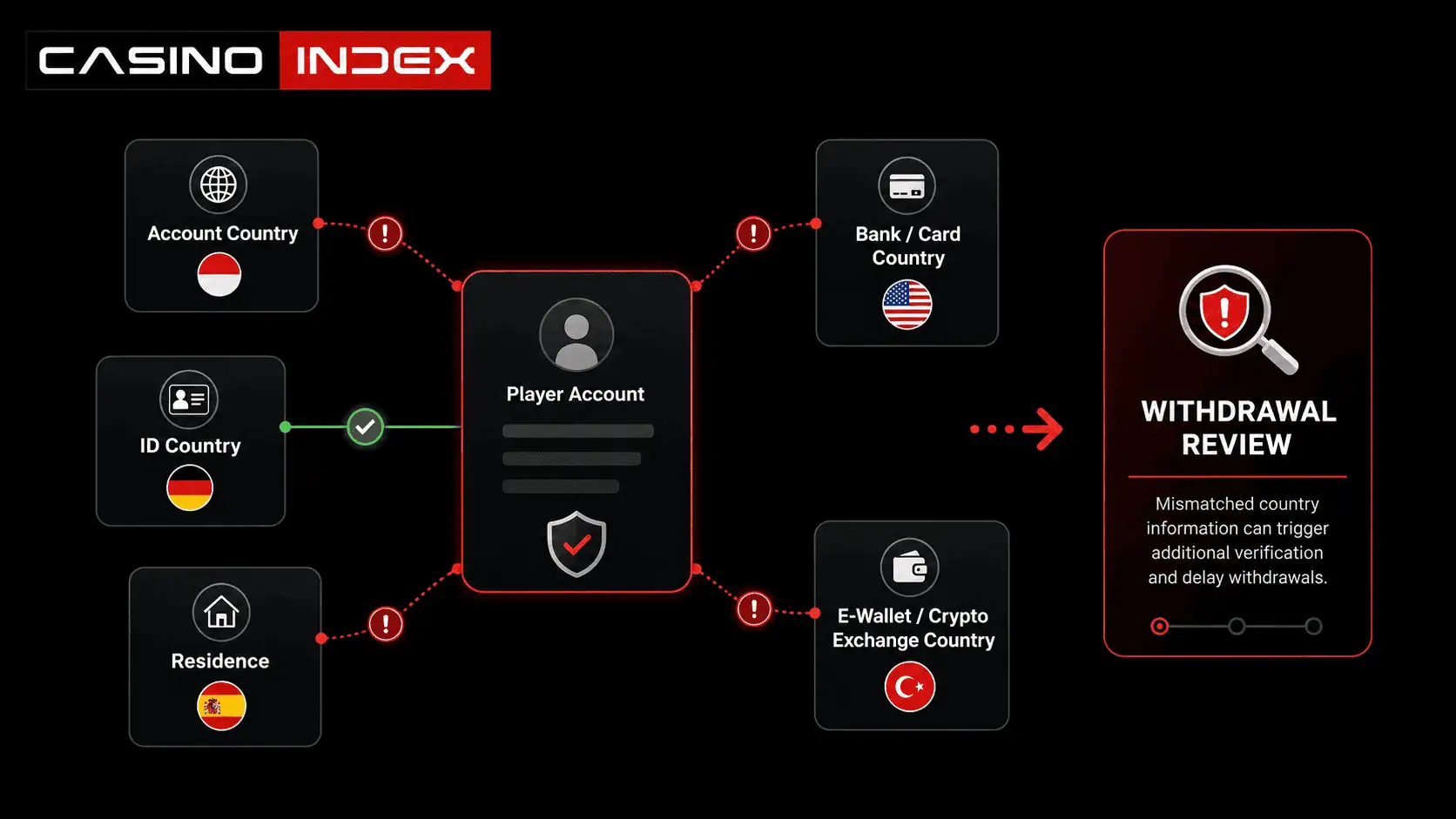
A player may register from one country, use an ID from another, deposit with a bank card from a third, and withdraw to an e-wallet registered somewhere else.
That can trigger review.
Casinos often check payment ownership and country consistency to manage fraud, AML risk, chargebacks, and closed-loop withdrawal rules.
| Mismatch | Why it can matter | What may happen |
|---|---|---|
| Account country differs from bank country | Casino may question the payment source | Extra payment proof |
| ID country differs from residence | Current address may need confirmation | Proof-of-address request |
| E-wallet country differs from casino account | Withdrawal method may need review | Delayed cashout |
| Crypto exchange records show another region | Source-of-funds review may become harder | Extra documents |
| Travel login differs from registered address | Location signal may trigger checks | Account review |
| Payment method belongs to another person | Ownership rules may be breached | Rejected withdrawal risk |
The player’s case is stronger when account details, documents, and payment methods are consistent.
When they are not, the player should be ready to explain the reason with valid documents.
Country changes, travel, and relocation
Country status can change after signup.
A player may move abroad. Another may travel for work. Someone else may open an account in one country and later try to withdraw from another.
That can create problems.
The casino may ask:
- Where do you currently live?
- Where were you located when you played?
- Which country issued your ID?
- Why does your payment method show another country?
- Why did your login history change?
- Are you now in a restricted jurisdiction?
Players should update account details when they move.
They should also avoid playing from countries where the casino does not allow real-money activity. Even a temporary login from a blocked region can create questions during review.
This matters most before withdrawals.
A country change, new device, new payment method, or unusual login pattern right before cashout can trigger extra checks, even when the explanation is legitimate.
VPN use and restricted countries
VPN use is one of the highest-risk areas in restricted-country disputes.
A VPN can protect privacy on public Wi-Fi. However, using a VPN to bypass country restrictions is different.
Casinos may treat VPN or proxy use as a risk signal because it can hide physical location, create mismatched login data, or weaken restricted-country controls.
That does not mean every VPN login proves abuse.
Still, players should be careful.
VPN risk rises when it appears together with:
- restricted-country access
- bonus play
- large wins
- first withdrawal
- document mismatch
- multiple country logins
- unusual device history
- payment-country mismatch
If a casino bans VPN use or prohibits location masking, ignoring that rule can weaken the player’s case during a dispute.
Once live, link this section to CasinoIndex’s dedicated guide to VPN use at online casinos, because VPN risk deserves its own deeper breakdown.
Anonymity does not remove country rules
Some players assume crypto casinos or low-KYC casinos make country restrictions irrelevant.
That is a mistake.
A casino may allow fast registration, crypto deposits, or limited early play without full verification. However, the terms may still restrict certain countries.
Anonymity at signup does not guarantee eligibility at withdrawal.
The casino may still check location, documents, wallet history, payment records, device signals, or account behaviour later.
This is why “no KYC at signup” is not the same as “no country rules.”
A player can stay private during parts of the casino journey and still face a country check when cashing out.
CasinoIndex explains this distinction in its guide to whether players can really stay anonymous at online casinos.
How country restrictions affect withdrawals
The biggest risk appears at withdrawal stage.
Deposits are often fast. Withdrawals are slower because the casino may review eligibility, KYC, payment ownership, bonus use, location history, and terms compliance.
A restricted-country issue can lead to:
- delayed withdrawal approval
- extra proof of address
- source-of-funds checks
- payment ownership review
- travel or residence questions
- rejected bonus winnings
- account restriction
- account closure
- balance review
The facts matter.
There is a difference between a player with mixed but legitimate residence documents and a player who knowingly bypassed a restricted-country rule.
There is also a difference between a casino that clearly blocked restricted users before deposit and one that accepted deposits easily, then raised the issue only after a win.
That is why every case needs context.
When account blocks happen
Country restrictions can lead to account blocks.
This may happen when the casino believes the player registered from a prohibited jurisdiction, used false location details, bypassed geoblocking, failed residence checks, or breached payment-country rules.
A block does not always mean the casino will keep all funds.
| Outcome | What it may mean | What players should ask |
|---|---|---|
| Account restricted but withdrawal allowed | Casino stops further play but permits eligible cashout | When will the withdrawal be processed? |
| Extra KYC required | Casino needs more proof before deciding | Which exact document is missing? |
| Bonus winnings voided | Casino applies country or bonus terms | Which rule was breached? |
| Real-money balance reviewed | Casino checks eligible funds | What happens to deposits and cash balance? |
| Account closed | Casino ends access due to location or compliance rules | Will any balance be returned? |
The key question is balance treatment.
A casino should explain what happens to deposits, real-money balance, bonus funds, and winnings. Vague blocking with no explanation is a stronger risk signal.
CasinoIndex covers this broader issue in its guide to what happens when casinos block accounts during review.
What safer casinos do differently
Safer casinos do not leave country eligibility unclear.
They make restricted-country rules visible before deposit. They also keep signup, cashier, KYC, bonus terms, and withdrawal rules aligned.
A safer casino is more likely to:
- show restricted countries clearly in the terms
- block unsupported countries before deposit
- explain whether rules apply to residence, location, or citizenship
- require accurate country selection at signup
- explain VPN and proxy rules
- check payment ownership clearly
- provide consistent KYC requirements
- explain what happens after relocation
- define balance treatment if an account is restricted
No casino system is perfect.
However, transparency reduces surprise. Players should not discover country ineligibility only after winning.
Red flags before depositing
Be careful when several warning signs appear together.
| Red flag | Why it matters | What players should do |
|---|---|---|
| Restricted-country list is hard to find | Eligibility may be unclear before deposit | Ask support before playing |
| Signup accepts restricted countries | Later review may be harsher | Do not rely on signup alone |
| Terms allow voided winnings for location breaches | Withdrawal risk is higher | Avoid play if status is unclear |
| VPN wording is broad or vague | Casino may have wide enforcement power | Get written clarification |
| Payment-country rules are unclear | Cashout may face extra review | Match account and payment details |
| KYC policy is vague | Residence checks may become unpredictable | Prepare proof before deposit |
| Bonus terms exclude some countries separately | Bonus wins may be voided | Check bonus eligibility separately |
| No balance-treatment policy exists | Account block outcome may be unclear | Treat as higher risk |
One red flag does not prove the casino is unsafe.
Several together should make players more cautious.
Practical pre-deposit checklist
Before depositing, check these points:
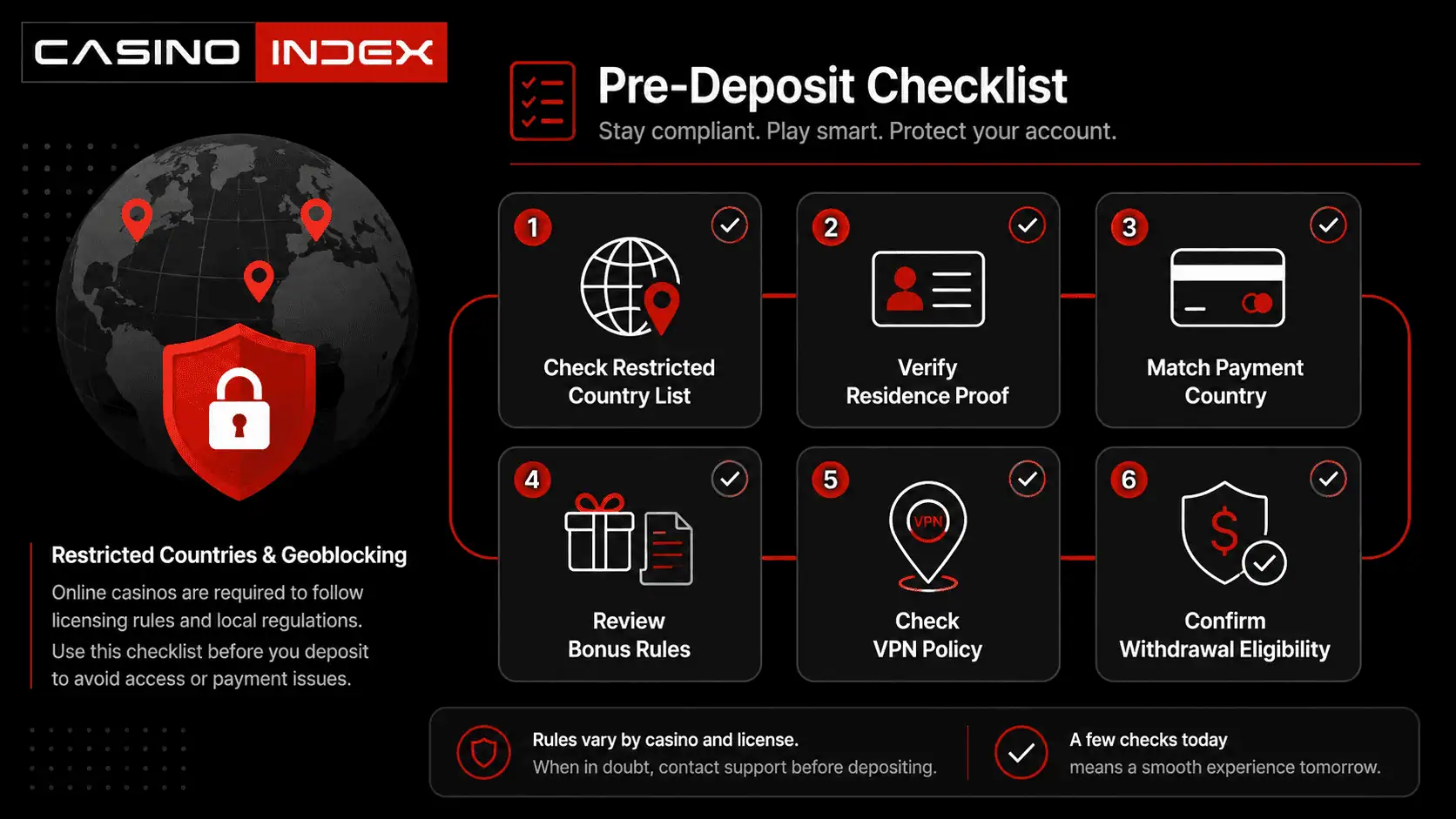
- Is your country listed as restricted?
- Do the terms refer to residence, location, citizenship, or all three?
- Does the casino geoblock your country?
- Can you prove current residence with valid documents?
- Does your payment method match your account country?
- Are bonuses restricted for your country?
- Does the casino ban VPN or proxy use?
- What happens if your country status changes?
- What happens to balances if the account is restricted?
- Is the license valid for the market you are using it from?
This check should happen before the first deposit.
It is much harder to fix after a withdrawal is already pending.
Bottom line: a working casino site is not enough
Restricted countries and geoblocking are not just access issues.
They are withdrawal issues.
A casino may let a player load the website, register, deposit, and play. However, eligibility can still be reviewed later through KYC, residence proof, payment details, login history, VPN signals, and license rules.
That is where the real risk sits.
Players should not rely on access alone. They should check the terms, restricted-country list, payment rules, verification requirements, VPN wording, bonus eligibility, and balance-treatment policy before depositing.
The safest rule is direct.
If your country status is unclear, do not deposit until the casino confirms eligibility in writing.
A working signup form is not enough.
Real eligibility exists when the casino’s terms, license, KYC process, payment rules, and withdrawal policy all point in the same direction.
FAQ
What are restricted countries at online casinos?
Restricted countries are countries, territories, or regions where a casino does not allow registration, deposits, real-money play, bonuses, withdrawals, or continued account access. The exact rule depends on the casino’s license, terms, payment policy, and business model.
Does casino access mean I am allowed to play?
No. Access is not eligibility. A casino website may load and accept registration even if the player’s country creates problems later during KYC or withdrawal review.
Can a casino refuse withdrawal because of my country?
Yes, depending on the terms, license, and facts of the case. A casino may delay, review, restrict, or reject withdrawals if it believes the player breached restricted-country rules.
Why does KYC matter for country restrictions?
KYC can reveal residence, ID country, payment country, address history, and source-of-funds details. These records may confirm or challenge the player’s eligibility.
Is using a VPN at online casinos safe?
VPN use can be risky if the casino bans VPNs or treats location masking as a breach of terms. It becomes especially risky when used to access a casino from a restricted country.
Can I play while travelling?
Only if the casino allows play from your temporary location. A player may be eligible at home but restricted while travelling in another country.
What is payment country mismatch?
Payment country mismatch happens when the player’s account country, ID, residence, bank, e-wallet, or crypto payment records point to different jurisdictions. This can trigger extra verification or withdrawal review.
What should I do if I moved country after registering?
Update your account details and ask support whether your new residence affects eligibility before depositing or playing further. Save the response in writing.

Maria Hoffmann has worked in cryptocurrency content and digital publishing since 2017. She is a co-founder of Freecoins24 and CryptoMutant and has covered blockchain projects, crypto platforms and emerging industry trends for several years. She has also been active as a cryptocurrency investor since 2019. At CasinoIndex, Maria combines content research and SEO experience with a focus on casino trust, platform security, withdrawal processes, payment risks and user protection. Her work looks beyond bonuses and product features to examine how gambling platforms handle player funds, verification and account-related risks.