What Happens When Casinos Block Accounts
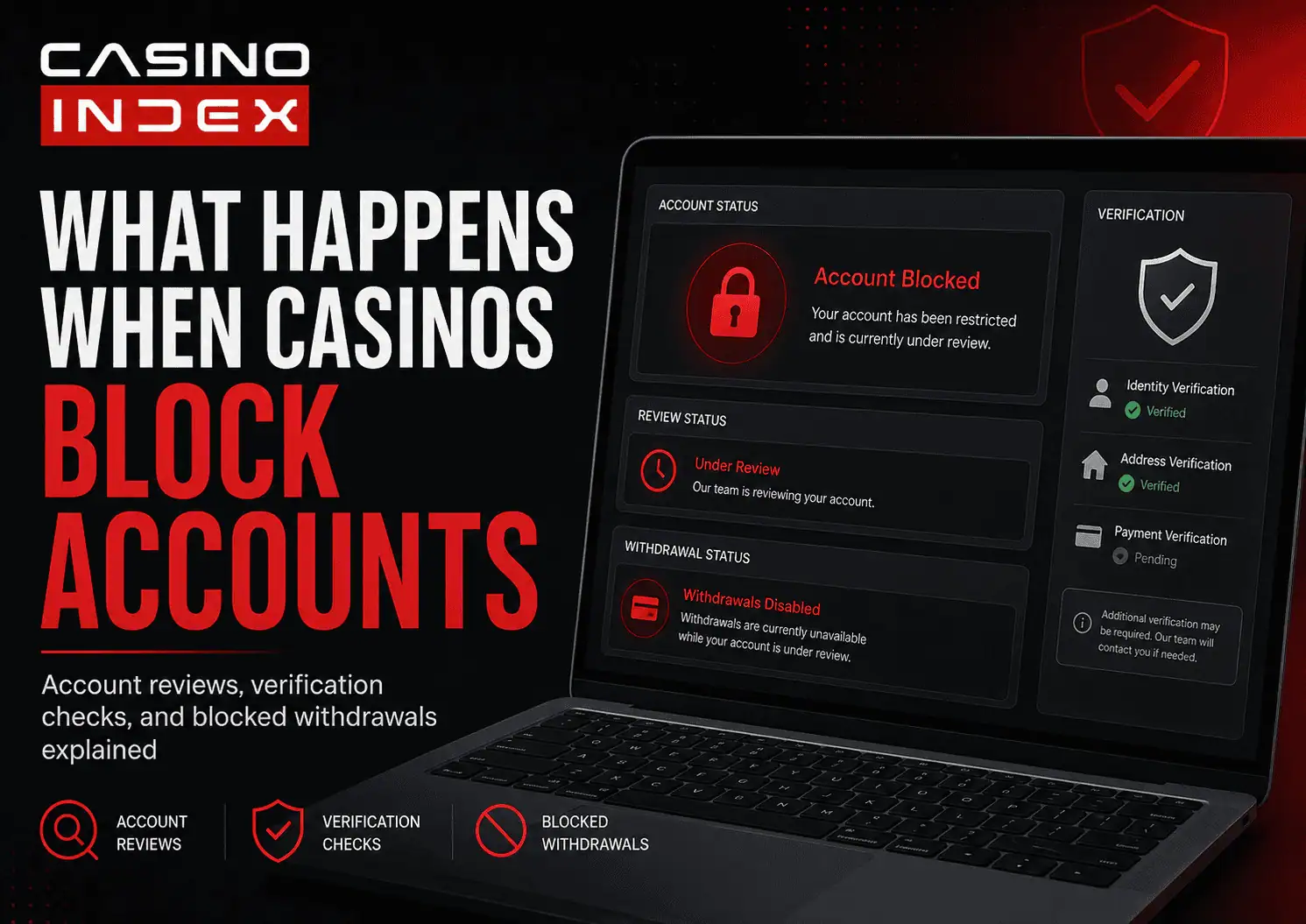
A blocked casino account changes the entire relationship between the player and the operator.
Before the restriction, the account may have worked normally. Deposits cleared, games loaded, bets were accepted and support felt routine. After the block, the important questions become very different: Can the player still access the account? Is the balance frozen? What documents are required? Will the withdrawal continue? Can the account be reopened? And what happens if the casino refuses to resolve the case?
This guide focuses on that post-block stage.
It does not explain every technical reason an account can be flagged. CasinoIndex covers the causes separately in how casino account blocks usually happen. Here, the focus is what the restriction means, what can happen to the money, how the player should respond and when a normal review starts turning into a dispute.
A casino can have a legitimate reason to restrict an account. The quality test begins after the restriction is active. A fair operator should explain the general issue, identify the next step and give the player a workable route toward verification, payment or a final decision.
What happens after a casino blocks an account?
The outcome depends on the type of restriction. A blocked account does not always mean permanent closure, and a frozen withdrawal does not automatically mean the casino has confiscated the balance.
| Account status | What the player usually sees | What may happen to the balance | Best next step |
|---|---|---|---|
| Temporary security lock | Login or account access is limited | Balance normally stays on the account while access is reviewed | Confirm identity or account ownership and avoid opening another account |
| Withdrawal hold | Account remains visible but the payout stays pending | Funds remain unavailable until the review is completed | Ask what exact review is active and what evidence is required |
| KYC or compliance review | Documents or payment evidence are requested | Withdrawals can remain paused until the casino reaches a decision | Submit only the requested evidence and keep a complete record |
| Account suspension | Gameplay, deposits or withdrawals may all be disabled | The full balance may remain frozen during the investigation | Ask which rule or review category applies and what happens next |
| Permanent closure | The casino says the account will not be restored | Deposits, winnings or the full balance may be returned, voided or disputed depending on the case | Request the final decision in writing and prepare for escalation if necessary |
The table is only a starting point. Two players can see the same “account under review” message and still face completely different situations. The useful information is what the casino says after that message.
First establish what kind of restriction you are dealing with
Players often react to every account block as if the casino has permanently closed the account. That can create unnecessary panic and bad decisions.
The first task is to separate four different states.
Temporary access restriction
This may involve a login problem, device-security check, password reset, two-factor authentication issue or short account hold. The player may regain access after proving account ownership.
Withdrawal-only restriction
The account still works, but the casino has stopped the payout. This is more serious because the dispute already involves access to money. The operator may be reviewing identity, payment ownership, transaction history, bonus use or another account condition.
Full account suspension
The player can no longer use normal account functions. The casino may block deposits, gameplay and withdrawals while a wider review continues.
Permanent account closure
The operator has reached or is claiming to have reached a final decision. At this point, the most important issue is no longer whether the player can log in. It is what happens to the remaining balance and whether the decision can be challenged.
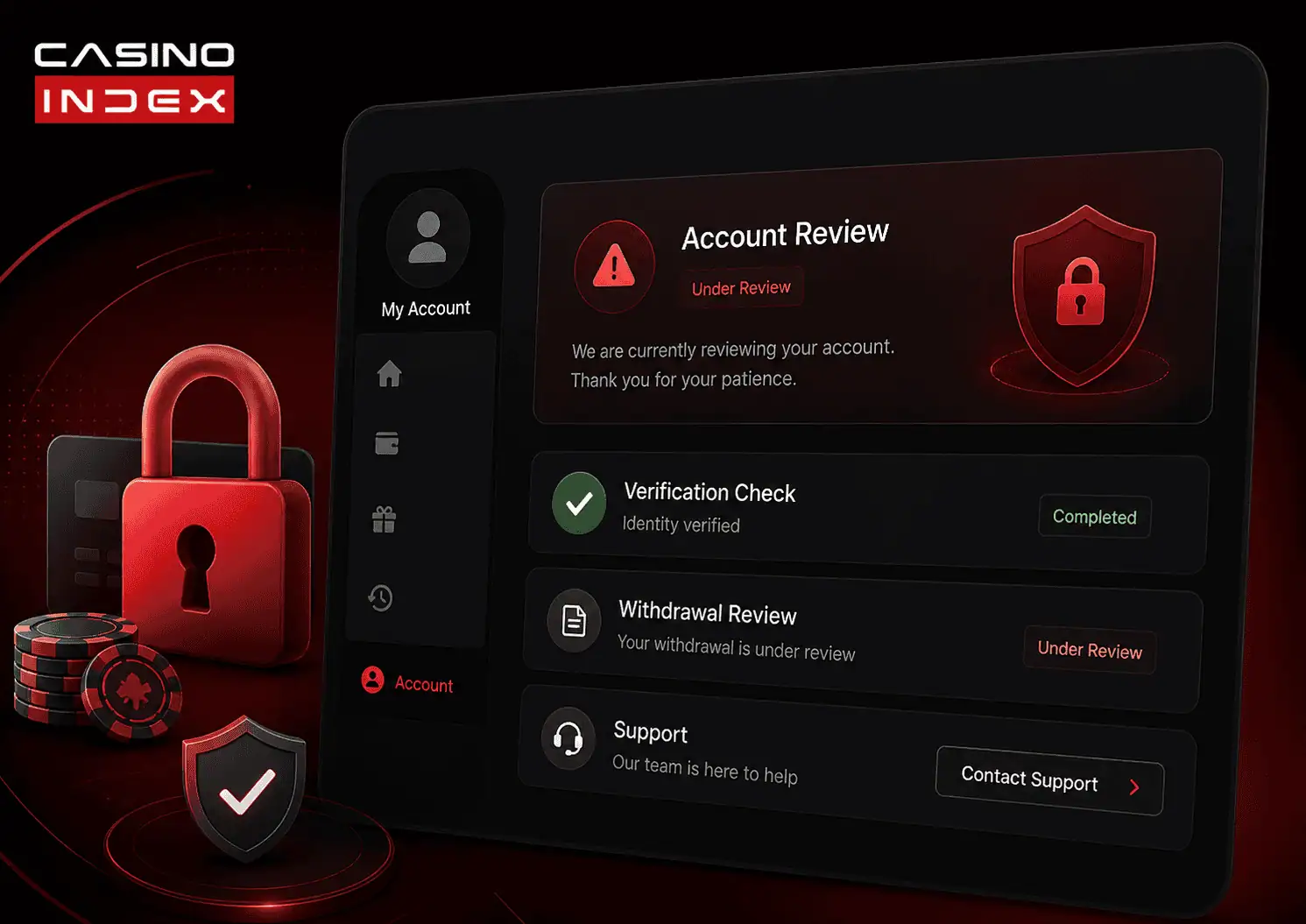
Do not assume that support uses these labels consistently. Ask what functions are restricted, whether the decision is temporary or final and whether the balance is still being held pending review.
What happens to the money when the account is blocked?
This is the part that matters most to players.
A blocked account can affect deposits, winnings and pending withdrawals differently. The casino should explain which funds are frozen and whether any part of the balance is currently considered undisputed.
During a normal review
The balance usually remains inaccessible while the operator completes the review. If the player satisfies the requested checks and no relevant breach is found, the casino may reopen the account or release the withdrawal.
When verification remains incomplete
The operator may continue holding the funds until identity, payment ownership, location or another required point is resolved. A legitimate review can still take time, but the casino should be able to explain what remains outstanding.
When the casino alleges a terms breach
The operator may claim the right to void a bonus, remove certain winnings, return only the original deposit or close the account. Whether that outcome is reasonable depends on the actual term, how clearly it was disclosed and whether the casino can connect the rule to the player’s conduct.
When the casino gives no usable decision
This is where risk rises sharply. A balance that remains frozen behind vague phrases such as “internal review” or “relevant department” becomes harder to distinguish from simple payout resistance when no clear requirement, timeline or decision appears.
CasinoIndex’s casino withdrawal guide explains the wider difference between internal approval and the payment stage itself.
What a fair blocked-account process should look like
A fair process does not mean the casino has to unlock the account immediately. It means the player can understand the case well enough to respond.
Several signals matter.
The reason has a clear category
The operator may not disclose every internal fraud rule or security trigger. However, it should usually be able to say whether the case involves verification, payment ownership, jurisdiction, account duplication, bonus use, security or another identifiable category.
The requested action is specific
The player should know what to provide or do next. “Send proof of address dated within the required period” is actionable. “Your account remains under review” is not.
The requirements stop expanding without explanation
Additional documents can sometimes be justified. The problem begins when each completed request produces another unrelated request and the casino never explains why the scope changed.
The support story stays consistent
Different support agents do not need to use identical wording, but the underlying reason should remain stable. A case that moves from security to bonus abuse to payment ownership without any explanation deserves closer scrutiny.
The balance status is explained
The operator should tell the player whether the money is simply frozen during review, whether a withdrawal remains pending or whether the casino is claiming a right to void part of the balance.
There is a route toward an outcome
A fair process moves toward one of three results: access is restored, the account is closed with the balance handled under a stated rule, or the player receives a final decision that can be challenged through the available dispute route.
Warning signs that the review is turning into a high-risk dispute
Weak blocked-account processes usually become obvious through repeated friction rather than one dramatic refusal.
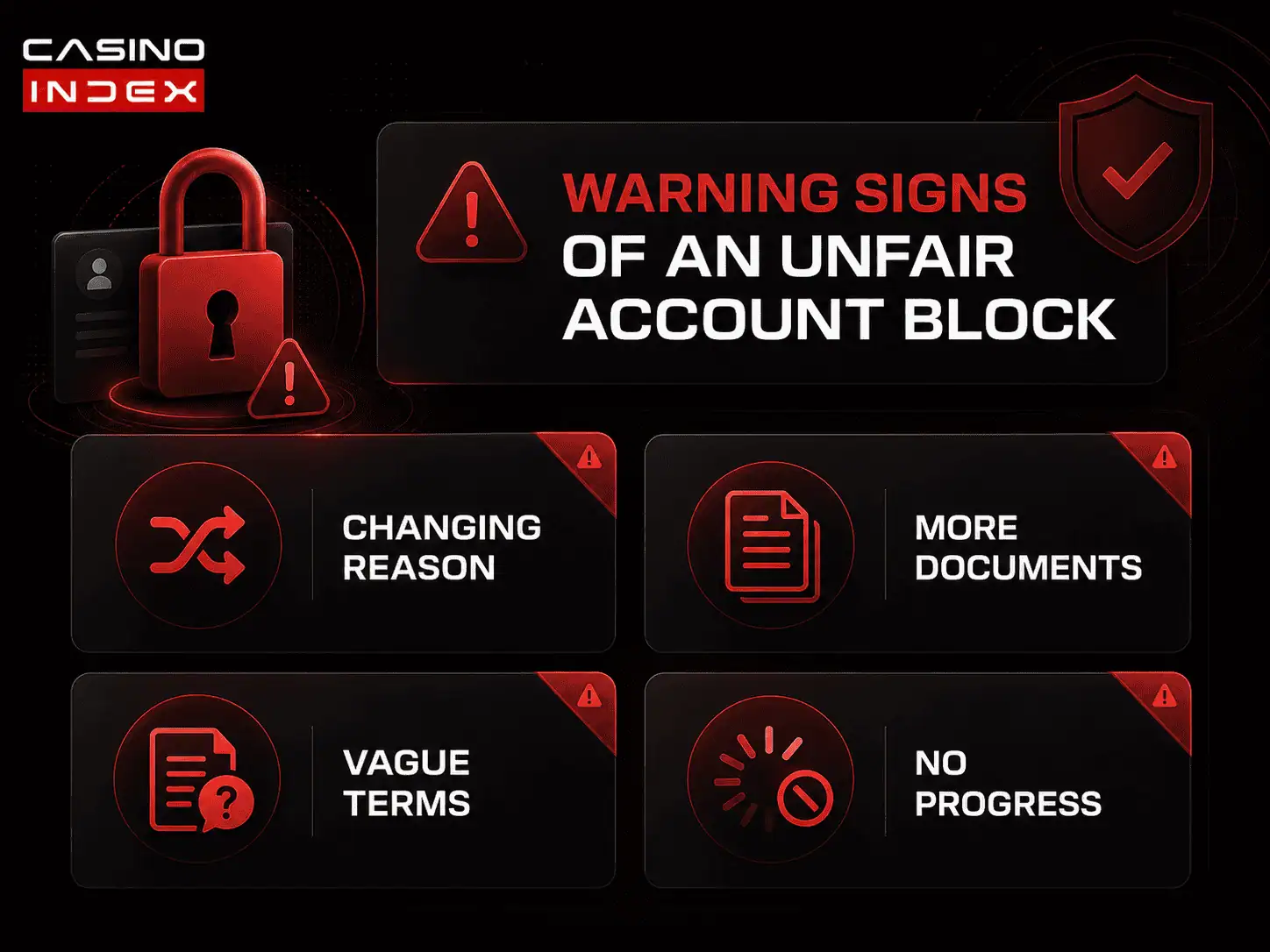
The most important warning signs are:
- the reason for the restriction keeps changing
- support refuses to identify even the general review category
- new document requests appear without explaining why previous evidence was insufficient
- the casino cites broad terms but cannot connect them to the case
- the withdrawal remains pending with no meaningful status update
- different departments repeatedly pass the case between each other
- the operator will not explain what happens to the balance
- the casino claims a final decision but gives no complaint or appeal route
None of those points alone proves that the operator is acting dishonestly. The pattern matters. A complicated verification case may legitimately require several steps. The trust problem appears when the process produces activity without moving toward a result.
What to do immediately after the account is blocked
The first response should protect the player’s evidence and reduce the chance of creating new problems.
- Save the current account state. Capture the balance, pending withdrawal, account message and any visible restriction.
- Save the relevant terms. Keep copies or screenshots of the rules that apply to verification, withdrawals, account closure, bonuses and the disputed issue.
- Ask for the exact status. Find out whether the account is temporarily restricted, under KYC, under a payment review, suspended or permanently closed.
- Ask what is required next. Request a precise list of documents or actions instead of accepting a generic “please wait.”
- Ask about the balance. Confirm whether the funds are frozen, still pending withdrawal or affected by a claimed rule breach.
- Keep communication concise. One clear message is more useful than several emotional messages that introduce inconsistencies.
- Do not open another account. A second profile can complicate the dispute and create a new terms issue.
- Do not make new deposits. Once access to existing funds is uncertain, adding more money increases exposure without solving the original problem.
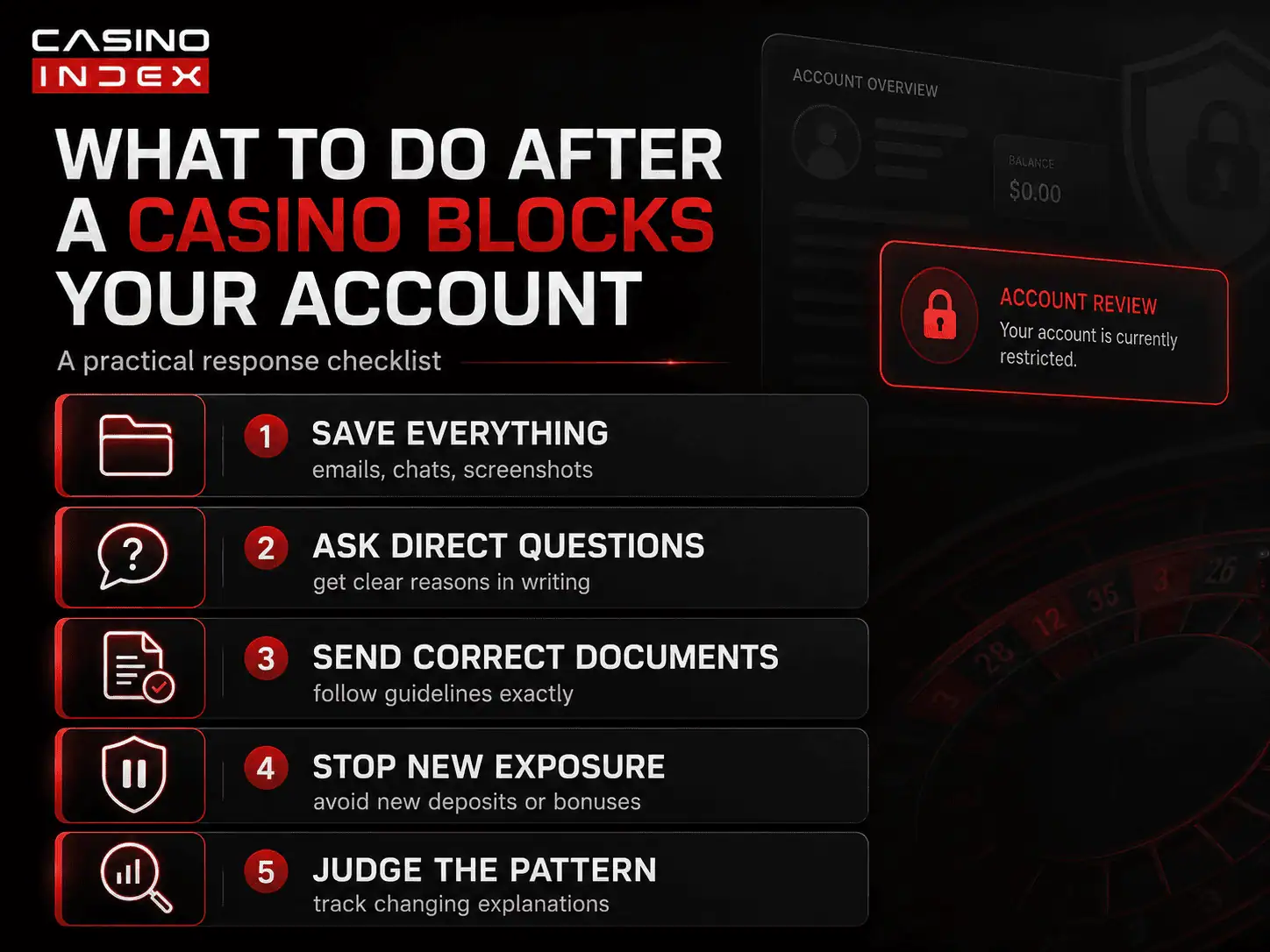
The goal at this stage is not to win an argument with support. It is to create a clean record that shows what happened, what the casino requested and whether the player complied.
Build an evidence file before the case becomes a dispute
Blocked-account cases become much harder to reconstruct after several weeks of emails and support chats.
Create one folder and keep the important evidence together:
- account ID or username
- registration email
- deposit confirmations
- withdrawal request details
- transaction IDs for crypto payments where relevant
- screenshots showing the balance before and after the block
- emails from the casino
- support-chat transcripts
- documents submitted for verification
- the date each document was sent
- the casino’s replies to each submission
- the relevant version of the terms and bonus rules
This record becomes especially important if the casino later changes the reason for the restriction or claims that a document was never supplied.
How to respond to document requests without making the case worse
When the casino requests KYC or payment evidence, send what was requested in a clear and organised format.
Do not send unrelated private information simply because the account is blocked. At the same time, do not deliberately crop out information that the casino reasonably needs to verify the document.
Label files clearly. Keep a copy of every submission. Record the date. If the casino rejects a document, ask what specific requirement it failed.
That creates a simple audit trail:
request → submission → response → next requirement.
If that chain remains coherent, the review may still be progressing normally. If the casino repeatedly resets the process without explaining what changed, the case deserves more scrutiny.
What if the account was blocked only after a withdrawal?
Restrictions that appear at payout stage deserve careful analysis because the player has already completed the deposit and gambling side of the relationship.
A withdrawal can legitimately trigger deeper checks. That alone does not make the block abusive.
However, the casino should still be able to explain why the review is now necessary and what the player must do to complete it.
The most concerning pattern looks like this:
- deposits are accepted without friction
- gameplay continues normally
- the player accumulates a meaningful balance
- a withdrawal is requested
- the account is restricted
- support gives no clear path toward release or a final decision
The problem is not simply that verification happened late. The problem is when the operator uses the review stage without providing a transparent route to completion.
How blocked-account complaints should be evaluated
Public complaints can help, but they need context.
A single angry review does not prove that a casino routinely confiscates balances. Players can leave out important details, misunderstand terms or report a case before the operator has finished reviewing it.
At the same time, repeated complaints around the same stage can reveal a pattern.
Pay more attention when multiple cases describe:
- the same withdrawal hold
- repeated document requests with no resolution
- account closure immediately after a large win
- changing explanations from support
- balances held after verification was completed
- the same disputed term being applied in similar cases
Resolved complaints matter too. A casino that eventually releases funds, explains the decision or participates constructively in mediation should not be treated the same as an operator that repeatedly ignores disputes.
CasinoIndex explains how blocked-account complaints should be read without treating every negative review as proof.
When should the player escalate the dispute?
Not every blocked account needs immediate external escalation.
Escalation becomes more reasonable when the internal process has stopped producing a meaningful next step.
Typical escalation signals include:
- the casino says the decision is final
- the operator refuses to identify what is still required
- all requested documents were supplied but the case remains indefinitely open
- the reason for the restriction keeps changing
- the casino claims winnings are void but does not explain the relevant rule
- support stops responding to substantive questions
- the casino provides a complaint route but normal support cannot resolve the case
The correct route depends on the operator. It may involve a formal internal complaint, an alternative dispute body, a regulator, a recognised mediation service or another complaint mechanism available under the casino’s licensing structure.
CasinoIndex covers how casino disputes can be escalated when normal support no longer moves the case forward.
What to include in a formal complaint
A strong complaint is chronological, specific and easy to verify.
Include:
- the account identifier
- the amount currently disputed
- the date the restriction began
- the date of the withdrawal request, if relevant
- the reason the casino gave
- the documents or evidence you supplied
- the dates of important support replies
- the exact term the casino relies on, if one was cited
- the outcome you are requesting
Avoid turning the complaint into a long emotional history of every interaction. The reviewer needs to understand the disputed decision and the evidence supporting your position.
What not to do after an account block
Several reactions can make a legitimate case harder to resolve.
- Do not create another account. It can introduce a new multi-account issue.
- Do not alter your story. Keep dates, payment details and explanations consistent.
- Do not submit edited documents. If a document needs clarification, ask what format the casino requires.
- Do not deposit more money. Additional deposits do not prove good faith and increase the amount exposed.
- Do not threaten support immediately. Ask clear questions first and preserve the record.
- Do not post accusations you cannot support. Stick to what happened, what was requested and what remains unresolved.
- Do not assume silence means confiscation. First establish whether the case is still open, escalated internally or formally closed.
The strongest position is usually the simplest: accurate facts, clean evidence and a clear request for resolution.
Temporary restriction vs permanent closure
The practical difference is whether the casino still offers a path back to normal account status or a defined settlement.
| Question | Temporary restriction | Permanent closure |
|---|---|---|
| Can the account be restored? | Usually possible if the review is completed successfully | Normally no |
| Are documents still being requested? | Often yes | Possibly, but usually to settle the balance or confirm a final decision |
| Is the balance necessarily lost? | No | No; the casino should explain what happens to deposits and winnings |
| Is escalation appropriate? | Usually after the internal process stops progressing | More likely once the final decision and balance treatment are known |
A permanent closure should not be treated as a complete answer by itself. The player still needs to know what happens to the money and why.
How to judge the final outcome
A blocked-account case can end in several ways.
Best case: the review is completed, the account is restored and the withdrawal is released.
Procedural closure: the casino closes the account but returns the undisputed balance under its rules.
Partial dispute: the operator returns deposits but voids certain winnings or bonuses under a specific term.
Full dispute: the casino refuses payment or keeps the balance frozen and the player challenges the decision.
Unresolved case: no meaningful final decision appears and the player has to escalate because internal support has stopped making progress.
The trust question is not whether every case ends in the player’s favour. Casinos can enforce legitimate rules. The question is whether the operator can explain the decision, apply the rule consistently and provide a fair route to challenge it.
Blocked-account outcome: final assessment
What happens after a casino blocks an account matters more than the block itself.
A temporary restriction can be a normal security or verification step. A withdrawal hold can be resolved after documents are supplied. Even permanent closure can be handled fairly when the operator explains the decision and settles the balance under clear terms.
The situation becomes high-risk when the process stops being understandable.
Changing explanations, endless document loops, unexplained balance holds and support conversations that never move toward a decision are stronger warning signs than the original “account blocked” message.
Players should therefore focus on four things: status, evidence, balance and escalation.
Find out what restriction is active. Save the evidence. Ask what happens to the money. Then escalate only when the internal process no longer provides a realistic path toward resolution.
That keeps this page distinct from the causes guide. The causes page explains why the block starts. This page explains what the player faces after it starts and what to do next.
Blocked-account FAQ
What happens when a casino blocks your account?
The casino may restrict login access, freeze a withdrawal, request verification, suspend normal account functions or permanently close the account. The balance can remain frozen while the operator reviews the case.
Can you still get your money from a blocked casino account?
Sometimes. In a normal review, funds may be released after the required checks are completed. If the casino claims a rule breach, it may dispute some or all winnings. The operator should explain what rule applies and how the balance will be handled.
Does a blocked casino account mean the casino is a scam?
No. Casinos can restrict accounts for legitimate security, compliance, payment and responsible gambling reasons. The stronger trust signal is how clearly and fairly the operator handles the case after the restriction begins.
What should you do first after a casino blocks your account?
Save screenshots and messages, confirm the exact account status, ask what evidence is required and request a clear explanation of what is happening to the balance. Do not create another account or make additional deposits.
How long can a blocked-account review take?
There is no single timeline that applies to every casino or case. The important point is whether the operator explains what remains under review and whether the case continues moving toward a decision.
What if the casino keeps asking for more documents?
Ask why each new document is required and what was insufficient about the previous submission. Additional checks can be legitimate, but repeated expansion without explanation is a warning sign.
When should a blocked-account case be escalated?
Escalation becomes more reasonable when normal support stops providing a meaningful next step, the casino issues a final disputed decision, or all requested evidence has been supplied but the case remains unresolved.
Can a casino permanently close an account and keep the winnings?
A casino may claim that its terms allow winnings to be voided after a serious rule breach. Whether that is fair depends on the rule, the evidence and how consistently the term was applied. The casino should provide a clear decision and an available complaint route where applicable.
Should you open a new account after being blocked?
No. Creating another profile can introduce a separate multi-account issue and make the original dispute harder to resolve.

Maria Hoffmann has worked in cryptocurrency content and digital publishing since 2017. She is a co-founder of Freecoins24 and CryptoMutant and has covered blockchain projects, crypto platforms and emerging industry trends for several years. She has also been active as a cryptocurrency investor since 2019. At CasinoIndex, Maria combines content research and SEO experience with a focus on casino trust, platform security, withdrawal processes, payment risks and user protection. Her work looks beyond bonuses and product features to examine how gambling platforms handle player funds, verification and account-related risks.