Can You Stay Anonymous in Casinos?
Article OverviewOnline casino play can reduce how much personal information you share, but complete anonymity should not be assumed. No-KYC signup only describes the registration stage, while conditional KYC, wallet checks and withdrawal reviews can appear later. Crypto wallets can reduce traditional payment-data exposure, yet public blockchains may still reveal transaction history. The key distinction is between anonymity, pseudonymity, no-KYC access, wallet privacy and formal identity verification.
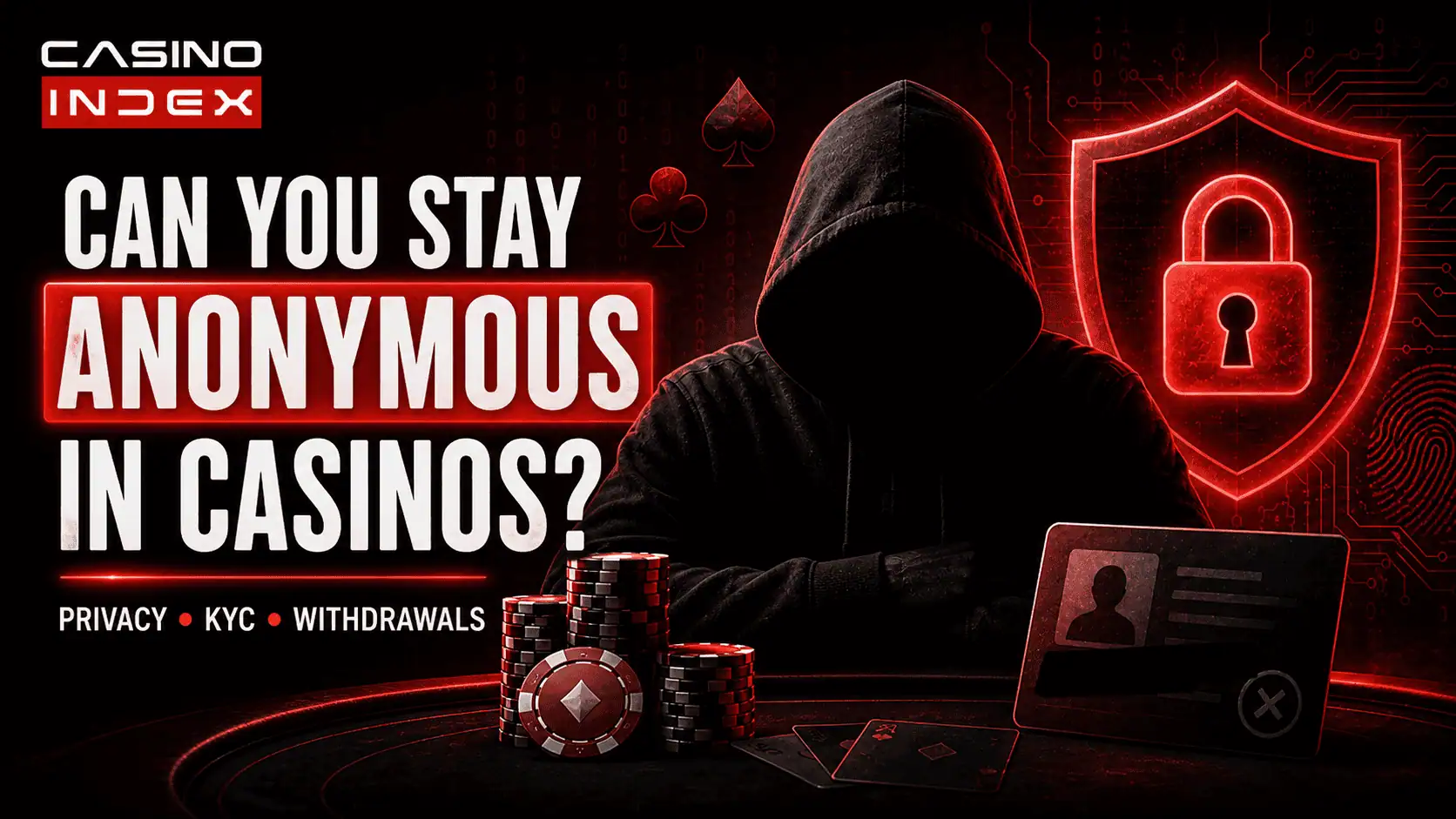
Most players asking this question are not looking for the same thing.
Some want to avoid uploading ID before they even place a bet. Some want to keep gambling activity away from their main bank account. Others want to use crypto and stay harder to track. A smaller group wants full anonymity from deposit to withdrawal.
That last version is where most casino content becomes misleading.
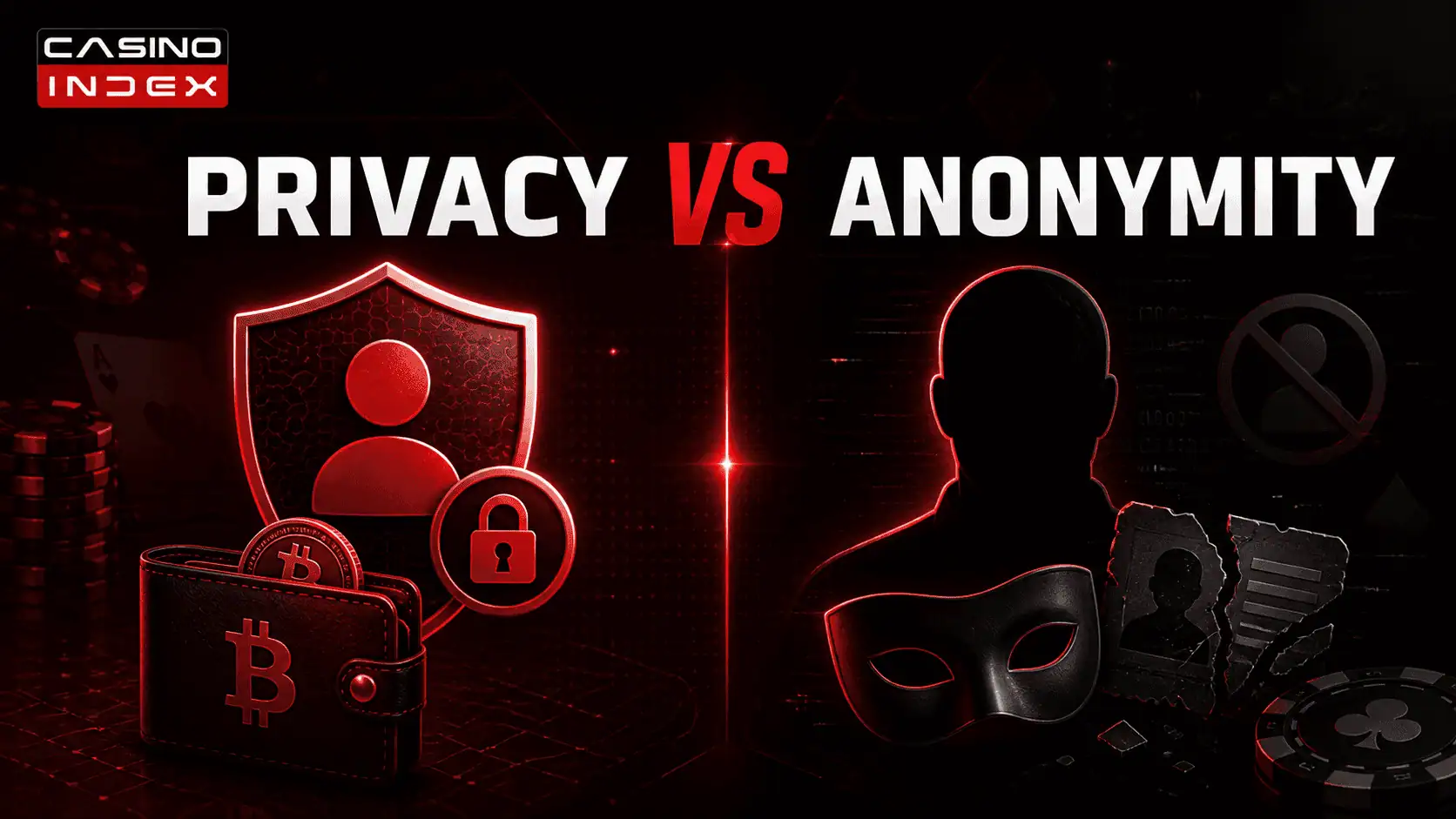
Because in real gambling environments, privacy and anonymity are not the same thing.
Some casinos can feel relatively private at the start, especially when they support crypto and do not require documents immediately.
That lower-friction entry can reduce how much personal information you share at first. However, once real money moves through the system — especially at withdrawal stage — the idea of staying completely anonymous usually becomes much harder to maintain.
You can sometimes stay less exposed. You usually cannot stay fully anonymous once identity checks, payment tracing, or withdrawal controls come into play.
No KYC at signup does not necessarily mean no later checks. A crypto wallet can also improve payment privacy without removing identity verification.
| Term | What it means | What it does not guarantee |
|---|---|---|
| Anonymous | No reliable link between the gambling activity and the player’s real-world identity from the information available. | That another payment, account, legal, or technical signal can never reveal identity. |
| Pseudonymous | Activity is tied to an identifier such as a wallet address, username, or account rather than a confirmed legal name. | That the identifier can never be connected to a person. |
| No-KYC signup | Registration can begin without traditional identity documents. | That verification will never appear later. |
| Conditional KYC | Identity or payment checks can appear after a trigger such as withdrawal activity, payment changes, jurisdiction concerns, or another risk review. | That every player faces the same trigger or threshold. |
| Wallet privacy | The amount of personal and payment information exposed through the crypto transaction route. | That the casino account itself is anonymous. |
In regulated online gambling, this is not a theory. The UK Gambling Commission states that online gambling businesses must verify age and identity before gambling, and operators should not delay those checks until withdrawal if they could have completed them earlier.
So the better question is not:
Can you stay anonymous in casinos?
It is this:
How much privacy can you realistically keep before the casino, the payment system, or the withdrawal process forces identification?
Casino Reviews for Players Who Want More Privacy and Lower Friction
| Casino | Why it fits this topic | What to verify before depositing | Review |
|---|---|---|---|
| BitStarz | Established crypto-casino environment with a long operating history and relatively simple crypto use. | Current KYC conditions, withdrawal rules, payment matching, and bonus-linked cashout terms. | Read BitStarz review |
| MyStake | Hybrid crypto-and-fiat platform that suits readers who value payment flexibility more than pure anonymity. | Verification timing, withdrawal processing, payment-route consistency, and current bonus conditions. | Read MyStake review |
| Bitz.io | Crypto-first option that is relevant to readers researching lighter onboarding and wallet-based play. | Current verification triggers, withdrawal limits, wallet rules, and how larger cashouts are reviewed. | Read Bitz.io review |
| CoinCasino | Useful contrast case for players attracted by fast onboarding, crypto support, and large promotions. | Payout-stage checks, withdrawal predictability, promotion terms, and verification rights. | Read CoinCasino review |
These are not ranked as “anonymous casinos.” They are review links for readers who want to compare privacy friction, verification rules, withdrawals, and overall trust at brand level.
What “Anonymous Casino” Usually Means in Practice
No, not in the way most people imagine it.
You can sometimes sign up without immediate KYC, use crypto instead of a bank card, and even play for a while without submitting documents.
That still does not mean the casino will let you deposit, win, and withdraw meaningful sums while remaining fully anonymous.
That is the part weak content keeps skipping.
Most so-called anonymous casino experiences are really just delayed verification environments. The account feels private early. The real checks appear later.
Usually at the exact moment the player cares most.
What “anonymous casino” actually means
This topic only makes sense if the terms are separated properly.
1. Low-friction signup
This is the version most players actually encounter.
You create an account with an email address, username, and password. No documents are required immediately. The process feels open and private.
It is not true anonymity. It is just a lighter first step.
2. Payment separation
This is where users try to keep gambling activity away from their everyday banking.
Crypto wallets, prepaid methods, or separate payment rails can reduce visibility on a personal bank statement. That gives more privacy on one layer.
It still does not remove the broader trail.
3. Pseudonymous play
This is the common crypto version.
The casino may initially see a wallet address, account alias, and transaction history before it sees a passport or utility bill. That is more private than traditional banking from a user-experience angle.
But it is still not invisible.
4. Full anonymity
This is what many readers mean.
No reliable connection between the account, payment flow, wallet ownership, and the real person.
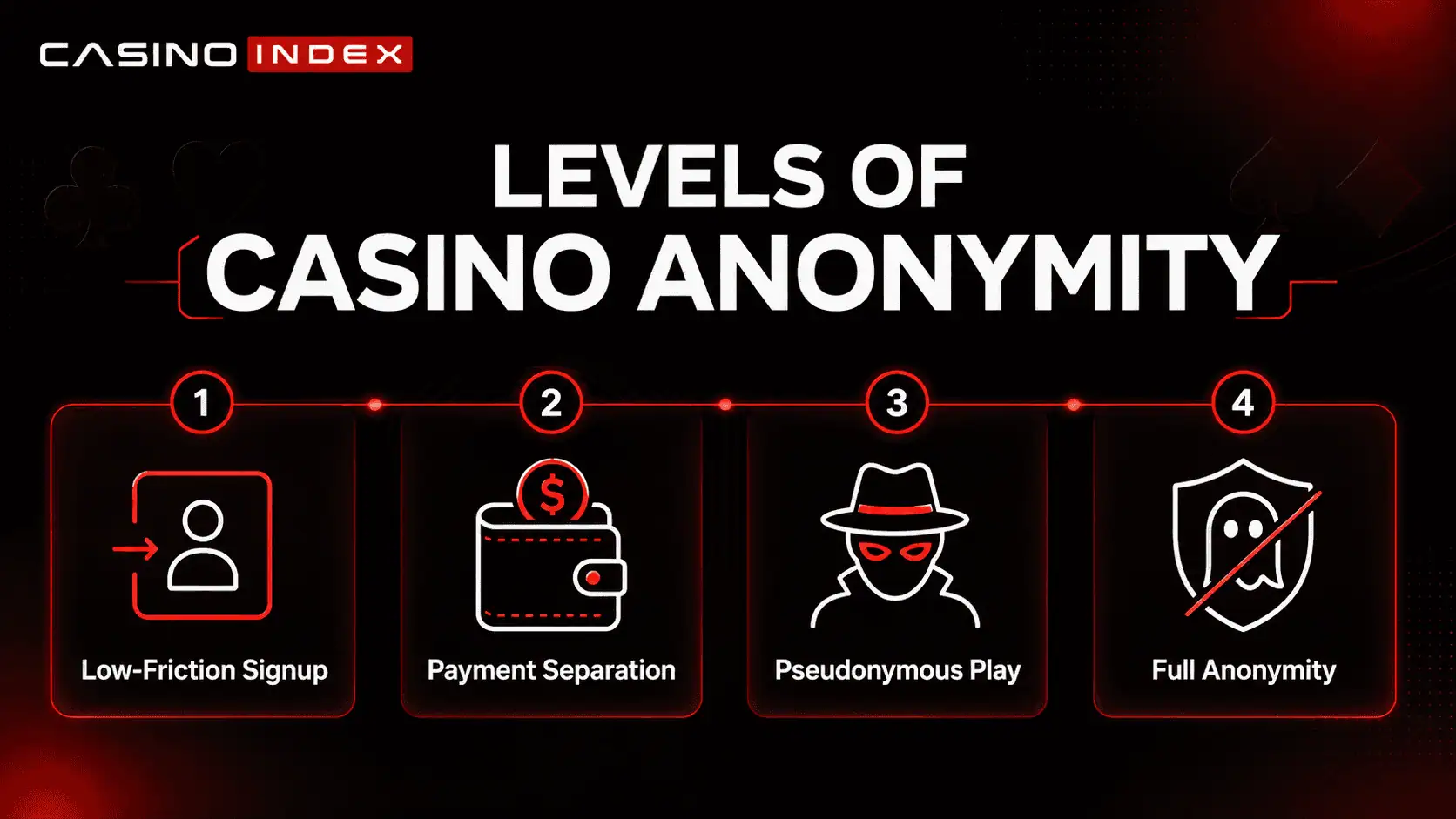
That is the least realistic version in online gambling.
Once deposits, withdrawals, compliance reviews, or exchange-linked crypto rails enter the system, the distance between the wallet and the person can shrink quickly. EU and wider crypto compliance rules keep moving toward more transfer traceability, not less. The EBA’s travel rule guidance was specifically issued to make crypto transfers more traceable for anti-money-laundering purposes.
No-KYC and low-KYC are verification models, not synonyms for anonymity. A no-KYC signup can still become conditional KYC later, while a low-KYC platform may ask for limited information from the start. CasinoIndex compares those models separately in No-KYC Casinos vs Low-KYC Casinos.
Why the dream breaks at withdrawal stage
If you want one sentence that explains this entire topic, it is this:
Anonymity usually survives deposits better than withdrawals.
Casinos are built to make deposits easy.
Withdrawals are different.
This is where operators start checking:
- account ownership
- payment consistency
- source of funds
- bonus usage
- country restrictions
- unusual transaction behavior
- linked accounts or suspicious patterns
That is why the smartest way to cover this keyword is not to romanticize “anonymous casinos.” It is to explain how privacy collapses under payout pressure.
For the full identity-check framework, see the Casino Verification Guide. For the cashout side specifically, CasinoIndex also explains what casinos check before approving withdrawals.
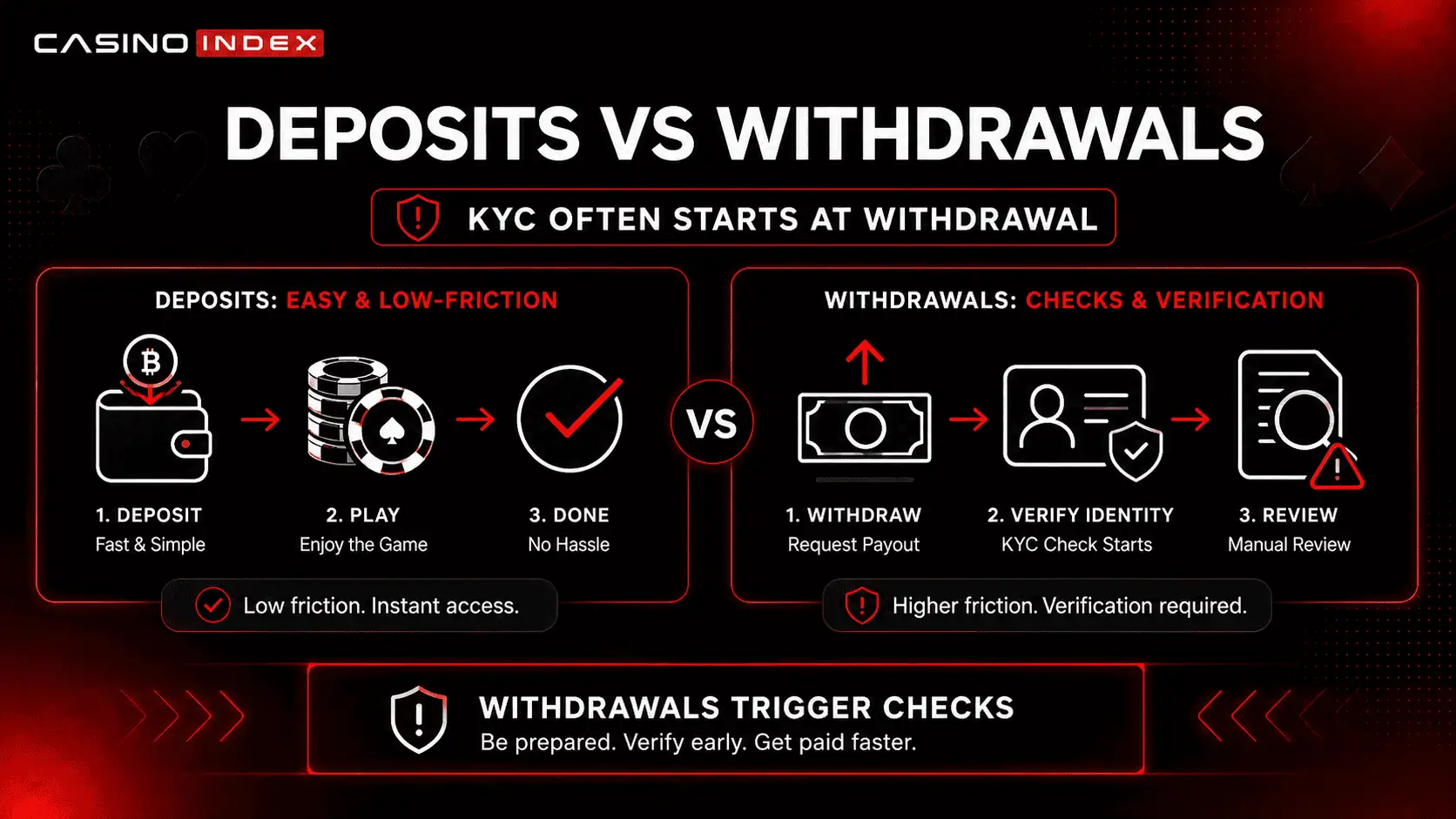
Why casinos ask for ID at all
Some platforms abuse verification. That is true.
But a serious article cannot pretend that all KYC is fake or purely malicious.
Casinos ask for ID for real structural reasons:
- age checks
- anti-money-laundering obligations
- fraud prevention
- account ownership confirmation
- self-exclusion checks
- payment-method mismatch reviews
- source-of-funds review
- bonus abuse prevention
The UK Gambling Commission is explicit: online gambling businesses must verify age and identity before gambling, and although businesses may still request additional information later for legal reasons, they should not hold standard ID checks back until withdrawal if they could have asked earlier.
That distinction matters.
Fair verification is explained early, used proportionately, and tied to clear risk logic.
Bad verification appears suddenly, grows without warning, and starts exactly when the player tries to cash out.
That is where trust separates from noise.
The important issue is therefore process quality, not whether KYC exists at all. CasinoIndex explains the difference between proportionate checks and open-ended document friction in What a Safe Casino KYC Process Looks Like.
Crypto Can Improve Privacy Without Making You Anonymous
This is one of the biggest misconceptions around private casino play.
Using digital assets can reduce reliance on traditional banking rails and keep gambling activity away from a regular card or bank statement. It can also make onboarding feel less intrusive, especially when a platform allows wallet-based deposits without immediate document checks.
However, none of that creates true anonymity.
A wallet address may not display a legal name, but transactions on public blockchains can still be visible and analyzed. Once that address connects to a KYC exchange, regulated service, or another identified account, the distance between the wallet and the real person can become much smaller.
In other words, digital assets can improve payment privacy and separation, but they do not remove identity checks from the casino account itself.
A wallet address may not show a legal name on the surface. But blockchain trails are visible, wallet movement can be analyzed, and once the wallet touches a KYC exchange, a licensed operator, or another identified service, the privacy shield becomes much thinner.
Regulated crypto gambling frameworks can also connect wallet ownership to identity checks. That is why a wallet address should not be treated as proof that a player can remain anonymous throughout the full account lifecycle.
That matters because it kills the lazy version of this topic.
Crypto changes the payment layer.
It does not remove identity logic from the system.
A wallet address can therefore improve payment separation without removing account-level checks. Wallet ownership, transaction screening, payment matching, and legal identity are separate questions. The Crypto Casino Wallet Checks guide explains that payment-side layer in more detail.
Which casino types come closest to “private” play?
There are really only a few models that come close.
Low-friction crypto casinos
These are the platforms that let users enter quickly, deposit with crypto, and start playing before heavy friction appears.
This is where Bitz.io fits best in your current set. Your own review frames Bitz as a crypto-focused, retention-driven casino with fast deposits, a simple interface, low-friction signup, and possible gameplay before full verification, while also noting that larger withdrawals or suspicious activity can still trigger checks.
That makes it a strong fit for this topic.
Not because it is truly anonymous.
Because it matches the intent of users looking for lighter onboarding with crypto-first privacy advantages.
Established crypto casinos with better trust
This is where BitStarz becomes more valuable than many “anonymous casino” pages would admit.
A lot of lower-quality SEO pages would avoid BitStarz because it is not the most aggressive “no KYC” pitch.
That is exactly why BitStarz is stronger for this keyword.
It gives the reader something more realistic: a platform that still feels fast and crypto-friendly, but has better trust, stronger operational consistency, and stronger payout logic than weaker offshore alternatives. Your BitStarz review explicitly frames it around stronger reputation, support, and payout consistency, while also making clear that larger payouts can still trigger checks.
That makes BitStarz the best trust-first answer to the search intent.
Flexible hybrid platforms
This is where MyStake fits.
MyStake is not the cleanest “anonymous” example, because it is broader and more system-heavy. But it is a strong keyword fit because many users searching this topic are not actually asking for full anonymity. They want flexibility, easy crypto use, optional fiat rails, and a platform that does not feel restrictive from the start.
Your MyStake review supports exactly that angle. It highlights fast entry, stable usability, crypto and fiat payment support, and larger system depth, while also noting that withdrawals may require verification and processing can vary once more variables interact.
So MyStake works best as the practical privacy pick, not the pure anonymity pick.
Aggressive bonus platforms with weaker trust balance
This is where CoinCasino fits.
You should include it in the article because it matches real search behavior. A lot of users looking for anonymity are also attracted to large bonuses, fast onboarding, and crypto access.
But this page should not position CoinCasino as the safest answer.
Your own review already gives the better angle: easy onboarding, wide crypto support, visible promotions, and a large sportsbook/casino ecosystem at entry stage, followed by weaker predictability once withdrawals get larger, profits grow, or payout-stage checks begin.
That makes CoinCasino useful as a contrast case.
It shows the reader what happens when privacy appeal and bonus size start outrunning trust.
What usually triggers KYC later
This is where the article should become more useful than generic affiliate pages.
The player does not need vague warnings. The player needs to know what changes the account profile.
The most common trigger points are:
Larger withdrawals
This is the obvious one.
A small casual user can often remain under the radar longer than a profitable account. Once balances rise, the operator has a stronger reason to review identity, wallet ownership, source of funds, or linked payment behavior.
Bonus usage
Bonuses do not just increase balance.
They increase scrutiny.
The moment a player uses a large welcome offer, cashback system, VIP transfer, or multi-stage promotion, the account becomes more review-heavy. That matters a lot in this article because several of the strongest affiliate-friendly picks here are also bonus-led.
That includes BitStarz, MyStake, Bitz.io, and especially CoinCasino.
Mixed payment behavior
Switching between wallets, cards, banks, and third-party rails creates more friction than a simple, consistent payment pattern.
Jurisdiction issues
Some players think a VPN solves everything.
Usually it creates more risk than privacy once the account lifecycle becomes serious. Terms, geolocation controls, and payment consistency still matter.
Suspicious activity patterns
Fast in-and-out behavior, bonus abuse signals, multiple accounts, or irregular transaction patterns are obvious triggers.
So can you stay anonymous in online casinos?
Not in the absolute sense most people hope for.
You can often stay more private at the beginning.
You can sometimes use a crypto-first platform, avoid immediate document submission, and keep gambling activity away from your day-to-day banking.
But once real money reaches payout stage, the system usually starts asking more serious questions.
That is especially true in regulated environments. The UK has explicit pre-gambling verification rules, and Malta’s virtual-currency framework links wallet ownership directly into the identity process.
So the honest conclusion is simple:
You can reduce exposure. You should not build your gambling strategy around guaranteed anonymity.
The smarter goal is not anonymity. It is controlled exposure.
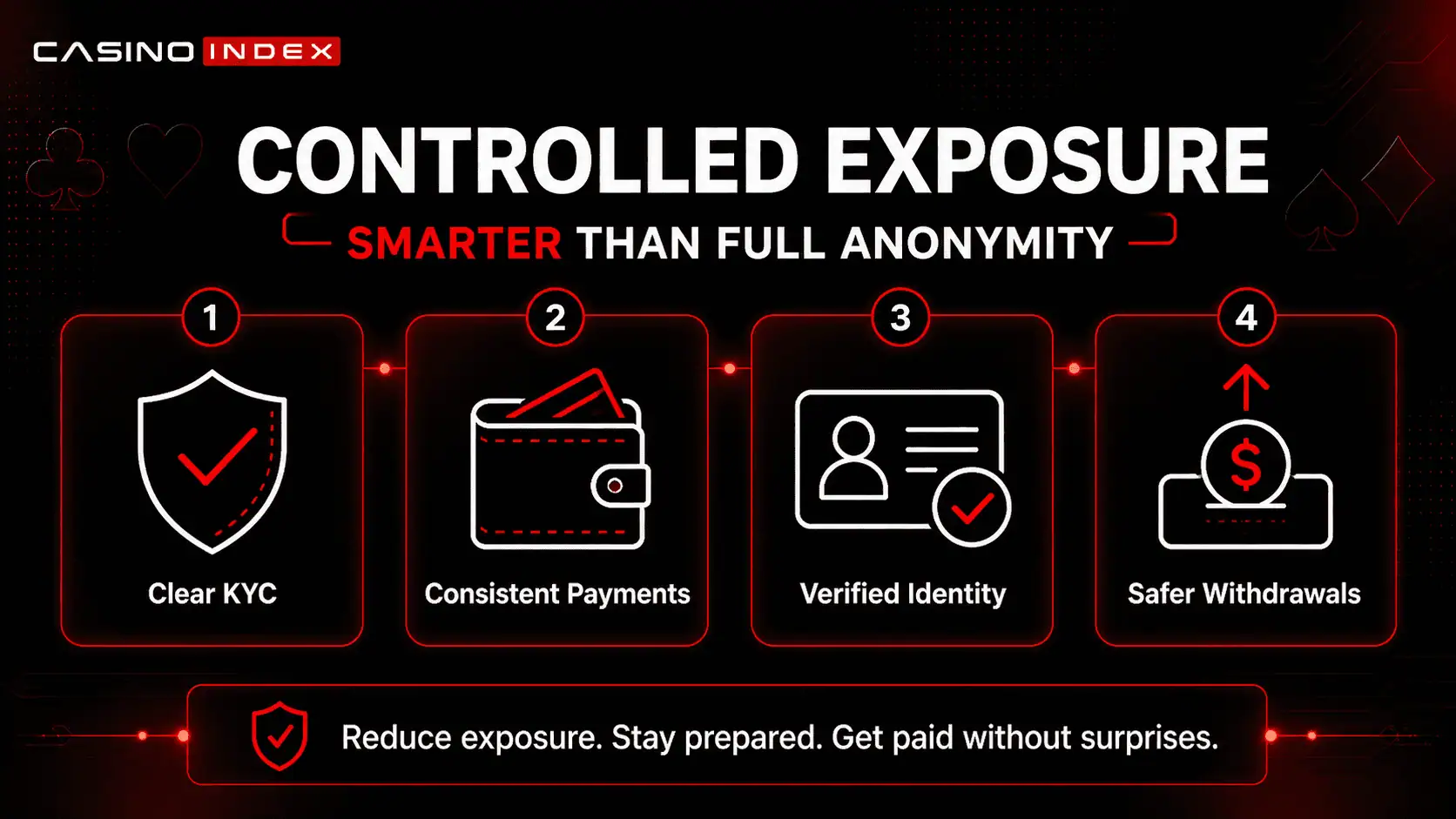
That is the better reader outcome.
Instead of chasing the fantasy of being invisible, a serious player should focus on:
- casinos with clear verification terms
- operators that explain payout logic before withdrawal
- consistent payment behavior
- crypto use that improves privacy without creating chaos
- realistic bonus use
- stronger licensing and complaint structure
- platforms with better payout history than their marketing suggests
For players, that means privacy should be judged together with verification clarity, payment consistency, and withdrawal reliability.
It is:
how anonymity actually works, why it breaks, and which casinos still make more sense if the reader wants lower friction without walking into a payout trap.
The four review examples above represent different trade-offs:
- BitStarz for a more established crypto-casino profile
- MyStake for broader crypto-and-fiat flexibility
- Bitz.io for lower-friction crypto-first onboarding
- CoinCasino as a higher-promotion contrast where payout terms deserve extra attention
Final verdict
Yes, you can still find casinos that feel more private than traditional gambling platforms.
No, that does not mean you will remain anonymous when it matters most.
The moment identity controls, bonus reviews, or withdrawal checks enter the picture, the “anonymous casino” promise becomes much weaker.
That is why the best answer is not hype.
It is this:
You can stay less exposed for a while. You usually cannot stay fully anonymous from deposit to withdrawal.
And if a casino’s whole appeal depends on pretending otherwise, that is usually where the real risk begins.

Talha Aydin has been active in cryptocurrency since 2017 and is a co-founder of Freecoins24 and CryptoMutant. Over the years, he has worked with crypto projects on community growth, giveaways, user acquisition and digital strategy while gaining hands-on experience across blockchain platforms and crypto markets. At CasinoIndex, Talha focuses on crypto casinos, withdrawals, payment systems, platform trust and the risks players face when moving funds between wallets and gambling platforms.