What Makes a Casino License Actually Trustworthy
A casino license matters.
It just does not matter in the lazy way many review pages pretend it does.
“Licensed and regulated” is one of the most overused trust claims in gambling. It appears in footers, bonus pages, homepage banners, and affiliate lists as if the badge alone settles the question. It does not. A license is not a safety certificate. It is not a payout guarantee. It is not proof that terms are fair, complaints will be handled well, or withdrawals will stay smooth once scrutiny begins. What it can be is something more useful: a legal and regulatory framework that tells you who stands behind the casino, what rules apply, and what happens if things go wrong.
That is the real starting point.
A trustworthy license is not one that sounds impressive. It is one that gives the player something concrete: a verifiable operator, a visible regulator, published standards, an actual complaints path, and public evidence that the regulator can act when a licensee fails. The UK Gambling Commission, for example, publishes a public register of regulatory actions and requires licensed operators to offer independent ADR for disputes. Malta’s regulator publishes a licensee register, an enforcement register, and a player complaint channel. Curaçao’s new Gaming Authority now states openly that it is the regulator for the online gaming industry under the LOK framework and the supervisor for AML/CFT compliance. Those are very different types of signals from a footer badge with no way to check what it really means.
That is why the right question is not “Is this casino licensed?”
The better question is: what does this license actually do for the player when money, documents, disputes, or account restrictions become real?
The first mistake: treating all licenses as equal
This is where weak casino content usually falls apart.
It sees a regulator name and stops thinking.
Real licensing analysis starts by accepting something simple: not all gambling oversight is equally visible, equally demanding, or equally useful to the player. Some regulators give you a searchable register, published enforcement actions, clear complaints routes, and explicit rules on dispute handling or customer funds. Others may offer less public detail, less visible consumer recourse, or a framework that is still evolving. That does not automatically make one market “bad” and another “perfect.” It means licensing quality has to be judged by the structure around it, not by the existence of a badge alone.
That distinction matters because players do not experience regulation as theory.
They experience it during friction.
A license starts to matter when a withdrawal is delayed, when the casino asks for deeper verification, when terms are enforced aggressively, when the site goes offline, when the business becomes insolvent, or when a complaint reaches a dead end. If the regulator has real public processes around complaints, dispute escalation, enforcement, and operator identity, the license becomes useful. If it does not, the badge is mostly marketing.
That is the line many affiliate pages blur on purpose.
They treat “licensed” as a conversion word. Serious players should treat it as a due-diligence category.
What a real casino license tells you
A real license should answer more than one question.
It should tell you who the operator is, which legal entity holds the authorization, where the business is regulated, which domain or domains are covered, what dispute path exists, and whether the regulator has an actual compliance and enforcement system behind the seal. Malta’s official materials are a good example of this structure: the authority provides a searchable licensee register, a formal player complaint route, a player-protection framework that includes ADR expectations, and a public enforcement register showing suspensions and cancellations. That is useful because it lets the player verify more than a logo.
So when people ask what a real casino license tells you, the best answer is this:
It tells you whether there is a visible system behind the casino, not just a claim made by the casino itself.
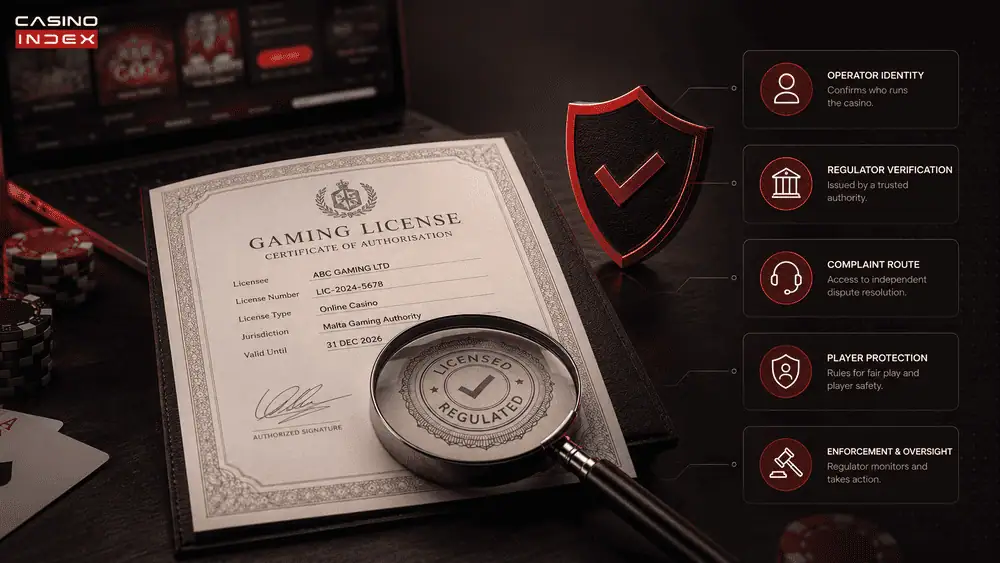
That system should let you check at least five things.
1. Who the operator really is
The first trust question is not “which badge is in the footer?”
It is “which company am I dealing with?”
A meaningful license should tie the site to a legal entity and a regulator that can be checked independently. If that connection is vague, buried, mismatched, or impossible to verify in a register, the badge is already losing value. Malta’s public register is designed for exactly this kind of verification, allowing searches by licensee name, authorization status, URL, or gaming service. The UK regulator likewise directs players to check whether a gambling business is licensed.
2. Whether the regulator expects complaint handling beyond support chat
A lot of casinos look clean while everything is going well.
The real test appears when support cannot or will not solve the issue.
That is where stronger licensing frameworks become visible. The UK Gambling Commission states that licensed operators must meet complaint-handling standards and must offer independent ADR. Malta requires operators to provide a complaints procedure and to give players the opportunity to refer disputes to a registered ADR entity after internal resolution has been exhausted; the MGA also offers its own formal complaint submission route for players. Those are practical consumer features, not decorative ones.
3. Whether customer funds are treated as a regulated subject
This is one of the clearest markers of serious oversight.
A regulator that says nothing public about customer money tells you less than one that publishes fund-handling obligations or disclosure rules. The UK’s LCCP requires remote licensees who hold customer funds to keep them in separate client bank accounts and to disclose clearly how customer funds are protected in insolvency. Malta’s FAQs state that player funds must remain segregated and separately identifiable at all times. Those are not the same rulebook, but they show the same principle: player money is not supposed to be an afterthought.
4. Whether the regulator can act publicly
A trustworthy license should not live in a vacuum.
You should be able to see that the regulator has compliance teeth.
The UK publishes a public register of regulatory actions with outcomes such as financial penalties, warnings, revocations, and other sanctions. Malta’s enforcement register publicly records suspensions and cancellations and, in some cases, directions connected to player-fund handling and removal of false references to the authority. When a regulator publishes visible action history, it becomes easier to treat the license as a live supervisory relationship rather than a one-time certificate.
5. Whether the regulator also protects against misuse of its own name
This point gets ignored too often.
A stronger regulator does not just license operators. It also warns the public when websites misuse the regulator’s name or falsely imply authorization. Malta maintains a page of unauthorised URLs and explicitly states that references to MGA licensing on those domains are false and misleading. That matters because scam prevention is part of licensing credibility too. A badge has more value when the regulator actively defends what the badge means.
When licensing actually matters
Licensing matters most once the easy part is over.
It matters less during sign-up than during the first real point of friction. Many players judge a license too early. They see a footer badge, complete a deposit, and assume the trust question has already been answered.
It has not.
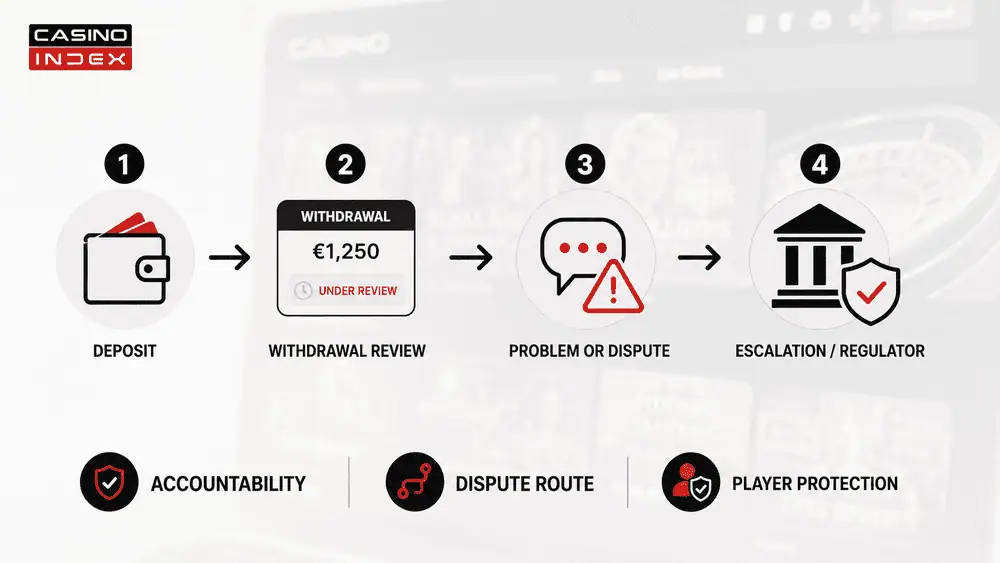
When withdrawals, checks, and disputes begin
A license becomes more meaningful when the casino slows down a withdrawal, cites “security checks,” freezes the account, rejects payment verification, enforces a bonus term aggressively, or stops giving useful answers through support.
That is the point where regulation stops being a marketing detail and starts becoming part of the player’s real position. If the regulator provides a visible complaints path, formal dispute handling, or independent escalation options, the license begins to carry practical value. If it does not, the badge often gives the player very little once pressure appears.
When operator failure stops being theoretical
Licensing also matters more when the operator itself runs into trouble.
If a business becomes unstable, enters liquidation, or fails to handle player balances properly, the difference between a weaker and stronger framework becomes much easier to see. In stronger systems, customer-fund treatment, segregation standards, and disclosure obligations are more clearly defined. That does not remove all risk, but it gives players more structure around what should happen next and what standards the operator was supposed to follow in the first place.
That is a major difference. A license cannot guarantee a clean outcome, but a stronger regulatory structure can make the situation far less opaque.
When branding no longer matches behavior
Licensing also matters when the casino’s presentation stops matching its conduct.
A site can look polished, pay quickly at lower amounts, and still become difficult once compliance, affordability, source-of-funds review, or a disputed interpretation of terms enters the picture. That is why serious trust analysis has to sit above design, game count, or promotion size.
A stronger regulator will not prevent every bad experience. But it can create a system where complaint handling, ADR, fund treatment, and enforcement are not left entirely to the operator’s goodwill.
From a CasinoIndex perspective, that is the real point: a license matters less as a homepage trust symbol and more as a pressure test once the casino relationship becomes stressful.
Stronger vs weaker gambling oversight
The cleanest way to compare regulators is not through reputation alone.
It is through public infrastructure.
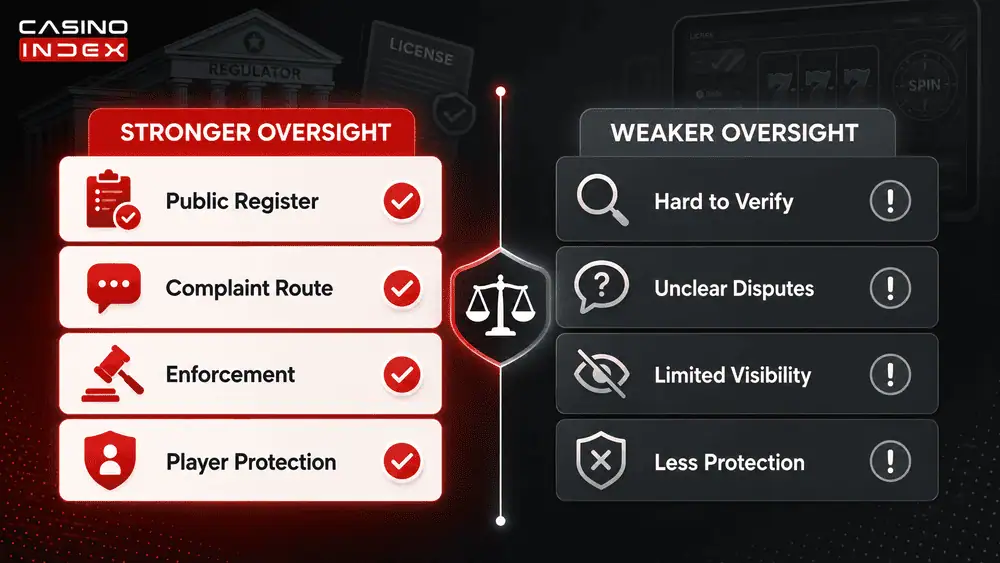
Stronger vs weaker gambling oversight usually comes down to three things: visibility, enforceability, and player recourse.
What stronger oversight usually looks like
Stronger oversight tends to leave a visible trail.
That often includes:
- a searchable public register
- published complaint or ADR routes
- visible enforcement history
- clear customer-fund or player-protection rules
- public warnings against false license claims
- published compliance expectations around AML, safer gambling, or dispute handling
When those elements are publicly available, the player can verify more than a logo. The regulator becomes something concrete rather than symbolic.
What weaker oversight usually looks like
Weaker oversight usually looks thinner, not always fake.
The casino may still claim to be licensed, but the player may struggle to verify the operator cleanly, find little detail on how disputes escalate, see limited enforcement visibility, or find no clear consumer-facing explanation of what happens when a licensee fails.
In that environment, “licensed” may still mean something. It just tells the player less about what happens once things become difficult. That is the real distinction. The problem is not always the existence of a license. It is the lack of visible structure behind it.
Why Curaçao should no longer be judged lazily
Curaçao is a good example of why lazy licensing analysis does not hold up well anymore.
For years, many review sites reduced Curaçao to a one-line stereotype. That is now too simplistic. The modern framework is moving toward a more formalized system, and that shift deserves to be judged on current structure and practical development rather than recycled clichés alone.
That still does not mean players should treat every Curaçao-licensed casino as equally trustworthy. The better approach is to watch how the framework performs in practice: public transparency, complaint usefulness, enforcement visibility, and operator behavior under the newer regime matter far more than old shorthand labels.
That is the balanced way to judge licensing strength.
Not through slogans. Through public evidence, regulatory structure, and what the player can actually rely on when pressure starts.
How to judge a casino regulator
If you want a practical method, stop asking only whether a regulator is “good” or “bad.”
Ask whether the regulator is useful to you as a player.
That is the heart of how to judge a casino regulator.
Start with verifiability
Can you independently verify that the casino, URL, and operating entity are actually listed? If the answer is not easy, the badge is already weaker than it looks. Public licensee registers and clear business-check tools are basic trust infrastructure, not premium extras.
Then check the dispute path
Does the regulator point you toward a complaint process, ADR, or any visible escalation route once support fails? If there is no meaningful answer here, the license gives you less protection in the situations that matter most.
Then check the regulator’s public memory
Can you see suspensions, cancellations, sanctions, warnings, or financial penalties? A regulator that publishes what it has done is easier to trust than one that asks you to assume it acts behind the curtain. Public enforcement history does not prove perfection, but it does prove the framework is capable of visible intervention.
Then check whether money and protection rules are public
Customer-fund treatment, player-fund segregation, complaint standards, affordability, AML/CFT supervision, or limit-setting rules tell you whether the regulator sees gambling as a real-money risk environment rather than just a business category. The UK and Malta publish player-fund and dispute-related materials. Curaçao’s authority now expressly presents itself as the AML/CFT supervisor for the sector under the new framework.
Finally, check whether the regulator protects the meaning of its own brand
A regulator that warns about fake license claims, clone domains, or unauthorized URLs is doing something practical for players. Malta’s public unauthorised-URLs notices are a good example of that. It shows the authority understands that trust is not only about licensing operators, but also about preventing misuse of the licensing label itself.
That is the kind of checklist serious players should use before they let a footer badge influence their trust.
It is also why CasinoIndex puts licensing inside a larger trust system rather than treating it as the final answer. This sits close to how we judge whether an online casino is actually safe once you move past the homepage promises and how CasinoIndex rates trust beyond a simple “licensed and regulated” claim.
What a license does not prove
This is the part too many casino pages avoid because it hurts conversion.
A trustworthy regulator improves your position. It does not remove the need for judgment.
A license does not prove:
- that withdrawals will always be fast
- that source-of-funds checks will always feel proportionate
- that support will always be competent
- that bonus terms will always be generous
- that the operator will never become aggressive during a dispute
- that every complaint will be resolved in the player’s favour
What the license does is change the environment around those problems. It may give you a public record, a legal entity, a regulator to reference, a complaint route, an ADR route, published obligations, and an enforcement system. That is meaningful. It is just not magic.
This is why “licensed = safe” is sloppy.
The better formula is closer to this:
A trustworthy license improves accountability.
Accountability improves player protection.
But player protection still depends on how the operator behaves inside that framework.
That is a much harder sentence to market, but it is much closer to reality.
Final thought
A real casino license should do more than decorate the footer.
It should help you identify the operator, verify the domain, understand the rulebook, escalate a complaint, and judge whether the regulator can act when trust breaks down. The strongest licensing signals are usually public ones: searchable registers, complaint procedures, ADR routes, fund-protection rules, enforcement records, and warnings against false license claims. The UK and Malta visibly provide that kind of public infrastructure. Curaçao’s new framework deserves to be judged through its current structure and practical development, not only through outdated clichés.
So the next time a casino tells you it is licensed, do not stop there.
Ask what the license actually gives you.
If the answer is a visible regulator, a clear legal entity, published protections, real dispute routes, and public enforcement, the badge means something.
If the answer is just a logo and a slogan, it probably means much less than the casino wants you to think.

Talha Aydin has been active in cryptocurrency since 2017 and is a co-founder of Freecoins24 and CryptoMutant. Over the years, he has worked with crypto projects on community growth, giveaways, user acquisition and digital strategy while gaining hands-on experience across blockchain platforms and crypto markets. At CasinoIndex, Talha focuses on crypto casinos, withdrawals, payment systems, platform trust and the risks players face when moving funds between wallets and gambling platforms.