


The CasinoIndex casino rating system scores online casinos from 0 to 10 using seven weighted categories. Trust and reputation carry 30% of the base score. Payments and withdrawals and bonus fairness each carry 15%. Product quality, games, retention, and support and KYC each carry 10%. The weighted result is only the starting point: serious payout, ownership, verification, or complaint risks can cap the final rating.
That last rule matters. A casino can have an excellent app, hundreds of payment options, and a generous rewards program. None of those features make an unreliable operator safe. Our ratings therefore start with the questions players usually care about most after depositing: Who runs the casino? Are the rules clear? What happens at withdrawal? How is KYC handled? Does support give a useful answer when money is delayed?
This page explains the complete CasinoIndex casino rating system, including the evidence we use, the scoring formula, the limits of our research, and the circumstances that can force a score down.
Casino Rating System at a Glance
| Category | Weight | Main question |
|---|---|---|
| Trust & Reputation | 30% | Is the operator identifiable, accountable, and consistent over time? |
| Payments & Withdrawals | 15% | Can legitimate players withdraw under clear and predictable rules? |
| Bonus & Fairness | 15% | Do promotions have realistic value after every restriction is counted? |
| Product & UX | 10% | Does the site work well and make important information easy to find? |
| Game Ecosystem | 10% | Are the providers, games, and live products credible and useful? |
| Retention Systems | 10% | Do VIP, cashback, rakeback, and reload systems provide clear ongoing value? |
| Support & KYC | 10% | Does support solve problems, and is verification proportionate and predictable? |
The weights in our casino rating system add up to 100%. They do not make every weakness interchangeable. Ten points for a polished product cannot simply cancel ten points of serious withdrawal risk. After calculating the weighted score, we check it against our red flags and rating caps.
Our practical priority remains:
Trust > Withdrawals > Reputation > Product > Bonus
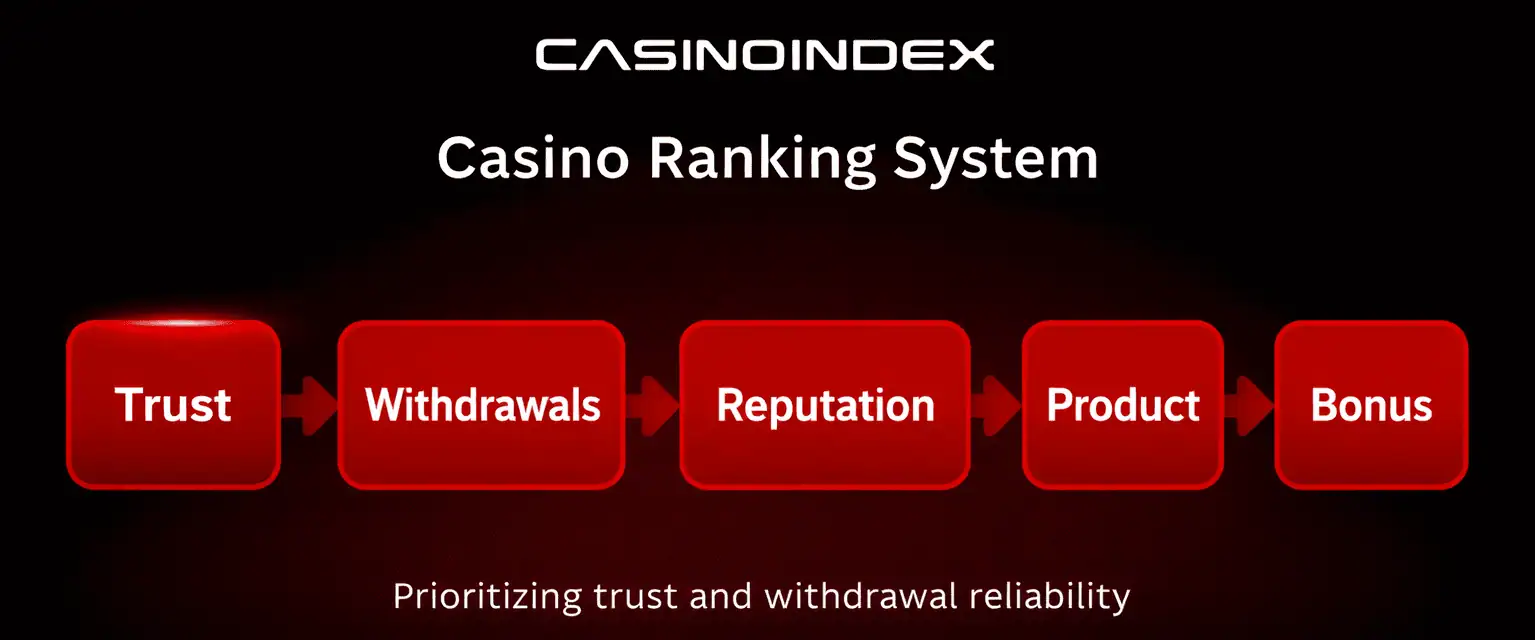
Why We Start With Withdrawals, Not the Welcome Offer
Our casino rating system starts with withdrawals because deposits tell us very little about an operator. Casinos have every reason to make deposits quick. A withdrawal tests more of the business at once: payment rules, account controls, verification, bonus enforcement, internal approval, limits, and support.
A delay is not automatically evidence of misconduct. Banks have processing times. Blockchains become congested. A legitimate security or source-of-funds review may take time. What matters is whether the reason fits the published rules, whether requests stay proportionate, and whether the casino communicates clearly.
We also separate casino processing from payment-network speed. A crypto transfer may settle within minutes after broadcast, yet remain pending inside the casino for hours before approval. Calling that an “instant withdrawal” would hide the part controlled by the operator. Our casino withdrawal guide explains these stages in more detail.
How We Research a Casino
Our casino review methodology combines published facts, product inspection, and reputation evidence. No single source decides the result. Official terms can be incomplete. Player complaints can lack context. A support agent can give a wrong answer. Even a valid license does not prove that every dispute will be handled well.
We record what can be verified, what is reported, and what remains uncertain. Those three types of information should not be written as if they have equal confidence.
1. We identify the operator and regulatory position
We look for the legal company name, license number, regulator, registered address where available, related brands, and relevant jurisdiction restrictions. License claims are checked against the regulator or public license record when such a record exists. Examples include the UK Gambling Commission business register and the Curaçao Gaming Authority online gaming license register.
Licensing is evidence of a regulatory relationship, not a universal safety certificate. Different authorities provide very different levels of oversight and dispute support. Our guide to casino license credibility explains why the badge alone is not enough.
2. We read the rules that affect access to money
The general terms are only the beginning. We check payment pages, withdrawal rules, KYC language, bonus terms, restricted-country clauses, inactivity rules, maximum cashout provisions, and any separate rules for crypto wallets or specific payment methods.
We pay particular attention to information a player could easily miss before depositing: turnover requirements on deposits, payment matching, daily or monthly withdrawal caps, document requests, maximum bets while a bonus is active, and the casino’s right to suspend or close an account.
3. We inspect the actual product
Where access is available, we examine registration, navigation, the cashier, bonus presentation, game filters, mobile behavior, account controls, responsible gambling tools, and support access. We also compare promotional claims with the rules behind them.
We do not claim that we personally completed a real-money deposit or withdrawal unless the individual review says so. Cashiers can also vary by country, account status, currency, and device. When a payment route is visible only after login, we tell readers to check the live cashier rather than guess.
4. We examine public player evidence
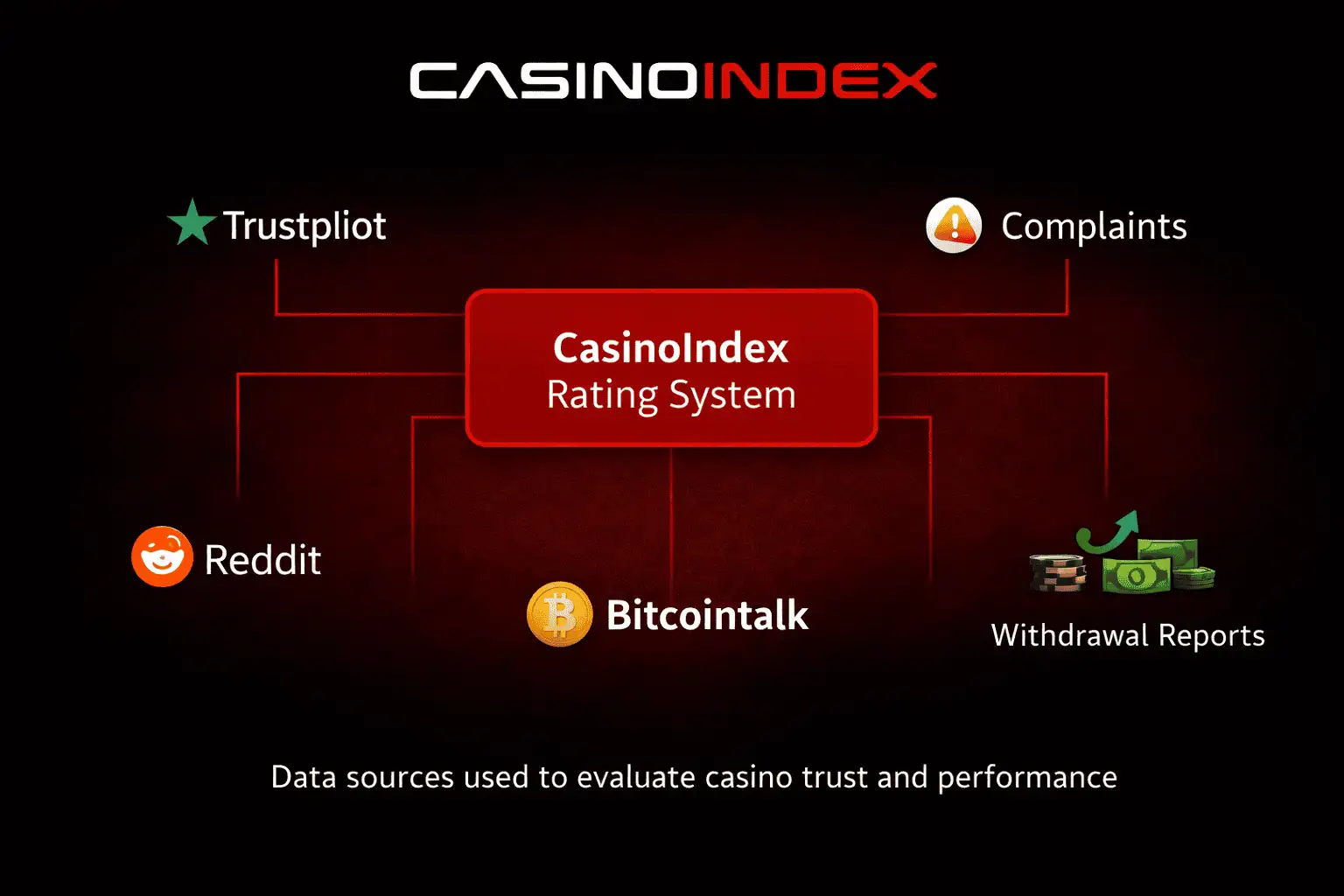
We review complaint sites, Trustpilot, Reddit, Bitcointalk, social channels, and other public discussions. These sources are useful for finding patterns, but their raw star scores do not become our score.
A complaint is stronger evidence when it includes dates, transaction details, screenshots, a consistent timeline, and a response from the operator. Anonymous accusations without supporting detail carry less weight. We also consider whether the dispute was resolved and whether the player may have broken a clearly published rule.
Our Evidence Hierarchy
Sources sometimes conflict. When they do, the casino rating system uses the following evidence hierarchy rather than treating every claim equally.
| Evidence level | Examples | How we use it |
|---|---|---|
| Primary, verifiable evidence | Licence registers, legal entities, dated terms, payment rules, bonus terms | Used for factual claims about ownership, rules, and stated limits |
| Direct product evidence | Live cashier, account interface, support transcript, KYC flow, mobile testing | Used to check how published rules appear in practice |
| Corroborated player evidence | Detailed complaints, forum threads, payment records, operator responses | Used to identify repeated behavior and operational risk |
| Contextual evidence | General sentiment, undetailed reviews, social discussion, third-party comparisons | Used as a lead or supporting signal, not proof by itself |
Official information is not automatically correct forever. Terms change, support answers can conflict, and a license can move or expire. That is why a review includes a last-updated date and why material facts should be rechecked at the time of use.
How the Casino Rating System Scores Seven Categories
1. Trust & Reputation — 30%
This is the foundation of the rating. We assess ownership transparency, license credibility, brand history, related operators, security and responsible gambling basics, serious complaint patterns, dispute handling, and consistency between the casino’s claims and its behavior.
A well-known brand does not receive automatic trust. Larger casinos naturally attract more complaints, so we consider severity, repetition, player volume, and resolution rather than simply counting negative posts. New casinos face the opposite problem: few complaints may mean a clean record, or simply too little evidence.
2. Payments & Withdrawals — 15%
We check available methods, supported currencies and networks, internal processing, minimum and maximum cashouts, fees, pending-withdrawal behavior, payment ownership rules, and support quality during delays.
Advertised speed receives little credit without context. We care more about consistency across ordinary and larger withdrawals, and about what happens when an account review begins.
3. Bonus & Fairness — 15%
We score the value a player can realistically use, not the largest number in the banner. The review covers wagering requirements, contribution rates, maximum bets, restricted games, expiry, excluded payment methods, bonus cancellation, maximum cashout, and how real and bonus balances interact.
A smaller offer can score better than a larger one. Clear 20x wagering may provide more practical value than a headline bonus with 50x wagering, a short deadline, a low cashout cap, and a long list of restricted games. The underlying logic is explained in our guide to casino wagering requirements.
4. Product & UX — 10%
We assess mobile and desktop usability, stability, navigation, search, account management, cashier clarity, page speed, and whether important rules can be found without hunting through the site.
Design has value when it helps a player avoid mistakes. A clean deposit selector, visible limits, and a clear bonus status are more useful than animation or visual polish alone.
5. Game Ecosystem — 10%
We look at provider credibility, category depth, live casino quality, original games, game stability, filtering, and RTP information where available. Raw game count is not a reliable measure because one integration can add thousands of near-identical titles.
Recognised providers improve the product score. They do not erase operator-level concerns about withdrawals, KYC, or account restrictions.
6. Retention Systems — 10%
This category covers VIP tiers, rakeback, cashback, reloads, missions, tournaments, and other recurring rewards. We examine how value is earned, when it becomes withdrawable, whether percentages refer to wager or loss, and whether limits or hidden conditions reduce the advertised benefit.
Complexity is not rewarded by itself. A simple, predictable cashback system can score better than an elaborate VIP program whose most valuable benefits remain discretionary.
7. Support & KYC — 10%
We assess contact options, availability, response quality, escalation, and whether support answers the question asked. Fast replies are useful only when they are accurate.
KYC is not treated as a failure. Legitimate identity, payment ownership, location, or source-of-funds checks may be necessary. We score whether the possibility is disclosed, instructions are clear, requests are proportionate, and the process is not used as an unexplained barrier after a win. See our guide to a fair casino KYC process for the details.
How We Keep Category Scores Consistent
A number without an anchor invites score inflation. To keep the casino rating system consistent, reviewers use the same broad standard across all seven categories. The exact evidence differs by category, but the meaning of the number stays consistent.
| Category score | General meaning |
|---|---|
| 9.0–10 | Exceptional, well-supported performance with no material weakness in that category. |
| 8.0–8.9 | Strong and dependable, with only limited drawbacks. |
| 7.0–7.9 | Acceptable to good, but with a meaningful limitation, mixed evidence, or less proof over time. |
| 6.0–6.9 | Below the standard we would call strong; caution or clear improvement is needed. |
| Below 6.0 | Weak evidence, serious shortcomings, or a problem that materially affects the player experience. |
We avoid false precision. Public evidence rarely supports distinctions such as 8.63 versus 8.67. Category notes can contain nuance; the published overall rating is rounded cautiously to one decimal place.
Crypto-Specific Checks
The online casino rating system includes several extra checks for crypto casinos that do not apply in exactly the same way to card or bank payments. We verify which coins are actually available in the cashier, the networks attached to each asset, minimum deposits and withdrawals where visible, and whether the operator warns users about unsupported chains or tokens.
We also distinguish blockchain settlement from casino approval. A fast network does not prove a fast cashout if the request waits in an internal queue. For stablecoins, the ticker alone is not enough: native and bridged versions can use different contract addresses even when both are called USDC or USDT.
Wallet ownership checks, transaction monitoring, source-of-funds questions, and address screening may be legitimate. The rating falls when these controls are hidden, inconsistent, or introduced without a clear connection to the account activity. We do not treat “crypto” or “no KYC” as a shortcut to trust.
Editorial Review and Quality Control
Before publication, the reviewer should be able to show where the important claims came from. Operator identity, license status, withdrawal limits, bonus restrictions, and KYC rules need a source or a clear note that the information was not publicly available.
The rating is then checked for internal consistency. If the written review describes repeated payout problems but the score remains in the top tier, the number and the evidence do not match. The same applies in reverse: a low rating needs a documented reason, not a vague impression.
We also compare the result with similar casinos. This is not done to force brands into a fixed order. It is a consistency check for our casino scoring criteria. Two operators with similar trust records should not receive sharply different scores because one has a larger affiliate offer or a more attractive homepage.
Material edits are dated. When an update changes the trust picture, we adjust the score and explain the new issue in the review instead of silently changing the number.
How the Casino Rating System Calculates the Final Score
Each category receives a score from 0 to 10. We multiply it by the category weight and add the results.
Weighted score = (Trust × 0.30) + (Payments × 0.15) + (Bonus × 0.15) + (Product × 0.10) + (Games × 0.10) + (Retention × 0.10) + (Support & KYC × 0.10)
A worked example
| Category | Category score | Weighted contribution |
|---|---|---|
| Trust & Reputation | 8.5 | 2.55 |
| Payments & Withdrawals | 8.0 | 1.20 |
| Bonus & Fairness | 7.0 | 1.05 |
| Product & UX | 8.2 | 0.82 |
| Game Ecosystem | 8.5 | 0.85 |
| Retention Systems | 7.5 | 0.75 |
| Support & KYC | 8.0 | 0.80 |
| Base score | 8.02 / 10 |
In this example, the normal published rating would be 8.0 after cautious rounding. If the same casino also had a credible pattern of unresolved withdrawal complaints, the score would be reviewed against the cap rules. The final rating could be lower than 8.0 because the base calculation is not allowed to hide a material risk.
Red Flags, Score Caps, and Delisting
Weighted averages work well for ordinary strengths and weaknesses. They work badly for deal-breakers. A severe payout issue is not the same kind of problem as a weak mobile menu, so the casino rating system applies manual caps after the calculation.
| Risk signal | Typical rating effect | What could change it |
|---|---|---|
| Short operating history or too little evidence | Prevents an elite rating until a meaningful record exists | Time, consistent payouts, clearer ownership, and more independent evidence |
| Unclear ownership or unverifiable license claim | Caps trust and the overall score | Verifiable legal and regulatory information |
| Repeated, credible withdrawal complaints | Blocks top-tier status and may move the casino into a risk category | Resolved cases and sustained evidence of improved payout behavior |
| Unpredictable KYC or account blocks | Reduces both Trust and Support & KYC; may trigger a cap | Clearer policy, proportionate checks, and consistent case handling |
| Hidden or retroactively applied terms | Immediate downgrade; severe cases may make the casino unsuitable for ranking | Rule correction, player remediation, and transparent enforcement |
| Credible non-payment, confiscation, or fraudulent behavior | Risky classification or removal from recommended rankings | Resolution requires strong, independently verifiable evidence |
Caps are judgment calls, so the reason should be stated in the relevant review. We do not lower a casino because one anonymous post sounds angry. We do lower it when serious, similar reports repeat, the evidence is credible, and the operator fails to resolve or explain the pattern.
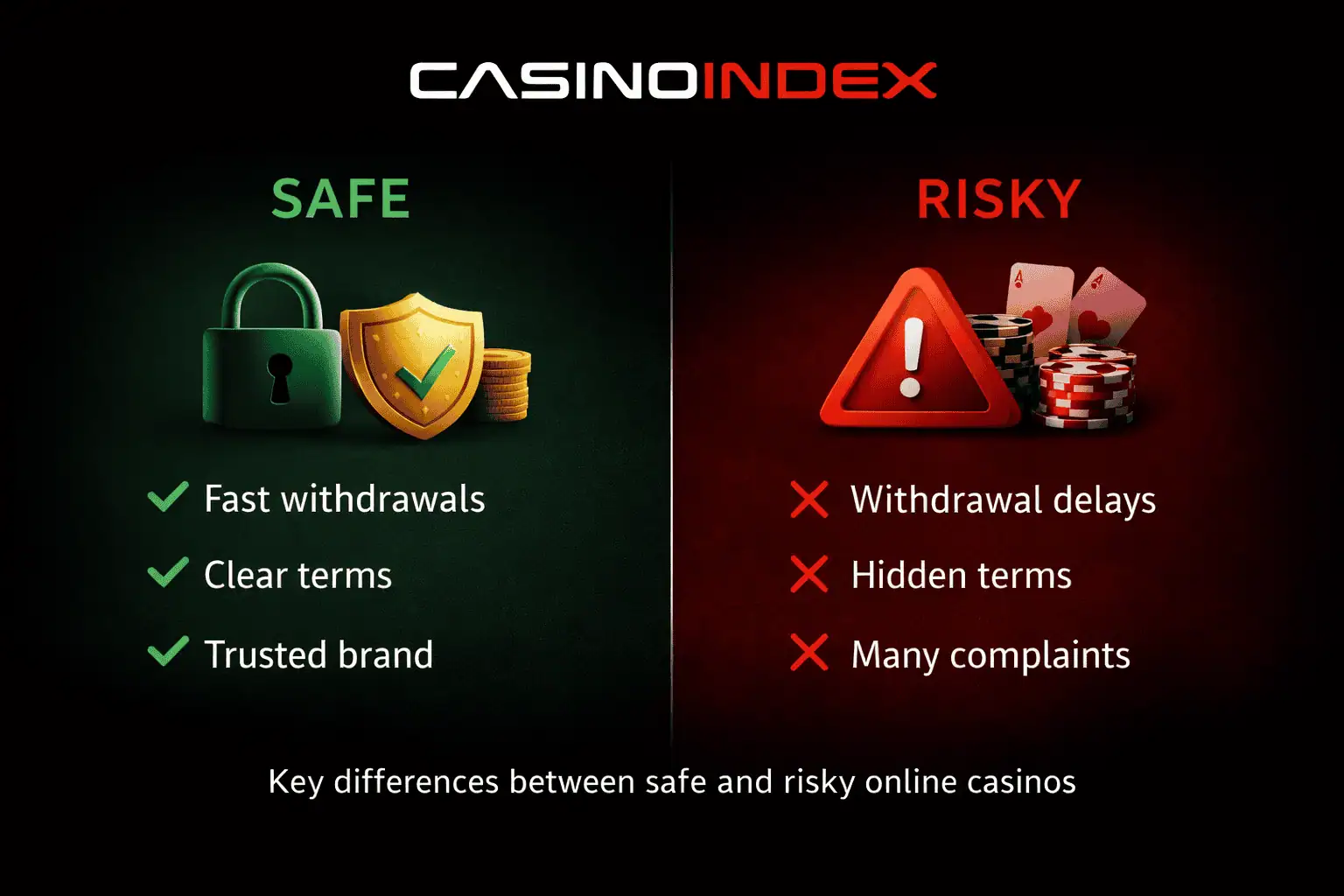
How We Evaluate Complaints Fairly
Complaint research is one of the easiest parts of a review to misuse. A large brand may have hundreds of negative posts simply because it serves more players. A small brand may look clean because almost nobody has discussed it.
We therefore ask five questions:
- Severity: Is the issue about inconvenience, or about access to money and the account?
- Pattern: Do independent users describe the same behavior?
- Timing: Is the report recent enough to reflect the current operator and rules?
- Evidence: Does the report contain a coherent timeline, records, screenshots, or an operator response?
- Resolution: Was the issue explained and fixed, or ignored?
Player error also matters. A dispute caused by duplicate accounts, third-party payments, a blocked country, or a clearly stated maximum-bet violation is different from a casino introducing a new rule after the withdrawal request. Our guide to reading casino complaints covers this distinction.
CasinoIndex Safety Index
The Safety Index translates the 0–10 score into a quick risk label. It is a summary, not a guarantee.
| Score | Label | Meaning |
|---|---|---|
| 9.0–10 | Very Safe | Exceptional evidence of long-term reliability, predictable withdrawals, and strong transparency, with no serious unresolved pattern. |
| 8.2–8.9 | Safe | Strong overall performance with controlled weaknesses that do not undermine the main trust case. |
| 7.5–8.1 | Moderate Safe | Generally credible, but with limitations or uncertainty worth understanding before depositing. |
| 6.8–7.4 | Moderate Risk | Material concerns, mixed evidence, limited history, or friction that calls for extra caution. |
| Below 6.8 | Risky | Serious trust weaknesses, repeated complaints, unclear payout behavior, or another structural problem. |
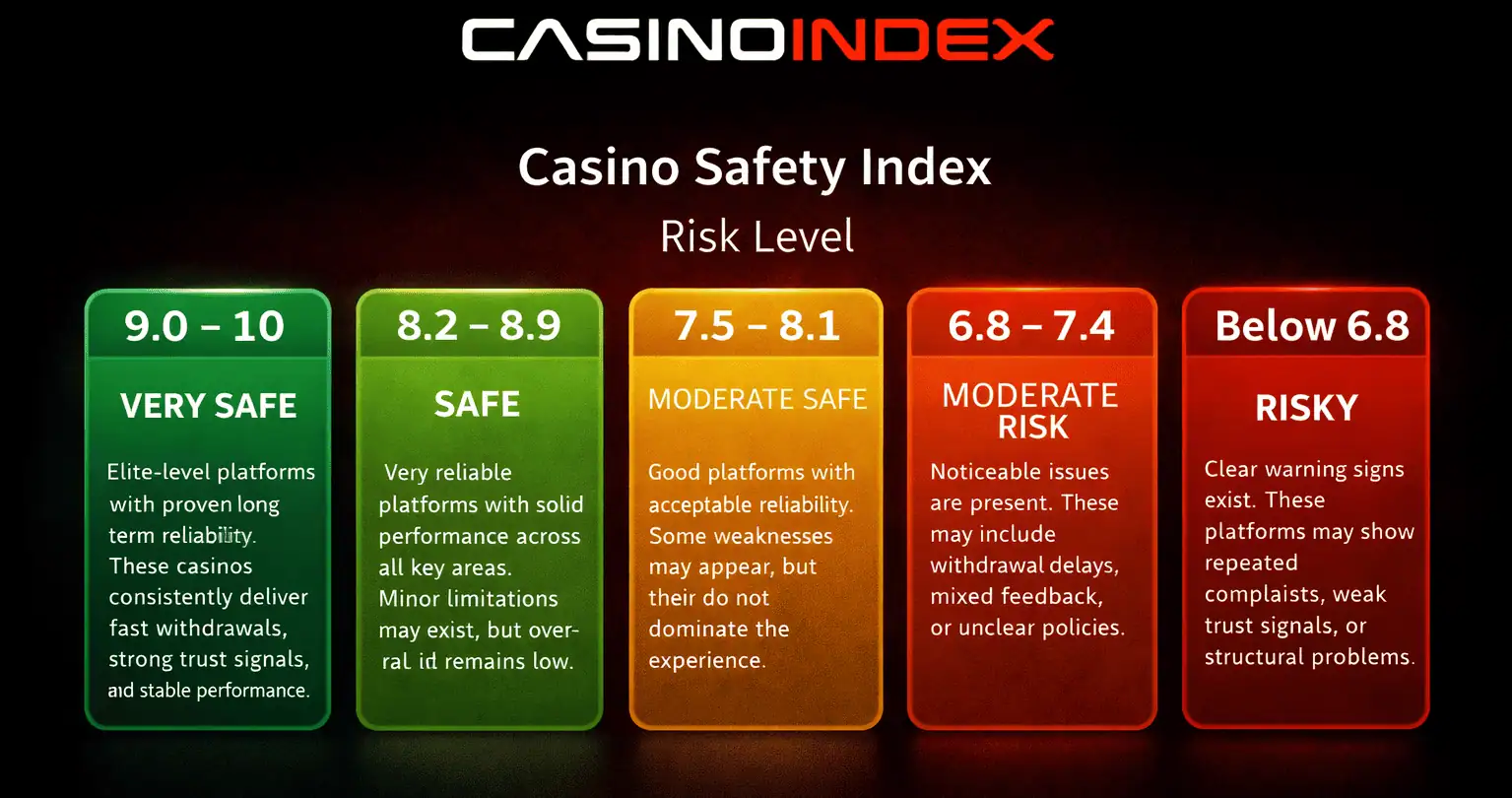
“Very Safe” does not mean risk-free. Gambling always involves the risk of losing money, and even a strong operator may request verification or review a payment. The label means the available evidence supports a lower level of operator risk relative to the casinos we assess.
What We Do Not Overvalue
- Bonus size: Headline value can disappear after wagering, expiry, restricted games, and cashout limits.
- Game count: A large lobby does not prove provider quality, fair terms, or reliable withdrawals.
- Crypto speed: Fast networks do not remove internal casino approval, KYC, or wallet checks.
- License logos: The regulator, operator, license status, and practical dispute path matter more than the badge.
- Public popularity: Sponsorships, streamers, and social reach create visibility, not automatic trust.
- One successful test: A small payout on one account does not prove consistent treatment for every player or withdrawal size.
Commercial Relationships Do Not Buy Ratings
CasinoIndex may earn a commission when a reader follows certain links. The casino rating system does not allow an operator to purchase a higher category score, remove a documented warning, or bypass a rating cap.
A casino can be reviewed without being a commercial partner, and a partner can receive a low rating or lose placement when the evidence changes. Paid placements or sponsored material should be labeled separately from editorial rankings. Our affiliate disclosure explains how the site is funded.
Updates, Corrections, and Changes in Evidence
Casino ratings are not permanent. We reassess a score when material information changes, including:
- new or resolved withdrawal complaints;
- a license, ownership, or operator change;
- new KYC, payment, or restricted-country rules;
- changes to withdrawal limits or processing;
- substantial bonus-term changes;
- provider, security, or product changes that affect the player experience;
- credible evidence that an earlier claim was incomplete or wrong.
Each review should show its latest update date. If public information is incomplete, we say so. If two credible sources conflict, we describe the conflict instead of presenting an uncertain claim as settled fact.
Operators and readers can submit corrections through the CasinoIndex contact page. Evidence is reviewed on its merits. A correction does not require a commercial relationship, and an operator response does not automatically remove a documented complaint.
What a Casino Rating Cannot Guarantee
A rating is a comparative assessment based on the evidence available at the time of review. It cannot guarantee that every player will have the same experience.
Payment methods, bonuses, licenses, game availability, and verification can vary by country. Cashier options may change after login. Individual transactions can trigger checks that did not affect another user. A casino can also improve or decline after publication.
Readers should use the score as a starting point, read the reason behind it, check the current terms and cashier, and never deposit more than they can afford to lose. For current examples of the methodology in use, see the CasinoIndex online casino rankings.
Frequently Asked Questions
How does the CasinoIndex casino rating system work?
CasinoIndex scores seven categories from 0 to 10 and applies fixed weights. Trust and reputation account for 30%; payments and withdrawals and bonus fairness account for 15% each; product, games, retention, and support and KYC account for 10% each. Red flags and caps are then applied to the weighted result.
Can an affiliate partner receive a higher score?
No. Commercial relationships do not change category scores or remove warnings. New evidence about withdrawals, KYC, ownership, or complaints can lower a partner’s score or remove it from a recommended ranking.
Does a gambling license make a casino safe?
No. A verifiable license is an important trust signal, but regulators differ in oversight and player protection. CasinoIndex also checks ownership, withdrawal behavior, terms, KYC, complaints, and dispute handling.
Does no-KYC access improve a casino’s rating?
Not automatically. Reduced verification can improve convenience, but vague or misleading no-KYC claims increase uncertainty. We score whether the casino explains when checks may occur and applies them fairly.
Why can the final score be lower than the weighted calculation?
The formula cannot treat every issue as interchangeable. Serious non-payment, hidden terms, unclear ownership, or repeated account-block complaints can cap a score even when the casino performs well in product, games, or rewards.
How often are ratings updated?
Ratings are reviewed when material evidence changes. Review pages display a last-updated date. Important triggers include license or ownership changes, new payout patterns, revised terms, and credible corrections from readers or operators.
