What Provably Fair Actually Proves — and What It Does Not Protect
Provably fair is one of the most useful ideas in crypto gambling, but it is also one of the easiest to misunderstand.
At its best, it gives players something traditional online casinos rarely offered: a way to check whether a game result came from the data shown by the casino, rather than trusting a closed system behind the screen.
That matters because casino players are usually asked to trust outcomes they cannot inspect. With provably fair games, a dice roll, crash result, mines board, plinko drop or casino original can be checked after the round. The player gets more than a claim. They get a method for testing whether the result followed the published process.
But the protection has limits.
Provably fair does not turn a casino into a safe operator by itself. Fast withdrawals, fair KYC handling, clean ownership, strong licensing, clear bonus terms and reliable support all sit outside the game result.
The system proves one specific thing: whether an outcome was generated from the published inputs and was not changed after the player placed the bet.
That is valuable.
It is not the whole trust story.
What provably fair actually proves
A provably fair system is built to show that a game outcome followed a known process.
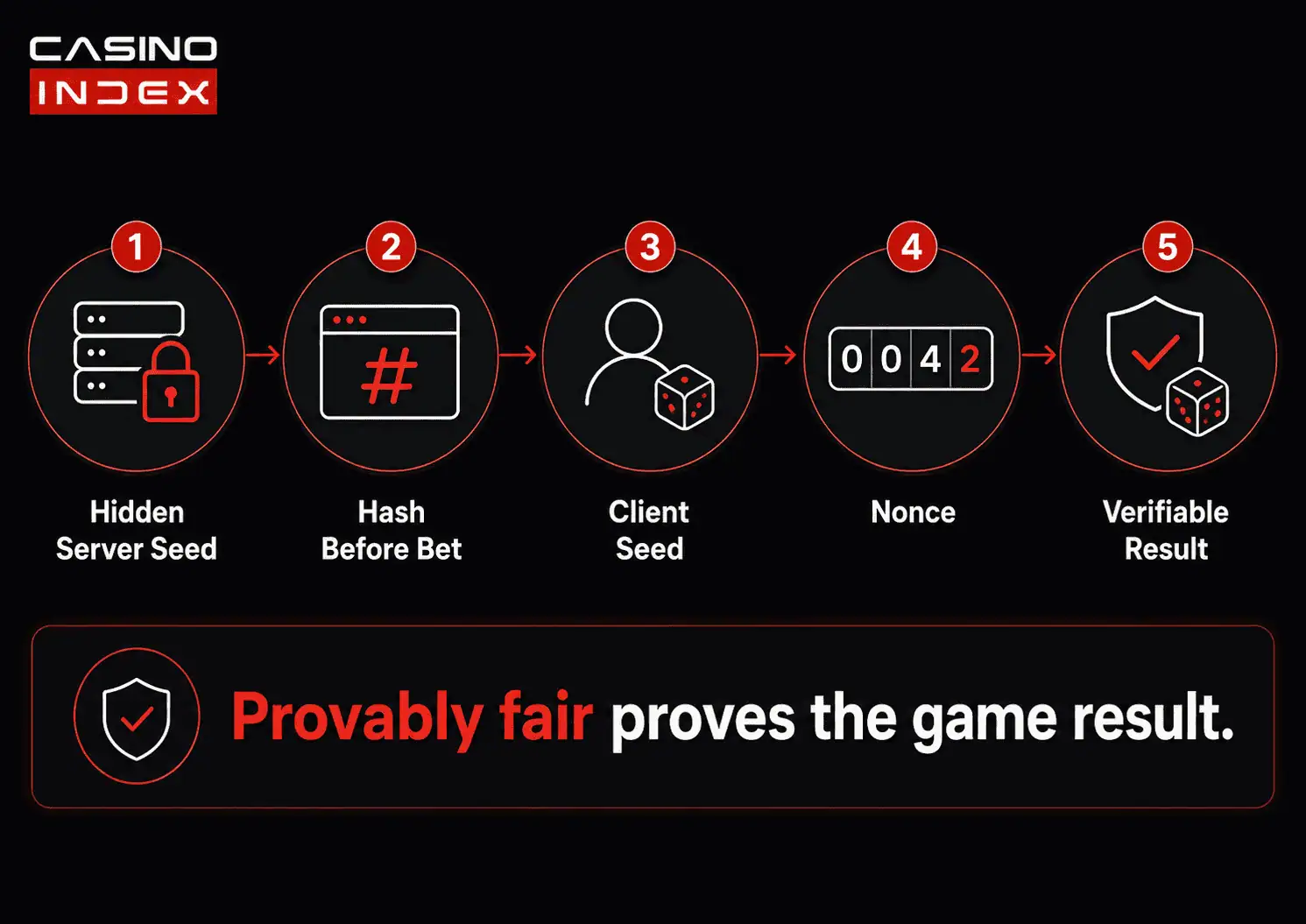
Most crypto casino systems use the same basic structure. The casino creates a hidden server seed and shows a hash of that seed before the bet. The player may use a client seed, while each round also uses a nonce. This nonce works like a counter, keeping every result unique.
After the round, or once the player rotates seeds, the casino reveals the server seed. The player can then check whether that seed matches the earlier hash and whether the final result matches the game’s formula.
In plain English, the casino is saying:
“We committed to this hidden value before your bet. Now that the round is over, you can check that we did not change it.”
That is the core value of provably fair casino games and verification tools.
The proof is narrow
A verified result only proves the game round.
It does not review the casino’s full operation. Payment behavior, withdrawal handling, support quality and payout disputes still need to be judged separately. A game result can verify correctly while the same casino still creates problems when a player tries to cash out after a large win.
This is where many players overtrust the label.
Provably fair is strong when the question is: “Was this result generated from the stated inputs?”
It becomes much weaker when the question is: “Can I trust this casino with my money?”
Those are different questions.
The limits of provably fair gambling
The limits of provably fair gambling begin where the game result ends.
A verifier can show that a dice roll, crash multiplier or mines result followed the published formula. Withdrawal approval, bonus enforcement and KYC handling are separate parts of the casino experience, and none of them are guaranteed by a working fairness system.
That is why provably fair should be treated as one trust signal, not a full safety label.
A casino can offer verifiable games and still create problems elsewhere. The game can be fair while withdrawals are slow. A seed can match while bonus rules remain restrictive. A result can verify while the account is still reviewed during payout.
In other words, the algorithm may be transparent while the operator is not.
Why this matters for real players
Most serious casino disputes are not only about whether one round was rigged.
They often happen after the player wins, withdraws, triggers verification, uses a bonus, changes payment methods or contacts support. None of those situations are solved by a server seed.
That is why CasinoIndex separates fairness technology from wider safe online casino checks.
A working verifier is useful.
It is not enough by itself.
Randomness vs operator behavior
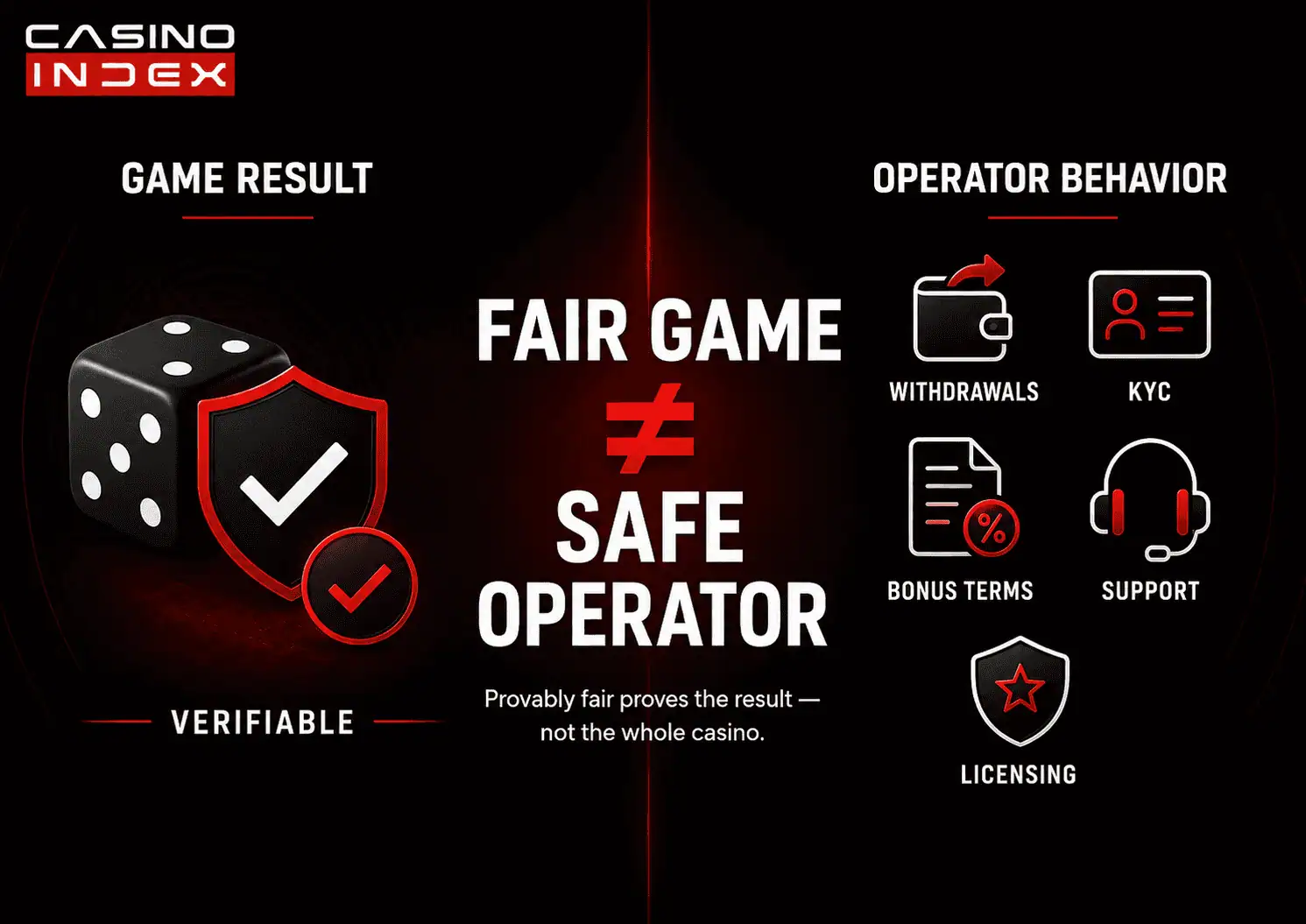
Provably fair mainly deals with randomness.
Casino risk is much bigger than randomness.
Randomness is about how the outcome is created. Operator behavior is about how the casino treats the player before, during and after play.
A strong provably fair system can reduce one type of manipulation: changing a result after the player has committed to the bet. That matters, especially for crypto originals like crash, dice, mines, limbo and plinko.
But operator behavior covers a different set of risks.
These include withdrawal delays, unclear account reviews, aggressive bonus enforcement, vague source-of-funds checks, restricted-country disputes, support silence and sudden document requests.
A server seed does not control any of that.
The clean distinction
The simple difference is this:
Provably fair can help prove the game round.
It cannot prove the casino’s business conduct.
That line should guide how players read “provably fair” claims. If a casino uses the term to make the whole brand look safe, the claim is being stretched too far.
Fairness technology belongs in the product review.
Operator behavior belongs in the trust review.
Both matter.
They are not the same thing.
What provably fair does protect
Provably fair protects against blind trust at game level.
In traditional online casino games, players usually cannot verify individual outcomes themselves. They rely on licensing, software providers, testing labs and the casino’s reputation. Those controls still matter, but they do not usually let a player check one specific result after a round.
Provably fair adds player-side auditability.
A proper system lets the player inspect the seed data, verify the hash and confirm that the result came from the published inputs.
It can reduce outcome manipulation
When the casino commits to a server seed before the bet and reveals it later, changing the result after the fact should break verification.
That makes simple result manipulation harder to hide.
The player may not understand every technical detail, but the proof can still be tested. Advanced users can check it manually. Casual players can use a built-in verifier when the casino offers one.
This is especially useful for casino originals, where the game is built around fast, repeated outcomes.
Crash, dice, mines and plinko are common examples.
It helps expose weak claims
A real provably fair system should be checkable.
If a casino uses the phrase but shows no verifier, no seed history, no server seed hash, no client seed and no nonce, the claim is weak.
Marketing is not verification.
A serious casino should make the process visible before asking players to trust it.
What provably fair does not protect
Provably fair does not protect your withdrawal.
That is the biggest limit.
Players should still understand the casino withdrawal process before trusting any site with larger balances.
It does not remove KYC risk
Some crypto casinos promote speed, privacy or low-friction signup. That does not mean documents will never be requested.
Even casinos with verifiable games may ask for KYC during withdrawals, larger wins, suspicious activity reviews, payment mismatches or source-of-funds checks.
A fair game result does not mean a smooth verification process.
This is why players need to know what a safe casino KYC process should look like. Fair verification is clear, proportionate and explained. Abusive verification often appears late, keeps changing, or blocks withdrawals without a clear path forward.
Provably fair cannot solve that.
It does not make bonus terms fair
A bonus can be attached to provably fair games and still be a poor deal.
High wagering, low max cashout limits, max bet rules, restricted games and vague bonus-abuse clauses can all reduce the real value of a promotion.
The game result may verify.
The bonus may still be restrictive.
That is why casino bonus rules need to be reviewed separately from game fairness.
It does not prove strong RTP
Fair does not mean generous.
A game can be provably fair and still carry a strong house edge. Verification only shows that the outcome followed the stated process. It does not mean the odds are favorable for the player.
This matters because some casinos use fairness language to create trust while offering games with weak long-term value.
Players should still understand RTP, volatility and game structure. A useful next step is comparing fairness claims with real RTP vs fake RTP checks.
It does not replace licensing
A casino license is not a perfect safety guarantee.
Still, licensing matters because it affects oversight, complaint routes, operator standards, AML rules and dispute handling.
Provably fair explains how a game result can be checked. It does not explain who owns the casino, which regulator supervises it, or how player complaints are handled.
That belongs in proper casino licensing checks.
Why fairness tech is not the whole story
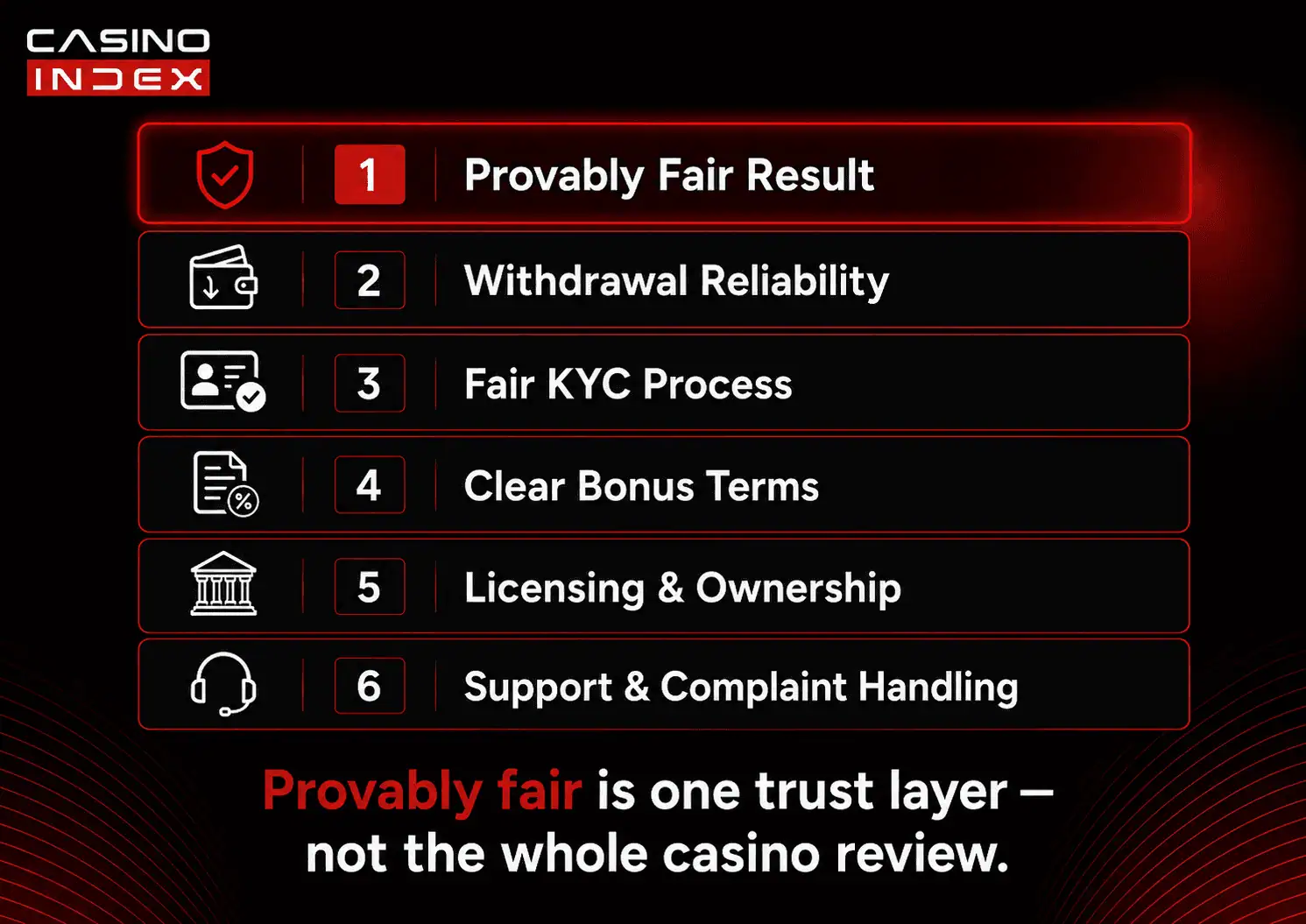
Fairness tech answers one narrow question.
Trust answers many.
A player does not only need to know whether a crash result was generated correctly. They also need to know what happens after a win. Can they withdraw? Will the casino ask for documents? Are the bonus rules clear? Does support respond? Are limits shown before deposit?
Those questions sit outside the provably fair system.
Good casinos combine several trust layers
A stronger casino should show more than a verifier.
It should offer clear payment rules, realistic withdrawal timelines, transparent KYC standards, visible licensing details, responsible gambling tools and understandable bonus terms.
Provably fair belongs inside that wider trust picture.
It should not replace it.
A casino that loudly promotes fair games but hides withdrawal rules deserves caution. The same applies when a casino explains seeds in detail but gives vague answers about KYC.
Technical transparency is good.
Operational transparency is better.
Players need both.
How players should check a provably fair claim
A real provably fair claim should be easy to test.
Start with the game interface. Look for a fairness tab, seed settings, bet history or built-in verifier. Check whether you can see your client seed. See if the game shows a server seed hash before betting. Look for the nonce or round ID attached to each result.
The process should not feel hidden.
Check the verification flow
The casino should explain how to verify a result in simple steps.
A player should be able to collect the round data, reveal or rotate the server seed, enter the data into the verifier and reproduce the same outcome.
If the verifier does not match the result, that is a serious issue.
If the casino gives no way to verify the round, the “provably fair” label has little value.
Check which games are covered
Not every game on a crypto casino is usually provably fair.
Often, the feature applies to originals and instant games. Third-party slots and live casino games may use standard provider RNG systems instead.
That is not automatically bad.
The problem starts when the casino is unclear.
A transparent casino will say which games are verifiable and which games use provider systems. A weak casino will use “provably fair” as a site-wide slogan without explaining the scope.
Red flags around provably fair casinos
Some warning signs are easy to spot.
A casino says “provably fair” but gives no verifier.
The server seed hash is not shown before betting.
The server seed is never revealed.
The client seed cannot be viewed or changed.
The nonce or round ID is missing.
Bet history does not show the data needed to verify the result.
The verifier exists, but the output is unclear or inconsistent.
The casino suggests all games are provably fair without separating originals, slots, live dealer games and sportsbook products.
The biggest warning sign
The worst use of provably fair language is when it becomes a distraction.
If a casino promotes fair games heavily but avoids clear payout terms, the player should slow down. The same applies when a site pushes “no KYC” or “instant withdrawals” without explaining limits and review triggers.
Fairness technology should support trust.
It should not be used to cover weak operations.
Where CasinoIndex places provably fair in reviews
CasinoIndex treats provably fair as a positive signal.
It helps when games are genuinely verifiable, the required data is visible and the process is simple enough for real players to use. A built-in verifier is stronger than a vague help page. Clear seed history is stronger than a marketing claim.
But the feature does not override bigger risk areas.
Poor withdrawal behavior still matters.
Unclear ownership still matters.
Weak licensing still matters.
Aggressive bonus rules still matter.
Repeated unresolved complaints still matter.
This is why how CasinoIndex ranks casinos puts trust and withdrawals above bonus size or surface-level product features.
A fair game result is one part of the review.
The full player journey matters more.
The simple way to think about provably fair
Provably fair is not fake.
It is not useless.
It is also not magic.
Used properly, it gives players a meaningful way to verify game outcomes. That is a real improvement over blind trust, especially in crypto casino originals where results happen quickly and players want more transparency.
The limit is just as important.
Provably fair proves the result.
It does not prove the relationship between player and casino.
A casino can be fair at game level and risky at operator level. That is the key distinction.
Before depositing, players should check the verifier, but they should also check withdrawals, KYC rules, licensing, RTP, bonus terms and complaint patterns.
Fairness tools are useful when the verifier is real and easy to test.
Unclear terms are a reason to slow down, not a detail to ignore.
Weak payout history should carry more weight than any fairness slogan.
A good casino should be willing to prove more than the game result.

Talha Aydin has been active in cryptocurrency since 2017 and is a co-founder of Freecoins24 and CryptoMutant. Over the years, he has worked with crypto projects on community growth, giveaways, user acquisition and digital strategy while gaining hands-on experience across blockchain platforms and crypto markets. At CasinoIndex, Talha focuses on crypto casinos, withdrawals, payment systems, platform trust and the risks players face when moving funds between wallets and gambling platforms.