Stake vs Shuffle: Which Crypto Casino Actually Delivers Real Value?
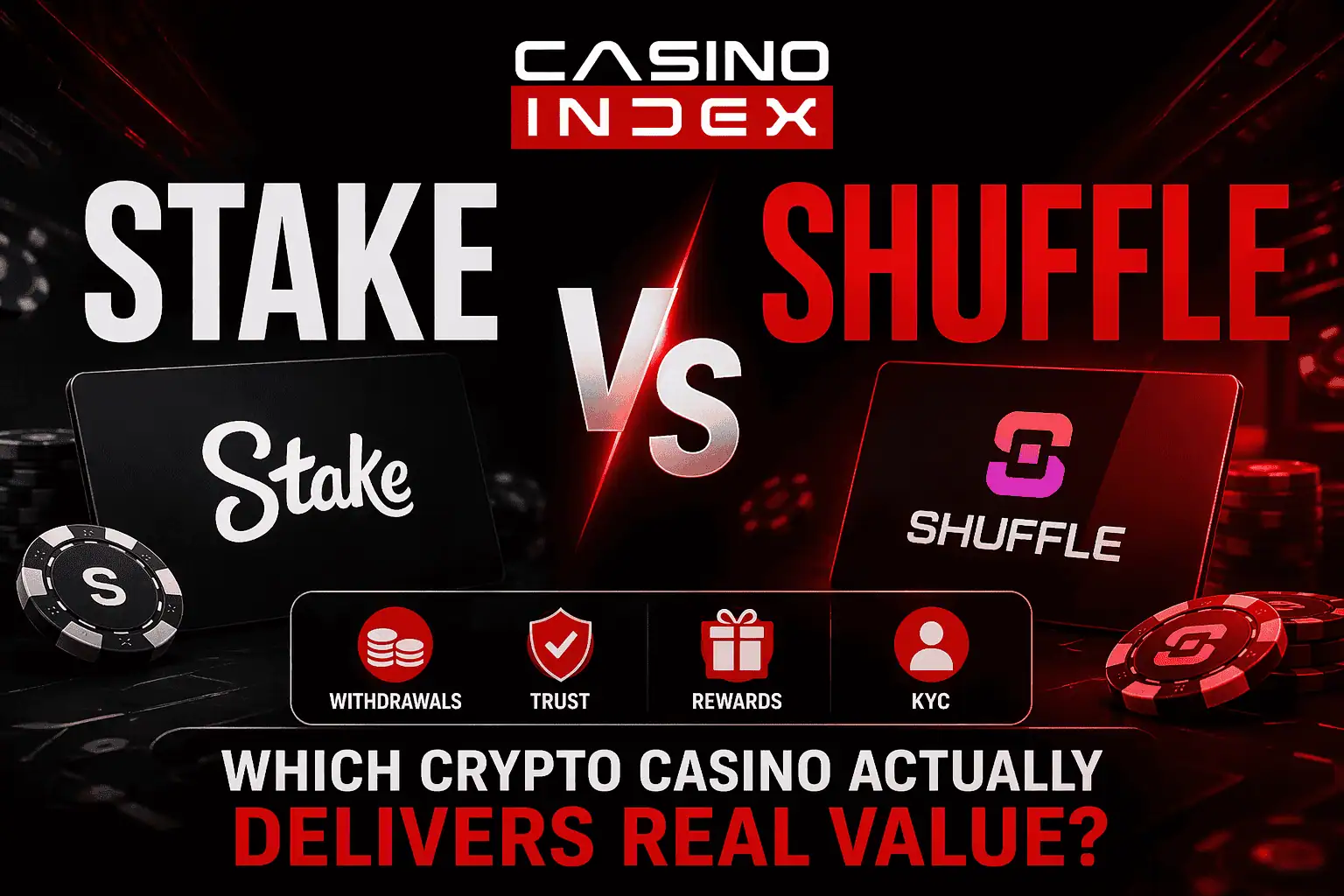
Stake vs Shuffle: Which Crypto Casino Is Better in 2026?
Stake vs Shuffle is not just a comparison between two crypto casinos with modern branding.
It is a decision between a proven large-scale operator and a newer, more focused crypto casino experience.
Both platforms appeal to players who want fast crypto payments, casino games, rewards and a digital-first gambling environment. Both can look strong before deposit. Both also attract players who want something faster and more flexible than a traditional online casino.
But the real comparison does not start at signup.
It starts after the deposit.
Once real money is involved, the question becomes sharper:
Which platform is easier to trust when withdrawals, KYC checks, rewards and long-term account use matter?
That is where Stake and Shuffle separate.
Stake has the stronger proof base. It has operated at larger scale, handled more player volume and built a broader reputation across casino and sportsbook users.
Shuffle has a different case. It feels cleaner, more focused and more reward-led. It can make sense for players who want a sharper crypto casino experience. Still, it does not carry the same long-term proof at scale.
That makes this comparison less about design and more about risk fit.
Quick Verdict
Stake is the better overall choice for most crypto casino players.
It has stronger scale, broader reputation, deeper liquidity and a more defensible case for long-term real-money use.
Shuffle is the better fit for a narrower player type.
It works best for crypto casino users who care about cleaner platform flow, reward efficiency and a more focused gambling experience. Its strongest case depends more on player preference than default trust strength.
In simple terms:
- Choose Stake if you want the stronger all-round crypto casino.
- Choose Shuffle if you specifically want a leaner, reward-focused crypto casino.
This is not a forced tie. Stake starts ahead on trust, scale and cashout confidence. Shuffle stays relevant through rewards, usability and crypto-native focus.
Stake vs Shuffle: Short Answer Table
| Decision Factor | Stake | Shuffle | Real-Money Impact | Better Pick |
|---|---|---|---|---|
| Trust profile | Proven at larger scale | Cleaner, but less tested | Stake needs fewer caveats before deposit | Stake |
| Cashout reliability | Stronger proof base for higher volume | Smooth for normal use, less proven under pressure | Stake is easier to trust when payout size increases | Stake |
| KYC risk | More visible risk controls at higher activity | Lighter early feel, but not no-risk | Both can request checks before payout | Stake for clarity |
| Rewards | Broad VIP and activity-based value | Stronger reward-focused appeal | Shuffle is more interesting for reward-driven users | Shuffle |
| Long-term use | Better broad default | Better for a narrower user type | Stake holds up better after the first deposit | Stake |
| Best player fit | Players who want scale, liquidity and reputation | Players who want rewards, cleaner flow and crypto-native focus | The right choice depends on risk tolerance and betting style | Stake for most |
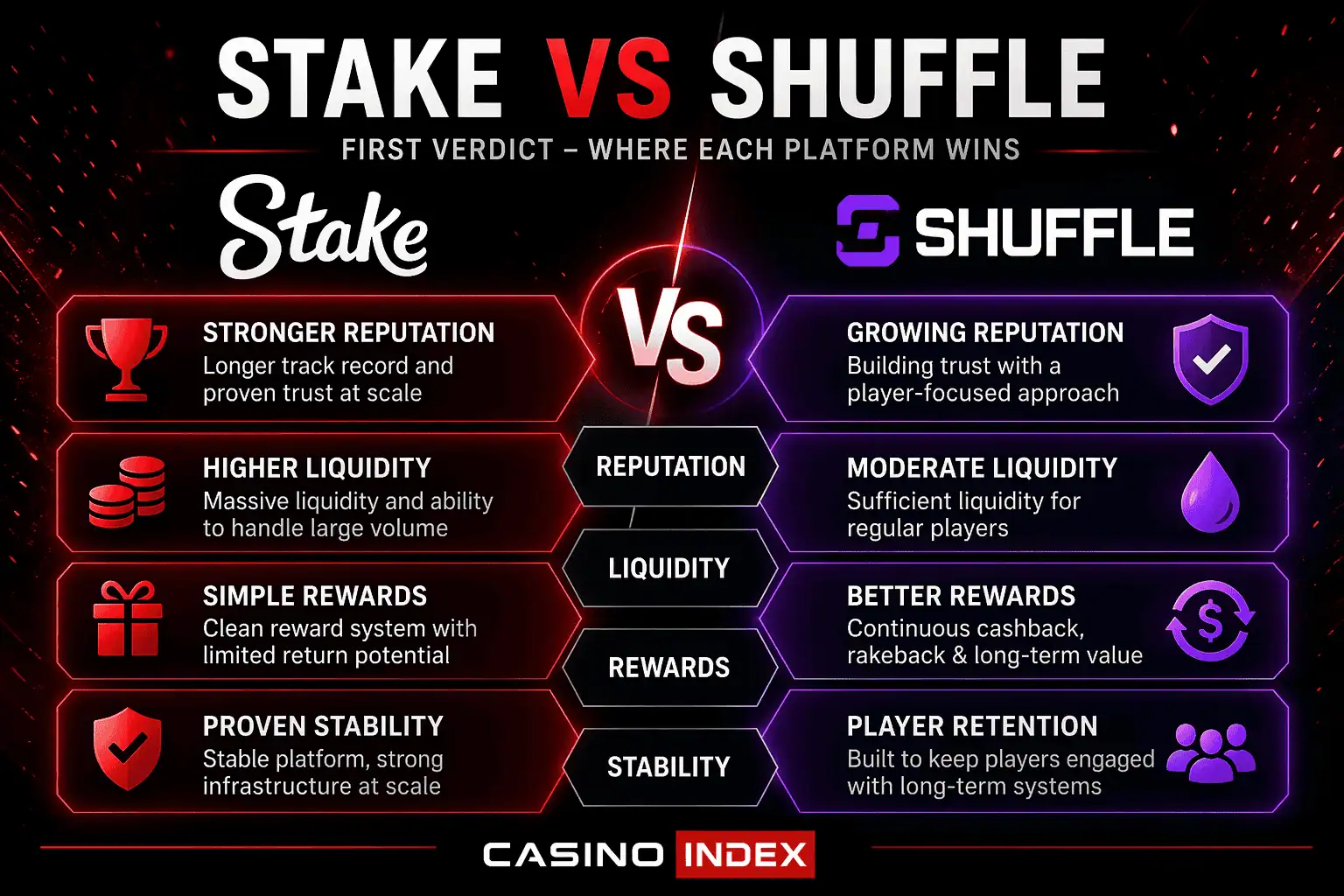
CasinoIndex observation: Stake wins by proof at scale. Shuffle competes through platform feel and reward efficiency. That makes Stake the stronger default choice, while Shuffle works best for players who already know they want a leaner, reward-focused crypto casino.
For deeper brand-level context, read the Stake review for long-term crypto players and the Shuffle review for crypto casino users before deciding which platform fits your style.
What This Comparison Is Really About
A weak comparison would ask which site has more games, better design or more visible promotions.
That is not enough.
A serious Stake vs Shuffle comparison has to answer what happens when the player stops browsing and starts using the platform with real money.
That means looking at:
- cashout reliability
- KYC timing
- reward value after repeated play
- how each platform handles larger balances
- whether the casino still makes sense after the first deposit
Stake and Shuffle both have strengths, but they solve different problems.
Stake is stronger when the player wants scale, reputation and broad confidence.
Shuffle is stronger when the player wants a lighter, reward-led crypto casino experience and accepts that the platform has less long-term proof at major scale.
That is the real trade-off.
How CasinoIndex Evaluates This Comparison
This comparison is not built around bonus size or surface-level features.
The main evaluation points are:
- how each casino behaves after deposit
- how withdrawals are likely to work at different levels
- how KYC or account checks may appear
- whether rewards create real value or only marketing appeal
- whether the platform makes sense for long-term real-money use
This follows the same framework used in how CasinoIndex evaluates real-money risk, where trust, withdrawals, verification and account behavior matter more than headline promotions.
That matters here because Stake and Shuffle can both look attractive on the surface.
The difference appears when you ask which platform is easier to defend after repeated play.
Trust Profile: Stake Starts Ahead
Trust is the most important part of this comparison.
Stake has the advantage because it has been tested by more users, across more markets and at higher visible scale. That gives players more evidence to judge before they deposit.
This does not make Stake perfect. It means the platform has a longer public track record around product stability, payment behavior and account handling under pressure.
Shuffle has recognition, but its trust case is still more focused and less proven at major scale. That does not make Shuffle weak. It makes the recommendation more conditional.
The difference is simple:
- Stake is easier to recommend before knowing much about the player.
- Shuffle is easier to recommend when the player already wants its specific style.
CasinoIndex trust view: Shuffle can be a good fit for the right crypto casino user, but Stake needs fewer explanations before it becomes a responsible recommendation. Stake leads because it has more proof under real-money conditions.
Business Model Difference: Scale vs Reward Focus
Stake and Shuffle are not trying to win the same way.
Stake wins through scale.
It has broad brand recognition, deeper liquidity, major traffic and a product that supports many player types. That creates confidence for users who want a crypto casino that feels established and battle-tested.
Shuffle wins through focus.
Its appeal comes from a cleaner user flow, stronger reward-focused positioning and a more direct crypto casino feel. It does not need to be as large as Stake to be useful for the right player.
But scale matters when real money is involved.
A platform that has handled more activity over a longer period gives players more information to judge. That is where Stake keeps the stronger default position.
Withdrawal Confidence: Why Cashout Behavior Decides the Comparison
Bonuses and design matter less when money is sitting in a withdrawal queue.
The real test begins after the player wins and asks the casino to release funds.
That is why why cashout reliability matters after deposit is central to this comparison.
Stake has stronger withdrawal confidence because it has more proof at scale. At normal levels, crypto withdrawals are one of its clearest strengths. The platform is built for high-volume transactions and repeat player activity.
That does not mean every payout is automatic.
Large withdrawals, sudden profit spikes, unusual betting patterns or account behavior outside normal activity can trigger extra checks. That is not automatically a red flag. It is how larger operators manage risk when exposure increases.
Shuffle can feel smoother during regular use. For normal crypto casino activity, the platform may feel lighter and less controlled than a larger operator.
The trade-off is evidence. Shuffle has less public proof under high-pressure payout conditions, especially when balances, volume or account review risk increase.
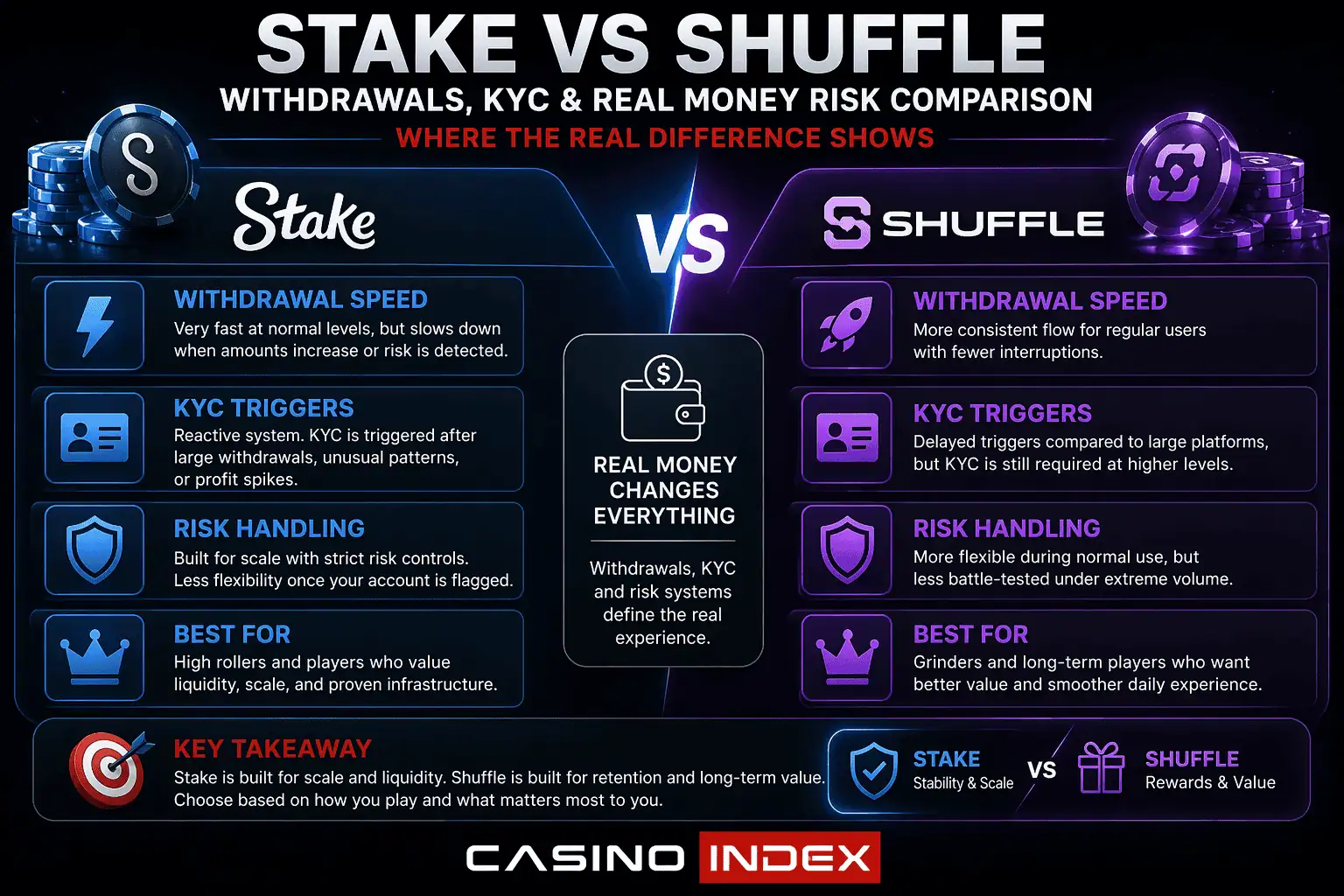
CasinoIndex payout view: Stake is stronger when the question is large-scale reliability. Shuffle can feel cleaner for regular crypto casino users, but Stake has the better proof base when withdrawal pressure rises.
KYC and Account Checks: Where the Experience Can Change
KYC is easy to ignore before signup.
It becomes important when a withdrawal is pending.
Stake often feels fast at entry level, but verification can appear when risk markers increase. Larger withdrawals, rapid account growth, unusual betting activity, payment checks or compliance reviews can trigger extra steps.
Shuffle can feel lighter in the early stages. That lighter feel is part of its appeal. Still, players should not treat Shuffle as a no-risk or fully anonymous option.
Both platforms can request verification if account or payout risk increases.
The real difference is not whether checks can happen. The real difference is how much confidence the player has that the process will be handled clearly, fairly and without unnecessary friction.
Stake has the stronger overall trust profile because its account-check process is more proven at scale. Shuffle has the lighter early experience, but less long-term public evidence under heavier account-review conditions.
Players comparing both brands should understand how casino verification can affect withdrawals before assuming that fast crypto deposits lead to automatic cashouts.
Real User Experience: What Happens After Signup
Stake feels strong immediately.
The platform is fast, familiar and broad. It gives players access to casino games, sportsbook options, crypto payments, rewards and a polished user experience. For many players, that is exactly what they want.
The weakness is that Stake can feel more controlled once account activity becomes larger or less predictable.
Shuffle feels more focused.
It does not try to be the biggest name in every category. It focuses more on a crypto-native feel, reward mechanics and a cleaner experience. That can make Shuffle more attractive for users who dislike heavier casino environments.
The weakness is that Shuffle still needs more long-term proof compared with Stake.
So the user experience split is clear:
- Stake feels stronger for players who want proven scale.
- Shuffle feels stronger for players who want a lighter, reward-focused crypto casino.
Rewards and Long-Term Value
Rewards are where Shuffle has its strongest argument.
Stake has a reward system that works well for many regular users. It includes VIP progression, reloads, activity-based rewards and promotional value. The system is broad and familiar.
But Stake is not always the sharpest option for reward optimization.
Shuffle’s case is stronger when the player cares about reward efficiency. Its platform feel and reward-led positioning can make repeated play feel more direct for users who understand how rakeback, cashback or loyalty loops affect long-term value.
That does not mean Shuffle creates profit.
No reward system removes the house edge.
But a strong reward system can reduce the effective cost of play for active users. That is why Shuffle deserves a real section in this comparison.
The important distinction is this:
- Stake is better as the safer broad recommendation.
- Shuffle can be better for users who actively understand and use reward systems.
Rewards help Shuffle stay competitive, but they do not fully close the trust and scale gap.
CasinoIndex reward view: Shuffle’s strongest argument is reward efficiency, not broad trust. That makes it attractive for active users who understand rakeback, cashback and long-term play cost. Stake still wins for most players because its reward system sits inside a more proven overall platform.
Bonuses vs Real Value
The wrong question is:
Which casino has the better promotion?
The better question is:
Which platform gives better value after the player deposits, plays, withdraws and returns?
This is where many casino comparisons become too shallow. CasinoIndex explains this broader decision logic in its guide to how to compare casinos beyond bonus size.
Stake does not need to win only through bonuses. Its value comes from scale, familiarity, liquidity, product depth and long-term usability.
Shuffle’s value comes more from reward efficiency and user fit. If a player uses the platform regularly and understands the reward system, Shuffle may feel more rewarding over time.
Still, reward value should never override payout confidence.
A reward is only useful if the platform remains reliable when the player wants to cash out.
Product Fit: Broad Platform vs Cleaner Crypto Casino Flow
Stake is broader.
Shuffle is more focused.
That is the product difference.
Stake works better for players who want one account that covers many needs. Casino games, sportsbook access, crypto payments, rewards and long-term brand confidence all sit inside one large platform.
Shuffle works better for users who want a more streamlined crypto casino experience. It appeals more to players who care less about brand size and more about platform feel, rewards and day-to-day usability.
Neither product angle is automatically wrong.
The better fit depends on the player.
But for the average user searching Stake vs Shuffle, Stake is easier to recommend because it covers more use cases with fewer conditions.
Reputation and Player Confidence
Reputation matters because casino trust is not built from one smooth deposit.
It is built from repeated performance over time.
Stake has a stronger public reputation because it has operated at larger scale for longer. That gives players more history to examine, more public feedback to compare and more confidence in how the platform handles normal activity.
Shuffle’s reputation is more specific.
It appeals to users who like its cleaner crypto casino identity and reward direction. That can be enough for the right player, but it is not the same as broad-market trust.
The difference is not popularity alone.
It is confidence under pressure.
That is why Stake leads this category.
Who Should Choose Stake?
Stake is the better choice for most players who want the stronger default crypto casino.
It makes the most sense for:
- players who want proven scale
- users who care about liquidity and payout confidence
- players who want a broad casino and sportsbook environment
- users who prefer an established brand over a newer reward-led platform
- players who want fewer unknowns before depositing
Stake is not risk-free. No casino is.
But it is easier to defend as the better all-round platform.
Who Should Choose Shuffle?
Shuffle is better for a more specific player type.
It makes sense for users who want:
- a cleaner crypto casino experience
- stronger reward-focused appeal
- less reliance on old-style casino structure
- a platform that feels more focused on active users
- a newer crypto-native environment with retention value
Shuffle is not the stronger default recommendation.
But it can be the better fit if the player understands why they want Shuffle specifically.
CasinoIndex player-fit view: Shuffle should not be judged as a weak Stake alternative. It should be judged as a narrower product. For the right user, that narrower focus is the point. For most users, Stake remains the safer default.
High Rollers and Larger Balances
For larger balances, Stake has the clearer advantage.
High-value players usually need deep liquidity, stronger infrastructure, faster cashier handling and a longer record of processing meaningful volume.
Stake is stronger in that environment.
That does not mean every large withdrawal will be instant. Larger balances can trigger more checks. But Stake is still the more proven platform when the question becomes large-scale reliability.
Shuffle may suit regular users and reward-focused players, but it is less proven for high-pressure account situations.
That makes Stake the better high-roller choice.
Beginners and Casual Crypto Casino Users
Beginners usually need simplicity, stability and fewer unknowns.
That gives Stake another advantage.
A new player comparing both platforms may not know how to judge reward mechanics, withdrawal thresholds or account-risk signals. In that situation, the broader and more established platform is easier to justify.
Shuffle can still work for casual users, but its strongest value appears when players understand how rewards and regular activity affect long-term value.
For beginners, Stake is the cleaner starting point.
Long-Term Players and Reward-Focused Users
This is where Shuffle becomes more competitive.
A long-term player who understands rewards may care less about brand size and more about what the platform returns during repeated play.
For that user, Shuffle has a real case.
Its reward-first appeal can make the platform feel more efficient over time. That matters when a player is not just making one deposit, but using the casino repeatedly.
Still, reward value must be balanced against trust, withdrawals and account risk.
Shuffle may offer better reward appeal for certain users, but Stake remains stronger for long-term confidence across a wider player base.
Final Decision Framework
Use this simple framework before choosing:
| Player Type | Better Choice | Reason |
|---|---|---|
| New crypto casino player | Stake | More proven, broader and easier to trust |
| Reward-focused regular player | Shuffle | Stronger appeal for ongoing reward value |
| High-volume or high-balance player | Stake | Better liquidity and more proof at scale |
| Player avoiding complex platform environments | Shuffle | Cleaner and more focused crypto casino feel |
| Player prioritizing payout confidence | Stake | Stronger broad-market withdrawal confidence |
Better Internal Comparison Paths
This comparison should not sit alone. Stake and Shuffle both belong inside a wider crypto-casino decision cluster.
Useful next comparisons include:
- Stake vs BC.Game for users who want another major-brand trust comparison
- BC.Game vs Shuffle for readers who want to compare Shuffle against a more complex crypto casino ecosystem
- Rollbit vs Stake for players comparing Stake against another reward-led crypto casino brand
These paths keep the comparison focused and help readers pressure-test the same decision from different angles.
Final Verdict: Stake or Shuffle?
For most players, Stake is the better overall choice.
It has stronger scale, broader reputation, deeper liquidity and a more proven record under real-money conditions.
Shuffle still has a real role.
It can be the better fit for crypto casino users who care about reward structure, cleaner platform flow and a more focused user experience. But it is not the stronger default pick.
The real comparison is simple: Stake is the stronger all-round crypto casino, while Shuffle is the more specific reward-focused alternative.
Choose Stake if you want broader trust, stronger scale and better long-term confidence. Choose Shuffle if you already prefer its cleaner crypto casino style and reward-led experience.
That is the real comparison.
Not brand noise. Not bonus hype. Just the better choice once real money matters.
FAQ: Stake vs Shuffle
Is Stake or Shuffle better overall?
Stake is better overall for most players because it has stronger scale, reputation, liquidity and long-term trust signals. Shuffle is better for a narrower user type that values reward-focused crypto casino play.
Which casino has better withdrawals?
Stake has stronger broad-market withdrawal confidence, especially because it has more proof at scale. Shuffle can feel smooth for regular users, but it has less long-term public evidence under high-pressure payout conditions.
Is Shuffle safer than Stake?
Shuffle can feel lighter and more flexible, but Stake has the stronger trust profile overall. Safer depends on player type, account activity, withdrawal size and how much proof you want before depositing.
Does Stake require KYC?
Stake can allow fast access at entry level, but KYC may be required when risk markers increase. Large withdrawals, unusual betting activity or account reviews can trigger verification.
Does Shuffle require KYC?
Shuffle may feel less restrictive early, but that does not mean KYC can never happen. Verification can still appear if account activity, withdrawals or compliance rules require it.
Which platform is better for rewards?
Shuffle has the stronger reward-focused appeal for active users. Stake still has a useful reward system, but its main advantage is broader platform trust rather than maximum reward optimization.
Which is better for beginners?
Stake is better for beginners because it is broader, more established and easier to understand as a first crypto casino choice.
Which is better for high rollers?
Stake is better for high rollers because it has deeper liquidity, more scale and stronger proof under larger account activity. Larger withdrawals can still trigger checks, but Stake remains the more proven option.
Should I choose Stake or Shuffle?
Choose Stake if you want the stronger all-round platform. Choose Shuffle if you specifically want a cleaner, reward-focused crypto casino and accept a smaller proof base compared with Stake.

Nina Kanu has worked in cryptocurrency content and blockchain research since 2016. She is also known within parts of the crypto community through CryptoMutant, where her work has covered emerging projects, market trends and developments across the blockchain ecosystem. At CasinoIndex, Nina focuses on crypto casino reviews, platform comparisons, player experience, game ecosystems and bonus fairness. Her research examines how casino products perform beyond their marketing, including usability, payment options, promotional terms and the overall experience players receive after signing up.