Provably Fair Casinos Guide
Article OverviewUnderstand how provably fair casinos use seeds, hashes and verification tools to make game results checkable. This guide explains which games are covered, how to compare fairness claims, and why a verifiable result does not guarantee reliable withdrawals, secure accounts or better odds.
Provably fair casinos offer games whose results can be checked using cryptographic records. That gives players a useful way to question an outcome: can the casino provide the information needed to reproduce what happened?
The answer depends on the game. A casino may offer verifiable Dice or Mines alongside hundreds of slots that use a different testing system. Even a successful verification says nothing about whether a withdrawal will arrive on time.
Start with the examples below, then use this guide to understand what the fairness evidence actually covers.
Provably Fair Casinos: Compare the Reviews
Compare the published fairness information, then open each review for withdrawal terms, account requirements and the wider casino assessment.
| Casino | Fairness information | Explore the review |
|---|---|---|
| Stake | Publishes implementation details and game-event calculations. Check the method for the specific supported game. | Read Stake review → |
| Shuffle | Explains commitments, seed rotation and bet verification. Check which records are available for completed bets. | Read Shuffle review → |
| TrustDice | Describes a built-in verification tool for Dice. This game-specific claim does not cover the entire casino library. | Read TrustDice review → |
Based on operator-published documentation, not independent testing or a ranking. Availability varies by location. View the operator sources.
What Does Provably Fair Mean?
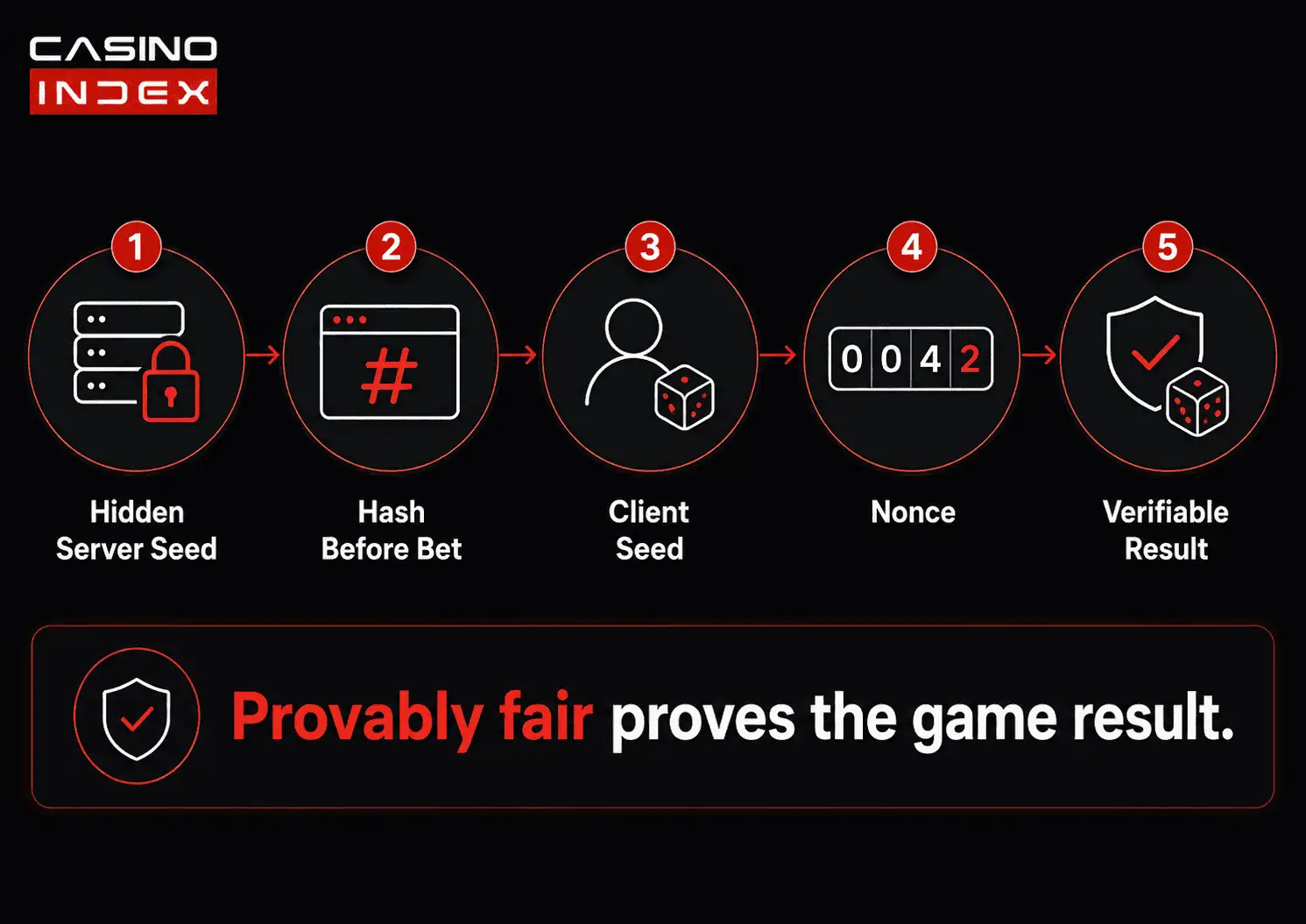
In a typical provably fair game, the operator commits to a secret value before play. The game combines that value with other inputs to calculate a result. Once the relevant secret is revealed, the player can check the earlier commitment and reproduce the outcome using the published rules.
The important feature is that the result can be checked against information fixed before the bet. A statement saying “our games are fair” does not provide that evidence.
However, there is no single algorithm used by every provably fair casino. Some games use a server seed and client seed. Others use hash chains or additional public inputs. The documentation should explain the method used by the particular game you are opening.
The terms you will see in a fairness menu
- Server seed: a value supplied by the operator. In common systems, it remains secret while it is being used for active bets.
- Server seed hash: a cryptographic fingerprint of that value, shown before play as a commitment.
- Client seed: an input associated with the player, which the player can often change.
- Nonce: a counter used to distinguish bets made with the same seed pair.
- Verifier: a tool that uses the recorded inputs and the game’s algorithm to reproduce an outcome.
A hash is not an encrypted message that the casino later decrypts. The operator reveals the original seed, and you hash that seed again to check whether it matches the earlier commitment.
Some games require additional inputs or counters. A verifier should identify these clearly rather than assume that the same three fields work for every title.
Which Provably Fair Games Does a Casino Actually Offer?
Start with the game you want to understand. A fairness badge on the homepage does not establish how every title in the lobby generates its results.
This distinction matters when a casino combines its own games with software from other providers. The operator’s seed controls may apply to its originals while having no role in a separate provider’s slot.
| Game type | Useful verification evidence | Detail worth checking |
|---|---|---|
| Dice and Limbo | Recorded inputs and a published calculation for the roll or multiplier. | The result range, rounding rules and payout calculation. |
| Mines and Plinko | A method for reproducing the board, path or sequence of game events. | The selected settings and how multiple events are generated. |
| Crash | Documentation for the specific game’s commitments and crash-point calculation. | Whether it uses a hash chain or another scheme instead of the casino’s usual seed process. |
| Slots | Evidence for the individual title and its applicable verification method. | Whether the fairness claim covers that slot, rather than only the casino’s other games. |
| Live dealer games | An explanation of how the actual game is operated and supervised. | A seed verifier for digital games does not verify a physical wheel or card shuffle. |
Game names alone are not enough. Two games called “Crash” can use different algorithms, and a verifier written for one may be unsuitable for the other.
For an example of game-specific documentation, Stake publishes separate calculations for its game events. The useful point is the separation between generating random data and turning that data into a particular result.
How to Compare Provably Fair Casinos
A practical comparison starts with the evidence available for the games that interest you. These checks help distinguish a usable verification system from a general marketing claim.
1. Find a clear statement of coverage
Look for an identifiable list of supported games, or a fairness section inside each relevant title. “Our originals are provably fair” is more specific than a badge applied to the entire casino, but you still need to know which games count as originals.
If a review describes a casino as provably fair, follow its sources. Does the evidence cover one Dice game, a collection of in-house titles or the complete library?
A useful description should make that boundary visible. Otherwise, readers may assume that a feature available in one game also applies to the slot they actually play.
2. Check what the published algorithm explains
Naming SHA-256 or another cryptographic function is only part of the explanation. The documentation also needs to show how the inputs become a roll, card, multiplier or other game event.
For example, a calculation might generate a number that must then be converted into a position on a board. That conversion affects the outcome and belongs in the published method.
You do not need to read code to ask a useful question: could someone reproduce a recorded result from these instructions? Public implementation details make that question easier for technically skilled readers to answer.
3. Look at when inputs are fixed and revealed
A commitment is useful because of when it was made. A hash first supplied after a disputed bet does not establish that the operator had committed to the same value beforehand.
The documentation should explain when the server commitment becomes visible, how the player input is chosen and when the old server seed can be revealed. It should also describe what happens when seeds are changed.
Do not assume that a matching calculation proves every part of the setup was sound. The order of these steps matters, as does the implementation behind them.
4. See whether records remain available
A verification feature is easier to use when a completed bet has a stable record containing its inputs, settings and result.
Check whether you can copy the relevant values, identify the seed pair used and return to the record after a seed change. If the game has several configurations, its history should preserve the configuration for that round.
A small “verified” icon provides much less information than a record you can inspect. Where available, published sample bets also help demonstrate the process without requiring you to deposit money to understand it.
5. Distinguish an internal checker from independent reproduction
A built-in verifier can make the process accessible. However, it is still a tool presented by the operator.
Published code and complete records can allow a separate implementation to check the same result. That provides a stronger basis for scrutiny than accepting the operator’s confirmation alone.
Independent tools also need care: they must support the correct game and algorithm version. A mismatch from an unrelated calculator is not evidence that a casino changed the result.
What a Successful Fairness Check Establishes
In a common seed-based system, two checks answer different questions:
- Does the revealed seed match the earlier commitment? This checks whether the disclosed value corresponds to the hash recorded before play.
- Do the recorded inputs reproduce the game result? This checks the outcome against the published calculation for that game.
Matching the seed hash alone does not complete the second check. You also need the correct game rules and any relevant settings.
For the practical process, including which records to save and how to investigate a mismatch, use our guide to verifying a provably fair casino game yourself.
Provably Fair Games and RNG Testing
“RNG” and “provably fair” are often presented as opposing systems. That can be misleading. Provably fair games also use processes that generate random or pseudorandom data.
The difference concerns the evidence available. A testing laboratory can assess aspects of an RNG and its implementation. A player-facing verification system can let someone reproduce a particular recorded result.
For example, Gaming Laboratories International describes RNG testing that includes source-code review and statistical analysis. Those activities have a different scope from checking one completed bet.
A game can have both independent testing and a provably fair mechanism. Conversely, the absence of a player seed menu does not, by itself, establish that a game is unfair. Look at the testing evidence that applies to the actual title and version.
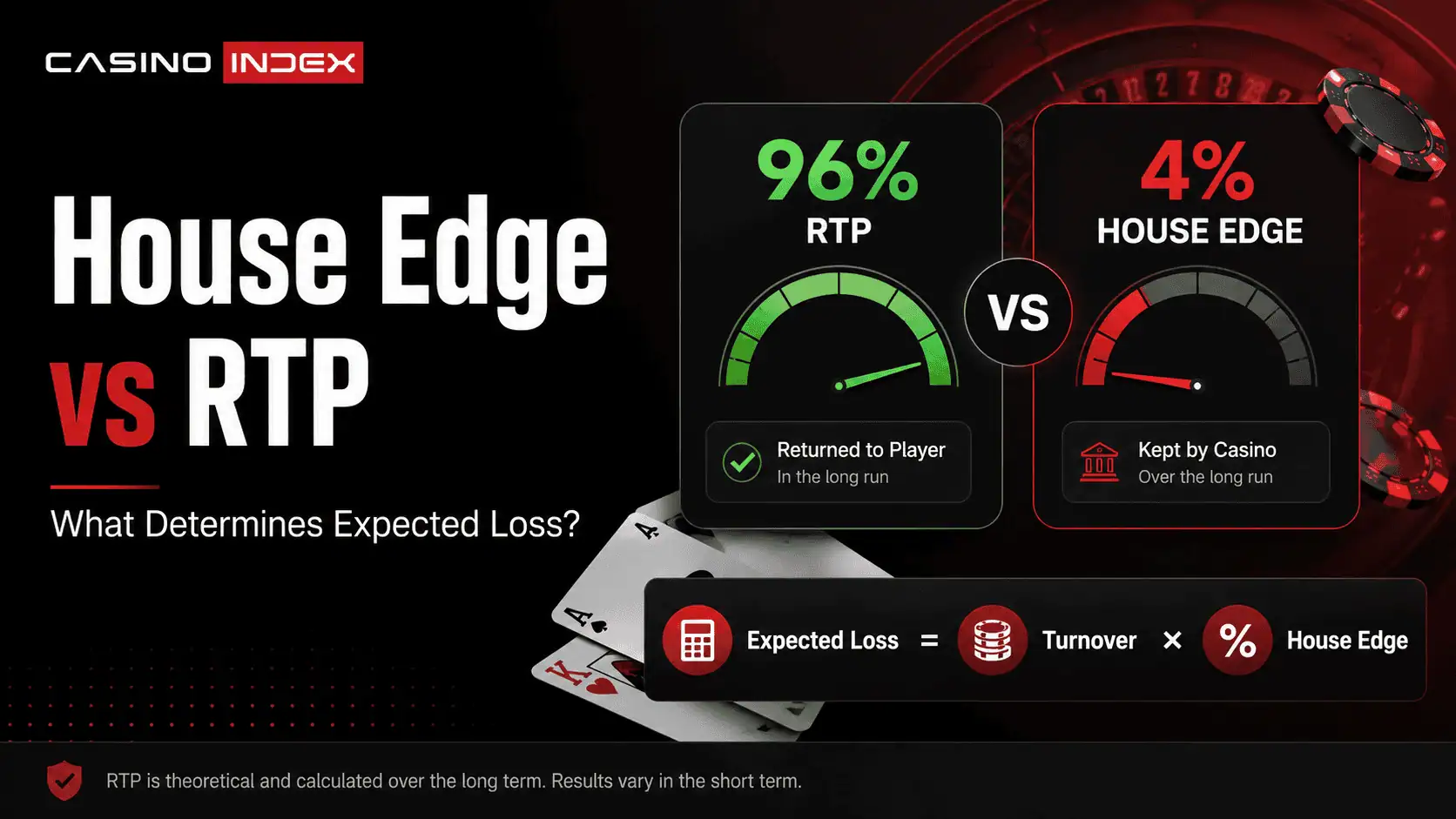
Provably Fair Gambling Still Has a House Edge
A verifiable outcome can be produced by a game whose payouts favour the operator. The proof does not remove that mathematical advantage.
Consider a hypothetical game with a 50% chance of winning. A $1 winning bet returns $1.98 in total, including the original stake; a losing bet returns nothing.
The expected return is:
0.50 × $1.98 = $0.99 per $1 wagered.
That is a theoretical RTP of 99% and a house edge of 1%. The result of every round could be verifiable while the game still has that expected cost.
This calculation describes an average implied by the rules. It does not predict your next result or mean that every $100 wagered produces exactly $99 back. Our casino RTP guide explains that distinction in more detail.
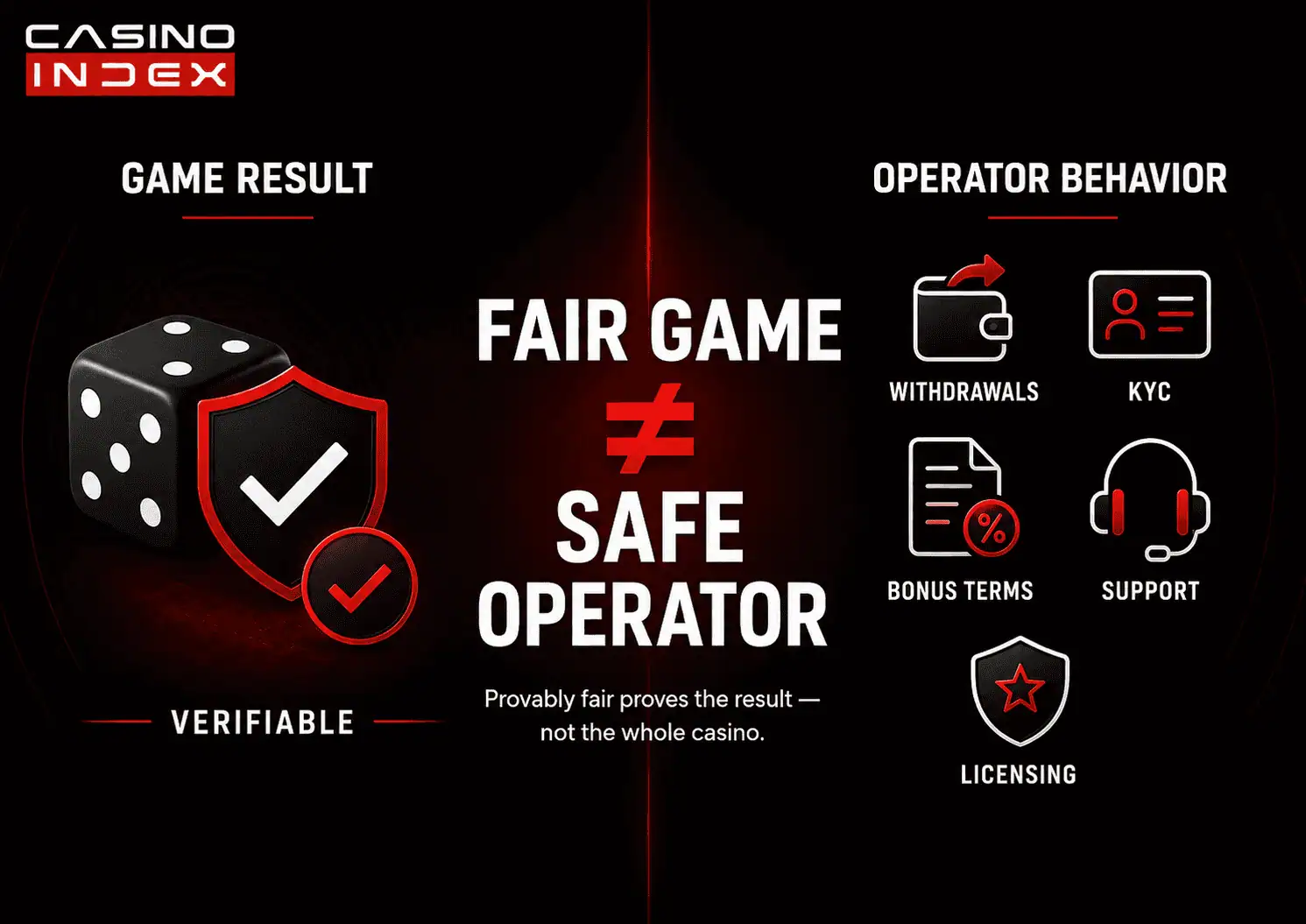
What the Fairness Label Does Not Answer
Will the casino pay a withdrawal?
A game result and a withdrawal are separate events. Cryptographic verification cannot make an operator release funds, remove a withdrawal limit or resolve an account dispute.
Before depositing, read the conditions governing your balance: verification requirements, withdrawal restrictions and any bonus rules. The guide to reading casino terms before a deposit covers those checks.
Is the account and platform secure?
Fairness verification does not protect an account from phishing, password theft or a compromised recovery process. It also does not establish how the operator protects personal documents.
Those are different questions, covered in our casino security guide. A casino can provide detailed game calculations while leaving important account-security questions unanswered.
Is the operator suitable for your location?
A technical feature does not establish local authorisation or eligibility. Check the operator’s identity, relevant licensing information and location restrictions separately.
For the broader assessment, see how CasinoIndex evaluates casinos. Fairness documentation contributes evidence about games; it cannot stand in for every other part of that assessment.
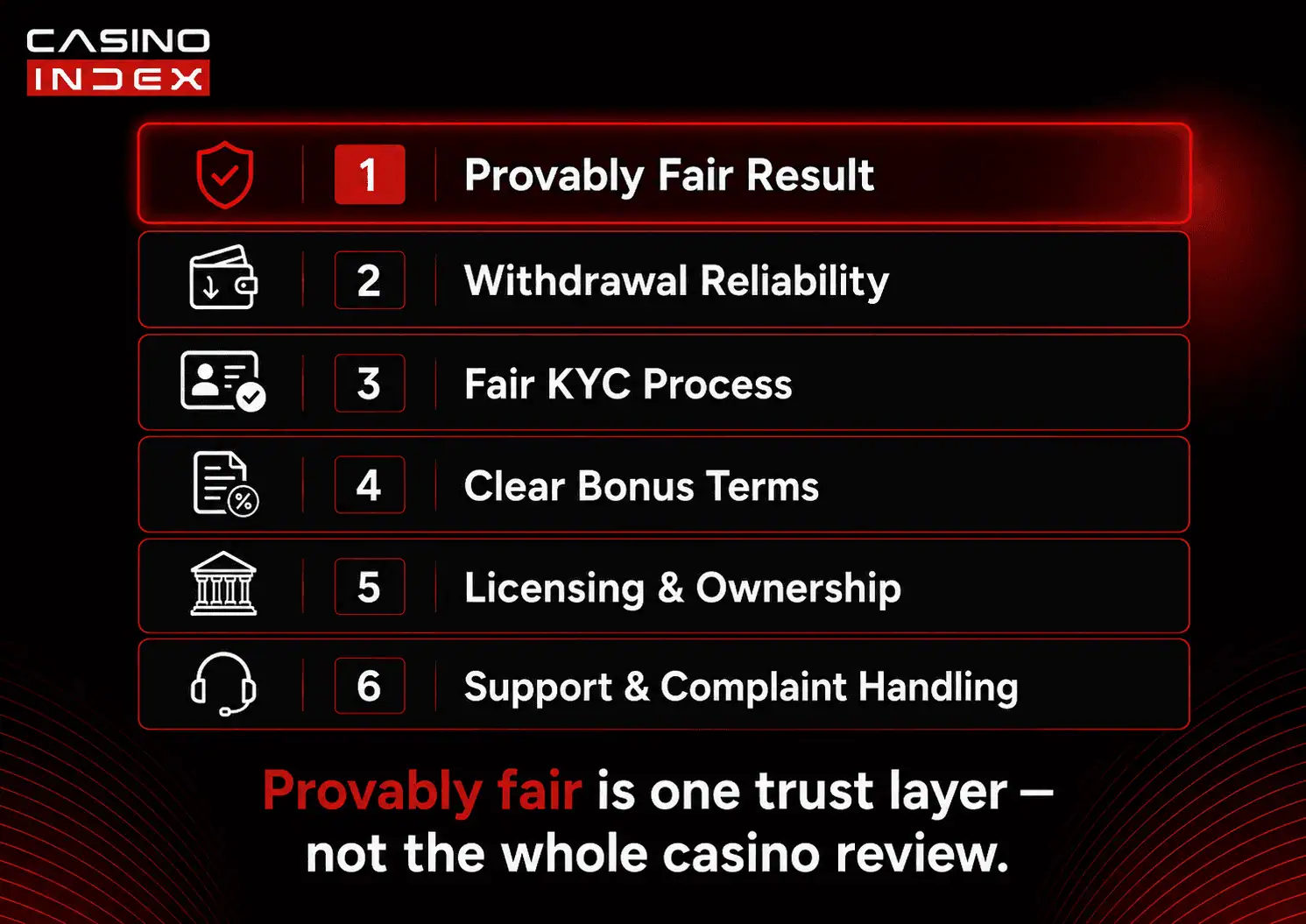
A Fairness Claim Can Be Stronger for One Game Than Another
Imagine two hypothetical casinos. The first advertises 3,000 games and displays a provably fair badge in its footer. Its help page explains a seed system, but never identifies which titles use it.
The second has a smaller selection of original games. Each supported title identifies its algorithm, provides accessible bet records and links to a verifier. Its third-party games are described separately.
For someone researching those original games, the second casino provides clearer evidence. That conclusion does not establish which business is safer overall, and it does not apply automatically to its third-party slots.
This is why a useful comparison names the game, the available evidence and the limits of the claim. A larger library or a more prominent badge cannot answer those questions.
When using our crypto casino comparison, carry that distinction into your research. Supported currencies and a provably fair feature describe different aspects of the service.
Questions to Ask When the Documentation Is Unclear
A specific question usually produces a more useful answer than “Is your casino fair?” You can ask support:
- Does the provably fair system cover this exact game and provider?
- Where is the algorithm that converts the recorded inputs into its result?
- When can I see the commitment, and when is the server seed revealed?
- Can I retrieve the settings and inputs for an older completed round?
- Is there a worked example or a verifier for this game version?
A reply linking to the applicable documentation is useful. Repeating a slogan, showing a licence badge or saying that cryptocurrency transactions are public does not answer these game-specific questions.
If the evidence remains unavailable, treat the fairness claim as unverified in your own assessment. You do not need to make a deposit to give the claim the benefit of the doubt.
Frequently Asked Questions About Provably Fair Casinos
Are all crypto casinos provably fair?
No. Accepting cryptocurrency describes a payment option. It does not establish how games generate outcomes. Even where a casino offers provably fair games, the feature may cover only selected titles.
Can a provably fair game still be manipulated?
The label alone cannot rule out a faulty or dishonest implementation. Proper commitments and reproducible calculations make certain changes detectable, but the inputs, timing and game rules still need scrutiny. A website displaying “provably fair” has not proved those conditions by displaying the phrase.
Does a blockchain transaction prove that a casino game was fair?
No. A transaction can provide evidence of a transfer without providing the inputs or calculation behind a game result. Some systems use blockchain data within their fairness design, but that must be documented explicitly.
Can I predict the next result from a server seed hash?
A properly designed system should not let a player recover the secret seed or predict future results from its public hash. A hash is provided as a commitment. Claims that an ordinary hash reveals the next winning round deserve considerable scepticism.
Does changing my client seed improve the odds?
Changing a client seed can change the sequence of outcomes in a seed-based system. It does not remove the house edge or create a reliable advantage under the same game rules. Choosing a memorable or supposedly lucky seed is not a winning strategy.
Can slots be provably fair?
Yes, a slot can be designed with a verifiable result-generation process. However, you need evidence for that particular title. A casino’s seed controls for Dice or Mines do not automatically cover every slot in its lobby.
What is the most useful first check?
Open the fairness information for the exact game you are considering. Establish whether the casino identifies its method and makes the necessary records available. If that basic connection is missing, a general fairness badge tells you very little.
Sources for the Casino Examples
- Stake: provably fair implementation — documentation covering its seeds, counters and result-generation process.
- Stake: game-event calculations — explanations of how generated data becomes outcomes in supported games.
- Shuffle: how to verify bets — instructions covering seed rotation and checking recorded results.
- TrustDice: Dice information — the operator’s description of its Dice game and built-in fairness verification.
These sources describe the operators’ systems. Their publication alone does not establish flawless implementation, reliable withdrawals or permission to serve your location.
Keep the scope of the proof in view: a reproducible game result is useful evidence about that result. Continue to assess the game’s cost and the operator’s terms separately. Verification does not make gambling risk-free.

Talha Aydin has been active in cryptocurrency since 2017 and is a co-founder of Freecoins24 and CryptoMutant. Over the years, he has worked with crypto projects on community growth, giveaways, user acquisition and digital strategy while gaining hands-on experience across blockchain platforms and crypto markets. At CasinoIndex, Talha focuses on crypto casinos, withdrawals, payment systems, platform trust and the risks players face when moving funds between wallets and gambling platforms.