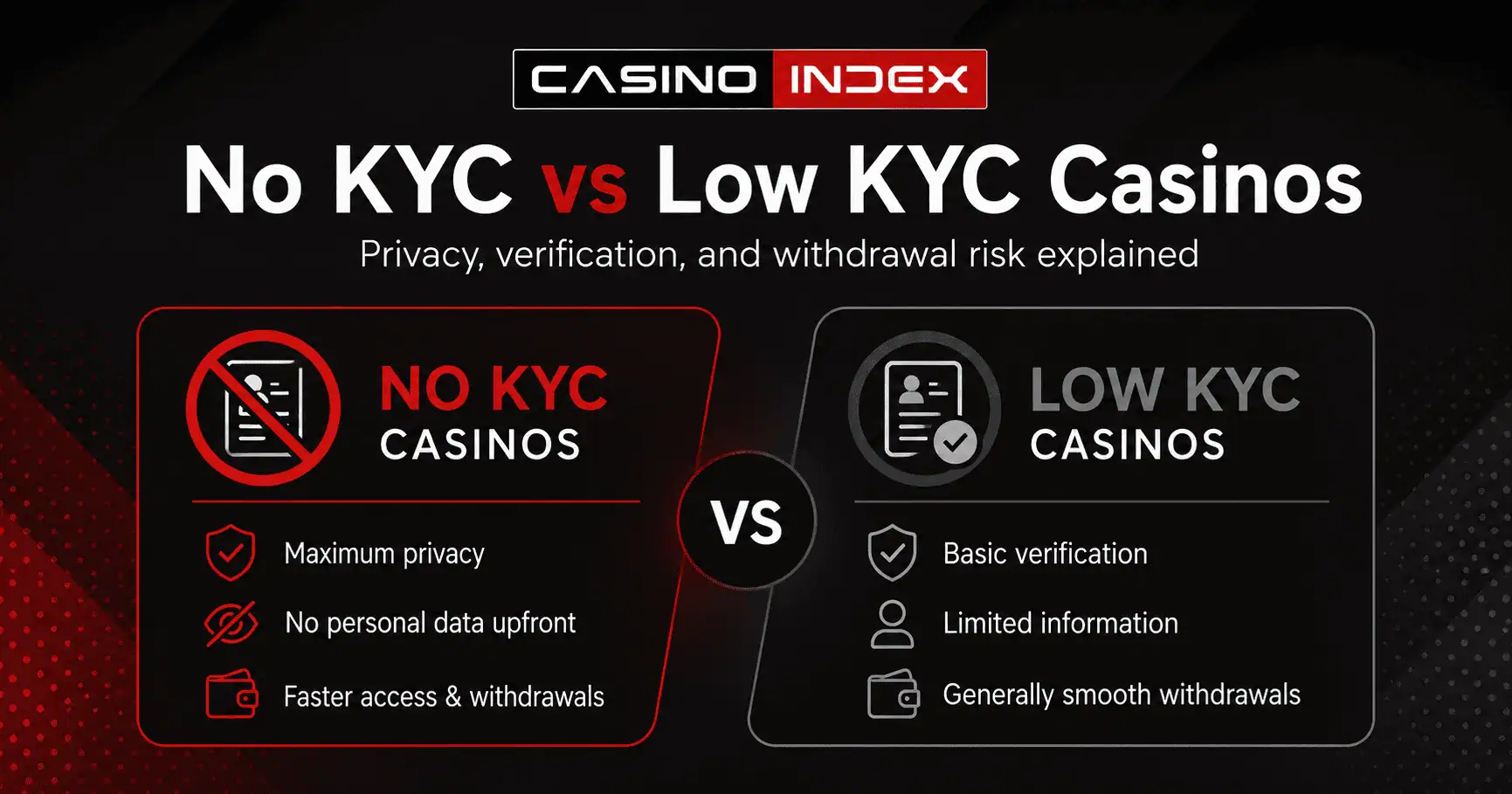


Are No KYC Casinos Safe? Withdrawal and KYC Risk Explained
What “Safe” Means at a No KYC Casino
No KYC casinos reduce verification at the beginning of the player journey. They do not remove casino-side controls.
A player may be able to register, deposit and play without uploading identity documents. That early convenience can be useful, especially for people who prefer crypto payments and want to limit how much personal information they share with gambling sites.
However, safety is not measured at signup.
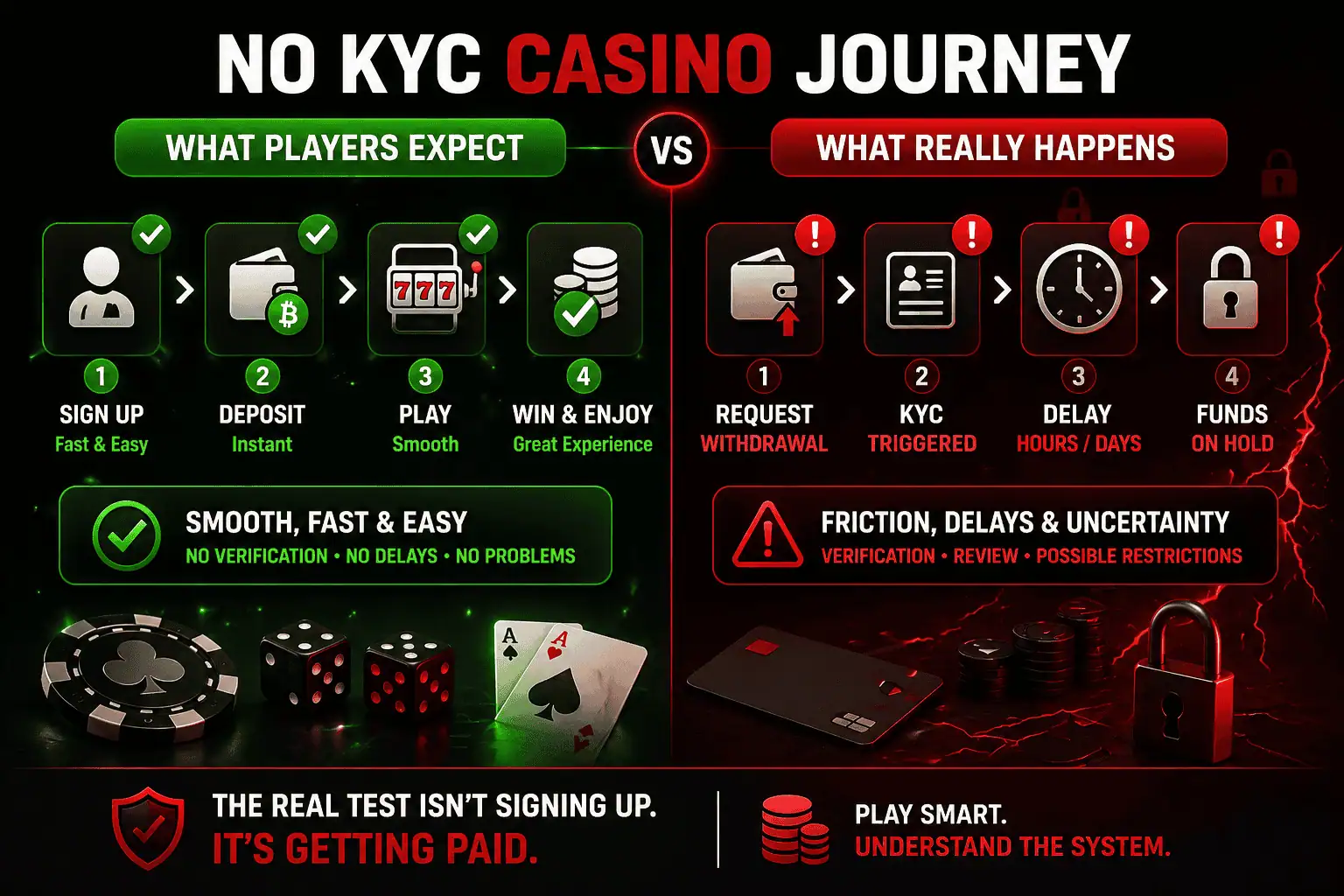
The stronger test begins when the player requests a withdrawal, changes wallets, wins a larger amount, uses a bonus or triggers an account review. At that point, the casino may examine identity, location, payment history, wallet activity, bonus use and account connections.
Therefore, the answer to “Are no KYC casinos safe?” is conditional:
Some can provide a reasonable real-money experience, but the no KYC label alone does not prove fair withdrawals, clear account rules or useful dispute protection.
Players looking for actual casino options can review no KYC casinos worth comparing carefully. This page focuses on the safety question rather than simply ranking brands.
No KYC Casinos Compared by Payout and Verification Risk
The comparison belongs near the top because most readers want to know which platforms deserve deeper research before reading the full risk analysis.
The labels below are editorial risk summaries, not guarantees. Withdrawal size, country, bonus status, wallet activity and account history can change the result for an individual player.
| Casino | Main Strength | Verification and Payout Risk | Best Fit | Review |
|---|---|---|---|---|
| BC.Game | Large crypto ecosystem and broad coin support | Medium: bonuses, wallet activity and larger withdrawals can add review layers | Experienced crypto users who understand complex rewards | BC.Game review |
| Rollbit | Crypto-first products and high-volume account features | Medium: scrutiny can increase as transaction value and activity rise | Regular users comfortable with higher-value crypto play | Rollbit review |
| Shuffle | Cleaner crypto interface and structured reward system | Low to medium: account and payment checks can still appear | Players who prefer a more controlled crypto casino setup | Shuffle review |
| Coins.Game | Simple crypto-led account and game experience | Medium: limited friction at entry does not remove withdrawal review risk | Users who value a straightforward interface | Coins.Game review |
| Gamdom | Established crypto profile and entertainment-led platform | Medium to high: bonus use and larger activity can complicate cashouts | Players who understand promotion and account-review risk | Gamdom review |
How to read this table
A lower risk label does not mean that verification will never happen. Likewise, a medium or higher label does not mean the casino is unsafe for every player.
The table shows where extra attention is needed. The safest decision still depends on the current terms, permitted countries, withdrawal limits, wallet rules and recent complaint evidence.
The Direct Answer: Are No KYC Casinos Safe?
No KYC casinos are not automatically safe or unsafe.
They trade less friction at entry for more uncertainty later. A platform may allow ordinary play without documents and still reserve broad rights to review the account before releasing funds.
The strongest no KYC casinos tend to share several qualities:
- the legal operator and license position are visible
- withdrawal limits are published before deposit
- KYC triggers are described in the terms
- wallet and payment rules are understandable
- support gives specific answers about account reviews
- bonus conditions do not quietly control the full balance
- public complaints do not show a repeated unresolved payout pattern
A weak casino may offer an equally fast signup. The difference appears when money needs to leave the platform.
What “No KYC” Actually Means
The phrase is often interpreted too literally.
In practice, no KYC usually means that routine onboarding does not require traditional identity documents. It may also mean that smaller withdrawals can be processed without a full document review.
It does not normally mean:
- the casino cannot monitor account activity
- the player is completely anonymous
- the casino will never request identity documents
- large withdrawals are exempt from review
- wallet activity cannot be checked
- restricted-country rules no longer apply
- the account cannot be blocked or limited
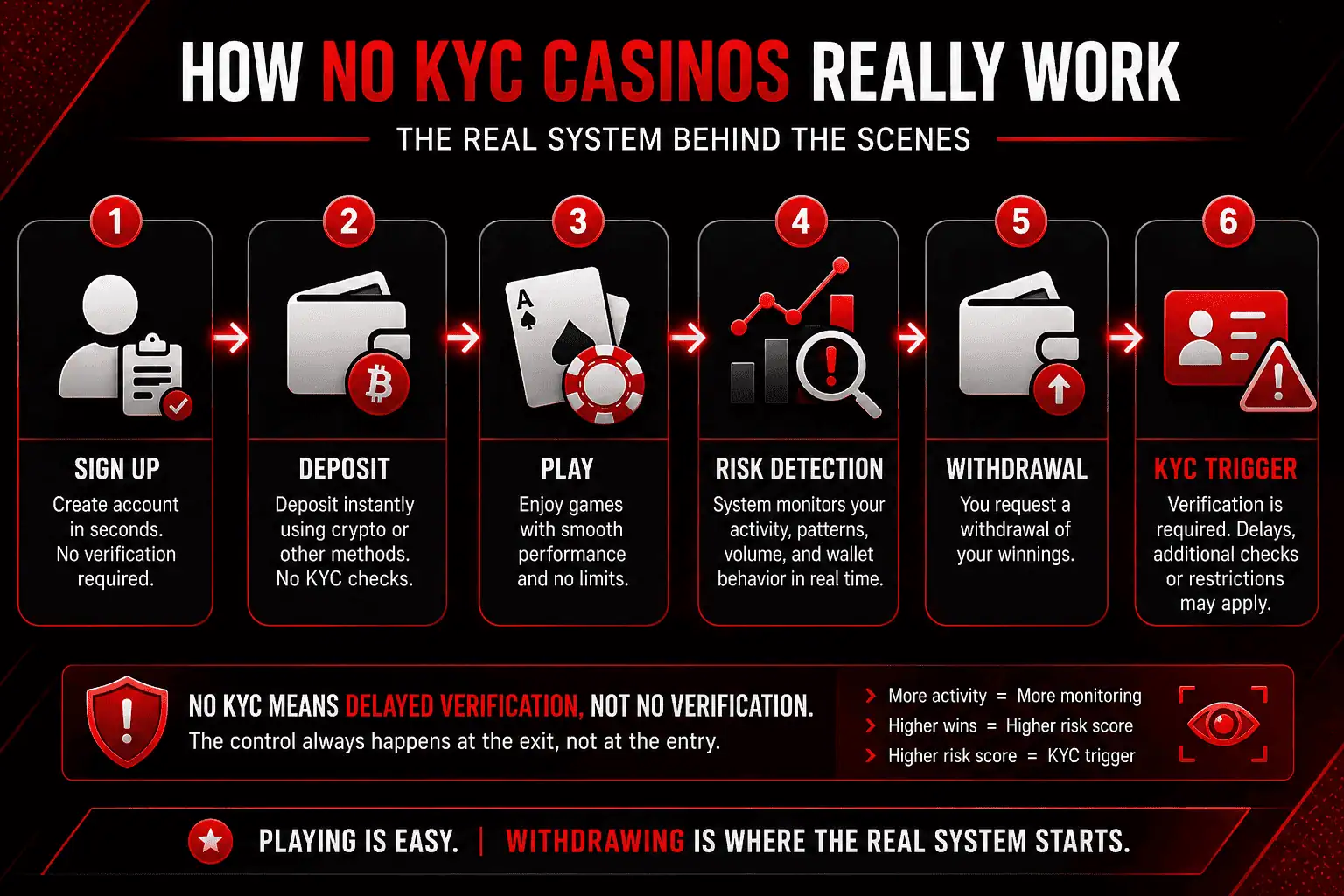
A more accurate description is risk-based or delayed verification.
Some casinos verify only after a threshold is reached. Others use basic account and wallet checks first, then request full KYC when several risk signals appear together.
The distinction between business models is covered in no KYC vs low KYC explained.
No KYC at Signup Is Not No Checks at Withdrawal
This is the most important point on the page.
Registration and withdrawal are different risk stages for the casino.
At signup, the account may hold no money and have no history. Once a player deposits, wins and requests a cashout, the operator has more information to evaluate and more financial exposure to manage.
| Stage | Typical Player Experience | What the Casino May Check |
|---|---|---|
| Signup | Email, username or wallet-based registration | Location, device and basic account signals |
| Deposit | Crypto credited after network confirmation | Coin, network, wallet path and transaction risk |
| Gameplay | Usually little visible friction | Betting pattern, bonus use and linked-account signals |
| Withdrawal | Automated payment or manual review | Identity, location, wallet ownership, bonus compliance and source of funds |
A completed small withdrawal is a useful signal. It does not prove that a much larger cashout will follow the same route.
Higher values can trigger additional checks even when earlier payments were automatic. The full verification flow is explained in how casino verification really works.
No KYC, Low KYC and Standard Verification Compared
| Model | How It Usually Works | Main Benefit | Main Risk |
|---|---|---|---|
| No KYC | Documents may not be required for routine use or smaller withdrawals | Less data shared at the beginning | Players may misunderstand later verification rights |
| Low KYC | Basic access is easy, but defined thresholds can trigger checks | More predictable balance between privacy and compliance | Thresholds may still be unclear or change by risk profile |
| Standard verification | Identity checks occur during onboarding or before first withdrawal | Account status may be clearer before larger play | More documents and slower initial access |
No model is automatically superior.
Upfront verification can feel intrusive, but it may reduce uncertainty later. Delayed verification protects more personal data initially, yet the player may face checks only after building a meaningful balance.
Why No KYC Casinos Still Monitor Accounts
A casino does not need a passport scan to assess account risk.
Depending on the platform, internal systems may consider:
- deposit size and frequency
- withdrawal value
- rapid balance growth
- changes in betting behavior
- bonus and promotion use
- device, location and IP signals
- linked accounts
- wallet changes and transaction history
- restricted-country risk
Not every factor leads to verification. A review often begins when several details create a higher-risk profile.
This is why checks can feel sudden from the player’s perspective. The account worked normally until the withdrawal request, but the risk assessment may have developed throughout the session.
Monitoring is not automatically abusive
Casinos have legitimate reasons to prevent fraud, duplicate accounts, stolen payments and promotion abuse.
The quality of the system depends on what happens after the review begins. A fair operator explains the issue, requests relevant evidence and gives the player a path to completion.
Concern rises when requirements keep changing, previously accepted documents are requested again or support refuses to identify the type of review.
What Usually Triggers Verification?
No public list can predict every internal decision, but several triggers appear repeatedly in casino terms and account-review processes.
- Larger first withdrawal: the account has little established payment history.
- Rapid account growth: the balance increases quickly relative to previous activity.
- Wallet changes: the withdrawal destination differs from the usual payment route.
- Location conflict: device or IP information does not match account eligibility.
- Linked-account signals: several accounts appear connected by device, wallet or network.
- Bonus review: the withdrawal involves wagering, restricted games or maximum-bet rules.
- Source-of-funds concern: transaction size or wallet history creates additional risk.
A legitimate trigger does not give the casino unlimited rights to delay payment. The request should remain relevant to the risk being investigated.
Small, Medium and Large Withdrawal Risk
Players often trust a platform after one small payout. That evidence matters, but it has limits.
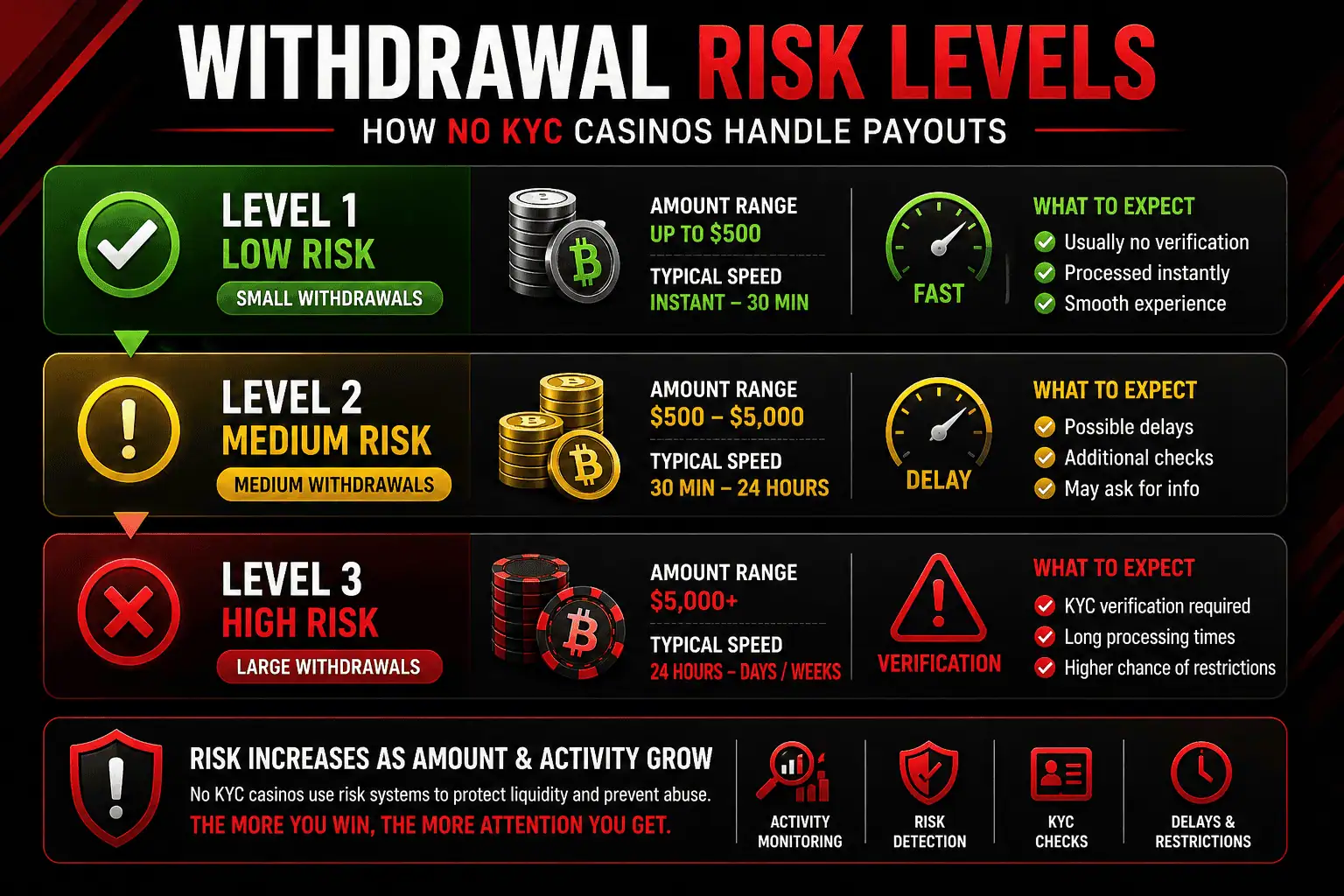
| Withdrawal Type | Likely Process | Main Risk |
|---|---|---|
| Small routine cashout | May be automated when the account is straightforward | The player assumes all future withdrawals will behave the same way |
| Medium cashout | May receive a manual account or payment review | Unclear limits or wallet matching create delay |
| Large first cashout | More likely to involve KYC, source-of-funds or activity checks | The player discovers verification rights only after winning |
| Bonus-linked cashout | Reviewed against wagering, game and maximum-cashout terms | Promotional rules affect otherwise valid winnings |
Blockchain speed begins only after the casino approves and sends the transaction. Before that point, the relevant issue is the operator’s internal review. CasinoIndex explains what casinos check before approving withdrawals.
What a Safer No KYC Process Looks Like
A safer platform does not need to promise that verification will never happen.
Instead, it should make the process understandable.
Clear wording before deposit
The terms should explain that the casino may request identity, location, wallet or payment evidence under defined circumstances.
Relevant document requests
The requested evidence should match the issue. A location concern may justify address or identity checks. A wallet question may require transaction or ownership evidence.
Specific rejection reasons
When a document cannot be accepted, the casino should explain whether the file is unclear, expired, incomplete or inconsistent with the account.
A visible endpoint
The player should know what needs to happen before the withdrawal can move forward.
A vague message about an “ongoing security review” is not enough when it gives no next step or update point.
How Account Blocks Can Still Happen
No KYC access does not prevent account restrictions.
A casino may pause or limit an account because of:
- suspected duplicate accounts
- restricted-location access
- VPN or device conflicts
- wallet or payment inconsistency
- bonus-rule concerns
- account takeover risk
- responsible gambling intervention
- documents that do not resolve the review
The timing matters.
A temporary lock after suspicious login activity is different from an account being restricted immediately after a large win with no explanation about the balance.
The stronger warning pattern is:
withdrawal request → account restriction → vague support → no clear decision on the funds.
The dedicated guide explains how account blocks can still happen even when a casino advertises low-friction access.
Safe vs Unsafe No KYC Casino Behavior
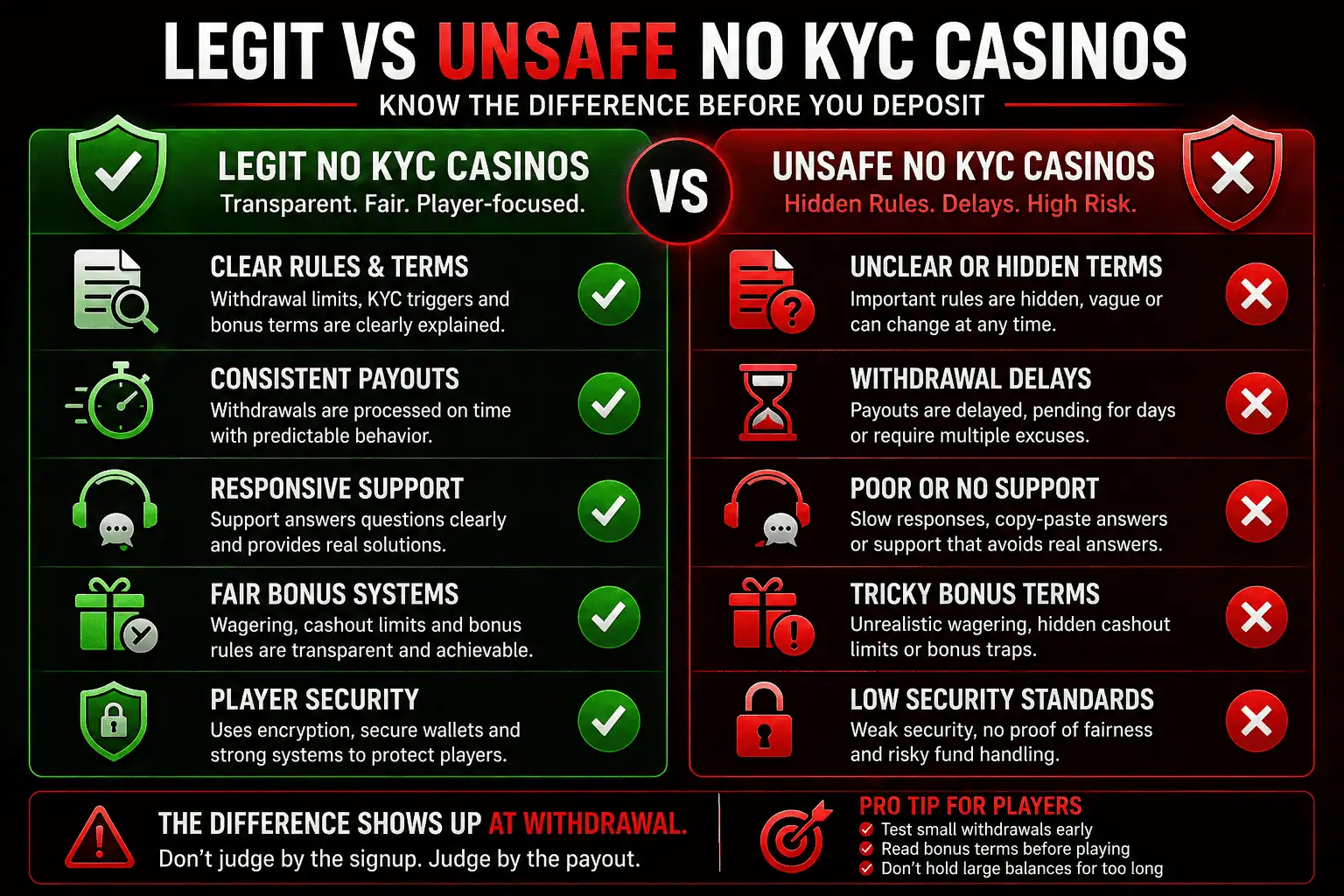
| Area | Safer Behavior | Higher-Risk Behavior |
|---|---|---|
| KYC terms | Possible triggers are disclosed | Marketing implies that checks can never happen |
| Withdrawal limits | Minimums and limits are visible | Limits appear only after the request |
| Document review | Requests are relevant and explained | New unrelated demands appear repeatedly |
| Support | Provides a specific status and next step | Repeats generic security language |
| Bonus enforcement | Cites a visible rule and affected balance | Uses broad clauses without identifying the breach |
| Account restriction | Explains the reason and status of funds | Blocks access without a clear appeal route |
The safety difference is not whether a casino ever reviews an account. It is whether the review remains proportionate, consistent and capable of reaching a decision.
Platform Notes: How the Main Casinos Differ
BC.Game
BC.Game combines casino games, original products, rewards and a large crypto ecosystem. That breadth can suit experienced users, but it also creates more interaction between bonus balances, account activity and withdrawal checks.
The platform is easier to assess when the player starts without a complex promotion and tests a modest withdrawal through one consistent wallet route.
Rollbit
Rollbit is relevant to higher-volume crypto users and players who use several products within one account.
As activity and transaction value increase, stronger checks should be expected. That does not make the platform unreliable by itself. It means a small successful cashout should not be treated as proof that larger balances will remain document-free.
Shuffle
Shuffle presents a more controlled crypto-first structure than some promotion-heavy alternatives.
Its cleaner interface and reward separation can reduce confusion, although ordinary account, wallet and withdrawal checks still apply when risk signals appear.
Coins.Game
Coins.Game focuses on a simpler surface experience.
That can make deposits and navigation easier to understand. However, a clean interface does not reveal the full review system behind withdrawals. Players should still confirm legal details, KYC rights and payout limits before scaling.
Gamdom
Gamdom has a longer crypto gambling profile and an entertainment-led product design.
The main caution comes from the interaction between promotions, activity level and cashout review. Players who use bonuses or hold a larger balance should check the terms more closely than someone completing a simple real-money test.
Bonus Terms Can Create More Friction Than KYC
A player may blame verification when the real problem comes from the promotional balance.
Common bonus-related risks include:
- unfinished wagering
- restricted games
- maximum-bet violations
- maximum cashout limits
- short expiry periods
- mixed real-money and bonus balances
- broad bonus-abuse clauses
No KYC players often choose a platform for speed. A complex bonus can remove that advantage by adding several extra conditions to the withdrawal.
The first test is usually cleaner without a promotion. Players who still want one should use the casino bonus guide to review wagering, restricted games and cashout rules before claiming.
Wallet Privacy Does Not Remove Wallet Checks
Crypto payments reduce the need to share card or bank information. They do not make transactions invisible.
A casino may examine:
- whether the deposit and withdrawal routes are consistent
- whether the selected network matches the asset
- whether the destination wallet creates a risk flag
- whether several accounts use connected wallets
- whether transaction history requires further review
Players should use a wallet they control, keep transaction records and avoid changing routes without understanding the casino’s payment rules.
Licensing, Ownership and Complaint Protection
The no KYC label says nothing about regulatory quality.
Before depositing, identify:
- the legal operator
- the license holder
- the exact authorised domain
- the restricted-country list
- the formal complaint route
A license does not guarantee fair payments. It provides a legal and regulatory trail that may matter if support cannot resolve the dispute.
Offshore casinos can vary widely. The regulator name should be assessed together with ownership transparency, withdrawal behavior and complaint patterns.
How to Test a No KYC Casino Without Scaling Too Early
A controlled test gives the player better information than a large first deposit.
- Read the withdrawal and KYC wording. Confirm the casino can request verification and understand the stated triggers.
- Check country eligibility. Do not assume access means legal account eligibility.
- Use one wallet and one network. Keep the payment route easy to explain.
- Deposit a modest amount. Do not store more money than the test requires.
- Avoid a complex bonus. Test the ordinary real-money process first.
- Play at normal stakes. Do not create unusual activity solely to test the system.
- Request an early withdrawal. Examine the status, communication and payment route.
- Scale gradually. A small payout is evidence, not a guarantee.
The goal is not to avoid every possible check. It is to find out whether the casino handles checks clearly before the balance becomes meaningful.
When You Should Avoid a No KYC Casino
Do not deposit when several basic parts of the account structure remain unclear.
Major warning signs include:
- no identifiable legal operator
- an unverifiable or irrelevant license claim
- no explanation of KYC rights
- unclear withdrawal limits
- support that refuses to discuss verification
- bonus terms that cannot be read before acceptance
- repeated complaints about the same unresolved cashout stage
- accounts restricted after wins without a clear balance decision
- pressure to deposit before legal or payment questions are answered
One unclear detail may have an explanation. A cluster of connected problems should change the decision.
FAQ: No KYC Casino Safety
Are no KYC casinos completely anonymous?
No. Players may avoid document uploads during routine use, but casinos can still collect account, device, location and transaction information. Verification can also appear later.
Can a no KYC casino ask for identification?
Yes. Many reserve the right to request identification after larger withdrawals, location concerns, wallet issues, bonus reviews or linked-account signals.
Does no KYC mean withdrawals are faster?
It can reduce document friction for routine payments. However, casino approval still happens before blockchain settlement, and a manual review can delay the withdrawal.
Why can a small withdrawal work while a large one triggers KYC?
Larger payments create greater fraud, compliance and account risk. A casino may therefore apply stronger checks once the value or activity profile crosses an internal threshold.
Are low KYC casinos safer than no KYC casinos?
Not automatically. Low KYC can provide clearer thresholds, while no KYC can protect more personal data initially. Operator quality and withdrawal behavior matter more than the label.
Can my account be blocked without completing KYC?
Yes. Casinos can restrict accounts because of duplicate-account concerns, location conflicts, wallet inconsistency, bonus reviews, security issues or other terms-based risks.
Are crypto-only casinos safer for privacy?
They usually require less banking information. Still, wallet activity, device signals and transaction routes can be monitored. Crypto privacy does not replace operator trust.
Do bonuses increase risk at no KYC casinos?
They can. Wagering, maximum-bet rules, restricted games and cashout caps may create more withdrawal friction than the identity process itself.
What is the safest way to test a no KYC casino?
Check the operator and terms, use one controlled wallet route, make a modest deposit, avoid a complex bonus and request a small withdrawal before increasing exposure.
Does one successful withdrawal prove the casino is safe?
No. It confirms that one transaction worked under one set of conditions. A larger payout, different wallet, bonus or later account activity may receive additional review.
What is the biggest no KYC casino risk?
The biggest risk is assuming that reduced verification at signup guarantees unrestricted withdrawals later. The player may discover the real account controls only after building a balance.
When should I leave a no KYC casino?
Leave when the operator cannot explain its legal identity, KYC rights, withdrawal limits or complaint route, or when support repeatedly changes the reason for a payment delay.
Final View: Privacy Is Useful Only When Cashouts Stay Clear
No KYC casinos can reduce document exposure and make crypto gambling easier to access.
That convenience has value, but it should not be confused with proof of safety.
The strongest platforms explain when checks can appear, how withdrawals are approved, what happens during an account review and who handles a formal dispute. Weaker operators rely on the no KYC label while leaving the most important cashout rules unclear.
The right decision is not based on which casino asks for the least information.
It is based on which casino remains transparent when the player asks for money back.
No KYC at entry is useful. Predictable treatment at withdrawal is what creates trust.