How Casino Account Blocks Usually Happen
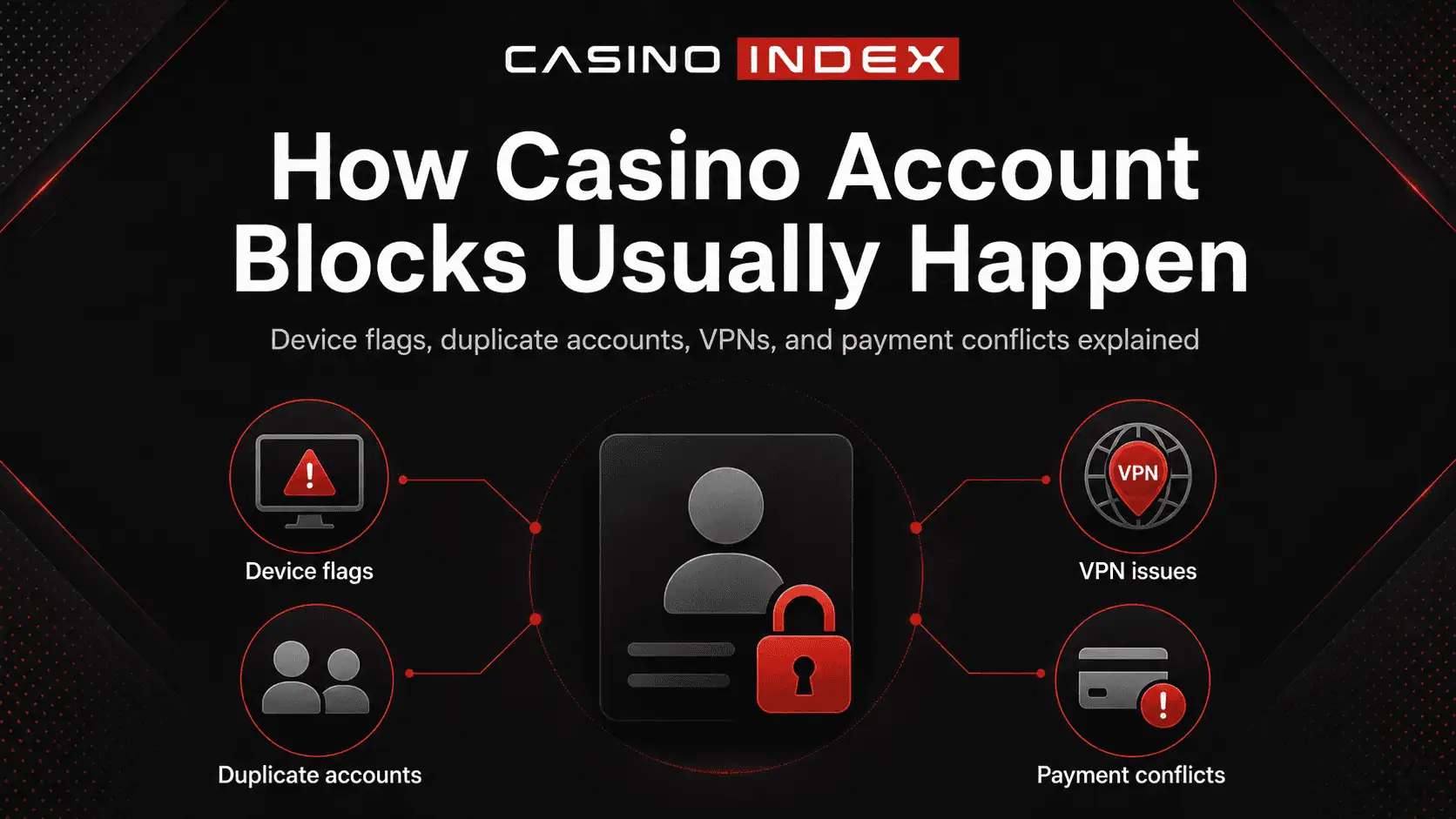
Casino account blocks usually feel sudden, but the trigger often starts earlier.
A player may deposit, play normally, claim a promotion or request a withdrawal without seeing any warning. Behind the scenes, however, the casino may already be comparing identity data, device history, payment ownership, location signals, bonus activity, login behaviour and previous account links.
The restriction usually appears when one signal becomes serious enough, or when several smaller signals combine and push the account into manual review.
This guide focuses on why casino accounts get blocked and how those risk signals build up. It does not cover the full post-block process, balance outcomes or escalation steps. Those belong to the separate guide on what happens when casinos block accounts.
That distinction matters for search intent as well as for players. One page explains the causes and trigger patterns. The other explains the consequences, review process and next steps after the restriction already exists.
Quick answer: why casino accounts get blocked
Casino accounts usually get blocked when the operator detects activity that may breach its terms, create payment or fraud risk, trigger compliance checks, conflict with responsible gambling controls, or suggest that the account is not being used by one clearly identifiable player.
The most common triggers include:
- duplicate or previously linked accounts
- shared devices, IP addresses or household connections
- VPN use or restricted-country signals
- payment ownership mismatches
- failed or inconsistent KYC information
- bonus abuse indicators
- unusual betting or transaction patterns
- third-party account or payment use
- chargeback, fraud or compromised-account risk
- self-exclusion or responsible gambling matches
None of these signals automatically proves abuse. A legitimate player can trigger a review by mistake. The important point is that casinos rarely judge one action in isolation. They usually look at the full account pattern.
How risk signals become an account block
Most account restrictions begin with detection rather than a human decision.
The casino may receive signals from several systems at once. Login tools can detect device or location changes. Payment systems can identify ownership conflicts. Bonus engines can flag linked accounts or unusual promotional activity. KYC tools can find document mismatches. Withdrawal systems can trigger deeper checks when money is about to leave the platform.
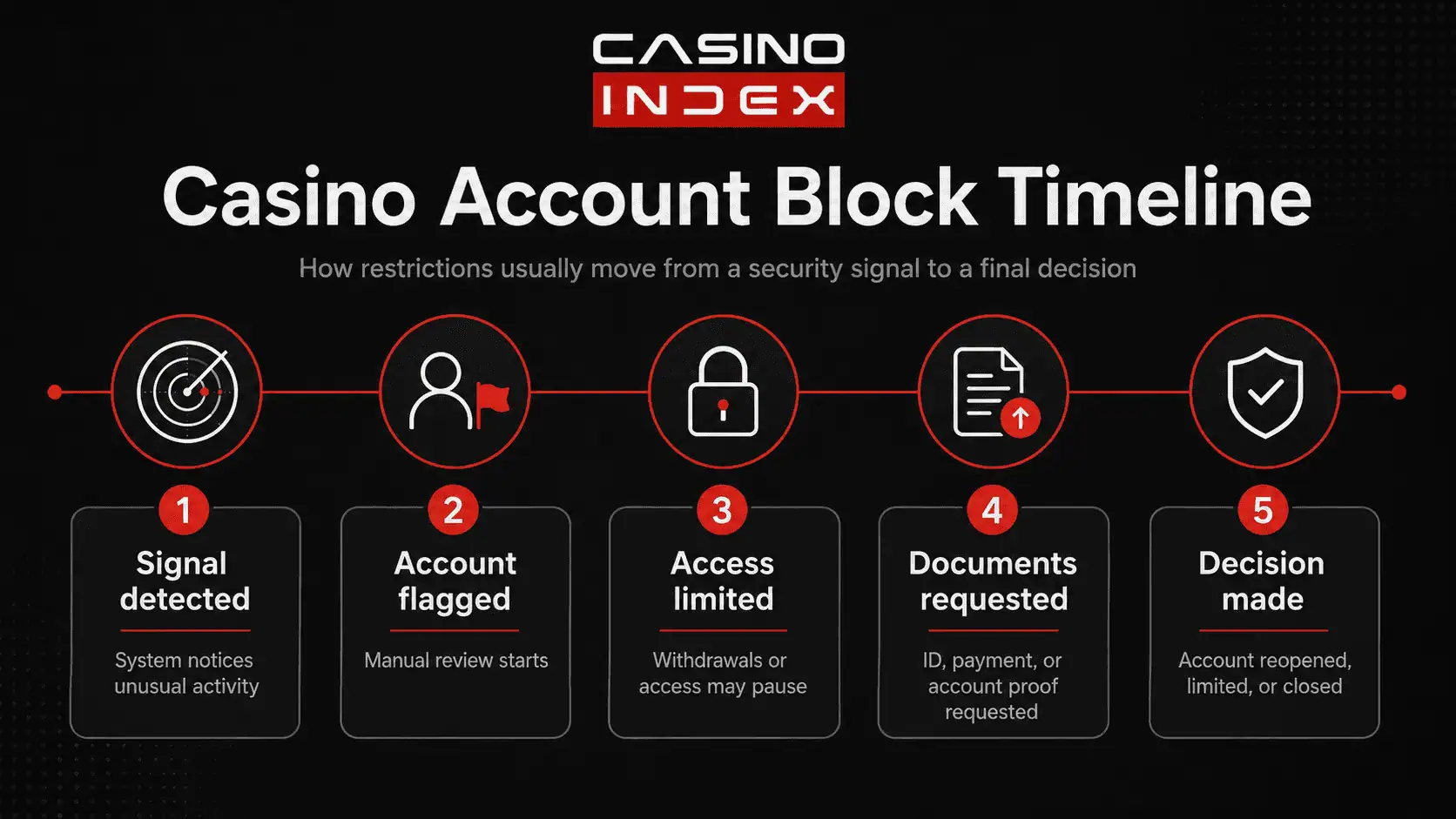
A simplified cause chain looks like this:
- A signal appears. The account shows a device, payment, identity, location, bonus or transaction inconsistency.
- The signal is compared with existing data. The casino checks whether the account connects to other profiles, previous sessions, payment methods or known risk patterns.
- Risk increases when signals overlap. One unusual login may be harmless. The same login combined with a new country, a bonus claim and a withdrawal can look very different.
- The account reaches a review threshold. Automated systems or staff decide that the activity needs closer inspection.
- Access is restricted. Withdrawals, deposits, bonuses, gameplay or the whole account may be paused while the operator reviews the cause.
The important part is what happens before step five. Players often see only the final restriction and assume the casino reacted to one recent action. In reality, the operator may be responding to a combination of older and newer signals.
Duplicate accounts are one of the biggest avoidable triggers
Multiple-account detection is one of the clearest reasons a casino may restrict an account.
Most gambling platforms expect one account per player. Depending on the terms, they may also monitor household, device, payment or IP overlap when several accounts use the same environment.
Players do not always create duplicates intentionally.
A second account can appear because someone forgot an old profile, lost access to the original email address, used social login once and email login later, moved country and registered again, or assumed that closing one profile allowed a fresh account immediately.
From the casino’s side, duplicate accounts can be associated with:
- claiming the same welcome bonus more than once
- circumventing betting or deposit limits
- avoiding a previous restriction
- bypassing self-exclusion
- splitting activity across several identities
- creating promotional or payment abuse patterns
This is why an innocent duplicate can still look serious at first.
Imagine a player who creates a new account because an older one has not been used for two years. The same home Wi-Fi and device were also used by a partner who has an account. Both profiles claimed a welcome offer. The player may see two ordinary household users. The casino may see a cluster of duplicate-account, device and bonus signals.
The safest approach is simple: if there is any chance an old account already exists, recover that account through support instead of creating another one.
Shared devices and households can create account links
A shared device does not automatically mean multi-accounting, but it can make two legitimate players look connected.
Casinos can use device-level signals to identify patterns across browsers, apps and login sessions. That does not mean a casino knows everything about a phone or laptop. It means repeated technical similarities can create a connection between accounts.
Common situations include:
- partners using the same laptop
- family members playing from one household
- several accounts using the same home Wi-Fi
- a previously owned or shared computer being reused
- multiple users signing in through the same browser profile
- one device being used for both account recovery and normal play
A device match becomes more important when another signal appears beside it.
Shared Wi-Fi plus separate payment methods may be easy to explain. Shared Wi-Fi plus the same card, the same bonus, similar account details and overlapping sessions can look much harder to separate.
This is one reason household rules deserve attention before a second person registers. The question is not only whether two people are genuinely different. The question is whether the casino’s terms allow the account setup and whether the available data can prove that separation clearly.
VPN and location mismatches can trigger jurisdiction checks
VPN use creates one of the messiest account-block patterns because the same technical behaviour can have very different explanations.
One player may use a VPN for general privacy. Another may use it to appear in a country where the casino is available. From the operator’s perspective, the location data may look similar until it is checked against the rest of the account.
Risk rises when:
- the casino restricts the player’s real country
- the registration country conflicts with the current login location
- identity documents show a different jurisdiction
- the player deposits from one region and withdraws from another
- sportsbook or bonus terms change by country
- the account suddenly moves between distant locations
- the VPN IP address is shared by many unrelated users
A VPN does not have to cause an immediate block. It can simply add another inconsistency to the account.
For example, a player registers from Germany, later logs in through a Canadian VPN server, claims a country-sensitive promotion and then requests a crypto withdrawal. The operator may see location mismatch, promotional activity and a payout event at the same time.
If the terms prohibit VPN use or the real country is restricted, the safest decision is not to use the casino through a workaround.
Payment mismatches are a major account-review trigger
Many players assume casino security is mainly about identity documents. Payment ownership can be just as important.
A casino wants the account holder, the funding source and the withdrawal destination to form a consistent pattern. When those elements do not line up, the operator may need to determine whether the account involves third-party gambling, stolen payment details, fraud, money movement or simple user error.
Common payment conflicts include:
- using someone else’s card
- depositing from a partner’s bank account
- sharing an e-wallet
- using payment methods registered in another country
- depositing from one ownership profile and withdrawing to another
- switching crypto wallets repeatedly around withdrawal time
- using third-party processors that make ownership harder to verify
A payment mismatch can look harmless from the player’s side.
Consider a player who deposits with a family member’s card because their own card is unavailable, then requests the winnings to a personal e-wallet. The player may view both accounts as household money. The casino sees two different owners connected to one gambling account.
That is exactly why payment mismatch can trigger account checks.
Using your own payment methods and keeping the deposit and withdrawal route consistent removes one of the easiest sources of avoidable account friction.
KYC inconsistencies can turn verification into account review
KYC problems do not always start with fraud.
A document can fail because the image is unclear, an ID has expired, an address is outdated, the registered name does not match the payment method, or information was entered differently during signup.
The casino may need to verify:
- identity
- age
- residential address
- country eligibility
- account ownership
- payment ownership
- source of funds
The risk increases when verification data conflicts with information the casino already has.
A small spelling difference may be easy to correct. A different name on the card, a different country in the ID, a VPN location and a recently changed withdrawal wallet create a much more complicated picture.
That is how verification can lead to account review: the document request may be only the visible part of a wider consistency check.
Legitimate players can still fail an automated verification step. The key prevention measure is to keep registration details accurate from the beginning and avoid creating unnecessary conflicts between identity, payment and location data.
Bonus abuse flags can block an otherwise normal account
Bonuses create their own set of risk signals because the casino is not only checking whether wagering was completed. It may also be checking how the offer was used.
Bonus-related restrictions can be triggered by patterns such as:
- several linked accounts claiming the same offer
- playing excluded or restricted games
- exceeding a maximum bet rule
- using prohibited wagering strategies
- moving between real-money and bonus balances in a restricted way
- claiming a promotion from an ineligible country
- using linked household accounts for the same bonus
Some players trigger these rules accidentally. Others deliberately try to exploit promotions. The casino still has to decide which pattern it is looking at.
One isolated mistake may be easy to explain. A new account that uses a VPN, claims a large offer, follows an unusual low-risk wagering pattern and requests a withdrawal immediately after completing the requirement creates several signals at once.
This is why players who do not fully understand a promotion are often safer skipping it. The bonus itself may be valuable, but it also adds another rule set to the account.
Unusual betting behaviour can add another risk signal
Casinos and sportsbooks also monitor how an account is used, especially when the activity changes sharply.
Unusual activity does not automatically mean cheating or abuse. A player can change games, increase stake size or place a large bet for perfectly legitimate reasons. The issue is whether the behaviour looks inconsistent when combined with the rest of the account.
Examples that may attract additional review include:
- sudden changes from very small stakes to unusually large bets
- high-volume activity shortly after registration
- betting patterns connected to a bonus restriction
- multiple accounts showing unusually similar play
- rapid deposit, limited play and immediate withdrawal behaviour
- activity that conflicts with responsible gambling limits
The important distinction is between a risk signal and a proven terms breach.
A legitimate account can look unusual. The casino may still review it because the system is designed to investigate patterns before assuming they are harmless.
Chargebacks, fraud signals and compromised accounts
Some account blocks start with payment or security events that are much more direct.
A chargeback can indicate that a payment was disputed after gambling activity occurred. A login from a new device followed by password changes and withdrawal attempts can suggest account takeover. Repeated failed payment attempts may create fraud risk even when the player is simply having card problems.
Security-related triggers can include:
- chargebacks or reversed deposits
- stolen or disputed payment methods
- rapid password or email changes
- unusual two-factor authentication activity
- login attempts from several countries
- withdrawal attempts immediately after account recovery
- device or wallet changes that do not match previous behaviour
In these cases, restricting the account can protect the player as well as the casino.
The cause matters because a fraud-prevention block is fundamentally different from a bonus dispute or a duplicate-account review, even though the player may see the same generic “account under review” message.
Self-exclusion and responsible gambling matches can override normal access
Not every block is about fraud, payments or promotions.
Responsible gambling systems can also restrict an account when the operator detects a self-exclusion match, a linked previous account, a limit conflict or another safer-gambling condition.
This becomes especially important when players create new profiles after closing or excluding an older account.
The new registration may look normal to the player, but the casino may connect it through identity details, device history, payment data or household information.
A responsible gambling match can therefore resemble a duplicate-account flag while serving a completely different purpose.
Players should not try to work around self-exclusion or account limits with new identities, devices or payment methods. Apart from creating account risk, doing so defeats the purpose of the protection that was put in place.
Why withdrawals expose account problems that deposits do not
Many players only discover an account problem when they request a withdrawal.
That can feel suspicious because deposits and gameplay worked normally beforehand.
Sometimes the explanation is simply that withdrawal is the point where several checks become relevant at once. The casino may need to confirm identity, payment ownership, bonus compliance, country eligibility, wallet consistency and transaction history before releasing funds.
This is also where earlier signals can become more important.
A shared device may have caused no visible issue during play. A VPN session may have passed without interruption. A payment mismatch may not have mattered while money was entering the account. Once the player requests a meaningful payout, those signals can be reviewed together.
This does not mean every withdrawal block is justified. It explains why the withdrawal request often acts as the moment when an earlier risk pattern becomes visible to the player.
For the specific checks casinos may run before a payout is approved, the relevant support page is CasinoIndex’s guide to casino withdrawal approval checks.
Signal stacking is what makes an account difficult to clear
The most important concept on this page is signal stacking.
Players often focus on the one action that happened immediately before the block. The casino may be looking at five connected signals collected over several sessions.
High-risk combinations can include:
- VPN use plus a restricted country
- duplicate account plus bonus use
- shared device plus the same payment method
- large withdrawal plus incomplete KYC
- wallet change plus a newly opened account
- chargeback history plus another card deposit
- self-exclusion match plus a new registration
- household account link plus the same promotion
Each individual action may have an innocent explanation. The combination is what raises the review risk.
For example, consider a player who registers correctly, uses a VPN occasionally, deposits from an exchange wallet, later logs in on a partner’s laptop, claims a welcome offer and finally changes the withdrawal wallet. None of those actions alone necessarily proves abuse. Together, they create a much more complex ownership and location picture.
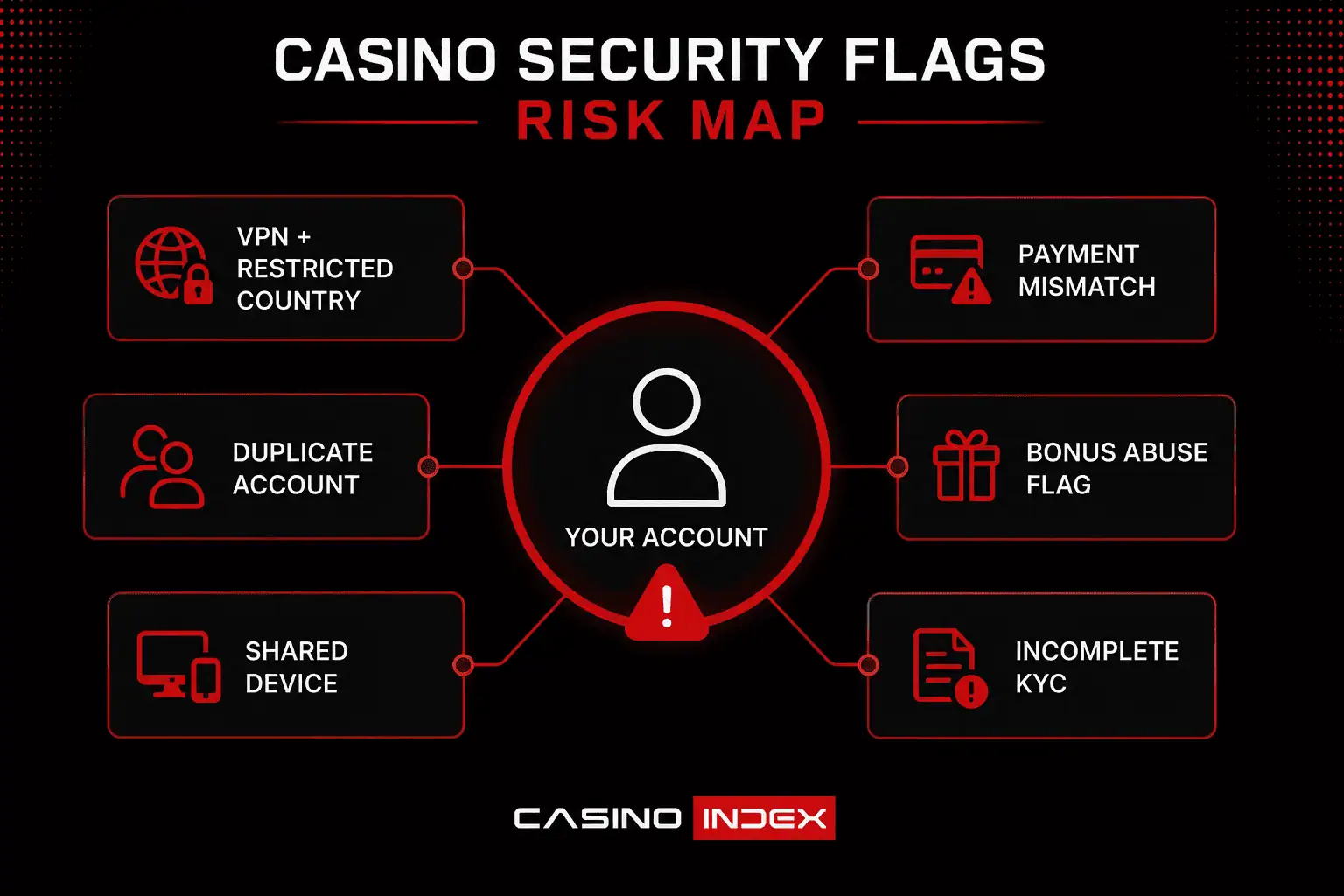
This is why a clean account history is valuable. It reduces the number of questions the operator has to resolve when a large withdrawal or compliance check occurs.
Why legitimate players can still trigger account blocks
Risk systems are designed to find patterns, not to understand every personal explanation immediately.
That creates false positives.
A couple may share a device legitimately. A player may move home and forget to update an address. A VPN may be running automatically. A name can appear differently on a bank card. A crypto user may switch wallets for normal security reasons.
The casino initially sees data, not the explanation.
This is why a trigger should not be treated as proof that the player did something wrong. It is also why players should avoid adding unnecessary inconsistencies to an account that already contains unusual activity.
The clearest distinction is:
- Trigger: something looks inconsistent or risky.
- Review: the casino investigates the signal.
- Finding: the operator decides whether the activity can be explained or whether a rule was breached.
This guide is about the first stage: the trigger and the conditions that make a review more likely.
How to reduce account-block risk before it starts
Most preventable account problems begin before the player ever sees a restriction.
Reducing risk is less about finding a casino that promises “no blocks” and more about keeping the account consistent.
- Use one account only. Recover an old account instead of opening another profile.
- Enter accurate personal details. Names, addresses, dates of birth and country information should match real documents.
- Use your own payment methods. Avoid cards, e-wallets and bank accounts owned by another person.
- Keep payment routes understandable. Unnecessary switching between wallets or methods creates extra ownership questions.
- Check VPN and country rules. Do not assume a successful login means your real jurisdiction is permitted.
- Understand the bonus before claiming it. Max bet rules, restricted games and household conditions can all matter.
- Keep documents current. Expired IDs and outdated addresses make later verification harder.
- Do not bypass self-exclusion or account limits. New accounts can be linked back to the previous restriction.
- Test a small withdrawal early. This can reveal payment or identity inconsistencies before a larger balance builds up.
- Keep useful records. Save key payment confirmations, wallet details and important terms when larger amounts are involved.
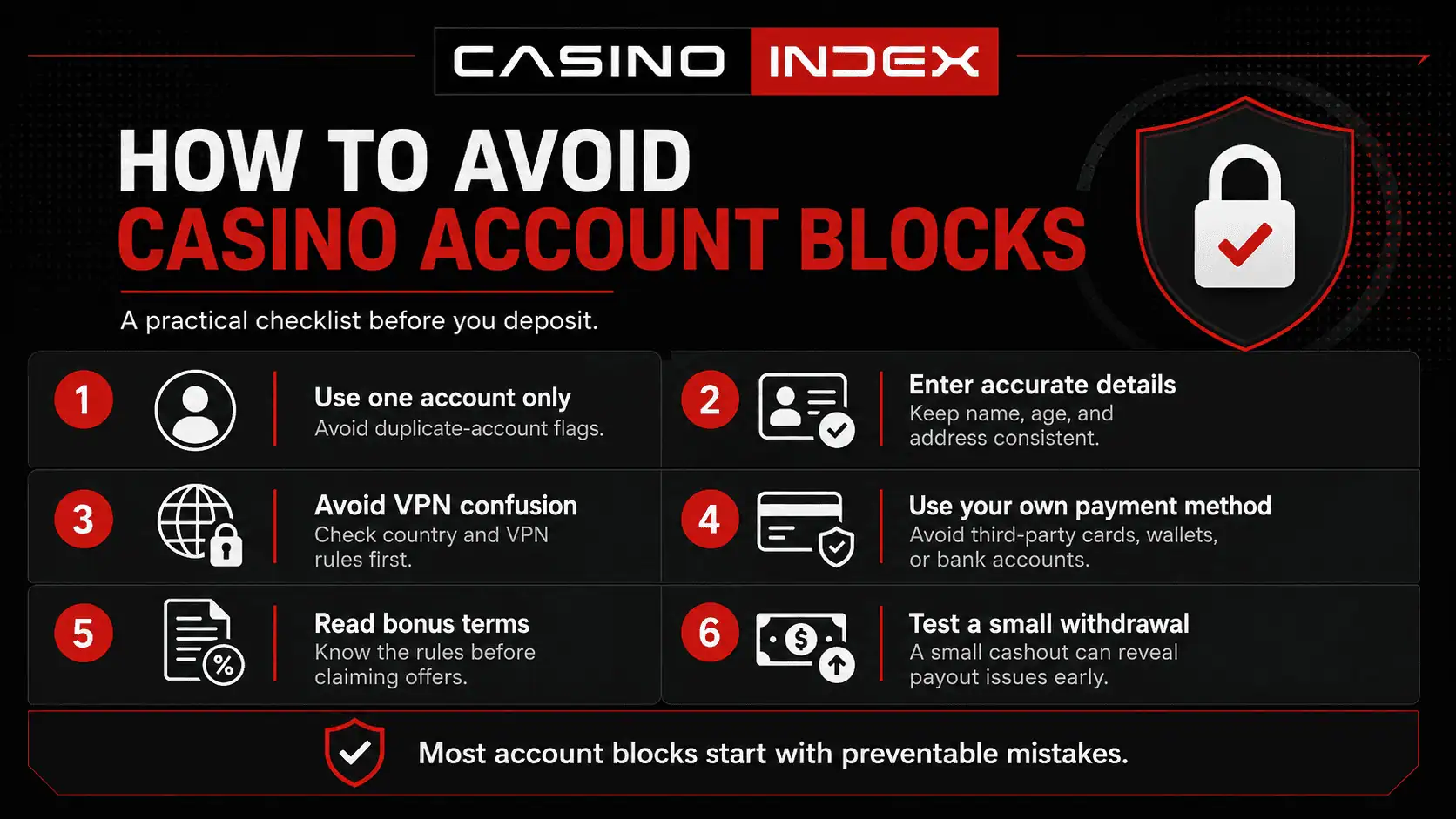
These steps cannot guarantee that an account will never be reviewed. They simply remove many of the avoidable signals that make a legitimate account look harder to verify.
Final verdict
Casino account blocks usually happen because the operator sees a risk pattern, not because one random action instantly proves wrongdoing.
The most common causes are duplicate accounts, shared devices, location conflicts, payment mismatches, KYC inconsistencies, bonus flags, unusual account behaviour, fraud signals and responsible gambling matches.
The strongest trigger is often not one of those factors by itself. It is several of them appearing together.
That is why a player can use an account normally for days or weeks before a restriction becomes visible. Earlier signals may only become important when a withdrawal, verification event or account change forces the casino to review the full history.
Legitimate players can still be caught by these systems. A trigger is not proof of abuse. But keeping identity, location, payment and account behaviour consistent makes the account easier to explain if a review begins.
This page should therefore answer one question only: what causes the block?
The separate blocked-account guide takes over once the restriction already exists and explains what the player may face next.
FAQ
Why do casino accounts usually get blocked?
Casino accounts are commonly blocked after the operator detects possible terms breaches, duplicate-account links, payment conflicts, KYC inconsistencies, location problems, bonus abuse signals, security concerns or responsible gambling matches.
Can one shared device get a casino account blocked?
A shared device can trigger a link between accounts, but it does not automatically prove abuse. The risk becomes higher when the shared device appears together with the same payment method, bonus, household, IP address or other overlapping data.
Can a VPN trigger a casino account review?
Yes. VPN use can create location inconsistencies, especially when the casino restricts the player’s real country or the account data conflicts with the VPN location. The risk becomes greater when bonus or withdrawal activity happens at the same time.
Why do casinos care about payment ownership?
Casinos use payment matching to confirm that the person funding and withdrawing from the account is the real account holder. Third-party cards, bank accounts, e-wallets or unclear ownership patterns can therefore trigger extra checks.
Can failed KYC cause an account block?
Yes. Verification problems can restrict an account when identity, age, address, country or payment ownership cannot be confirmed. A failed check may be caused by a simple document problem or by a wider inconsistency in the account data.
Can bonus use cause a casino account block?
Yes. Duplicate bonus claims, restricted games, max bet breaches, linked household accounts or prohibited wagering patterns can all trigger review. Not every bonus mistake is intentional abuse, but the casino may still investigate it.
Why do account blocks often appear during withdrawals?
Withdrawal is often the stage where identity, payment ownership, bonus compliance, country eligibility and account history are reviewed together. Earlier risk signals that caused no visible problem during deposits or gameplay can therefore become important at payout time.
Can a legitimate player be blocked by mistake?
Yes. Shared households, automatic VPN use, outdated documents, payment-name differences or normal wallet changes can create false-positive risk signals. A restriction means the account has been flagged for review; it does not by itself prove a terms breach.
What is signal stacking?
Signal stacking means several smaller risk indicators appearing together. A VPN, shared device, payment mismatch and incomplete KYC may each have an innocent explanation, but the combination makes the account more likely to be reviewed.
How can players reduce account-block risk?
Use one account, enter accurate details, follow country and VPN rules, use your own payment methods, keep payment routes consistent, understand bonus conditions and avoid creating unnecessary identity or location mismatches.

Maria Hoffmann has worked in cryptocurrency content and digital publishing since 2017. She is a co-founder of Freecoins24 and CryptoMutant and has covered blockchain projects, crypto platforms and emerging industry trends for several years. She has also been active as a cryptocurrency investor since 2019. At CasinoIndex, Maria combines content research and SEO experience with a focus on casino trust, platform security, withdrawal processes, payment risks and user protection. Her work looks beyond bonuses and product features to examine how gambling platforms handle player funds, verification and account-related risks.