No KYC Casinos vs Low KYC Casinos
Article OverviewNo KYC and low KYC casinos use different verification models. No KYC usually means standard identity documents are not required during routine signup, while low KYC keeps verification lighter but may apply limited checks earlier. In both models, conditional verification can still appear when payment, withdrawal, account, jurisdiction, or risk signals change. The key difference is not whether checks can ever happen, but when they begin and how clearly the casino explains them.
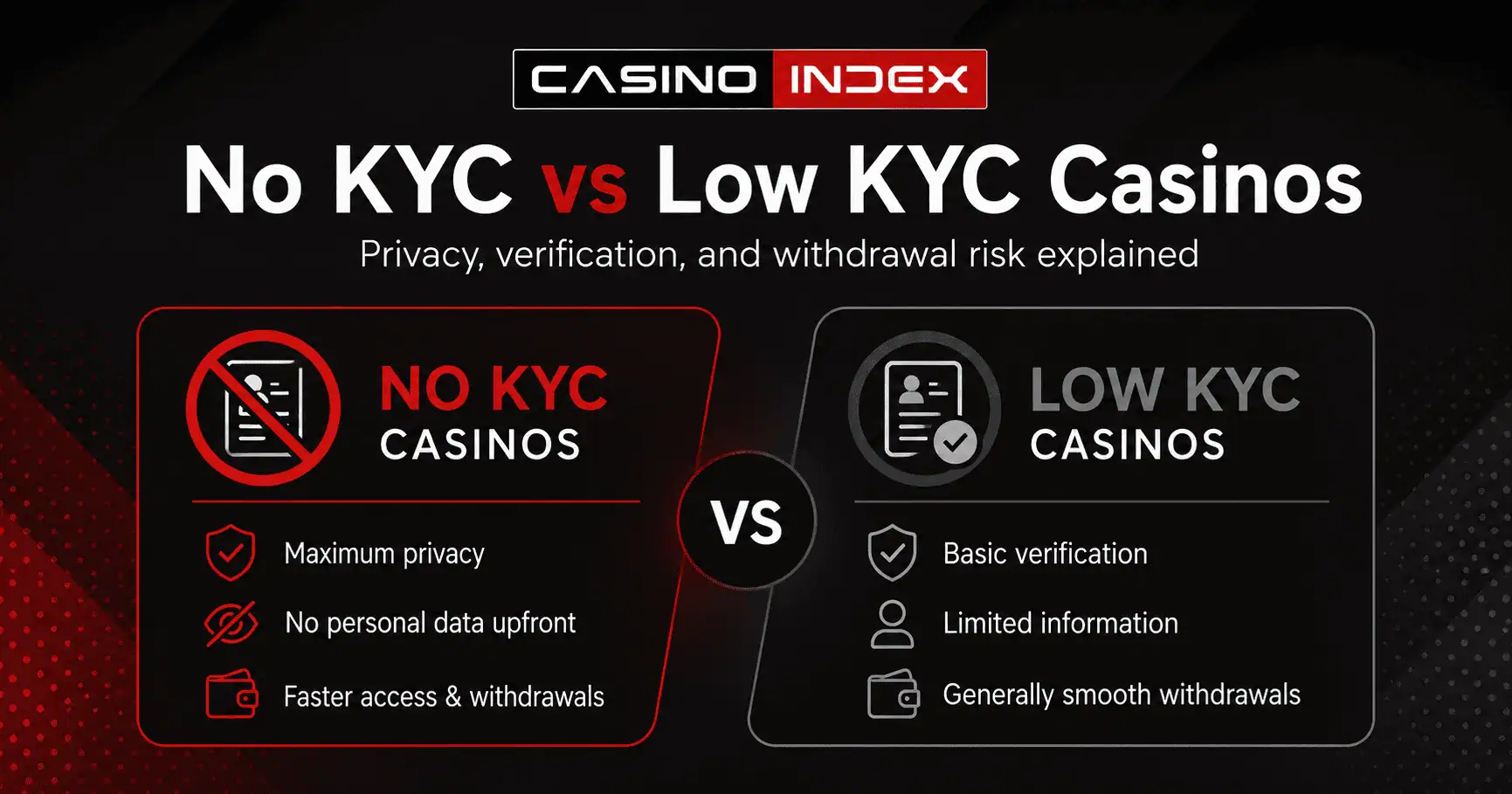
No KYC casinos and low KYC casinos are not the same verification model. The difference is mainly about when identity checks begin, how much information is requested during normal account use, and what can trigger a deeper review later.
A no KYC casino generally means the operator does not require standard identity documents during routine signup. A low KYC casino uses a lighter verification approach at first but may apply limited checks earlier or escalate verification when account, payment, jurisdiction, or risk signals justify it.
Neither label should be read as a promise that verification can never happen. “No KYC” is widely used as a marketing term, while “low KYC” is not a universal regulatory category. On CasinoIndex, these labels describe the amount and timing of verification friction, not an exemption from casino rules or legal obligations.
This page only compares those verification models. Readers looking for current operator options can use the No KYC Casinos guide. The sections below focus on definitions, withdrawal behavior, possible triggers, and the difference between low-friction access and conditional verification.
No KYC vs Low KYC Casinos: Quick Comparison
| Model | Signup | Withdrawal | Possible Triggers | Main Risk |
|---|---|---|---|---|
| No KYC | Routine signup may begin without passport, ID card, or proof-of-address documents. | Some withdrawals may remain document-free, but later verification can still be possible under the terms. | Account risk, payment or wallet mismatch, jurisdiction questions, unusual activity, bonus disputes, or other compliance concerns. | Players interpret “no KYC” as “verification can never happen.” |
| Low KYC | The casino may use basic account details, email or phone confirmation, location checks, payment matching, or other light controls. | Routine cashouts may use limited checks, while higher-risk activity can lead to stronger verification. | Changes in transaction pattern, payment ownership questions, larger or unusual cashouts, account inconsistencies, or legal requirements. | The phrase is vague unless the operator explains what “low” actually means. |
| Standard / Full KYC | Identity verification forms part of normal onboarding or early account use. | The account may already be identity-verified, although separate payment or source-of-funds reviews can still occur. | Payment review, enhanced due diligence, source-of-funds questions, account security, or other specific issues. | More friction and data sharing from the start. |
The cleanest distinction is this:
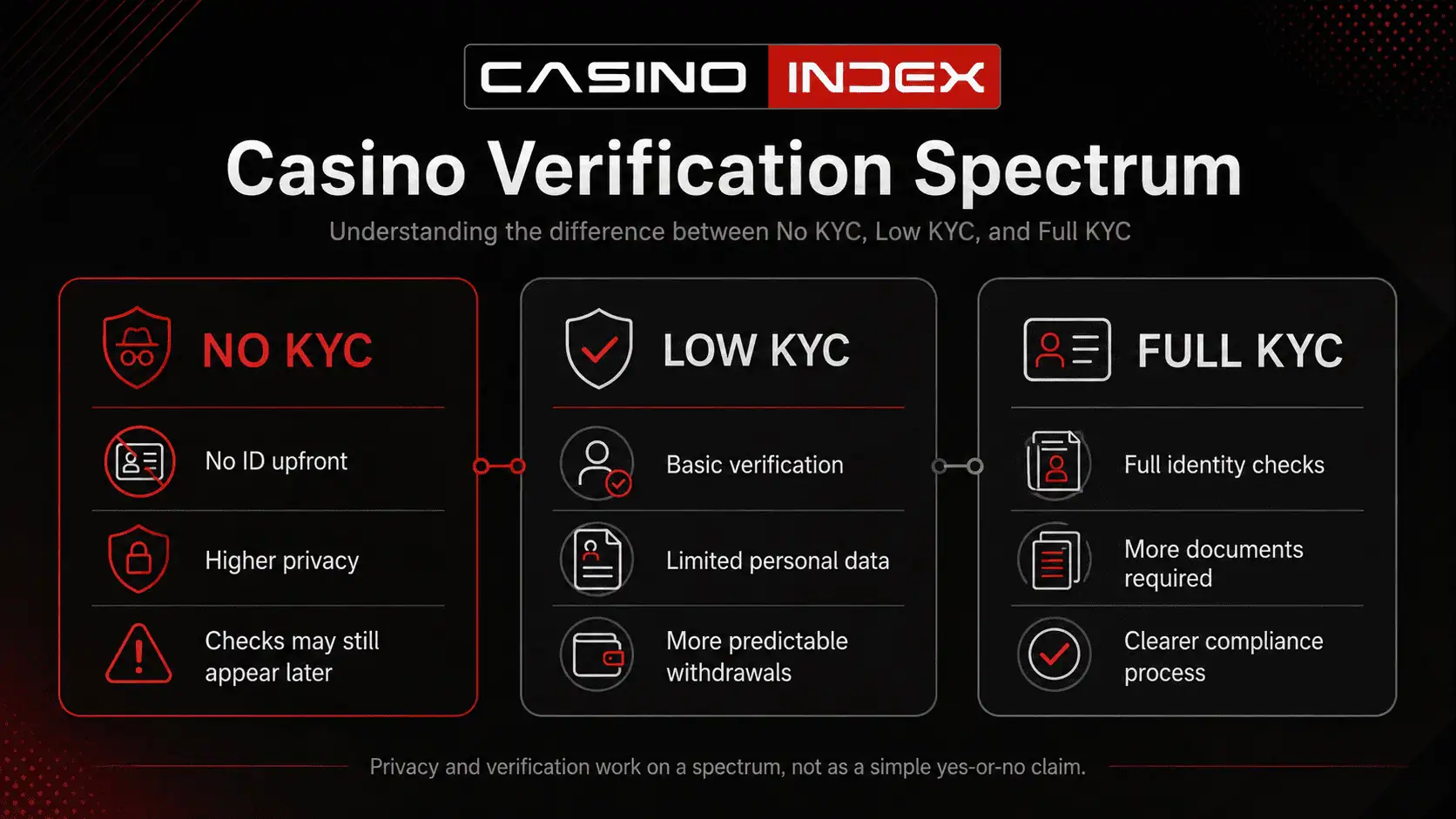
No KYC reduces routine identity checks at the start. Low KYC keeps the initial process lighter but accepts that limited or conditional verification may form part of normal account use.
What “No KYC Casino” Actually Means
“No KYC” sounds absolute. In practice, it usually describes the default onboarding process, not every situation that can occur during the life of an account.
A no KYC model may allow a player to create an account, deposit, and begin playing without uploading standard identity documents. Depending on the operator, routine withdrawals may also process without a traditional document review.
However, the phrase itself does not tell you what happens if the account later creates a different risk profile.
A casino can still have rules covering:
- payment ownership;
- crypto wallet consistency;
- restricted jurisdictions;
- duplicate accounts;
- bonus abuse concerns;
- account security;
- unusual transaction patterns;
- or legally required verification.
That is why CasinoIndex does not treat a “No KYC” homepage badge as proof that documents can never be requested.
The useful question is not simply:
Does the casino ask for ID at signup?
It is:
Under which circumstances can the verification level change, and are those circumstances explained before the player deposits?
What “Low KYC Casino” Actually Means
Low KYC is a more flexible label, but it also needs a precise definition.
It is not a standardized legal category with one universal checklist. CasinoIndex uses low KYC to describe an operator that keeps routine verification lighter than a traditional full-KYC model while still applying some account, payment, or identity controls when needed.
For example, the initial process may rely on:
- basic account information;
- email or phone confirmation;
- country or location checks;
- payment matching;
- wallet ownership checks;
- or limited account review.
The important difference is expectation. A low KYC model does not present the account as permanently verification-free. Instead, it accepts that the level of checking can increase when the situation changes.
This can make the model more predictable when the terms are written clearly. However, “low KYC” is not automatically safer or fairer. A vague low-KYC policy can still create the same payout uncertainty as a vague no-KYC claim.
Conditional Verification Is the Missing Middle
Conditional verification is often the concept that explains the gap between marketing language and real account behavior.
It is not necessarily a separate casino category. Instead, it describes a process in which stronger checks appear only after a defined event or risk signal.
That process can exist inside both no KYC and low KYC models.
| Situation | What May Happen | What It Does Not Automatically Mean |
|---|---|---|
| Routine account activity | The player continues with little or no additional verification. | That all future activity will follow the same process. |
| Payment mismatch | The operator may ask who controls the deposit or withdrawal method. | That full identity verification is always required. |
| Account-risk signal | Security or compliance review may become more detailed. | That the player has done something wrong. |
| Withdrawal review | The casino may apply checks that were not necessary during signup. | That every cashout triggers KYC. |
| Legal or jurisdiction requirement | Formal verification may become necessary. | That every casino uses the same threshold or document set. |
The full document and identity process belongs in the Casino Verification Guide. On this page, the key point is simply that verification intensity can change without turning every low-friction account into a full-KYC account from day one.
Signup and Withdrawal Are Two Different Stages
The largest source of confusion is judging the entire verification model from the registration screen.
Signup answers one question:
What does the casino require before the account can begin normal use?
Withdrawal can answer several additional questions:
- Does the payment route match the account?
- Does the withdrawal destination make sense?
- Has the account behavior changed?
- Are there jurisdiction or location issues?
- Does a bonus or promotion need review?
- Has another verification trigger appeared?
A no KYC signup can therefore remain genuinely low-friction while still allowing conditional verification later. That is not a contradiction if the terms make the possibility clear.
The problem begins when the marketing implies permanent document-free use while the terms quietly reserve broad verification powers that only become visible after a player requests money.
Small vs Larger Withdrawals: Avoid Fixed Assumptions
Players often assume that small withdrawals are “no KYC” and larger withdrawals are “KYC.” That can happen at some operators, but it is too simple as a universal rule.
A routine cashout may pass with little friction because the account, payment route, location, and activity all look consistent. A larger or unusual withdrawal can receive more review because the financial exposure or risk profile has changed.
However, withdrawal size is only one possible factor.
A smaller transaction can still trigger review if there is a payment mismatch, location problem, unusual wallet route, account security concern, duplicate-account signal, or another issue. Likewise, a larger withdrawal does not automatically mean the same documents will be requested at every casino.
For that reason, this page does not use fixed claims such as:
- “under $1,000 means no KYC”;
- “over $5,000 always requires documents”;
- or any other universal verification threshold.
Those rules are operator-specific and can change. A useful comparison focuses on the logic of the model rather than inventing a number that does not apply everywhere.
What Can Trigger a Higher Verification Level?
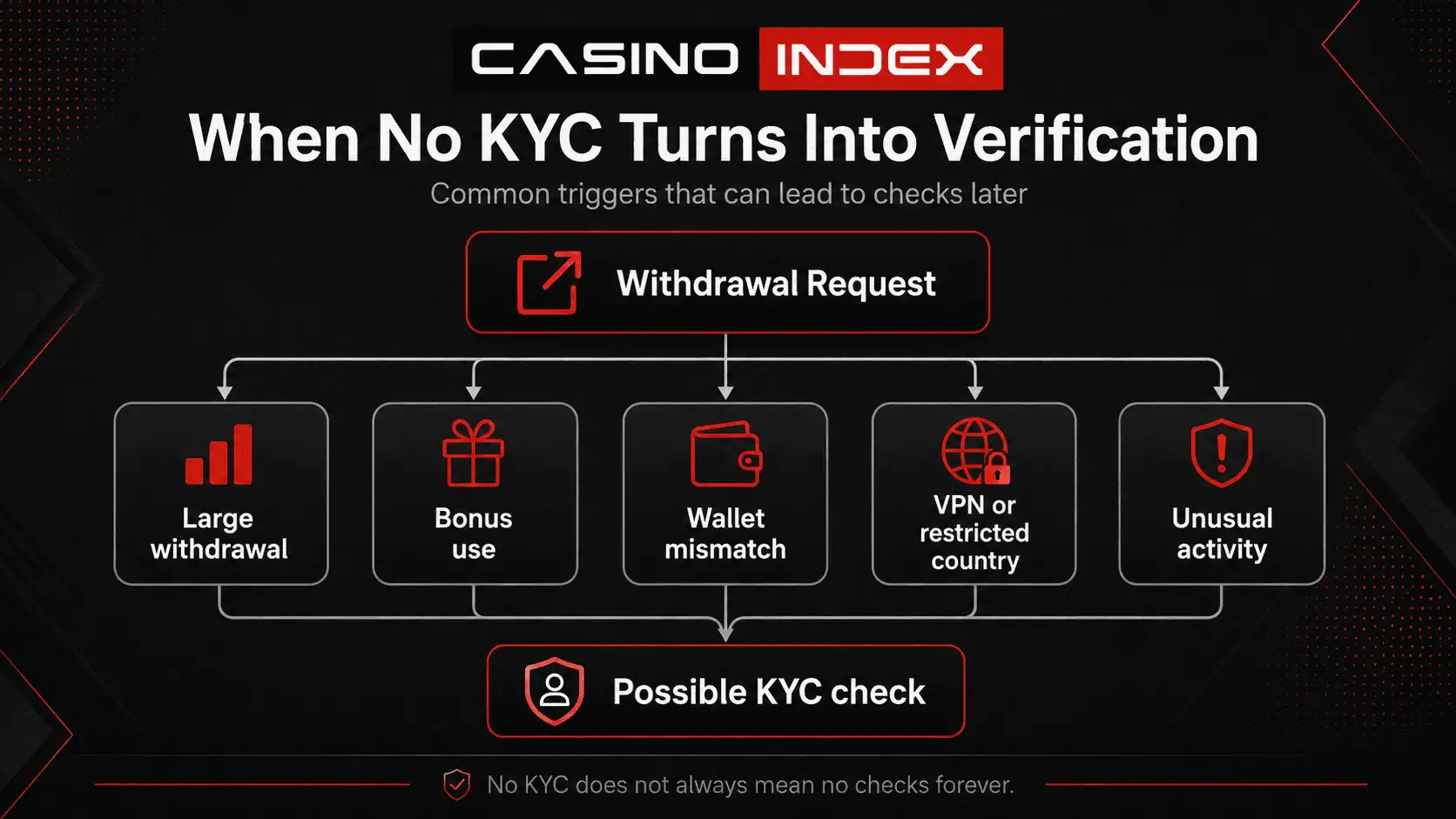
The exact trigger set varies by operator, licence, payment method, and account circumstances. Still, several categories commonly explain why an account moves from low-friction use to a stronger review.
Payment or wallet inconsistency
A deposit route that does not match the intended withdrawal route can create an ownership or payment-matching question. The issue is the financial route, not necessarily the player’s legal identity.
Account or security changes
A new device, unusual location signal, account recovery event, or other major change can lead to additional checks designed to confirm that the legitimate account holder still controls the account.
Jurisdiction questions
Restricted-country rules and location consistency can matter even at casinos that use light onboarding. Easy registration does not prove that every jurisdiction is eligible.
Bonus or promotion review
Bonus use can add a second rule set to the account. Wagering, restricted games, maximum-bet clauses, duplicate-account checks, and promotion eligibility can create review questions that do not exist during simple real-balance play.
Unusual or higher-risk transaction activity
A change in transaction pattern, larger exposure, or another risk signal can lead to a deeper review. The important point is not that one specific behavior always triggers KYC, but that the account can move into a different review level.
Keeping those concepts separate prevents “no KYC” from being treated as a promise that no other account or payment checks can ever occur.
- identity verification asks who the customer is;
- payment ownership asks who controls the payment method;
- wallet screening looks at the transaction route and risk signals;
- conditional verification describes when a stronger review is triggered.
For this comparison page, the key distinction is simple:
Likewise, a player can already be identity-verified and still face a payment-matching issue if the withdrawal method changes or a third-party route appears.
A casino may ask whether the player controls a particular wallet, whether deposits and withdrawals follow a consistent route, or whether a transaction creates a risk signal. Those are payment and wallet questions. They do not always require the same evidence as full identity verification.
Crypto players often treat every payment review as “KYC,” but several different checks can sit underneath the same withdrawal delay.
Wallet Checks, Payment Matching and KYC Are Related but Different
This is also where the distinction between no KYC and low KYC becomes practical. A no-KYC model may preserve a lighter routine experience for longer. A low-KYC model may be more open about limited checks from the beginning. Neither approach is automatically better; the quality depends on how clearly the operator explains the transition from routine use to deeper review.
- whether the withdrawal route must match the deposit route;
- whether wallet ownership can be checked;
- whether manual approval is possible;
- whether bonus use changes the review path;
- whether location and account details must remain consistent;
- and whether the terms explain when stronger verification can appear.
A low-friction model should therefore be judged on more than how quickly an account opens. Useful questions include:
Withdrawals reveal more because the operator has to release money and confirm that the request is consistent with the account, payment method, terms, and jurisdiction. That is why two casinos with almost identical signup flows can behave very differently at cashout.
Registration is usually the lowest-friction stage of the account lifecycle. A player can often judge signup in a few minutes: what details are requested, whether documents are needed, and how quickly the cashier becomes available.
Why Withdrawals Reveal More Than Signup
Use these reviews as brand-level examples, not as proof of a permanent KYC status. Verification policies can change, and the same operator can treat routine play differently from an account that triggers a payment, bonus, security, or compliance review.
| Casino | Model Signal | What to Check | Review |
|---|---|---|---|
| Gamdom | Crypto-first access with relatively low onboarding friction | Current withdrawal rules, verification rights, account restrictions, and payment consistency | Gamdom review |
| BC.Game | Low-friction crypto environment where risk-triggered checks can still matter | KYC timing, wallet handling, account controls, larger withdrawals, and current terms | BC.Game review |
| CoinCasino | Easy onboarding with a broader casino-and-sportsbook setup | Payout-stage checks, bonus-linked reviews, payment matching, and withdrawal predictability | CoinCasino review |
| TrustDice | Lightweight crypto-first account model | Cashier rules, wallet use, withdrawal limits, and when verification can be requested | TrustDice review |
| Jackbit | Crypto-friendly access with promotions that can add another review layer | Bonus terms, withdrawal conditions, account checks, and payment ownership rules | Jackbit review |
The important point is that a casino can feel light at signup while still reserving stronger checks for withdrawals, payment ownership, location issues, bonus reviews, or unusual account activity.
Verification labels become easier to understand when you compare them with actual operator behavior. The examples below are not a “best no KYC casinos” ranking and they do not promise permanent document-free play. They simply show how lower-friction models can look different at brand level.
How These Verification Models Look in Real Casino Reviews
Where No-KYC Marketing Becomes Misleading
The label becomes problematic when the marketing statement is much simpler than the actual terms.
For example, a homepage may use “No KYC” to describe easy onboarding. The terms may then state that verification can be requested for payment reviews, account risk, jurisdiction issues, or other reasons.
That does not automatically make the model unfair. The problem is the expectation gap.
| Marketing Message | What Players May Assume | What the Terms Need to Clarify |
|---|---|---|
| No KYC | No identity checks will ever occur. | Whether later verification can be triggered and under what general circumstances. |
| Instant signup | The entire account lifecycle will remain frictionless. | Whether withdrawal and payment reviews use separate checks. |
| Crypto only | Crypto automatically removes KYC. | Whether wallet ownership, transaction screening, or jurisdiction controls can still apply. |
| Fast withdrawals | Every payout is automatic. | When manual approval or account review may occur. |
Readers who want the broader safety question should use the separate guide on whether no KYC casinos are safe and where the main risks appear. This comparison page does not repeat that full trust analysis.
No KYC, Low KYC and Privacy Are Different Concepts
Verification level and privacy overlap, but they are not identical.
A no KYC account can reduce identity-document sharing while still creating account, device, payment, and transaction records. A low KYC account can collect limited information early without requiring a full identity file. A full-KYC casino can collect more personal data but still have clear privacy and security controls.
That is why “more private” should not automatically be translated into “anonymous.”
The privacy question is covered separately in Can You Stay Anonymous in Casinos?. On this page, privacy matters only insofar as it helps explain why different verification models collect different amounts of information at different stages.
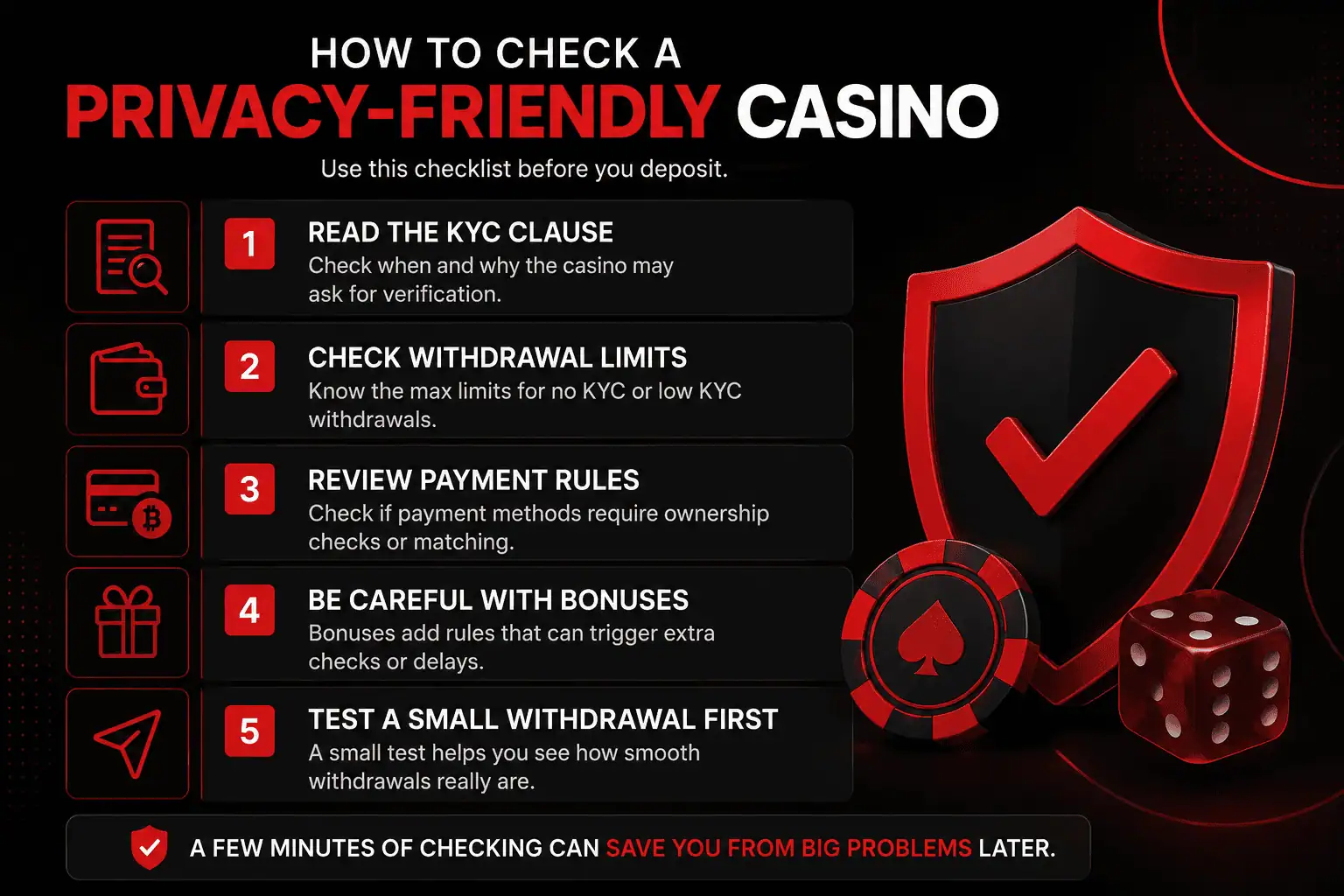
How to Read a Casino’s Verification Model Before Depositing
You do not need to reproduce the entire KYC process to understand which model a casino uses. A few questions usually reveal whether the operator behaves more like no KYC, low KYC, or standard KYC.
- What is required at signup? Check whether the casino asks only for account basics or requires formal identity documents before normal use.
- Does the policy distinguish normal use from triggered review? Clear wording should explain that deeper checks may occur in specific circumstances.
- Are withdrawal checks described separately? Signup and cashout rules should not be treated as the same stage.
- Are payment and identity checks separated? Wallet ownership or payment matching does not always equal full identity KYC.
- Does the operator use absolute promises? Claims such as “never verify” deserve more scrutiny than language that clearly explains conditional review.
How This Page Differs From the Other KYC Guides
CasinoIndex separates this topic into different search intents so one page does not try to answer every KYC question.
| Page | Main Question | What It Owns |
|---|---|---|
| This comparison | What is the difference between no KYC and low KYC? | Definitions, signup differences, withdrawal expectations, conditional verification, and model risk. |
| No KYC Casinos | Which current casinos use lower-verification models? | Commercial comparison and operator selection. |
| Are No KYC Casinos Safe? | What are the safety and trust risks? | Risk assessment, payout behavior, and trust signals. |
| Casino Verification Guide | How does KYC actually work? | Documents, identity checks, verification stages, and process detail. |
| Can You Stay Anonymous in Casinos? | How much privacy can a player realistically keep? | Anonymity, pseudonymity, wallet privacy, and identity exposure. |
This separation matters because the keywords sound similar but the reader’s question is different. The comparison page should explain the models clearly, then send the reader to the more specific guide when the intent changes.
Final Comparison
No KYC and low KYC casinos sit on the same verification spectrum, but they do not make the same promise.
No KYC describes a model where routine use begins without standard identity-document checks. Low KYC describes a model where verification remains lighter than traditional full KYC but limited checks can be part of normal account management.
Conditional verification explains why either model can become more demanding later. A change in payment route, account risk, withdrawal behavior, jurisdiction, promotion use, or another review factor can alter what the casino needs to check.
The strongest distinction is therefore not “documents or no documents.” It is:
What does the casino require at signup, what can change at withdrawal, which events can trigger a deeper review, and does the operator explain those rules before the player deposits?
FAQ — No KYC vs Low KYC Casinos
What is the main difference between no KYC and low KYC casinos?
No KYC usually means standard identity documents are not required during routine signup. Low KYC means the operator uses a lighter verification model but may apply basic checks earlier or escalate them when specific risk or compliance triggers appear.
Does no KYC mean a casino can never ask for ID?
No. The label often describes normal onboarding rather than every possible account event. The casino’s terms may still allow identity verification when a later review makes it necessary.
Is low KYC an official regulatory category?
No. There is no universal low-KYC standard used by every regulator or casino. CasinoIndex uses the term descriptively for models that keep verification lighter than traditional full KYC while retaining limited or conditional checks.
What is conditional verification?
Conditional verification means stronger checks appear only after a particular event or risk signal. It can exist inside both no KYC and low KYC models rather than acting as a completely separate casino category.
Do larger withdrawals always trigger KYC?
No. Larger or unusual withdrawals can receive more review at some casinos, but there is no universal amount that triggers the same process everywhere. Payment consistency, account behavior, jurisdiction, wallet activity, and other factors can also matter.
Can small withdrawals still trigger verification?
Yes. A smaller transaction can still lead to review if another issue appears, such as payment ownership, account security, location inconsistency, or a terms-related concern.
Are no KYC casinos more private than low KYC casinos?
They can require less identity information during routine onboarding, but privacy depends on more than document collection. Account, device, payment, wallet, and transaction data can still exist under either model.
Where should I compare actual no KYC casinos?
Use the dedicated No KYC Casinos page for current operator comparisons. This page is intentionally limited to the definitions and differences between verification models.

Maria Hoffmann has worked in cryptocurrency content and digital publishing since 2017. She is a co-founder of Freecoins24 and CryptoMutant and has covered blockchain projects, crypto platforms and emerging industry trends for several years. She has also been active as a cryptocurrency investor since 2019. At CasinoIndex, Maria combines content research and SEO experience with a focus on casino trust, platform security, withdrawal processes, payment risks and user protection. Her work looks beyond bonuses and product features to examine how gambling platforms handle player funds, verification and account-related risks.