Crypto vs Fiat Casinos: Which Payment System Is Better for Players?
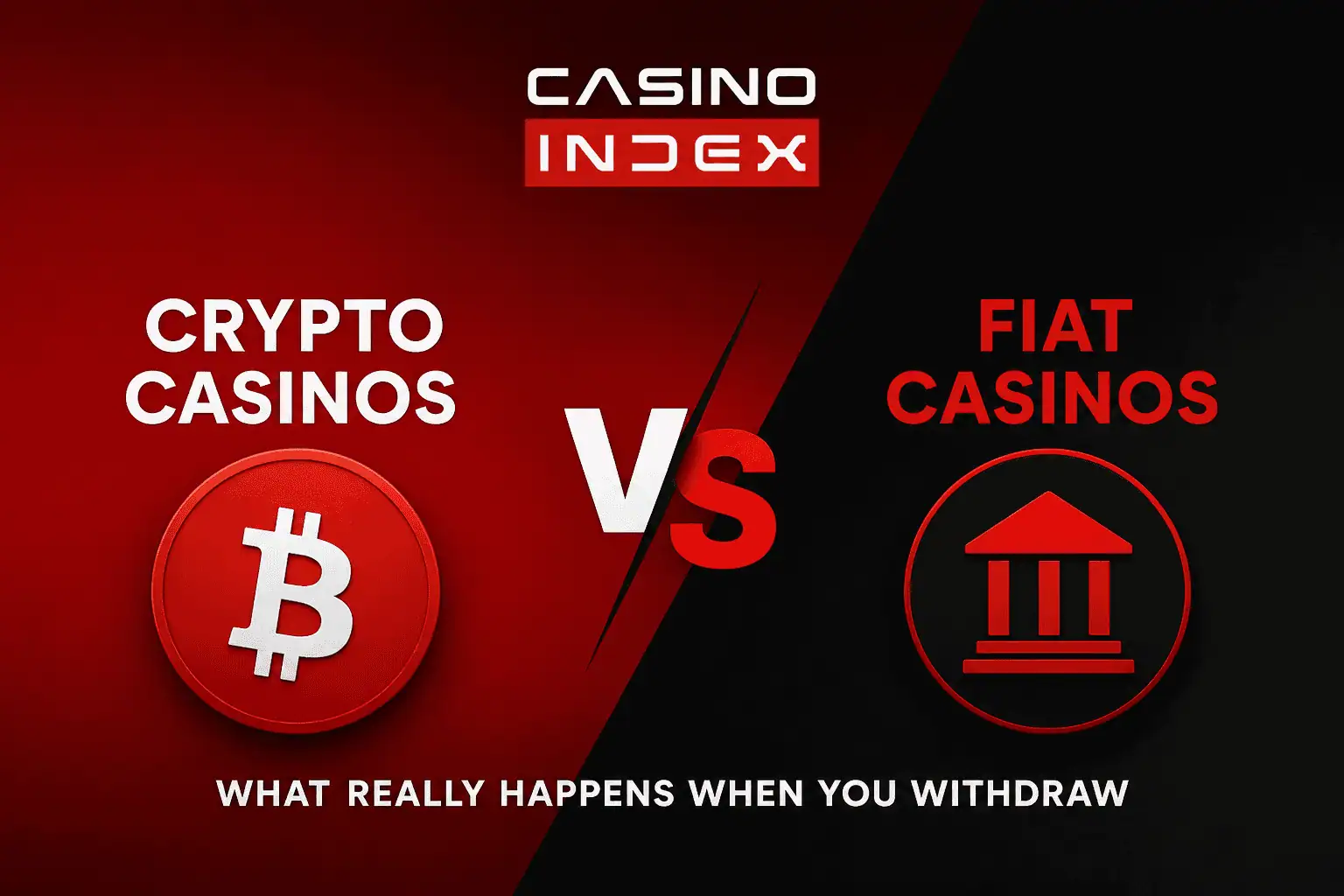
Crypto and fiat casinos can offer the same games, the same providers and even similar bonuses. The biggest difference is not the lobby. It is the payment rail connecting the player to the casino.
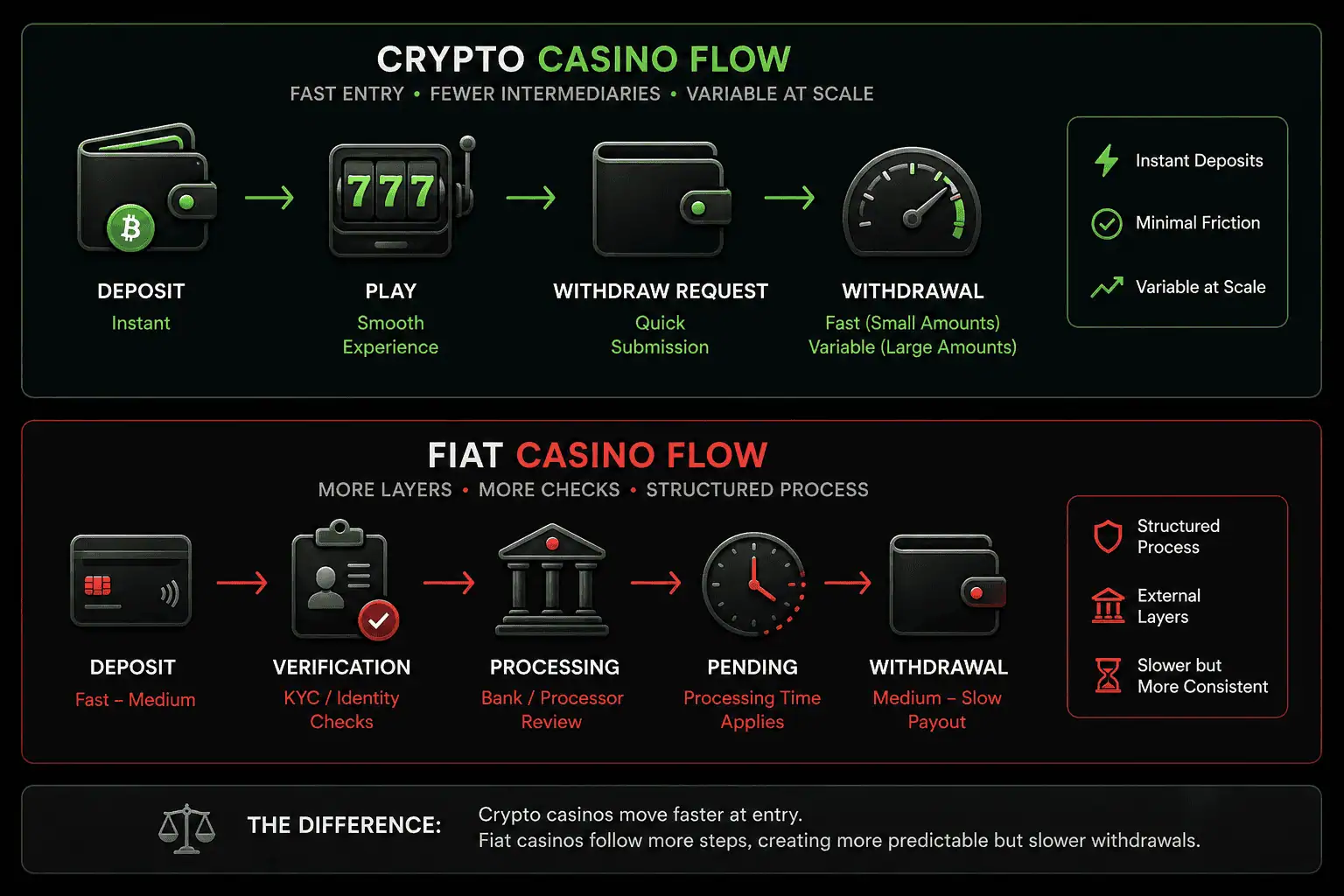
With crypto, value moves through a blockchain and usually reaches the casino without a bank or card network processing the transfer. With fiat, deposits and withdrawals rely on methods such as cards, bank transfers, e-wallets or other payment services. That changes speed, reversibility, wallet responsibility, fees and the number of parties involved.
It does not remove the casino from the process.
A blockchain can settle a transaction quickly while the casino still takes time to approve a withdrawal. A bank transfer can be slower while the operator itself approves the payout quickly. For that reason, CasinoIndex treats payment speed and casino approval as two separate questions.
This guide compares crypto and fiat casinos at system level: how money enters, who controls each stage, where KYC can appear, what can delay withdrawals and which payment model fits different types of players. It does not replace the separate step-by-step deposit or wallet guides.
Crypto vs fiat casinos: quick comparison
| Factor | Crypto casinos | Fiat casinos |
|---|---|---|
| Payment rail | Blockchain transaction | Bank, card, e-wallet or payment processor |
| Deposit settlement | Depends on network confirmations and casino crediting | Depends on payment method and processor |
| Withdrawal approval | Casino approval happens before on-chain settlement | Casino approval happens before processor or bank settlement |
| KYC | Can still be required before or during withdrawal | Commonly integrated into account and payment checks |
| User-side payment risk | Wallet, address, asset and network accuracy matter | Bank, card, e-wallet and account ownership must match |
| Reversibility | Blockchain transfers are generally difficult to reverse once confirmed | Some fiat rails offer more dispute or reversal mechanisms, depending on the method |
| Best fit | Players comfortable managing crypto payments | Players who prefer familiar financial rails |
The table shows the real trade-off. Crypto can reduce payment-rail friction, but it adds wallet and transaction responsibility. Fiat can feel more familiar, but additional financial intermediaries can add processing steps.
The payment method matters more than the casino label
“Crypto casino” and “fiat casino” are useful labels, but real payment behaviour is more specific than that.
A fiat casino can support cards, bank transfers and e-wallets at the same time. Those methods do not have identical deposit speeds, withdrawal routes or ownership checks. Likewise, a crypto casino can support several coins and networks with different confirmation times, fees and wallet requirements.
That is why payment comparisons should start with the actual rail rather than a broad assumption that all crypto is instant or all fiat is slow.
CasinoIndex covers the wider landscape in casino payment methods explained. This page stays focused on the higher-level difference between blockchain-based and traditional payment flows.
Deposits: crypto reduces intermediaries, not responsibility
Crypto deposits usually involve fewer traditional financial intermediaries. The player sends an asset to a casino deposit address, the blockchain processes the transaction and the casino credits the balance after its required confirmation or internal checks.
That process can be fast, but it should not be described as universally instant. Network conditions, confirmation requirements and the casino’s own crediting system can all affect when the balance appears.
Fiat deposits depend more heavily on the selected payment method. A card or e-wallet can credit quickly, while a bank transfer may take longer. The casino may also receive information from the processor that helps match the payment to the account.
The important difference is responsibility.
With crypto, the player usually has to select the correct asset, destination and network. With fiat, more of the routing is handled by banks or payment providers, although account ownership and payment eligibility still matter.
This article deliberately does not turn that into a step-by-step deposit tutorial. The detailed workflow belongs in how crypto deposits work at online casinos, where network selection, transaction confirmation and deposit mistakes can be explained without diluting this comparison page.
Wallet preparation is a separate risk layer
Crypto gambling adds a wallet layer that fiat users may never need to manage directly.
A player can interact with crypto through a private wallet or through a custodial service such as an exchange account. Those are not the same custody model. A private wallet gives the user direct control over the keys, while a custodial service controls the underlying wallet infrastructure on the user’s behalf.
That distinction can matter when a casino later asks about payment ownership, transaction history or the source of funds.
It also changes what can go wrong before the casino even receives the money. Crypto transfers depend on accurate transaction details, and an incorrect address, asset or network choice can create a problem that does not exist in the same form with a normal card payment.
This comparison only needs that distinction at a high level. The practical setup belongs in how casino wallets should be prepared.
Keeping the topics separate prevents three pages from competing for the same intent:
- Payment methods guide: compares the available payment rails.
- Crypto deposit guide: explains how to make a crypto deposit correctly.
- Crypto wallet guide: explains wallet preparation, control and wallet-specific risk.
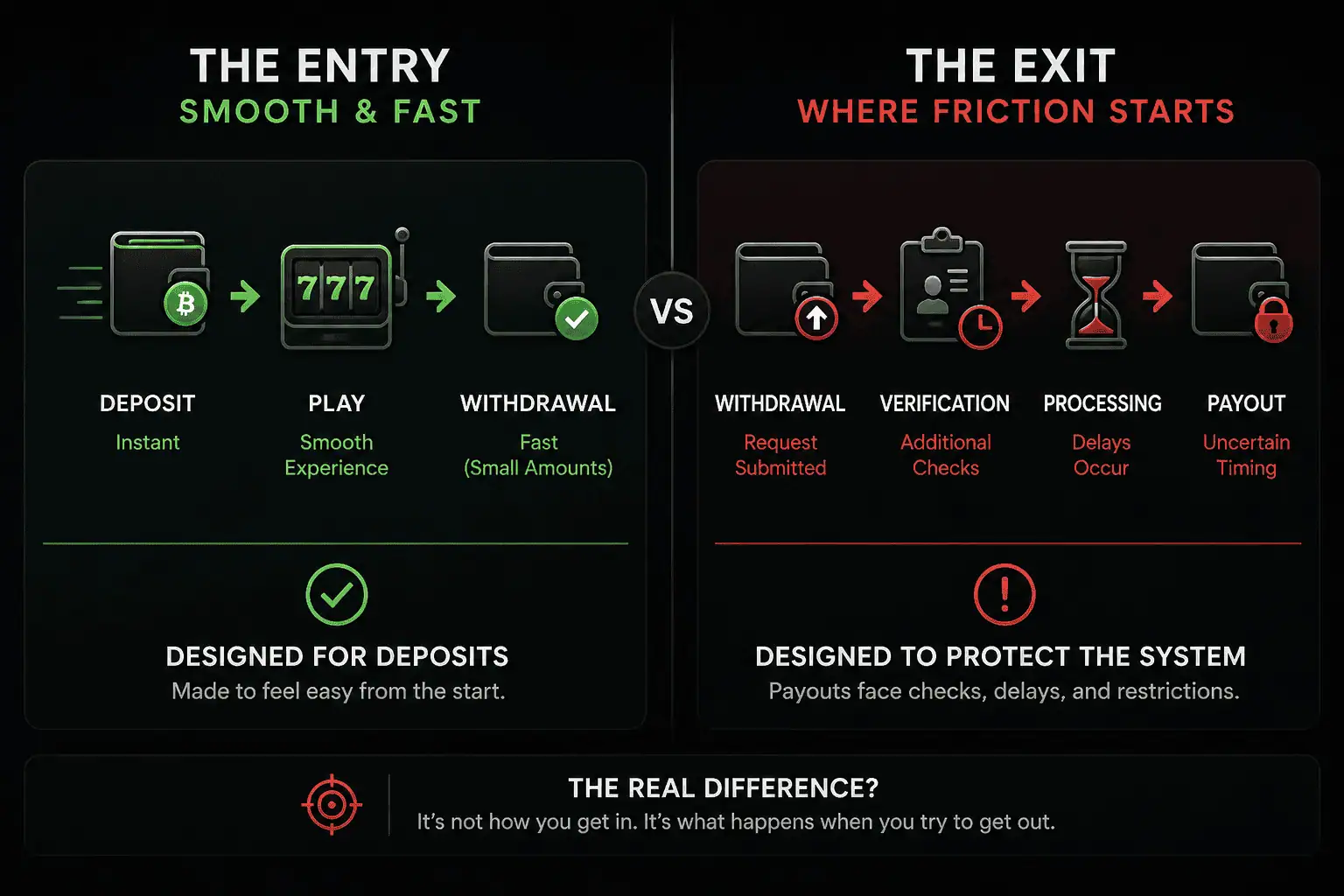
Withdrawal speed has two clocks
This is the most important part of the comparison.
Players often describe a crypto casino withdrawal as “blockchain speed” and a fiat withdrawal as “bank speed.” That skips the operator-controlled stage that comes first.
Every casino withdrawal has two broad clocks.
Clock 1: casino approval
Before money leaves the platform, the casino may check whether the withdrawal is allowed. Depending on the account and operator, that can include identity, payment ownership, bonus conditions, account restrictions, country eligibility, security checks or other review requirements.
Until the casino approves the payout, neither blockchain speed nor bank processing speed matters.
Clock 2: external settlement
After approval, the payment rail takes over.
For crypto, that means the transaction is broadcast and confirmed on the relevant blockchain. For fiat, the withdrawal moves through the selected bank, card, e-wallet or payment processor route.
This separation prevents a common mistake. A crypto withdrawal can be technically capable of settling quickly but remain pending inside the casino for hours or days. A fiat withdrawal can be approved quickly by the casino and then take additional time because the external payment rail is slower.
For the payout side, CasinoIndex explains why withdrawals depend on casino approval before the payment network becomes relevant.
Crypto does not mean automatic or permissionless withdrawals
The player controls crypto before it is deposited. Once the funds are credited to a normal custodial casino balance, the operator generally controls whether the withdrawal request is approved and released.
That is why “crypto casino” should not be treated as a synonym for “non-custodial casino.” A site can accept Bitcoin, stablecoins or other digital assets while still using a conventional internal balance and approval system.
The distinction is crucial.
Blockchain settlement may be decentralised at network level, but the casino can still maintain centralised controls over account access, verification and payout approval.
This is one reason the advertised transaction speed should never be the only payment metric. A player should also consider withdrawal rules, KYC requirements, account limits and the operator’s reputation for handling reviews.
Fiat does not automatically mean slower or safer
Traditional payment rails can add more external processing, but that does not make every fiat casino slow or every fiat transaction safer.
An e-wallet withdrawal can behave differently from a bank transfer. Card deposits may be fast while card withdrawals may use a different route or may not be available at all. Local banking systems can also differ substantially by country.
Fiat payments can provide familiar account records and, in some cases, stronger consumer-dispute mechanisms than a final blockchain transfer. However, those protections depend on the payment method, jurisdiction and nature of the dispute.
They also do not replace the casino’s own withdrawal approval process.
If the operator freezes the account or disputes the winnings, a familiar bank rail does not automatically solve the underlying casino dispute.
KYC exists on both sides
One of the weakest crypto-versus-fiat comparisons is the claim that fiat means KYC while crypto means anonymity.
That is too simple.
Crypto casinos can still verify identity, age, country, payment ownership or source of funds. Some platforms allow registration or small transactions with minimal friction and request more information later, especially when withdrawals or account reviews trigger additional checks.
Fiat payment methods often make the player’s financial identity more visible from the start because the card, bank account or e-wallet is already tied to a named account holder. That can make payment matching more straightforward, but it does not mean the full casino verification process is complete.
The practical question is not “crypto or fiat?” It is:
- what does the casino require before withdrawal
- whether the payment method belongs to the account holder
- whether the player’s country is eligible
- whether additional checks can appear later
- how clearly the operator explains the review
Payment ownership looks different in crypto and fiat
Fiat ownership is often linked to a named card, bank account or e-wallet. Crypto ownership can be harder to interpret because blockchain addresses are not inherently labelled with a legal identity.
That does not mean crypto payments have no ownership rules.
A casino may still ask the player to prove control of a wallet, explain a transaction path or provide information about where the funds originated. The exact requirement depends on the operator and the case.
This becomes especially relevant when funds move through several wallets or services before reaching the casino.
For comparison purposes, the important point is simple: both payment models can create ownership questions, but the evidence used to answer those questions can look different.
Fees are more complicated than “crypto cheap, fiat expensive”
Neither payment model has one universal fee structure.
Crypto users can face network fees, exchange withdrawal fees, conversion costs or casino-specific charges. The amount can vary by asset, network congestion and the service used to send the funds.
Fiat users can face card fees, bank charges, payment-provider fees, currency conversion or withdrawal fees depending on the casino and payment method.
Stablecoins can reduce exposure to crypto price volatility, but they do not remove network selection, wallet or platform risk.
For this reason, players should compare the complete payment path rather than one advertised “0% deposit fee.”
Finality and reversibility create different risks
Crypto transactions generally become difficult to reverse after they are confirmed on-chain. That increases the importance of checking the destination and network before sending funds.
Some fiat payment methods provide more reversal or dispute mechanisms. However, that does not mean a player can simply reverse a legitimate gambling transaction without consequences. Chargebacks and disputed payments can lead to account restrictions, payment investigations or wider disputes.
The trade-off is therefore not “crypto has no protection, fiat has protection.”
Crypto gives the user more direct transaction responsibility. Fiat delegates more of the payment process to financial intermediaries that may have their own rules, checks and dispute procedures.
Bonuses can complicate withdrawals in either model
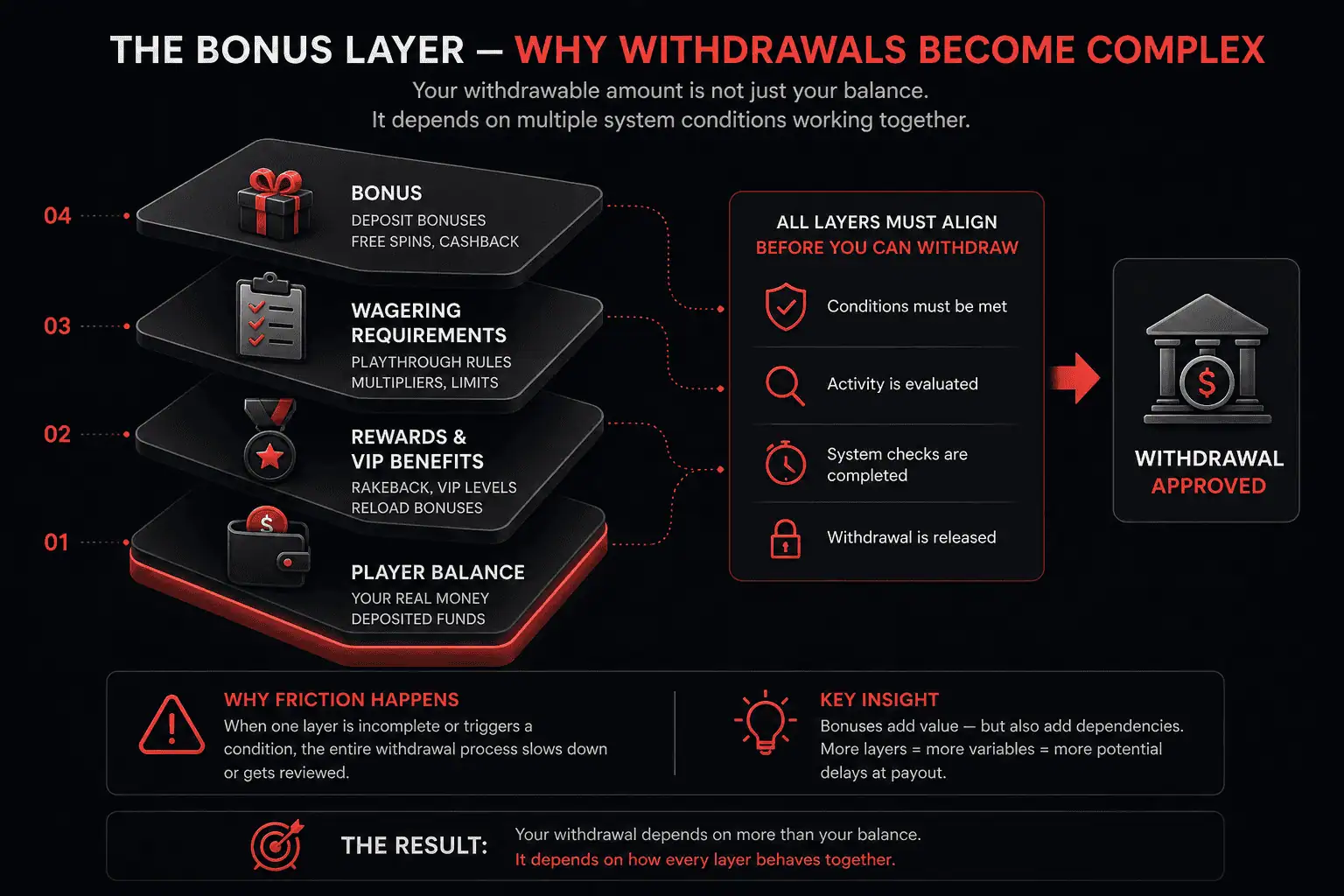
Bonus rules are separate from the payment rail.
A crypto casino can attach wagering requirements, maximum-bet rules, restricted games or withdrawal conditions to a promotion. A fiat casino can do the same.
The original version of this comparison placed too much weight on the idea that crypto bonuses are inherently more integrated into the balance while fiat bonuses are more isolated. That is not a reliable system-level distinction.
The correct comparison is whether the operator keeps bonus funds, cash funds and withdrawal conditions clear enough for the player to understand what is actually withdrawable.
Risk monitoring is not unique to crypto casinos
Casinos can monitor account activity regardless of whether the player deposited crypto or fiat.
Payment changes, unusual login behaviour, bonus use, account duplication, large withdrawals and identity inconsistencies can all trigger review. The payment rail changes the data available and the transaction path, but it does not create a completely different trust model.
That is another reason the casino itself matters more than the currency label.
A strong operator should explain what is being reviewed and what the player needs to do. A weak operator can create payout friction regardless of whether the withdrawal is heading to a blockchain address or a bank account.

Hybrid casinos make the label even less useful
Many online casinos support both crypto and fiat payments.
A single player may deposit by card, later use an e-wallet and also maintain a crypto balance. In that environment, the operator is not purely “crypto” or “fiat.” It is running several payment rails through the same account and risk framework.
This can be convenient, but it can also create more payment-matching questions if the player constantly changes methods.
The safest assumption is that every rail has its own rules. Do not expect a successful crypto deposit to prove that a later bank withdrawal will work the same way, or vice versa.
Which is better for withdrawals?
Crypto has the technical advantage when the casino has already approved the payout and the selected blockchain settles quickly.
Fiat can be slower because banks and processors may add more steps after approval.
But those statements describe settlement, not the full withdrawal experience.
If a crypto casino places the account under review, the blockchain provides no speed advantage until the operator releases the funds. If a fiat casino approves quickly and uses an efficient e-wallet or bank rail, the real difference may be much smaller than expected.
For serious players, approval predictability is more important than advertised payment speed.
Which is safer: crypto or fiat casinos?
Neither payment type is automatically safer.
Safety depends more on the operator than the currency.
Useful checks include:
- who operates the casino
- which licence or legal framework applies
- how withdrawals are approved
- when KYC can be requested
- how payment ownership is handled
- whether bonus terms can affect withdrawals
- how the operator handles complaints and account reviews
Crypto can give the player greater control before deposit and after withdrawal because funds can move directly between wallets. Fiat can provide familiar financial rails and additional payment records. Neither advantage protects the player from a weak operator holding an internal casino balance.
Crypto vs fiat casinos by player type
| Player type | Better fit | Reason |
|---|---|---|
| Player already comfortable with wallets | Crypto | Direct blockchain payments can be efficient when handled correctly |
| Player who wants familiar payment rails | Fiat | Cards, banks and e-wallets require less crypto-specific knowledge |
| Player focused on post-approval payout speed | Crypto | On-chain settlement can be fast after the casino releases the withdrawal |
| Player worried about irreversible payment mistakes | Fiat | Traditional payment flows reduce wallet and network-selection responsibility |
| Player who uses several payment types | Hybrid | More options, but payment matching should remain consistent |
| Player focused on overall safety | Neither by default | Operator trust and withdrawal behaviour matter more than the payment rail |
What to check before choosing crypto or fiat
Instead of choosing based on “instant crypto” or “trusted banking,” compare the actual payment conditions.
- Check the withdrawal method before depositing. Do not assume every deposit rail can also receive withdrawals.
- Separate casino approval from payment settlement. A fast blockchain or bank rail does not bypass an internal review.
- Check KYC timing. Find out whether verification can appear at withdrawal or after account activity changes.
- Understand payment ownership. Use methods that can be clearly linked to you.
- For crypto, confirm asset and network requirements. Leave the detailed procedure to the deposit and wallet guides, but never treat these details as optional.
- Compare total costs. Include network, processor, exchange and currency-conversion fees where relevant.
- Read bonus withdrawal rules separately. Payment speed cannot override wagering or account conditions.
- Test the payout route with a manageable amount. This confirms the basic workflow before a larger balance accumulates.
Final verdict: the casino matters more than the currency
Crypto and fiat casinos are different payment environments, not separate safety classes.
Crypto can reduce reliance on traditional financial intermediaries and provide fast settlement after approval. In return, the player takes on more responsibility for wallet control, transaction details and irreversible payment mistakes.
Fiat uses familiar financial rails and can provide clearer ownership records or additional payment protections, depending on the method. In return, banks and processors can add extra settlement steps, restrictions or delays.
Neither model changes the central trust question.
The casino still decides whether an internal balance can be withdrawn.
That means the most important comparison is not “Bitcoin or bank transfer?” It is whether the operator has clear rules, reasonable KYC, predictable approval behaviour and a reputation for releasing legitimate withdrawals.
Use the payment rail that fits your experience, but judge the casino separately from the currency it accepts.
FAQ: crypto vs fiat casinos
Are crypto casinos better than fiat casinos?
Not automatically. Crypto can offer faster blockchain settlement and more direct wallet-based payments, while fiat offers familiar payment rails. Operator trust, withdrawal approval and KYC rules matter more than the currency alone.
Are crypto casino deposits instant?
Not always. A crypto deposit may need blockchain confirmations and internal casino crediting before the balance becomes available. Speed depends on the network, asset and operator.
Why can a crypto withdrawal be pending if the blockchain is fast?
Because casino approval happens before blockchain settlement. The operator may review the account, verification, payment ownership, bonuses or other conditions before broadcasting the transaction.
Do crypto casinos require KYC?
They can. Crypto payments do not remove the operator’s ability to verify identity, age, country, payment ownership or source of funds.
Are fiat casino withdrawals always slower?
No. The result depends on the payment method and operator. Some e-wallet or local payment routes can be efficient, while bank or card-related withdrawals may involve more processing steps.
Is a private wallet better than an exchange wallet for casino payments?
They serve different custody models. A private wallet gives the user direct key control, while an exchange wallet is custodial. Which one is suitable depends on the casino’s payment rules and the user’s ability to manage wallet security and transaction history.
Can a wrong crypto network cause a casino deposit problem?
Yes. Crypto deposits depend on compatible assets, addresses and networks. The detailed prevention steps belong in the separate crypto deposit guide so this comparison page does not duplicate that technical intent.
Which is safer for large withdrawals?
Neither crypto nor fiat guarantees safer large withdrawals. The key factors are the operator’s approval rules, verification process, limits, payment ownership requirements and dispute history.

Talha Aydin has been active in cryptocurrency since 2017 and is a co-founder of Freecoins24 and CryptoMutant. Over the years, he has worked with crypto projects on community growth, giveaways, user acquisition and digital strategy while gaining hands-on experience across blockchain platforms and crypto markets. At CasinoIndex, Talha focuses on crypto casinos, withdrawals, payment systems, platform trust and the risks players face when moving funds between wallets and gambling platforms.