Stake vs Gamdom: Withdrawals, KYC and Long-Term Value Compared
Stake and Gamdom compete for many of the same crypto gamblers, but the choice becomes clearer once the account moves beyond signup and the first few bets.
Stake is the stronger all-round platform for players who want casino games, Originals, sports betting and a deep VIP system in one account. Gamdom has a more focused crypto-gambling identity, with recurring rewards, community features and a lighter approach to verification until the team requests a deeper account check.
The quick verdict: Stake is the better default choice for long-term play. Its current terms make the withdrawal and compliance framework unusually explicit, while the wider product remains useful even when rewards are not the main reason to stay. Gamdom can be the better fit for players who value its reward structure and lower-friction day-to-day experience, but recent public complaints show why KYC and withdrawal review deserve serious attention before larger balances build up.
This is not a “who has more games?” comparison. The important differences appear after deposit: how each casino approves cashouts, when KYC changes the account experience, how payment and wagering rules affect withdrawals, what public complaint patterns suggest, and which platform remains manageable after months of use.
Full Stake and Gamdom reviews
If you already prefer one brand, use the full review for the deeper operator-level analysis. These pages cover payment methods, verification, licensing, rewards, complaints and the product in more detail than a head-to-head comparison can.
| Casino | Best for | Main reason to consider it | Full review |
|---|---|---|---|
| Stake | Long-term crypto casino and sportsbook users | Clearer current payout rules, deeper ecosystem and stronger high-volume fit | Stake review |
| Gamdom | Reward-focused crypto users who prefer a lighter account experience | Fast standard withdrawals, recurring promotions and conditional rather than universal KYC | Gamdom review |
Overall edge: Stake for long-term predictability and platform depth. Gamdom remains competitive when reward style and a lower-friction everyday experience matter more.
Stake vs Gamdom: how CasinoIndex judges the comparison
A serious comparison needs to separate product appeal from real-money risk.
CasinoIndex weighs six areas here:
- Withdrawal behaviour. What has to happen before the casino releases a payout?
- KYC and account checks. Can either operator request identity, location, payment ownership or financial evidence later?
- Payment and wagering rules. What conditions can stop an otherwise valid withdrawal?
- Reputation. Do public complaints repeatedly involve access to funds, account restrictions or verification?
- Long-term usability. Does the account remain understandable as volume, VIP status and transaction history grow?
- Reward value. Do promotions and rakeback improve the experience without becoming the reason a player ignores payout risk?
This follows how CasinoIndex evaluates trust and real-money risk. Product quality matters, but withdrawals, verification and reputation come first when the comparison involves money already held inside the casino.
That framework also corrects a problem with many Stake vs Gamdom comparisons. A platform can look stronger because it has more games, more VIP levels or a more generous reward percentage. None of those things answers whether a player can predict what happens when a withdrawal enters review.
Stake vs Gamdom comparison table
| Area | Stake | Gamdom | Edge |
|---|---|---|---|
| Long-term fit | Broader casino, Originals, sportsbook and VIP ecosystem | More focused crypto gambling and reward experience | Stake |
| Withdrawal framework | Detailed rules for KYC, payment ownership, wagering and enhanced checks | Fast standard withdrawals, with review and KYC possible when triggered | Stake for clarity |
| KYC | Stake may request KYC at any time and restrict withdrawals | Gamdom usually starts lighter but may request ID, address and proof of funds | Gamdom for lighter entry; no risk-free winner |
| Deposit wagering before cashout | Stake requires 100% deposit wagering before withdrawal | Gamdom requires one-times wagering of deposits and free-spin winnings | Similar principle |
| Reputation pressure | Public KYC and account-restriction complaints exist; operators resolved many cases | Recent complaints include delayed withdrawals, KYC and account closures | Stake, slight |
| Reward style | Deep VIP progression that becomes more relevant with volume | Promotions, community rewards and invitation-based VIP benefits | Depends on activity |
| Best fit | Players who expect repeated, higher-value use | Players who value rewards and simpler everyday crypto play | Depends on player |
The useful conclusion is not that Stake “always pays” and Gamdom “creates friction.” Current evidence does not support a claim that absolute. The stronger conclusion is narrower: Stake publishes a more detailed withdrawal framework, while Gamdom offers a lighter standard experience that can become much stricter when the team opens a verification or account review.
Withdrawals: approval matters more than blockchain speed
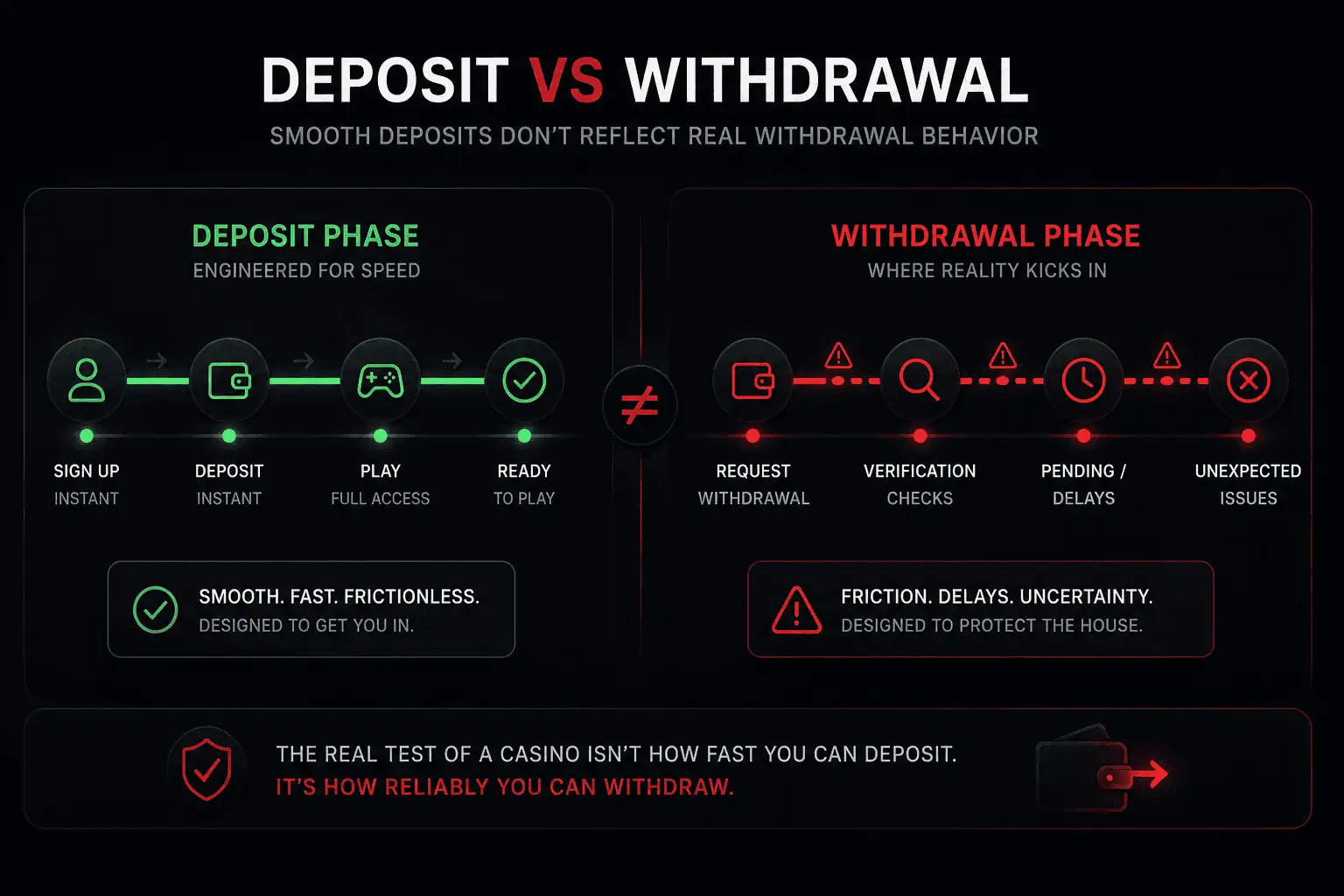
Crypto makes the final payment leg fast. It does not remove the casino’s internal approval process.
Stake’s current terms are clear about that distinction. Before Stake releases a withdrawal, it can require identity verification, confirmation that the payout destination belongs to the player, additional information and compliance with the minimum wagering requirement attached to deposits.
For crypto withdrawals, Stake requires players to wager 100% of the deposit value before requesting a withdrawal. The operator can also perform additional KYC and enhanced due diligence, investigate gaming activity and delay or decline withdrawals while an investigation is active.
That is stricter than the “instant crypto withdrawal” image many players associate with the brand. It is also useful information because the rules explain where friction can appear before the blockchain transaction exists.
How Gamdom handles the standard withdrawal path
Gamdom presents a faster standard-case picture. Its current help material says Gamdom typically processes withdrawals within roughly five minutes to one hour. The transaction page separates submission and review from the later sending and confirmation stages, which is a useful distinction.
However, Gamdom also requires players to wager deposits and free-spin winnings at least once before withdrawal. Its account-review guidance allows temporary restrictions while the team investigates suspected rule breaches, and Gamdom can disable withdrawals while KYC remains incomplete.
That means the best-case speed tells only part of the story.
- Stake: more explicit rules around what can interrupt approval.
- Gamdom: faster-looking standard flow, but conditional KYC or internal review can stop the normal path.
- Neither: offers a guaranteed instant payout for every account or amount.
CasinoIndex explains why cashout behavior matters after deposit, including the difference between casino approval time and blockchain settlement.
For long-term players, that difference matters more than whether a normal $100 withdrawal arrives a few minutes faster. Judge a platform by what happens when the request no longer fits the automatic path.
KYC: Stake is more explicit, Gamdom is more conditional
The KYC difference is one of the clearest reasons to update this comparison.
Stake does not promise permanent low-verification play. Its terms allow the operator to request KYC documentation at any time to establish identity and location. Stake can restrict payments and withdrawals until it accepts the information the player supplies.
Stake’s anti-money-laundering material goes further. When risk indicators appear, enhanced due diligence can include identity information, address details, source of funds and source of wealth.
Gamdom takes a more conditional approach at entry. Its current help centre states that players can generally deposit, play and withdraw without completing KYC unless the team specifically requests it.
Once requested, the process can become considerably deeper.
Gamdom describes several verification levels:
- basic personal details
- government-issued ID and selfie verification
- proof of funds such as payslips, invoices or bank statements
- proof of address in additional cases
Gamdom also states that it may temporarily disable withdrawals until the team completes the required checks.
This makes the decision more nuanced than “Stake has KYC, Gamdom does not.” Gamdom has the lighter default onboarding path, but it can still introduce full verification at the point where a player wants to withdraw or when regulatory checks require it. The casino verification guide explains how identity, address and payment checks can affect approval timing.
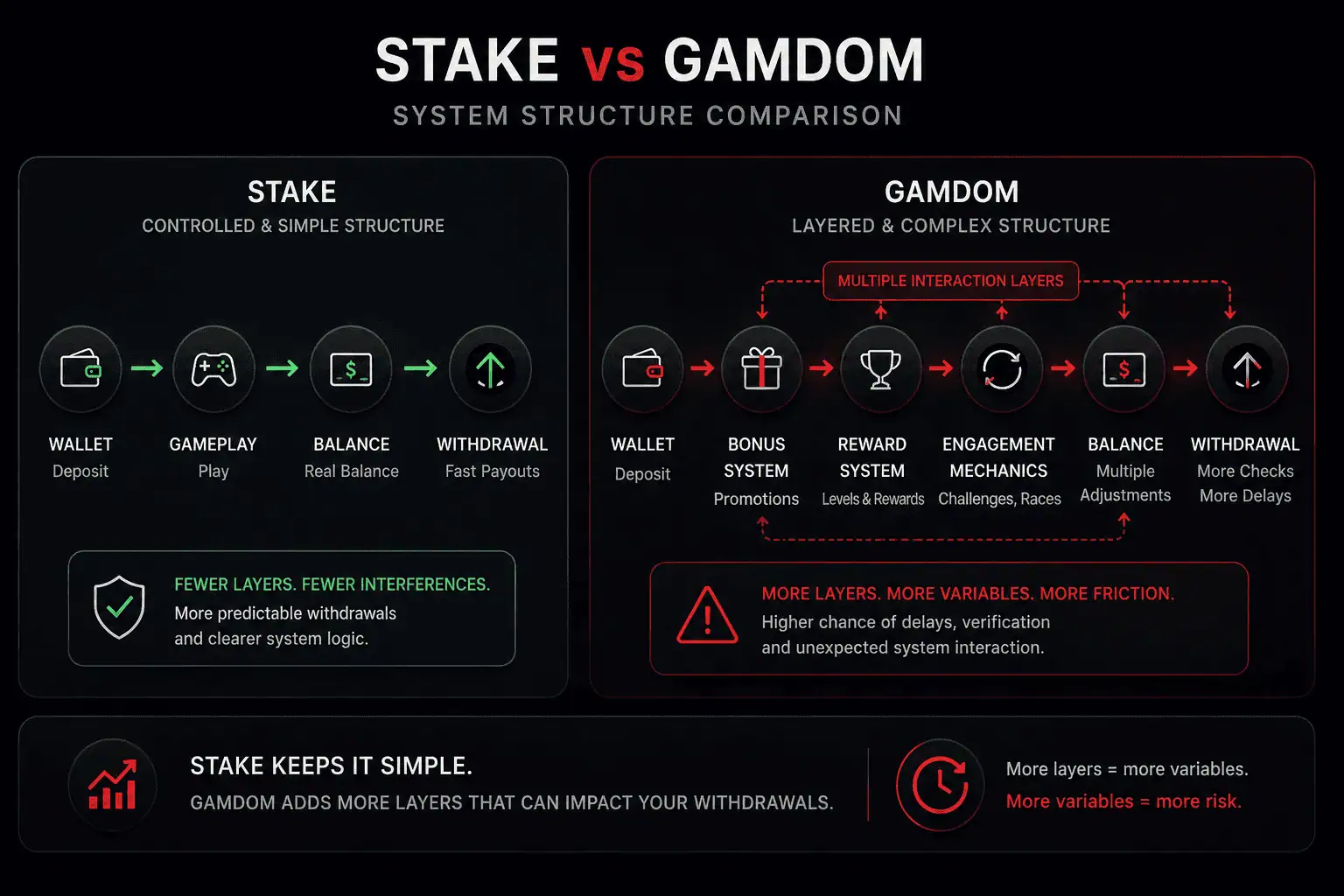
Players who expect larger balances should prepare for the stricter version of the process, not assume the first week of account activity predicts every future cashout.
Payment rules and limits: small details become larger problems over time
Withdrawal friction is not always caused by KYC. Payment-route and wagering rules can create problems even when identity is not disputed.
Stake requires withdrawals to use the same payment method as the deposit unless the operator decides otherwise or the player cannot use the original route. The terms also state that the withdrawal destination should belong to the player.
Gamdom’s current help material says currency swapping is not available as a withdrawal shortcut. If a player deposits in one cryptocurrency, the normal route is to withdraw using that same cryptocurrency rather than using the casino as an exchange.
Gamdom also publishes a one-times wagering rule for deposited funds and free-spin winnings. Repeated attempts to bypass the requirement can lead to temporary withdrawal restrictions.
These rules are not unusual in gambling. They matter because crypto users often treat the cashier like a wallet or exchange.
A long-term account is easier to manage when the player:
- uses payment methods and wallets they control
- does not deposit through third parties
- keeps the selected crypto network consistent
- understands the wagering requirement before attempting a cashout
- keeps transaction records for larger activity
- checks the live minimum and network fee before sending money
A casino comparison that ignores these details can make two fast cashiers look identical when their account rules are not.
Reputation: neither brand is friction-free
The previous version of this page leaned too heavily toward a simple “Stake predictable, Gamdom variable” story.
Current public complaint data needs a more balanced interpretation.
Stake has a large public footprint and recent complaints involving account suspension, stalled KYC, rejected documents and funds temporarily restricted during review. Operators resolved several cases, while other complaints ended in rejection or dispute after the operator supplied additional evidence.
That matters because it proves that even a mature Stake account can enter a difficult verification path. The existence of a detailed policy does not guarantee that every player will find the process quick or easy.
Gamdom has a smaller public complaint footprint, but recent AskGamblers cases include withdrawals held during KYC or internal review, account closure and disputed confiscation of balances or winnings. Gamdom ultimately resolved a number of these cases, while others remained unresolved or ended in rejection.
Read the pattern carefully.
- A complaint is an allegation, not proof that the operator acted unfairly.
- Large platforms naturally generate more public cases.
- Resolved complaints still reveal where account friction can occur.
- Cases involving access to player funds matter more than complaints about promotions or interface preferences.
Stake receives a slight reputation edge because its legal and compliance framework is easier to trace and its public complaint history includes many resolved cases. Gamdom is not disqualified by its complaints, but the cluster around withdrawal review and KYC deserves attention from anyone planning higher-value play.
Long-term use: where Stake has the clearer advantage
Long-term casino value is not the same as reward value.
A player using an account for months has to manage more than bonuses. There is transaction history, VIP status, previous withdrawals, device and location patterns, payment ownership and potentially much larger balances.
Stake supports that wider relationship more effectively.
Its product remains useful across casino games, Originals and sports betting, while the VIP system becomes more meaningful as wagering volume grows. The platform is complicated, but Stake documents the major compliance rules in enough detail for serious users to see what the operator may ask later.
Gamdom is attractive in a different way. It can feel lighter during normal use, and its community-driven reward culture can be more engaging for users who do not want the scale and density of Stake.
The trade-off appears when activity grows.
Gamdom’s own help centre makes clear that higher scrutiny can introduce proof-of-funds checks, withdrawal restrictions and internal account reviews. That means the easy early experience should not be mistaken for a permanently lighter risk model.
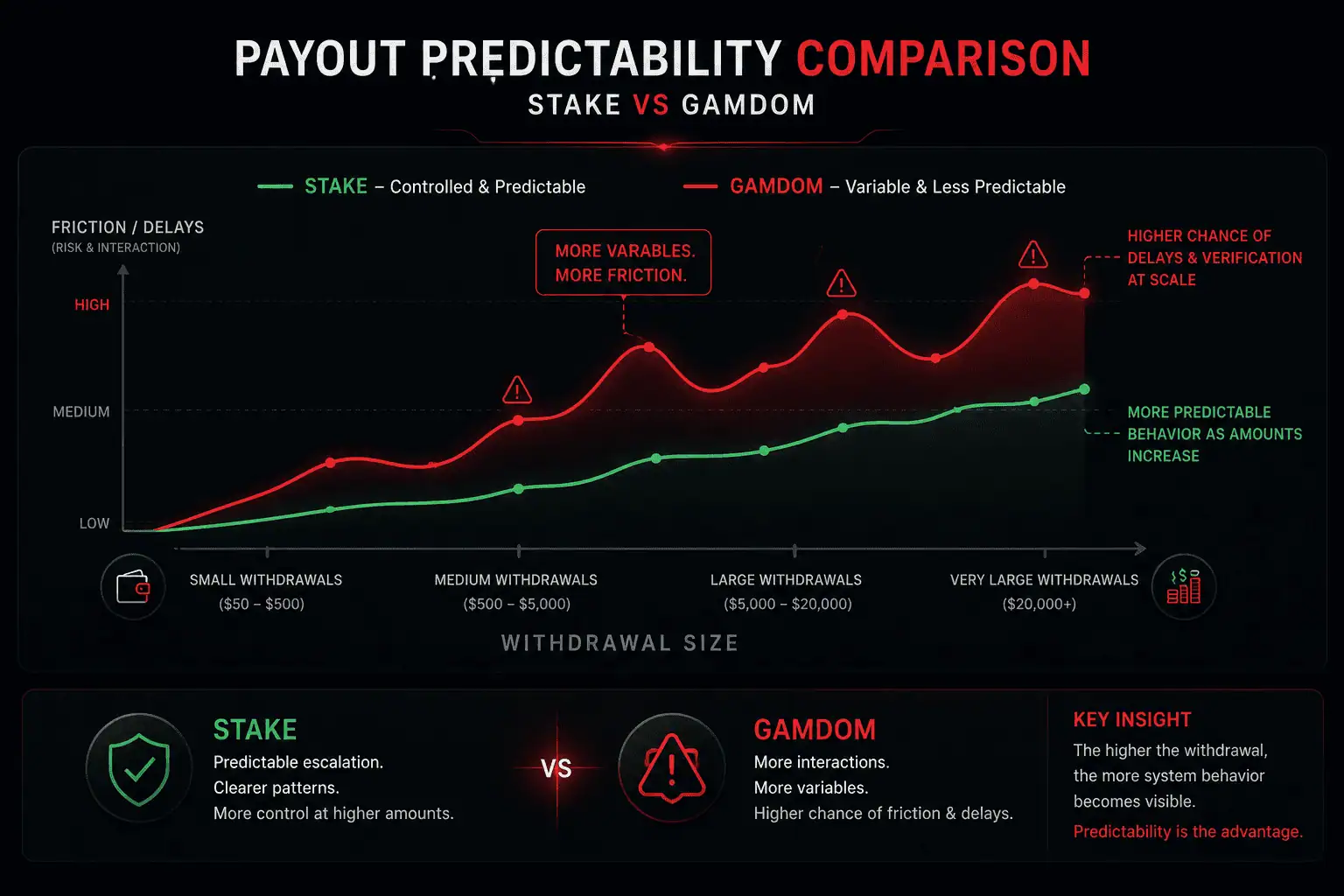
For repeated higher-value use, Stake has the advantage. For lighter or reward-focused use, Gamdom can still be the more comfortable account.
Rewards and VIP value: do not let retention decide trust
Stake and Gamdom both use rewards to make repeat activity more attractive, but the structure differs.
Stake structures its VIP program around progression. As wagering grows, the account can unlock recurring bonuses, rakeback, reloads and higher-tier support. The strongest value therefore appears later rather than during the first few sessions.
Gamdom’s current help centre describes an invitation-based VIP program with personalised support, VIP promotions and fee-free withdrawals for qualifying members. Outside VIP, the platform also uses promotions, raindrops and other campaign-based rewards.
That creates a different feel.
Stake rewards long-term volume through a deep ladder. Gamdom uses a more community- and promotion-led environment, with VIP treatment layered on top for selected users.
Neither approach changes the underlying rule: a reward only has value after the player accounts for the cost of the wagering needed to earn it.
For this comparison, rewards should be a tie-breaker after trust, withdrawals and KYC. They should not be the reason to ignore those factors.
Which casino is better by player type?
| Player type | Better choice | Reason |
|---|---|---|
| Long-term casino and sportsbook user | Stake | Broader ecosystem and clearer rules for repeated use |
| High-volume VIP player | Stake | Deeper progression and stronger long-term platform fit |
| Player who wants lighter initial KYC | Gamdom | Gamdom usually requests verification only when a trigger appears |
| Reward- and community-focused user | Gamdom | Promotions and community mechanics are more central to the experience |
| Player worried about withdrawal review | Stake, slight | More detailed current terms make the possible review path easier to anticipate |
| Player seeking permanent no-KYC gambling | Neither | Each operator can require verification and restrict withdrawals while checks are active |
| Player storing a large balance long term | Neither | Do not use a casino account as a personal wallet |
The right choice depends on what the player will actually do after the first deposit. Stake has the stronger default case because more long-term use cases fit inside the same account. Gamdom becomes more attractive when the player specifically values its lighter everyday feel and reward culture.
What serious players should test before scaling up
The strongest way to evaluate either platform is not to rely on a label such as “fast payout” or “low KYC.” Test the account while the financial exposure is still modest.
- Use accurate registration details. A mismatch becomes much harder to fix after a large win.
- Use a wallet or payment method you control. Ownership questions create avoidable withdrawal friction.
- Complete the required deposit wagering. Do not treat either casino as a crypto exchange.
- Request a modest withdrawal early. Confirm that the basic route works before increasing the balance.
- Keep transaction records. Larger activity can lead to enhanced verification or proof-of-funds requests.
- Read the current restricted-country rules. Location problems can turn into account problems later.
- Do not leave unnecessary funds on-site. Withdraw money that is no longer needed for active play.
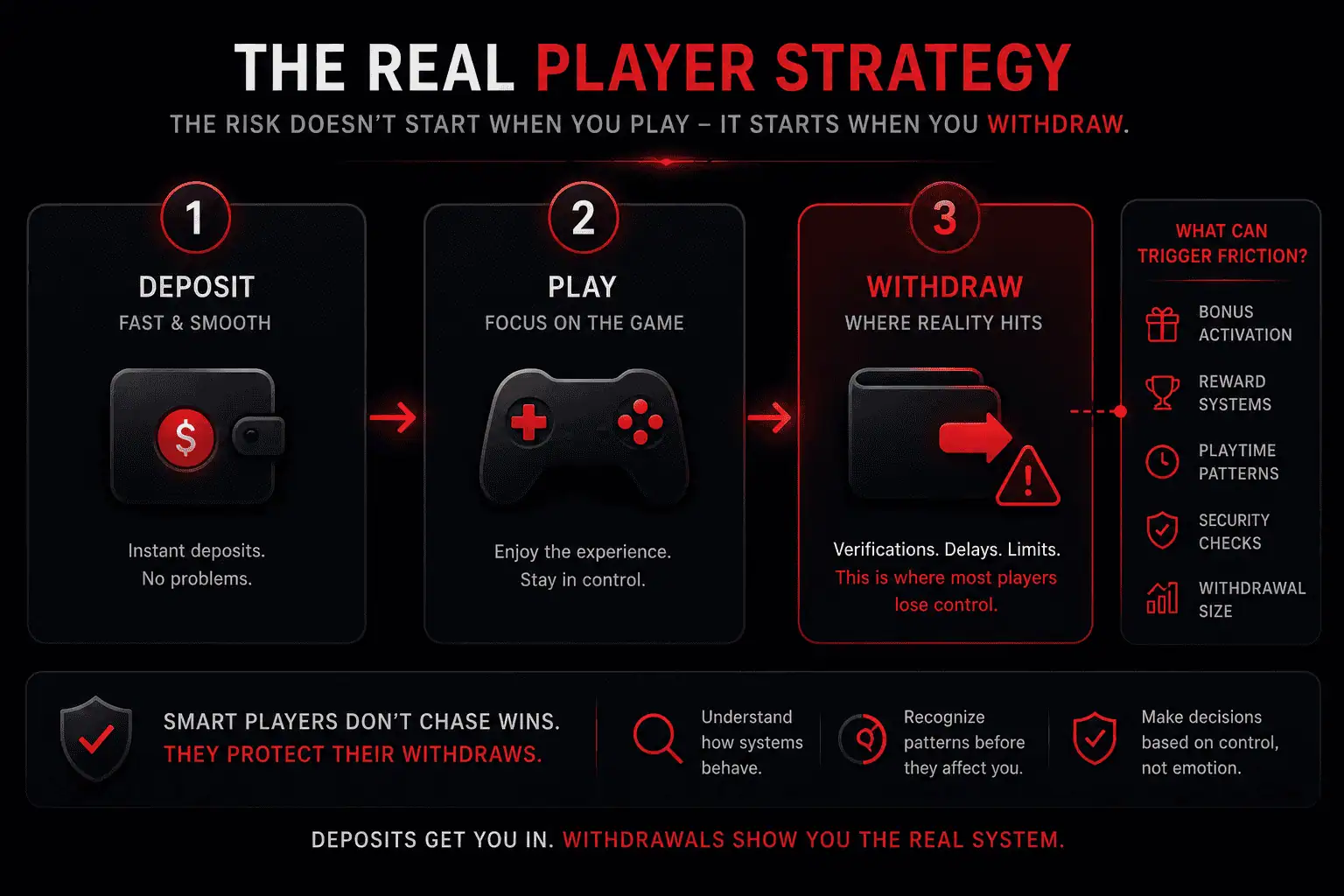
This approach does not guarantee that a future larger withdrawal will follow the same path. It does reduce preventable mistakes and gives the player real information about the account before the stakes increase.
Final verdict: Stake is stronger for long-term play
Stake wins this comparison, but not because it is free from KYC or withdrawal complaints.
It wins because the full account structure is better suited to repeated use. The casino, Originals, sportsbook and VIP system remain useful over time, while the current terms provide a detailed picture of the checks that can appear when money leaves the account.
Gamdom remains a credible alternative.
Its standard withdrawal flow can be fast, Gamdom uses a lighter verification model until the team requests a review, and its reward environment can suit players who prefer a more community-focused crypto gambling experience.
The trade-off is that Gamdom can become much stricter once KYC, proof of funds or an internal account review begins. Recent complaint cases make that risk worth acknowledging rather than presenting the platform as permanently low-friction.
The final decision is therefore:
- Choose Stake for the stronger long-term all-round account and clearer current withdrawal framework.
- Choose Gamdom if you value its reward culture and lighter standard account experience more than maximum ecosystem depth.
- Choose neither blindly if your main reason is a fast-withdrawal claim, a bonus or the assumption that crypto means no verification.
For real-money players, the better casino is the one whose rules still make sense when a balance needs to leave the platform.
Stake vs Gamdom FAQ
Is Stake better than Gamdom?
Stake is the stronger overall choice for long-term use because it combines deeper platform coverage with more explicit withdrawal and compliance rules. Gamdom can be better for players who prefer its reward culture and lighter everyday experience.
Which casino is better for withdrawals?
Stake has the clearer documented approval framework. Gamdom states that normal withdrawals are typically fast, but KYC or an internal review can temporarily disable withdrawals. Neither platform guarantees instant cashout in every case.
Does Stake require KYC?
Stake can request KYC at any time and can restrict payments or withdrawals until it verifies identity and location to its satisfaction. Enhanced checks can also include source-of-funds and source-of-wealth evidence.
Does Gamdom require KYC?
Gamdom says it generally does not require KYC from every player at entry, but the team can request it for withdrawals, promotions or regulatory checks. Higher verification levels can include ID, proof of address and proof of funds.
Why do crypto withdrawals get delayed?
The blockchain is only one stage. Before the casino sends a transaction, it may review identity, payment ownership, wagering requirements, account activity or financial evidence.
Which is better for high-volume players?
Stake has the stronger high-volume case because it designs its platform and VIP structure around long-term progression. High-volume users should still expect stronger compliance scrutiny as activity increases.
Is Gamdom safer because KYC is usually conditional?
No. Lighter initial verification does not automatically mean lower risk. Gamdom can still restrict withdrawals and request deeper verification when the team opens a review.

Nina Kanu has worked in cryptocurrency content and blockchain research since 2016. She is also known within parts of the crypto community through CryptoMutant, where her work has covered emerging projects, market trends and developments across the blockchain ecosystem. At CasinoIndex, Nina focuses on crypto casino reviews, platform comparisons, player experience, game ecosystems and bonus fairness. Her research examines how casino products perform beyond their marketing, including usability, payment options, promotional terms and the overall experience players receive after signing up.