Custodial vs Non-Custodial Wallets for Casino Gambling
The wrong wallet can turn a simple casino withdrawal into a payment review.
That is the part many crypto casino players learn too late.
A wallet is not only where you hold coins. In casino gambling, it can affect proof of ownership, payment matching, source-of-funds checks and whether a withdrawal destination creates extra risk.
That is why custodial vs non-custodial wallets matter.
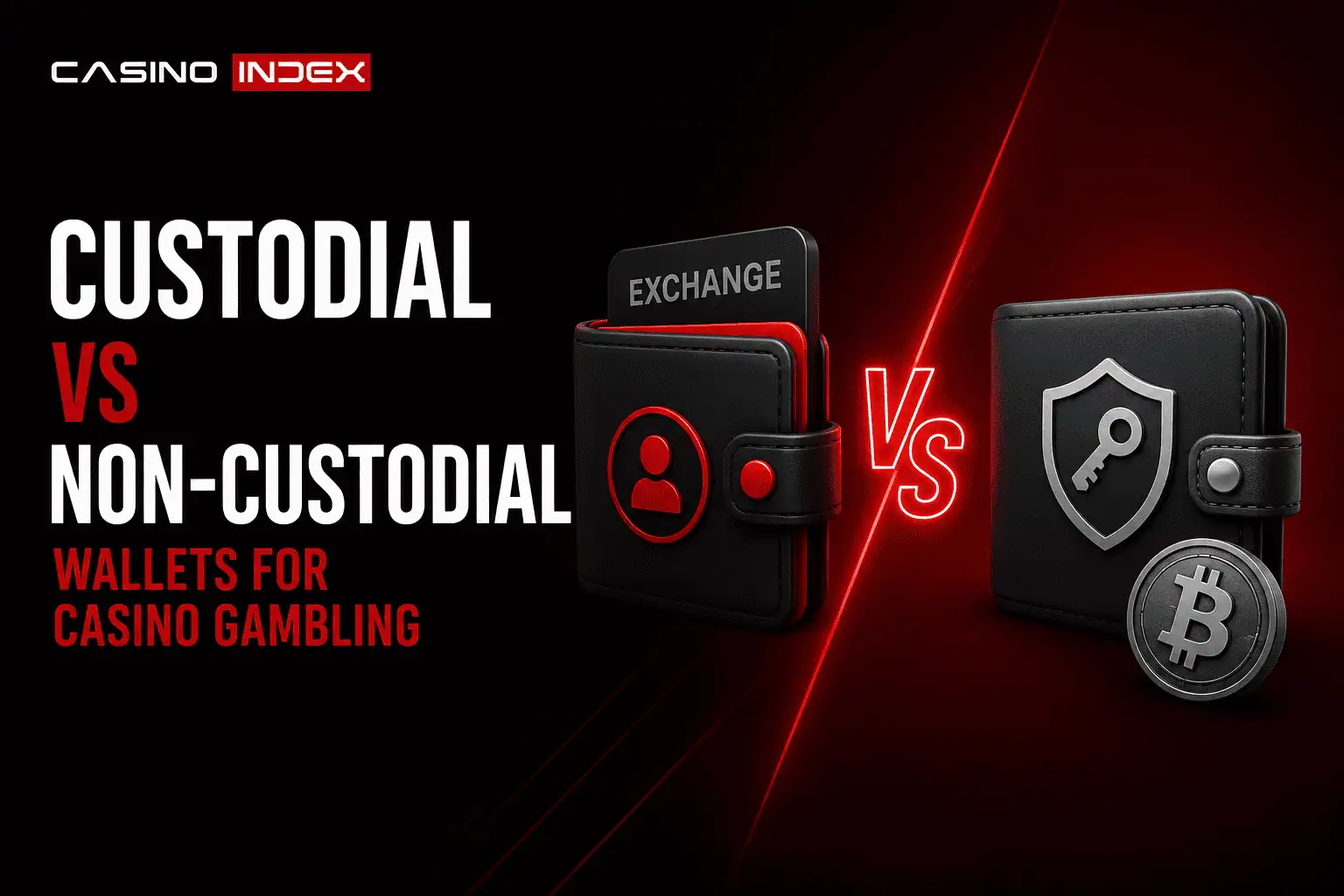
A custodial wallet usually means a third party controls the private keys for you. Most exchange accounts work this way. A non-custodial wallet means you control the private keys yourself through a private wallet, browser wallet, mobile wallet or hardware wallet.
For casino players, the better question is not only “which wallet is safer?”
The better question is: which wallet creates the cleanest deposit and withdrawal path?
Quick Answer: Custodial vs Non-Custodial Wallets for Casino Gambling
For most regular crypto casino players, a non-custodial private wallet is cleaner for deposits and withdrawals.
An exchange wallet is still useful, but mainly for buying, selling and converting crypto.
The safest practical route is usually:
Exchange → private wallet → casino → private wallet → exchange when needed.
That gives the player more control, a clearer transaction path and stronger proof if the casino asks who owns the wallet.
| Wallet Option | Best Use in Casino Gambling | Main Advantage | Main Risk | Best For |
|---|---|---|---|---|
| Custodial exchange wallet | Buying crypto, selling crypto, fiat conversion | Easy to use and beginner-friendly | Exchange controls the wallet infrastructure, and casino withdrawals to exchanges can trigger destination or compliance issues | Beginners and fiat cashout |
| Non-custodial software wallet | Regular casino deposits and withdrawals | Cleaner ownership control and easier wallet proof | User must protect seed phrase and choose the correct network | Regular crypto casino players |
| Hardware wallet | Long-term storage after withdrawals | Stronger custody for larger balances | Less convenient for frequent casino transfers | Larger balances and storage |
| Casino account balance | Active play only | Simple while playing | Not a real wallet; casino controls payout release | Short gaming sessions only |
| Third-party wallet | Usually avoid | None for most players | Payment ownership problems, KYC friction and withdrawal rejection risk | Not recommended |
The key rule is simple: do not treat a casino balance like a wallet.
A casino account is only suitable for active play. It should not be used as long-term crypto storage.
For broader crypto wallet basics, CasinoIndex explains this deeper in its crypto wallet guide for casino players.
How CasinoIndex Evaluates Wallet Choice for Casino Gambling
CasinoIndex does not evaluate casino wallets only by convenience.
Convenience matters, but the payout path matters more.
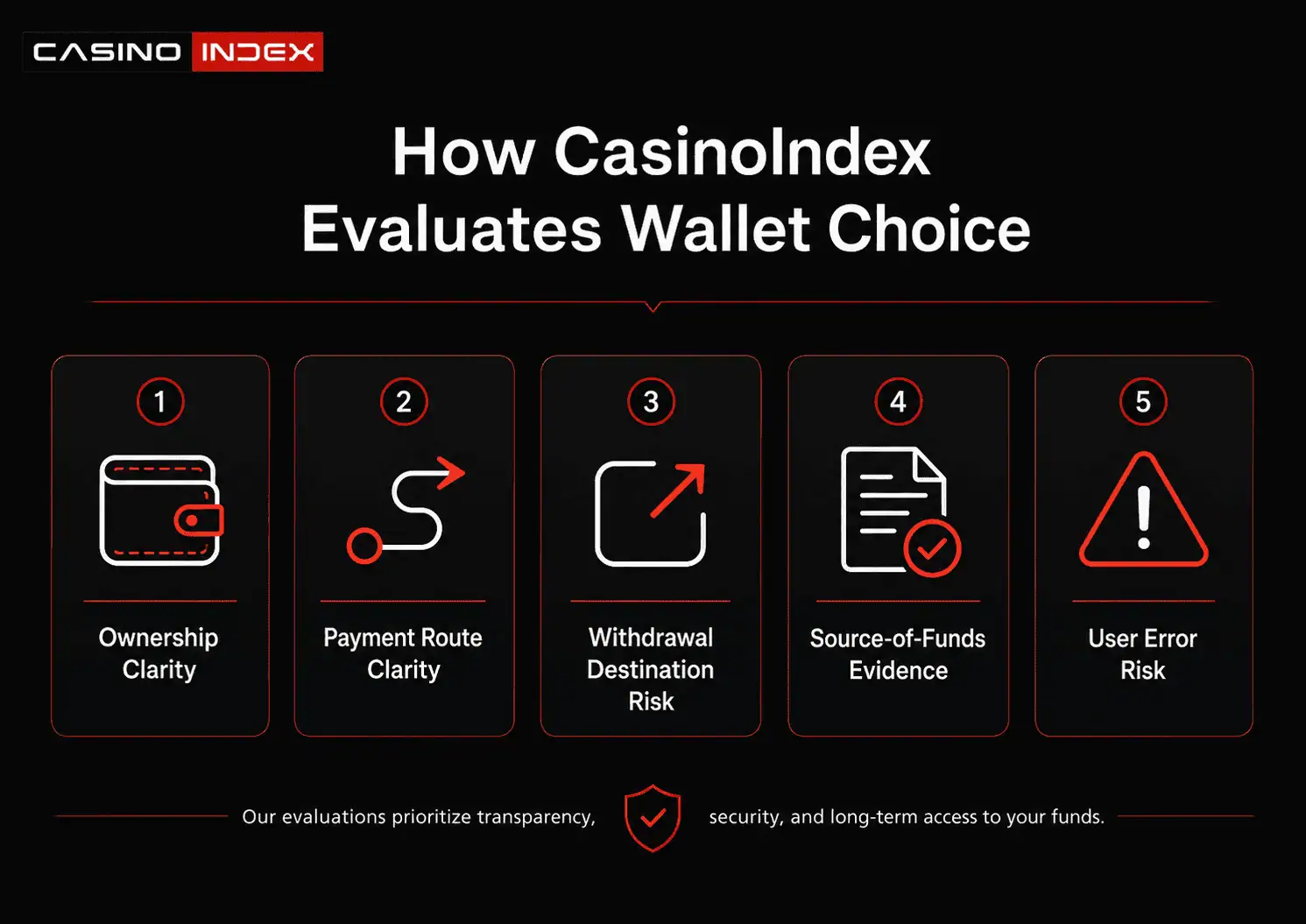
A wallet can look easy at deposit stage and still create problems at withdrawal stage. That is why CasinoIndex looks at five practical factors.
Ownership clarity.
Can the player prove that the wallet belongs to them?
Payment route clarity.
Can the deposit and withdrawal path be explained without confusion?
Withdrawal destination risk.
Could the receiving wallet, exchange or network create a payout problem?
Source-of-funds evidence.
Can the player show where the crypto came from if the casino asks?
User error risk.
Does the setup increase wrong-network transfers, seed phrase loss or address mistakes?
The best wallet setup is not always the most advanced.
It is the one the player can use correctly, explain clearly and document if a casino payment review happens.
Custodial Wallets: What They Mean in Casino Gambling
A custodial wallet is controlled by a third party.
For most players, this means a crypto exchange account. You log in, buy crypto, hold coins, send funds and receive deposits through the exchange.
That is convenient.
The trade-off is control.
You control the exchange account, but the exchange controls the wallet infrastructure. You usually do not control the private keys behind the address.
For normal crypto buying, that may be fine.
For casino gambling, it can create questions.
A casino may ask whether the deposit wallet or withdrawal wallet belongs to you. With an exchange wallet, the answer is not as clean as with a private wallet.
You may own the exchange account.
But the blockchain address may be controlled by the exchange.
That distinction matters during payment reviews.
Exchanges may also use pooled wallets, rotating deposit addresses or internal crediting systems. The blockchain may show funds going to an exchange-controlled address, while your personal exchange account only shows an internal credit.
That can make proof harder.
Custodial wallets are useful for:
- buying crypto with fiat
- selling crypto after a withdrawal
- converting between coins
- beginner access
- regulated platform records
They are weaker for:
- proving wallet control
- receiving gambling payouts
- explaining pooled exchange addresses
- keeping casino payment routes clean
- avoiding exchange-side reviews
An exchange wallet is useful.
It should not always be the main casino wallet.
Non-Custodial Wallets: What They Mean in Casino Gambling
A non-custodial wallet gives you control of the private keys.
That can mean a mobile wallet, browser wallet, desktop wallet or hardware wallet. You control the seed phrase and sign transactions yourself.
For casino gambling, this often creates a cleaner payment route.
If a casino asks whether the wallet belongs to you, a private wallet is easier to explain. In some cases, the player may be able to prove control through a signed message, wallet screenshot or small verification transaction.
The main advantage is ownership clarity.
The main risk is personal responsibility.
If you lose the seed phrase, send funds on the wrong network or approve a malicious transaction, there may be no support team that can reverse the mistake.
That is why non-custodial wallets are better for players who understand:
- seed phrase storage
- network selection
- transaction fees
- wallet addresses
- test transfers
- blockchain confirmations
- basic wallet security
A private wallet does not remove all casino-side checks.
The casino may still ask for KYC, wallet proof or source-of-funds evidence.
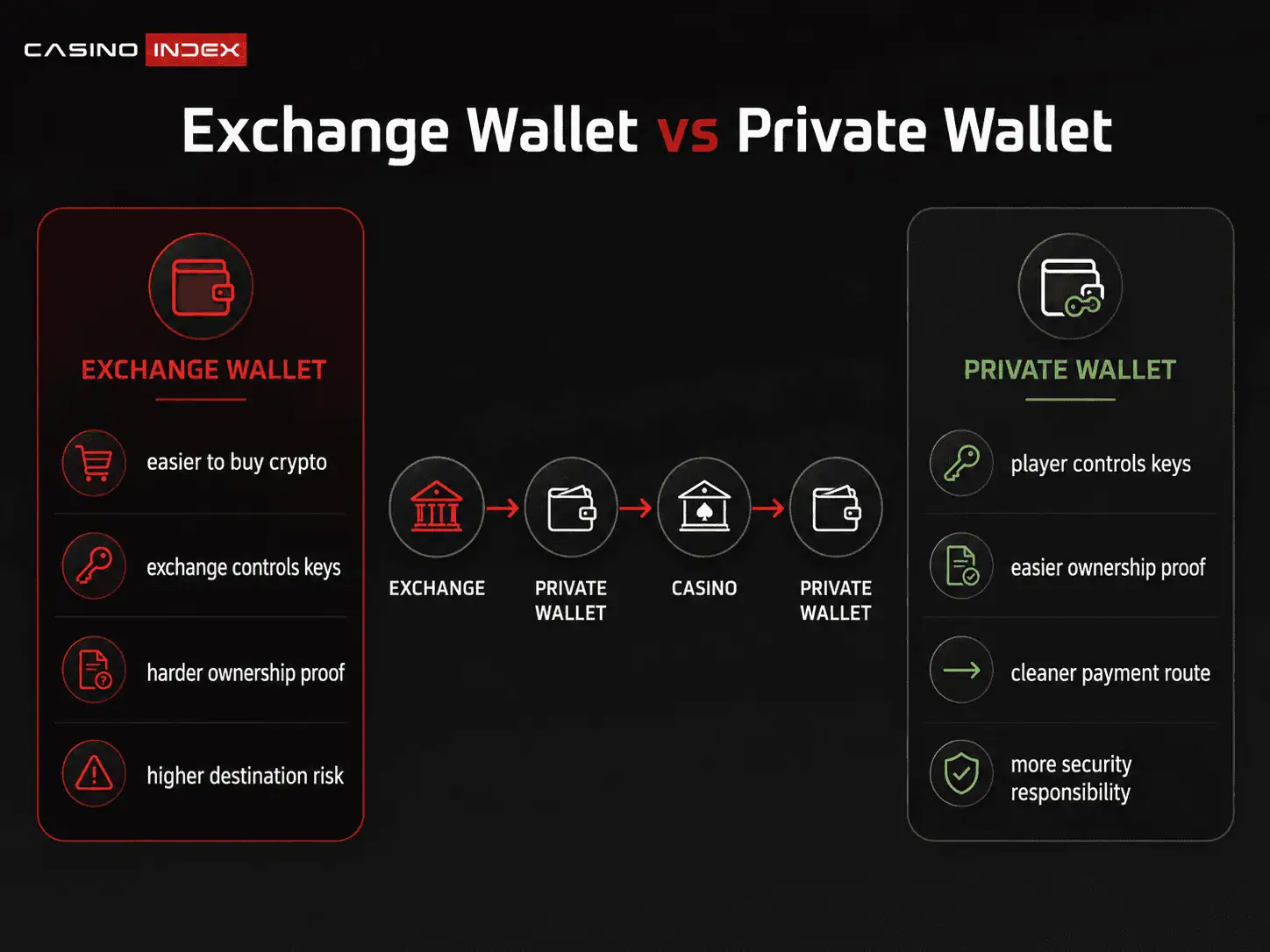
But the player has a cleaner story:
“This is my own wallet. I control it, used it for the casino deposit and want the withdrawal returned to the same wallet address.”
That is usually stronger than trying to explain exchange-controlled addresses after a payout delay.
Exchange Wallet vs Private Wallet: The Practical Difference
The difference becomes clearest at withdrawal time.
An exchange wallet is convenient, but it can create destination risk. A private wallet gives better control, but it requires safer handling.
| Question | Exchange Wallet | Private Wallet |
|---|---|---|
| Who controls the private keys? | The exchange | The player |
| Best casino role | Buying or selling crypto | Deposits and withdrawals |
| Easy to prove ownership? | Often harder | Usually easier |
| Risk of exchange-side review? | Higher | Lower |
| Risk of user mistakes? | Lower for beginners | Higher if the player is careless |
| Good for large casino withdrawals? | Riskier | Cleaner when used correctly |
| Good for long-term storage? | Not ideal | Better with strong security |
| Best use case | Conversion and fiat movement | Clean casino payment route |
A simple rule works well:
Use exchanges for conversion. Use your own wallet for casino movement.
That means you may still buy crypto on an exchange. But before depositing to a casino, move the funds to a private wallet first.
For the wider deposit process, CasinoIndex explains how crypto deposits work at online casinos.
Why Casino Players Should Care About Wallet Ownership
Wallet ownership becomes important when the casino wants to confirm that the payment route belongs to the account holder.
This can happen before or during a withdrawal.
It may happen when:
- the deposit came from an exchange wallet
- the withdrawal address is different from the deposit route
- the withdrawal is larger than usual
- the player uses several wallets
- the wallet appears linked to another account
- the casino asks for source-of-funds evidence
- account details and payment details do not match cleanly
Proof of ownership is not always suspicious.
Sometimes it is a normal payment-security step.
The problem is unclear handling.
A safe process should explain what the casino needs and why. It should not keep adding vague requirements after every submission.
With a private wallet, proof can be more direct.
The casino may ask for a wallet screenshot, signed message or verification transaction.
With an exchange wallet, proof can be more awkward.
The player may need to show exchange account ownership, transaction history, deposit addresses and internal records. That can expose more personal information while still leaving the casino with questions about address control.
That is why private wallets often create a cleaner casino payment trail.
Source-of-Funds Checks and Crypto Wallets
Source-of-funds checks are different from wallet ownership checks.
Wallet ownership asks:
Does this wallet belong to you?
Source of funds asks:
Where did the crypto come from?
A casino may ask this when activity looks unusual, the withdrawal is large, the player’s transaction history is unclear or compliance rules require deeper review.
Possible evidence can include:
- exchange purchase records
- bank transfers used to buy crypto
- crypto sale records
- wallet transaction history
- salary or business income evidence
- proof of previous holdings
- tax or accounting records in serious cases
Players often feel these checks are intrusive.
Sometimes they are.
But source-of-funds reviews can be legitimate when a casino has AML or licensing obligations.
The key issue is proportionality.
A small withdrawal should not usually need the same depth of evidence as a major account review. A fair casino asks for relevant documents, explains the reason and gives a clear path to completion.
A messy wallet route makes this harder.
A clean route makes it easier.
For example, this is easier to explain:
Exchange purchase → private wallet → casino deposit → withdrawal to same private wallet.
This is harder:
Exchange → unknown wallet → casino → different wallet → exchange → new wallet.
CasinoIndex covers this topic deeper in its guide to how source-of-funds checks work at online casinos.
Withdrawal Destination Risk
Withdrawal destination risk means the payout address itself creates the problem.
This is common in crypto casino gambling.
The casino may approve the withdrawal, but the receiving destination may still cause trouble.
That can happen when:
- the destination is an exchange that reviews gambling-related funds
- the selected network is wrong
- the wallet does not support the token
- the address is linked to another casino account
- the player uses a third-party wallet
- the casino requires withdrawals to return to the original payment route
- blockchain monitoring tools flag the address
- the exchange credits deposits internally and slowly
The biggest beginner mistake is withdrawing straight from a casino to an exchange without checking the exchange’s policy.
The casino may say the payout was sent.
The exchange may hold the deposit.
From the player’s side, the money feels stuck.
But the delay may no longer sit with the casino.
That is why many experienced players withdraw to a private wallet first. From there, they decide when to send funds to an exchange.
This extra step may feel slower.
It can reduce confusion.
For payout-stage checks, CasinoIndex explains what happens before a casino approves a withdrawal.
Payment Matching and Wallet Consistency
Payment matching is one of the quietest causes of casino payout friction.
The casino wants the deposit route, withdrawal route and account owner to make sense together.
With cards and banks, the rule is simple. The name should match.
With crypto, the review can be more technical.
A casino may look at wallet addresses, transaction flow, account links and whether the same wallet appears across several accounts.
Risk increases when players:
- deposit from one wallet and withdraw to another without explanation
- use a friend’s wallet
- use wallets linked to other casino accounts
- deposit from an exchange and withdraw to a different private wallet
- split deposits across several wallets
- send funds through privacy-heavy or hard-to-explain routes
- make the payment path look structured or unclear
Not every wallet difference is suspicious.
A player may buy crypto on an exchange, move it to a private wallet and then deposit to a casino. That is normal.
The key is whether the route is clean and explainable.
A simple path reduces questions.
CasinoIndex explains related payout issues in its guide to why payment matching rules can delay cashouts.
Casino-Specific Examples: Stake, BC.Game and BitStarz
The same wallet choice can feel different depending on the casino.
That is why players should check the cashier and withdrawal rules before depositing.
Stake
At a large crypto casino like Stake, wallet accuracy matters because withdrawals are sent to the cryptocurrency address submitted during the withdrawal request.
That makes address control important.
Players should check the coin, network and destination address before confirming. A wrong network or exchange deposit issue can create problems after the casino releases the payment.
Stake can also request additional KYC verification for withdrawals, which means low-friction crypto play does not remove account-review risk.
The practical lesson is simple: use a wallet you control, double-check the withdrawal network and keep records.
BC.Game
BC.Game-style crypto casinos often attract players because access can feel fast and wallet-based.
That does not mean every withdrawal is frictionless.
Players should be careful with wallet consistency, KYC triggers, regional issues and account links. Public player discussions around BC.Game often focus on KYC timing and withdrawal-stage friction, so players should treat “crypto-first” access as convenience, not a guarantee.
The safer approach is to test small, avoid VPN confusion, keep the wallet path simple and avoid depositing from or withdrawing to wallets connected with other accounts.
BitStarz
BitStarz is a more established crypto casino brand, but wallet and verification rules still matter.
Players should not assume that brand history removes KYC or payment-review risk. BitStarz terms allow typical KYC document requests and may require additional documentation in some cases.
For wallet use, the practical risk is simple: a clean private wallet path is easier to explain than a payout route through exchange addresses, shared wallets or third-party payment details.
BitStarz is usually better approached with clean ownership records, bonus clarity and a small withdrawal test before larger play.
Casino Account Balance Is Not a Wallet
This point matters.
A casino balance is not a crypto wallet.
When you deposit to a casino, the platform controls the payout process until you withdraw. Your balance may show BTC, ETH, USDT or another coin, but the casino still controls approval and release.
That creates counterparty risk.
The casino can pause withdrawals, request KYC, review bonus play, apply limits or delay payouts.
A blockchain transaction may not even exist until the casino releases the withdrawal.
This is why players should not store long-term funds inside a casino account.
Use the casino balance only for active play.
After the session, withdraw funds you do not plan to use. For larger amounts, move them to your own wallet and keep records.
Crypto may make payments faster.
It does not turn a casino into a bank.
Recommended Wallet Setup for Casino Players
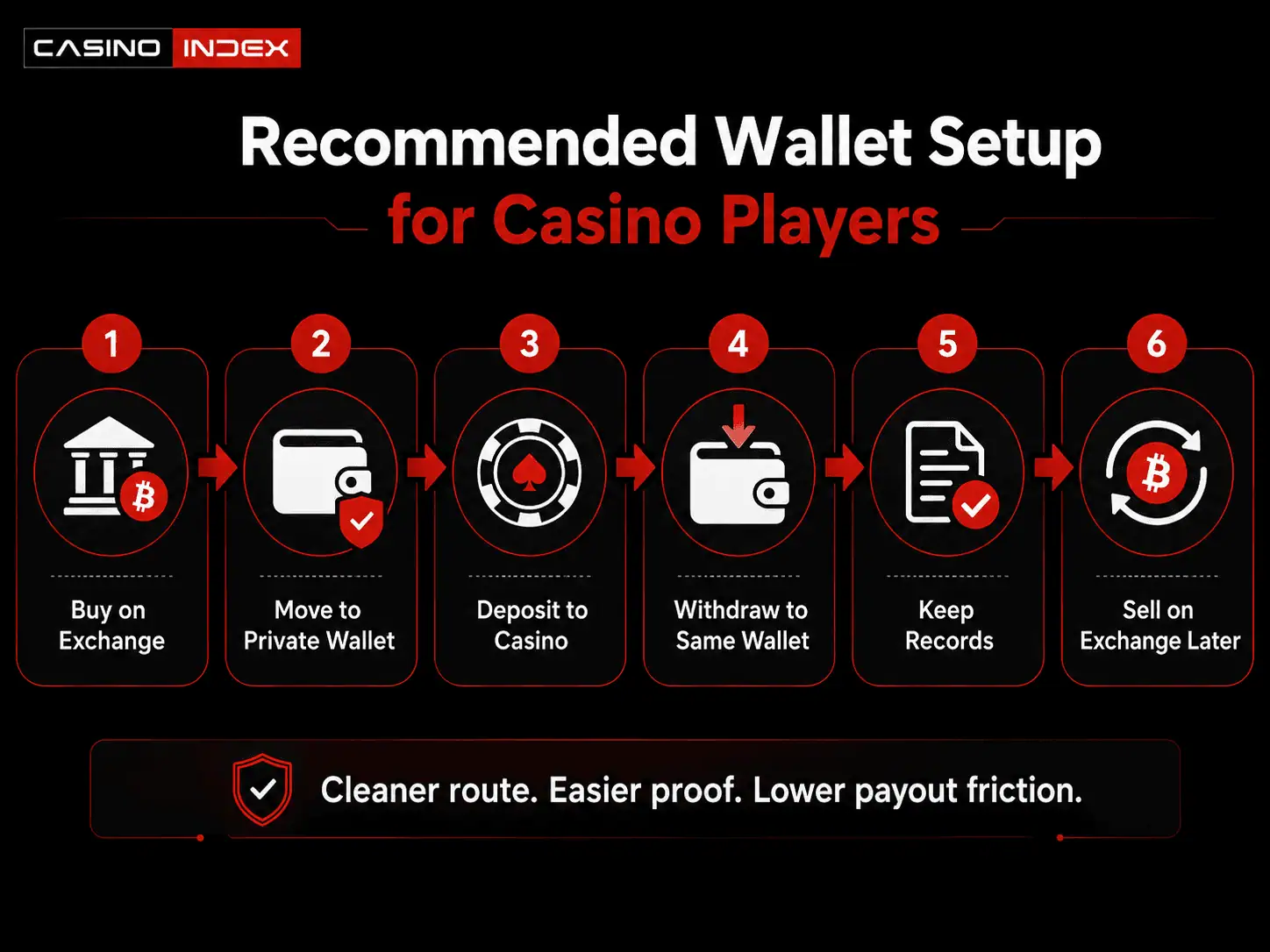
For most regular crypto casino players, the cleanest setup is simple.
An exchange works best for buying and selling crypto.
Your own wallet should handle casino deposits and withdrawals.
Larger balances belong in a hardware wallet or separate storage wallet.
| Step | Recommended Action | Why It Helps |
|---|---|---|
| 1 | Buy crypto on a reputable exchange | Creates a purchase record |
| 2 | Move funds to your own private wallet | Gives better ownership control |
| 3 | Deposit from that wallet to the casino | Creates a clean payment route |
| 4 | Withdraw back to the same wallet | Reduces payment matching questions |
| 5 | Keep transaction hashes and screenshots | Helps with reviews or disputes |
| 6 | Move to an exchange only when selling | Reduces withdrawal destination risk |
| 7 | Store larger balances outside the casino | Avoids unnecessary platform risk |
This setup is not perfect.
No wallet setup removes all casino risk.
But it gives the player a clearer explanation if a withdrawal review happens.
The goal is not to make gambling complicated.
The goal is to avoid preventable payout friction.
Common Wallet Mistakes Casino Players Should Avoid
Most wallet-related casino problems are avoidable.
The biggest mistakes are simple.
Using someone else’s wallet
This can trigger ownership and payment matching checks.
Withdrawing directly to an exchange without checking policy
The casino may release the funds, but the exchange may review the deposit.
Choosing the wrong network
USDT on TRON, Ethereum, BNB Chain, Polygon and other networks are not the same route.
Mixing too many wallets
More addresses can make the payment path harder to explain.
Keeping large balances at the casino
A casino account is not long-term storage.
Losing seed phrase access
A private wallet gives control, but recovery becomes your responsibility.
Ignoring source-of-funds records
If the casino asks where the funds came from, clean records help.
Good wallet hygiene is not paranoia.
It is payment clarity.
What You Should Do Before Your First Crypto Casino Deposit
Before depositing crypto to a casino, take a few minutes to check the route.
Use this checklist:
- decide whether funds start from an exchange or private wallet
- check the casino’s supported coin and network
- use a wallet you control
- avoid third-party wallets
- save exchange purchase records
- keep transaction hashes
- test a small deposit first
- test a small withdrawal before larger play
- withdraw to a wallet you can prove ownership of
- keep casino, wallet and exchange records together
A clean wallet path gives the casino less reason to pause a payout.
It also gives you stronger evidence if a review happens.
Final Verdict: Use Exchanges for Conversion, Private Wallets for Casino Movement
Custodial and non-custodial wallets both have a role in casino gambling.
An exchange wallet is useful for buying crypto, selling crypto and moving back to fiat. It is convenient, especially for beginners.
A private wallet is usually better for casino deposits and withdrawals. It gives clearer ownership control, a cleaner transaction path and stronger proof if the casino asks for wallet evidence.
The recommended strategy is clear:
Buy on an exchange. Move to your own wallet. Deposit from your own wallet. Withdraw back to your own wallet. Keep records. Use the exchange later only when you want to sell.
That does not remove all risk.
A casino can still request KYC, source-of-funds proof or wallet ownership evidence.
But a clean wallet setup makes those checks easier to answer.
For casino gambling, the best wallet is not just the one that holds crypto safely.
It is the one that helps you prove ownership, explain the payment route and avoid withdrawal destination problems when real money is on the line.
FAQ
Is a custodial wallet safe for casino gambling?
It can be convenient for buying or selling crypto, but it is less ideal for casino withdrawals because the exchange controls the wallet infrastructure.
Is a non-custodial wallet better for casino withdrawals?
Usually yes. A private wallet gives clearer ownership control and can make wallet-proof requests easier to answer.
Can I deposit to a casino directly from an exchange?
Sometimes, but it can create payment-route confusion. A private wallet between the exchange and casino is usually cleaner.
Can I withdraw casino winnings to an exchange?
It may work, but it carries destination risk. The exchange may review, delay or question gambling-related funds.
Why would a casino ask for wallet proof?
The casino may want to confirm that the deposit or withdrawal wallet belongs to the account holder.
What is a source-of-funds check?
It is a review asking where the crypto came from. This may involve exchange records, bank transfers, wallet history or proof of previous holdings.
Should I keep large balances at a casino?
No. A casino balance is not a wallet. Keep only what you plan to use for active play and withdraw unused funds to your own wallet.

Talha Aydin has been active in cryptocurrency since 2017 and is a co-founder of Freecoins24 and CryptoMutant. Over the years, he has worked with crypto projects on community growth, giveaways, user acquisition and digital strategy while gaining hands-on experience across blockchain platforms and crypto markets. At CasinoIndex, Talha focuses on crypto casinos, withdrawals, payment systems, platform trust and the risks players face when moving funds between wallets and gambling platforms.