Crypto Wallet Guide 2026: Safe Casino Deposits, Wallet Checks and Storage
How Crypto Wallets Protect Casino Players Before Deposit
Crypto changes how money moves at online casinos.
There are no bank intermediaries, no card chargebacks, and often fewer regional payment blocks. Transfers can move directly from a player’s wallet to a casino cashier. That is the main advantage.
At the same time, crypto removes many safety nets. A wrong address, wrong network, compromised device, copied wallet from an old transaction or careless approval can lead to permanent loss.
That is why wallet management is not a side detail. It is the first real safety step before using any crypto casino.
This Crypto Wallet Guide 2026 explains how wallets work, how to use them safely, how crypto deposits connect to online casinos, where wallet checks can appear before withdrawals, and how experienced players separate daily-use funds from long-term storage.
The goal is simple:
use crypto with control, not guesswork.
Players planning to use platforms listed among crypto casino platforms ranked by trust and payments should understand wallets before making the first deposit. A casino can be crypto-friendly, but the player still controls the most important first step: sending funds correctly.
What a Crypto Wallet Actually Is
The real function of a wallet
A crypto wallet does not store coins in the traditional sense.
It stores access.
More specifically, a wallet gives the user control over:
- the private key or seed phrase that controls funds
- the public address used to receive transactions
- the ability to sign transactions on a blockchain
The actual balance exists on the blockchain. The wallet allows the user to interact with that balance.
This distinction matters because losing wallet access usually means losing control of the funds. A bank account may have a recovery process. A self-custody crypto wallet usually does not.
Why wallet control matters for casino users
Online casino players often think about deposits first.
That is understandable. Deposits are the visible action. However, the wallet decision affects much more than the first transfer.
It can affect:
- whether the casino accepts the deposit
- whether the player sends funds through the correct network
- whether the withdrawal address matches expected wallet behavior
- whether wallet ownership questions appear later
- whether the player can move winnings away from the casino safely
- whether a compromised wallet can expose more funds than intended
A crypto wallet is therefore not only a payment tool. For casino users, it is part of the risk system.
Hot Wallets vs Cold Wallets
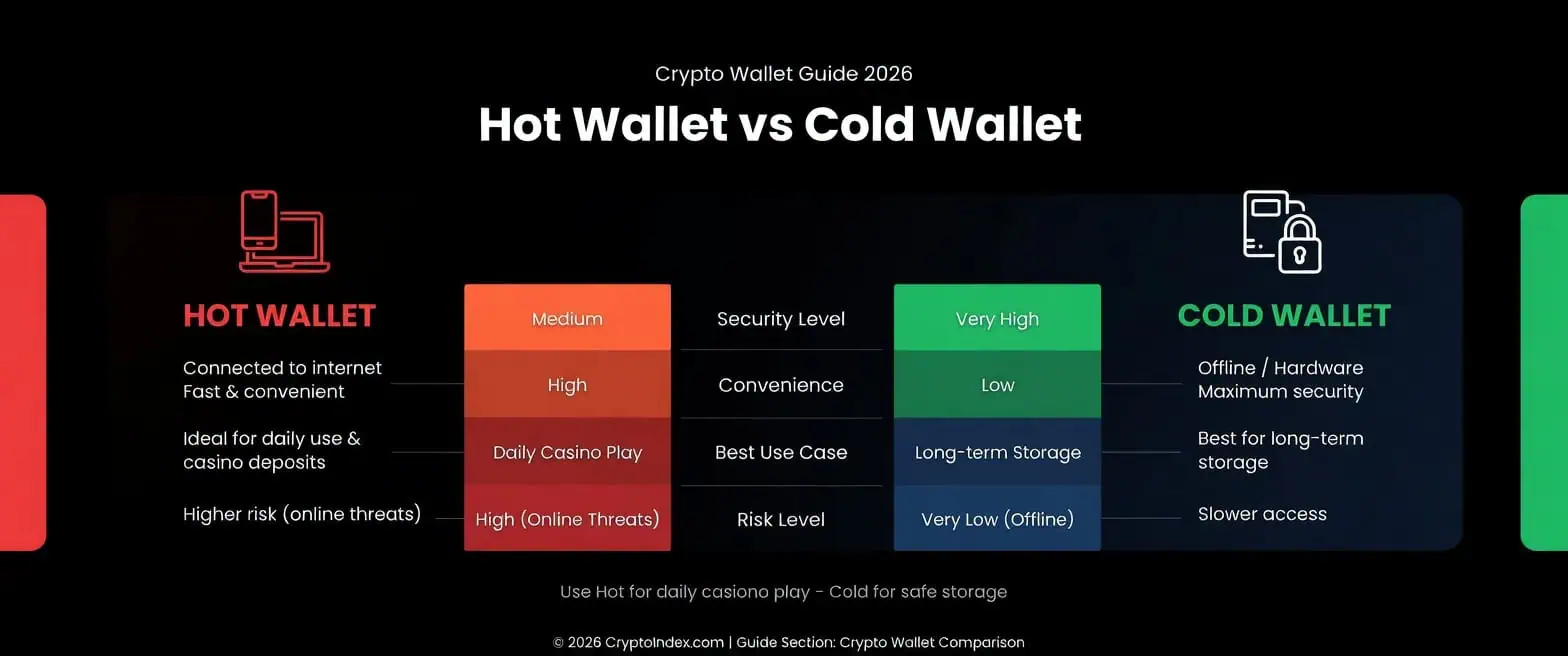
Understanding wallet types is essential before making any casino transfer.
The simplest split is between hot wallets and cold wallets.
Hot wallets for daily use
Hot wallets are connected to the internet.
They include:
- mobile wallets
- browser wallets
- desktop wallets
- exchange accounts
They are designed for speed and convenience.
That makes them useful for casino deposits, small withdrawals and active payment movement. A player can open the app, copy an address, check a transaction and move funds quickly.
Where hot wallets become risky
Hot wallets are also exposed to online risk.
The device can be compromised. A browser extension can be targeted. A fake app can imitate a real wallet. A phishing link can trick the user into approving a bad transaction.
Because of this, hot wallets should not hold large balances for long periods.
A good rule is simple:
use hot wallets for movement, not long-term storage.
Cold wallets for storage
Cold wallets are offline or designed to keep keys away from internet exposure.
Hardware wallets are the most common example. They are slower to use, but much safer for storing larger funds over time.
Cold wallets make more sense when the player has funds that are not needed for current casino activity.
The practical setup
Experienced crypto users usually separate wallet roles:
- hot wallet: casino deposits, small withdrawals and active use
- cold wallet: long-term storage and larger balances
This structure reduces exposure. If a hot wallet is compromised, the player does not lose the entire crypto balance.
Custodial vs Non-Custodial Wallets for Casino Gambling
Another important distinction is custody.
A wallet can be custodial or non-custodial. This matters more than many beginners realize, especially when casino deposits and withdrawals are involved.
Custodial wallets
A custodial wallet is controlled by a third party.
Exchange accounts are the most common example. The user can see a balance and request withdrawals, but the platform controls the infrastructure behind the wallet.
Custodial wallets are convenient for buying crypto. However, they create dependency.
The platform may:
- pause withdrawals
- request identity checks
- block certain destinations
- delay transfers during review
- change limits or supported networks
This can create problems when moving funds to or from gambling sites.
Non-custodial wallets
A non-custodial wallet gives the user control over the private key or seed phrase.
That means the user controls transactions directly. The trade-off is responsibility. If the user loses the seed phrase, sends funds through the wrong network or signs a malicious approval, support usually cannot reverse the mistake.
For casino players, non-custodial wallets are often preferred because they give more control over deposits and withdrawals. They also reduce dependency on exchange withdrawal policies.
CasinoIndex explains this deeper in custodial vs non-custodial wallets for casino gambling.
Best practical choice
The safest setup is not “only exchange” or “only self-custody.”
A practical flow looks like this:
- buy crypto through a trusted exchange
- move active funds to a personal hot wallet
- deposit from the personal wallet into the casino
- withdraw back to the same personal wallet where possible
- move larger winnings to cold storage
This keeps the exchange as a buying tool, not as the main gambling wallet.
Exchange Wallet vs Personal Wallet
The key difference
Beginners often leave funds on exchanges because it feels easy.
That can work for buying crypto, but it is weaker as a casino payment setup.
Exchange wallets:
- are controlled by the platform
- can limit withdrawals
- may block or delay transactions
- can require extra verification
- may not support every network the casino uses
A personal wallet gives the player more direct control.
Why personal wallets are usually better before casino use
With a personal wallet, the player controls the address and transaction flow.
That becomes important when moving funds to casinos because the user can check the correct coin, network, address and amount before sending.
It also creates a cleaner withdrawal path. Some casinos prefer withdrawals to return to the same wallet route used for deposit or may review payment consistency during cashout.
This does not mean a personal wallet removes casino-side checks. It simply gives the player more control over the payment layer.
Where payment flow fits in
Before making deposits, players should understand how different payment systems interact with casino cashiers.
The broader casino payment methods guide explains how crypto, cards, e-wallets and bank-style methods behave differently during deposit and withdrawal.
Buying Crypto the Right Way Before Casino Use
Before using a wallet at a casino, the player needs crypto.
The process is simple when structured correctly.
Step 1 — Choose a reliable exchange
Start with a trusted exchange that supports the coin and network you plan to use.
A platform like Bitunix can be used to buy crypto and transfer it to a wallet you control before interacting with any casino.
The key point is not the brand alone. The player should check whether the exchange supports the correct asset, network, withdrawal limits and identity requirements before buying.
Step 2 — Choose the right asset
For casino use, common options include:
- USDT: stable value and easier bankroll tracking
- Bitcoin: wide casino support and strong brand recognition
- Ethereum: broad ecosystem support but often higher fees
- Solana: low fees and fast confirmation when supported clearly
- Litecoin: practical speed and broad casino acceptance
Stablecoins are often preferred because they reduce price movement during gameplay. However, network choice still matters. USDT on TRON, Ethereum or BNB Chain are not the same route.
Step 3 — Move funds to your wallet
After buying crypto, move the amount you plan to use into your personal wallet.
This step removes dependency on third-party custody and shifts control to the player. It also allows the user to test small transfers before interacting with the casino.
Do not move the full balance at once unless you already know the network, wallet and casino cashier work correctly.
How Crypto Transactions Actually Work
The basic process
Every crypto transfer follows a simple structure:
- the sender wallet initiates the transaction
- the blockchain validates it
- the receiving wallet or platform credits the funds
For casino deposits, there is also a platform layer. The blockchain may show a confirmed transaction, but the casino still needs to credit the account internally.
That is why players should separate blockchain confirmation from casino account crediting.
Where errors happen
Most crypto mistakes happen during transfer setup.
Common problems include:
- incorrect address
- wrong network
- unsupported token
- missing memo or tag where required
- copying an old deposit address without checking current instructions
- sending from an exchange that blocks casino-related transfers
Many of these errors are irreversible.
Casino support may not be able to recover funds sent through the wrong network or to an unsupported address.
Transaction safety routine
Before sending crypto to any casino:
- verify the coin
- confirm the network
- copy the address directly from the casino cashier
- check whether a memo or tag is required
- send a small test transaction first
- wait for confirmation
- then send the larger amount only if everything credits correctly
Even experienced users follow this process every time.
Networks Explained: The Mistake That Costs Players Money
Why networks matter
Many tokens exist across multiple blockchains.
For example, USDT can run on:
- Ethereum as ERC-20
- TRON as TRC-20
- BNB Chain as BEP-20
- Solana as SPL, where supported
Each network operates separately.
A casino supporting USDT does not automatically support every USDT network.
The real risk
If networks do not match, funds may not arrive.
Recovery can be difficult or impossible.
This is one of the most common beginner mistakes in crypto casino payments. The player sees the correct token name but sends through the wrong chain.
That is why the cashier must be read carefully before every deposit.
Safe network practice
Use this rule:
the coin, network and address must all match.
Do not assume. Do not reuse old addresses without checking. Not send because the coin name looks right.
If the casino cashier says USDT TRC-20, do not send USDT ERC-20. If it says native SOL, do not send a wrapped token or a different chain version.
CasinoIndex explains the wider deposit process in how crypto deposits work at online casinos.
Fees and Transaction Speed
Why costs differ
Each blockchain has different fee behavior.
Typical patterns include:
- Ethereum: higher fees during busy periods
- Bitcoin: moderate fees, depending on network conditions
- TRON: often practical for stablecoin transfers
- Solana: fast confirmations and low transaction cost when supported properly
- Litecoin: practical for many casino deposits and withdrawals
Lower fees make small test deposits more practical.
That matters because the safest casino approach is to test first, not to deposit a large amount immediately.
Speed does not equal payout reliability
Fast blockchain speed does not guarantee fast casino withdrawals.
A crypto network can confirm quickly while the casino still reviews the withdrawal internally. The casino may check account history, bonus use, wallet behavior, payment ownership, KYC status or withdrawal limits before releasing funds.
This distinction is critical.
Crypto helps with transaction movement. It does not remove casino-side approval risk.
CasinoIndex explains the payout side in the casino withdrawal guide.
Efficient usage
Frequent users usually prefer networks with:
- lower fees
- clear exchange support
- good wallet support
- fast confirmations
- casino cashier clarity
The best choice is not always the fastest chain. It is the chain the casino supports clearly and the player can use without confusion.
How Crypto Casino Wallet Checks Work
Crypto wallets give players more control, but they can also become part of casino risk review.
A casino may check wallet behavior before approving withdrawals, especially when account activity looks unusual or when payout size increases.
What casinos may review
Wallet checks can include:
- whether deposits and withdrawals use consistent wallet routes
- whether the wallet looks newly created
- whether the account uses many unrelated wallet addresses
- whether crypto movement looks like pass-through behavior
- whether the wallet is linked to high-risk activity
- whether payment ownership needs confirmation
- whether withdrawal behavior changes suddenly after a win
Not every wallet check is unfair.
Some checks exist to prevent fraud, money laundering, bonus abuse, account resale or third-party payments. The problem starts when the casino gives no clear explanation, repeatedly asks for unrelated documents or uses vague wallet concerns to delay legitimate withdrawals.
CasinoIndex explains this deeper in how crypto casino wallet checks work.
How players reduce wallet-check friction
Players can reduce avoidable risk by keeping wallet behavior simple.
A safer pattern looks like this:
- use one clean personal wallet for casino activity
- avoid switching wallet addresses without reason
- do not deposit from someone else’s wallet
- avoid using the casino as a pass-through payment tool
- keep records of exchange purchases and transfers
- withdraw winnings back to your own wallet
This does not guarantee instant approval. However, it gives the casino fewer reasons to question the payment path.
Choosing the Right Wallet Tool
What matters more than the wallet name
Many players ask which wallet is “best.”
The better question is whether the wallet supports the coin, network and security routine needed for casino use.
A suitable wallet should offer:
- support for the coins you actually use
- clear network selection
- easy address checking
- strong backup options
- device-level security
- transaction history visibility
- reliable wallet updates
Practical example
A widely used option is Trust Wallet, known for multi-chain support and direct control over private keys.
Other users may prefer MetaMask for EVM networks, Phantom for Solana activity or hardware wallets for cold storage.
The correct choice depends on the coins and casinos the player uses.
Wallet choice and casino fit
A wallet that works well for one casino may not be ideal for another.
For example, a Solana-focused player needs strong SOL support. A USDT TRC-20 user needs a wallet and exchange route that handle TRON clearly. A MetaMask user needs to understand gas fees and wrong-chain risk.
Wallet choice should match payment behavior, not trend popularity.
How to Store Crypto Safely
Do not keep everything in one place
Storing all funds in a single wallet increases risk.
If that wallet is compromised, the damage is larger.
Instead, experienced players separate usage.
Practical storage model
A simple model looks like this:
- exchange account: buying crypto
- hot wallet: active casino deposits and small withdrawals
- cold wallet: long-term storage and larger balances
This structure reduces exposure.
If one wallet has a problem, the rest of the funds remain separated.
Why this works
The goal is not to make crypto risk disappear.
The goal is to limit the damage from one failure.
A casino account can be reviewed. A hot wallet can be compromised. An exchange can pause withdrawals. A device can fail.
Separation prevents one problem from becoming a total loss.
The Advanced Wallet Setup Used by Experienced Players
At this stage, basic usage is not enough.
Experienced users do not rely on a single wallet or a single flow. Instead, they build a structured system that separates risk, improves speed and maintains control.
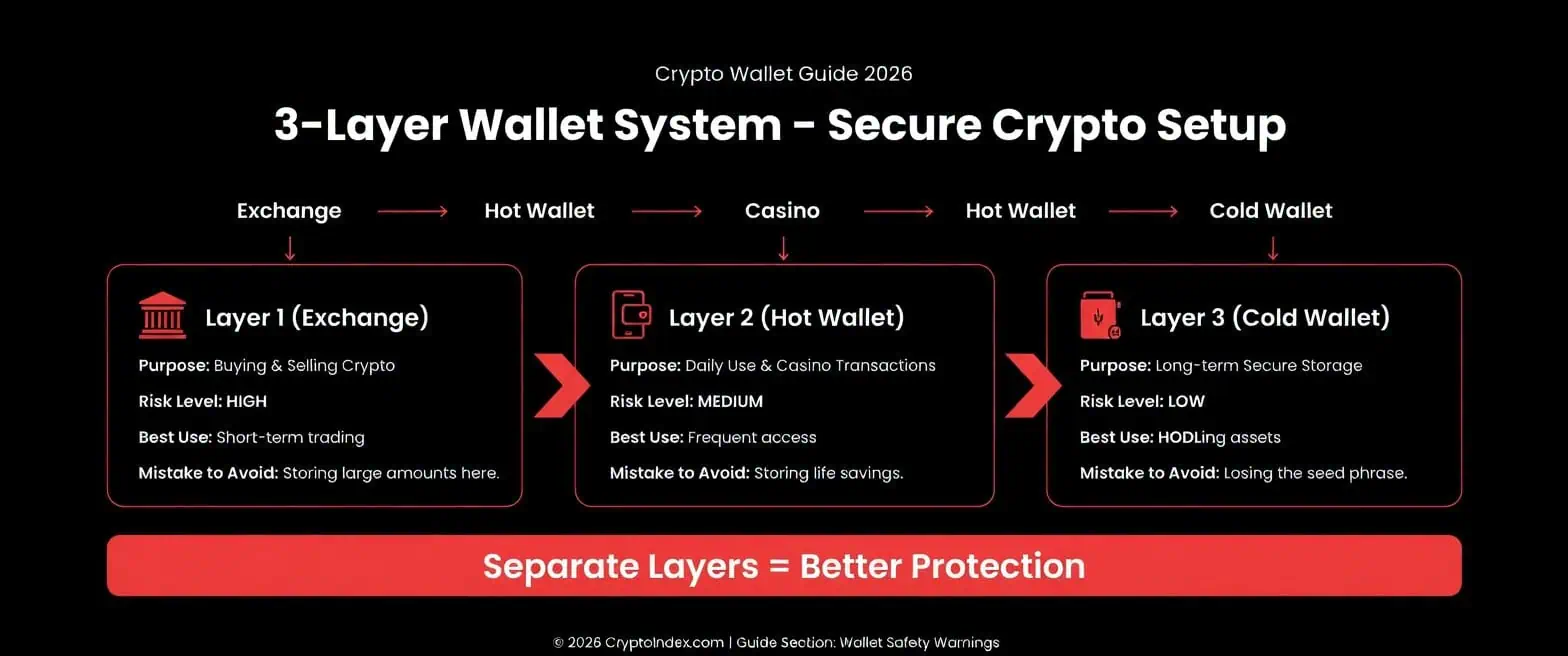
The 3-layer wallet system
A practical setup looks like this:
- exchange account: buying crypto
- hot wallet: daily usage
- cold wallet: long-term storage
Each layer has a clear role.
How funds move in this system
The flow is controlled:
exchange → hot wallet → casino → hot wallet → cold wallet
This helps players keep control over funds, reduce exposure inside casinos and move winnings into safer storage after sessions.
Why this structure works
It limits risk at every step.
If something fails, only a smaller portion should be affected.
For example, if the casino delays a withdrawal, cold storage remains untouched. If the hot wallet is compromised, the cold wallet should still protect larger balances. If an exchange pauses withdrawals, funds already moved to personal custody remain outside that platform.
How to Connect Your Wallet to a Casino
The deposit process
Crypto casino deposits usually follow a simple structure:
- choose the coin inside the casino cashier
- select the correct network
- copy the deposit address from the casino
- send funds from your wallet
- wait for blockchain confirmation
- wait for casino account crediting
The last step matters. A transaction may be confirmed on-chain before the casino balance updates.
Where problems occur
Issues usually happen when:
- networks do not match
- unsupported tokens are used
- addresses are copied incorrectly
- players send from an exchange with withdrawal restrictions
- a memo or tag is missing
- the player assumes one network works because another casino accepted it
Most of these errors are preventable.
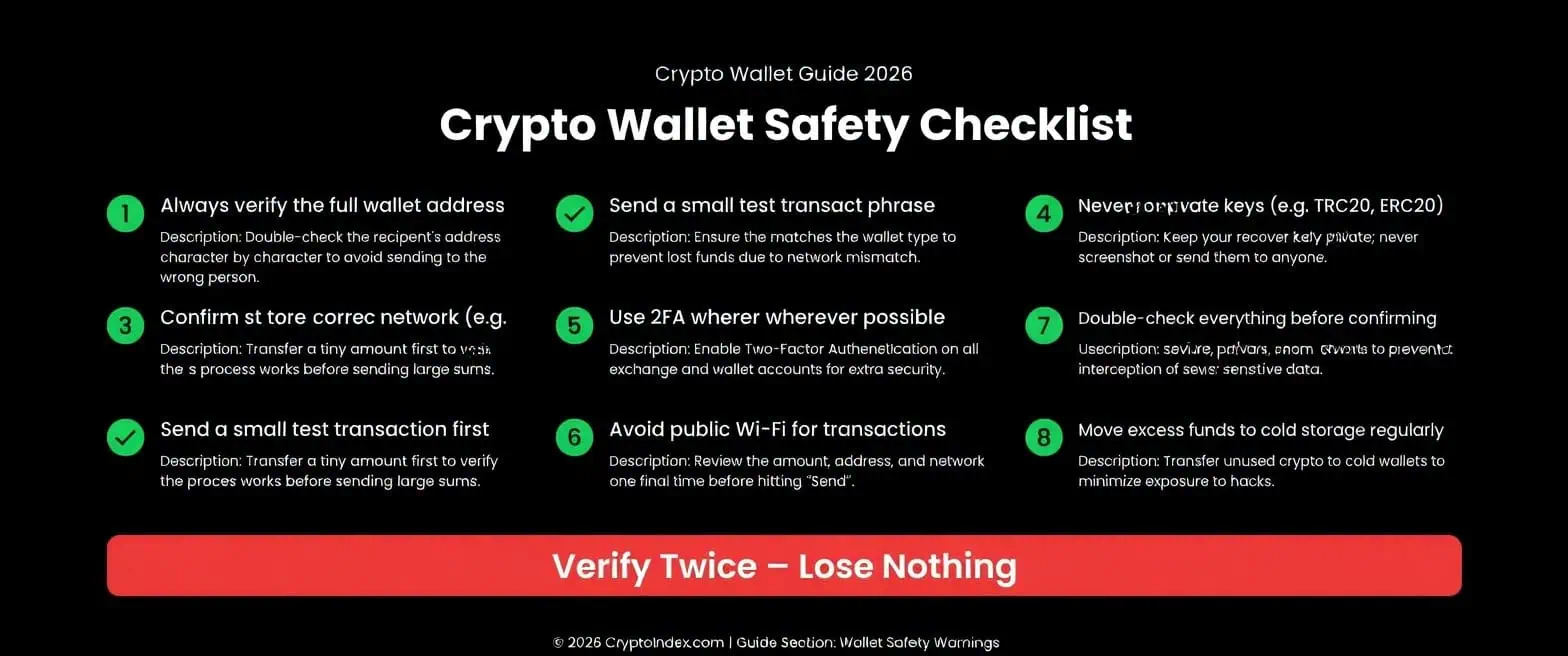
Safe deposit routine
Use this process every time:
- Select the correct coin.
- Select the correct network.
- Copy the address carefully.
- Check whether a memo or tag is required.
- Send a small test transaction.
- Confirm the casino credits it.
- Send the full amount only after the test works.
This process prevents most avoidable deposit errors.
Choosing the right casino platform
Not all casinos handle crypto equally.
Some platforms explain networks, limits and deposit addresses clearly. Others simply show a wallet address and leave the user to guess.
For wallet-based users who want a Solana-focused brand example, the SolCasino review for wallet-based users can help compare cashier expectations, wallet usage and payout-stage risk against broader crypto casino options.
For general crypto deposit process, use the guide to how crypto deposits work at online casinos.
Managing Fees and Speed Efficiently
Why fees matter
Frequent transfers increase costs.
If fees are high, the player loses value before even reaching the game.
This matters most for:
- small test deposits
- repeat withdrawals
- stablecoin transfers
- players moving funds between exchange, wallet and casino
Efficient network choice
For many users, lower-fee routes are more practical.
Common examples include:
- TRON for USDT transfers where supported
- Solana for fast, low-cost movement where the casino supports native SOL
- Litecoin for simple, practical casino transfers
The correct route is always the one the casino cashier supports clearly.
Timing transactions
Network activity can affect speed and cost.
During busy periods, fees may increase and confirmations can slow down.
Planning transfers helps, but it does not solve casino-side review. A withdrawal can still wait for approval even when the network itself is fast.
The Human Factor: The Most Overlooked Wallet Risk
Where most errors come from
Most crypto losses do not come from advanced attacks.
They come from simple mistakes:
- rushing transfers
- skipping address checks
- ignoring networks
- trusting copied wallet addresses
- signing approvals without reading
- storing seed phrases poorly
- keeping too much money in one hot wallet
Why this happens
Crypto feels fast.
That speed can make players careless.
A casino deposit may feel routine after a few transfers, but every transaction still needs precision.
Small mistakes can create permanent consequences.
Consistency framework
Use the same process every time:
- slow down
- check coin
- check network
- check address
- check memo or tag
- send small first when unsure
- confirm receipt
Consistency protects funds better than confidence.
How Wallet Security Connects to Casino Trust
Wallet safety is only one part of the system.
The casino itself also matters.
A player can use the perfect wallet setup and still face payout friction if the casino has weak withdrawal rules, unclear KYC triggers, poor support, vague payment terms or repeated public complaints.
What wallet security cannot fix
A strong wallet cannot fix:
- unclear casino withdrawal limits
- late-stage KYC without explanation
- bonus terms that block cashouts
- payment matching disputes
- operator-side approval delays
- support that cannot explain transaction issues
This is why CasinoIndex separates blockchain efficiency from casino trust.
Crypto can move quickly. The casino still decides whether to approve, review or delay a payout.
How to evaluate the casino side
Before using a wallet with any gambling site, check whether the casino explains:
- supported coins and networks
- deposit minimums
- withdrawal minimums
- fees
- KYC triggers
- payment ownership expectations
- withdrawal approval checks
- bonus restrictions before cashout
CasinoIndex explains broader platform security in the casino security guide.
Casino Wallet Checklist Before You Deposit
| Check | Why It Matters | Risk If Ignored |
|---|---|---|
| Coin | The casino must support the exact asset | Deposit may not credit |
| Network | The blockchain route must match the cashier | Funds can be lost or hard to recover |
| Address | The address must come from the current casino cashier | Funds may go to the wrong destination |
| Memo / tag | Some coins require extra identifying information | Deposit may not be credited automatically |
| Wallet ownership | Some casinos review wallet consistency before payout | Withdrawal may trigger extra checks |
| Test transfer | Small deposits prove the route works | Larger mistakes become more expensive |
| Withdrawal route | The payout path matters before you deposit | Cashout may be delayed or restricted |
This table is the practical minimum.
If a player cannot confirm these details, the deposit should wait.
Best Wallet Setup by Player Type
| Player Type | Best Wallet Setup | Main Risk to Avoid |
|---|---|---|
| Beginner | Exchange for buying, simple personal wallet for small casino deposits | Wrong network and exchange dependency |
| Frequent casino user | Dedicated hot wallet for casino activity plus cold storage for larger funds | Keeping too much inside one active wallet |
| Stablecoin user | Wallet that clearly supports the chosen USDT or USDC network | Sending stablecoins through the wrong chain |
| Solana user | Wallet with clear native SOL support and a small test-transfer habit | Assuming every SOL-friendly casino handles the same route |
| High-balance user | Hot wallet for active play, cold wallet for long-term storage | Exposing large funds to daily-use risk |
Common Crypto Wallet Mistakes in Online Casinos
Using the exchange as the gambling wallet
Many beginners deposit directly from exchanges.
This can work, but it adds dependency. The exchange may block certain transfers, delay withdrawals, require extra checks or change network support.
A personal wallet gives the player more control.
Ignoring the withdrawal path
Some players check only whether deposits work.
That is not enough.
The withdrawal route should be checked before deposit. If the casino only supports withdrawals through specific networks, minimums or verification stages, the player should know that early.
Reusing old casino addresses
Deposit addresses can change.
Some casinos generate unique addresses by coin, network or account session. Reusing an old address without checking the current cashier can create unnecessary risk.
Holding large balances inside casinos
A casino account is not a wallet.
It is an account inside a platform controlled by an operator. Once funds sit inside the casino, withdrawals depend on that operator’s rules, approval checks and account review process.
Keep only the balance needed for current play.
FAQ: Crypto Wallets and Casino Gambling
What is the safest crypto wallet for casino use?
The safest setup is usually a personal hot wallet for active casino use and cold storage for larger balances. The hot wallet handles deposits and small withdrawals. The cold wallet protects funds that are not needed for current play.
Should I deposit to casinos directly from an exchange?
It is usually better to move funds from the exchange to a personal wallet first. Exchange wallets are custodial, and the platform can delay withdrawals, restrict destinations or require extra checks. A personal wallet gives more control over the payment route.
What is the biggest wallet mistake casino players make?
The biggest mistake is sending the right coin through the wrong network. For example, USDT on TRON and USDT on Ethereum are not the same route. The coin, network and address must all match the casino cashier.
Can casinos check my crypto wallet?
Casinos may review wallet activity when withdrawals trigger risk checks. That can include wallet consistency, payment ownership, unusual movement, high-risk activity or deposit and withdrawal behavior. This is why wallet hygiene matters before cashout.
Do crypto wallets remove KYC?
No. A wallet gives payment control, but the casino can still request KYC. Verification may appear during large withdrawals, suspicious activity, bonus disputes, payment ownership questions or source-of-funds checks.
Are non-custodial wallets better for gambling?
Non-custodial wallets give players more control because they hold their own keys. They are usually better for casino payment control, but they also require more responsibility. If the seed phrase is lost or a transaction is sent incorrectly, recovery may not be possible.
Should I use a separate wallet for casino gambling?
Yes, a dedicated hot wallet for casino activity is usually safer. It separates gambling payments from long-term storage and reduces exposure if a casino account, browser wallet or device has a problem.
What should I do before my first crypto casino deposit?
Check the coin, network, deposit address, memo or tag, minimum deposit and withdrawal route. Then send a small test transaction before moving a larger amount.
Can wallet checks delay withdrawals?
Yes. Wallet checks can delay withdrawals when the casino reviews address history, payment consistency, ownership concerns or unusual transaction patterns. A clean and consistent wallet route reduces avoidable friction.
Is a crypto casino wallet the same as my personal wallet?
No. A casino balance is not the same as a personal wallet balance. Once funds are inside the casino, the operator controls the account system. A personal wallet gives you direct control outside the casino.
Final View: Wallet Control Comes Before Casino Trust
A crypto wallet gives players control, but that control only helps when the player uses it carefully.
The safest casino users do not rush deposits. They choose the correct wallet, match the network, send small test transfers, keep long-term funds away from daily-use wallets and understand that withdrawals still depend on casino approval.
Crypto improves payment speed and flexibility. It does not remove risk.
The key lesson is simple:
A good wallet setup protects the player before deposit. A trustworthy casino proves itself when the player tries to withdraw.

Talha Aydin has been active in cryptocurrency since 2017 and is a co-founder of Freecoins24 and CryptoMutant. Over the years, he has worked with crypto projects on community growth, giveaways, user acquisition and digital strategy while gaining hands-on experience across blockchain platforms and crypto markets. At CasinoIndex, Talha focuses on crypto casinos, withdrawals, payment systems, platform trust and the risks players face when moving funds between wallets and gambling platforms.