How Online Casino Dispute Resolution Actually Works
A casino dispute does not start when a player posts a complaint online.
It starts earlier.
It starts when the normal process breaks: a withdrawal stays pending, a KYC check keeps moving, bonus winnings disappear, support gives vague answers, or the casino closes an account without explaining what happens to the balance.
At that point, the player often feels cheated. The casino may claim it is still reviewing documents, payment ownership, bonus use, game records, or account risk.
Online casino dispute resolution is the process of turning that conflict into a clear case.
That matters because frustration alone does not win disputes. Evidence does. A player may be right and still lose if the timeline is messy, screenshots are missing, or the complaint cannot show exactly what the casino did wrong.
This guide explains how online casino dispute resolution actually works, what happens at each stage, what evidence matters, how complaint platforms and regulators fit in, and when the player’s case may be weaker than it first appears.
Quick answer: how does online casino dispute resolution work?
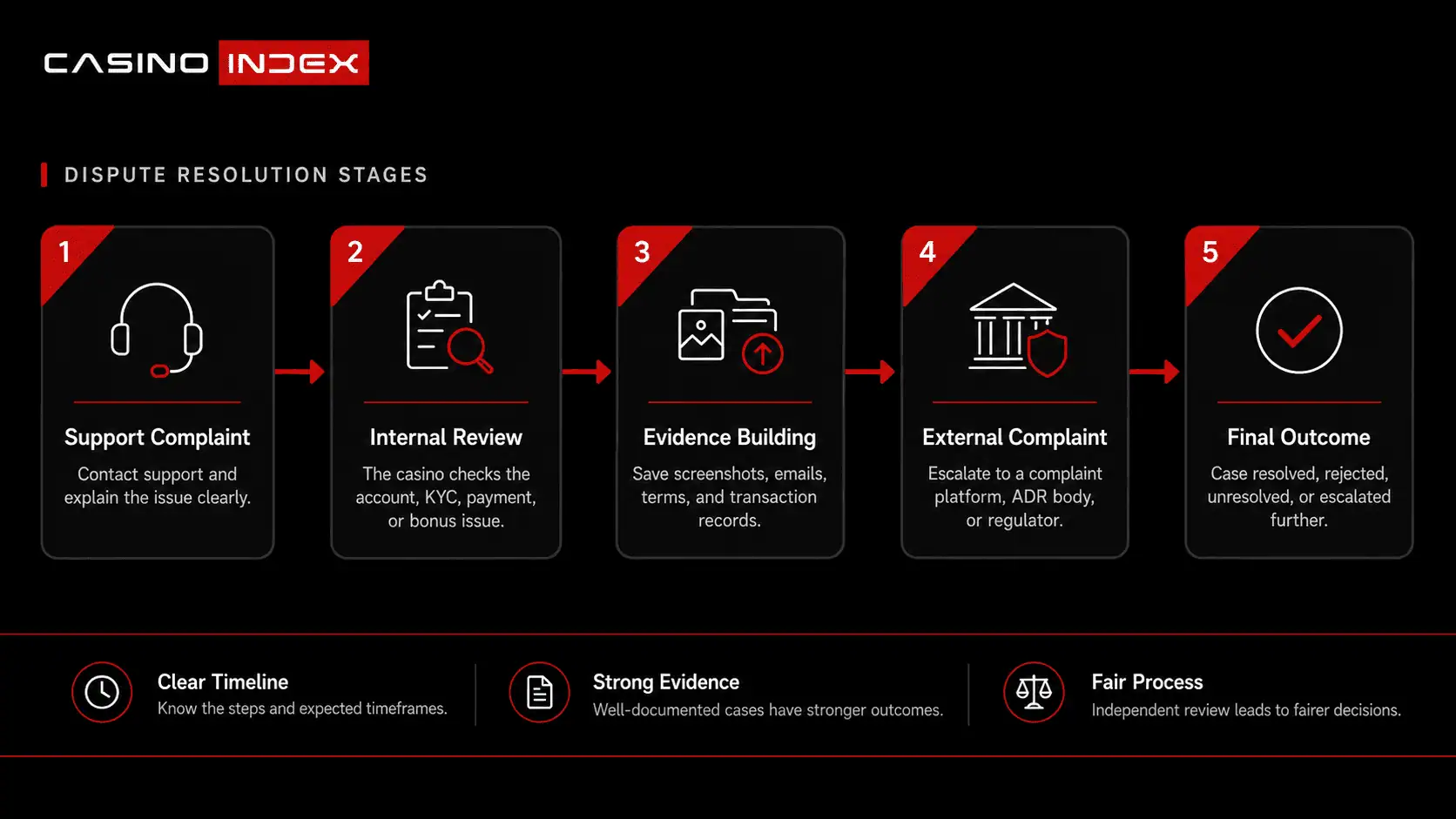
Online casino dispute resolution usually follows five stages.
| Stage | What happens | What the player should do | Main risk |
|---|---|---|---|
| Support complaint | Player contacts the casino first | Stay factual and save all replies | Emotional messages create a weak record |
| Internal review | Casino checks account, KYC, payments, bonus use, or gameplay | Ask for the reason in writing | Support may stay vague or delay |
| Evidence building | Player collects screenshots, emails, terms, transactions, and timeline | Build a clean case file | Missing proof makes the case harder |
| External complaint | Player escalates to a complaint platform, ADR body, or regulator | Choose the right route | Some bodies cannot force payment |
| Final outcome | Case is resolved, rejected, unresolved, or escalated further | Focus on facts, not assumptions | Weak cases often fail here |
The strongest disputes have a clear timeline, saved terms, account records, transaction details, and written casino replies.
The weakest disputes rely only on anger.
How CasinoIndex evaluates casino disputes
CasinoIndex does not treat every complaint as proof that a casino is unsafe.
That would be too simple.
Large casinos receive complaints because they process large volumes of deposits, withdrawals, bonuses, and verification checks. Some complaints show real operator risk. Others come from player mistakes, missing evidence, misunderstood terms, or losses being framed as unfair treatment.
CasinoIndex looks at dispute resolution through five questions.
First, what type of dispute is it? A delayed withdrawal is different from a bonus-rule dispute. A KYC issue is different from a gameplay complaint.
Second, did the player provide evidence? Screenshots, timestamps, emails, transaction IDs, and terms matter more than strong wording.
Third, did the casino explain its decision? A casino does not always have to reveal every fraud-control detail, but it should identify the rule, process, or review behind the decision.
Fourth, was the rule clear before the player deposited, accepted a bonus, or requested a withdrawal? Terms applied after the fact are a stronger risk signal.
Fifth, does the same issue appear across other complaints? One case may be unclear. Repeated unpaid withdrawal complaints, repeated KYC loops, or repeated bonus confiscations create a stronger pattern.
That is where many basic dispute guides stop too early. They explain “contact support, then complain.” CasinoIndex goes further by looking at the quality of the case, the casino’s response, the rule being applied, and the wider complaint pattern.
CasinoIndex explains this deeper reading process in its guide to how public casino complaints should be read before trusting them.
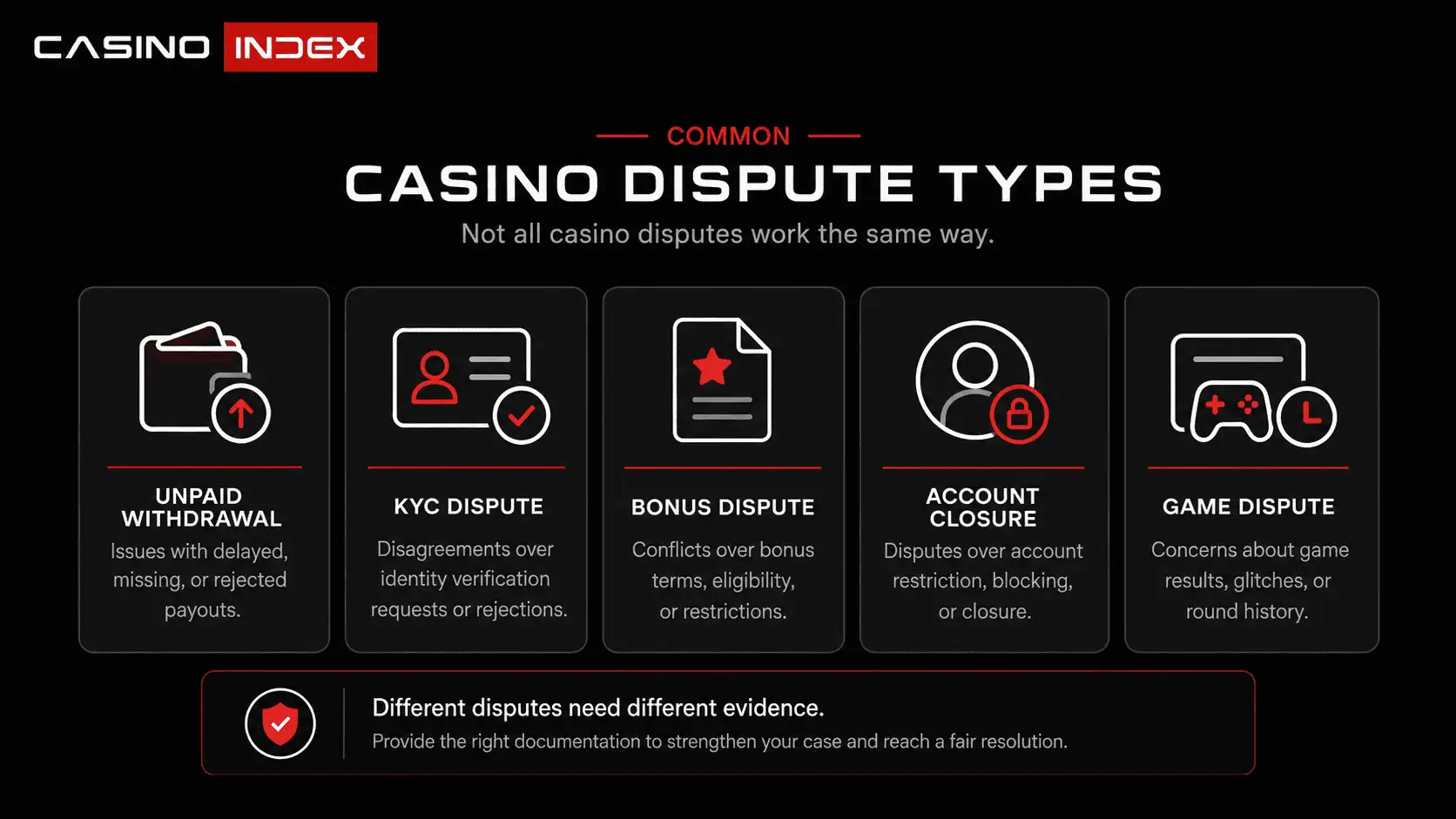
The main casino dispute types
Not all casino disputes work the same way.
The type of dispute decides which evidence matters and where the player’s risk sits.
| Dispute type | What usually matters most | Strong player evidence | When the player’s case is weak |
|---|---|---|---|
| Unpaid withdrawal | KYC, payment ownership, approval checks, limits | Pending withdrawal screenshot, support replies, transaction records | Stated withdrawal time has not passed |
| KYC dispute | Identity match, document quality, account details | Upload records, clear documents, email confirmations | Documents are edited, unclear, or inconsistent |
| Bonus dispute | Max bet, wagering, restricted games, max cashout | Bonus terms, gameplay history, bet records | Clear bonus rule was broken |
| Account closure | Duplicate accounts, restricted country, self-exclusion, fraud checks | Account history, terms, support explanations | Multiple accounts or VPN breach exists |
| Payment dispute | Deposit ownership, payment matching, chargebacks, crypto transaction match | Wallet records, bank proof, transaction ID | Payment method is not in player’s name |
| Game dispute | Round ID, provider logs, session history | Game ID, timestamp, screenshots | No round data or only suspicion exists |
This table is important because players often treat all disputes the same.
They are not the same.
A bonus dispute needs bonus evidence. A KYC dispute needs document history. An unpaid withdrawal complaint needs payment and approval records. A game dispute needs round IDs and provider logs.
The wrong evidence makes even a valid complaint harder to prove.
Stage 1: contact casino support first
The first stage is almost always casino support.
This is where many players damage their own case.
They open live chat while angry, accuse the casino of stealing, send long messages, and repeat the same claim in different words. That may feel understandable, but it rarely helps.
Support teams usually need specific information:
- account username or registered email
- disputed amount
- withdrawal date
- payment method
- transaction ID
- bonus name, if a bonus was used
- KYC status
- screenshots or emails
- exact outcome requested
A strong message is short and factual.
Example:
“My withdrawal of €850 requested on 12 March is still pending. My account shows verified status, and support confirmed on 13 March that all documents were received. Please confirm the current reason for the delay and whether any action is still required from my side.”
That gives the casino something to answer.
A weak message says:
“You are a scam casino and stole my money.”
That may describe how the player feels, but it does not create a clean record.
At this stage, the goal is not to win the entire dispute. The goal is to get the casino’s position in writing.
Stage 2: wait for the internal review, but control the timeline
Once support logs the issue, the case may move to payments, compliance, risk, fraud, bonus, or account security staff.
Players often do not see these teams directly. Still, their review may decide whether the casino pays, asks for more documents, voids winnings, or closes the account.
Common review triggers include:
- large or unusual withdrawal
- first withdrawal from the account
- bonus winnings
- mismatched payment details
- unclear KYC documents
- duplicate-account concerns
- restricted-country concerns
- suspicious gameplay patterns
- source-of-funds checks
Not every review is unfair.
A safe casino can still check identity, payment ownership, bonus compliance, and fraud risk before approving a withdrawal.
The problem starts when the casino gives no clear reason, keeps changing the request, ignores valid documents, or applies unclear rules only after the player wins.
The player should ask direct questions:
- Which term is being applied?
- Which document is still missing?
- Which transaction is under review?
- Has the withdrawal been approved, rejected, or still pending?
- Is this the casino’s final decision?
- What is the expected review timeframe?
Those questions create a better record if the case later moves outside the casino.
CasinoIndex explains this stage in more detail in its guide to what happens before a casino approves a withdrawal.
Stage 3: build the evidence file
Evidence decides most disputes.
A complaint without evidence is a story. A complaint with evidence is a case.
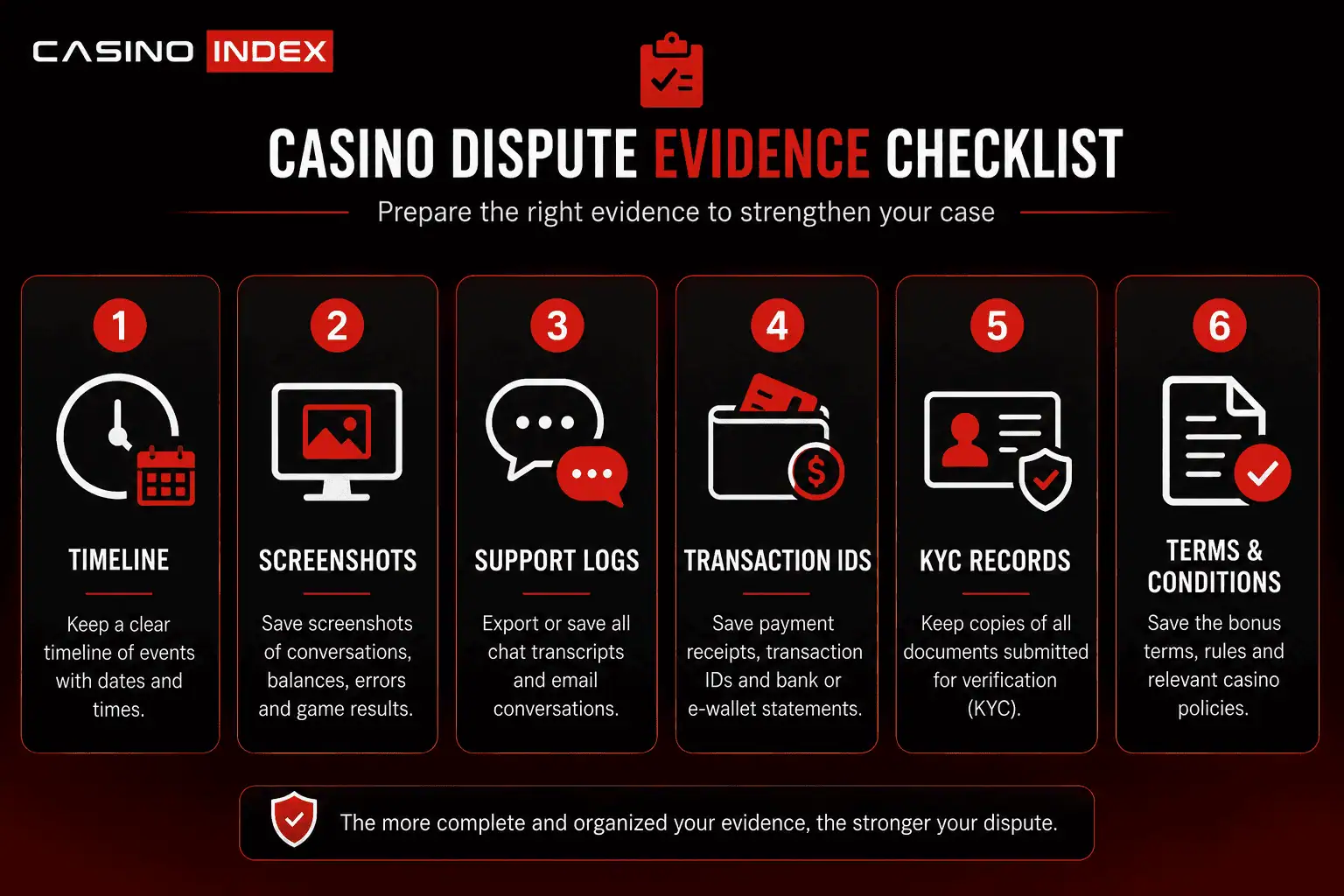
Players should collect records before submitting an external complaint. This includes account screenshots, cashier records, emails, live chat transcripts, KYC upload confirmations, bonus terms, and transaction IDs.
The strongest evidence file usually includes:
| Evidence | Why it matters |
|---|---|
| Withdrawal screenshot | Shows amount, date, and pending status |
| Support emails | Shows what the casino confirmed or denied |
| Live chat transcripts | Shows promises, explanations, or delays |
| KYC upload records | Shows when documents were submitted |
| Bonus terms screenshot | Shows the rules active at the time |
| Transaction ID | Helps prove deposit or withdrawal movement |
| Account status screenshot | Shows whether the account is verified, blocked, or limited |
| Timeline summary | Helps reviewers understand the case quickly |
The timeline is especially important.
A good timeline looks like this:
- 4 March: deposited €100 by USDT
- 4 March: claimed 100% bonus
- 5 March: completed wagering
- 5 March: requested €620 withdrawal
- 6 March: submitted ID and address proof
- 8 March: support confirmed documents received
- 12 March: casino requested source of funds
- 15 March: submitted bank statement
- 20 March: withdrawal still pending with no final decision
That is much easier to review than a long emotional complaint.
Also save the terms as soon as the dispute starts. Casino terms can change. A screenshot or archived copy helps show which rules existed when the player deposited, claimed a bonus, or requested payment.
Stage 4: unpaid withdrawal disputes
Unpaid withdrawal complaints are the most serious casino disputes.
They usually begin when the player requests a cashout and the money does not arrive within the expected timeframe.
The casino may say the withdrawal is pending, under review, waiting for KYC, delayed by payment checks, affected by bonus review, or subject to manual approval.
A delay alone does not prove misconduct.
A delay becomes more concerning when the casino gives no reason, repeats the same vague response, asks for unrelated documents, changes the explanation, or stops replying.
The player should first check the casino’s stated withdrawal timeframe. If that timeframe has passed, ask for the exact reason.
The important question is not only “Where is my money?”
It is:
“Which process is stopping this withdrawal from being approved?”
That answer tells the player what evidence to prepare.
Match the evidence to the issue. A KYC dispute needs document records. A payment-matching dispute needs proof of payment ownership. A bonus review needs the bonus terms and gameplay history. A withdrawal-limit issue needs the cashier rules and limit details.
Stage 5: KYC and verification disputes
KYC disputes happen when the casino asks for identity documents, address proof, payment ownership proof, selfies, source-of-funds documents, or additional verification.
Some checks are normal.
Casinos may need to prevent fraud, underage gambling, duplicate accounts, payment misuse, and restricted-country access.
The dispute starts when the process becomes unclear or unreasonable.
Warning signs include repeated rejection without explanation, new document requests after every upload, unclear image-quality standards, long silence after submission, or payout delays with no status update.
A player’s case is stronger when they can show:
- documents were valid
- images were clear
- account details matched the documents
- documents were submitted on time
- the casino confirmed receipt
- no new reason was given for rejection
A player’s case is weaker when the name does not match, the address changes, the payment method belongs to someone else, documents look edited, or the player refuses reasonable checks.
This is why players should use accurate account details from the start. Small shortcuts during registration can become serious problems during withdrawal.
Stage 6: bonus disputes
Bonus disputes are often harder than players expect.
Casinos usually rely on detailed bonus terms. These may include wagering requirements, max bet rules, restricted games, max cashout limits, time limits, country restrictions, and bonus abuse clauses.
A player may feel the casino voided winnings unfairly. The casino may argue that the player broke a written rule.
The case usually depends on three questions:
- Was the rule clear before the player accepted the bonus?
- Did the player actually break it?
- Did the casino apply the rule fairly?
A strong bonus complaint includes the bonus terms, gameplay history, bet sizes, wagering status, and the casino’s written explanation.
A weak bonus complaint only says “I won and they cancelled it.”
That is not enough.
Bonus disputes show why players should screenshot the bonus terms before claiming an offer. The headline bonus is rarely the issue. The real dispute usually sits in the rules underneath it.
Stage 7: account closure and game disputes
Account closures can involve duplicate accounts, self-exclusion, restricted countries, failed verification, bonus abuse, suspicious activity, or payment concerns.
These cases can be difficult because casinos may not reveal every fraud-control detail.
The player should ask which term was used to close the account and what happens to deposits, real-money balance, and winnings.
There is a major difference between:
- closing an account and paying the legitimate balance
- closing an account and voiding bonus winnings under clear terms
- closing an account and keeping funds without a clear explanation
The last situation deserves closer scrutiny.
Game disputes are different. They involve missing wins, frozen spins, disconnected rounds, incorrect balances, or suspected game errors.
These cases need round IDs, timestamps, game names, provider logs, screenshots, and account history. Without those details, they are hard to prove.
Players should avoid broad claims like “the game was rigged” unless they have specific records. A stronger request is to ask the casino to obtain the game log from the provider.
Stage 8: complaint platforms
Complaint platforms can help when the casino stops giving useful answers.
They can review evidence, ask the casino for its side, mediate the conversation, and publish the outcome. Public visibility can push some operators to respond more carefully.
But complaint platforms have limits.
They are not courts. They may not have legal power to force payment. Some casinos ignore them. Some platforms reject complaints when the evidence is weak, the player stops responding, the issue is outside scope, or the claim is too old.
A complaint platform is most useful when:
- the disputed amount is specific
- the timeline is clear
- the casino has given unclear or changing replies
- the player has screenshots and written records
- the issue involves withdrawals, KYC, bonus terms, or account closure
- the player stays calm and responds quickly
It is less useful when the player has no proof, broke clear terms, refuses verification, or submits different versions of the same story across multiple sites.
Accuracy matters.
Keep the complaint accurate. Do not exaggerate, fill gaps with assumptions, or call the casino a scam unless the evidence clearly supports serious misconduct.
Stage 9: ADR and regulators
ADR means Alternative Dispute Resolution.
In some regulated markets, licensed operators must provide access to an approved ADR body when the casino’s internal complaint process does not solve the issue.
Regulators and ADR bodies are not the same thing.
An ADR body may review a player dispute and issue a decision. A regulator may supervise operators, collect complaints, investigate wider conduct, or direct players to the correct complaint route.
Many players expect the regulator to force instant payment. That is not always how it works.
The route depends on:
- the casino’s license
- the player’s country
- whether the casino is licensed for that market
- whether the internal complaint process is complete
- whether the dispute falls within the regulator’s scope
- whether an approved ADR body exists
- whether the player has enough evidence
Before escalating, read the casino’s complaint policy.
A strong escalation includes the casino’s final response, disputed amount, timeline, terms, screenshots, transaction records, and the exact resolution requested.
When the player’s case is weak
Not every casino dispute is strong.
That needs to be said clearly.
A player’s case may be weak when:
- there is no evidence
- the timeline is unclear
- the player broke a clear bonus rule
- the player used someone else’s payment method
- KYC details do not match the account
- the player created multiple accounts
- the player played from a restricted country
- a VPN was used against the terms
- documents were edited or inconsistent
- the complaint is only about gambling losses
- the player stopped responding during review
- the dispute is too old and records are missing
This does not mean casinos are always right.
It means dispute resolution is evidence-based.
A strong complaint explains what happened and why the casino’s decision was wrong. A weak complaint only explains why the player is angry.
That difference matters.
When the casino’s position looks weak
The casino’s case can also look weak.
Warning signs include:
- no written explanation
- repeated delays without reason
- changing document requests
- terms applied after the fact
- refusing to name the rule involved
- closing the account without explaining balance treatment
- support giving contradictory answers
- ignoring complaint platforms
- no clear ADR or complaint route
- repeated similar public complaints
This is where patterns matter.
One unclear case may not prove much. Repeated unpaid withdrawal complaints, repeated KYC loops, and repeated bonus confiscations across different players become more serious.
If those patterns appear across public forums and complaint platforms, players should treat them as risk signals.
CasinoIndex covers wider warning signs in its Casino Scams Guide, especially where withdrawal delays, unclear terms, and blocked accounts appear together.
How disputes affect casino reviews
A casino review that ignores disputes is not complete.
A casino can have a strong game lobby, fast deposits, and large bonuses while still handling complaints poorly. That matters because dispute handling shows how the operator behaves when something goes wrong.
CasinoIndex looks at dispute handling as part of real-money trust.
Important review signals include:
- clear complaint process
- transparent bonus terms
- reasonable KYC handling
- timely withdrawal communication
- consistent rule enforcement
- public complaint patterns
- operator response quality
- final outcome when cases escalate
A casino does not need zero complaints. Big brands will always attract some disputes.
The better question is whether the casino resolves legitimate complaints fairly and explains rejected claims clearly.
That is why complaint handling is part of review reliability, not a side detail. CasinoIndex explains this in its guide to what makes a casino review reliable when real money is involved.
How to reduce dispute risk before depositing
The best dispute is the one that never starts.
Players can reduce risk by checking withdrawal rules, KYC requirements, bonus terms, payment ownership rules, license details, and public complaint history before depositing.
A safer approach is simple:
Start small. Avoid complicated bonuses at first. Use a payment method in your own name. Complete basic verification early if possible. Request one small withdrawal before keeping a larger balance on the site.
That small cashout test tells players more than a bonus page ever will.
Players who care most about payout reliability should compare casinos by withdrawal clarity, approval behavior, payment rules, and complaint patterns, not headline bonus size. CasinoIndex’s list of casinos with smoother withdrawal paths follows that kind of real-money logic.
Practical dispute checklist
Before escalating a casino dispute, prepare:
- Casino name and exact website domain
- Registered account email or username
- Disputed amount
- Deposit date and payment method
- Withdrawal date and payment method
- Bonus name and terms, if relevant
- KYC documents submitted and dates
- Support emails and chat transcripts
- Account status screenshots
- Pending withdrawal screenshots
- Transaction IDs
- Casino’s final response or latest explanation
- Clear timeline of events
- Exact outcome requested
Keep the complaint short.
A reviewer should understand the case in two minutes. If the case needs many screenshots, label them clearly.
The cleaner the file, the harder it is for the casino to hide behind vague replies.
Bottom line: dispute resolution is about proof, not noise
Online casino dispute resolution is not about who sounds angriest.
It is about who can prove the facts.
A strong case has a clear timeline, saved terms, support records, transaction details, KYC history, screenshots, and a realistic request. A weak case has emotion, missing records, unclear dates, and no clear link between the casino’s decision and the evidence.
Casinos should handle complaints fairly. They should explain delays, apply rules consistently, and give players a clear escalation route when support cannot solve the issue.
Players also need to protect themselves.
Save records. Read terms before using a bonus. Use your own payment method. Complete verification honestly. Keep messages factual. Escalate only when you can show what happened.
A dispute does not automatically mean the casino is a scam.
But the way a casino handles disputes tells players a lot about whether it deserves trust.
FAQ
What is online casino dispute resolution?
Online casino dispute resolution is the process used to handle disagreements between players and casinos. It may involve support, internal review, evidence collection, complaint platforms, ADR bodies, or regulators.
What should I do first if a casino does not pay my withdrawal?
Contact support and ask for the exact reason in writing. Confirm whether the delay relates to KYC, payment checks, bonus review, withdrawal limits, or manual approval.
What evidence do I need for a casino dispute?
You need screenshots, emails, chat transcripts, withdrawal records, transaction IDs, KYC submission proof, bonus terms, account status screenshots, and a clear timeline.
Can a complaint platform force a casino to pay?
Usually not like a court or binding ADR body. Complaint platforms can review evidence, mediate, publish outcomes, and create reputational pressure.
When should I escalate a casino complaint?
Escalate when the casino misses its stated timeframe, gives no clear explanation, issues a final decision you believe is unfair, or stops responding.
Are KYC delays always unfair?
No. Casinos may need identity and payment checks. KYC becomes a dispute when requests are unclear, repetitive, unreasonable, or used to delay payment without proper explanation.
Can a casino void bonus winnings?
Yes, if the player broke clear bonus terms. The dispute is stronger when the rule was unclear, hidden, changed later, or applied inconsistently.
Does a regulator handle every casino complaint?
No. Some regulators supervise operators and may direct players to ADR or the casino’s internal complaint process first. The route depends on the license and jurisdiction.
What makes a player complaint weak?
A complaint is weak when there is no evidence, the timeline is unclear, the player broke clear terms, refused KYC, used mismatched payment details, or created multiple accounts.
What is the best way to avoid casino disputes?
Use small test deposits, avoid unclear bonuses, verify early, use payment methods in your own name, read withdrawal terms, and test one small cashout before keeping a larger balance on the site.