Online Casino Scams Guide 2026: How to Spot Fake Casinos and Payout Red Flags
Article OverviewThis guide explains how online casino scams work, which warning signs appear before and after depositing, how to distinguish normal KYC from payout resistance, and what players should do if a withdrawal or account problem begins.
Online casino scams are easiest to spot by following the money. A fake or dishonest operator may look convincing while deposits are flowing in. The useful evidence appears when a player asks who owns the site, checks the licence, reads the cashout rules, submits verification or requests a withdrawal.
This guide shows how to investigate those signals without treating every delay, strict term or negative review as proof of fraud. It combines CasinoIndex’s pre-deposit checks with a practical response plan for players who already have money at risk.
AI Overview: How to Spot an Online Casino Scam
Online casino scams are best identified by a pattern, not by one slow payment or one angry review. Before depositing, match the domain, legal operator and licence to an official register. Read the rules for withdrawals, KYC, bonuses and account closure, then check whether independent complaints repeat the same unresolved problem.
Strong red flags include extra payments demanded to release winnings, copied legal pages, unverifiable ownership, shifting reasons for a blocked withdrawal, repeated unrelated document requests and support that stops giving specific answers after a win. A normal verification review has a stated reason, relevant documents and a route to completion.
If a problem begins, stop depositing, preserve screenshots and transaction records, and send the casino one written timeline. Escalate through the operator’s complaint process, its regulator or ADR provider, your payment provider, or a local fraud-reporting service where appropriate. Never share a wallet seed phrase or pay an upfront recovery fee.
What Counts as an Online Casino Scam?
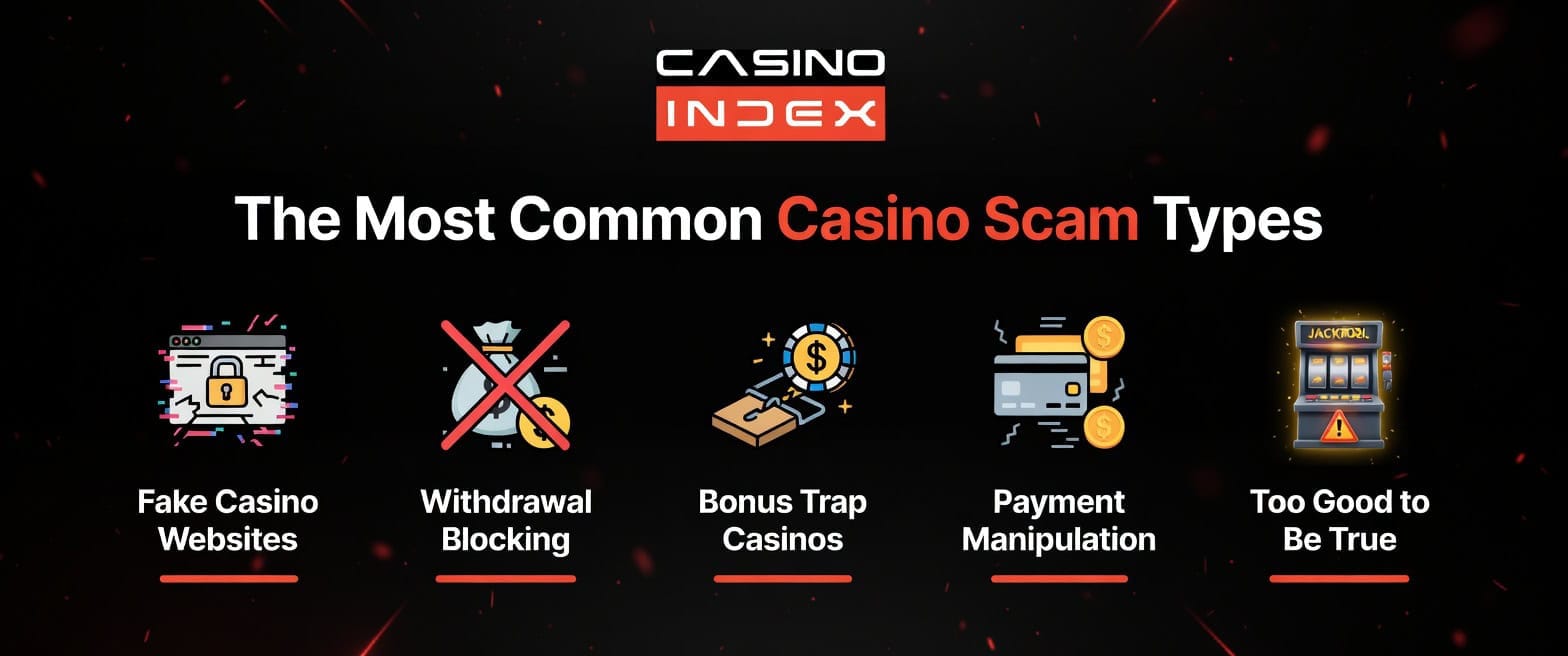
A casino scam is an operation or scheme that deliberately misleads players in order to take money, personal data or account access. It may involve a completely fake website, an impersonation of a real casino, fabricated winnings, a bonus designed around hidden exit barriers, or an operator that uses invented reasons to prevent legitimate withdrawals.
That definition needs a boundary. A frustrating casino is not automatically a fraudulent one. Licensed operators can request identity documents, review large wins, enforce clearly published bonus rules, restrict an account for security reasons or experience a genuine payment delay. Those controls may be inconvenient, but they have legitimate uses.
The question is whether the action is relevant, proportionate, consistent and capable of being completed. Risk rises when the explanation changes, the requested action has no connection to the stated problem, or every completed step produces a new barrier.
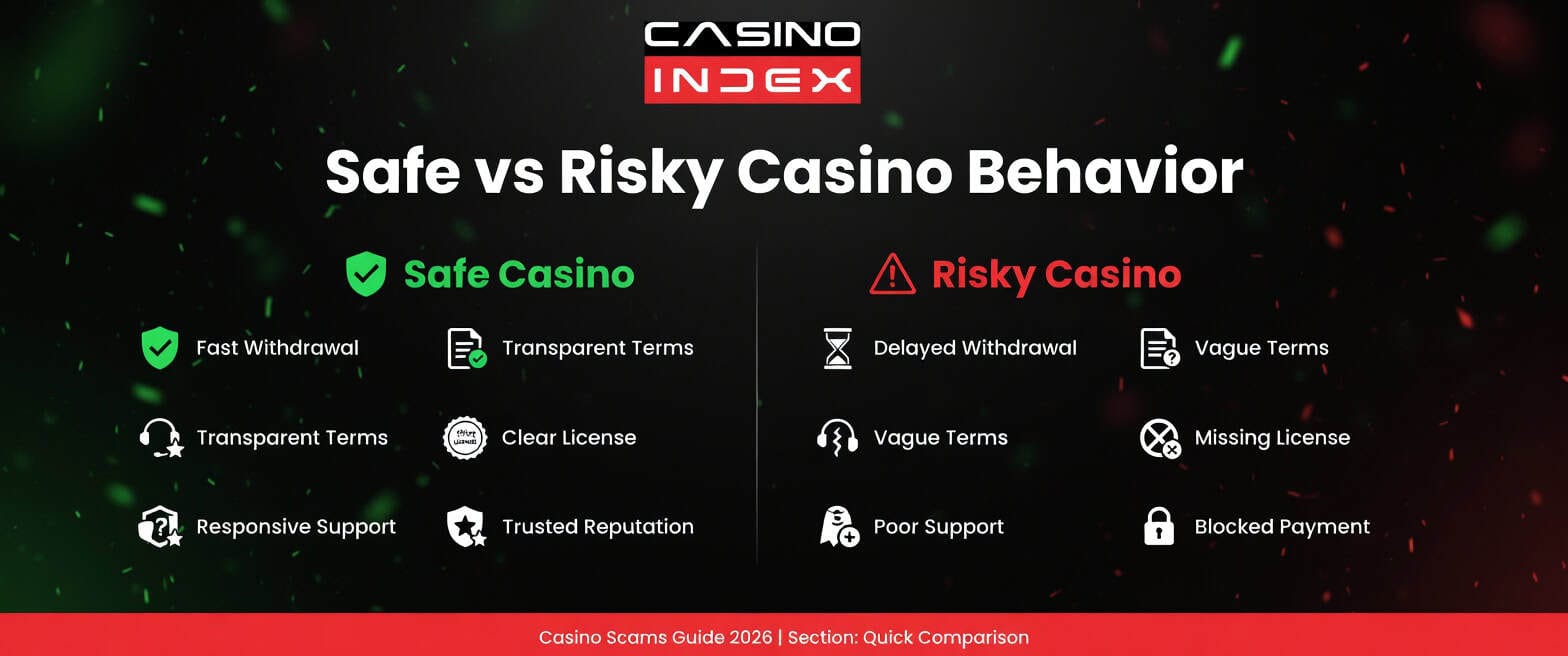
| Situation | Normal friction may look like | Higher-risk behaviour may look like |
|---|---|---|
| KYC | A specific document is requested and rejection reasons are explained. | The same files are requested repeatedly, or unrelated documents appear after each submission. |
| Withdrawal | The casino identifies the review stage, the missing item and the next step. | No timeframe exists, the reason keeps changing or support pressures the player to cancel and keep gambling. |
| Bonus dispute | The casino cites a visible rule and the relevant play or transaction. | A new restriction appears after the win or a vague clause is used without case-specific evidence. |
| Account block | The player is told whether the block is temporary and what happens to the balance. | Access disappears after a cashout request and nobody will address the remaining funds. |
If you want the wider trust framework first, use the safe online casino guide. It covers security, licensing, payments and responsible gambling beyond the specific issue of scams.
The Fastest Red-Flag Check
Stop before depositing if you cannot answer these five questions:
- Who operates the casino? Find the legal company name in the terms, not only the brand name in the header.
- Can the licence be verified independently? Match the operator and, where the register provides it, the approved domain.
- How does money leave? Check withdrawal methods, limits, approval stages, fees and payment-matching rules.
- Which rules can remove winnings? Read the bonus, country, account, payment-ownership and verification clauses.
- What happens when something goes wrong? Look for a complaints process, a regulator or ADR route and support that answers specific questions.
If several answers remain unclear, the casino has not earned a real-money deposit. A bonus, influencer recommendation or polished homepage does not repair missing accountability.
How Online Casino Scams Work Across the Player Journey
Most scam casinos do not create constant friction. They remove it while the player is moving money in and introduce it when the player tries to move money out. That is why the full journey matters:
advertisement → registration → deposit → gameplay → verification → withdrawal → complaint
Before the deposit: borrowed trust
The site may use familiar game images, payment logos, security claims and licence badges. Some fake sites copy the design or legal wording of a real brand. Others use a slightly altered domain and reach players through social media, private messages or search ads.
The appearance proves very little. HTTPS protects the connection; it does not prove the business behind the site is honest. A well-designed cashier proves that deposits can be collected; it does not prove withdrawals will be approved.
After the deposit: displayed value and pressure
A fake platform can display any account balance it wants. The number on the screen is not proof that the money exists or can be withdrawn. Some schemes show early wins, offer a larger VIP opportunity or create a limited-time bonus to encourage another payment.
The most serious warning appears when the player is told to send a new deposit, tax, insurance payment, verification charge or blockchain fee to release existing winnings. A legitimate casino may deduct a disclosed fee from a balance in limited circumstances. It should not require an unrelated private payment to unlock money already shown as withdrawable.
At withdrawal: movable barriers
A high-risk operator rarely begins with a clear refusal. The withdrawal remains pending. One document becomes three. The stated issue moves from KYC to a bonus review, then to a payment-provider problem. Support replies, but each reply resets the process instead of resolving it.
One extra check may be valid. A sequence with no stable reason or endpoint is different. The pattern, timing and operator response carry more weight than the existence of a review alone.
11 Casino Warning Signs That Matter
1. The operator is difficult to identify
The footer, terms and privacy policy should point to the same legal business. Treat missing company details, contradictory entities or legal pages containing another casino’s name as serious concerns.
2. The licence cannot be matched to the site
A badge is only a claim until it is checked. Search the regulator’s own register and compare the licence holder, status and authorised domain where available. Our step-by-step licence verification guide explains the process. The UK Gambling Commission’s public register, for example, lists licensees and regulatory actions for Great Britain.
A valid licence reduces uncertainty but does not guarantee a perfect experience. Jurisdictions differ in supervision, player eligibility and complaint options. See the casino licensing guide for that distinction.
3. The domain or support channel is slightly wrong
Look for substituted letters, added hyphens, unusual subdomains and login links sent through unsolicited messages. Do not send funds to a wallet address supplied by a supposed support agent outside the casino’s official cashier. Never provide a password, one-time code, private key or seed phrase.
4. The terms give the casino unlimited discretion
All operators need rules for fraud, bonuses and prohibited activity. The problem is wording that permits indefinite delays, fund confiscation or account closure without identifying a breach or explaining the balance treatment.
Check the clauses that affect money before the general legal text. The practical order is covered in how to read casino terms before depositing.
5. The bonus has clear entry terms but vague exit terms
A promotion should disclose wagering, maximum bet, game contribution, expiry and maximum cashout rules. The risk increases when the headline is specific but the route to withdrawal is scattered, contradictory or changed after play begins.
6. Deposits are easy, but the withdrawal route is unclear
A casino may legitimately support more deposit methods than withdrawal methods. It should still explain how the player will be paid, whether funds must return to the original method and which ownership checks apply. Avoid third-party payment instructions that bypass the normal cashier.
7. Support is helpful until the player asks for money
Test support before registering. Ask about the monthly withdrawal limit, KYC timing and internal approval window. A useful answer cites the rule or explains the process. Sales pressure, conflicting replies or endless references to an unnamed finance team reveal how little accountability the channel provides.
8. The review profile looks manufactured
Real casinos receive mixed feedback. Be cautious when a profile contains clusters of short five-star posts, repeated wording or praise with no detail about payments, verification or support. Compare several independent sources and look for complete timelines rather than star averages.
9. Complaint details repeat across independent sources
One complaint can be incomplete or based on a misunderstood rule. Several well-documented cases that describe the same unresolved sequence deserve more weight, especially when they involve the same withdrawal stage, document request or confiscation clause.
10. New payments are required to release old money
Requests for a fresh deposit, private tax payment, VIP activation fee or wallet-verification transfer are among the strongest scam indicators. Stop sending money. Do not assume the next payment will be the final one.
11. The brand has no stable public footprint
A new casino will have less history than an established one. That is uncertainty, not proof of fraud. Risk rises when the domain is new, the operator is hidden, legal details conflict and no credible complaint or business history can be found. Reduce exposure or walk away.
Bad Casino vs Scam Casino: Do Not Confuse the Two
This distinction is important for players and for fair reporting.
| Evidence | Weak or badly managed casino | Possible scam pattern |
|---|---|---|
| Service | Slow, disorganised or inconsistent | Designed to delay without resolving anything |
| Rules | Strict but published before play | Hidden, contradictory or introduced after a win |
| KYC | Poor communication around a relevant check | Repeated unrelated demands with no completion point |
| Payments | Delayed with a stable explanation | Blocked while reasons, deadlines and required actions keep changing |
| Complaints | Mixed cases, some visibly resolved | Similar unresolved cases across independent sources |
| Intent | The process fails through poor execution | The process repeatedly benefits from preventing payment or demanding more money |
Intent is difficult to prove from the outside. CasinoIndex therefore describes verifiable behaviour and risk patterns instead of turning one dispute into a definitive fraud accusation. That is also why a current evidence review matters more than maintaining a permanent warning list.
How Complaint Patterns Reveal Online Casino Scams
A useful complaint is not necessarily the angriest one. It contains enough detail to reconstruct what happened.
Record the same fields for every case
- date and country
- deposit and withdrawal method
- amount and withdrawal age
- whether a bonus was active
- documents requested and reasons given
- the term cited by the casino
- operator response
- final outcome
Then ask whether independent reports describe the same problem at the same stage of the journey. Ten vague posts may be less useful than three detailed cases that show the same changing KYC reason after large withdrawals.
Check what could distort the pattern
Copied complaints can make one case look larger. Old reports may relate to a previous owner, licence or payment system. A player may omit a bonus, third-party payment or restricted-country issue. An operator’s reply may also be incomplete or self-serving. Read both sides and separate confirmed facts from allegations.
Use our full method for reading casino complaints and reputation evidence when assessing a specific brand.
Withdrawal Red Flags: Where Trust Is Really Tested
Casino marketing can be copied in an afternoon. Consistent payouts require a functioning process, cash management and rules the operator is willing to follow when a player wins. That makes withdrawal behaviour one of the strongest trust signals.
Friction that may be normal
- first-time identity and age verification
- proof that the payment method belongs to the player
- a stated anti-money-laundering or source-of-funds review
- a published daily or monthly withdrawal limit
- additional review after an unusually large win
- bank, card or blockchain processing after casino approval
Friction that becomes concerning
- the casino will not identify the review stage or next step
- a completed request is replaced by an unrelated one
- the stated reason changes between support agents
- the withdrawal is repeatedly cancelled without explanation
- support encourages the player to reverse the request and continue gambling
- a new deposit or fee is required before payment
- similar unresolved cases appear elsewhere
Blockchain speed starts only after the casino sends the transaction. A claim such as “instant crypto payouts” says nothing about the operator’s internal approval time. The casino withdrawal guide separates approval, payment processing and network confirmation.
KYC: Normal Verification or Payout Resistance?
KYC is not evidence of a scam. Identity, age, location, payment ownership and source-of-funds checks can protect both players and operators from account takeover, underage gambling, prohibited access and payment fraud.
A credible process asks for information connected to an identified risk. It gives acceptable formats, explains why a file failed and allows correction. The review ends once the relevant checks are satisfied.
Concern grows when requests are unrelated, duplicate or impossible to complete; when rejection reasons remain generic; or when the rules say “no KYC” but verification appears without qualification after a win. Learn what normal checks look like in the casino KYC and verification guide.
An account restriction can also have legitimate causes, including failed logins, geolocation conflicts, duplicate accounts, payment concerns or responsible gambling intervention. The key questions are whether the restriction is explained and what happens to legitimate funds. See what happens when a casino blocks an account.
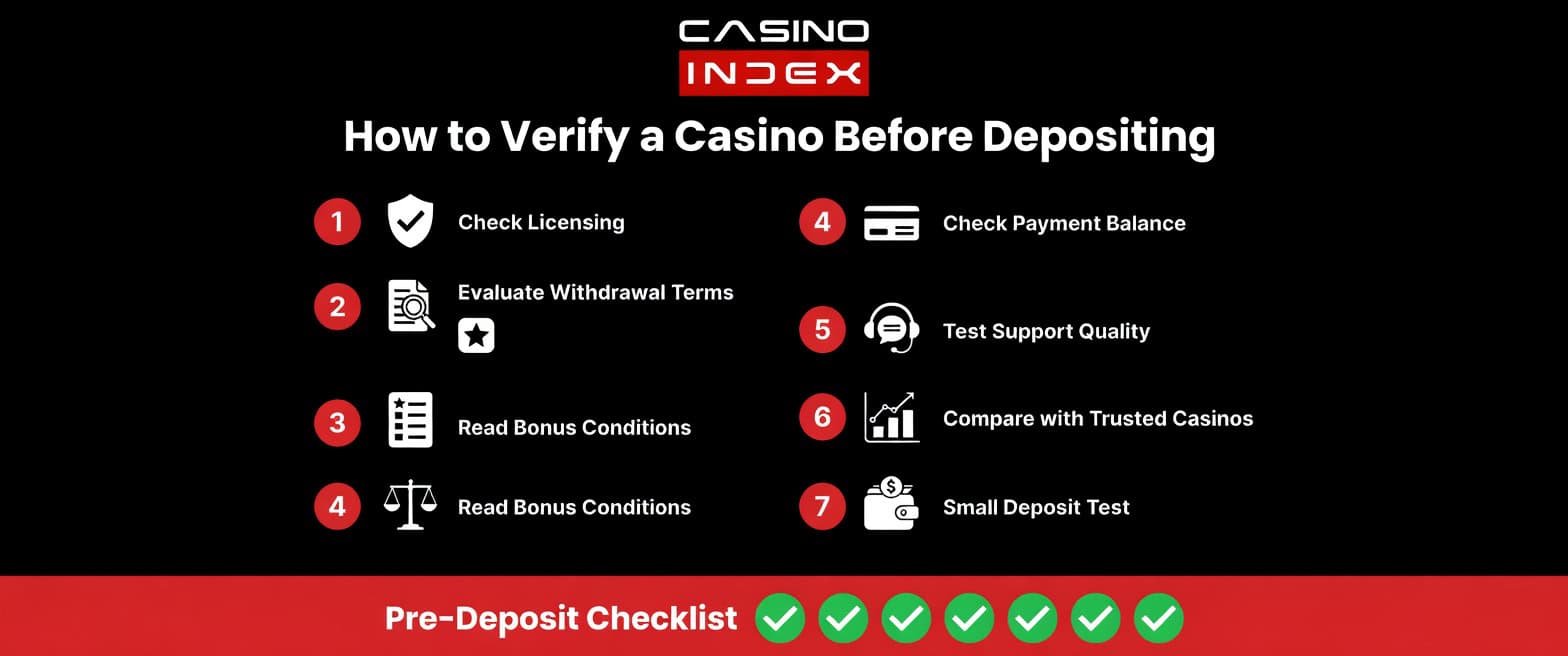
How to Avoid Online Casino Scams Before You Deposit
Step 1: Confirm the real domain
Enter the address yourself or follow the domain shown in an official regulator entry. Avoid login and payment links sent through unsolicited email, social media, Telegram, WhatsApp or direct messages.
Step 2: Match the company, licence and domain
Find the legal operator in the terms. Check it against the regulator’s register and confirm that the licence is active and relevant to online gambling in your location. A licence belonging to a similarly named company is not enough.
Step 3: Read the money rules
Start with withdrawal limits, KYC, payment ownership, country restrictions, bonus wagering, maximum bets, restricted games and grounds for account closure. Compare the cashier, promotion page and general terms for contradictions.
Step 4: Investigate complaints
Search the brand with “withdrawal,” “KYC,” “blocked account,” “bonus,” “complaint” and the operator’s legal name. Look for repeated timelines and outcomes, not a single rating score.
Step 5: Test support
Ask one question whose answer you already found in the terms and one about the withdrawal process. This shows whether support can locate the rule, explain it consistently and provide a usable next step.
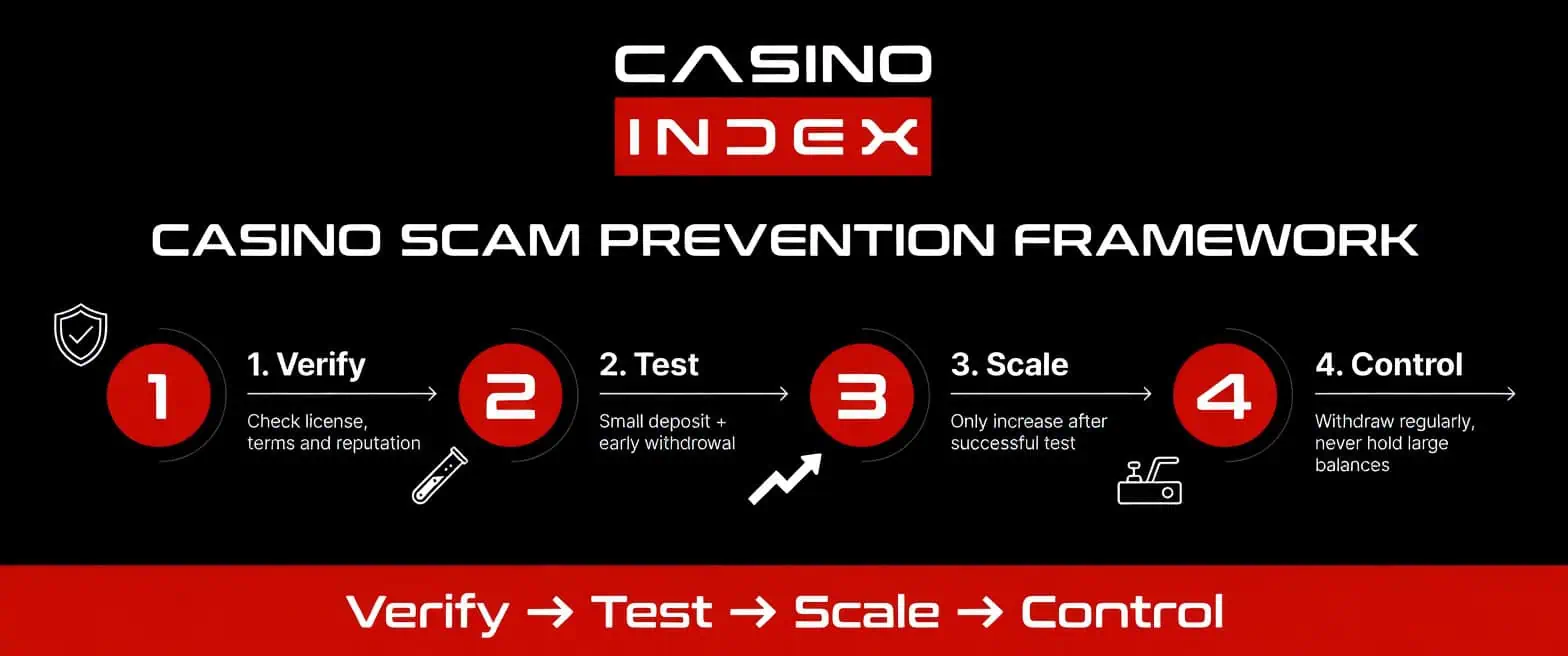
Step 6: Start small and avoid complexity
Use a modest amount, skip a complicated bonus during the first test and use a payment method you control. Do not store more money in a casino account than necessary.
Step 7: Withdraw early
Request a small payout after normal play. Record the approval time, document requests and support quality. One successful payment is useful evidence, but it does not guarantee that a later large win will be handled identically.
What to Do If a Casino Problem Has Already Started
1. Stop depositing and stop playing
Do not add money to gain status, satisfy a private unlock request or chase the disputed balance. Avoid accepting a new bonus while the account is under review.
2. Preserve evidence before access disappears
- account ID and registered details
- deposit and withdrawal confirmations
- transaction hashes or bank references
- balance and withdrawal-status screenshots
- the terms and bonus rules that applied
- document-upload confirmations
- emails, live-chat transcripts and account notices
Save the page URL and date with each screenshot. A clean timeline is easier for a complaints team, regulator, ADR provider, bank or lawyer to understand.
3. Send one precise written complaint
State the date, amount, payment method, current status and action already completed. Ask which exact issue prevents payment, which term applies, what evidence is missing and when the next update is due. Keep the message factual.
4. Use the operator’s formal process
Live chat may not be the complaints channel. Follow the procedure in the terms and keep the ticket or case number. For Great Britain, the UK Gambling Commission advises players to complain to the gambling business first; eligible unresolved disputes may then move to an ADR provider.
5. Escalate through the correct route
Depending on the operator, country and payment method, that may be:
- the stated regulator or ADR provider
- the card issuer, bank, e-wallet or payment processor
- a national consumer-protection or cybercrime reporting service
- the app store, hosting provider or advertising platform for an impersonation site
- independent legal advice for a material balance
Do not file a false chargeback or describe an authorised gambling loss as an unauthorised payment. Explain the real dispute and let the payment provider decide which protections apply. Our guide to escalating a casino complaint after support fails maps the steps in more detail.
6. Secure connected accounts
Change reused passwords, enable two-factor authentication, remove unknown sessions and contact your bank or wallet provider if credentials may be compromised. Revoke suspicious wallet approvals where appropriate. Never send an OTP, private key or seed phrase to casino support.
Can Money Lost to a Fake Casino Be Recovered?
Recovery depends on the payment route, how quickly the player acts, whether the recipient can be identified and whether a regulated complaint or legal process exists. There is no universal recovery method and no honest service can promise a result.
Contact the bank, card issuer, e-wallet or crypto platform promptly and provide transaction evidence. They may be able to stop, trace or flag a payment, but reversal is not guaranteed. Irreversible crypto transfers sent to a scammer are particularly difficult to recover.
Watch for the second scam
Victims are often approached by people claiming they can retrieve the money for an upfront tax, retainer, blockchain fee or legal deposit. The US Federal Trade Commission warns about refund and recovery scams that target people who have already lost money.
Do not pay an unsolicited recovery contact, share wallet credentials or allow remote access to your device. Verify any law firm, regulator or recovery business through contact details you find independently.
The CasinoIndex Scam-Risk Method
We do not call a casino fraudulent because one player is angry or because a payment exceeded its advertised estimate. We examine the complete evidence chain:
- Identity: operator, ownership, domain and licence.
- Rules: withdrawal, bonus, KYC, country and closure terms.
- Behaviour: what changes after a win or withdrawal request.
- Patterns: whether independent complaints describe the same unresolved sequence.
- Response: whether the operator gives a specific explanation and a route to resolution.
- Outcome: whether legitimate balances are paid, returned or supported by a clear decision.
Trust and withdrawal behaviour carry more weight than product size or bonus value. That principle is documented in how CasinoIndex ranks casinos.
Pre-Deposit Casino Scam Checklist
- The domain was reached through a verified route.
- The operating company is named consistently.
- The licence is active and matches the operator and site where the register permits that check.
- Restricted countries are clear.
- Withdrawal methods, minimums, limits and approval stages are visible.
- KYC and payment-ownership rules are understandable.
- Bonus wagering, maximum bet, game restrictions and cashout caps are disclosed.
- Support answers specific questions without deposit pressure.
- Complaint research shows context, dates and outcomes.
- No new payment is required to release existing money.
- A small first deposit and early withdrawal are possible.
If the check produces more questions than answers, choose another operator. There is no bonus large enough to compensate for unverifiable ownership or an unclear route to your money.
FAQ About Online Casino Scams
What is the biggest sign of a scam casino?
A demand for more money to release an existing withdrawal is one of the strongest signs. Unverifiable ownership, fake licence information and a repeated pattern of changing payout barriers make the concern stronger.
Does one delayed withdrawal mean a casino is a scam?
No. Verification, payment ownership checks, large-win reviews and payment processing can cause legitimate delays. Check whether the casino gives a stable reason, relevant next step and realistic route to completion.
Can a licensed casino still be risky?
Yes. A licence is an important first filter, not a guarantee. Verify it, then evaluate the withdrawal rules, complaint pattern, operator response and protections available in that jurisdiction.
How do I know whether casino reviews are fake?
Look for repeated wording, review bursts, vague praise and profiles that never mention actual withdrawals or verification. Detailed, dated accounts with evidence and visible outcomes are more useful than star ratings.
Is KYC after a win proof of payout manipulation?
No. A win or withdrawal can trigger legitimate identity, location, payment or source-of-funds checks. Concern increases when requests are unrelated, repeatedly duplicated or impossible to complete, and when the casino will not give a specific rejection reason.
Are crypto casinos more likely to be scams?
Crypto does not make an operator fraudulent. It can increase the impact of a bad decision because transfers may be irreversible and recovery options may be limited. The casino still controls internal withdrawal approval.
Should I deposit more to unlock a withdrawal?
No. Stop when a casino or supposed support agent demands a new deposit, tax, insurance payment or private crypto transfer to release existing winnings. Preserve the request as evidence.
What should I save when a casino dispute begins?
Save account and transaction IDs, payment confirmations, transaction hashes, withdrawal status, balances, applicable terms, document submissions, emails and chat transcripts. Put them into a dated timeline.
Where should I report a fake casino?
Use the casino’s formal complaint process if the operator is identifiable. Depending on your country and the facts, you may also contact its regulator or ADR provider, your payment provider, a consumer-protection body, cybercrime reporting service, app store or advertising platform.
What is the safest way to test a new casino?
Verify the operator and rules first. If the evidence is acceptable, deposit a modest amount without a complicated bonus, play normally and request an early withdrawal. Do not treat one successful test as permission to keep a large balance on the site.
Final View: Judge the Pattern, Not the Promise
Online casino scams succeed when appearance is mistaken for accountability. The homepage, bonus and game lobby are easy to copy. A verifiable operator, coherent rules, relevant KYC, specific support and consistent withdrawals are much harder to fake.
Do not label a casino from one inconvenient step. Follow the sequence. If every new barrier appears only after money needs to leave, the explanations keep moving and similar complaints remain unresolved, exposure should stop.
Verify the operator, read the exit rules, test with a small amount and keep control of your evidence. If gambling is affecting your finances or wellbeing, use the independent support options in our responsible gambling guide.

Maria Hoffmann has worked in cryptocurrency content and digital publishing since 2017. She is a co-founder of Freecoins24 and CryptoMutant and has covered blockchain projects, crypto platforms and emerging industry trends for several years. She has also been active as a cryptocurrency investor since 2019. At CasinoIndex, Maria combines content research and SEO experience with a focus on casino trust, platform security, withdrawal processes, payment risks and user protection. Her work looks beyond bonuses and product features to examine how gambling platforms handle player funds, verification and account-related risks.