What Makes a Casino Review Actually Reliable?
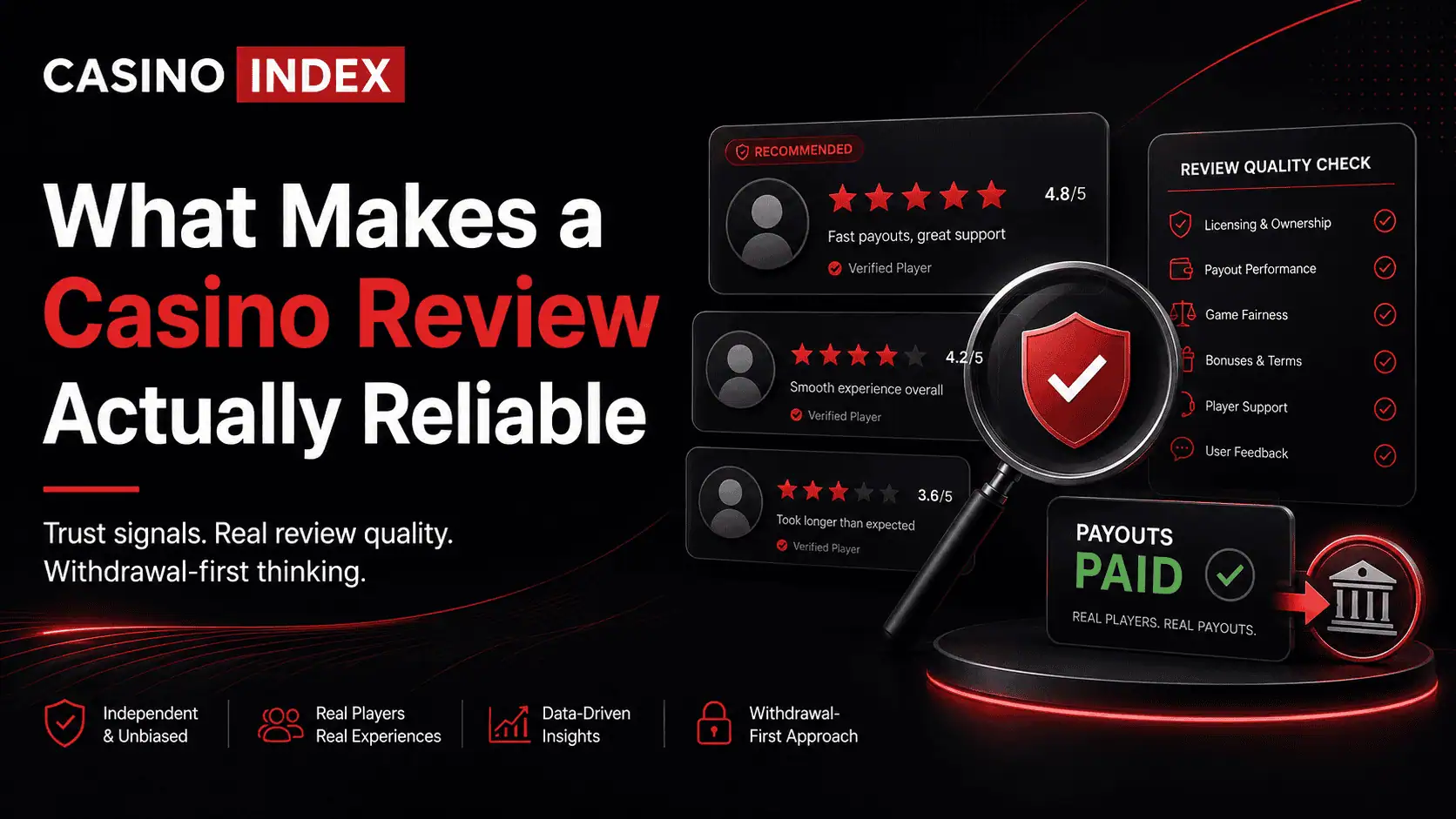
Reliable Casino Reviews Start Where Marketing Ends
Casino reviews are everywhere.
Reliable casino reviews are not.
That gap matters because most players do not lose trust in a casino review while reading it. They lose trust later, when the real-money experience no longer matches the polished summary they saw before depositing.
A review can mention bonuses, game providers, payment options and licensing details and still fail at the one job that matters most:
Helping the reader judge whether the operator deserves real money.
That is the difference between a page that looks complete and a page that is genuinely useful.
Too many reviews still follow the easiest path. They describe the offer, summarize the lobby, list the cashier methods, add a mobile section and finish with a score. On the surface, that feels professional. In practice, it often tells the reader very little about what happens once the easy part ends.
The hard part of casino analysis begins later.
It starts when a player wants to verify an account, cash out meaningful winnings, deal with a term that suddenly matters or understand why the process feels different once money needs to leave the platform.
That is where review quality gets tested.
A trustworthy review should not just explain what a casino offers. It should explain how the operator behaves once the relationship becomes more demanding. That means looking beyond design, bonus size and feature lists. It also means judging fairness, friction, consistency and payout behavior under pressure.
This guide explains what a trustworthy casino review includes, how real review quality is judged, what most casino review sites miss and why withdrawal behavior matters in reviews far more than most pages admit.
Why Most Casino Reviews Are Easy to Publish but Hard to Trust
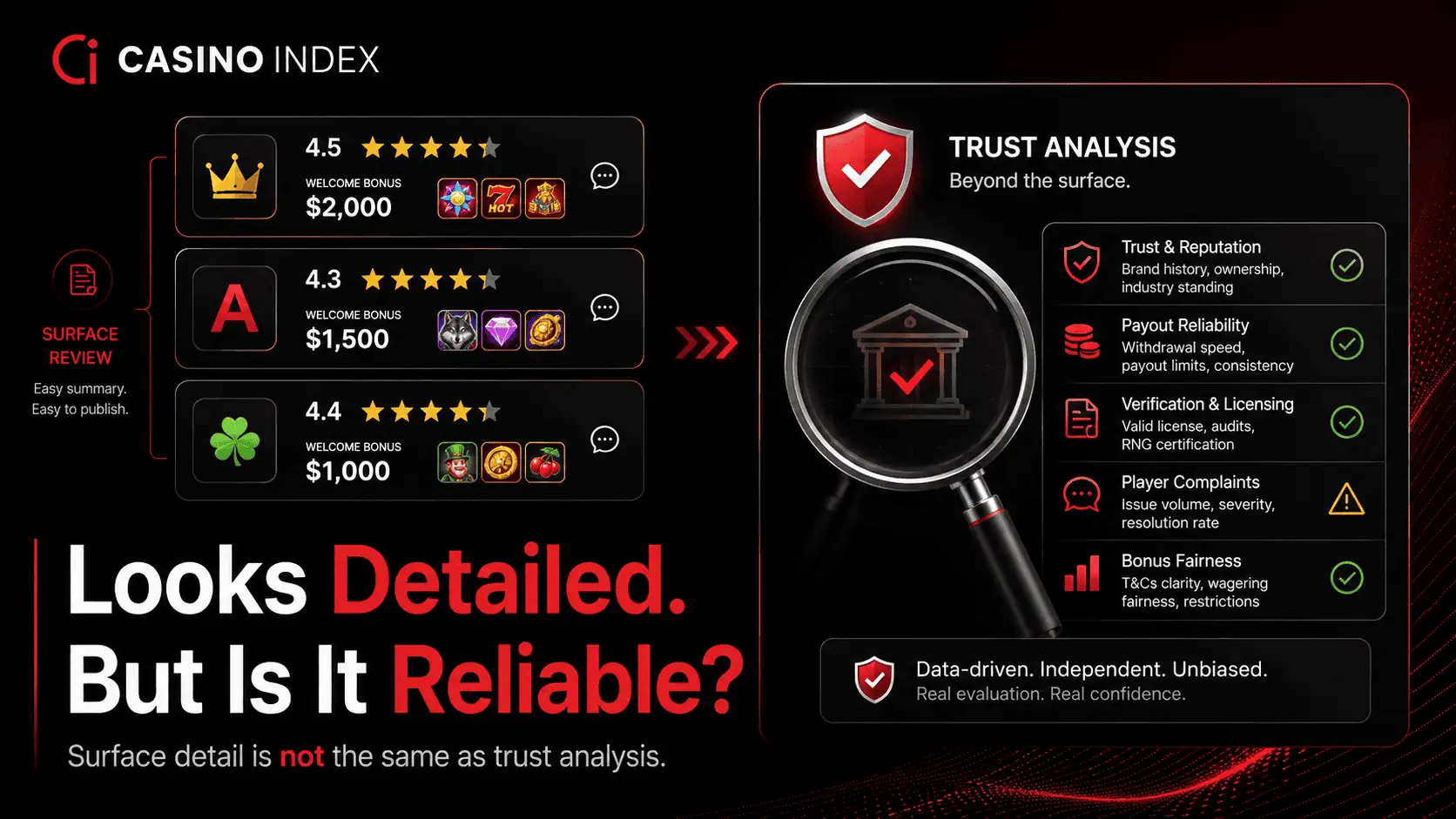
The easiest review to write is usually the least valuable one to rely on.
That type of article is familiar. It opens with the bonus, moves into games, mentions support and payments, then ends with a general verdict.
Nothing in that structure is automatically wrong.
The problem is that most of those facts can be gathered quickly from the casino itself. As a result, the review often reflects the brand at its most polished.
Real evaluation starts where simple page summaries stop.
Surface detail is not the same as review depth
A long review can still be weak.
Section count does not create authority. Relevance does.
Many casino articles look detailed because they contain lots of headings. Yet a page can run through software providers, welcome offers, slot categories, live games and mobile access without telling the reader much about the real pressure points.
If the article spends more time on entertainment variety than on payout behavior, it is already revealing where its priorities sit.
That is a major weakness.
A casino can feel smooth during registration and still become difficult later. Deposits can be instant. The site can look premium. Promotions can seem generous.
None of those signals tells the reader enough about how the operator behaves when money is due back to the player.
The real test comes after deposit
Once real-money pressure appears, the priorities change.
Game count matters less than withdrawal consistency. Bonus size matters less than term enforcement. A polished interface matters less than what happens when the first serious withdrawal request arrives.
Even a licensing badge means less if the operator’s real behavior does not match the trust signal.
That is why CasinoIndex puts trust ahead of polish in how CasinoIndex reviews casinos.
A review becomes useful when it reflects that same order.
What a Trustworthy Casino Review Includes
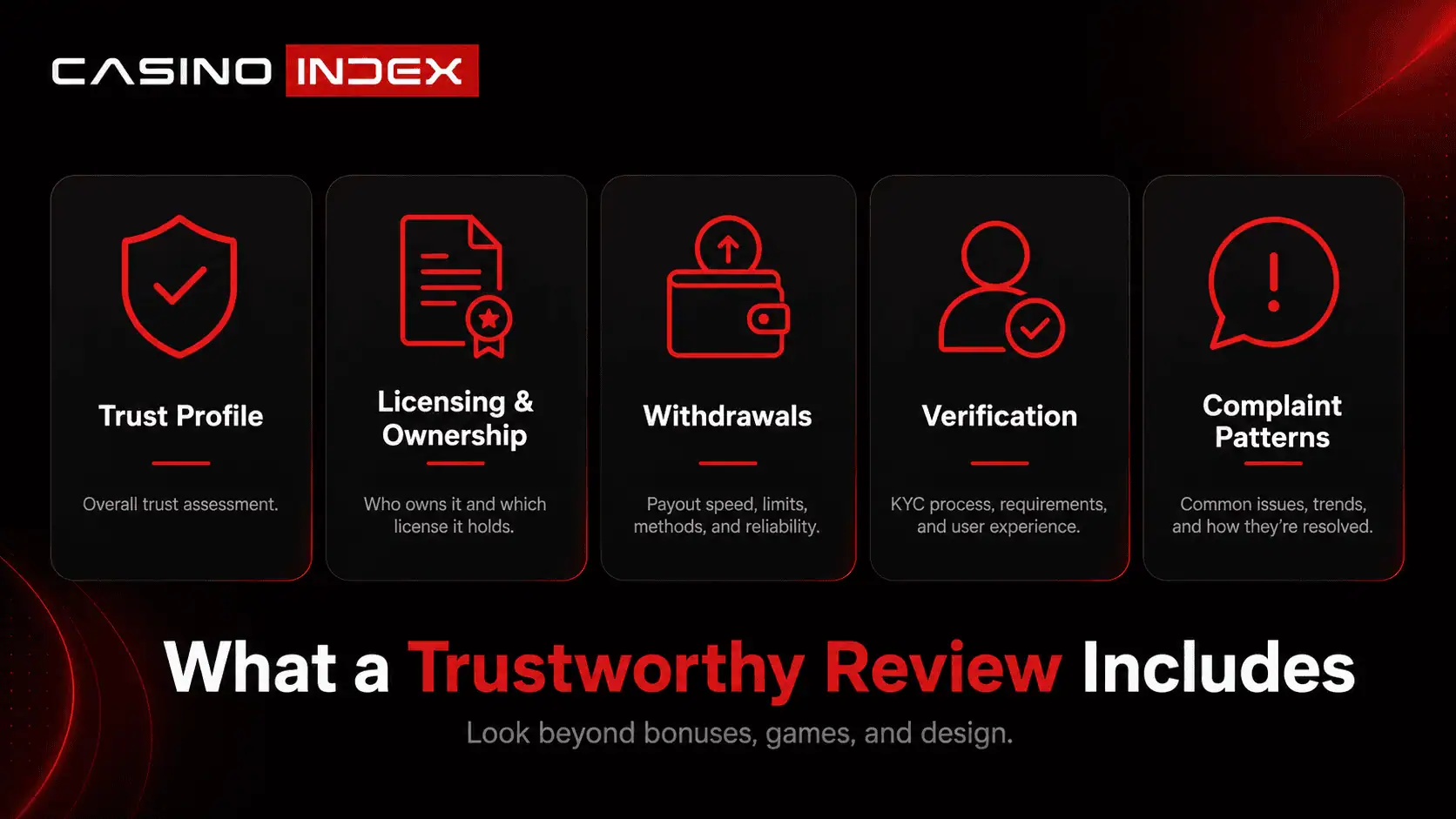
A good review should reduce uncertainty in the parts of the journey that can hurt the player most.
That only happens when the structure is built around risk, not around marketing.
A clear trust profile from the start
Readers should understand early what kind of operator they are dealing with.
Is the casino relatively stable but strict? Fast to enter but less predictable once payout checks begin? Attractive on the surface but weaker when terms start getting enforced? More suitable for casual use than for larger withdrawals?
Those questions should not be left until the final score.
A reliable review gives the reader a usable trust frame near the beginning because that frame shapes how every later section will be read.
Licensing and ownership that mean something
A weak review treats “licensed” as a complete answer.
A stronger review asks whether the license adds real accountability, whether ownership is clear and whether the business structure feels transparent enough to support trust.
Some licenses carry more practical value than others. Some operators disclose more clearly than others. Brands feel accountable. Others look thinner once you move past the footer badges.
That is why licensing belongs inside the trust analysis rather than inside a small company-facts box. CasinoIndex goes deeper on that point in what makes a casino license actually trustworthy.
Real withdrawal analysis
This is one of the clearest signs of review quality.
A weak review repeats the casino’s claim that payouts are fast.
A stronger review asks what that speed depends on.
Pending times, approval stages, reversal behavior, withdrawal limits, payment method logic and repeated friction points all matter here.
Complaint patterns around delayed or blocked cashouts also matter. Even when outcomes vary between users, the review should still explain where payout pressure tends to appear and what usually causes it.
That is why what a trustworthy casino review includes must go beyond a one-line withdrawal note.
Verification logic, not just a KYC mention
Verification should never be reduced to a throwaway paragraph.
A reliable review explains when checks are likely to appear, what documents may be required, how payment ownership rules affect withdrawals and when normal verification starts turning into a trust concern.
There is a major difference between routine identity checks and payout-stage document loops that only begin after a player wins.
Readers need that distinction before they deposit.
CasinoIndex explains that line in more detail in what a safe casino KYC process actually looks like.
Why Review Pages Must Test Withdrawal-Stage Risk
A casino review is not reliable if it only describes what happens before deposit.
The real test starts later, when a player requests money back.
At that stage, the casino is no longer selling the experience. It is enforcing rules, checking account behavior, reviewing payment ownership and deciding whether the withdrawal can move forward.
That is why review pages must test withdrawal-stage risk, not only deposit-stage convenience.
Deposit speed does not prove payout reliability
Fast deposits are easy to make look impressive.
A casino can accept crypto quickly, show a polished cashier and still create friction when the player wants to cash out.
A serious review should separate three things:
- how fast deposits arrive
- how long casino approval takes
- how reliably withdrawals are released after checks
This distinction matters because many payout problems happen before the payment method even starts processing. CasinoIndex explains this broader process in its guide to why withdrawal behavior matters in reviews.
Withdrawal-stage risk shows operator behavior under pressure
At withdrawal stage, small details become important.
The review should check whether the casino applies clear limits, whether payment routes match the deposit method, whether bonus terms affect the cashout and whether KYC appears in a predictable way.
When those checks are clear, the operator looks more trustworthy.
When they appear late, change during the process or create vague support replies, review confidence should drop.
This is where CasinoIndex connects review quality with how trust and payout risk are evaluated, because payout behavior is one of the strongest signals of whether a casino deserves real-money trust.
Reliable reviews explain the approval layer
A good review should not just say “withdrawals are fast.”
It should explain what happens before approval, what can slow the process and which risks players should understand before depositing.
That includes:
- pending withdrawal time
- KYC timing
- payment ownership checks
- bonus review
- withdrawal limits
- complaint patterns around delayed cashouts
Without this layer, the review may look complete but still leave the reader unprepared for the moment that matters most.
Bonus Fairness Matters More Than Bonus Size
Bonus coverage is one of the easiest places for a casino review to become weak.
Promotional articles tend to treat the offer like a headline. Reliable reviews treat it like a contract.
Headline value can mislead
A large bonus number looks impressive.
That does not make it useful.
Once wagering, max cashout rules, time limits, excluded games and abuse clauses enter the picture, the same promotion can feel much less attractive.
Review quality rises fast when the article moves past the headline and asks whether the offer still looks fair once real money and payout rules are involved.
That is a much better way to protect the reader.
Terms deserve more weight than marketing copy
Terms often change the whole meaning of a promotion.
An aggressive wagering structure, a harsh max cashout clause or a broad restricted-games rule can quietly turn a “great bonus” into a risky one.
A trustworthy review does not bury that in the fine print section. It puts the reader’s likely outcome ahead of the casino’s preferred presentation.
That same principle should guide the wider article too.
Complaint Patterns Belong Inside Serious Review Work
Reliable reviews do not panic over every complaint.
They also do not ignore repeated warning signs.
Isolated anger is not enough
Almost every casino with a real player base will attract criticism.
That is not the useful signal by itself.
A single angry review may be emotional, incomplete or missing context. Some players complain about bonus outcomes without explaining that bonus rules were involved. Others react before the full process is finished.
Complaint research becomes useful only when the reviewer reads it as pattern analysis rather than background noise.
Repetition changes the meaning
Repeated friction matters.
If similar problems keep appearing at the same stage of the player journey, the review should take that seriously.
Withdrawal delays, verification escalation, payment objections at cashout stage or blocked-account complaints become much more meaningful when the same mechanism shows up again and again.
That is why CasinoIndex treats complaint reading as part of trust analysis, not as a side note. The broader logic is explained in how public casino complaints should be read.
How Real Review Quality Is Judged
The most convincing review is not always the most dependable one.
Tone can mislead. Length can mislead. Even a very neat layout can mislead if the priorities underneath it are weak.
So how should the quality of a casino review actually be judged?
By decision value, not by appearance
A strong review reduces uncertainty where the stakes are highest.
That means it helps the reader understand what could become difficult later, what still looks fair under pressure and which areas deserve caution before real money goes in.
A page that only summarizes what exists on the site may still be readable, but it is not doing enough decision work.
By visible reasoning
Reliable reviews show their logic.
Readers should be able to understand why trust rises, why it falls, where uncertainty remains and which issues carry the most weight.
Empty authority language is easy to produce. Transparent reasoning is harder and far more useful.
That is where real credibility starts.
By its handling of gray areas
Not every delay is abuse.
Not every complaint proves a pattern.
Not every KYC request is excessive.
Good review work handles that middle ground carefully. Instead of flattening everything into either “safe” or “scam,” it explains where routine friction ends and operator risk begins.
That kind of judgment is a major part of how real review quality is judged at a serious level.
By how seriously it reads the terms
Many pages mention terms without really engaging with them.
That is a mistake.
Terms often reveal the real power balance between the player and the operator.
Bonus enforcement clauses, payment matching rules, withdrawal limitations, source-of-funds language, inactivity rules and broad security provisions can all become decisive later.
A review that barely reads the rules is still too close to the marketing layer.
What Most Casino Review Sites Miss
The biggest weakness in the category is not lack of information.
It is poor weighting.
Too many pages still focus on the easiest parts of the user journey and give too little attention to the parts that create real damage when handled badly.
Too much emphasis on acquisition-stage detail
Registration, bonuses, games, deposit convenience and interface quality are easy to write about.
That is one reason so many reviews lean heavily in that direction.
Those areas still matter, but they should not dominate the trust logic of the article.
A player can live with an average lobby. A player cannot easily recover from a payout process that becomes unstable after a win.
Not enough payout analysis
This remains one of the biggest misses.
Some review pages mention withdrawal speed as a simple line item, then move on.
That is far too shallow.
The more useful question is not “how fast is the withdrawal?” but “what tends to happen once the player reaches withdrawal stage?”
Approval logic, payment friction, delay patterns, withdrawal limits and complaint clustering all belong here.
When that section is weak, the review is weak too.
Complaint use without real interpretation
Player feedback gets mentioned often.
It gets interpreted well much less often.
A review should not just quote the existence of positive or negative sentiment. It should explain what the complaints are actually about, when they appear and whether the same issues keep repeating around the same moment in the player journey.
That is where the signal becomes meaningful.
KYC treated as a minor formality
Verification is often presented too casually.
The real issue is not that KYC exists.
The real issue is how it is applied, when it starts and whether it expands under pressure.
Reviews that do not explain that leave readers unprepared for one of the most important parts of the real-money experience.
The biggest miss of all
Most casino review sites still do not explain what changes after deposit.
That is the real gap.
Before deposit, the casino is selling an experience.
After deposit, the player starts testing the system.
After a win, the system starts testing the player back.
That is what most casino review sites miss, and it is exactly why so much casino review content feels polished but still not dependable enough.
Why Withdrawal Behavior Matters in Reviews
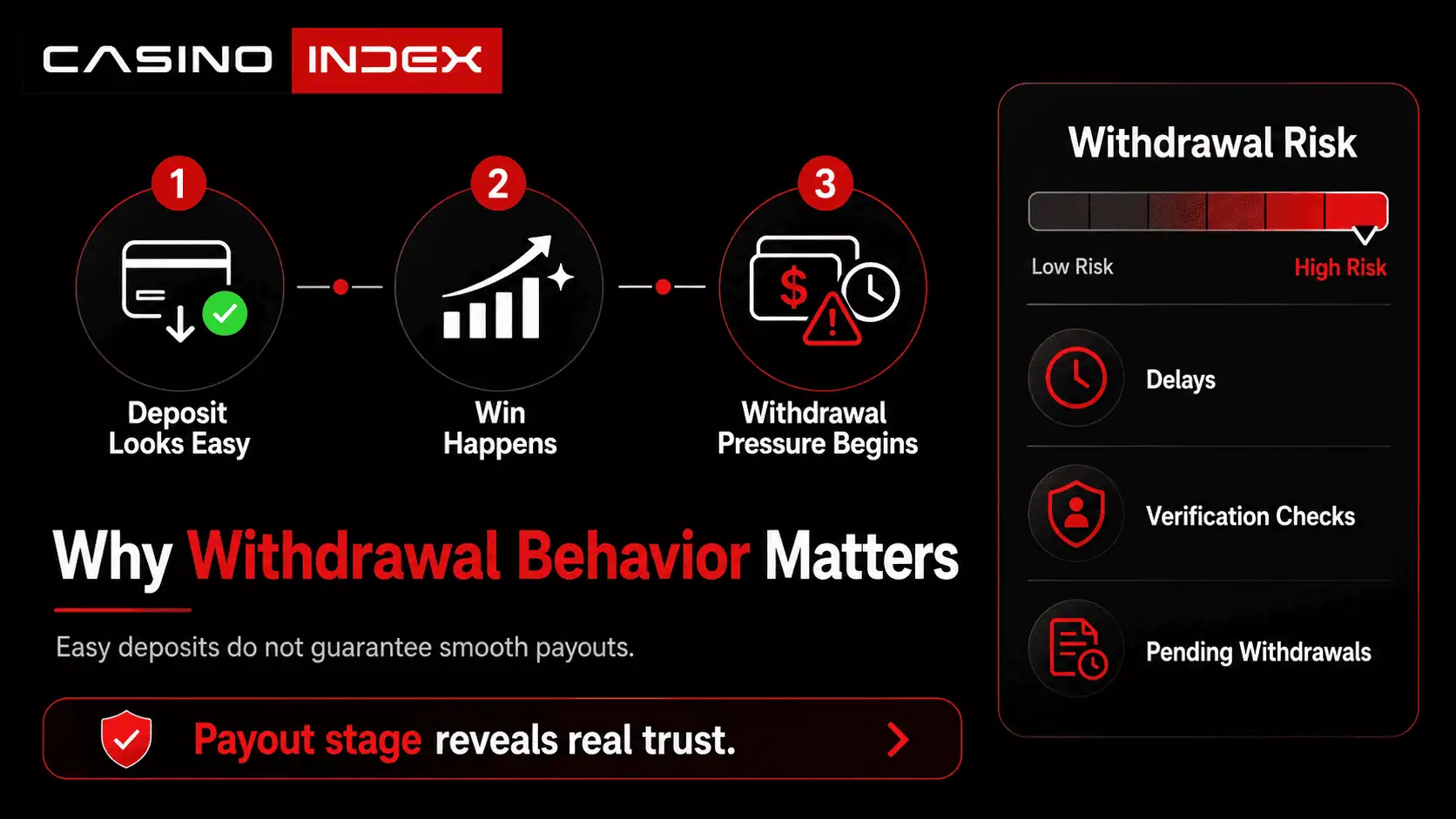
If one part of a casino review deserves heavier weight than almost everything else, it is this one.
Why withdrawal behavior matters in reviews comes down to one simple fact:
Payout is where the casino has to prove that its promises still hold when money is moving in the opposite direction.
Smooth entry proves very little
Before that stage, most things can look fine.
The sign-up flow works. Deposits arrive fast. Promotions feel accessible. The site looks stable. Support may seem responsive enough.
None of that is the hard part.
The hard part begins when the player wants money back.
That is the moment when payment processing, account checks, verification logic, withdrawal limits, complaint patterns and internal risk rules all meet in the same window.
Payout reveals operator priorities
Even moderate friction can matter here.
A site that looks easy during deposit but becomes inconsistent during cashout is not showing a small usability flaw.
It is showing the reader where trust becomes weaker under pressure.
Fresh conditions that appear late, payment methods that are challenged only at withdrawal stage or repeated complaints around pending cashouts all tell the reader something more important than a polished homepage ever could.
That is why this section should never be light.
CasinoIndex explains the approval layer further in what casinos check before approving withdrawals.
A reliable review should not just say whether payouts exist.
It should explain whether payouts are likely to stay fair.
The Difference Between Promotional Reviews and Decision-Grade Reviews
This is where the gap becomes easiest to see.
A promotional review helps the reader imagine joining the casino.
A decision-grade review helps the reader imagine what could happen after joining.
That is a major difference.
Promotional reviews focus on attraction
Promotional reviews usually follow the casino’s strongest sales points.
They highlight the bonus, the number of games, the payment options, the app experience and the general brand appeal.
Those details can be useful, but they do not answer the deeper question.
The deeper question is whether the player should trust the casino with real money once terms, verification and withdrawal checks become relevant.
Decision-grade reviews focus on risk
A decision-grade review has a different job.
It helps the reader understand the trade-off before depositing.
That means showing the benefits, but also explaining the weak points clearly. It looks at what can go wrong, where friction may appear and which player type fits the casino best.
That is why a serious review can still recommend a casino while being honest about its risks.
The goal is not to make every operator sound dangerous.
The goal is to make the reader less surprised later.
Reliable Reviews Need Clear Scoring Logic
A score without reasoning is decoration.
Readers should be able to understand why a casino earns its rating, where the score could improve and which weaknesses lowered confidence.
A useful score reflects priorities
A casino should not score highly only because it has many games or a large bonus.
Those things matter, but they do not outweigh trust, withdrawals, reputation and account safety.
A useful review score should reflect:
- trust profile
- withdrawal behavior
- licensing quality
- complaint patterns
- KYC and verification logic
- payment reliability
- bonus fairness
- product quality
That order matters because the player’s biggest risk usually appears after deposit, not before it.
Scores should not hide uncertainty
Some reviews make uncertain casinos look safer than they are by giving a polished number without context.
That weakens trust.
Limited public evidence should be stated clearly. Mixed complaints need pattern analysis, not quick conclusions. And when a casino looks strong for small withdrawals but less proven for larger cashouts, that distinction should be visible in the review.
Reliable scoring does not remove nuance.
It organizes it.
How CasinoIndex Builds More Reliable Casino Reviews
CasinoIndex reviews are built around real-money decision value, not only feature description.
That means the review has to answer a practical question:
Would an experienced player trust this casino with real money?
Trust comes before conversion
The strongest casino review is not the one that pushes the reader fastest toward registration.
It is the one that helps the reader understand whether registration is a good idea at all.
That is why CasinoIndex gives more weight to withdrawal behavior, verification risk, reputation signals and complaint patterns than to headline bonus size.
That approach is explained further in how trust and payout risk are evaluated.
Casino reviews should match real player concerns
Players do not only ask whether a casino has games.
They ask whether it pays, whether KYC is fair, whether the bonus can be cleared, whether support responds and whether complaints point to deeper risk.
A reliable review should answer those concerns directly.
If it does not, it may still rank well in search results, but it is not serving the reader properly.
Review quality improves when the weak points are visible
A review does not become trustworthy by sounding positive.
It becomes trustworthy by showing the full picture clearly.
That includes strengths, weaknesses, unknowns and practical risk signals.
When the weak points are visible, readers can make better decisions.
When weak points are hidden, the review starts behaving like marketing.
Checklist: What a Reliable Casino Review Should Answer
Before trusting any casino review, check whether it answers the questions that actually matter.
| Review Area | What a Reliable Review Should Explain | Weak Review Warning Sign |
|---|---|---|
| Trust profile | What kind of operator this is and where confidence is strongest or weakest | Only says the casino is “trusted” without explaining why |
| Withdrawals | What payout speed depends on, where delays may appear and how limits work | Only repeats “fast withdrawals” from the casino |
| KYC | When verification may happen and whether the process looks proportionate | Treats KYC as a minor footnote |
| Complaints | Whether public complaints form a pattern or look isolated | Quotes complaints without interpretation |
| Bonuses | Whether the offer still looks fair after wagering, max cashout and restrictions | Focuses only on headline bonus value |
| Licensing | Whether the license and ownership structure add real accountability | Uses “licensed” as the whole trust argument |
If a review answers these points clearly, it is doing real decision work.
If it avoids them, the article may be polished but not reliable enough for real-money decisions.
Final View: Reliable Casino Reviews Explain What Happens After Deposit
A casino review becomes reliable when it helps the reader understand the full player journey.
That journey does not end at signup.
It continues through deposits, bonuses, gameplay, verification, withdrawals, complaints and support behavior.
The review must therefore test the parts of the casino experience that become important only after the player already has money involved.
That is where weak reviews fail.
They describe the surface, but not the pressure points.
A trustworthy review does the opposite.
It explains where trust is earned, where it weakens, where payout risk can appear and what kind of player the casino actually suits.
The key lesson is simple:
A casino review is only reliable if it prepares the reader for what happens after deposit.
Anything less is only a polished summary.

Nina Kanu has worked in cryptocurrency content and blockchain research since 2016. She is also known within parts of the crypto community through CryptoMutant, where her work has covered emerging projects, market trends and developments across the blockchain ecosystem. At CasinoIndex, Nina focuses on crypto casino reviews, platform comparisons, player experience, game ecosystems and bonus fairness. Her research examines how casino products perform beyond their marketing, including usability, payment options, promotional terms and the overall experience players receive after signing up.