How to Read Casino Complaints the Right Way
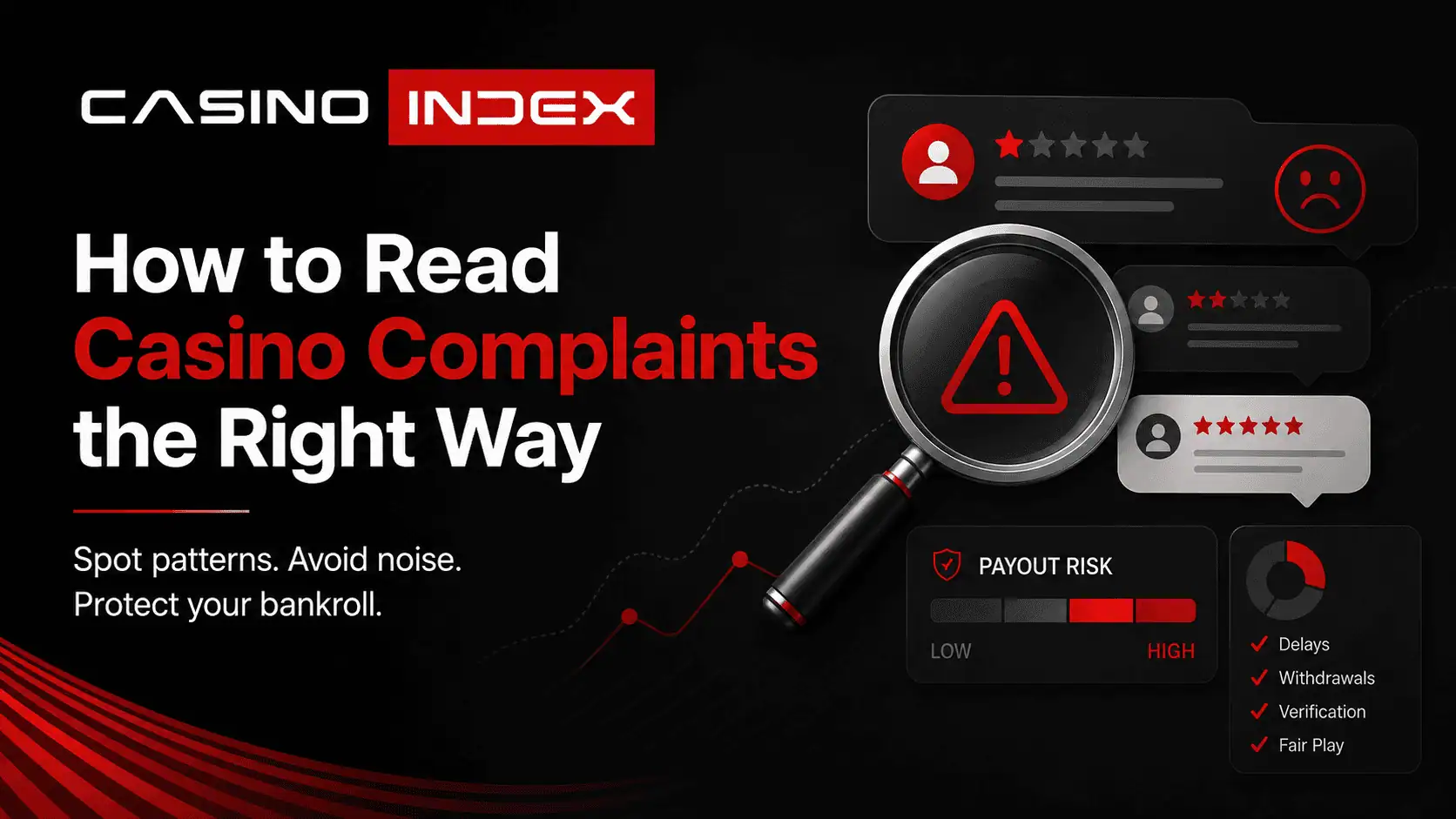
How Casino Complaints Reveal Real Risk Before You Deposit
Most players read casino complaints too quickly.
They search for a brand, open a review page and skim a few angry comments. One dramatic story can feel like proof that the casino is unsafe. Meanwhile, a high public rating can create the opposite impression.
Neither conclusion is reliable on its own.
Complaints become useful only when they are read with context. A single post may be emotional, incomplete or written while the case is still under review. At the same time, a polished rating can hide repeated problems around withdrawals, verification or account restrictions.
The important question is not whether a casino has complaints.
Any operator with a meaningful player base will eventually receive criticism. Instead, experienced players look at:
- which problems keep appearing
- when those problems begin
- whether the same stage of the player journey causes friction
- how the operator responds
- whether cases are resolved
- whether the complaints match the casino’s published terms
That shift in perspective changes complaint research from emotional browsing into a practical trust check.
This guide explains how to read casino complaints properly, separate isolated disputes from meaningful patterns and identify when public reports point to a wider withdrawal or account-handling risk.
Why Most Players Read Casino Complaints Badly
The biggest mistake is treating every complaint as equally important.
A player sees phrases such as “scam,” “stolen balance” or “account blocked” and assumes the case is already clear. That reaction is understandable because real money is involved. Delays feel personal, while document requests can feel hostile.
However, emotion is not evidence.
Important details are often missing
Some public complaints are detailed and well supported. Others leave out information that could change the interpretation completely.
For example, a player may report confiscated winnings without mentioning that a bonus was active. Another person may complain about a frozen withdrawal while leaving out a payment-name mismatch. Someone else may post during an active verification review and never return to explain the final outcome.
Those omissions do not prove that the casino acted fairly. Still, they mean the complaint cannot be judged properly from the headline alone.
Early convenience is weak evidence
A casino may perform well during registration and still create problems later.
The account opens quickly. Deposits arrive immediately. Games load without issues. Support answers basic questions.
None of that tells the player much about payout-stage trust.
The stronger test begins when the player stops depositing and requests money back. At that point, the casino may check identity, payment ownership, bonus activity, withdrawal limits or account history.
Understanding why casinos delay withdrawals helps distinguish an explainable review from an open-ended payment problem.
Complaint volume alone can mislead
A large casino may receive more complaints simply because it has more players.
Meanwhile, a smaller operator may have very few public reports because its user base is limited, not because its service is better.
Therefore, raw complaint counts should never be used without examining:
- the size and age of the casino
- the seriousness of the complaints
- the stage where problems occur
- the number of visible resolutions
- whether the same issue repeats
Start With the Complaint Type, Not the Emotion
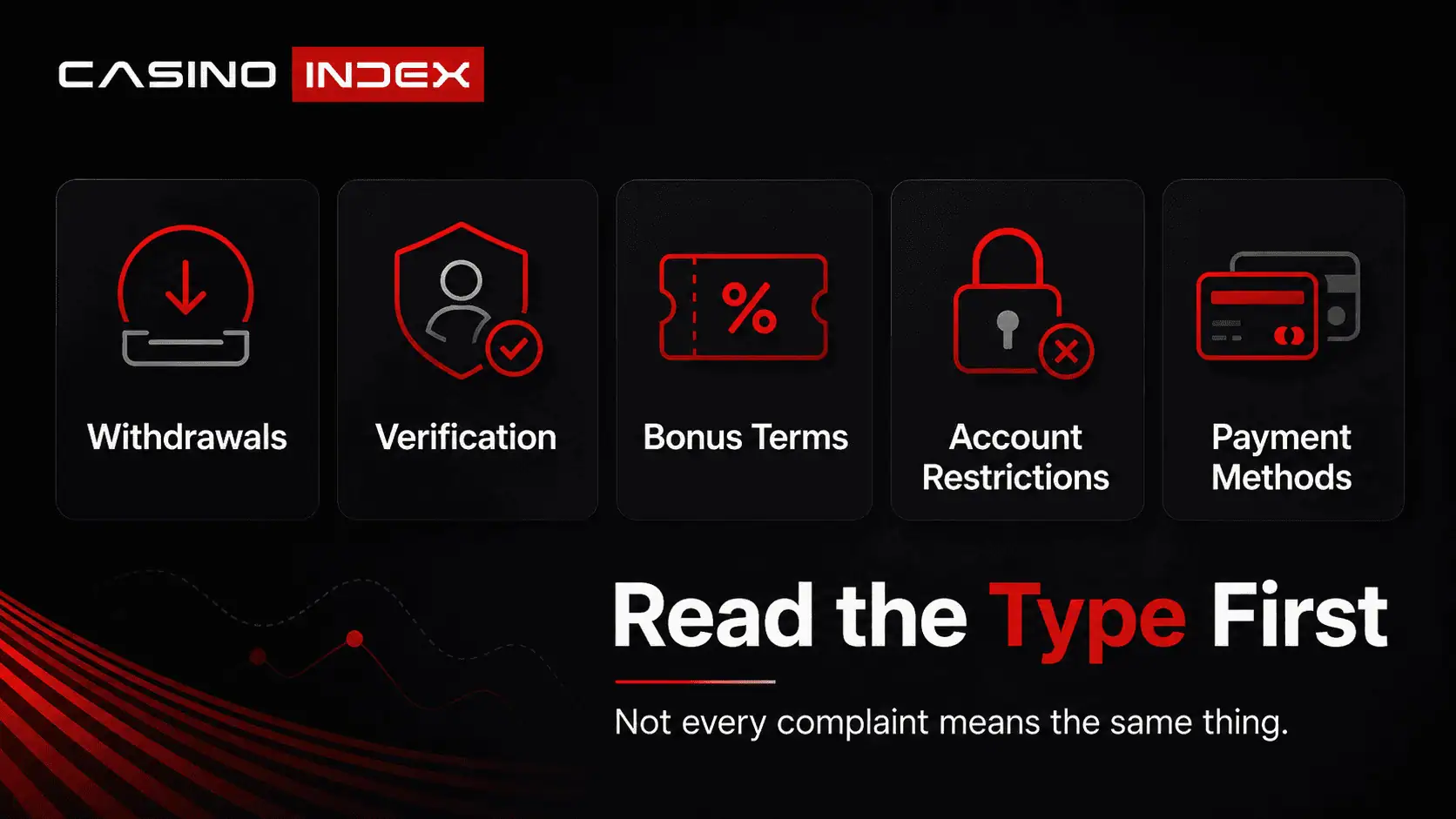
A better method begins by separating complaints into categories.
Without this step, every negative story blends into one pool of frustration. Once the complaint types are separated, it becomes much easier to judge which reports affect trust and which need more context.
Withdrawal complaints
Withdrawal complaints usually deserve the most attention.
Repeated reports about pending payments, reversed cashouts, finance-team reviews or undefined processing times can reveal how the operator behaves when money is due to the player.
Look closely at whether the casino:
- provides a specific reason for the delay
- identifies the action required from the player
- states an expected review period
- keeps the explanation consistent
- completes the payment once the issue is resolved
A fast deposit system means little when the withdrawal process becomes vague or unpredictable.
Verification complaints
Verification by itself is not suspicious.
KYC can be a normal part of regulated gambling, payment security and fraud prevention. Even crypto-focused casinos may request documents at some stage.
The better question is how and when verification begins.
A normal process usually explains which documents are needed and gives specific reasons for rejection. By contrast, a more concerning process may expand after every submission, repeat previously completed requests or remain open without a clear endpoint.
CasinoIndex explains this distinction in its guide to what a safe casino KYC process looks like.
Bonus complaints
Bonus disputes create a large amount of complaint noise.
Many players do not read wagering requirements, maximum-bet rules, restricted-game lists or cashout limits before accepting an offer. As a result, some severe-sounding complaints become more complicated once the applicable terms are examined.
Nevertheless, casinos can also use weak or overly broad bonus clauses unfairly.
When reading a bonus complaint, check:
- whether a bonus was active
- which balance was confiscated
- which specific rule was cited
- whether the rule was visible before the player deposited
- whether the casino applied the same interpretation consistently
A dispute over bonus funds should not automatically carry the same trust weight as a delayed withdrawal involving clean, non-bonus winnings.
Account restriction complaints
Account restrictions become more important when the timing looks unusual.
A security review during registration may be routine. However, repeated reports of accounts being restricted only after larger wins or first withdrawal requests deserve closer attention.
Possible legitimate triggers include:
- duplicate-account concerns
- restricted-country access
- payment ownership problems
- suspected account takeover
- bonus or promotion review
- responsible gambling intervention
The key issue is whether the operator explains the type of review, the next step and what will happen to the remaining balance.
Players facing this issue can read what happens when casinos block accounts.
Payment method complaints
Payment complaints are often overlooked because players focus more heavily on games and bonuses.
In practice, the cashier can reveal far more about the operator’s real risk profile.
Important issues include:
- payment-name mismatches
- third-party deposits
- deposit and withdrawal methods that do not align
- wallet ownership questions
- payment matching requirements
- source-of-funds checks
- fees or limits disclosed only after deposit
CasinoIndex explains part of this process in its guide to what happens before a casino approves a withdrawal.
Single Complaint vs Complaint Pattern
A single complaint can describe a genuine and serious problem.
However, it does not automatically show how the casino treats its wider player base.
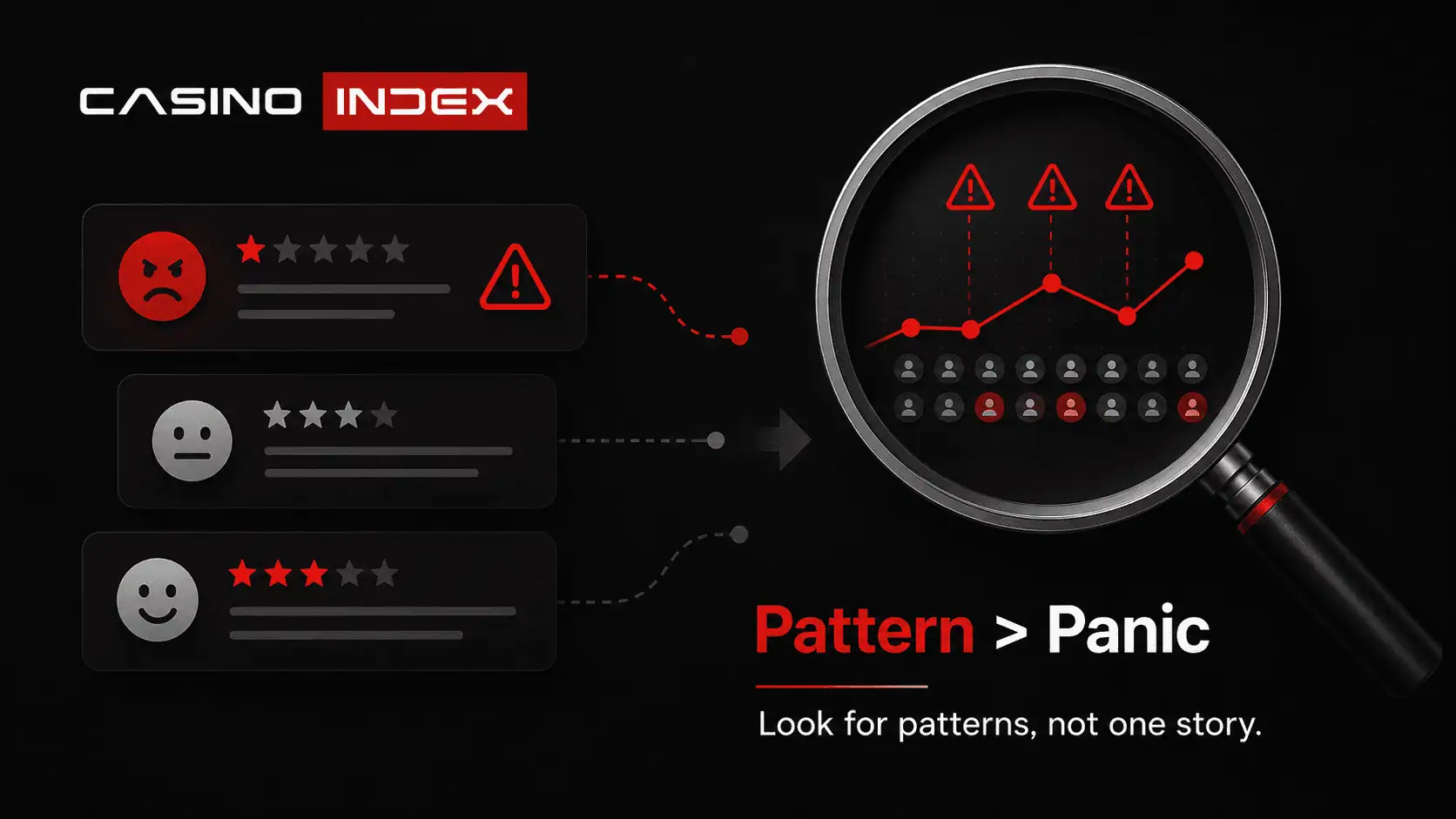
A pattern carries more weight because several independent reports point toward the same underlying weakness.
| Signal | Single Complaint | Repeated Pattern |
|---|---|---|
| Number of reports | One isolated account | Several players describe similar problems |
| Stage of the issue | Unique or unclear timing | Friction repeatedly appears during withdrawal, KYC or account closure |
| Available context | Important details may be missing | Several timelines reveal the same operational sequence |
| Operator response | A specific explanation may resolve the case | Generic replies or shifting reasons appear across multiple disputes |
| Resolution | The outcome may be unknown | Similar cases remain unresolved or end in the same result |
| Risk value | Useful context, but limited proof | Stronger evidence of a process-level weakness |
What an isolated complaint may look like
An isolated report may include only a short accusation and no timeline.
Other common features include:
- the withdrawal was requested very recently
- the player does not state whether a bonus was used
- the payment method is not mentioned
- the casino has already provided a case-specific response
- the player stops updating the complaint
- no similar cases appear elsewhere
The report may still be valid. Yet the evidence remains too limited for a broad conclusion.
What a meaningful pattern looks like
A pattern becomes more credible when several reports describe the same mechanism.
Examples include:
- multiple withdrawals remain pending beyond the stated timeframe
- KYC requests expand only after larger wins
- support repeatedly changes the reason for the delay
- the same disputed clause appears in several cases
- accounts are restricted at the same point in the payment process
- the operator posts generic replies without resolving the underlying issue
- similar reports appear across several independent sources
This does not prove that every player will receive the same treatment.
Still, the pattern should be treated as a risk signal rather than dismissed as one angry customer.
How to Judge Casino Complaint Patterns
Once complaints are divided into categories, the next step is to study repetition.
The goal is not to find identical wording. Instead, look for different players describing the same operational outcome.
Look for repeated friction, not repeated language
One player may write that a cashout remains pending. Another may say that the finance department keeps reviewing the request. A third may report that documents were submitted twice without progress.
The wording is different, but the underlying issue may be the same.
Matching outcomes carry more weight than matching phrases.
Track the stage of the player journey
Complaint timing helps explain risk.
A registration problem tells you something about onboarding. A bonus complaint points toward promotional rules. A first-withdrawal dispute tests the cashier and account-review process.
A larger-payout complaint can carry even more weight when new requirements appear only after the player builds a meaningful balance.
Ask:
- What happened before the problem started?
- Was a bonus active?
- Had the account already been verified?
- Did the casino stay easy to use until money was due out?
- Did the issue begin after a specific win or withdrawal amount?
Watch for threshold-based problems
Some complaint patterns only become visible at higher values.
A casino may process small withdrawals smoothly while reviewing larger payouts more aggressively. That is not automatically unfair, because larger transactions can justify stronger checks.
However, concern increases when:
- the casino does not disclose the relevant limit
- the review process has no clear endpoint
- requirements keep changing
- similar high-value complaints remain unresolved
Therefore, a successful small withdrawal should be treated as useful evidence, not proof that every larger cashout will behave the same way.
Check the casino’s response quality
The operator’s response matters almost as much as the original complaint.
A stronger response usually explains:
- which rule or process applies
- what caused the issue
- which action is required
- whether the case remains under review
- what happened after the problem was resolved
The answer may still be unpopular. However, the logic is visible.
Weaker responses often rely on phrases such as “security reasons,” “routine review” or “relevant department” without identifying the actual problem or next step.
When that response style repeats across several complaints, it becomes part of the pattern.
Check whether the cases were resolved
A complaint count without resolution data gives an incomplete picture.
Some casinos receive serious complaints but resolve a large share of them. Others answer publicly without fixing the underlying problem.
Look for:
- whether the player confirmed payment
- whether the account was restored
- whether the casino explained the disputed rule
- whether the complaint platform marked the case resolved
- whether similar cases continued after the supposed fix
Resolution quality is often more useful than the public rating itself.
Reading Complaint Sources the Smart Way
No single review platform should control the final judgment.
Different sources serve different purposes, and each has limitations.
Public review platforms
General review platforms are useful for measuring broad sentiment and identifying recurring keywords.
However, they often contain:
- very short reviews
- complaints unrelated to withdrawals
- emotional reactions after gambling losses
- incentivized positive ratings
- cases with no follow-up
Use them to identify possible themes, not to reach an immediate verdict.
Complaint portals
Complaint-focused websites often provide better timelines, operator responses and case outcomes.
They can be especially useful for:
- withdrawal disputes
- bonus confiscations
- KYC problems
- blocked accounts
- payment-method disagreements
Even so, the complaint platform sees only the evidence submitted to it. A visible resolution does not necessarily explain every internal detail.
Forums and community discussions
Forums can reveal early warning signs before they appear in formal review scores.
Experienced users may also provide useful context about payment methods, license changes or known account rules.
On the other hand, forum claims can spread quickly without verification. Duplicate stories, copied screenshots and incomplete timelines can make one dispute look like several independent cases.
Casino terms and official replies
Always compare public complaints with the casino’s own rules.
This does not mean the terms are automatically fair. It shows whether the operator is applying a published rule or introducing a new interpretation after the event.
Official replies should also be examined critically. A public response can sound professional while avoiding the central question.
Reliable reviews should connect the evidence
A strong review does more than repeat a public rating.
It should connect complaints with licensing, payment rules, KYC timing, withdrawal limits and the casino’s response history.
CasinoIndex explains what makes a casino review reliable and why withdrawal-stage evidence matters more than product descriptions alone.
Separating Genuine Risk From Complaint Noise
Complaint analysis is not about deciding who is right in every individual dispute.
The practical goal is to decide whether the visible risk is high enough to affect the deposit decision.
| Signal | More Likely to Be Noise | More Meaningful Risk |
|---|---|---|
| Details | Vague accusation with no timeline | Clear dates, amounts, payment method and account stage |
| Main issue | Complaint focuses mainly on gambling losses | Complaint focuses on funds, verification or account access |
| Repetition | The issue appears once | Similar cases appear repeatedly |
| Timing | Problem appears during a normal short review | Friction repeatedly begins after wins or withdrawals |
| Operator response | Specific explanation and visible progress | Changing reasons, generic replies or silence |
| Outcome | The case is resolved after a clear step | Several similar cases remain unresolved |
Common signs of complaint noise
Noise often includes:
- explosive language without operational detail
- complaints about losing rather than withdrawing
- no mention of bonus use
- no payment or account context
- a case posted immediately after the request began
- no similar report from another source
Common signs of a meaningful risk pattern
A stronger signal usually has structure.
- the same issue appears more than once
- the problem starts at the same stage
- several players describe similar withdrawal friction
- document demands expand late in the process
- payment objections appear only after a win
- support remains vague while the case continues
- cases stay unresolved beyond published timeframes
Repeated late-stage friction does not automatically prove deliberate abuse.
Nevertheless, it is one of the strongest public warning signals available before depositing.
Players who need a broader risk checklist can review the main casino scam warning signs.
What Repeated Payout Complaints Can Signal
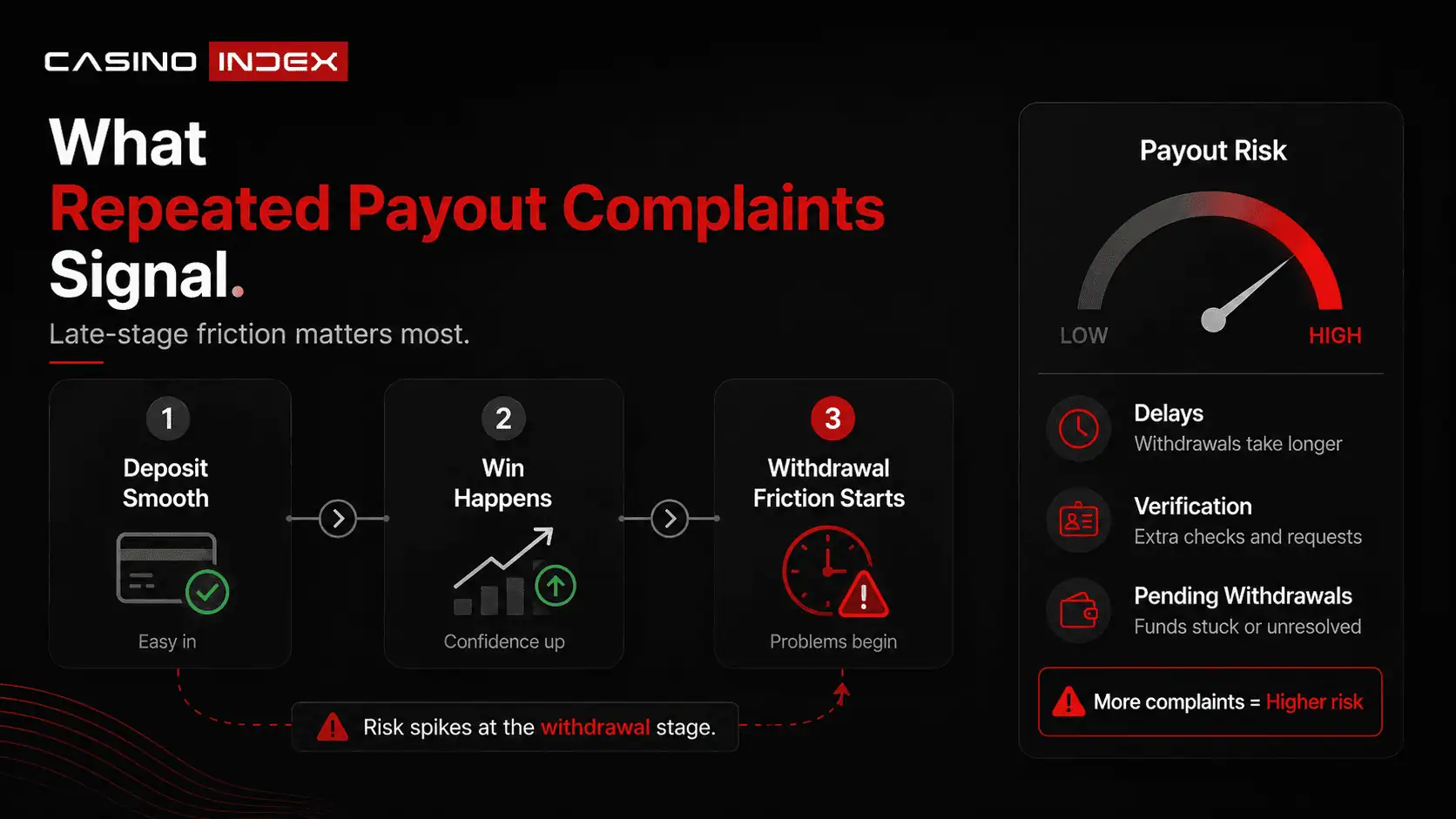
Among all complaint categories, payout reports usually deserve the greatest attention.
They test the point where trust stops being theoretical.
A casino may have a modern interface, large promotions and thousands of games. None of those features carry much weight when the operator becomes inconsistent after a withdrawal request.
Weak payment operations
Repeated complaints may indicate that the casino’s finance, support and risk teams do not work together effectively.
Players may receive different answers depending on which team responds. The payment can remain pending because no department takes ownership of the case.
A cashier optimized for deposits
Some casinos make deposits extremely easy while providing limited information about withdrawals.
Warning signs include:
- many deposit options but few withdrawal methods
- unclear cashout limits
- no visible approval stages
- withdrawal statuses that do not update
- support that cannot explain finance-team delays
Stricter treatment after wins
Additional checks after a larger win can be legitimate.
Still, the risk rises when several players report that:
- previously accepted documents are rejected
- new requirements appear without explanation
- payment ownership is questioned only at withdrawal
- the account becomes restricted after the payout request
- the casino invokes broad terms without identifying the breach
A single payout complaint does not settle the issue. Repeated cases involving the same sequence deserve far more attention.
Players should also understand how long casino withdrawals should take before treating every pending payment as misconduct.
Those who prefer a decision-focused comparison can examine casinos compared for smoother withdrawals.
When Account Restrictions Strengthen a Complaint Pattern
Account complaints should be judged separately from ordinary login problems.
A password reset, temporary security lock or failed authentication attempt does not carry the same weight as an account being closed with a meaningful balance inside.
Questions to ask about the restriction
- Did the restriction begin before or after a withdrawal?
- Did the casino provide a specific reason?
- Was the player asked for relevant documents?
- Did the operator explain what happens to the balance?
- Was there a clear appeal or complaint route?
- Do similar account-block reports appear elsewhere?
Normal account protection
A safer account restriction usually has a clear purpose.
The operator may temporarily block access after suspicious login activity, a location change or a possible account takeover. Once the player confirms control, normal access can be restored.
Higher-risk account handling
Concern increases when an account is restricted immediately after a large win and the operator refuses to explain the status of the funds.
The signal becomes stronger when several players describe the same sequence:
win → withdrawal request → account restriction → vague support → unresolved balance.
That repeated structure matters more than the phrase “account blocked” by itself.
How Casino Dispute Resolution Usually Works
A complaint does not always end with the first support response.
When a meaningful dispute remains unresolved, the player may need to move through a structured escalation process.
Step 1 — Use the casino’s formal complaint process
Begin with the casino’s support or complaints team.
Provide:
- the account identifier
- the disputed amount
- the payment method
- the relevant dates
- the documents already submitted
- a clear description of the requested resolution
A short, organized timeline is more useful than several emotional messages sent through different channels.
Step 2 — Request the specific rule or decision
Ask the operator to identify:
- which rule applies
- what evidence supports the decision
- whether the restriction is temporary or final
- what happens to the remaining balance
- which team can review an appeal
Step 3 — Escalate outside the casino where available
External escalation may involve:
- the licensing authority
- an alternative dispute resolution provider
- the payment provider
- a bank or card issuer
- a recognized casino complaint service
- legal advice for a significant balance
Not every regulator offers direct compensation or individual dispute handling. Therefore, players should understand the actual powers of the licensing authority before relying on the badge.
CasinoIndex explains how casino dispute resolution usually works, including internal complaints, regulators, ADR services and payment-provider escalation.
Step 4 — Preserve the final outcome
If the dispute is resolved, the outcome still matters for future complaint research.
A player should update the public report where possible. Without that update, an old complaint may continue to look unresolved even after payment was made.
Likewise, a casino that resolves a case should explain enough to show that the process reached an endpoint without exposing sensitive account information.
A Better Pre-Deposit Complaint Check
The most useful complaint review is structured and patient.
1. Search by problem, not only by brand
Combine the casino name with terms such as:
- withdrawal
- pending payment
- KYC
- blocked account
- bonus confiscation
- payment method
- complaint
2. Separate the complaint categories
Do not place a minor support complaint and a large unresolved withdrawal in the same risk category.
Classify the reports before judging the overall picture.
3. Note when each problem began
Timing often reveals more than the complaint score.
Record whether the issue started during:
- registration
- deposit
- bonus play
- verification
- first withdrawal
- larger payout
- account closure
4. Compare at least two types of source
Use general reviews for sentiment, complaint portals for case details and forums for emerging patterns.
Then compare those reports with the casino’s current terms.
5. Check the operator’s replies
Look beyond whether a reply exists.
Ask whether it answers the actual complaint, identifies the process and shows visible progress.
6. Check the dates
Older complaints may relate to a previous owner, license, management team or payment system.
Recent cases usually provide better evidence of current behavior. However, a long-running unresolved pattern can remain relevant when the same issue continues under the current operation.
7. Decide whether the pattern changes your deposit decision
Finish with one practical question:
Would I still be comfortable depositing if this exact complaint pattern happened to me after a win?
That question is often more useful than a public rating score.
Casino Complaint Research Checklist
| Check | Question to Ask |
|---|---|
| Complaint type | Is this about withdrawal, KYC, bonus terms, payment or ordinary service? |
| Timing | Did the problem begin before or after a win or cashout request? |
| Context | Are the payment method, bonus status and account history explained? |
| Repetition | Do independent reports describe the same mechanism? |
| Response | Does the casino provide a specific and consistent explanation? |
| Resolution | Was the player paid, verified or given a clear final decision? |
| Freshness | Do the reports reflect the current operator and payment system? |
| Deposit impact | Is the pattern serious enough to change the decision? |
FAQ: Reading Casino Complaints
Does one complaint mean a casino is unsafe?
No. One complaint may describe a serious and genuine problem, but it does not prove a wider pattern.
Check the context, operator response, final resolution and whether similar reports appear elsewhere.
Which casino complaints matter most?
Withdrawal, account restriction, payment ownership and late-stage verification complaints usually deserve the most attention because they affect access to real funds.
Minor interface or promotional complaints may still be useful, but they carry less trust weight.
How many complaints create a meaningful pattern?
There is no fixed number.
A few highly similar, well-documented and unresolved cases can carry more weight than many vague complaints. The stage, evidence and operator response matter more than raw volume.
Are all withdrawal complaints serious?
No. Some involve normal KYC, published limits, bank processing or a recent request that is still within the stated timeframe.
The concern rises when reasons change repeatedly, no endpoint is provided or similar cases remain unresolved.
How should bonus complaints be judged?
Check whether a bonus was active, which rule was cited and whether the condition was visible before deposit.
A bonus dispute needs more context than a complaint involving clean, non-bonus funds.
Can positive reviews hide payment problems?
Yes. General ratings may be influenced by game selection, bonuses, support before deposit or incentivized reviews.
Players should search specifically for withdrawal, KYC and blocked-account experiences rather than relying on the overall score.
Why does complaint timing matter?
The timing shows which part of the casino operation is under pressure.
A problem that repeatedly begins after a win or withdrawal request is more relevant to payout trust than an isolated registration issue.
Should I trust the casino’s public reply?
A public reply is useful only when it addresses the specific issue.
Generic statements about security or internal reviews do not resolve the complaint unless the operator also explains the relevant process and next step.
Do resolved complaints still matter?
Yes. Resolved cases show how the operator behaves under pressure.
A casino that acknowledges mistakes and completes payments may present a different risk profile from one that repeatedly leaves cases unanswered.
Where should I look for casino complaints?
Use several source types, including general review platforms, detailed complaint portals, gambling forums and the casino’s own terms.
No single platform provides the full picture.
What should I do after finding a repeated complaint pattern?
Reduce exposure or avoid the casino when the repeated issue affects withdrawals, account access or legitimate balances.
At minimum, begin with a small deposit, avoid complex bonuses and request an early test withdrawal.
Can a complaint pattern prove that a casino is a scam?
A pattern can create a strong risk signal, but it should not automatically be treated as final proof of intentional fraud.
CasinoIndex considers the available evidence, operator responses, applicable terms and case outcomes before reaching an editorial judgment.
Final View: Read the Pattern, Not Just the Headline
A complaint on its own presents one version of events.
A complaint pattern shows something more useful.
It reveals timing, repetition, operator behavior and whether the same friction appears when players try to withdraw or regain access to their accounts.
That is why serious complaint research should not react to the angriest headline or the highest rating.
Instead, separate complaint types, compare sources, study the player journey and check how the operator responds under pressure.
Done properly, complaint research becomes a practical trust filter.
Done badly, it becomes noise.
The right way to read casino complaints is to look past isolated emotion and identify the repeated process behind the problem.

Maria Hoffmann has worked in cryptocurrency content and digital publishing since 2017. She is a co-founder of Freecoins24 and CryptoMutant and has covered blockchain projects, crypto platforms and emerging industry trends for several years. She has also been active as a cryptocurrency investor since 2019. At CasinoIndex, Maria combines content research and SEO experience with a focus on casino trust, platform security, withdrawal processes, payment risks and user protection. Her work looks beyond bonuses and product features to examine how gambling platforms handle player funds, verification and account-related risks.