Shuffle vs Rollbit: Which Crypto Casino Is Better for Long-Term Play?

Shuffle and Rollbit appeal to the same broad crypto-gambling audience, but they solve the long-term player problem in different ways.
Shuffle is easier to understand as a casino and sportsbook. The platform has a modern crypto-first feel, a broad game product and a reward system that does not need to dominate the entire account experience.
Rollbit is more layered. Casino games, sports betting, rakeback, rank progression and other platform mechanics sit inside a wider crypto ecosystem. That gives active users more to optimise, but it also gives them more rules and account activity to manage over time.
The quick verdict: Shuffle is the better default choice for players who want a cleaner long-term casino and sportsbook account. Rollbit is the stronger specialist option for high-activity users who actively value rakeback and a deeper crypto-native ecosystem. The trust gap is narrower than a simple feature comparison suggests, though. Both platforms can apply KYC and withdrawal checks, and both have public complaint patterns that serious players should consider before leaving a large balance on-site.
That is why this comparison focuses on what happens after the easy stage of signup and deposit. Withdrawal behaviour, KYC, reputation, account rules and long-term usability matter more here than counting games or comparing one promotion.
Full Shuffle and Rollbit reviews
If you are already leaning toward one of the two brands, the full reviews provide the deeper operator-level checks that a head-to-head comparison cannot cover in the same space.
| Casino | Best for | Main reason to consider it | Full review |
|---|---|---|---|
| Shuffle | Crypto casino and sportsbook users who want a cleaner long-term account | Broader everyday fit, straightforward product structure and strong crypto usability | Shuffle review for crypto casino users |
| Rollbit | Experienced users who actively track rakeback, rewards and platform value | Deeper reward mechanics and more ways to optimise high-activity play | Rollbit review for high-activity players |
Current comparison edge: Shuffle for the broader long-term fit. Rollbit for users who specifically want the deeper reward ecosystem.
Shuffle vs Rollbit: how CasinoIndex compares real-money risk
A useful comparison cannot stop at game libraries, supported coins, sportsbook markets or VIP labels. Those details describe the product before pressure appears. They do not explain what happens when a player has a meaningful balance waiting for approval.
CasinoIndex compares Shuffle and Rollbit across six areas:
- Withdrawal behaviour. What can interrupt a cashout before the blockchain transaction is sent?
- KYC and account checks. Can identity, location, wallet ownership or source-of-funds checks appear later?
- Reputation. Are public complaints concentrated around minor service issues or access to player funds?
- Long-term usability. Does the account remain easy to manage after weeks or months of activity?
- Reward value. Do recurring rewards improve the experience without hiding the underlying gambling cost?
- Operator clarity. Are the rules around withdrawals, location and account restrictions understandable before a problem appears?
This follows how CasinoIndex evaluates real-money risk. Product quality matters, but access to funds, verification behaviour and reputation carry more weight than reward intensity.
That approach changes this matchup. Shuffle still has the stronger general-user case, but it should not be presented as a friction-free safety winner. Rollbit still has a strong product and reward case, but its public withdrawal and account-restriction complaints make high-activity users especially dependent on understanding the terms.
Shuffle vs Rollbit comparison table
| Area | Shuffle | Rollbit | Edge |
|---|---|---|---|
| Long-term fit | Cleaner default for casino and sportsbook use | Better for users who actively optimise rewards | Shuffle for most |
| Withdrawal rules | KYC and additional checks can restrict withdrawals | Terms explicitly allow verification, source-of-funds and payment-route checks | No clean winner |
| KYC | Can be requested at any time and can restrict payments | Can expand around identity, location and financial checks | No low-friction winner |
| Reputation | Recent public complaints include withdrawal review and support friction | Recent complaints include blocked withdrawals, KYC and account restrictions | Shuffle, slight |
| Reward depth | Strong recurring VIP value without dominating the whole product | Deeper rakeback and account-progression identity | Rollbit |
| Complexity | Lower learning curve | More systems and conditions to track | Shuffle |
| Best fit | Players who want one clear crypto gambling account | High-activity users comfortable with platform mechanics | Depends on player |
The important point is that the table does not make the decision by itself. Shuffle can be easier to use while still placing a withdrawal under review. Rollbit can offer deeper rewards while still applying account checks that matter more than those rewards. The useful comparison starts where the table ends.
Platform positioning: cleaner account vs deeper ecosystem
Shuffle is easier to read as a gambling product.
The core experience is familiar: casino, sportsbook, Originals, crypto payments and a VIP layer. The platform has expanded over time, but the account still works for users who do not want every session to revolve around reward optimisation.
That matters more than it sounds.
A simpler platform creates fewer opportunities to misunderstand how balances, rewards and account activity interact. It also makes it easier to judge whether the casino remains useful after the first promotional stage.
Rollbit has a more distinctive ecosystem identity. Its appeal goes beyond the basic casino and sportsbook. Rakeback, rank progression and platform-specific incentives are more central to the experience, which gives regular users more reasons to stay active.
That can be valuable for a disciplined player who already understands the system.
It can also create more mental load. A player who follows several reward layers at once may start making decisions around the next rebate or rank milestone rather than the underlying cost of the gambling.
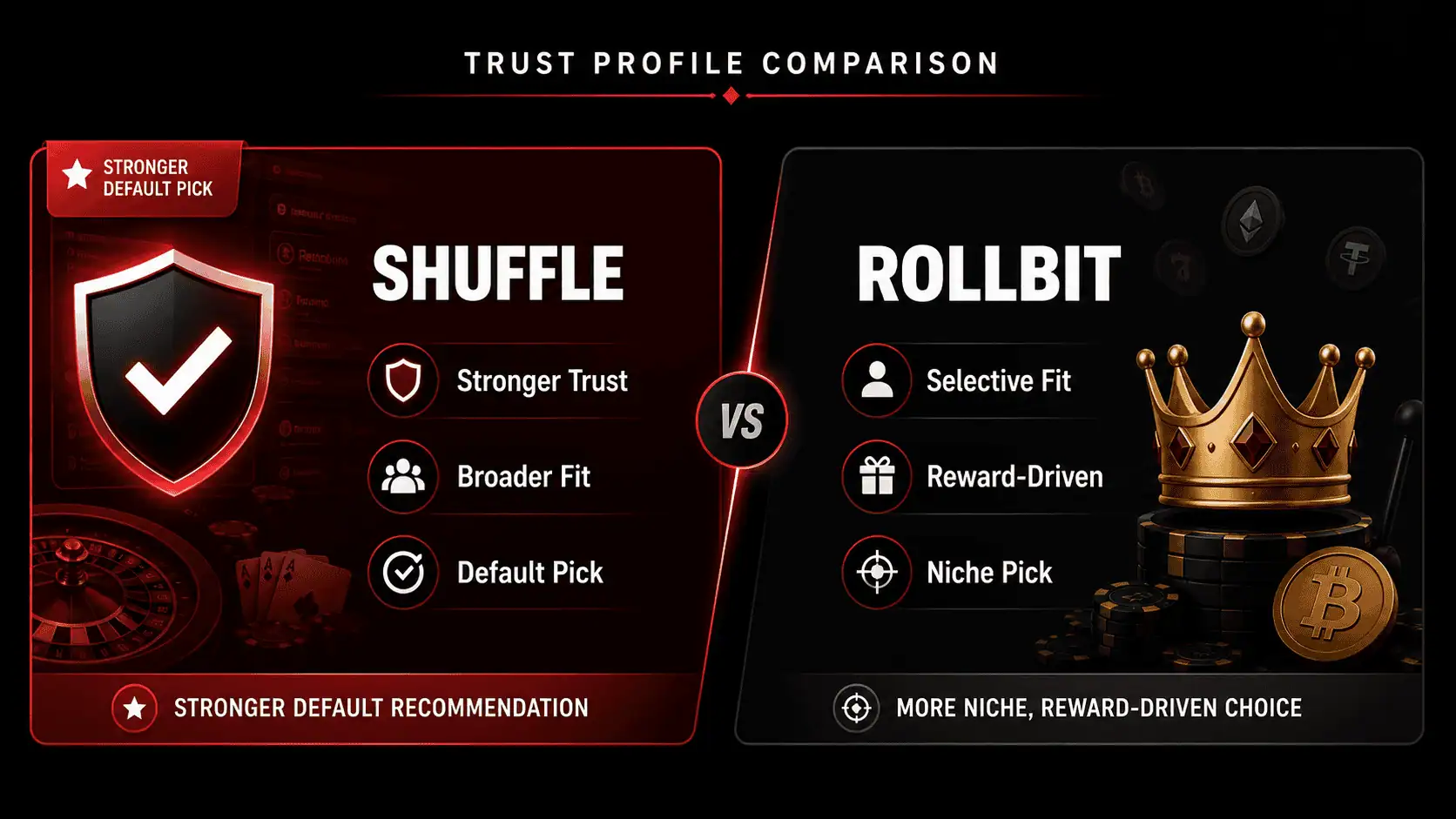
Shuffle is easier to live with. Rollbit gives active users more to optimise. Neither advantage tells you which platform will handle a future account review better.
Withdrawals: the gap is smaller than the marketing suggests
This is where the old version of the comparison needed the biggest correction.
Shuffle has a reputation for fast crypto withdrawals in uncomplicated cases, and the platform itself promotes that strength. However, its current terms also make clear that withdrawals can be restricted when suspicious or unauthorised activity is detected. The operator can request KYC at any time and can restrict payments or withdrawals until verification is completed to its satisfaction.
The terms also allow additional checks when an account is closed, blocked or under review.
That distinction matters because an “instant withdrawal” claim usually describes the best-case account. It does not describe a withdrawal that has entered KYC, compliance or security review.
Rollbit is similarly clear that withdrawal approval is conditional. Its current terms say identity and other verification checks may need to be completed before funds are released. The operator can review suspicious transactions, require source-of-funds evidence and ask for proof that the withdrawal method belongs to the player.
Rollbit can also delay or cancel withdrawals while additional checks are carried out.
So the real comparison is not “Shuffle pays instantly and Rollbit does not.” It is:
- Shuffle has the stronger fast-withdrawal reputation for accounts that pass automatically.
- Rollbit publishes a detailed set of conditions that can interrupt a withdrawal.
- Both can move a cashout into manual review when account risk changes.
CasinoIndex explains the wider distinction between internal approval and payment settlement in its casino withdrawal guide.
For serious players, the practical rule is simple: test the withdrawal route before increasing the balance. A small successful payout does not guarantee that a later high-value withdrawal will avoid review, but it confirms that the basic wallet route and account setup work.
KYC: neither platform should be treated as anonymous
Crypto-first registration can create the impression that verification is optional forever. The terms of both operators say otherwise.
Shuffle reserves the right to request KYC documentation at any time to confirm identity, location or age. It can restrict access to services, payments or withdrawals until the review is complete. Its terms also mention geolocation checks, IP-masking detection and blockchain transaction analysis.
Rollbit also uses identity and compliance checks. Its withdrawal terms allow verification before a payout and specifically mention suspicious transactions, source-of-funds review and payment-method ownership.
This creates a different risk profile from a traditional “verify once at signup” account.
A player can have several smooth deposits and withdrawals before later activity triggers additional review. That does not automatically mean the casino is acting unfairly. It does mean low-friction onboarding should not be used as evidence that future withdrawals will remain document-free.
Before building a larger balance on either platform, check:
- whether your real country is permitted
- whether your account details match your identity documents
- whether the crypto wallet or payment method belongs to you
- whether a VPN conflicts with the operator’s location rules
- whether higher transaction values can trigger additional checks
- whether you can provide a clean history for the funds used on the account
The key question is not whether KYC exists. It is whether the casino explains the request clearly, asks for relevant evidence and gives the player a workable path to completion.
Reputation: Shuffle no longer deserves an automatic trust win
Older versions of this comparison gave Shuffle a broad trust advantage too easily.
That position needs more nuance in 2026.
Public complaint databases now include Shuffle cases involving withdrawals left under review, delayed support responses and balance disputes. Some cases have been resolved after the player eventually received funds, while others remain open or contested.
Shuffle’s Trustpilot profile has also carried a platform warning, and Trustpilot states that reviews were removed for guideline violations. That is not proof that the casino manipulates every public review or that player funds are unsafe. It is still a reputation signal that should lower confidence in using the raw star rating as evidence.
Rollbit has its own, more serious-looking complaint pattern. Recent public complaints include blocked withdrawals, multi-account allegations, lengthy KYC disputes, account restrictions and cases closed unresolved after failed mediation attempts.
Again, complaints are allegations, not automatic proof.
The right way to read the pattern is:
- Shuffle has enough withdrawal and support friction that it should no longer be described as a clean trust winner.
- Rollbit has repeated public disputes around account restrictions and payout access that remain important for high-activity users.
- Raw complaint counts are not enough because platform size and reporting behaviour differ.
- Cases involving access to balances deserve more weight than complaints about bonuses, interface design or slow chat responses.
On that basis, Shuffle still gets a slight reputation edge in this comparison, but not the sweeping advantage the older article implied.
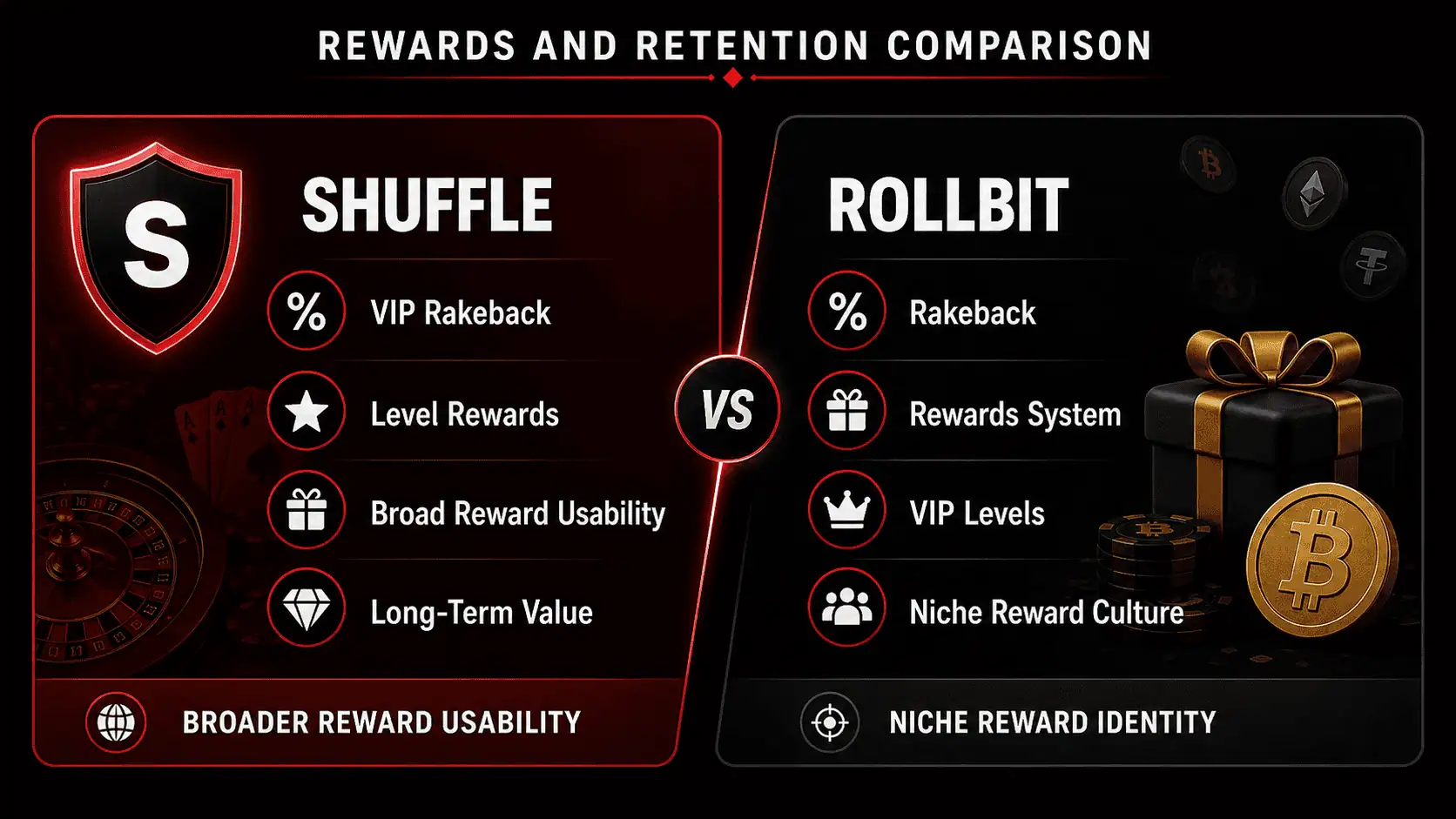
Rewards: Rollbit has more depth, Shuffle has less friction
Rollbit’s strongest argument is still reward depth.
The platform has built a large part of its identity around recurring value, rakeback and progression. For a player who wagers regularly and tracks the effective cost of play, that can produce a stronger long-term reward case than a simpler casino account.
However, reward depth creates two problems when it is compared badly.
First, reward percentages and structures can change. A comparison article can become stale quickly when it treats one promotional number as permanent.
Second, rakeback is not profit. It reduces part of the house cost after wagering has already occurred.
Shuffle also has recurring VIP value, but the reward layer feels less central to the entire product. For many users, that is an advantage because the account remains easy to judge even when the player is not actively optimising every reward.
| Player style | Better fit | Why |
|---|---|---|
| Casual or moderate-volume user | Shuffle | Reward system stays easier to manage |
| High-activity grinder | Rollbit | More reward depth to optimise |
| Player who values a simple casino account | Shuffle | Less dependence on platform mechanics |
| Player who actively calculates rakeback | Rollbit | Reward structure is more central to long-term use |
The safest way to compare rewards is to use the live account terms, not a percentage copied from an old review. Reward value should also be judged after withdrawal rules and KYC risk are included.
Long-term use: where Shuffle still has the clearer case
Long-term use is not the same as having the most features.
A platform can be exciting during the first month and tiring by month six. The real test is whether the account remains understandable when the player has transaction history, reward status, previous withdrawals and more money moving through it.
Shuffle has the better broad-user case because the product stays easier to interpret. Players can use casino games, sportsbook markets and rewards without making account optimisation the main reason to remain.
Rollbit can be better for users who deliberately want a more involved system. The extra reward layers are not automatically a weakness. They become a weakness only when the player does not understand them or starts chasing the next reward instead of judging total gambling cost.
Long-term users should also think about account evidence.
As balances and transaction volumes grow, it becomes more important to keep wallet records, avoid third-party funding, use accurate registration details and understand which country rules apply. That matters on both platforms because later KYC can be more demanding than the signup experience suggests.
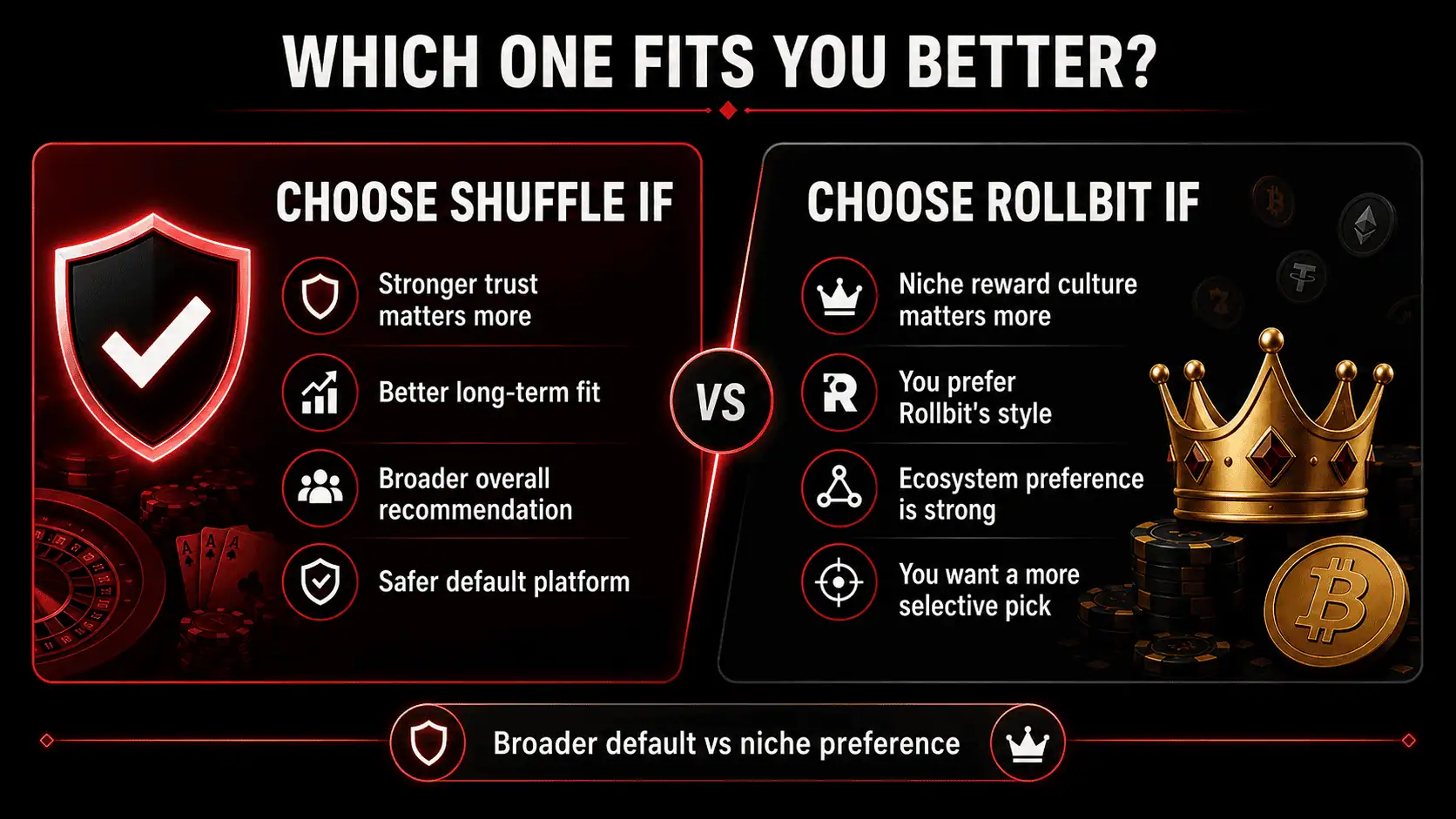
For most users, Shuffle’s lower complexity makes it easier to manage over time. For a smaller group of high-activity users, Rollbit’s added depth is exactly the point.
Which platform is better by player type?
| Player type | Better choice | Reason |
|---|---|---|
| First-time user comparing the two | Shuffle | Easier account structure and broader fit |
| Regular casino and sportsbook user | Shuffle | Less reward-system complexity |
| High-activity rakeback player | Rollbit | Deeper recurring reward logic |
| Player worried about KYC | Neither as a no-KYC choice | Both can require verification and restrict withdrawals during review |
| Player worried about complaint patterns | Shuffle, slight | Both have payout complaints, while Rollbit shows more repeated account-restriction disputes |
| Player who wants minimum mental load | Shuffle | Cleaner long-term account experience |
| Player who enjoys ecosystem mechanics | Rollbit | More platform depth and optimisation |
This is more useful than declaring one casino superior in every category. Shuffle wins the default recommendation because more player types can use it without needing the reward ecosystem to justify the choice. Rollbit wins a narrower set of high-activity use cases more convincingly.
What to check before using either casino long term
Players who expect to use either account for more than casual testing should make the decision before the balance becomes difficult to move.
- Confirm country eligibility. Do not assume crypto access overrides restricted-jurisdiction rules.
- Use your own wallet and payment routes. Third-party funding creates avoidable ownership questions.
- Complete a modest withdrawal early. This tests the basic payout route and exposes simple account mismatches.
- Read the current KYC terms. Signup friction does not predict later verification.
- Do not calculate rewards in isolation. Compare value after wagering, losses and account conditions.
- Keep transaction records. Larger or unusual activity can create source-of-funds or wallet-history questions.
- Do not leave an unnecessarily large balance on-site. A casino account is not a personal wallet.
These steps do not eliminate risk. They reduce the number of avoidable problems a player creates before a withdrawal review begins.
Final verdict: Shuffle for most, Rollbit for a narrower high-activity user
Shuffle remains the better overall choice in this comparison, but the reason needs to be stated more carefully than before.
It does not win because every withdrawal is instant or because its reputation is spotless. Current terms allow KYC and additional withdrawal checks, and recent public complaints show that some players have faced payout reviews and support friction.
Shuffle wins because the account is easier to justify for a broader range of users. The product is less dependent on reward complexity, long-term use is easier to manage and the platform works well for players who want casino and sportsbook access without making ecosystem optimisation the centre of the experience.
Rollbit remains the stronger niche option for high-activity users.
Its deeper reward structure and crypto-native identity can create more value for players who deliberately track rakeback and progression. The trade-off is that these users should pay closer attention to account rules, KYC, payment ownership and public withdrawal complaints.
The decision is therefore:
- Choose Shuffle if you want the stronger broad-user fit and cleaner long-term account.
- Choose Rollbit if you specifically want deeper reward mechanics and are comfortable managing more platform complexity.
- Choose neither blindly if your main reason is a fast-withdrawal claim, a reward percentage or the assumption that crypto means permanent anonymity.
For real-money use, the better platform is the one whose rules still make sense when the player is trying to withdraw rather than deposit.
FAQ
Is Shuffle better than Rollbit?
Shuffle is the better default choice for most players because the account is easier to manage over time. Rollbit is stronger for high-activity users who specifically want deeper rakeback and reward mechanics.
Which is better for withdrawals, Shuffle or Rollbit?
Shuffle has a stronger reputation for fast standard crypto withdrawals, but its terms allow KYC and additional checks to restrict payouts. Rollbit also allows verification, source-of-funds and payment-ownership checks. Neither should be treated as guaranteed instant withdrawal.
Does Shuffle require KYC?
Shuffle can request KYC at any time to verify identity, location or age, and it can restrict services, payments or withdrawals while verification is incomplete.
Does Rollbit require KYC?
Rollbit can require identity and other verification before withdrawals. Its terms also allow additional checks around suspicious transactions, source of funds and ownership of the withdrawal route.
Which has the better reputation?
Shuffle gets a slight edge, but not a clean win. Recent public complaints exist for both platforms. Shuffle has withdrawal and support complaints, while Rollbit has repeated public disputes involving KYC, account restrictions and access to balances.
Which has better rewards?
Rollbit has the deeper reward identity for active users. Shuffle offers enough recurring value for most players without making reward optimisation the centre of the account.
Which is better for long-term play?
Shuffle is easier for most players to use long term because it has fewer layers to manage. Rollbit can be better for experienced high-activity users who deliberately use its deeper reward system.

Nina Kanu has worked in cryptocurrency content and blockchain research since 2016. She is also known within parts of the crypto community through CryptoMutant, where her work has covered emerging projects, market trends and developments across the blockchain ecosystem. At CasinoIndex, Nina focuses on crypto casino reviews, platform comparisons, player experience, game ecosystems and bonus fairness. Her research examines how casino products perform beyond their marketing, including usability, payment options, promotional terms and the overall experience players receive after signing up.