BC.Game vs Shuffle: Which Platform Actually Makes More Sense?
Article OverviewShuffle leads CasinoIndex’s 2026 comparison with an overall rating of 8.5/10 (Safe), compared with 7.4/10 (Moderate Risk) for BC.Game. BC.Game offers a broader casino and VIP ecosystem, but Shuffle ranks higher under CasinoIndex’s trust-first methodology. Both platforms have withdrawal and verification requirements, with Shuffle’s terms explicitly providing for an identity check before the first withdrawal.
Shuffle is the stronger trust-first choice in the BC.Game vs Shuffle comparison for 2026. CasinoIndex currently rates Shuffle 8.5/10 (Safe), compared with BC.Game at 7.4/10 (Moderate Risk). BC.Game still has an advantage for players who prefer a larger, more layered gambling ecosystem, but product depth does not outweigh concerns about withdrawals, account handling and reputation.
Both platforms combine cryptocurrency casino games, sports betting, original games and loyalty rewards. The more important differences emerge when players examine the operator behind each website, the verification requirements before withdrawal and the conditions attached to bonuses.
Quick verdict: Shuffle wins this comparison under CasinoIndex’s trust-first methodology. BC.Game wins on the breadth and complexity of its product ecosystem. Neither platform guarantees immediate withdrawals or freedom from account verification.
BC.Game vs Shuffle: Quick Comparison
CasinoIndex places trust and reputation above product features. A strong game library or an elaborate VIP program can improve the user experience, but it cannot independently establish reliable treatment of player funds.
Shuffle
8.5 / 10
Safe
Higher current CasinoIndex rating, clearer published withdrawal rules and a more focused interface.
BC.Game
7.4 / 10
Moderate Risk
Broader reward and engagement ecosystem, but additional account and payout concerns.
| Comparison Factor | Shuffle | BC.Game | CasinoIndex Assessment |
|---|---|---|---|
| Overall Rating | 8.5/10 — Safe | 7.4/10 — Moderate Risk | Shuffle leads under the current trust-first rating system. |
| Published Operator | Natural Nine B.V., Curaçao. | Twocent Technology Limited, Belize, according to its current website disclosure. | Verify the current legal entity and licence for the exact website and jurisdiction. |
| Published Licensing | Curaçao Gaming Authority, OGL/2024/1337/0628. | Anjouan licence ALSI-202410011-FI1, according to the operator’s disclosure. | Different regulatory frameworks; an operator’s licence claim is not independent confirmation of status. |
| First Withdrawal KYC | Terms expressly provide for an identity-document check before the first withdrawal. | Identity and additional account checks can affect withdrawal processing. | Players should prepare for verification at either casino. |
| Withdrawal Reliability | Clear published conditions, but approval and KYC reviews can delay payments. | Publicly reported account and payout disputes require additional caution. | No independently verified head-to-head payout speed winner. |
| Game and Product Depth | Broad casino, sportsbook, live games and Originals offering. | Larger and more layered overall platform ecosystem. | BC.Game product advantage. Not an overall trust win. |
| Interface | More focused layout and comparatively straightforward navigation. | Feature-heavy design with multiple reward and product layers. | Preference-dependent; these are editorial UX observations, not benchmark results. |
| VIP and Rewards | Published VIP progression, rakeback and recurring reward categories. | Extensive VIP levels, promotions, cashback and engagement mechanics. | Reward value depends on eligibility, wagering rules and availability. |
| Provably Fair Games | Verification tools for eligible Originals. | Provably fair tools for eligible in-house games. | Game-result verification does not verify casino solvency or withdrawal behavior. |
| Overall Decision | Higher-rated trust-first option. | More expansive product option. | Shuffle wins the overall comparison. |
Rating note: These are CasinoIndex’s current overall casino scores, not ratings from a controlled head-to-head withdrawal test. The label “Safe” is a relative editorial risk classification and does not guarantee an account will be approved or paid.
Read Shuffle Review →Read BC.Game Review →
Why Shuffle Wins Under CasinoIndex’s Trust-First Methodology
CasinoIndex does not rank casinos by feature count alone.
According to our rating methodology, Trust & Reputation accounts for 30% of the overall assessment, Payments & Withdrawals for 15%, and Product & UX for 10%. Bonus Fairness, Games, Retention and Support/KYC are evaluated separately.
That distribution is important here. BC.Game may provide more reward systems and interactive features, but those advantages belong primarily to product and retention considerations. They cannot be used to override a weaker overall trust assessment.
The current CasinoIndex reviews give Shuffle 8.5/10 and BC.Game 7.4/10.
The editorial conclusion is therefore straightforward: Shuffle is the higher-rated overall casino in this comparison, while BC.Game remains a strong product-depth alternative for eligible users who understand its risks.
This is not a claim that every Shuffle customer receives faster payments or that every BC.Game customer will experience a problem. Those would require controlled testing and evidence that this comparison does not have.
Licensing and Operator Transparency
The first step in assessing either casino is identifying the legal company responsible for the service.
Shuffle’s current Terms of Service identify Natural Nine B.V. as the operator. The terms also disclose Curaçao Gaming Authority licence OGL/2024/1337/0628.
BC.Game’s current public website and licensing disclosure identify Twocent Technology Limited, registered in Belize, and refer to Anjouan licence ALSI-202410011-FI1.
These statements identify what the platforms currently publish. They do not by themselves constitute independent confirmation from the relevant regulators that every licence claim, domain and permitted market has been verified.
Why the Licensing Difference Matters
A licensing badge cannot explain the whole regulatory position.
Players should confirm the named legal entity, licence number, relevant domain, regulator and available dispute procedures. They should also check whether the casino is legally permitted to serve their location.
Curaçao and Anjouan operate under different regulatory arrangements. It would be misleading to present them as interchangeable or to assume identical player remedies.
In particular, Shuffle’s current terms contain an explicit list of prohibited jurisdictions. That list includes Germany, the United Kingdom and the United States, among other locations. Players in restricted markets should not attempt to bypass access rules through a VPN or inaccurate registration information.
For a more detailed explanation, see the CasinoIndex Casino Licensing Guide.
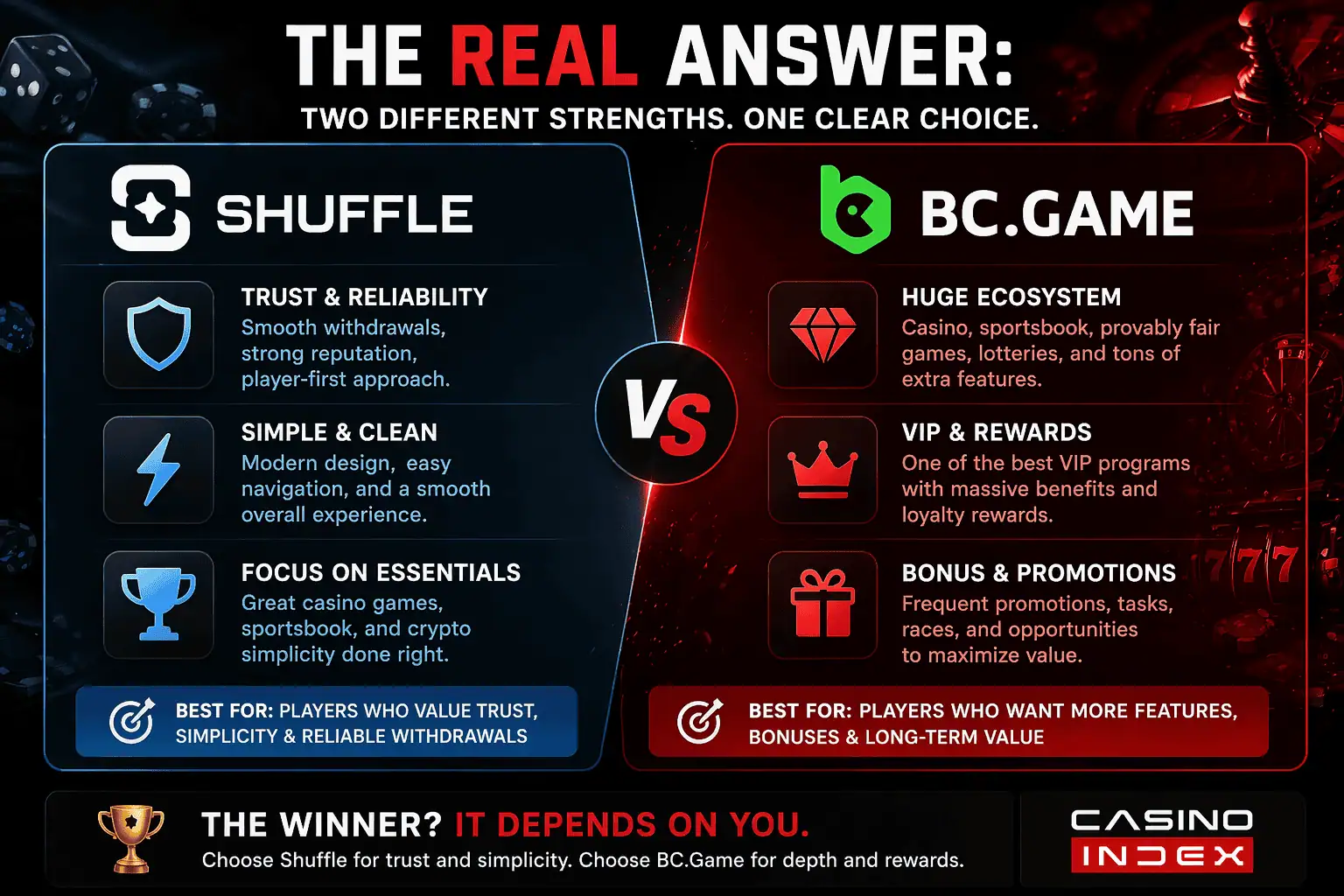
BC.Game’s larger ecosystem and Shuffle’s higher trust-first score answer different questions. Product variety cannot establish payout reliability.
Withdrawals and KYC: What Happens Before the Money Is Sent?
Withdrawal conditions are the most important practical distinction in this comparison.
A cryptocurrency transfer may settle quickly once the casino sends it to the blockchain. However, the platform can first require identity verification, payment ownership checks, wagering compliance or an account review.
Neither casino should be presented as offering unconditional instant withdrawals.
Shuffle: Identity Checks Before the First Withdrawal
Shuffle’s current Terms of Service are more specific than a general statement that verification might happen after a large win.
Section 5.2 expressly provides for an identity-document check before the first withdrawal. The operator also reserves the right to request verification at other times or thresholds.
Section 10.1 states that Shuffle may refuse a withdrawal until identity, payment ownership, requested information and wagering conditions have been satisfied.
This means players should prepare for first-withdrawal verification even when registration and deposits initially appear straightforward.
It is not accurate to describe Shuffle’s KYC process mainly as a late-stage trigger affecting only unusually large payouts.
Shuffle: General Deposit Turnover vs Bonus Wagering
Another important distinction appears in Section 10.2.
Shuffle’s standard terms require wagering equal to 100% of a deposit before withdrawing funds attributable to it. The clause includes an exception for a digital-asset withdrawal sent back to the same wallet address on the same network as the corresponding deposit.
This general deposit rule is separate from the much higher wagering requirements that can apply when a promotional bonus has been accepted.
Players should not confuse a routine deposit-turnover requirement with the conditions of a welcome-bonus campaign.
BC.Game: Verification and Account Reviews
BC.Game also has identity verification and withdrawal-control procedures. The operator publishes KYC guidance, and accounts can encounter additional checks depending on the applicable circumstances.
The current CasinoIndex review identifies publicly reported concerns involving withdrawals, account restrictions, verification and dispute handling.
However, it would be inaccurate to claim that BC.Game automatically blocks larger winnings or that certain betting patterns always produce the same response.
The available evidence does not support a universal trigger threshold, a standard delay for every account or a quantified comparison of successful withdrawal rates.
Players should examine the current cashier, verification requirements, payment ownership rules and bonus conditions for their own account.
Withdrawal Process: Which Stages Can Cause Delays?
The following table shows why a fast blockchain cannot guarantee a fast total withdrawal.
| Withdrawal Stage | Who Controls It | What Players Should Check |
|---|---|---|
| 1. Request | Casino account and cashier | Minimum withdrawal, asset, network, destination address, bonus status and available balance. |
| 2. Approval | Casino compliance and payment teams | KYC, payment ownership, deposit turnover, bonus rules, security checks and any manual review. |
| 3. Broadcast | Casino or payment processor | Whether the payment has actually been sent and whether a transaction hash is available. |
| 4. Settlement | Blockchain network or receiving payment provider | Network confirmation requirements, receiving-wallet compatibility and any provider processing time. |
A player can therefore experience a long pending period even when the eventual blockchain transaction confirms quickly.
For both casinos, the key questions are whether the withdrawal has passed internal approval and whether payment has actually been broadcast.
The CasinoIndex Casino Withdrawal Guide explains these stages in greater detail. Our Casino Verification Guide covers common document requests and potential delays.
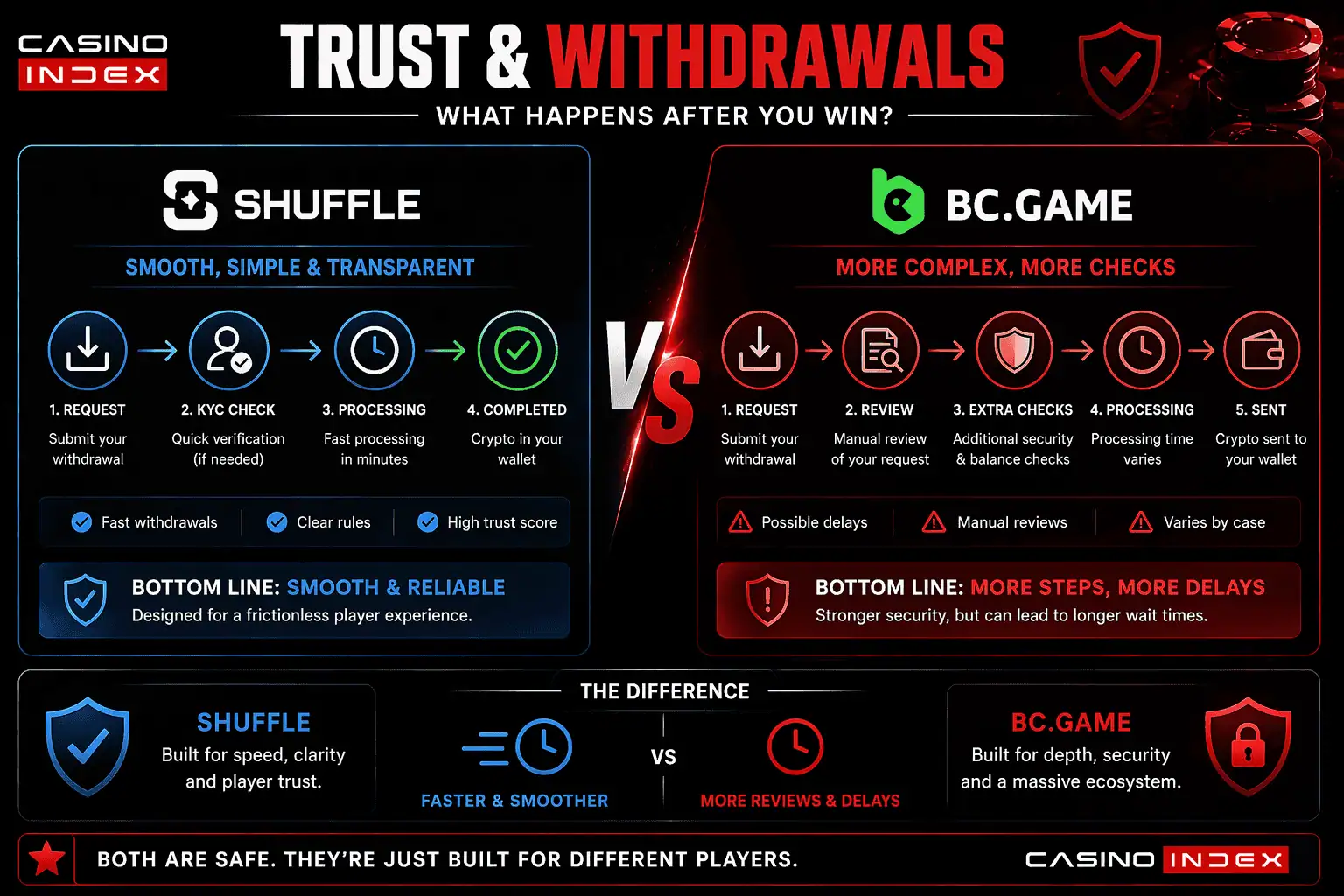
The casino controls the approval stage. Blockchain confirmation speed becomes relevant only after the transaction has been sent.
Reputation and Public Complaints
CasinoIndex gives reputation a substantial role in its overall rating system.
The current BC.Game review describes public complaint themes involving pending withdrawals, verification disputes, restricted accounts and unclear support outcomes. These are relevant risk signals for players considering the platform.
Shuffle’s review also acknowledges complaints involving delayed payments, identity checks and support responses. Its shorter operating history limits the amount of long-term public evidence available.
Complaint evidence needs careful interpretation.
A public report is not proof that a casino acted improperly. Individual cases can involve restricted jurisdictions, duplicate accounts, bonus violations, missing documentation or incorrect payment details.
At the same time, repeated and well-documented complaints should not be ignored simply because a platform offers many games or attractive bonuses.
What this comparison can conclude: BC.Game has the weaker current CasinoIndex trust rating and warrants greater caution regarding its broader account and payment profile.
What it cannot conclude: That Shuffle has a measured higher payout-success rate, that it always processes withdrawals faster, or that every individual complaint accurately represents the operator’s conduct.
This distinction is essential to an independent casino comparison.
Bonuses and VIP Rewards: Depth vs Clear Conditions
Both platforms use rewards to encourage continued participation, but their systems differ.
BC.Game emphasizes a broad collection of promotions, VIP progression, cashback-style benefits, in-house games and ongoing engagement features.
Shuffle publishes a structured VIP program with progression levels, rakeback and recurring rewards.
The number of available benefits does not automatically tell a player how much value can actually be withdrawn.
Shuffle’s Welcome-Bonus Wagering
Shuffle’s published deposit-bonus terms explain that the wagering requirement generally applies to the combined eligible deposit and bonus amount unless the specific promotion says otherwise.
For example, a hypothetical $100 deposit matched with a $100 bonus at 35x deposit-plus-bonus wagering would require:
ILLUSTRATIVE BONUS CALCULATION
($100 deposit + $100 bonus) × 35
$7,000
Qualifying wagering required in this example. It is not a guaranteed loss, expected profit or promise that the bonus can be converted into cash.
Players must also examine eligibility, activation timing, eligible games, maximum bets, expiry dates and any restrictions that affect payout.
The terms of an actual promotion may differ from this illustration.
BC.Game’s Broader Reward Ecosystem
BC.Game offers more reward layers and promotional formats. That creates more choices but also more conditions to understand.
Some offers can have wagering requirements, contribution restrictions, expiration rules, maximum-win limitations or account-specific eligibility.
Rather than treating the largest headline bonus as the better offer, players should calculate which amounts are immediately available, which are bonus funds and which are subject to future claims or wagering.
Neither casino’s loyalty system should be used as a reason to increase betting volume merely to reach a higher VIP level.
For a more complete explanation, read the CasinoIndex Casino Bonus Guide.
Games, Sportsbook and User Experience
This is where BC.Game’s product strengths are most relevant.
BC.Game combines casino games, in-house Originals, sports betting, reward mechanics, promotions and VIP features in a comparatively large ecosystem.
Shuffle also offers provider games, live casino titles, Originals, sports betting and recurring rewards, but its interface presents these features in a more focused way.
Where BC.Game Has the Product Advantage
Players who prefer a feature-rich platform may appreciate BC.Game’s broader range of engagement systems.
Its interface places substantial emphasis on frequent promotions, reward progression and opportunities to switch between different activities.
That flexibility can be useful for experienced users who understand the various products and their conditions.
However, additional features can also increase complexity. A large number of reward mechanisms is not equivalent to greater financial value.
Where Shuffle Has the UX Advantage
Shuffle’s layout is generally more straightforward to navigate from an editorial usability perspective.
That can appeal to users who prefer fewer competing interface elements and more visible separation between games, sports betting and rewards.
These observations should not be confused with standardized laboratory testing. CasinoIndex has not published device-by-device benchmarks establishing that either website is always faster or more reliable.
Provably Fair Games Do Not Resolve Withdrawal Risk
Both platforms offer in-house games associated with provably fair verification tools.
Where correctly implemented, these tools can help a player check an individual game’s outcome against the published verification method.
They do not prove that the operator can pay every withdrawal, that its licensing is adequate or that an account will never face verification.
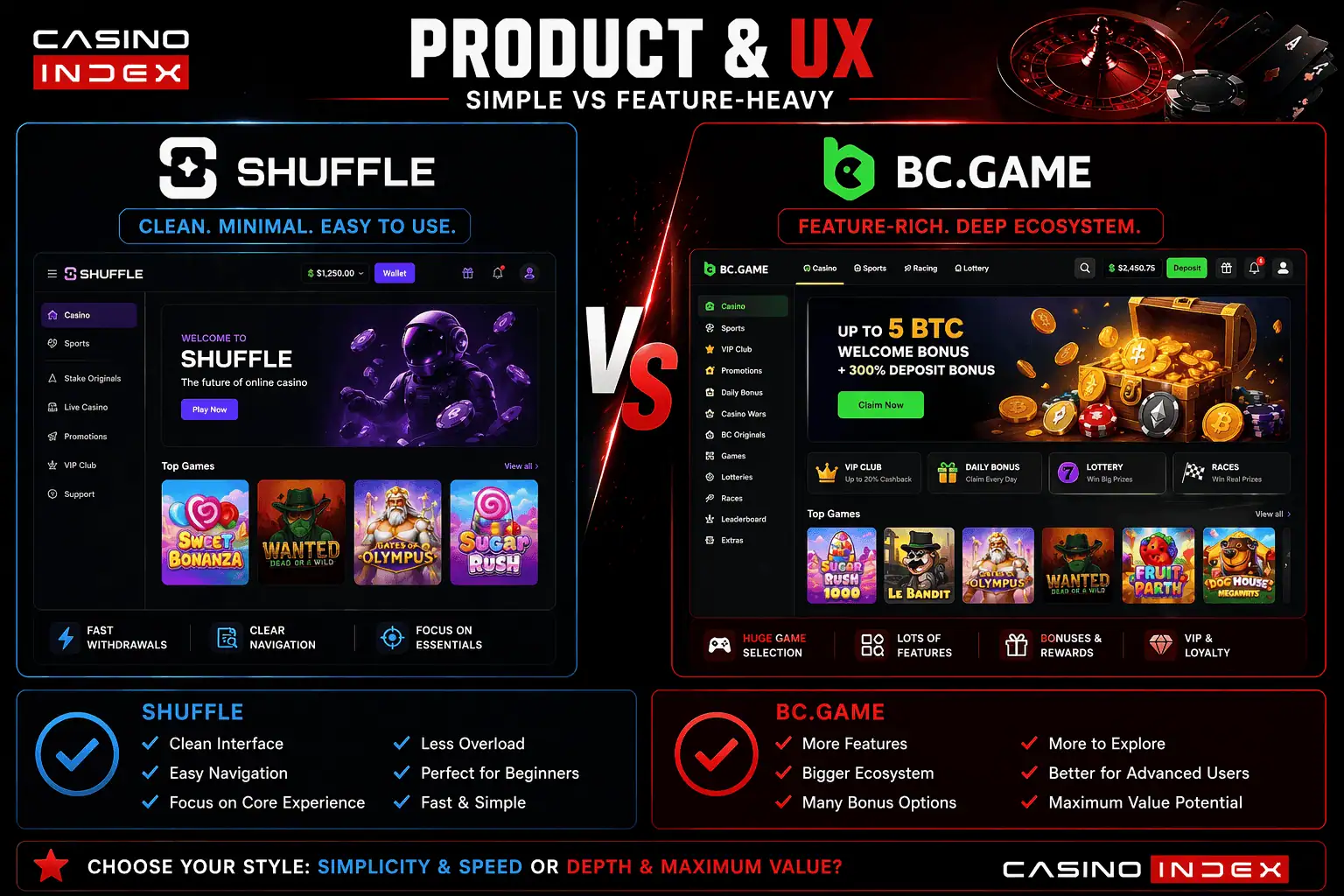
BC.Game emphasizes a larger set of product and reward features. Shuffle favors a more focused interface. Neither approach independently determines casino trust.
Key Risks to Check Before Using Either Casino
Instead of assuming that a particular betting pattern will trigger a problem, focus on the conditions that can be verified before depositing.
- Jurisdiction and account eligibility: Check whether the operator permits players from your location and whether its terms prohibit VPN or proxy use.
- Current operator and licence: Identify the legal company, licence number and relevant regulator. Do not rely exclusively on a footer badge.
- Identity verification: For Shuffle, account for the express first-withdrawal identity-check provision. For BC.Game, confirm the verification requirements that apply to your account and payment method.
- Withdrawal limits and processing: Check the cashier for supported currencies, networks, minimums, fees and applicable account restrictions.
- Bonus eligibility: Distinguish ordinary deposited funds from promotional balances and rewards that require additional wagering or scheduled claims.
- Support and dispute handling: Locate the official support channels and applicable complaint procedures before placing significant funds at risk.
- Account security: Enable supported two-factor authentication and use only the official website and payment instructions.
A small eligible withdrawal may help a player understand the process, but a successful test does not guarantee approval of a later or larger payment.
For broader context, see the CasinoIndex Safe Online Casino Guide.
Final Verdict: Is BC.Game or Shuffle Better in 2026?
Shuffle wins the overall BC.Game vs Shuffle comparison under CasinoIndex’s current trust-first evaluation.
Its 8.5/10 Safe rating is higher than BC.Game’s 7.4/10 Moderate Risk rating. It also provides clear public documentation of important withdrawal and identity-verification conditions.
That conclusion comes with an important limitation: clear documentation does not guarantee painless KYC or immediate payouts. Shuffle explicitly provides for identity checks before the first withdrawal, and its terms allow withdrawals to be withheld until relevant requirements are satisfied.
BC.Game remains the stronger choice when the comparison is limited to the breadth of its product ecosystem, VIP complexity and engagement features. That is a legitimate product advantage, but not a reason to award it the trust-first overall win.
For a risk-conscious reader deciding between these two platforms, Shuffle is the higher-rated option. Players attracted to BC.Game’s additional features should place particular emphasis on reviewing the operator disclosure, account rules, payout conditions and relevant complaint evidence.
Neither casino is suitable for a player who is legally ineligible to use it, and neither platform should be treated as risk-free.
For the wider market context, compare our Best Crypto Casinos ranking. The individual Shuffle review and BC.Game review contain the broader operator assessments.
BC.Game vs Shuffle: Frequently Asked Questions
Is Shuffle better than BC.Game in 2026?
Under CasinoIndex’s current trust-first rating system, yes. Shuffle scores 8.5/10 (Safe), while BC.Game scores 7.4/10 (Moderate Risk). BC.Game retains an advantage in the scale and complexity of its product ecosystem, but that does not give it the higher overall casino rating.
Is Shuffle safer than BC.Game?
Shuffle currently has the stronger CasinoIndex editorial risk rating. However, “Safe” is a relative classification, not a guarantee of account security, legal availability or successful withdrawals. Players must still follow its KYC, payment and account rules.
Why is BC.Game rated lower despite having more features?
CasinoIndex prioritizes trust, reputation and withdrawal handling over game count and reward complexity. BC.Game’s broader product can be an advantage for some users, while its account and payout risk signals contribute to a weaker overall assessment.
Does Shuffle require KYC before the first withdrawal?
Shuffle’s Terms of Service, Section 5.2, expressly provide for an identity-document check before the first withdrawal. Section 10.1 allows the operator to refuse payment until relevant verification and withdrawal conditions are met. Players should prepare for this requirement rather than assuming KYC happens only after a large win.
Does BC.Game require identity verification for withdrawals?
BC.Game operates identity verification and account-review procedures. Additional checks can be relevant before funds are released. The precise requirements depend on applicable operator rules and account circumstances, so players should verify the current conditions rather than assume that simple registration means unrestricted withdrawals.
Does Shuffle have a wagering requirement before withdrawing deposits?
Section 10.2 of Shuffle’s terms generally requires wagering equal to 100% of the relevant deposit. The clause includes an exception for certain digital-asset withdrawals returned to the same wallet address on the same network. Promotional bonus wagering requirements are separate and may be considerably higher.
Which casino processes cryptocurrency withdrawals faster?
This comparison does not establish a verified winner for payout speed. Both casinos control withdrawal approval before blockchain settlement. KYC, security checks, account reviews, bonus conditions and payment processing can affect the total waiting time.
Which casino has the better bonus system?
BC.Game offers a wider and more layered promotional ecosystem. Shuffle has structured VIP rewards and published bonus conditions. The better offer depends on the exact wagering requirements, eligibility rules, expiry dates and the player’s needs. Neither platform guarantees profit from rewards.
Which casino is better for beginners?
Shuffle has a comparatively focused interface, but beginners should not mistake easier navigation for fewer account rules. Its first-withdrawal identity-check provision and bonus wagering terms require careful reading. Legal eligibility and operator trust should be checked before considering either platform.
Is BC.Game more suitable for experienced crypto players?
Experienced users may appreciate BC.Game’s in-house games, VIP mechanics and broader product ecosystem. However, familiarity with cryptocurrency does not eliminate operator risk, withdrawal checks or the need to understand promotional restrictions.
Are provably fair games evidence that a casino is safe?
No. Provably fair verification can help establish how eligible game outcomes were generated. It does not verify operator solvency, financial controls, licence status, payment reliability or dispute resolution.
Sources and Editorial Scope
This comparison is based on CasinoIndex’s current overall casino ratings and published operator documentation. It does not claim first-hand testing of high-value payouts or statistically measured withdrawal-success rates.
- CasinoIndex — How We Rank Casinos
- CasinoIndex — Shuffle Casino Review
- CasinoIndex — BC.Game Casino Review
- Shuffle — Official Terms of Service, including Sections 5 and 10
- Shuffle — Official Deposit Bonus Terms
- BC.Game — Published Operator and Licensing Information
Research scope: Public documentation and current CasinoIndex ratings checked in October 2026. Operator terms, licences, regional restrictions and promotional conditions can change. The actual cashier and applicable terms must be checked before depositing.

Nina Kanu has worked in cryptocurrency content and blockchain research since 2016. She is also known within parts of the crypto community through CryptoMutant, where her work has covered emerging projects, market trends and developments across the blockchain ecosystem. At CasinoIndex, Nina focuses on crypto casino reviews, platform comparisons, player experience, game ecosystems and bonus fairness. Her research examines how casino products perform beyond their marketing, including usability, payment options, promotional terms and the overall experience players receive after signing up.