How to Spot a Scam Casino
Most scam casinos do not look like scams at first.
That is what makes them dangerous.
The homepage looks modern. The welcome bonus sounds competitive. The game lobby appears full. Deposit methods look familiar. Live chat may even answer within minutes.
For a new player, that can feel enough.
It is not enough.
A scam casino is rarely exposed by its design. It is exposed by its behavior once real money enters the system. The real test starts when the player deposits, wins, requests a withdrawal, gets asked for documents, or tries to contact support after something goes wrong.
That is where the gap appears between a legitimate casino with normal controls and a casino that was built to take deposits without paying fairly.
This guide is not about paranoia. It is about pattern recognition.
A strong casino can still have slow support on a bad day. It can still ask for verification. It can still limit a bonus. None of that automatically makes it a scam.
The problem is not one isolated issue.
It is whether the whole operation shows a repeatable pattern of manipulation, opacity, and payout resistance.
If you understand those patterns, you can filter out a large share of high-risk casinos before you ever send money.

That matters even more in crypto gambling, where fast onboarding, lighter identity checks, and offshore licensing can make weak operators look more attractive than they really are. For a broader trust framework, start with our guide on how to tell whether an online casino is actually safe.
A Scam Casino Is Usually Revealed by Friction, Not by Marketing
The easiest mistake players make is judging a casino by the front end.
Scam casinos invest in the visible layer because it is cheap compared to building a trustworthy operation.
A polished site does not prove:
- funds are segregated
- withdrawals are processed fairly
- player complaints are handled honestly
- terms are enforced consistently
- ownership is transparent
- licenses are real and meaningful
In many cases, scam casinos look smoother than legitimate ones.
Why?
Because the deposit journey is the product they care about most.
The site is designed to remove hesitation:
- instant registration
- aggressive bonus framing
- visible crypto logos
- popular game thumbnails
- promises of fast withdrawal
- vague trust language without real proof
That early experience creates confidence before the player has enough information to judge the operator.
A real casino earns trust through consistency.
A scam casino manufactures trust through appearance.
That difference is critical.
Players often think, “It looked professional, so I assumed it was fine.”
Professional design is not a trust signal.
It is a conversion tool.
The real signals sit deeper:
- corporate transparency
- licensing quality
- withdrawal history
- complaint patterns
- rules around verification
- bonus enforcement behavior
- support quality under pressure
A casino should not be judged by how easy it is to deposit.
It should be judged by how predictable it is when the player wants money out.
The First Rule: Treat Every New Casino as Untrusted Until Proven Otherwise
This is the mindset that prevents most avoidable losses.
Do not begin with “Does this casino look legit?”
Begin with: “What evidence do I have that this operator behaves fairly when a payout matters?”
That shift changes everything.
It forces you to stop thinking like a bonus hunter and start thinking like a risk analyst.
A trustworthy casino should be able to answer basic questions clearly:
- who owns it
- where it is licensed
- what rules apply to players
- which countries are restricted
- how withdrawals work
- when KYC starts
- how disputes are handled
- what terms can void winnings
If those basics are hidden, vague, contradictory, or buried behind marketing copy, risk is already rising.
Scam casinos depend on low-friction optimism.
They want players to move fast:
- claim the offer
- deposit now
- assume the badge is real
- trust the “instant payouts” language
- worry about the terms later
That is exactly the wrong order.
The correct order is:
- verify the operator
- verify the rules
- verify the payout logic
- check complaint patterns
- only then consider depositing
That process is less exciting, but it prevents expensive mistakes.
Red Flag 1: The Operator Is Hard to Identify
One of the strongest early warning signs is unclear ownership.
A legitimate casino does not need to hide the operator behind vague branding language.
You should be able to find:
- the legal company name
- the license holder
- a real registered jurisdiction
- clear terms and conditions
- privacy policy and responsible gambling pages
- a usable contact route
- country restrictions
- dispute or regulatory references where relevant
A site that shows only a brand name and a few generic promises is already giving you too little to work with.
The risk increases when the company name in the footer does not match the entity listed in the terms. It rises again when the casino claims to be licensed, but no license number, regulator details, or verifiable operator identity can actually be confirmed.
Scam casinos often rely on confusion here.
They know many players will never check whether:
- the company is real
- the licensing body is credible
- the entity in the footer actually controls the site
- the terms were copied from somewhere else
- the legal pages contradict the homepage claims
The less accountable the operator looks, the easier it becomes for them to stall, limit, or disappear when complaints increase.
This is where many players underestimate the role of licensing.
A weak or meaningless license does not automatically prove fraud, but it reduces accountability when something goes wrong. A serious operator should at least make its legal structure understandable. For a deeper breakdown of what different licensing models actually mean for player safety, see how licensing affects player safety.
Red Flag 2: The Terms Are Built to Give the Casino Too Much Control
Most players do not read casino terms until after the problem starts.
By then, it is often too late.
A scam or high-risk casino usually protects itself through broad, elastic rules that can be used against the player later.
Look for terms that let the casino:
- cancel winnings at its own discretion
- redefine bonus abuse without clear criteria
- request any documents at any stage without limits
- delay payments indefinitely for “security checks”
- close accounts without meaningful explanation
- void bets because of vague “irregular play”
- reject withdrawals under loosely defined compliance reasons
Not every broad clause proves bad intent.
The issue is density and balance.
If nearly every important rule is written in a way that protects the operator and weakens the player, that is a serious warning sign.
A fair casino explains:
- when KYC is required
- what documents may be needed
- when bonuses can be restricted
- how long withdrawals normally take
- what happens if there is a dispute
- which actions trigger account review
A risky casino hides behind ambiguity.
That ambiguity becomes a weapon later.
This matters even more with bonuses.
Scam casinos often use bonuses as intake funnels. The offer pulls players in, but the attached rules are broad enough to block withdrawals later. On the surface, the promotion looks generous. In practice, it gives the casino multiple ways to say no once the player wins.
The danger is not only harsh wagering.
The bigger danger is selective enforcement.
That means the rule is not there to create order. It is there to create optional denial.
Red Flag 3: Withdrawal Language Sounds Strong, but the Process Is Vague
This is one of the most important scam indicators.
Many bad casinos advertise fast withdrawals because the phrase converts well. But when you look for details, the process becomes blurry.
Watch for claims like:
- instant withdrawals
- guaranteed payouts
- no waiting
- cash out anytime
- fastest crypto payments
Then compare that marketing to the actual withdrawal rules.
A legitimate casino should be able to explain:
- processing windows
- approval stages
- minimum and maximum cashout limits
- whether KYC may be triggered before payout
- whether payment method matching is required
- whether manual review applies to large wins
- whether bonus-linked withdrawals face separate rules
When that information is missing, scattered, or inconsistent, the risk is not theoretical.
It means the casino is keeping room to control the outcome later.
That is how many high-risk operations behave.
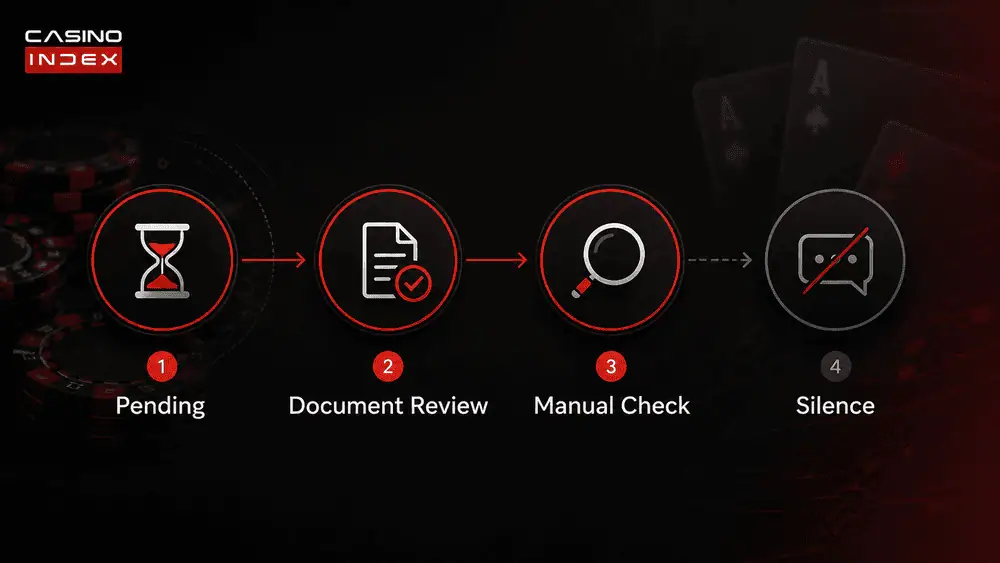
They rarely reject withdrawals outright at the start.
The process usually begins with a pending status. After that, more documents are requested. Another review follows, then support replies that the finance team is still checking the case.
Eventually, communication slows down or stops completely.
This is why serious players do not judge casinos by stated withdrawal speed alone. They judge them by how transparent the payout process is before the first deposit. To understand what legitimate fast withdrawals actually depend on, and why some sites slow down once balances grow, read what fast withdrawals actually depend on and why some casinos delay withdrawals.
Red Flag 4: Support Exists for Deposits, but Weakens Once the Risk Shifts
Support quality tells you a lot about intent.
Before deposit, even a bad casino may feel responsive.
That is not the test.
The real test is whether support remains useful when the player:
- asks about KYC
- questions a blocked withdrawal
- disputes a bonus decision
- requests clarification on terms
- wants a timeline for payment
- challenges an account restriction
Scam casinos often use support as a pressure valve, not a resolution channel.
That means support is there to:
- calm the player down
- repeat generic scripts
- say the case was escalated
- avoid giving names or timeframes
- redirect responsibility to another department
- keep the complaint alive without solving it
This pattern matters.
A legitimate casino may not solve every issue instantly, but it should still provide:
- consistent answers
- a traceable process
- clear next steps
- some level of accountability
A risky casino gives you motion without progress.
That distinction is easy to miss in the moment.
A player may think, “At least they replied.”
But a reply is not the same as help.
If five conversations produce no concrete action, support is functioning as delay management.
That is exactly how payout pressure gets neutralized in weak operations.
Scam Casinos Usually Reveal Themselves Before the Deposit — If You Know Where to Look
The good news is that most scam signals appear early.
Players miss them because they focus on excitement instead of structure.
They see:
- a bonus
- a slick homepage
- thousands of games
- crypto logos
- attractive promises
They do not stop long enough to ask:
- who runs this site
- what rules actually govern withdrawals
- whether terms are balanced
- whether support explains anything clearly
- whether payout promises are precise or vague
That first layer of analysis already filters out a large number of bad operators.
And it does so before real money is exposed.
The next step is deeper: checking how the casino behaves in the wild, how complaint patterns form, how fake trust signals are used, and how scam operators create credibility through copied branding, manipulated reviews, and selective transparency.
That is where the second layer of scam detection begins.
Red Flag 5: Review Profiles Look Too Clean, Too Thin, or Too Coordinated
A casino does not need perfect reviews to be trustworthy.
In fact, a flawless review profile can be a warning sign.
Real gambling brands usually attract mixed feedback. Players complain about limits, get frustrated with verification, praise fast payouts, or criticize bonus restrictions. That is normal.
The problem begins when the public reputation looks too polished, too coordinated, or too heavily managed.
Watch for patterns like:
- large clusters of short five-star reviews with no detail
- repeated phrasing across different accounts
- review spikes in a narrow time window
- praise that sounds promotional rather than personal
- almost no mention of withdrawals, verification, or support outcomes
- a reputation gap between one platform and multiple others
Scam casinos often understand that players search trust signals quickly.
So they manufacture the easiest one to manipulate: surface sentiment.
A review profile full of generic praise is not strong evidence. It may only show that reputation shaping is active.
A more useful question is this:
Do the reviews describe real platform behavior, especially once money needs to come back out?
That is where the quality difference appears.
Useful reviews mention things like:
- whether withdrawals were processed on time
- whether KYC appeared suddenly
- whether support explained delays clearly
- whether bonus rules were enforced fairly
- whether the account stayed functional after a big win
- whether the casino kept changing what it needed
That kind of detail is harder to fake at scale.
You should also compare platforms, not rely on one source.
A casino may look respectable on one review site while showing a much worse pattern in forums, Reddit threads, complaint boards, or player discussions. That is why CasinoIndex does not treat a single review source as enough. We look for repeatable behavioral signals, not isolated sentiment. For the logic behind that approach, see how CasinoIndex rates casinos and our trust-first ranking system.
Red Flag 6: The Casino Talks About Security, but Not About Accountability
Many scam or weak casinos use trust language that sounds impressive until you examine it closely.
They say things like:
- your safety is our priority
- cutting-edge encryption
- secure gaming environment
- protected payments
- trusted by thousands
- player-first platform
None of this means much on its own.
Security language is cheap.
Accountability is harder.
A trustworthy casino should be able to show not just that the site is technically usable, but that the operator can be challenged when something goes wrong.
That includes:
- clear ownership
- clear licensing references
- clear terms
- clear complaint handling
- clear verification logic
- clear withdrawal procedures
- clear restricted country rules
- clear support pathways
A scam casino often replaces real structure with surface-level trust signals.
The site may look polished. The responsible gambling section may be present. The footer may show security logos and compliance language. But once you move past the presentation layer, the operational detail often stays vague.
That matters because technical safety and operational fairness are not the same thing.
HTTPS does not make a casino trustworthy. A modern design does not prove fair withdrawal handling. Compliance language does not mean the terms are balanced or that the operator will act fairly when a payout is under review.
The real issue is not whether the brand uses trust language well.
The real issue is whether the business accepts clear accountability when something goes wrong.

If that remains unclear, the risk is already higher than the branding suggests.
Red Flag 7: Bonus Design Feels Attractive, but the Exit Conditions Feel Hostile
Scam casinos understand one basic truth: bonuses attract faster decisions.
A large deposit match, free spins package, or cashback offer can reduce caution immediately. Players focus on what they might gain and pay less attention to how the casino can later restrict that gain.
That is why bonus structure is one of the most important scam filters.
You are not only checking whether the bonus is big.
You are checking whether the player has a realistic path from claim to withdrawal.
Look for warning signs such as:
- max cashout rules buried deep in terms
- unusually harsh wagering requirements
- limited contribution percentages hidden across game types
- vague “bonus abuse” definitions
- sudden withdrawal caps on bonus-linked winnings
- rules that allow the casino to remove winnings after the fact
- unclear expiry windows that pressure irrational play
A fair casino may still have strict bonus conditions.
That alone is not the problem.
The problem starts when the bonus looks easier on the front end than it is in the rules, or when the rules seem designed to create technical failure rather than fair participation.
This is where scam casinos often beat inexperienced players.
They do not need to steal directly.
They only need to build a bonus path where denial becomes likely later.
That can happen through:
- impossible turnover relative to time limits
- hidden cap rules
- prohibited betting patterns that many users will trigger unknowingly
- document requests that arrive only after the player completes the bonus
- broad rights to void winnings over interpretation disputes
In those cases, the bonus is not really a player benefit.
It is an intake mechanism.
If a casino leans heavily on promotions but remains weak on withdrawal clarity, KYC clarity, or dispute clarity, that imbalance is telling you something. The marketing engine is strong. The payout confidence is not.
That is why smart players judge bonus fairness through exit logic, not offer size alone. For a deeper breakdown of what fair terms actually look like, see what fair bonus terms actually look like.
Red Flag 8: KYC Is Not Explained Up Front, but Appears Aggressively at Payout Stage
Verification is one of the biggest confusion points in online gambling.
Many players think:
“No KYC” means no documents ever.
That is not how it works.
Even casinos that market low-friction onboarding can still request identification later, especially during withdrawal review, source-of-funds checks, or risk analysis. The issue is not that KYC exists.
The issue is how and when it is used.
A trustworthy casino usually makes the logic understandable:
- which triggers may lead to checks
- which documents may be required
- when a withdrawal can be paused
- whether enhanced due diligence may apply
- whether payment method verification matters
- whether country restrictions or IP mismatches can cause review
A scam or abusive casino often leaves this vague on purpose.
That allows the operator to weaponize verification later.
Common risk patterns include:
- no clear KYC warning before deposit
- verification only mentioned after a large win
- repeated requests for new documents after each submission
- documents rejected without clear explanation
- shifting requirements from support to finance team
- no timeline for review completion
- withdrawals locked during open-ended verification
This is where many players feel trapped.
The casino took the deposit instantly.
Gameplay worked normally.
Only when funds move in the other direction does compliance suddenly become complex.
That does not always prove fraud, but it is one of the strongest danger patterns in the industry.
You should always ask:
Does the casino explain verification as a normal process, or does it seem to use verification as a payout filter?
That difference matters more than the marketing label.
If you want the full reality behind this area, read how casino verification really starts before payout and what to check before trusting a no KYC casino.
Red Flag 9: Payment Variety Is Wide, but Payment Logic Is Weak
A long payment list can make a casino feel established.
It creates the impression of flexibility, scale, and legitimacy.
But payment breadth is not the same as payment quality.
Scam casinos often display many deposit methods because it improves conversion. The real question is whether those methods connect to a fair and predictable withdrawal system.
Check whether the casino explains:
- which methods are deposit only
- which methods support withdrawals
- whether the same method must be used both ways
- what the limits are
- how long each route normally takes
- whether crypto payouts are manual or automated
- what happens if your original deposit method cannot be used for cashout
A weak operator may offer impressive payment variety on the front end while keeping the back end opaque.
That creates several risks.
First, players assume convenience that may not exist later.
Second, the casino keeps flexibility to redirect payouts into slower or more controlled channels.
Third, delays can be justified through vague payment review language.
This issue becomes even more important in crypto casinos.
Crypto deposits are fast. That part is easy.
The real test is whether withdrawals are:
- processed consistently
- reviewed predictably
- subject to hidden manual delays
- blocked through selective security checks
- affected by wallet risk scoring or identity triggers that were never explained
A serious payment setup should make the money path understandable before you use it. If the site puts far more effort into deposit logos than payout detail, that imbalance is meaningful.
For a broader framework, compare the operator’s claims against how crypto deposits work at gambling sites and the wider casino payment methods guide.
Red Flag 10: The Casino Avoids Specific Answers When the Stakes Increase
One of the clearest patterns in scam operations is selective vagueness.
At low stakes, the site feels simple.
At high stakes, clarity disappears.
This can happen when:
- you ask about large withdrawal approval
- you ask why a cashout is pending
- you ask which rule was supposedly broken
- you ask when review will end
- you ask whether account limits changed
- you ask which document is still missing
- you ask who made the final decision
Instead of direct answers, you get language like:
- your case is under review
- the relevant team is checking
- please wait for an email
- for security reasons we cannot provide more detail
- your account has been flagged internally
- this decision is final under our terms
That language may sometimes be valid.
But repeated vagueness around important financial questions is a major warning sign.
A trustworthy casino should still be able to explain the process, even when it cannot disclose every internal detail.
A scam or abusive casino uses uncertainty as leverage.
Why?
Because vague communication:
- buys time
- reduces accountability
- creates confusion
- weakens the player’s ability to challenge the outcome
- makes patterns harder to prove publicly
This is especially common once the player balance becomes meaningful.
The larger the liability, the weaker the clarity becomes.
That is not a coincidence.
It reflects incentives.
Good operators try to control risk fairly.
Bad operators try to control exposure strategically.
Once you see that pattern, the whole site starts to look different.
Red Flag 11: The Brand Looks Independent, but the Site Feels Like a Recycled Template
Some scam casinos are not built as long-term brands.
They are built as disposable fronts.
That is why template reuse matters.
Look for signs such as:
- identical structure to other suspicious casino sites
- copied legal text with inconsistent brand names
- generic “about us” pages with no real detail
- repeated design elements across unknown sister brands
- terms that refer to the wrong domain or operator
- support language that looks copied word for word
- payment, bonus, or licensing sections that do not fully match the brand
Template use alone is not proof of fraud. Many operators use shared infrastructure.
The problem is when the template looks stronger than the identity behind it.
A real casino may share back-end tools, but it should still show:
- coherent branding
- consistent legal references
- consistent rules
- consistent support structure
- a believable operating identity
A scam network often fails here.
It builds fast, reuses assets, changes brand names, and focuses on short-term deposit extraction. In that environment, the site is not a genuine brand asset. It is a replaceable shell.
That is why inconsistencies matter.
A copied footer, mismatched company name, or wrong terms reference may look minor, but it often reveals something bigger: weak operational integrity.
Legitimate gambling brands usually have problems of execution.
Scam brands often have problems of identity.
That is a more serious issue.
The Real Scam Pattern Is Usually Cumulative
Most players lose money because they wait for one dramatic signal.
They expect a giant warning:
- scam accusations everywhere
- obvious fake license
- broken website
- public collapse
- complete support silence from day one
Sometimes that happens.
More often, the pattern is quieter.
It builds through accumulation:
- weak operator clarity
- broad terms
- vague withdrawals
- selective KYC
- manipulated trust signals
- bonus traps
- unclear payment logic
- evasive support
- inconsistent legal structure
Any one issue might still be survivable.
Several together create a high-risk profile.
That is how scam detection actually works.
Not through one dramatic detail.
Through a pattern that keeps pointing in the same direction.
Bad Casino vs Scam Casino: Know the Difference Before You Misjudge the Risk
Not every bad casino is a scam.
That distinction matters.
Some casinos are weak because they are poorly run. Support is slow. Verification is clumsy. Withdrawal times are inconsistent. Terms are badly written. The product may still function, but the operation feels messy and unreliable.
That is different from a scam casino.
A scam casino is not just incompetent.
It is structurally dangerous.
The difference usually comes down to intent and pattern.
A bad casino may:
- process withdrawals slowly
- frustrate players with support delays
- apply rules inconsistently
- feel disorganized under pressure
A scam casino tends to:
- create friction when the player wins
- hide key operator information
- use vague rules to block payouts
- manipulate trust signals
- escalate verification selectively
- avoid accountability once money is at stake
That difference is important because players often normalize serious warning signs.
They say:
- maybe support is just busy
- maybe finance is delayed
- maybe they need one more document
- maybe the payment team is overloaded
Sometimes that is true.
But once the same pattern keeps repeating, the issue stops being operational weakness and starts looking like extraction behavior.
That is the point where the casino is no longer just inconvenient.
It becomes unsafe.
This is why scam detection should not rely on emotion.
It should rely on structure.
The right question is not:
“Did I have one bad experience?”
The right question is:
“Does this casino repeatedly create conditions that make fair payout harder than fair deposit?”
If the answer is yes, the risk is already high.
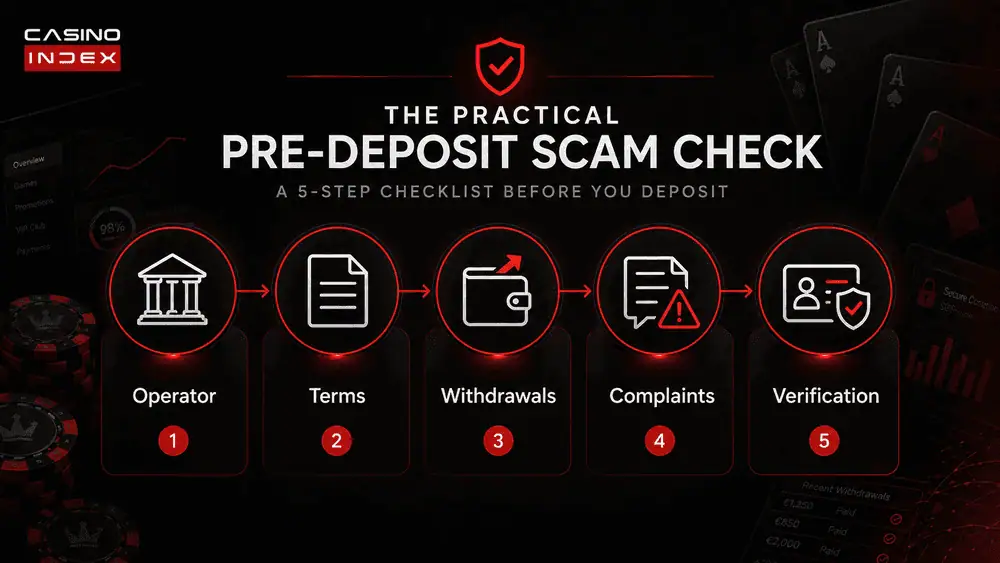
The Pre-Deposit Scam Check: A Real Screening Process Players Can Actually Use
Most players do not need a massive investigation.
They need a clean screening process that catches obvious risk before the deposit happens.
This is the practical version.
Step 1: Identify the Operator Before You Look at the Offer
Before you judge the bonus, game count, cashback, or design, find out who runs the site.
Check:
- legal company name
- license holder
- jurisdiction
- terms and conditions
- contact channels
- restricted countries
- dispute path if one exists
If that information is hard to find, inconsistent, or vague, stop there.
A casino that wants your money should not make its own identity difficult to verify.
Step 2: Read the Withdrawal Rules Before You Read the Bonus
This is where many players do the exact opposite.
They see the promotion first, deposit fast, and only think about withdrawal once they want money out.
That is backwards.
Before depositing, check:
- minimum withdrawal
- maximum withdrawal
- approval time language
- manual review clauses
- payment method restrictions
- whether identity checks can pause payout
- whether bonus-linked winnings face separate limits
If the site explains deposits clearly but stays vague on withdrawals, that imbalance is a warning sign.
A serious casino should not be more transparent about how to get money in than how to get money out.
If you want the wider payout logic behind these issues, it helps to read the guide to casino withdrawals and what fast withdrawals actually depend on.
Step 3: Test the Terms for Balance, Not Just for Presence
Many players feel safe as soon as they see legal pages.
That is not enough.
Bad actors know that most users only check whether the pages exist, not whether the rules are fair.
Look at whether the terms are balanced.
Ask:
- are player obligations clear
- are casino rights too broad
- can winnings be voided under vague language
- is “bonus abuse” defined properly
- are compliance reviews open-ended
- can the casino close accounts without meaningful explanation
The issue is not whether the casino protects itself.
Every operator does that.
The issue is whether the player has any predictable framework at all.
If nearly every important clause gives the casino more room than the player, the risk profile is already wrong.
Step 4: Look for Real Complaint Patterns, Not Emotional Noise
Every casino gets complaints.
That alone proves nothing.
What matters is whether the same problem keeps appearing across different places.
That includes:
- payout delays
- sudden KYC at withdrawal stage
- unexplained account restrictions
- bonus voiding after wins
- support loops with no resolution
- repeated claims that documents were never enough
You are not looking for one angry review.
You are looking for behavioral repetition.
The more often the same issue appears across public sources, the less likely it is to be random.
That is one of the strongest ways to separate isolated frustration from operational pattern.
Step 5: Check Whether the Brand Feels Real Under Pressure
A lot of casinos feel real when everything is easy.
The real test is whether the structure still makes sense once risk enters the picture.
Check whether:
- the legal pages match the brand
- the company name stays consistent
- the support replies feel specific
- the payment rules match the marketing
- the KYC logic is understandable
- the bonus rules connect logically to the offer
A fake-feeling casino often starts to break apart once you compare page against page.
That is when inconsistencies appear.
A real brand can still be imperfect.
But it should at least be coherent.
What to Do If You Already Deposited and the Casino Starts Acting Wrong
This is where panic causes mistakes.
If the casino starts delaying, changing its story, or escalating friction, move carefully.
Do not make the situation worse through emotional support chats, repeated aggressive messages, or random document resubmissions without tracking what was sent.
Instead, take control of the record.
1. Save Everything
Before anything disappears, save:
- deposit confirmations
- withdrawal requests
- support chat logs
- emails
- bonus terms
- the version of the terms visible at the time
- screenshots of balance, pending status, and account notices
This matters because weak operators often rely on confusion and incomplete records.
The better your record, the harder it is for them to rewrite the situation later.
2. Stop Accepting New Promotions
If the situation already looks unstable, do not claim another bonus, reload offer, cashback deal, or VIP incentive.
That only creates more rule exposure.
At that stage, your goal is not to increase value.
Your goal is to reduce variables.
3. Ask Specific Questions, Not Emotional Ones
Do not send messages like:
- why are you scamming me
- this is ridiculous
- pay me now
- I know you are fake
That may feel justified, but it rarely improves the outcome.
Ask direct questions instead:
- which exact rule is causing the delay
- which document is still missing
- when was the withdrawal placed under review
- what is the expected review window
- which department is handling the case
- has the account status changed in any way
Specific questions force more accountable answers.
Even if support stays evasive, that evasiveness becomes clearer in the record.
4. Do Not Keep Depositing to “Unlock” the Problem
This is one of the oldest traps.
Some high-risk casinos create the impression that another deposit, another turnover requirement, or another account action will help resolve the issue.
It usually does not.
If payout is already under pressure, adding more money rarely improves trust.
It increases exposure.
5. Escalate Based on Evidence, Not Hope
If the casino keeps delaying without clear justification, gather the full pattern and escalate through every credible route available to that operator’s structure.
That may include:
- formal support email
- complaint channel
- licensing dispute route if one exists
- public documentation of the issue where appropriate
The key is credibility.
A calm, evidence-based complaint is stronger than an emotional accusation with missing detail.
The Smartest Way to Avoid Scam Casinos Is to Think Like the Casino First
This is the mindset shift most players need.
Stop asking:
“What is this casino offering me?”
Start asking:
“Where does this casino gain control over me later?”
That one question reveals a lot.
A scam casino usually creates control through one or more of these points:
- vague legal language
- selective identity checks
- unclear payout stages
- bonus traps
- support deflection
- brand opacity
- fake trust reinforcement
Once you start looking for control points instead of marketing promises, scam detection becomes easier.
The casino may still look attractive.
But the structure tells a different story.
That is where experienced players separate themselves from first-time depositors.
They do not chase the best-looking offer.
They test the parts most operators hope nobody reads.
That is also why scam awareness connects directly to broader player safety. A casino can look exciting and still fail basic trust standards once money is involved. For the broader trust framework behind that idea, see how to tell whether an online casino is actually safe and the warning signs behind casino scams.
Final Verdict: A Scam Casino Is Usually Detected Before the First Deposit, Not After the First Problem
Most players ask whether a casino is a scam only after something has already gone wrong.
By that stage, the question is no longer preventive. It is defensive.
That is the mistake.
Scam detection works best before the first deposit, not after the first blocked withdrawal, the first vague support reply, or the first sudden verification request.
The smarter approach is to screen the structure before trusting the brand.
That means looking at the parts that actually decide player safety: operator clarity, licensing quality, withdrawal logic, KYC transparency, bonus fairness, complaint patterns, support accountability, and overall consistency.
No single red flag tells the whole story.
The risk usually builds through accumulation.
A scam casino rarely announces itself openly. It creates confidence early, removes friction at deposit stage, and keeps the site looking polished enough to feel legitimate. The problems appear later, when the player wants something back: a withdrawal, an explanation, a review outcome, or a fair resolution.
That is where the real separation begins.
A trustworthy casino is not defined by its welcome bonus, its homepage, its game count, or its branding.
It is defined by whether the operation remains clear, accountable, and predictable once real money is involved.
That is the line that matters.
If the casino becomes vague when you ask basic questions, aggressive when you win, inconsistent when you verify, or slow when you withdraw, the problem is no longer cosmetic. It is structural.
And that is usually where scam casinos reveal what they really are.
FAQ: How to Spot a Scam Casino
What is the biggest red flag in a scam casino?
The strongest red flag is usually payout friction combined with vague explanations. A casino that takes deposits instantly but becomes unclear, slow, or evasive when you request a withdrawal is showing one of the most important danger patterns.
Can a licensed casino still be risky?
Yes. A license does not automatically mean strong player protection. The real issue is who holds the license, how accountable the operator is, and whether the casino has a credible record of fair withdrawals and consistent rule enforcement.
Are delayed withdrawals always a sign of a scam?
No. Delays can happen at legitimate casinos too. The risk rises when delays are repeated, poorly explained, combined with shifting document requests, or supported by a wider pattern of complaints from other players.
Are no KYC casinos safer or more dangerous?
Neither by default. Low-friction onboarding can be convenient, but it does not remove payout risk. Some casinos market “no KYC” aggressively and still request documents once a withdrawal matters. What matters is whether the verification logic is explained clearly before deposit.
How do scam casinos use bonuses against players?
They often use attractive offers to reduce caution, then rely on harsh or vague rules later. The most dangerous bonus terms are not always the biggest wagering requirements. They are the rules that give the casino broad discretion to cap, void, or delay winnings after the player has already participated.
Can fake reviews make a casino look legitimate?
Yes. Surface-level review profiles are easy to manipulate. What matters more is whether public feedback contains detailed, believable experiences about withdrawals, KYC, bonus enforcement, and support behavior under pressure.
What should I check before depositing at a new casino?
Check who runs it, where it is licensed, how withdrawals work, how KYC is handled, whether the terms are balanced, and whether complaint patterns show repeated payout problems. If those basics are unclear, the safest move is to walk away.
How can I tell whether a casino is bad or actually a scam?
A bad casino feels messy, inconsistent, or weak. A scam casino shows structural danger. The difference usually appears when the same friction points keep protecting the casino and hurting the player, especially during withdrawal, verification, and dispute stage.

Talha Aydin has been active in cryptocurrency since 2017 and is a co-founder of Freecoins24 and CryptoMutant. Over the years, he has worked with crypto projects on community growth, giveaways, user acquisition and digital strategy while gaining hands-on experience across blockchain platforms and crypto markets. At CasinoIndex, Talha focuses on crypto casinos, withdrawals, payment systems, platform trust and the risks players face when moving funds between wallets and gambling platforms.