

Live Casino Guide 2026

Live Casino Guide 2026: How Live Dealer Games Really Work and What Most Players Misunderstand
Live casinos create the most realistic casino experience available in online gambling.
You see a dealer. Cards are dealt in real time. The wheel spins live in front of you.
That visual trust is one of the main reasons many players move from slots into live dealer formats.
However, this is the part most live casino guides fail to explain clearly:
Live casinos do not change the math of gambling.
They only change the pace, presentation, and psychological feel of the loss cycle.
If you do not understand what is happening behind the table, you are not gaining control. You are only changing the speed at which losses happen.
This guide explains live casinos from a practical player perspective:
- how live dealer games actually work
- what makes them different from slots
- where players lose control
- how experienced players approach them
If you’ve already reviewed platforms in the trusted casino rankings, this guide will help you understand how to use their live casino sections properly.
Quick Start – Popular Live Casino Platforms
Before going deeper, here’s a practical overview of platforms known for strong live casino sections.
These are not random picks. They are recurring platform references for players who prioritize live dealer access, table variety, and smooth session flow.
| Casino | Key Strength | Best For |
|---|---|---|
| BitStarz Casino Review | Large game selection + strong providers | Variety |
| BC.Game Casino Review | Feature-rich + modern UI | Advanced players |
| Duelbits Casino Review | Clean interface + fast access | Simplicity |
| MyStake Casino Review | Hybrid payments + live options | Mixed users |
| Shuffle Casino Review | VIP system + smooth UX | Regular players |
These platforms differ in design and features, but they all rely on the same core live casino providers.
The real difference is rarely the table itself. It is how the casino handles payments, table limits, access speed, and overall user flow.
What Is a Live Casino (Real Explanation, No Marketing)
The Core Idea
A live casino streams real dealers in real time.
You are not watching a purely software-generated animation.
You are watching:
- a real person dealing cards
- a real wheel spinning
- a real table environment
Your bets are processed digitally, but the game event itself is physical and studio-based.
What Actually Changes vs Slots
This is where most players misunderstand live casinos.
Slots
- instant results
- no thinking time
- fully automated
- high speed
Live Casino
- slower pace
- real-time decisions
- human interaction
- fixed game flow
This changes the rhythm of risk exposure.
It does not remove the underlying cost of play.
Why Live Casinos Feel Safer (But Aren’t)
Many players assume live games are safer.
That assumption is misleading.
They feel safer because:
- you see everything
- results look transparent
- no “hidden algorithm” feeling
From a mathematical perspective, the house edge still applies.
The live format does not remove it.
Understanding this early prevents one of the biggest beginner mistakes.
How Live Casino Games Actually Work
What Happens Behind the Table
What the player sees is only the visible layer of a much larger operating system.
Behind the stream, there is:
- studio production
- dealer training
- camera control
- game monitoring
- software integration
Every action is recorded, synchronized, and processed through a controlled system. This is not an informal setup. It is a structured production environment built for consistency and oversight.
The Role of Providers (Very Important)
Casinos do not run live games themselves.
They rely on providers.
These providers:
- operate studios
- manage dealers
- run tables
- ensure fairness
This is why the same blackjack table appears across multiple casinos.
The casino is only the platform.
The provider runs the game.
Understanding this provider structure is critical, and it is covered in the game provider breakdown.
How Bets Actually Work
Even though the game is real, the system is hybrid.
Flow:
- You place a digital bet
- System records your bet
- Dealer runs the round
- Result is confirmed
- System calculates payout
The dealer does not control the financial side of the round.
The platform system handles bet recording, result mapping, and payout logic.
Why This Matters
This structure explains:
- why payouts are instant
- why errors are rare
- why fairness is controlled
It also shows that live casinos are not loose or uncontrolled environments. They are structured systems with fixed processes, monitoring layers, and provider oversight.
The Most Popular Live Casino Games (And How They Differ)
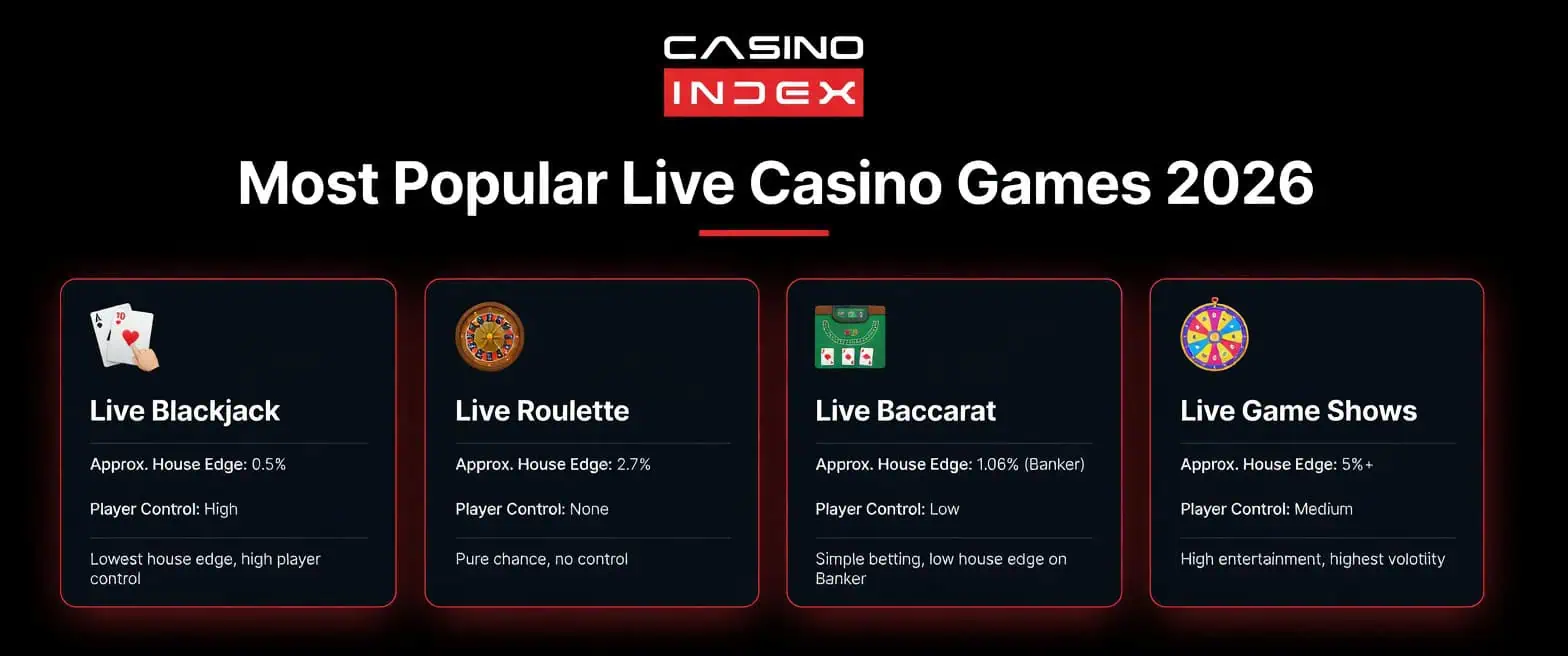
Live Blackjack
Blackjack is the most strategically relevant live casino game.
Why?
- lowest house edge
- decision-based
- slower gameplay
It is the closest live casino format to controlled, decision-based play.
But only if you play correctly.
Live Roulette
Roulette is structurally simple.
You place the bet, the wheel spins, and the result is resolved without further player input.
There is no decision layer that changes the mathematical outcome.
Betting systems may change variance, but they do not change probability.
But pacing still matters.
Live Baccarat
Baccarat is even simpler from a decision perspective.
The core choice is limited to three bet options:
- Player
- Banker
- Tie
That simplicity is exactly why the game attracts high-volume and low-friction play.
This simplicity is why high-volume players prefer it.
Live Game Shows
Modern casinos include:
- Popular Live Game Show
- Monopoly-style games
- wheel-based formats
These are designed for:
- entertainment
- high volatility
- fast engagement
They are not strategy-driven games.
They are high-volatility entertainment formats built around excitement rather than efficiency.
The Biggest Difference vs Slots (Critical Insight)
Slots
- fast
- repetitive
- high volume
- low control
Live Casino
- slower
- structured
- limited rounds
- more control
This is why many players switch after losing in slots.
But here’s the truth:
Slower losses often feel safer.
In practical terms, they are not safer at all.
Understanding game structure differences is also covered in the game category breakdown.
Where Players Lose Control in Live Casinos
Mistake 1 — Thinking “Real = Better Odds”
Seeing a real dealer does not improve your chances.
The math stays the same.
Mistake 2 — Playing Too Long
Because the pace is slower, players often stay longer at the table.
Longer sessions create more cumulative exposure to the house edge.
Mistake 3 — Following Other Players
Chat influence is real, especially in fast-moving live rooms. Players often copy bets without applying their own reasoning, which weakens discipline and removes structured control.
Mistake 4 — Ignoring Limits
Each table has:
- minimum bet
- maximum bet
Wrong table = wrong risk level.
Quick Player Reality Check
Before continuing, understand this:
Live casinos are not safer by default.
They are simply slower and more behavior-driven.
That’s the difference.
Players who understand this:
- manage bankroll better
- avoid emotional decisions
- stay in control longer
Players who don’t:
- rely on feeling
- overplay sessions
- lose consistency
Understanding House Edge in Live Casino Games (No Illusions)
What House Edge Really Means in Practice
House edge is not just a theoretical concept.
It is the economic foundation of every casino model.
Every live game is designed so that over time, the casino keeps a small percentage of every bet.
Example:
If a game has a 2% house edge, the casino expects to keep $2 for every $100 wagered over time.
This does not mean you lose every session.
It means:
The longer you play, the more closely your results move toward that built-in edge.
Why Live Games Feel “More Fair”
Live casinos feel fair because:
- you see real dealers
- outcomes look physical
- nothing feels hidden
However, visible fairness does not remove the edge.
It only changes how randomness is perceived by the player.
The math still works the same way as explained in the RTP mechanics.
Real House Edge Comparison (Important)
| Game | House Edge (Approx.) | Player Control |
|---|---|---|
| Blackjack | 0.5% – 1% | High |
| Baccarat | ~1% (Banker) | Low |
| Roulette (EU) | 2.7% | None |
| Roulette (US) | 5.26% | None |
| Game Shows | 4% – 10%+ | None |
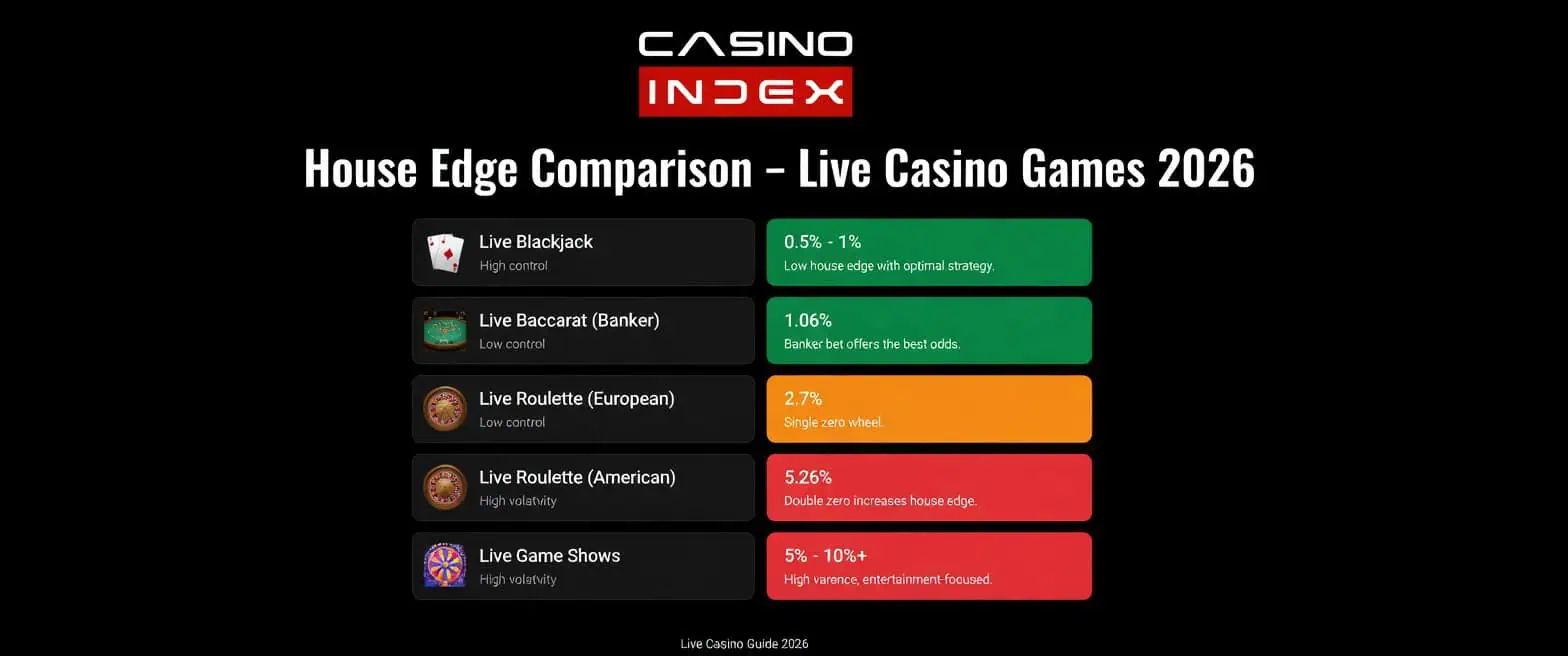
A lower edge usually means slower long-term loss.
It never guarantees profit.
Live Blackjack Strategy (What Actually Works)
Why Blackjack Is the Only Strategic Live Game
Blackjack is different.
It allows decisions that affect outcomes.
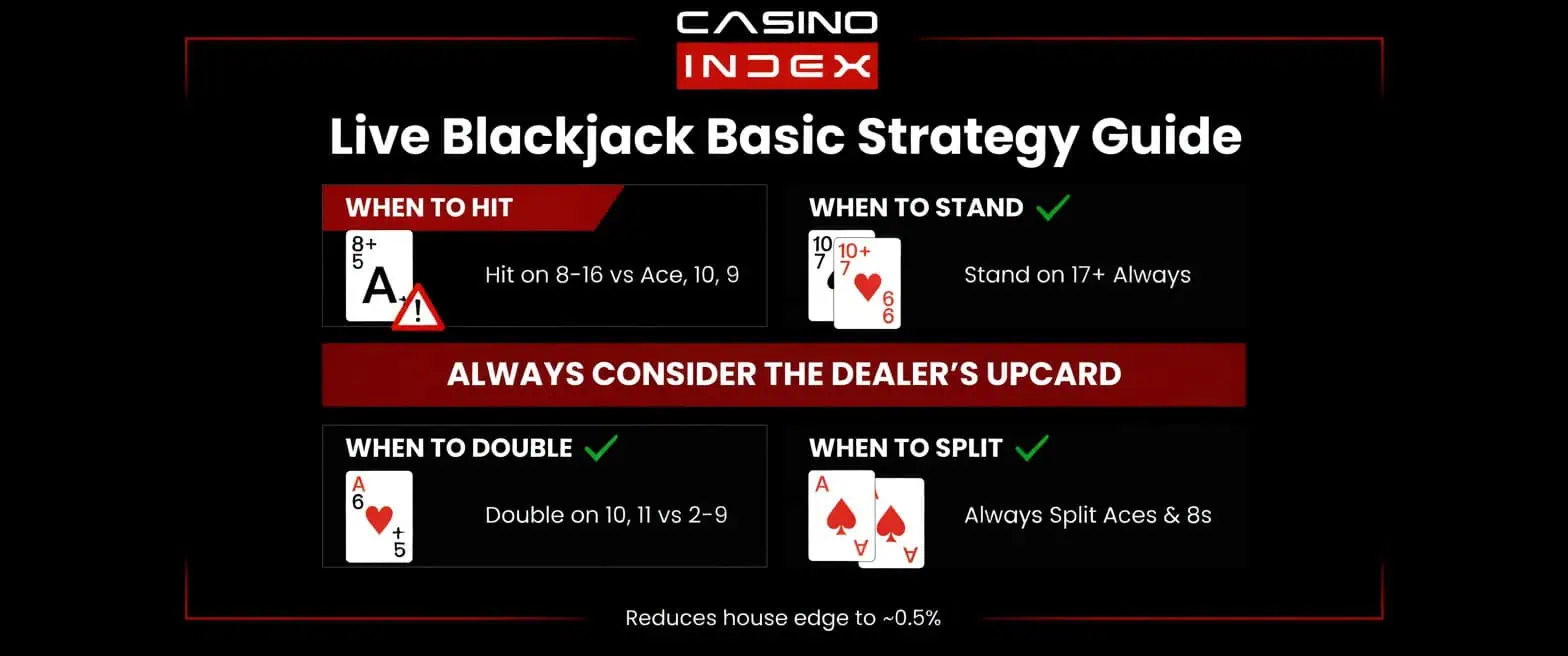
You choose:
- hit
- stand
- double
- split
These decisions can reduce avoidable mistakes.
They do not eliminate risk or overturn the house advantage.
The Simplest Winning Adjustment
You don’t need full strategy charts.
Start with this:
- stand on strong hands (17+)
- hit weak hands (below 12)
- avoid emotional decisions
- respect dealer upcard
Even basic decision discipline can improve consistency and reduce unnecessary errors.
The Biggest Blackjack Mistakes
Most players lose control because they:
- change decisions after losses
- play aggressively after wins
- ignore consistency
Experienced players do not chase short-term outcomes.
They repeat structured decisions and let variance play out without emotional adjustment.
Why “Almost Winning” Is Dangerous
Blackjack creates a strong illusion:
“I was close.”
This leads to:
- extended sessions
- higher bets
- emotional play
Probability does not reward near-misses or emotional interpretations.
Only correct decisions and disciplined execution matter over time.
Roulette Strategy (Breaking the Illusion Completely)
Why Roulette Feels Predictable
Players see patterns:
- red streaks
- black streaks
- repeating numbers
This creates the illusion of control.
Reality – Every Spin Is Independent
Roulette outcomes have no memory.
Each spin is:
- independent
- unaffected by previous results
That means no progression system or pattern-reading method can predict future outcomes reliably.
Popular Strategies Explained
Martingale
Double after losses.
Works short-term.
Fails long-term due to:
- table limits
- bankroll limits
Fibonacci
Slower progression system.
Same problem:
Does not change probability.
Flat Betting
Same bet every round.
This is usually the safest betting approach.
Not because it creates an advantage, but because it limits variance escalation and controls losses.
The Smart Way to Play Roulette
Instead of chasing systems:
- use fixed bet size
- set session limit
- stop early
This reduces risk.
Baccarat Strategy (Simple but Misunderstood)
Why Baccarat Attracts Serious Players
Baccarat is simple.
There are no decisions after betting.
This removes many mistakes.
The Only Important Rule
Betting on Banker is usually the most efficient baccarat option.
The reason is simple: it carries the lowest house edge, even after commission.
Even with commission, it remains the most efficient option.
What Players Get Wrong
Common mistakes:
- chasing streaks
- betting on “patterns”
- choosing Tie for high payouts
Tie bets carry a much higher house edge than the main baccarat options. They look attractive because of the payout size, but they are usually inefficient over repeated sessions.
Live Game Shows (Entertainment vs Reality)
Why They Are So Popular
Game shows are designed to:
- look exciting
- create big wins
- attract attention
They combine gambling with entertainment.
The Hidden Cost
Game shows usually have:
- higher volatility
- higher house edge
This means:
- bigger wins possible
- faster losses likely
When They Make Sense
Best use:
- short sessions
- small stakes
- entertainment focus
Not suitable for structured play.
Bankroll Management (The Real Strategy)
Why Bankroll Beats Everything
You cannot remove the house edge.
What you can control is the pace of exposure and the size of mistakes.
That’s what bankroll management does.
Basic Structure That Works
Example:
- total bankroll → $300
- session size → $30–$50
- stop-loss → fixed limit
Once the limit is reached:
Stop.
No exceptions.
The Most Important Rule
Never increase bets to recover losses.
This is one of the fastest ways to destroy a bankroll.
Why Small Bets Win Long-Term (Psychologically)
Small bets:
- reduce pressure
- extend sessions
- prevent panic
Large bets:
- create stress
- lead to mistakes
- accelerate losses
Table Selection Strategy (Underrated Edge)
Why Table Choice Matters
Not all tables are equal.
Different tables have:
- different limits
- different speeds
- different player behavior
Choosing the Right Table
Look for:
- comfortable minimum bet
- manageable pace
- low pressure environment
Avoid:
- crowded tables
- very fast dealers
- tables above your budget
How Table Speed Affects Losses
Faster tables create more rounds per hour, which increases exposure.
Slower tables reduce decision volume and usually improve behavioral control.
Psychological Control (Where Most Players Fail)
The Illusion of “Control”
Live casinos often feel controlled and manageable.
That feeling becomes dangerous when it lowers discipline.
It leads to:
- longer sessions
- higher bets
- relaxed discipline
Emotional Triggers
Players lose control when:
- chasing losses
- reacting to streaks
- following other players
These are not strategy decisions.
They are emotional reactions.
The Professional Mindset
Experienced players:
- ignore chat
- ignore streaks
- follow structure
Connecting Strategy With Platform Choice
Even strong table discipline becomes unreliable on weak platforms with poor withdrawals, unstable systems, or unclear terms.
Players still need:
- reliable withdrawals
- fair terms
- stable systems
This is why comparing platforms like the Duelbits reward model or the MyStake platform helps reveal differences beyond gameplay.
The Real Risks of Live Casino Play (What Most Players Ignore)
Risk 1 — Slower Games Create Longer Sessions
Live casinos feel controlled because they are slower.
That creates a hidden problem:
Players stay longer.
Longer sessions create more bets.
More bets create more exposure to the house edge.
This is one of the biggest hidden risks.
Risk 2 — The Illusion of Skill
Live games, especially blackjack, give players the feeling that they can influence outcomes.
To a degree, that’s true.
But only within limits.
You can:
- reduce mistakes
- improve decisions
You cannot:
- remove the house edge
- guarantee wins
Believing otherwise usually creates overconfidence and weakens risk control.
Risk 3 — Social Influence
Live casinos include:
- chat
- visible player bets
- table interaction
This creates pressure.
Players:
- follow others
- copy bets
- react emotionally
This removes control.
Risk 4 — Gradual Losses Feel “Safe”
Slots lose money fast.
Live casinos lose money slowly.
Slow losses often feel less dangerous.
In reality, they are simply less visible in the moment and easier to underestimate.
Live Casino Advantages vs Disadvantages
Advantages
- real-time gameplay
- higher perceived transparency
- slower pace
- more controlled decisions
- engaging experience
Disadvantages
- longer sessions
- psychological pressure
- house edge still exists
- social influence
- easier to overplay
The Reality
Live casinos are not better or worse.
They are different.
Players who understand those structural differences usually make better decisions and maintain control for longer.
How to Use Live Casinos Safely (Simple Framework)
Step 1 — Choose the Right Platform
Start with a reliable casino.
Look for:
- strong reputation
- stable withdrawals
- clear terms
Comparing platforms like the BitStarz bonus structure or the BC.Game ecosystem helps identify more stable live environments.
Step 2 — Start With a Small Session
Never start large.
Use:
- small deposits
- low stakes
This allows practical testing with limited risk.
Step 3 — Set a Hard Stop-Loss
Before playing, define:
- how much you can lose
Once reached:
Stop.
No exceptions.
Step 4 — Control Session Time
Set a time limit.
Example:
- 30–60 minutes per session
This prevents:
- fatigue
- emotional decisions
- extended exposure
Step 5 — Withdraw Early
Winning sessions should often end earlier than players expect.
Do not:
- keep playing after profit
- increase bets aggressively
Protecting profit is part of a disciplined session structure.
The Professional Player Framework

What Experienced Players Actually Do
They don’t chase wins.
They focus on:
- consistency
- control
- structure
Their System Looks Like This
- Choose a reliable casino
- Set bankroll
- Select correct table
- Play controlled session
- Stop at limit
- Withdraw regularly
There is no room for guessing and no value in emotional decision-making.
What They Avoid Completely
- chasing losses
- copying other players
- increasing bets after wins
- relying on streaks
This is where most players fail.
Live Casino vs Other Casino Types
These games offer more control.
| Factor | Live Casino | Slots |
|---|---|---|
| Speed | Slow | Fast |
| Control | Medium | None |
| Interaction | High | None |
| Risk Style | Gradual | Rapid |
Live Casino vs Crypto Games
| Factor | Live Casino | Crypto Games |
|---|---|---|
| Transparency | Visual | Mathematical |
| Speed | Medium | Very fast |
| Volatility | Medium | High |
| Control | Medium | Low |
Understanding these differences helps players choose the format that best matches their pace, risk tolerance, and control style.
The Most Important Rule (Final Insight)
Live casinos reward one thing more than any other format:
discipline.
Not luck.
>Not patterns.
>Not “feeling the table”.
Players who stay structured usually last longer.
Players who lose discipline usually hand control back to variance.
Live Casino FAQ
Are live casino games really fair?
Yes, live casino games are generally fair. They use real dealers, real equipment, and controlled studio environments. Outcomes are based on physical actions like shuffling cards or spinning a wheel.
However, fairness does not mean you will win. Every game still includes a built-in house edge. This ensures the casino profits over time, even if players win in the short term.
Can you win consistently in live casino games?
No, not in the long run. You can win short-term sessions, but consistent long-term profit is not realistic.
Every game is designed around probability. Even in blackjack, where decisions matter, the house still holds a small edge. Experienced players focus on minimizing losses rather than chasing consistent wins.
Why do live casino games feel safer than slots?
Live games feel safer because they are slower and more transparent. You see real actions happening, which creates trust.
In reality, the risk remains the same. The slower pace simply spreads losses over time instead of concentrating them into fast slot sessions.
Which live casino game has the lowest house edge?
Blackjack usually offers the lowest house edge when played correctly, often around 0.5% to 1%.
Baccarat (Banker bet) is also low, around 1%. Roulette has a higher edge, especially in American versions. Game shows and bonus-style games often have the highest house edge.
Do live casino dealers influence results?
No. Dealers follow strict rules and procedures. They do not control outcomes.
In blackjack, they deal according to fixed rules. In roulette, the outcome depends on physical movement. The system is monitored to ensure consistency and fairness.
Is there any real strategy in live casino games?
There is limited strategy depending on the game.
Blackjack allows decision-making, which can reduce mistakes. Baccarat is based on simple probability. Roulette has no strategy that changes outcomes.
Strategy helps with control and consistency, not with beating the house.
Why do players lose control in live casinos?
Most players lose control due to psychological factors, not the game itself.
Common reasons include:
- playing for too long
- reacting emotionally to wins or losses
- copying other players
- increasing bets without structure
Live casinos feel controlled, which often leads to overconfidence.
How long should a live casino session last?
A controlled session usually lasts between 30 and 60 minutes.
Longer sessions increase exposure to the house edge and reduce decision quality. Setting a time limit before playing helps maintain control.
Are live casino bonuses worth using?
Some bonuses are useful, but many come with restrictions.
Live games often contribute less toward wagering requirements. This makes bonuses harder to clear. Always check terms before accepting any offer.
What is the safest way to start playing live casino games?
Start small and test the platform.
A simple approach:
- deposit a small amount
- play a short session
- request an early withdrawal
This helps you understand how the casino handles payments and support.
Why do experienced players prefer live blackjack?
Blackjack offers the most control compared to other live games.
Players can make decisions that reduce mistakes. The house edge is relatively low, and the slower pace allows more structured play.
Is it better to play live casino games or slots?
It depends on your preference.
Live games are slower and more controlled. Slots are faster and more volatile.
Live casinos offer more decision-making, while slots rely entirely on chance. Neither removes the house edge.
Do live casino games require verification?
Yes, most platforms require verification, especially for withdrawals.
This includes identity checks and payment verification. Completing this early helps avoid delays later.
What is the biggest mistake beginners make?
The biggest mistake is believing live games are safer or easier to win.
This leads to:
- longer sessions
- higher bets
- reduced discipline
Understanding the system early prevents this.
Can table choice affect your results?
Table choice does not change probability, but it affects behavior.
High-limit tables increase pressure. Fast tables increase the number of bets. Choosing the right table helps maintain control.
Why do players follow others at the table?
Live casinos create a social environment.
Players see others betting and winning, which influences decisions. This often leads to copying bets without thinking.
Experienced players avoid this completely.
What is the safest mindset for live casino play?
Treat live casino games as controlled entertainment, not income.
Focus on:
- limits
- discipline
- consistency
Avoid emotional decisions and stop when your limits are reached.
Final Conclusion
Live casinos feel more real than most online formats.
That realism is their strength, but it also creates their biggest psychological risk.
They slow down losses, but they don’t remove them.
The difference between a good experience and a bad one comes down to one thing:
Understanding the system before playing.
Players who:
- stay disciplined
- control sessions
- ignore emotion
usually perform more consistently over time.
Everyone else relies on luck.
And luck does not last.
Explore More Casino Guides
If you want to go deeper:
- Learn how to evaluate casino safety through the casino safety breakdown
- Understand how game math works through the return-to-player model
These guides complete the full CasinoIndex evaluation system.