What a Safe Casino KYC Process Looks Like
Safe Casino KYC Process: Normal Checks vs Abusive Verification
KYC does not automatically make an online casino unsafe.
In fact, proper verification often protects players. It helps confirm account ownership, block underage gambling, reduce stolen payment use, prevent duplicate accounts, and keep withdrawals tied to the right person.
However, the way an operator handles KYC matters more than the request itself.
A safe casino KYC process feels clear, proportionate, and predictable. The player understands what documents may be needed, why the request exists, how the review works, and what happens after approval.
An abusive process feels very different. It appears mainly after a win, rejects documents without clear reasons, adds new demands step by step, and keeps the withdrawal stuck without a real decision.
That difference matters.
Many players do not object to reasonable verification. They object to surprise verification that starts only when money needs to leave the account.
Therefore, the right question is not simply: “Does this casino ask for KYC?”
The better question is: does the operator verify users fairly, or does it use KYC as a payout barrier?
This article explains what safe casino checks look like, which requests are normal, when verification becomes excessive, and how players can spot the difference before a withdrawal turns into a dispute.
Why Online Casinos Use KYC
KYC stands for “Know Your Customer.” In online gambling, it means the operator checks who owns the account and whether the activity creates regulatory, payment, fraud, or responsible gambling risk.
That can include identity verification, age confirmation, address checks, payment ownership, source of funds review, or account activity monitoring.
At a basic level, this protects the platform. More importantly, it also protects legitimate players.
Without verification, an operator may struggle to stop stolen cards, third-party payments, fake identities, bonus abuse, account takeovers, self-exclusion breaches, or restricted-country play.
Still, not every KYC request deserves automatic trust.
A serious operator uses verification as a controlled safety process. A weak one may use the same word to slow down withdrawals, pressure players, or create enough friction that some people give up.
Because of that, players should judge the full process, not just the document request.
For the broader foundation, CasinoIndex explains how casino verification works, including when documents are requested, why KYC appears during withdrawals, and which mistakes create avoidable delays.
What a Safe Casino KYC Process Should Include
A safe process starts with clarity.
Players should not discover the real verification rules only after requesting a withdrawal. The operator should explain the basics before deposit, either in the account area, cashier, help section, or terms.
That does not mean every possible risk check needs a long legal explanation. However, the platform should give enough information for players to understand when verification may happen and which documents may come up.
Clear Verification Rules Before Deposit
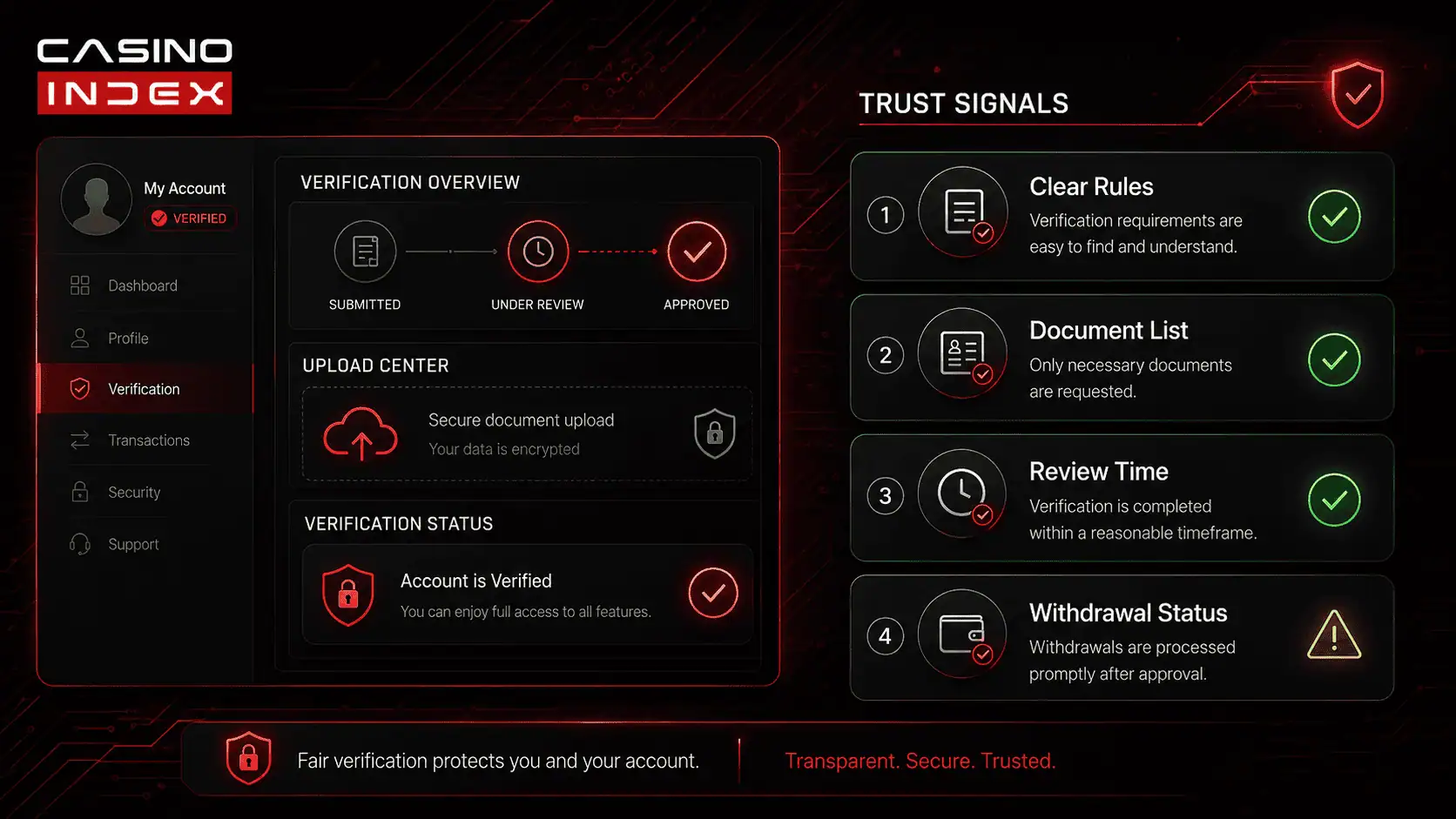
The first trust signal is simple: the rules are visible before money goes in.
A reliable operator explains that it may request ID, proof of address, payment ownership, or source of funds documents. It should also clarify that withdrawals can pause during review if the account needs approval.
This protects the player from surprise.
It also protects the operator because clear rules reduce disputes later.
The strongest signs of a fair verification process appear before the player wins. Clear terms, realistic document expectations, and honest withdrawal wording matter more than polished homepage promises.
Verification That Matches the Risk
Safe KYC follows the level of risk.
A low-stakes player making small deposits should not normally face the same review as a high-volume account moving large sums through several payment methods.
Likewise, a simple ID mismatch does not justify broad financial questioning. A large withdrawal after heavy crypto activity may create a stronger reason for extra checks.
That balance matters because proportionality separates fair verification from pressure tactics.
A trustworthy team asks for the least intrusive document that can solve the issue. If it needs more, it explains why.
Secure Upload and Clear Status Updates
Players upload sensitive documents during KYC. That can include passports, bank statements, utility bills, card screenshots, exchange records, or wallet transaction details.
Because of this, the upload process should feel secure and organized.
A proper system gives players clear instructions, accepted file types, document rules, and review status. Ideally, the account area shows whether verification is pending, rejected, approved, or waiting for more information.
Support should not push players to send private documents through random chat windows or unclear channels unless the platform has no better option and explains the process carefully.
The way an operator handles documents tells you a lot about its wider security culture. That is why verification quality also connects naturally with how trustworthy casinos verify users across account protection, payment safety, and withdrawal control.
Normal KYC vs Payout KYC vs Abusive KYC
The biggest mistake players make is treating every verification request the same.
Normal KYC is not automatically bad. Payout-stage KYC is not automatically abusive. However, unclear, repetitive, and expanding verification after a withdrawal request can become a serious trust warning.
| KYC Type | What It Means | Normal Timing | Player Risk | CasinoIndex View |
|---|---|---|---|---|
| Normal KYC | The casino checks identity, age, address, and payment ownership as part of standard compliance. | Signup, before first withdrawal, or before higher limits are allowed. | Low | Normal when rules are clear, requests are specific, and documents are reviewed within a reasonable timeframe. |
| Payout-stage KYC | The casino verifies the account when money needs to leave the platform. | First withdrawal, larger withdrawal, payment change, or account-risk review. | Medium | Acceptable if the casino explains what is being checked and moves the withdrawal forward after approval. |
| Enhanced KYC | The casino requests extra proof such as source of funds, payment ownership, or crypto wallet history. | High-value activity, large deposits, large withdrawals, or unusual payment behavior. | Medium to high | Legitimate when proportional, but risky when broad, vague, or disconnected from account activity. |
| Abusive KYC | The casino repeatedly adds new document requests, rejects valid files without detail, or leaves withdrawals pending without a clear decision. | Often after a win or once a meaningful withdrawal is pending. | High | A major warning sign if verification feels designed to delay payout rather than confirm account ownership. |
This comparison matters because fair KYC has a clear purpose.
By contrast, abusive KYC creates uncertainty. It makes the player guess what is missing, keeps the withdrawal unresolved, and often turns a normal compliance check into a payout dispute.
What Safe Casino Checks Look Like
Safe casino checks are specific, relevant, and limited to the issue being reviewed.
They do not feel random. They do not expand endlessly. Most importantly, they connect to account ownership, payment safety, regulatory duties, or clear risk signals.
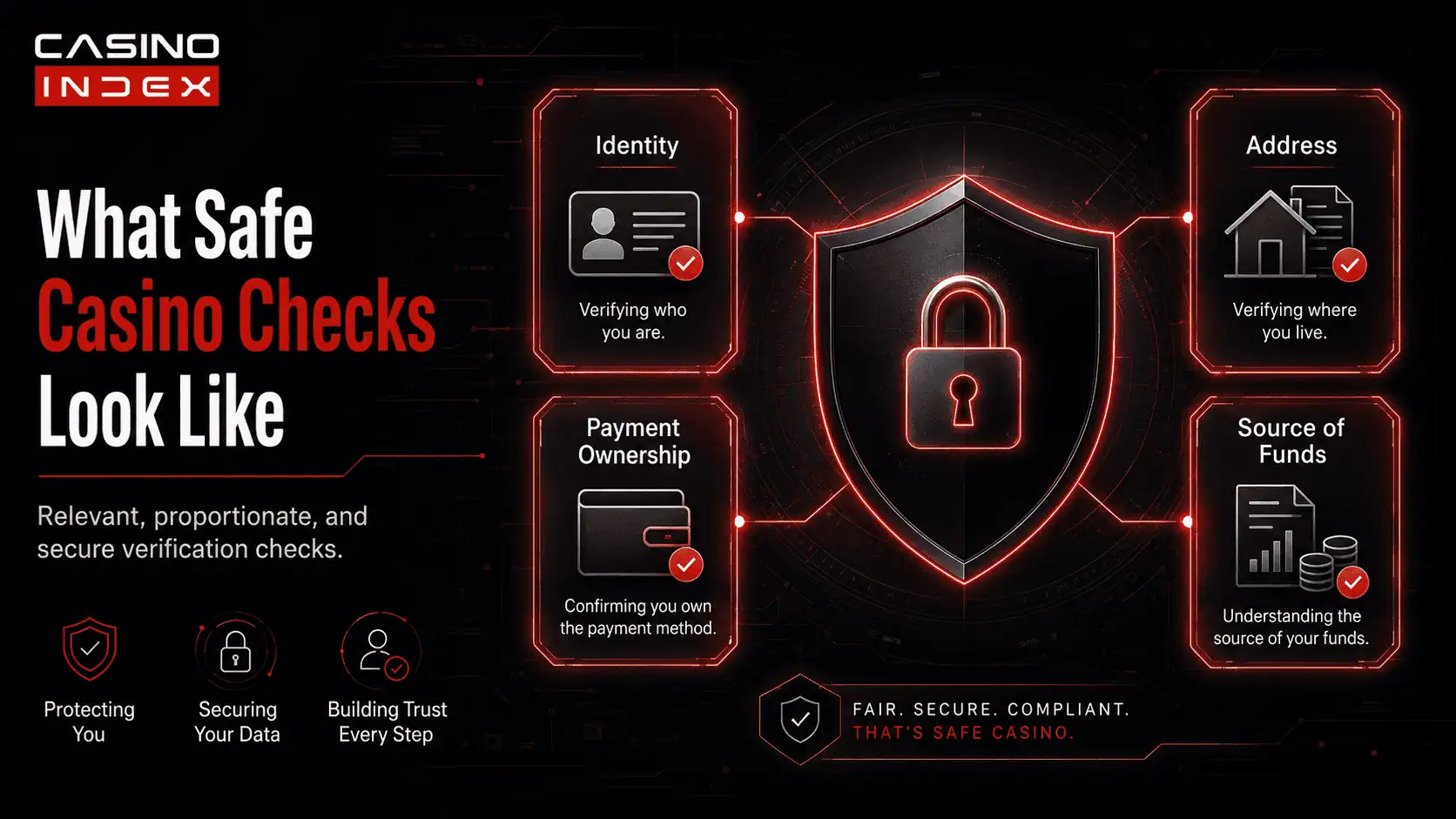
Identity Verification
Identity checks usually ask for a passport, national ID card, driving license, or another government-issued document.
The goal is to confirm the player’s legal name, age, and account ownership.
A fair request tells the player whether the document must show all four corners, whether it needs to remain valid, and whether the image must include both front and back.
This is normal.
Problems begin when a clear, valid document gets rejected again and again without a useful reason. In that case, the issue is no longer the ID request. The issue becomes the review behavior.
Proof of Address
Proof of address helps confirm that the player lives where the account says they live.
Common examples include utility bills, bank statements, tax letters, government documents, or official residence letters. Usually, the document must show the player’s full name, address, and recent issue date.
A fair operator states the age limit clearly. For example, it may require a document from the last three months.
In practice, address checks become unfair when support keeps rejecting valid documents without explaining what failed. A serious verification team should say whether the problem involves date, name, address, file quality, document type, or missing information.
Payment Ownership Checks
Payment checks protect both sides.
If a player deposits with a card, e-wallet, bank account, or crypto wallet, the operator may need proof that the payment method belongs to the same person who owns the gambling account.
This prevents third-party deposits, stolen payment use, chargebacks, and withdrawal ownership disputes.
A fair request focuses on the payment method actually used. For example, card verification should not turn into unrelated crypto questioning unless the account also used crypto or triggered another risk review.
This is where payment verification becomes practical: the request must have a clear connection to the account, payment trail, or withdrawal path.
Players should also understand why payment ownership must match when the deposit method, withdrawal method, and account owner do not align cleanly.
Source of Funds Checks
Source of funds checks ask where the gambling money came from.
This may involve salary, savings, business income, crypto sales, investments, inheritance, or other legitimate sources. These checks can feel intrusive, yet they may become reasonable when deposits, withdrawals, or transaction patterns reach a higher-risk level.
The key is scope.
A fair source of funds request explains what the platform needs and which document can satisfy the check. Players who face this review should understand how source of funds checks work before assuming every financial document request is abusive.
Fair Use of Source of Funds
A fair request might ask for a recent payslip, bank statement, exchange withdrawal record, business income document, or transaction proof related to the deposited funds.
It should match the size and pattern of account activity.
For example, a high-value player moving large sums through several methods may face deeper review than someone making small casual deposits.
Abusive Use of Source of Funds
An abusive request feels broad, vague, and endless.
The operator may ask for excessive financial history, reject reasonable documents without detail, or keep adding new demands after each submission.
At that point, the concern shifts from compliance to obstruction.
The more personal information a platform requests, the more clearly it should explain why the request makes sense.
Normal vs Abusive KYC Requests
The difference between normal and abusive KYC rarely comes from one document.
Usually, the pattern tells the story.
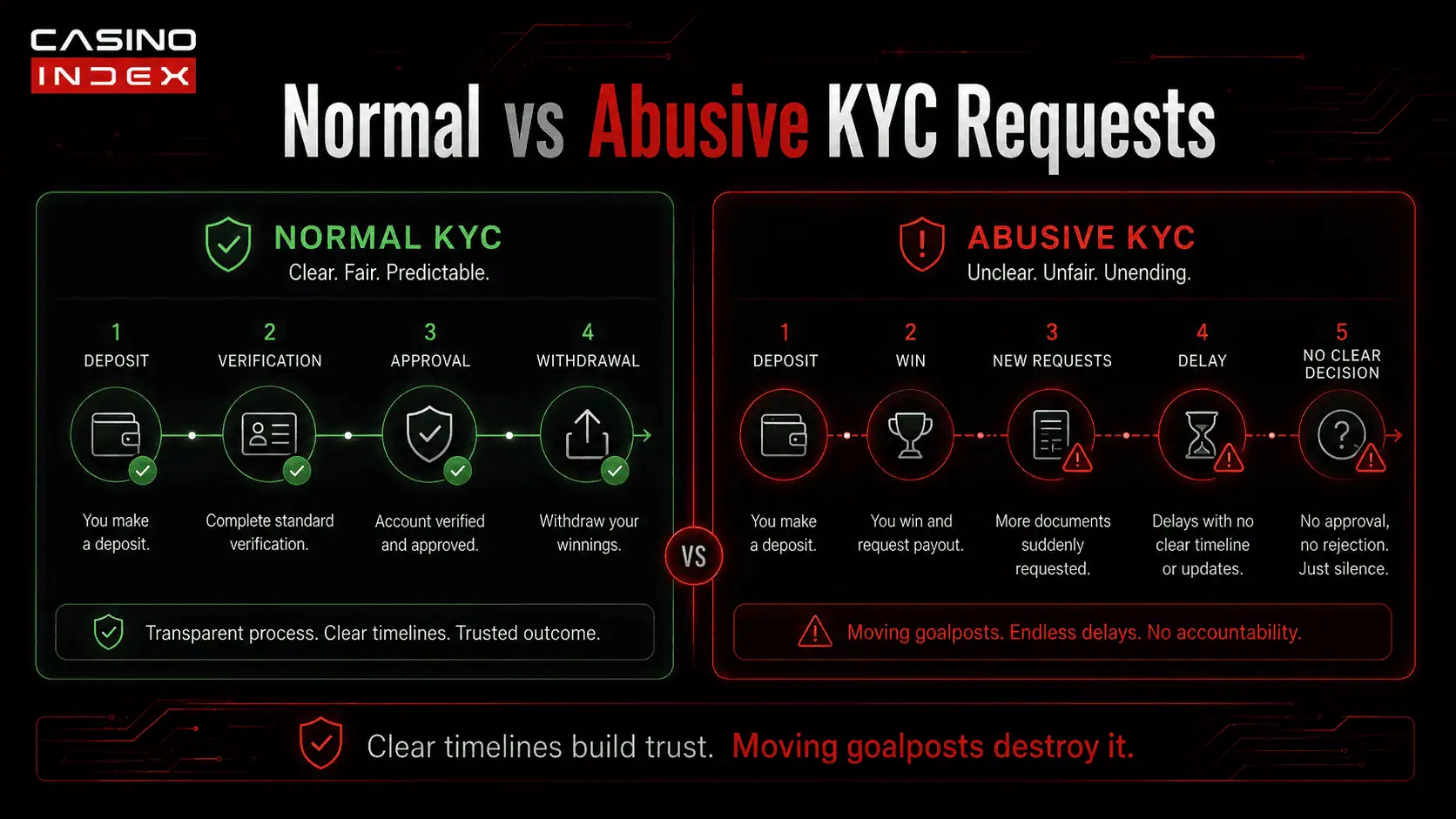
Normal KYC Requests
Normal verification requests have a clear purpose.
They confirm identity, address, age, payment ownership, source of funds, account safety, responsible gambling risk, or suspicious activity.
A normal request can still feel annoying. However, it should remain specific, proportionate, and reviewable.
For example, an operator may ask for ID before releasing a withdrawal. It may also request proof of card ownership if the player deposited by card. In higher-risk situations, it may ask for source of funds evidence.
Those steps do not automatically signal abuse.
Instead, players should look at how the platform explains the request, how fast it reviews documents, and whether it gives a clear decision after approval.
Abusive KYC Requests
Abusive KYC often appears after the player wins.
The account worked fine during deposits and gameplay. Then, once the withdrawal starts, verification becomes strict, unclear, and slow.
Common red flags include vague rejections, repeated new document demands, no review timeline, support replies with no case detail, sudden withdrawal cancellations, and requests that do not match the account activity.
Another warning sign appears when approved documents later become “not enough” without explanation.
This is where normal vs abusive KYC becomes more than a compliance topic. It becomes a payout-risk topic.
A single delay may have a reasonable cause. A pattern of shifting requirements deserves caution.
The Payout-Only KYC Problem
Timing matters.
If a platform accepts deposits instantly, allows long play sessions, and raises no issue while the player loses, then starts heavy verification only after a withdrawal, players have a valid reason to question the process.
Late KYC can still be legitimate. Some checks only start when a withdrawal crosses a threshold or when payment review begins.
Even so, a serious operator should explain the trigger and handle the review efficiently.
When the platform gives only vague “security department” replies, trust drops quickly.
Players who want to understand the wider pattern should look at what casinos check before approving withdrawals, because KYC often overlaps with bonus review, payment matching, fraud checks, and account restrictions.
How Trustworthy Casinos Verify Users
Trustworthy operators do not need to avoid KYC.
They need to manage it properly.
A strong verification process gives the player a clear path from request to approval. It also separates real compliance checks from unclear payout delays.
They Explain the Type of Review
Good operators tell players what kind of check they need.
That may be identity verification, address confirmation, payment ownership, source of funds, source of wealth, account activity review, or responsible gambling review.
Players do not need internal risk scores. However, they deserve enough context to understand why the account cannot proceed yet.
When support only says “security review,” the answer may be technically true, but it does not help the player solve the issue.
They Ask for Relevant Documents
A trustworthy verification team keeps requests focused.
If the issue involves address confirmation, it asks for proof of address. If payment ownership creates the problem, it checks the payment method. If transaction size creates AML risk, it explains the source of funds requirement.
This creates trust because the player can see the logic.
By contrast, random or unrelated document demands make the process feel hostile.
They Give Specific Rejection Reasons
Document rejection should never feel like a guessing game.
If a file is blurry, support should say it is blurry. If the document is too old, the response should mention the date rule. If the name does not match, the team should identify the mismatch.
Specific feedback helps the player fix the issue.
Generic rejection creates friction and often leads to repeated delays.
They Pay After Approval
This is the real test.
After the player passes verification and no rule breach exists, the withdrawal should move forward.
If the platform adds another review, it should explain why. If it cancels the payout, it should point to the rule or issue behind the decision.
A safe KYC process ends with a result.
An abusive process avoids closure.
KYC at Crypto and No-KYC Casinos
Crypto casinos create extra confusion because many promote speed, privacy, and low-friction access.
Some platforms advertise no-KYC gambling. However, players should read that claim carefully.
In many cases, “no KYC” means the operator does not require full identity verification at registration or for normal low-risk play. It may still reserve the right to verify users after certain triggers.
Those triggers can include large withdrawals, suspicious wallet activity, duplicate accounts, restricted-country signals, bonus abuse concerns, sanctions risk, or unusual transaction patterns.
Therefore, “no KYC” does not always mean “verification can never happen.”
The safer question is: when can checks start, and how fairly does the operator handle them?
A platform that advertises no verification but freezes withdrawals with vague demands can create more risk than one that verifies early and pays reliably.
For deeper context, CasinoIndex explains when no-KYC gambling stops being low-friction and why privacy claims need careful reading before deposit.
How Players Can Reduce KYC Problems
Players cannot control every review decision.
However, they can avoid many preventable issues.
Before Depositing
Use accurate personal information from the start.
Your name, date of birth, address, country, email, and payment details should match your real documents.
Do not register with nicknames, old addresses, fake details, or someone else’s payment method. Also, check restricted countries, VPN rules, bonus terms, and withdrawal conditions before sending funds.
If early verification exists, complete it before building a large balance.
That step may feel boring, but it can prevent serious payout friction later.
During Verification
Upload clear, complete documents.
Make sure images show all required corners, dates, names, addresses, and ownership details. Avoid editing files unless the platform clearly allows you to mask certain sensitive numbers.
If support rejects a document, ask for the exact reason.
Do not keep guessing.
A fair team should tell you what failed and what replacement it needs.
If the Process Feels Unfair
Stay calm and keep written records.
Save screenshots of withdrawal requests, KYC messages, uploaded files, rejection reasons, support replies, account status changes, bonus terms, and payment history.
Do not cancel the withdrawal just because verification becomes frustrating.
Instead, ask direct questions:
- Which document is missing?
- Why did the previous document fail?
- Is the withdrawal paused or still pending?
- What review timeframe applies?
- Has the case moved to a higher department?
- Does the operator allege a rule breach?
Clear questions make vague answers easier to spot.
If the platform cannot answer basic process questions, that becomes part of the trust assessment.
How CasinoIndex Judges KYC Quality
CasinoIndex does not rate KYC by asking only whether verification exists.
That would be too shallow.
A strong review needs to examine when the operator asks for documents, how clearly it explains the rules, whether public complaints mention payout-stage verification, how payment checks work, and whether approved players actually receive their withdrawals.
This matters because KYC connects several trust areas at once.
It touches licensing, security, payment reliability, withdrawal speed, bonus enforcement, account restrictions, responsible gambling, and complaint handling.
A reliable operator uses verification to protect the platform and the player.
A weaker one may use the same process to delay payment, create pressure, or search for technical reasons to avoid approval.
That is why CasinoIndex looks closely at why withdrawals slow down after approval starts and how verification behaves under payout pressure.
In practice, the safest sites are not always the ones with the least KYC.
They are the ones that verify clearly, review consistently, and pay once the account passes.
Final Verdict: Safe KYC Is Clear, Proportionate, and Consistent
A safe casino KYC process should not surprise players at the worst possible moment.
It should appear in the rules before deposit, follow a clear document checklist, use secure upload methods, match the level of account risk, and end with a clear decision.
Normal verification confirms identity, address, payment ownership, and sometimes source of funds. It may feel inconvenient, but it has a valid purpose when handled properly.
Abusive verification feels different. It starts mainly after withdrawals, expands without clear reasons, rejects documents vaguely, creates pressure, and delays payment without closure.
Therefore, players should not judge KYC only by whether it exists.
They should judge how the operator uses it.
The best gambling sites do not avoid verification completely. They handle it fairly, explain it clearly, and move withdrawals forward once the account is approved.
That is what a safe casino KYC process looks like.

Maria Hoffmann has worked in cryptocurrency content and digital publishing since 2017. She is a co-founder of Freecoins24 and CryptoMutant and has covered blockchain projects, crypto platforms and emerging industry trends for several years. She has also been active as a cryptocurrency investor since 2019. At CasinoIndex, Maria combines content research and SEO experience with a focus on casino trust, platform security, withdrawal processes, payment risks and user protection. Her work looks beyond bonuses and product features to examine how gambling platforms handle player funds, verification and account-related risks.