What Restricted Games Mean in Casino Bonuses and Why They Matter More Than Most Players Think
Article OverviewRestricted games are not the same as games with 0% wagering contribution. A restricted game may be unavailable while a casino bonus is active, while a 0% contribution game can still be playable but add nothing toward wagering progress. Max bet, wagering requirements and max cashout are separate bonus rules. Breaking a term also does not automatically mean full confiscation, as the outcome depends on the specific promotion, rule and operator policy.

Restricted games are a separate casino-bonus rule. They are not the same thing as games with 0% wagering contribution.
That distinction matters because several bonus rules can affect the same session at the same time. A casino may allow a game while giving its wagers 100%, 10%, 5%, or 0% contribution toward wagering. Another title may be unavailable while the bonus is active. A separate max-bet rule can limit stake size, while the wagering requirement sets the amount of qualifying play you need before you can withdraw bonus-linked funds.
Players often see all of those conditions grouped under “bonus terms” and assume they describe one restriction. They do not. Restricted games, contribution rates, wagering requirements, max-bet limits, max cashout rules, expiry, and bonus-abuse clauses control different parts of the offer.
This guide separates those rules so you can see what a restricted game actually means, what happens when a game contributes nothing, and why a visible title in the casino lobby is not automatically eligible for bonus play. For the wider framework behind promotions, see the Casino Bonus Guide.
These CasinoIndex reviews are useful brand-level examples because their bonus structures show different ways game eligibility and wagering rules can interact. They are not a ranking of “best” bonuses, so check the current promotion terms before opting in.
| Review | Why it is relevant here | Open review |
|---|---|---|
| Stake | Useful for separating house-edge-based wagering contribution from games that are unavailable during an active deposit-bonus requirement. | Read the Stake review |
| BitStarz | Useful for comparing low contribution, excluded game mechanics, max-bet rules, wagering and bonus cancellation. | Read the BitStarz review |
| BC.Game | Useful for seeing why players need to check the live promotion pane for weighting, max bet, expiry and other offer-specific conditions. | Read the BC.Game review |
Restricted Games vs Contribution, Wagering, Max Bet and Max Cashout
The easiest way to avoid confusion is to treat each bonus rule as a separate control. A casino can combine several of them in one promotion, but they answer different questions.
Seven Bonus Rules That Control Different Parts of an Offer
| Bonus Rule | What It Controls | Typical Effect | What Players Should Check |
|---|---|---|---|
| Restricted game | Whether the casino allows a title while the bonus or wagering condition remains active. | The casino may block the game, remove bonus-fund access, or prohibit it under the promotion terms. | Eligible and excluded game lists, provider restrictions and feature restrictions. |
| 0% contribution | How much a permitted wager advances the wagering requirement. | The game may remain playable, but the wager adds nothing to rollover progress. | Game contribution table or weighting rules. |
| Partial contribution | How much of each qualifying wager counts. | A $100 wager at 5% contribution adds only $5 toward the requirement. | The exact percentage or formula for that game or category. |
| Wagering requirement | The total amount of qualifying turnover needed. | The player must complete the required eligible wagering before withdrawing bonus-linked funds under the offer. | Whether wagering applies to bonus only, deposit plus bonus, or another base. |
| Max bet | The largest permitted stake while the bonus is active. | A wager can breach the promotion even if the game itself is eligible. | Per-spin, per-round, double-up and bonus-buy treatment. |
| Max cashout | How much bonus-related value the player can ultimately withdraw. | The promotion may limit winnings above the stated cap. | Whether the casino applies the cap to bonus winnings, free spins, no-deposit offers or another defined balance. |
| Expiry | How long the player has to use or complete the offer. | The published terms can let an unfinished bonus expire. | Activation date, wagering deadline and how the casino treats linked funds at expiry. |
This distinction is more useful than treating every restriction as a “wagering rule.” Wagering tells you how much qualifying play you need. Contribution tells you how quickly each game advances that requirement. Game restrictions tell you whether the casino allows certain titles at all.
Restricted Game Does Not Mean 0% Contribution
A restricted game and a 0% contribution game can lead to a similar outcome for wagering progress, but they are not the same rule.
If a game contributes 0%, the casino may still allow you to open and play it. Your real-money balance can move normally, yet those wagers do not reduce the remaining bonus requirement. The session is valid gameplay, but it is irrelevant to rollover.
A restricted game is different. The promotion may prohibit bonus-fund use on that title or prevent players from using it while the promotion remains active. Some casinos enforce this technically by blocking access. Others rely on the terms or on promotion-specific controls.
There is also a third category: partial contribution. Here the game is eligible, but only part of each wager advances the requirement.
That creates three very different questions:
- Am I allowed to play this game while the bonus is active?
- If I am allowed to play it, does it count toward wagering?
- If it counts, what percentage or formula applies?
A serious bonus review should answer those questions separately.
How Game Contribution Changes Wagering Progress
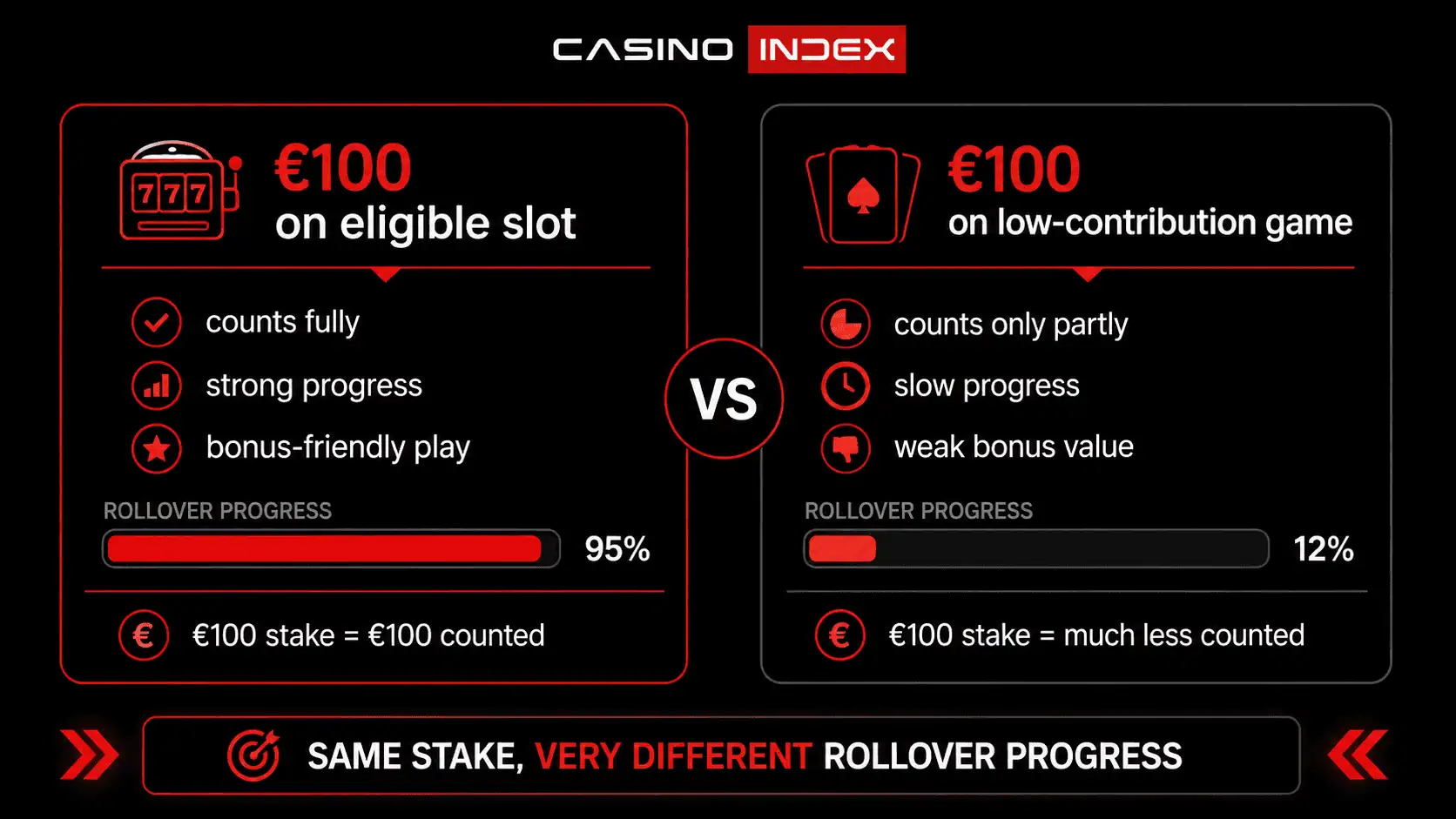
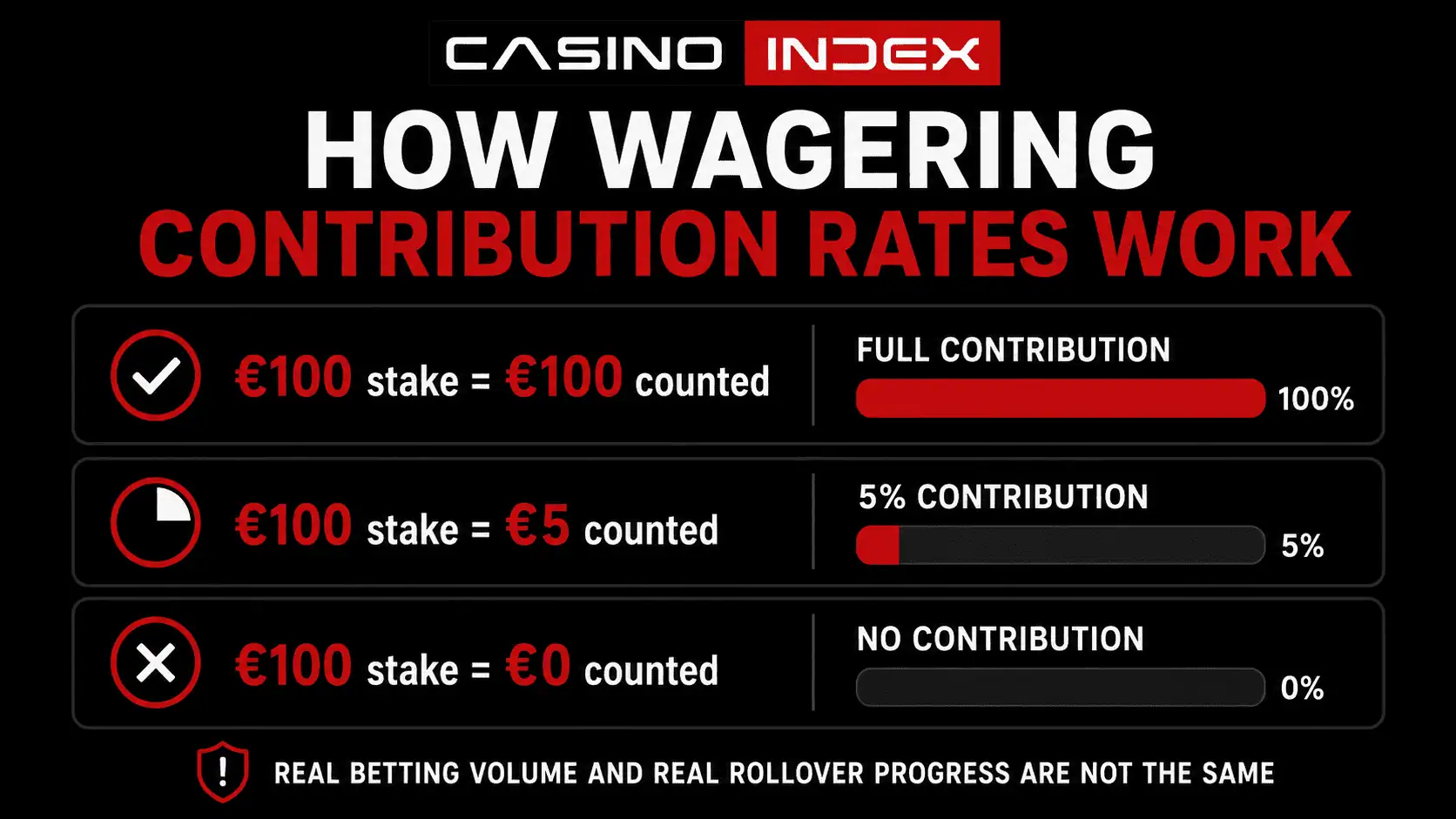
Game contribution measures the portion of a qualifying wager that counts toward the wagering requirement. It does not describe the actual amount risked, and it does not change the game’s normal stake.
Suppose you have $1,000 of wagering left:
- At 100% contribution, a $100 eligible wager reduces the remaining requirement by $100.
- At 20% contribution, the same $100 wager adds $20 of progress.
- At 5% contribution, it adds $5.
- At 0% contribution, it adds nothing.
The player can therefore generate substantial betting volume without making equivalent progress. That is why total stakes and qualifying turnover are not interchangeable.
Casinos can set contribution by game category, individual title, provider, promotion, or another formula. Never assume that every slot counts 100% or that every table game uses the same lower rate. The active promotion terms are the source of truth.
Why a Visible Game Can Still Count 0%
One of the most confusing situations is when a game remains visible and playable but produces no wagering progress.
Players naturally use lobby availability as a signal. If the casino lets them open a title, it feels reasonable to assume that the title is compatible with the active bonus. However, game availability and bonus eligibility can be separate systems.
A game can therefore fall into one of several states:
- available and fully contributing;
- available with partial contribution;
- available with 0% contribution;
- unavailable with bonus funds;
- or specifically restricted while the promotion is active.
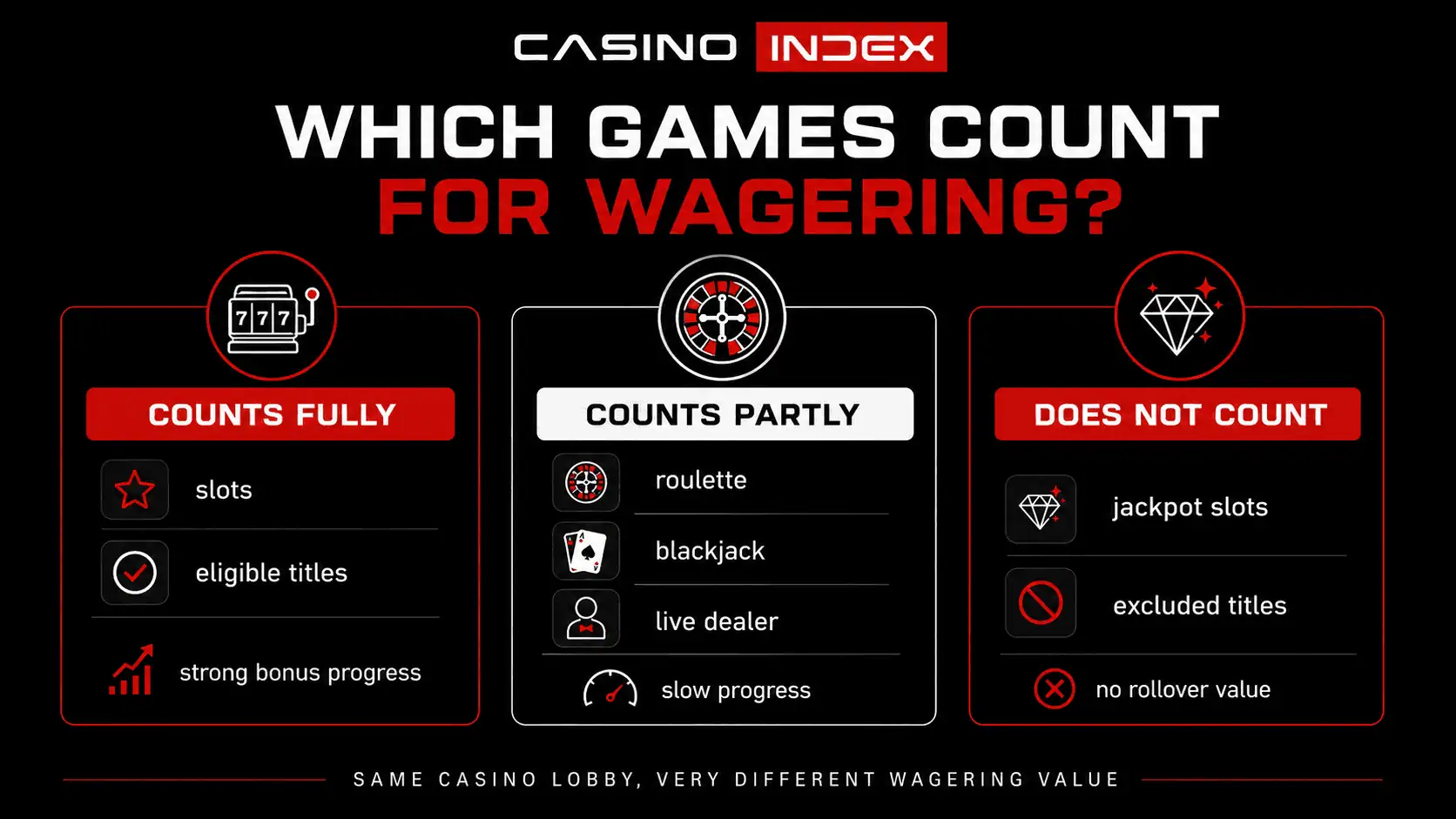
This is why a progress tracker can create false confidence. A tracker that barely moves may reflect low contribution rather than a technical problem. A tracker that does not move at all may reflect 0% weighting. Neither situation proves that the casino prohibited the game itself.
Max Bet Is a Separate Bonus Rule
Game eligibility does not tell you how much the promotion allows you to stake.
A title can be fully eligible and still sit under a promotion-wide maximum bet. The operator may apply the rule per spin, hand, round, double-up action, or purchased bonus feature.
That distinction matters because players sometimes check the eligible-games list and assume they are safe once they find the title there. They can still breach a separate max-bet condition if their stake exceeds the promotion limit.
The correct sequence is therefore:
- confirm that the promotion permits the game;
- check its contribution rate;
- check the maximum permitted wager;
- then confirm any feature-specific rules such as bonus buys or double-up bets.
Do not treat a max-bet rule as part of game contribution. One controls stake size. The other controls wagering progress.
Wagering Requirements Are the Total Target, Not the Game Rule
A wagering requirement defines the total amount of qualifying play needed under the promotion. It is the target. Game contribution determines how quickly different wagers move you toward that target.
For example, a promotion could require $3,000 of qualifying wagering. A fully weighted $100 wager could add $100 of progress, while a 5% weighted $100 wager would add only $5. The wagering requirement did not change; only the amount of credit given to that wager changed.
Another important variable is the wagering base. A casino can apply the multiplier to the bonus amount, the deposit plus bonus, free-spin winnings, or another defined promotional amount. Two offers with the same “30x” headline can therefore require very different real turnover.
The full calculation belongs in the separate guide to how casino wagering requirements really work. On this page, the key point is narrower: restricted games and contribution rules determine which wagers can help complete that requirement.
Max Cashout Is Also Separate From Restricted Games
Max cashout controls the amount a player can ultimately withdraw from a defined bonus or promotion. It does not decide whether a game is eligible and it does not determine the speed of wagering progress.
A player can follow every game restriction, respect the max-bet limit, and complete all required wagering yet still face a payout cap if the promotion contains a valid max-cashout clause.
That is why bonus evaluation should not stop when wagering reaches 100%. You still need to check the offer for any limit on bonus-related winnings.
Max-cashout rules vary widely by bonus type. They are especially important in some no-deposit, free-spin, or highly promotional offers, while other bonuses may have no comparable cap. CasinoIndex covers that issue separately in how max cashout rules affect the real value of casino bonuses.
Current Operator Terms Show Why the Distinction Matters
We checked the examples below against public operator material on September 18, 2026. They are examples of structure, not permanent promises. Operators can change bonus terms by promotion, jurisdiction, account and date.
Stake: contribution formula and restricted titles are separate
Stake’s public Deposit Bonus Requirement policy currently uses a 4% house-edge benchmark for casino wagering progress. Its own example says a game with a 1% house edge completes the requirement four times more slowly, so a $1 wager contributes $0.25 toward the requirement.
The same policy separately lists games that players cannot use while an active deposit-bonus requirement applies. That is a clean real-world example of the core distinction on this page: reduced contribution is one rule; an unavailable or restricted game is another.
BitStarz: low contribution, excluded mechanics and max bet sit in different clauses
BitStarz’s current Bonus Terms and Conditions state that table games, live games, instant-win games, lotteries and bingo typically contribute 5% toward wagering. The same terms separately exclude progressive-jackpot and accumulating-mechanic games from bonus wagering and allow additional game restrictions.
The terms also publish a separate maximum bet while a bonus is active and explain that bonus cancellation or expiry affects the bonus and associated winnings. Those are distinct conditions. Keep each condition separate from the definition of “restricted game.”
BC.Game: the live promotion details matter
BC.Game’s current public promotion guidance tells players to check the active promotion details for the wagering multiple, game weighting, max bet and expiry. Its public material also notes that percentages, caps and availability can vary by region and account status.
That makes BC.Game useful as a different kind of example. Rather than treating one old percentage as permanent, the safer approach is to verify the live offer attached to the account before depositing or changing games.
What Can Happen If a Bonus Term Is Broken?
Do not describe a terms violation as if every casino automatically confiscates the entire account balance. The consequence depends on the exact promotion, the rule involved, how the operator enforces it, and whether the issue concerns bonus funds, bonus-linked winnings, real-money funds, fraud, or another account problem.
Possible outcomes can include:
- the wager not counting toward wagering progress;
- the casino blocking the game while bonus funds are active;
- the casino cancelling the bonus;
- the casino removing bonus-linked winnings where the published terms provide for that outcome;
- the casino reviewing a withdrawal or promotion;
- the casino asking the player to clarify activity;
- or stronger account action when separate fraud, multi-accounting, payment, or abuse rules are involved.
The severity should match the term and the documented policy. Playing a 0%-contribution game is not automatically the same as fraudulent bonus abuse. Likewise, accidentally exceeding a max-bet condition and deliberately exploiting a promotion are not conceptually identical even if an operator’s terms may attach serious consequences to both.
CasinoIndex separates the broader behavior question in what counts as bonus abuse at online casinos. That keeps this guide focused on game restrictions rather than treating every bonus mistake as abuse.
Why Casinos Restrict Certain Games
Game restrictions usually exist because different games create different economics for a promotion.
Low-house-edge games can produce a large amount of turnover with relatively low expected loss. Some jackpot or accumulating-mechanic titles interact badly with bonus funding or provider rules. Certain bonus-buy or feature mechanics can change the relationship between stake, volatility and promotional value. An operator, provider or temporary promotion can also create its own exclusions.
That does not mean every restriction is automatically player-friendly. The trust question is how clearly the casino discloses it.
A clear bonus policy tells the player which titles qualify, which contribute partially or not at all, which titles the casino restricts, what the max bet is, and what happens after a rule breach. A weaker structure leaves those conditions spread across several pages or uses broad discretion without making the practical effect easy to understand.
How to Read Restricted-Game Terms Before Depositing
The most useful check is not simply “are there restricted games?” Almost every meaningful bonus comes with conditions. The better question is whether you can understand the complete rule set before you commit money.
| Check Before Claiming | What You Need to Find | Why It Matters |
|---|---|---|
| Eligible games | Which titles, categories or providers the promotion allows. | The promotion may still exclude a title that remains visible in the lobby. |
| Contribution | 100%, partial, 0%, or formula-based weighting. | Determines how much each wager advances rollover. |
| Max bet | Per-spin or per-round limit and treatment of special features. | You can still breach the stake limit while playing an eligible game. |
| Wagering base | Bonus only, deposit plus bonus, or another defined amount. | The same multiplier can create very different turnover. |
| Max cashout | Whether bonus-linked winnings have a payout ceiling. | Completing wagering does not necessarily remove a separate cashout cap. |
| Expiry | How long the offer and wagering period remain active. | An otherwise valid bonus can expire before completion. |
| Violation outcome | What the terms actually say happens after a breach. | Prevents assumptions about automatic confiscation or harmless mistakes. |
For a wider pre-deposit review, use the CasinoIndex guide to which casino terms to check before depositing. Restricted games should be one item in that review, not a replacement for reading the rest of the offer.
Why Restricted Games Matter More for Some Players
A bonus can be mathematically identical for two players and still be a poor fit for one of them.
If most of your normal play is on titles that count fully, the contribution rules may cause little friction. If you prefer blackjack, roulette, live dealer, jackpot games, instant games, or feature-heavy titles, the same offer can become much harder to complete because your preferred games may contribute less, contribute nothing, or be unavailable during the bonus.
That is why you should judge the headline bonus amount together with your game preference. A large match is not useful if completing it requires abandoning the games you actually wanted to play.
This is also why a restricted-games page should not become another generic “best bonus” list. Its job is to show how the game layer changes the practical value and risk of a promotion.
FAQ — Restricted Games in Casino Bonuses
Is a restricted game the same as a 0% contribution game?
No. A 0% contribution game may still be playable but add nothing toward wagering. The casino may block a restricted game, remove bonus-fund access, or prohibit it under the active promotion. Always check both eligibility and contribution.
Can a casino allow a game but give it only partial contribution?
Yes. Partial contribution means the game is eligible for wagering progress but only a percentage or formula-based portion of each wager counts toward the requirement.
Does 0% contribution mean I broke the bonus terms?
Not automatically. If the casino allows the game but assigns it 0% contribution, playing it may simply produce no wagering progress. A separate restriction would need to prohibit the game or the way the player used it.
Can an eligible game still breach a casino bonus?
Yes. A game can be eligible while a separate max-bet, bonus-buy, expiry, payment or other promotion rule still applies. Eligibility is only one part of the terms.
Are max bet and wagering requirement the same rule?
No. Max bet limits the size of an individual wager or round. The wagering requirement sets the total qualifying turnover the player must complete under the promotion.
Does completing wagering remove the max-cashout rule?
Not necessarily. If a promotion has a separate max-cashout rule, that cap can still apply after the player completes the wagering requirement according to the terms.
Does every bonus-rule violation lead to confiscation?
No single outcome applies to every breach. Consequences depend on the operator, promotion and rule involved. They can range from no wagering credit or bonus cancellation to removal of bonus-linked winnings or a wider account review where the published terms allow it.
Where should I check restricted games?
Start with the specific promotion terms, not only the casino’s general terms. Check the eligible-games list, contribution table, max-bet rule and any provider or feature exclusions immediately before claiming because these details can change.
Final View
Restricted games deserve their own place in casino-bonus analysis because they answer a different question from wagering contribution.
A restricted-game rule tells you whether the promotion allows the title. Contribution tells you how much an eligible wager counts. Wagering defines the overall turnover target. Max bet controls stake size. Max cashout controls the payout ceiling where one exists.
Those rules can interact, but you should not merge them into one vague idea of “bonus restrictions.” That makes it much harder to understand what happened when a wagering tracker moves slowly, the casino blocks a game, or a payout enters review.
The practical rule is simple: before claiming a bonus, verify game eligibility, contribution, max bet, wagering base, max cashout, expiry and the stated consequence of a breach. That gives you a much clearer picture of the offer than the deposit-match percentage alone.

Nina Kanu has worked in cryptocurrency content and blockchain research since 2016. She is also known within parts of the crypto community through CryptoMutant, where her work has covered emerging projects, market trends and developments across the blockchain ecosystem. At CasinoIndex, Nina focuses on crypto casino reviews, platform comparisons, player experience, game ecosystems and bonus fairness. Her research examines how casino products perform beyond their marketing, including usability, payment options, promotional terms and the overall experience players receive after signing up.