Gambear vs BC.Game: Simplicity vs System Depth in Crypto Casinos
Article OverviewGambear currently scores 7.7/10 on CasinoIndex, compared with 7.4/10 for BC.Game. BC.Game offers a broader casino and sportsbook ecosystem, while Gambear provides a more focused casino experience with progression-based rewards. Neither platform has a proven advantage in withdrawal reliability. This comparison examines trust, KYC, bonus conditions and payout risks.
Gambear vs BC.Game 2026: Which Crypto Casino Is Better?
Gambear currently scores 7.7/10 on CasinoIndex, compared with 7.4/10 for BC.Game. However, the two casinos serve different product preferences. BC.Game offers a broader gambling ecosystem with a sportsbook, extensive rewards and community features. Gambear places greater emphasis on a comparatively focused casino experience and loyalty progression.
That distinction matters, but it does not prove that Gambear processes withdrawals more consistently or that BC.Game applies stricter internal checks. Neither conclusion follows from interface design alone.
This Gambear vs BC.Game comparison examines the factors that matter most before depositing: operator trust, withdrawal rules, KYC, bonus terms, product usability and the limitations of publicly available evidence.
For more detailed assessments, see our Gambear casino review and BC.Game casino review.
Gambear vs BC.Game: Quick Comparison
The most important distinction is between an overall editorial rating and an individual product advantage. BC.Game can offer more features without receiving the higher overall CasinoIndex score.
| Comparison Factor | Gambear | BC.Game |
|---|---|---|
| CasinoIndex rating | 7.7/10 | 7.4/10 |
| Product focus | Casino experience with progression-based rewards. | Broader casino, sportsbook and community ecosystem. |
| Reward structure | Rakeback, cashback and account progression, subject to programme terms. | Deposit promotions, recurring rewards, VIP progression and additional promotional features. |
| Interface | Comparatively focused navigation and casino presentation. | More product categories and promotional entry points. |
| KYC | Verification may apply under account and compliance rules. | Verification may apply under account and compliance rules. |
| Withdrawal evidence | No representative comparative success-rate dataset. | No representative comparative success-rate dataset. |
| Full review | Read Gambear Review → | Read BC.Game Review → |
Quick verdict: Gambear currently holds the higher CasinoIndex overall rating. Meanwhile, BC.Game offers the broader product ecosystem. Neither fact establishes which operator has the more reliable payout process.
BC.Game: The Broader Crypto Gambling Ecosystem
BC.Game combines several products and account features within one platform. Its offering includes casino games, live dealer titles, Originals, sports betting, promotions and VIP-related rewards.
Players who want access to multiple gambling products may appreciate that variety. In addition, community features and recurring promotions create more ways to interact with the service.
However, the expanded feature set introduces additional information to evaluate. For example, different promotions can have different eligibility, wagering and withdrawal conditions.
As a result, players should not assume that every reward displayed in their account represents immediately withdrawable money.
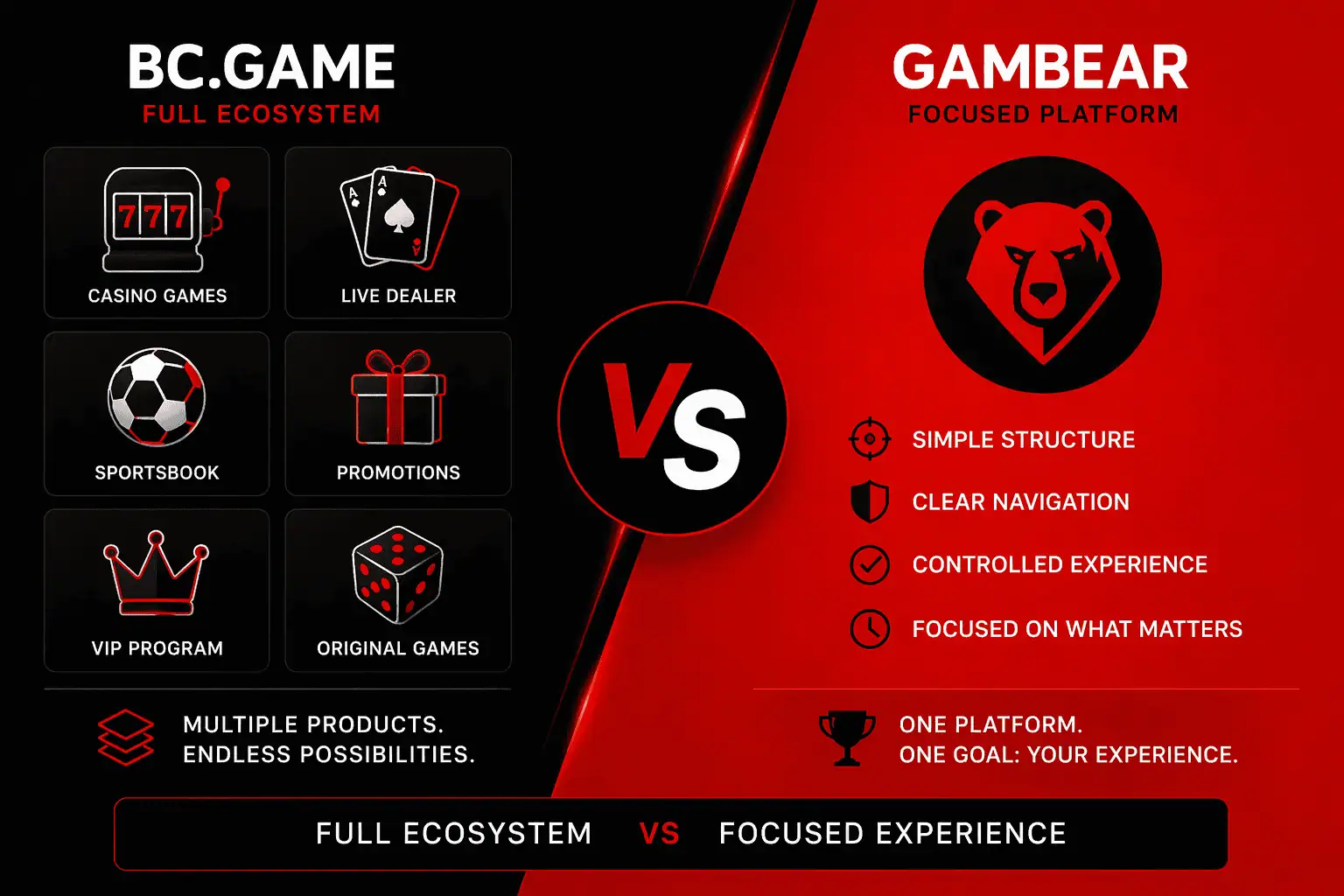
Illustration: A conceptual comparison of product breadth and interface structure, not a study of player behaviour or withdrawal performance.
What BC.Game’s Product Depth Actually Means
The main advantage is choice. Users can move between casino categories, sports betting, promotions and loyalty features without switching operators.
Nevertheless, product depth is only one part of a casino assessment. A large game library cannot compensate for unclear account restrictions, unresolved withdrawal disputes or weak regulatory transparency.
Therefore, CasinoIndex evaluates those factors separately instead of assigning a higher overall rating simply because a casino offers more features.
Gambear: A More Focused Casino Experience
Compared with BC.Game, Gambear presents a more focused casino environment. Its product experience places less emphasis on combining numerous gambling verticals and community features inside the same interface.
For some users, that organisation may make navigation easier to understand. In particular, players who prefer fewer menus or promotional categories may find the layout more approachable.
However, a simpler interface does not establish a safer casino or a more predictable withdrawal process.
Payment approvals, identity checks and account restrictions depend on the operator’s policies and the circumstances of individual transactions. CasinoIndex has not verified that Gambear applies fewer internal reviews than BC.Game.
Does a Simpler Platform Improve Player Control?
A focused interface may reduce visual complexity. Nevertheless, Gambear still offers rewards and progression mechanics that can encourage additional activity.
Therefore, neither casino should be described as automatically better for controlling gambling sessions.
Players who want to limit their exposure should use personal deposit and spending limits, avoid chasing promotional milestones and consider whether a reward changes their original budget.
Product and Usability: Which Approach Fits Better?
Both platforms have recognisable strengths, although they serve different preferences.
BC.Game offers a more extensive selection of connected features. Gambear, by contrast, may appeal to users who prefer a narrower interface and a more direct route through its casino sections.
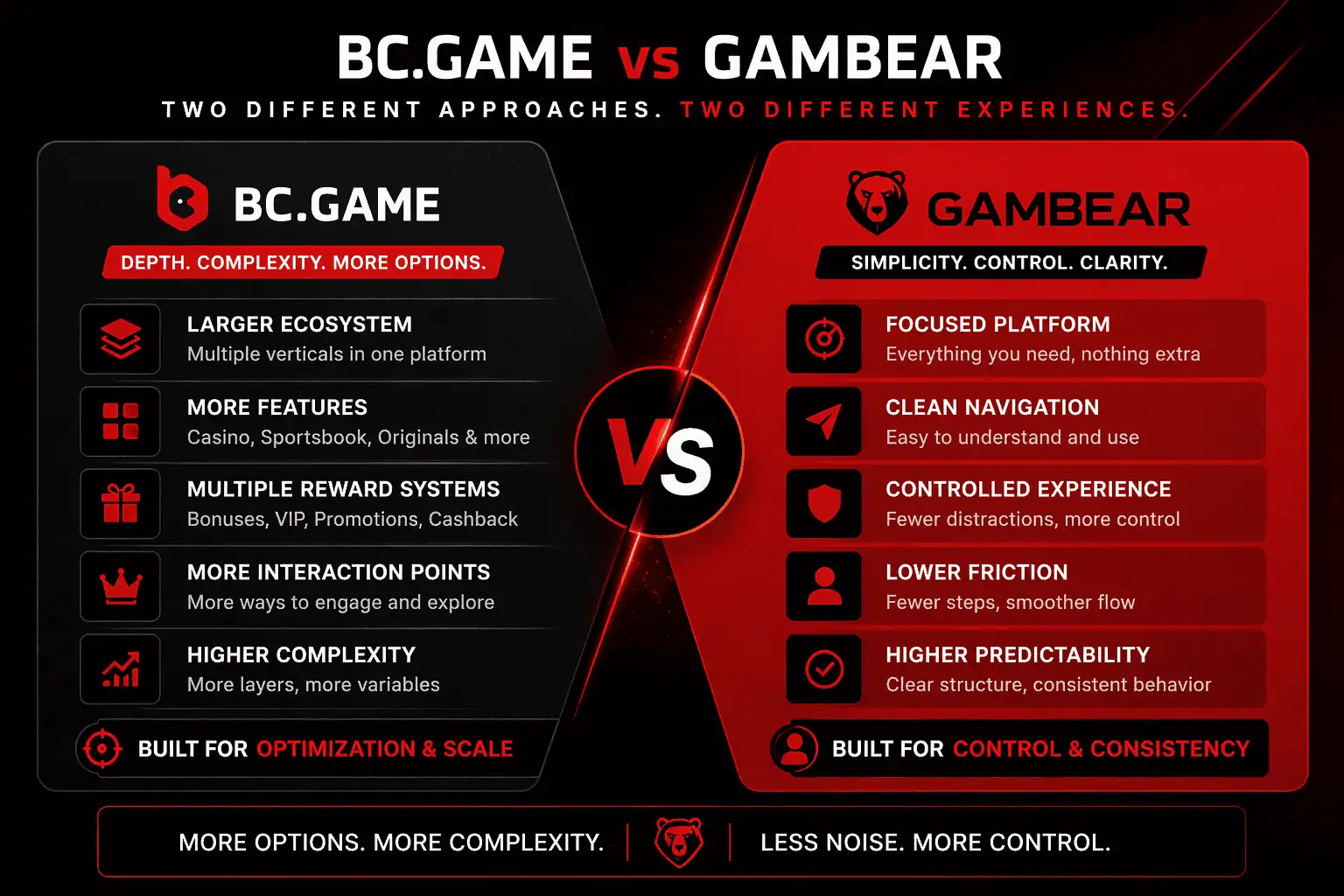
Illustration: Product and usability differences are editorial observations. They do not demonstrate better payment outcomes.
Importantly, usability should not be confused with the reliability of a casino’s financial operations. A player may prefer one interface while still finding stronger trust or payment evidence elsewhere.
Gambear vs BC.Game: Trust and Withdrawals
Neither Gambear nor BC.Game has a verified advantage in consistent withdrawals based on the comparative evidence available for this article.
That distinction is central to CasinoIndex’s trust-first methodology. While payout speed matters, approval consistency, account verification and dispute handling can be equally important.
What We Can Verify
The relevant evidence includes published withdrawal rules, account terms, transaction limits and sufficiently documented player complaints.
For example, an operator may publish a minimum withdrawal amount or explain when identity documents become necessary. Those details help players understand the process.
However, published rules do not reveal how frequently an operator delays payments or approves larger transactions. Such claims require additional transaction evidence.
What We Cannot Claim
The original comparison suggested that Gambear delivers a more consistent withdrawal experience because its platform contains fewer product layers.
That conclusion went beyond the supporting evidence. A simpler casino interface does not demonstrate a lower rate of payment interruptions.
Likewise, BC.Game’s broader promotional structure does not prove that its internal systems trigger more account reviews.
CasinoIndex has not conducted a controlled comparison using matched withdrawal amounts, cryptocurrencies, verification histories and approval times across both platforms.
Consequently, we cannot establish which operator has the higher payment-success rate.
Why Withdrawal Predictability Still Matters
Players need to distinguish the time required for an operator to approve a withdrawal from the time a blockchain transaction takes after approval.
Furthermore, an account review may require additional identification or payment information before the casino releases funds.
These risks deserve attention at either platform. Yet a responsible comparison should explain them without inventing platform-specific patterns or internal triggers.
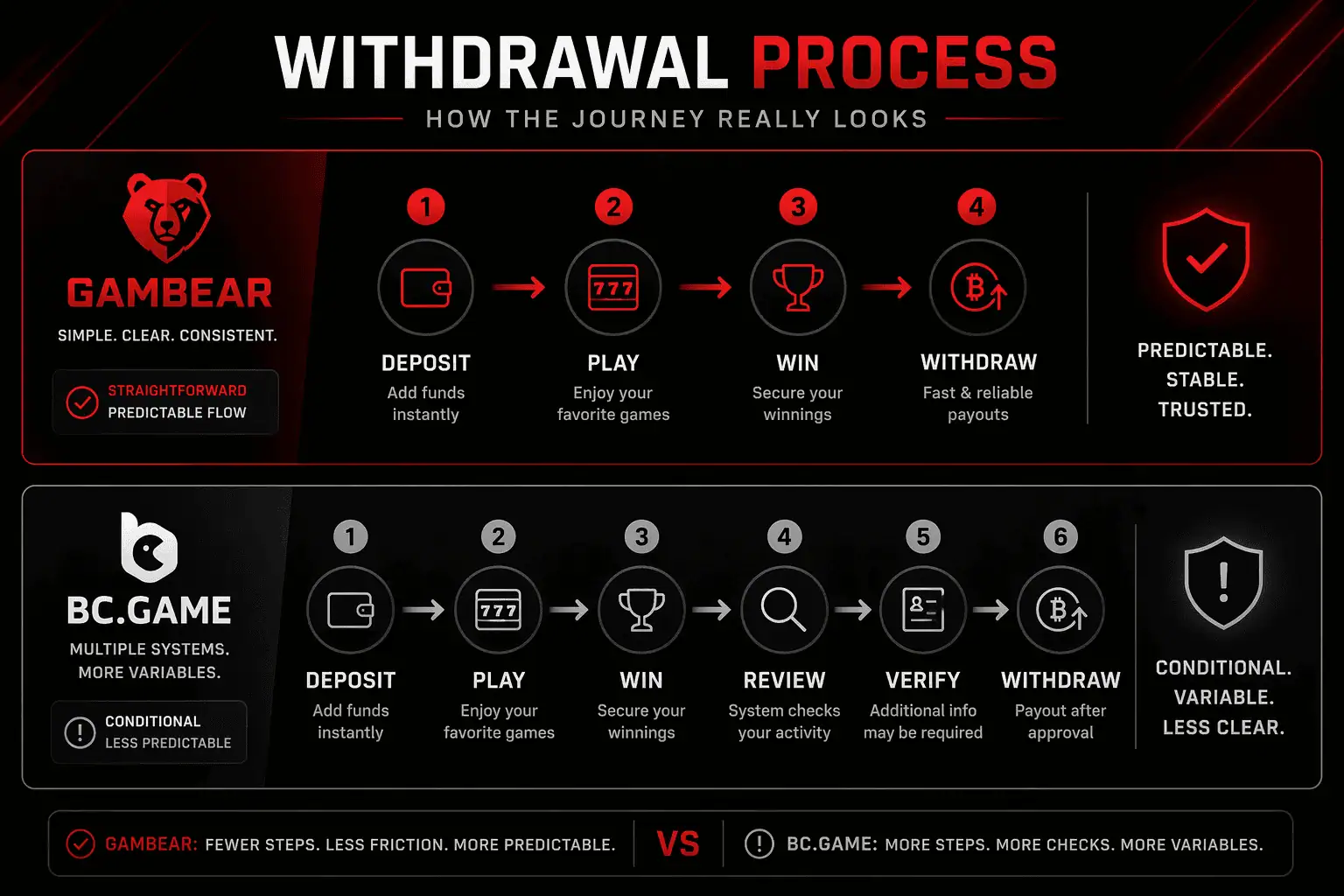
Illustration: The stages shown are explanatory. The graphic does not represent measured Gambear or BC.Game transaction data.
For a more detailed explanation, read why casino withdrawals get delayed.
KYC and Account Verification
Both Gambear and BC.Game may request identity information under their account and compliance policies. Therefore, easy registration should never be treated as proof of permanently document-free withdrawals.
Verification may involve identification, address information, payment ownership or other documentation relevant to an account review.
However, CasinoIndex cannot confirm the exact internal risk-scoring algorithms that either casino uses. Nor can we reliably compare how often they trigger additional checks.
Do the Casinos Use Different Risk Triggers?
They may apply different operational policies, but the available documents do not establish a specific trigger-by-trigger comparison.
For instance, it would be inappropriate to state that Gambear only reacts to standard verification thresholds while BC.Game automatically responds to changes in betting frequency.
Instead, players should focus on the rules each casino actually publishes and the documentation the operator may request.
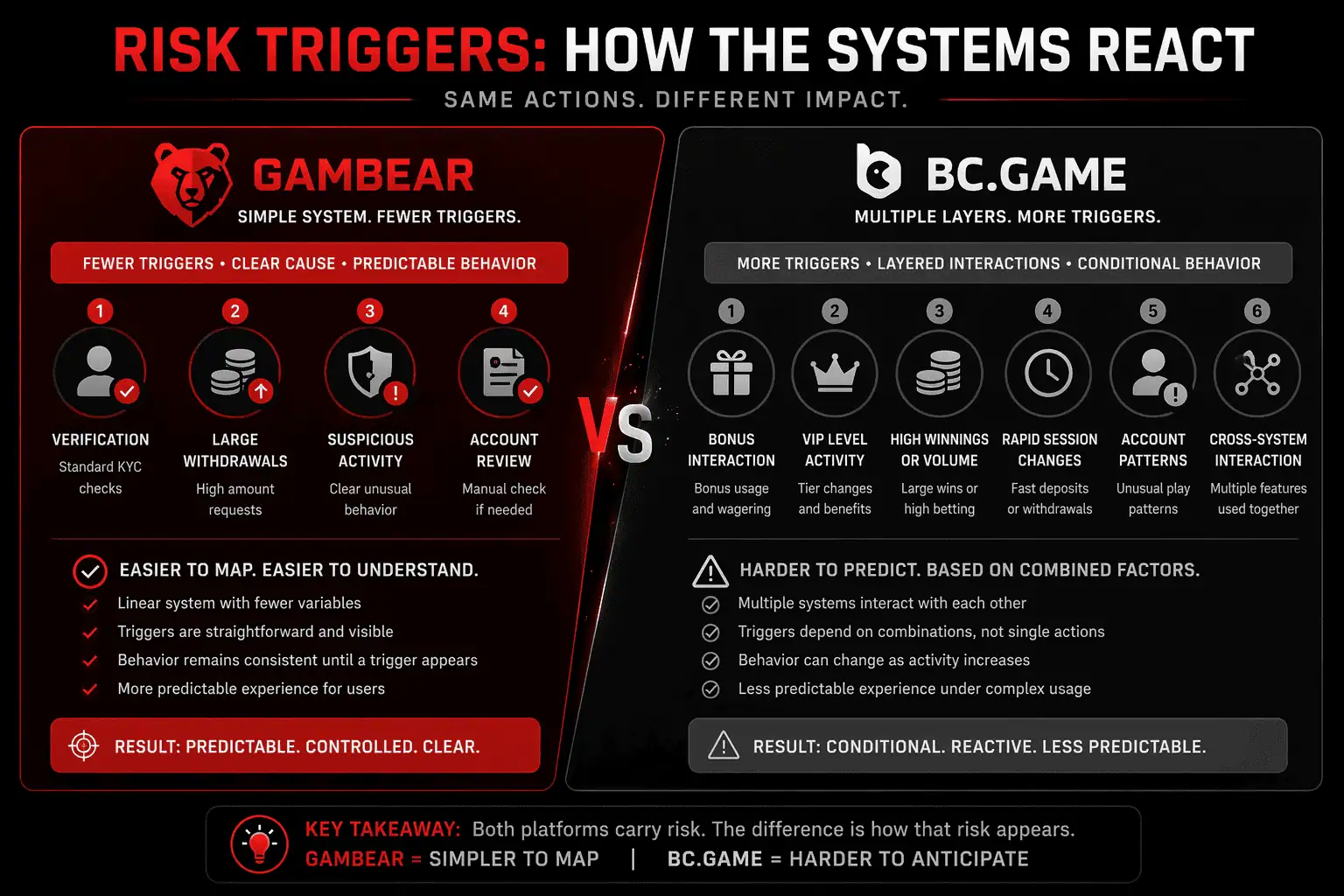
Illustration: This graphic explains possible account-review considerations. It does not document actual differences between the operators’ undisclosed internal systems.
Bonuses and Rewards: Gambear vs BC.Game
Both casinos use reward programmes, but they organise their promotional features differently.
Gambear Rewards
Gambear’s casino proposition includes progression-based incentives, rakeback and cashback-related features. Such programmes can provide benefits to eligible accounts, although their practical value depends on current terms.
Players should check when they earn rewards, whether they must claim them manually and whether wagering or withdrawal restrictions apply.
Importantly, account progression should not be described as guaranteed earnings. Loyalty rewards cannot eliminate the mathematical house edge of casino games.
BC.Game Rewards
BC.Game offers a wider range of promotional categories, including deposit-related campaigns, ongoing rewards and VIP progression.
Its reward documentation and programme structure have changed over time. As a result, older BCD unlocking descriptions should not automatically stand in for every current promotion.
For current programme details, consult the relevant promotion and the official BC.Game explanation of its bonus and leveling system.
Each promotion may have separate eligibility, unlocking and withdrawal conditions. Therefore, players should evaluate the actual terms rather than the headline reward amount.
Which Bonus System Is Easier to Understand?
Gambear’s progression-oriented presentation may feel more straightforward to some users. Meanwhile, BC.Game offers more promotional categories to explore.
However, this is a usability distinction, not evidence that all Gambear rewards have simpler wagering conditions or that BC.Game rewards always produce more value.
For a fair comparison, players should examine the claim requirements, withdrawal availability, expiration rules and whether bonuses affect access to deposited funds.
Key Risks Before Depositing
The following table summarises the most useful checks for either casino.
| Risk Area | What to Check | Why It Matters |
|---|---|---|
| Operator and licence | Current legal entity, licence details and applicable jurisdiction. | A casino’s size or interface does not establish regulatory protection. |
| Withdrawal rules | Payment minimums, maximums, approval terms and available methods. | Published limits can affect when and how funds leave an account. |
| KYC | Identity requirements and circumstances that permit further review. | Fast registration does not guarantee document-free cashouts. |
| Bonuses | Wagering conditions, maximum bets, expiry and reward unlocking. | Promotional funds may differ from withdrawable cash. |
| Complaints | Specific cases, dates, operator responses and final outcomes. | Isolated complaints are not statistical payout measurements. |
| Responsible gambling | Deposit limits, self-exclusion options and account restrictions. | Frequent rewards and progression may encourage additional wagering. |
Editorial note: This checklist identifies relevant evidence, not a finding that one casino has fewer internal compliance controls.
Which Casino Is Better for Different Players?
For Players Who Want More Product Variety
BC.Game may appeal to users who want casino games, sports betting, community features and multiple promotions in one account.
However, those additional features do not automatically make it the higher-rated or safer operator.
For Players Who Prefer Focused Navigation
Gambear may suit users who prefer its casino layout and progression-based rewards. Its relatively focused presentation can be easier to navigate for some players.
Nevertheless, simple navigation does not guarantee uncomplicated payments or fewer verification requests.
For Players Who Prioritise Withdrawals
Neither casino should receive an automatic recommendation based on unverified claims about payout consistency.
Instead, consider current withdrawal conditions, account verification rules, the operator’s complaint record and CasinoIndex’s broader trust assessment.
For Players Who Prefer Clear Bonus Terms
Review each promotion individually. In particular, look beyond bonus size to identify locked balances, wagering requirements, cashout restrictions and expiry dates.
A smaller reward with clear terms may be easier to evaluate than a larger promotion with complex restrictions. However, the specific offer determines that comparison.
Gambear vs BC.Game: Final Verdict
Gambear currently holds the higher CasinoIndex overall score: 7.7/10 compared with BC.Game’s 7.4/10.
However, BC.Game provides the broader product ecosystem. Its casino, sportsbook, community and reward features may appeal to players who value variety.
Gambear offers a comparatively focused platform experience with progression-based rewards. That difference may influence usability preferences, but it does not establish a superior payment process.
Most importantly, CasinoIndex has not identified sufficiently controlled comparative data to claim that Gambear delivers more consistent withdrawals or that BC.Game triggers more frequent internal account reviews.
The sensible choice depends on more than interface design. Players should consider operator transparency, withdrawal terms, KYC policies, bonus restrictions and documented complaint outcomes before depositing.
For our detailed findings, consult the Gambear review, the BC.Game review and CasinoIndex’s evaluation methodology.
FAQ: Gambear vs BC.Game
Is Gambear or BC.Game better overall?
CasinoIndex currently rates Gambear 7.7/10 and BC.Game 7.4/10. Gambear therefore holds the higher overall editorial score. Nevertheless, individual product preferences and account risks may lead players to different conclusions.
Why does BC.Game offer more features than Gambear?
BC.Game combines casino games, sports betting, Originals, community features and extensive promotions within a broader ecosystem. However, greater product variety does not give BC.Game the higher current CasinoIndex overall score.
Which casino is more reliable for withdrawals?
CasinoIndex cannot establish a reliable winner from the available evidence. We do not have a representative, controlled comparison of payout approvals and withdrawal times for Gambear and BC.Game.
Can players withdraw large winnings from Gambear or BC.Game?
Both casinos have withdrawal processes, but large transactions may involve operator limits, account verification or further checks. Players should consult the current payment rules and should not assume that either casino guarantees friction-free withdrawals.
Does Gambear require KYC?
Gambear can request identity verification under its account and compliance policies. Therefore, registration without immediate document upload does not guarantee withdrawals without verification.
Does BC.Game require KYC?
BC.Game can also require account verification. The specific circumstances depend on its published terms and the details of an individual account.
Does Gambear trigger fewer account reviews?
CasinoIndex has not verified that claim. Differences in interface complexity cannot establish how frequently a casino applies internal compliance checks.
Which casino has better bonuses?
BC.Game provides a wider range of promotional categories, while Gambear uses a progression-oriented reward structure. However, players need to compare the current terms of individual offers to determine their practical value.
Is Gambear safer than BC.Game?
Gambear has the higher current CasinoIndex overall score, but a single rating does not guarantee safety. Both casinos require examination of their operator disclosures, payment rules, KYC policies and complaint histories.
Is BC.Game better for experienced players?
BC.Game offers a broader selection of products and rewards that may interest users looking for specific features. However, experience does not eliminate gambling risks or guarantee better financial outcomes.
Does a simpler casino interface mean faster withdrawals?
No. Interface design and payment approval are separate matters. A focused layout does not demonstrate faster cashouts, fewer KYC requests or a higher payment-success rate.
Can bonuses affect withdrawals?
Yes. Depending on the promotion, wagering requirements, locked balances, maximum-bet rules and eligibility restrictions may affect when funds become available for withdrawal.
Sources and Editorial Method
CasinoIndex separates operator-published rules, documented public complaints and independent editorial assessment. We do not present website design observations as proof of payment behaviour.
Our primary comparison references are the current Gambear casino review, BC.Game casino review and the CasinoIndex ranking methodology.
For additional operator context, BC.Game publishes an explanation of its bonus and leveling system. Individual casino promotions and legal terms remain subject to change.
Editorial disclosure: Reviewed October 2026. CasinoIndex has not completed a representative controlled comparison of payout approval times, withdrawal-success rates or undisclosed KYC triggers for Gambear and BC.Game. Scores reflect our broader editorial assessments rather than guaranteed outcomes. Casino terms, promotions, legal eligibility and payment rules can change. Gambling carries financial risk and is restricted to eligible adults.

Nina Kanu has worked in cryptocurrency content and blockchain research since 2016. She is also known within parts of the crypto community through CryptoMutant, where her work has covered emerging projects, market trends and developments across the blockchain ecosystem. At CasinoIndex, Nina focuses on crypto casino reviews, platform comparisons, player experience, game ecosystems and bonus fairness. Her research examines how casino products perform beyond their marketing, including usability, payment options, promotional terms and the overall experience players receive after signing up.