Self-Exclusion at Crypto Casinos and Why It Often Fails
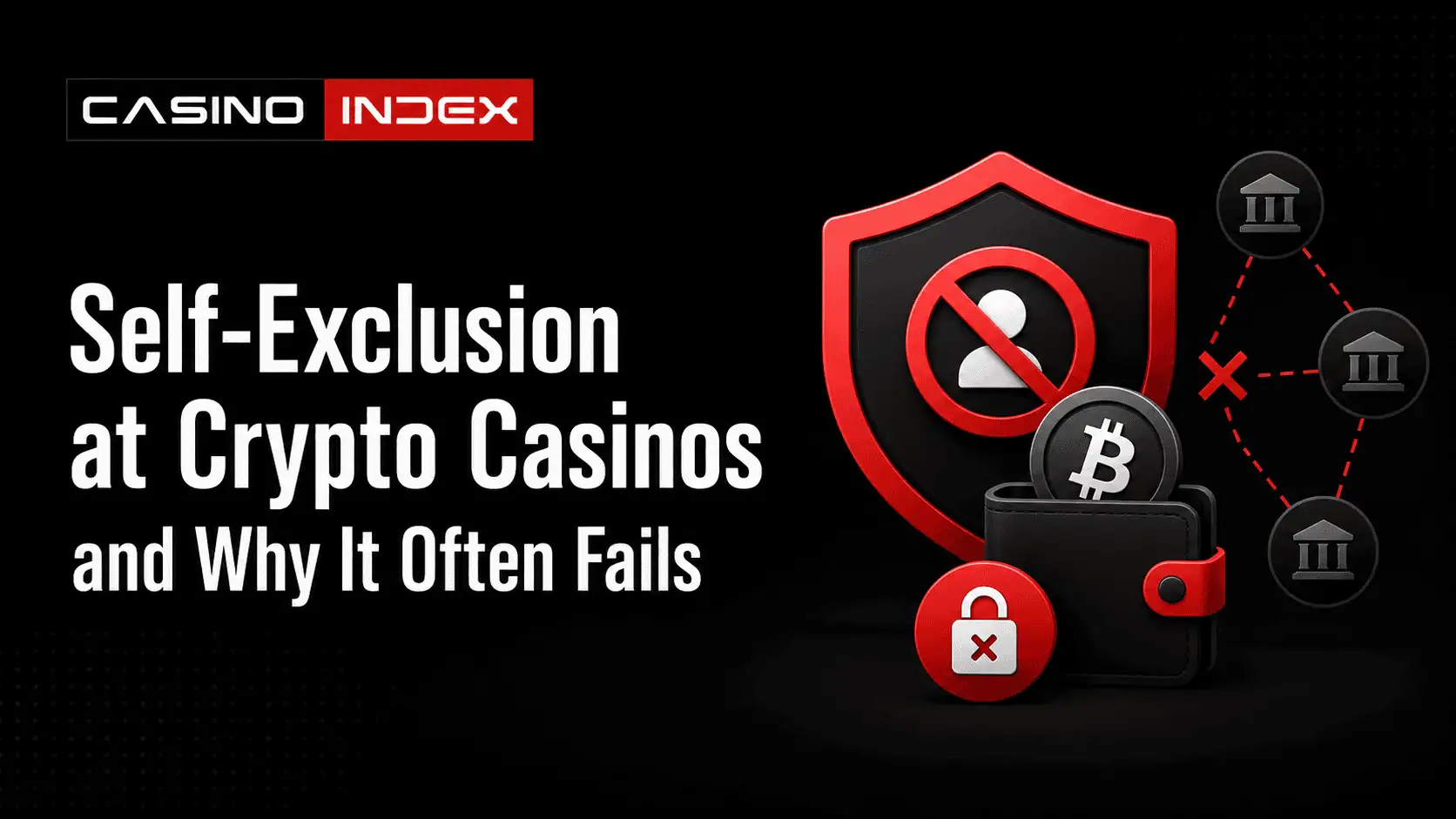
Self-exclusion should protect a player when willpower is not enough.
That is the point.
A player decides they need to stop gambling. The account should be blocked. Deposits should stop. Marketing should stop. Reopening should not be easy. A related casino brand should not quietly become the next way back in.
At many crypto casinos, especially offshore or low-KYC platforms, that protection can be weaker than players expect.
Some sites offer only basic account closure. Others block one account but allow a new account with another email, wallet, device, or sister brand. In many cases, responsible gambling tools exist on paper, but enforcement depends on weak identity checks, manual support, unclear operator rules, or brand-level systems that do not carry across the wider network.
This matters because self-exclusion is not a normal account setting.
It is a player-protection tool.
When it fails, the risk is serious. A player may return during a vulnerable moment, deposit again, reopen access, bypass limits, or move to a related offshore brand that does not recognise the earlier exclusion.
This guide explains how self-exclusion works at crypto casinos, why it often fails, where offshore and no-KYC models create gaps, how sister brands can weaken protection, and what safer operators should do differently.
Quick answer: why does self-exclusion often fail at crypto casinos?
Self-exclusion often fails at crypto casinos because many offshore platforms do not use strong identity checks, centralised exclusion systems, connected sister-brand controls, or strict reopening rules.
A casino may block one account, while the same player can still return through a new email, wallet, device, account name, or related brand.
| Failure point | Risk level | Why it happens | Player risk | Safer standard |
|---|---|---|---|---|
| Basic account closure only | High | Closure may be treated as a normal support request | Account can be reopened too easily | Clear self-exclusion separate from closure |
| No central exclusion system | High | Offshore brands may rely only on internal tools | Exclusion may work on one site only | Recognised blocking tools and clear external support |
| Weak KYC at signup | High | Player identity is not strongly matched early | New accounts can bypass the block | Stronger matching before deposits or risky play |
| Crypto wallet flexibility | Medium to high | New wallets are easy to create | Player can return quickly with another wallet | Wallet checks plus account-linking controls |
| Sister-brand gaps | High | Related brands may not share exclusion data | Protection stops at brand level | Group-wide exclusion across related sites |
| Easy support reopening | Very high | Manual support may reverse access too quickly | Player returns during a risky moment | Fixed periods and cooling-off rules |
| Marketing continues | Medium to high | Promotional systems may not sync with exclusion | Offers can pull the player back | Immediate removal from marketing lists |
| No balance policy | Medium | Funds and withdrawals are not explained clearly | Confusion during closure or dispute | Written balance and withdrawal rules |
The core problem is simple: self-exclusion only works when the operator can recognise the player and enforce the block consistently.
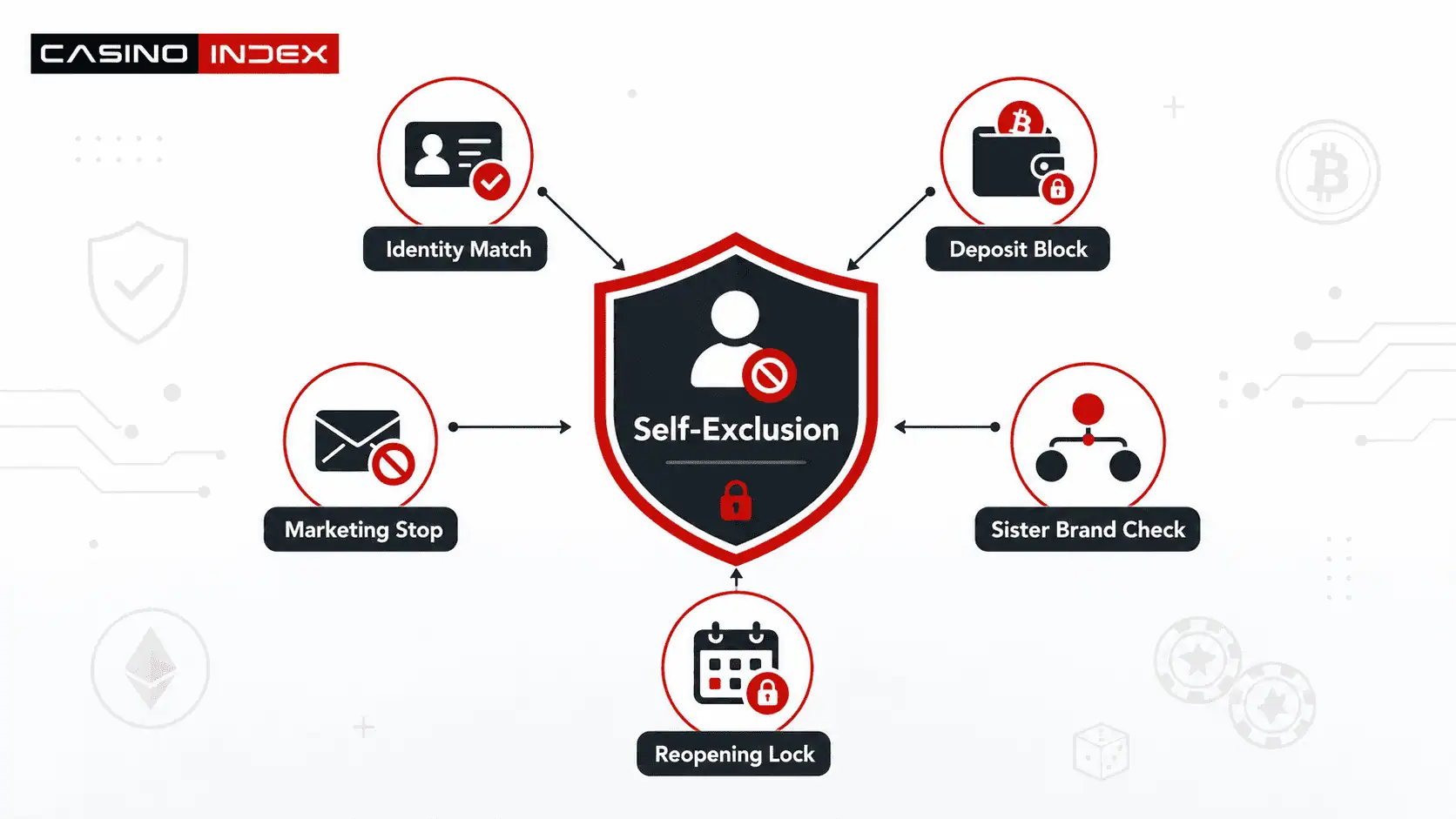
How CasinoIndex evaluates self-exclusion quality
CasinoIndex does not judge self-exclusion by the existence of a responsible gambling page.
Almost every casino can publish one.
The real question is whether the system works when a player is trying not to gamble.
CasinoIndex evaluates crypto casino self-exclusion through six layers.
| Layer | What CasinoIndex checks | Stronger sign | Weaker sign |
|---|---|---|---|
| Access layer | Login, deposits, gameplay, bonuses, sportsbook, chat access | Exclusion blocks all gambling access | Only the visible account page is closed |
| Identity layer | Name, email, phone, device, wallet, documents, KYC records | Casino can recognise the same player again | New email or wallet bypasses the block |
| Operator layer | Sister brands, white-label network, license group, shared backend | Exclusion applies across related brands | One brand blocks access, others remain open |
| Communication layer | Confirmation emails, marketing lists, promotional offers | Marketing stops immediately | Bonus emails continue after exclusion |
| Reopening layer | Cooling-off rules, fixed periods, support override | Reopening is blocked during the exclusion period | Support can reopen access casually |
| Balance layer | Pending withdrawals, remaining funds, bonus balances | Balance treatment is explained clearly | Player receives vague or inconsistent answers |
This framework matters because self-exclusion is only as strong as its weakest layer.
In weaker systems, the protection often breaks in small but important ways. Deposits may be blocked while promotional emails continue. One account may close, yet sister brands remain open. A timeout may exist on paper, but instant reopening can still be possible. Sometimes identity checks only happen after the player has already returned and deposited again.
That is not strong protection.
A safer crypto casino makes exclusion visible, firm, hard to reverse, and harder to bypass across linked accounts or related brands.
CasinoIndex explains the wider player-protection standard in its Responsible Gambling Guide.
Self-exclusion is not the same as account closure
This distinction should appear early because it is where many disputes start.
Account closure usually means the player asks to shut the account. Depending on the casino, support may reopen it later. The player may still receive marketing. Another account may be possible. Sister brands may remain available.
Self-exclusion should be stronger.
A proper self-exclusion should:
- block gambling access for a defined period
- stop deposits
- stop promotional messages
- prevent easy reopening
- restrict account reactivation
- make new account creation harder
- clarify what happens to pending withdrawals
- explain whether related brands are included
Crypto casinos often blur this difference.
They may use several tools with similar names:
- account closure
- deactivation
- timeout
- cooling-off period
- deposit limit
- responsible gambling limit
- self-exclusion
These tools are not equal.
A 24-hour timeout is not the same as a six-month exclusion. A deposit limit is not the same as a gambling block. A closed account is not the same as a protected exclusion record.
Players should not rely on labels alone.
They should check what the tool actually blocks.
Why offshore self-exclusion can be weak
Offshore casinos often operate outside stricter national self-exclusion systems.
That does not make every offshore casino unsafe. However, it can weaken player protection because enforcement depends more heavily on the operator’s own standards.
The weakness usually appears in four areas.
First, the casino may not connect to a central exclusion database. That means one exclusion may not carry across the wider market.
Second, the casino may not verify identity early. A player can sometimes deposit and play before the platform has enough information to recognise a previous exclusion.
Third, related brands may not share responsible gambling data. A player can be blocked on one site but still access another brand under the same operator or white-label network.
Finally, support may treat reopening as a normal account request instead of a high-risk responsible gambling issue.
This is why “self-exclusion available” is not enough.
The stronger question is:
Will the casino still protect the player when the player tries to return?
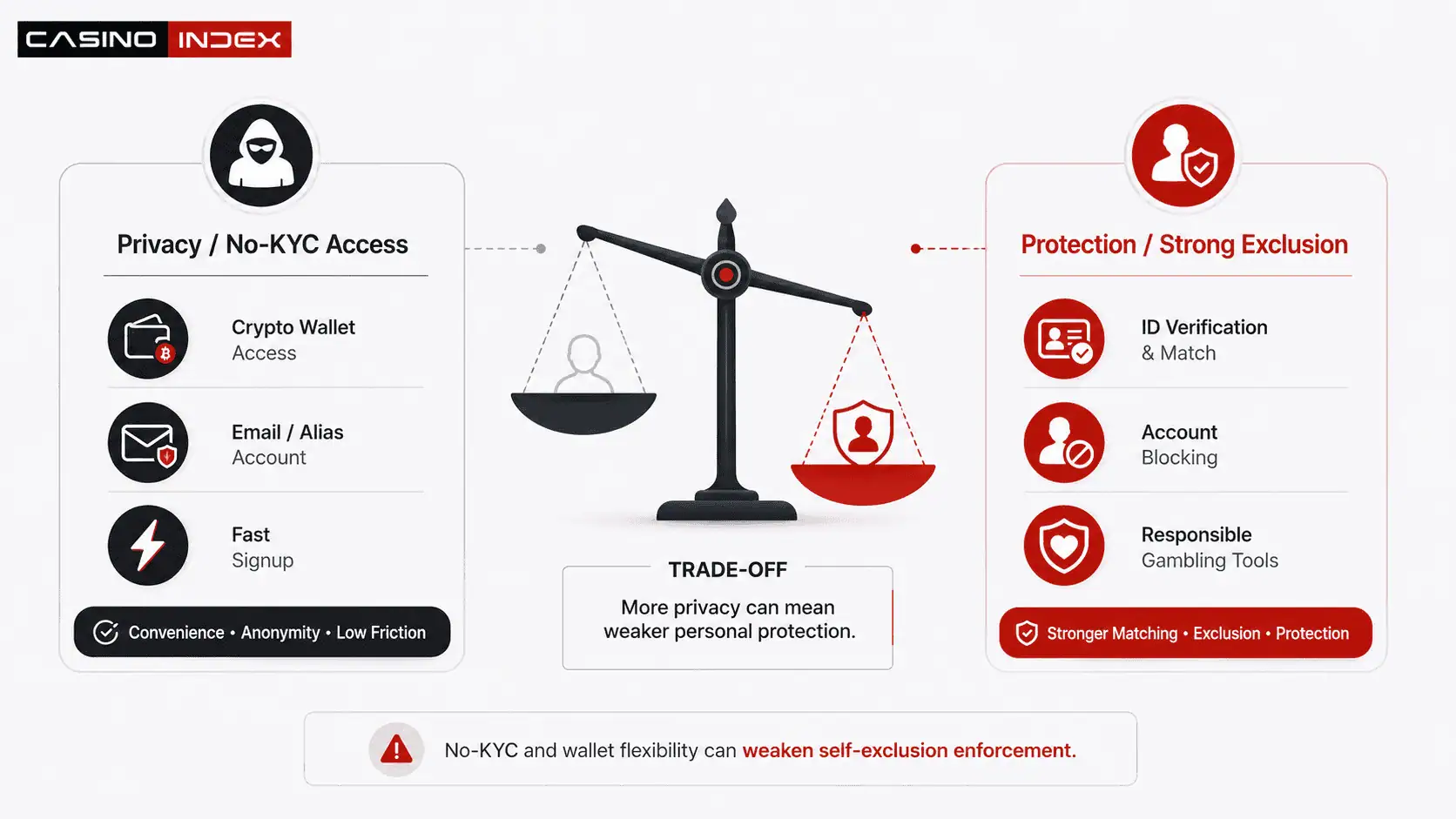
No-KYC and low-KYC models create extra risk
No-KYC casinos are popular because they reduce friction.
For privacy-focused players, that can feel attractive.
However, self-exclusion becomes harder when the casino does not reliably know who the player is.
A blocked player may return with:
- a new email
- a new username
- a new crypto wallet
- a different device
- a changed IP address
- slightly different account details
Low-KYC casinos can face a similar problem. They may collect some details, but not enough to reliably stop re-registration across accounts, wallets, or sister brands.
This does not mean every no-KYC casino ignores responsible gambling.
Some still offer timeouts, deposit limits, wallet checks, account restrictions, and support-based exclusions.
Still, the structure is weaker when the casino cannot confidently match the person behind the account.
CasinoIndex explains the difference between these models in its guide to No KYC Casinos vs Low KYC Casinos.
Crypto wallets make account reopening easier
Crypto adds another weak point.
A player can create a new wallet quickly. They may use another chain, another exchange, or another wallet address. If the casino relies heavily on wallet-based access, exclusion becomes easier to bypass.
The casino may not know that a new wallet belongs to an excluded player unless other signals match.
Those signals may include:
- email patterns
- username patterns
- device data
- IP history
- KYC documents
- wallet history
- support conversations
- responsible gambling notes
None of these signals is perfect.
Wallet changes alone do not prove a new person. At the same time, they can make responsible gambling enforcement harder when identity checks are weak.
This is one of the trade-offs in crypto gambling.
More privacy can mean weaker personal protection.
Sister brands can break protection
Self-exclusion can fail when related brands do not share exclusion data.
A player may exclude from one casino, then open an account at another brand that looks different but belongs to the same operator, license holder, white-label provider, or platform network.
If the group does not apply exclusion across related brands, the player can keep gambling.
That is a serious protection gap.
Players should check responsible gambling terms for wording such as:
- all brands under this license
- across our group
- associated brands
- sister sites
- operator network
- white-label platform
- related websites
A safer operator explains this clearly.
If a casino blocks a player for gambling-control reasons, the protection should not disappear because the player clicks a different logo from the same group.
CasinoIndex explains how to detect those connections in its guide to telling whether two casino brands share the same operator.
Account reopening is a major weak point
Self-exclusion fails when reopening is too easy.
A player may request exclusion during a calm moment. Later, during a risky moment, the same player may contact support and ask to reopen access.
A strong system should not treat that like a normal support request.
There should be fixed exclusion periods, cooling-off rules, and clear refusal policies. Support should not reopen access simply because the player insists.
Weak reopening systems often include:
- vague exclusion periods
- manual support overrides
- no cooling-off requirement
- no record of the original reason
- new accounts allowed too easily
- marketing still active after exclusion
- no sister-brand block
- deposits allowed before review
Account reopening should be difficult by design.
If reopening is easy, the exclusion is not doing its job.
Self-exclusion and KYC checks
KYC can make self-exclusion stronger.
A casino that verifies identity can better match excluded players across account attempts. It can compare names, dates of birth, addresses, documents, phone numbers, payment details, and sometimes device or wallet records.
However, timing matters.
If verification happens only at withdrawal, the player may already have deposited and played before the casino identifies the exclusion issue.
That is weak prevention.
Self-exclusion should not depend only on payout-stage checks.
The strongest systems detect risk earlier: at registration, login, deposit, limit changes, and reopening attempts.
KYC can help, but only when it supports prevention.
CasinoIndex explains how verification affects casino account reviews in its Casino Verification Guide.
Responsible gambling limits are not enough
Limits can help, but they are not a substitute for exclusion.
Deposit limits, loss limits, wagering limits, session reminders, timeouts, and cooling-off tools can reduce harm when a player still has control.
Self-exclusion is different.
It is for a player who needs a stronger barrier.
A deposit limit may still allow gambling. A timeout may end quickly. A session reminder may be ignored. A limit increase may become possible after a waiting period.
For some players, that is not enough.
A casino should not treat every responsible gambling tool as equal. Someone requesting self-exclusion needs a harder block than someone setting a casual weekly deposit limit.
The problem at weaker crypto casinos is that all tools may sit in the same loose menu, without meaningful escalation.
That weakens protection.
Why “not on GamStop” marketing is a warning sign
Some offshore casinos promote themselves as “not on GamStop” or use similar wording.
For players who self-excluded because gambling was becoming harmful, that message should not feel like an advantage. It should raise concern.
The phrase often signals that the casino sits outside the national exclusion system the player deliberately chose. In some cases, this type of marketing also appeals to people who are trying to bypass regulated protection.
The risk becomes higher when “not on GamStop” messaging appears together with:
- instant crypto deposits
- no-KYC signup
- aggressive bonuses
- weak responsible gambling pages
- easy account reopening
- unclear operator details
- poor complaint handling
A trust-first casino should not present weaker protection as freedom.
When someone is looking for a way around an exclusion, the safer answer is not another casino. The safer answer is to keep the block active, remove access routes, and use support tools.
What safer crypto casinos do differently
Safer crypto casinos treat self-exclusion as a serious protection system, not as a support formality.
The strongest operators make exclusion visible, clear, and difficult to reverse. They also stop promotional contact after a player asks to step away.
A safer operator is more likely to:
- separate account closure from self-exclusion
- explain exclusion periods clearly
- block deposits after exclusion
- stop promotional emails
- prevent early reopening
- apply restrictions across related brands
- use KYC or account matching where needed
- keep responsible gambling tools easy to find
- explain what happens to balances and withdrawals
- train support to treat gambling-control requests seriously
No system is perfect.
However, stronger operators add friction on purpose. They make it harder for a vulnerable player to reverse the decision too quickly.
That is a sign of real protection.
CasinoIndex explains the broader trust standard in its Safe Online Casino Guide.
Red flags in crypto casino self-exclusion
Be careful when several warning signs appear together.
| Red flag | Risk level | Why it matters | What players should do |
|---|---|---|---|
| Self-exclusion only through support chat | Medium | The process may be slow or inconsistent | Ask for written confirmation |
| No fixed exclusion period | High | The block may be too easy to reverse | Avoid relying on it alone |
| Support can reopen access quickly | Very high | Protection depends on mood and timing | Treat as weak protection |
| Sister brands are not mentioned | High | Exclusion may apply to one site only | Ask about related brands |
| No-KYC signup with weak matching | High | Re-registration may be easy | Use external blockers too |
| Marketing continues after exclusion | High | Offers can pull the player back | Request removal and save emails |
| “Not on GamStop” used as a selling point | Very high | Weak protection is being promoted | Avoid if already self-excluded |
| No balance policy after exclusion | Medium | Funds and withdrawals may become unclear | Ask before confirming closure |
One red flag does not prove the casino is unsafe.
Several together should make players cautious.
What players should do before self-excluding
A player who wants to self-exclude should make the request direct and save records.
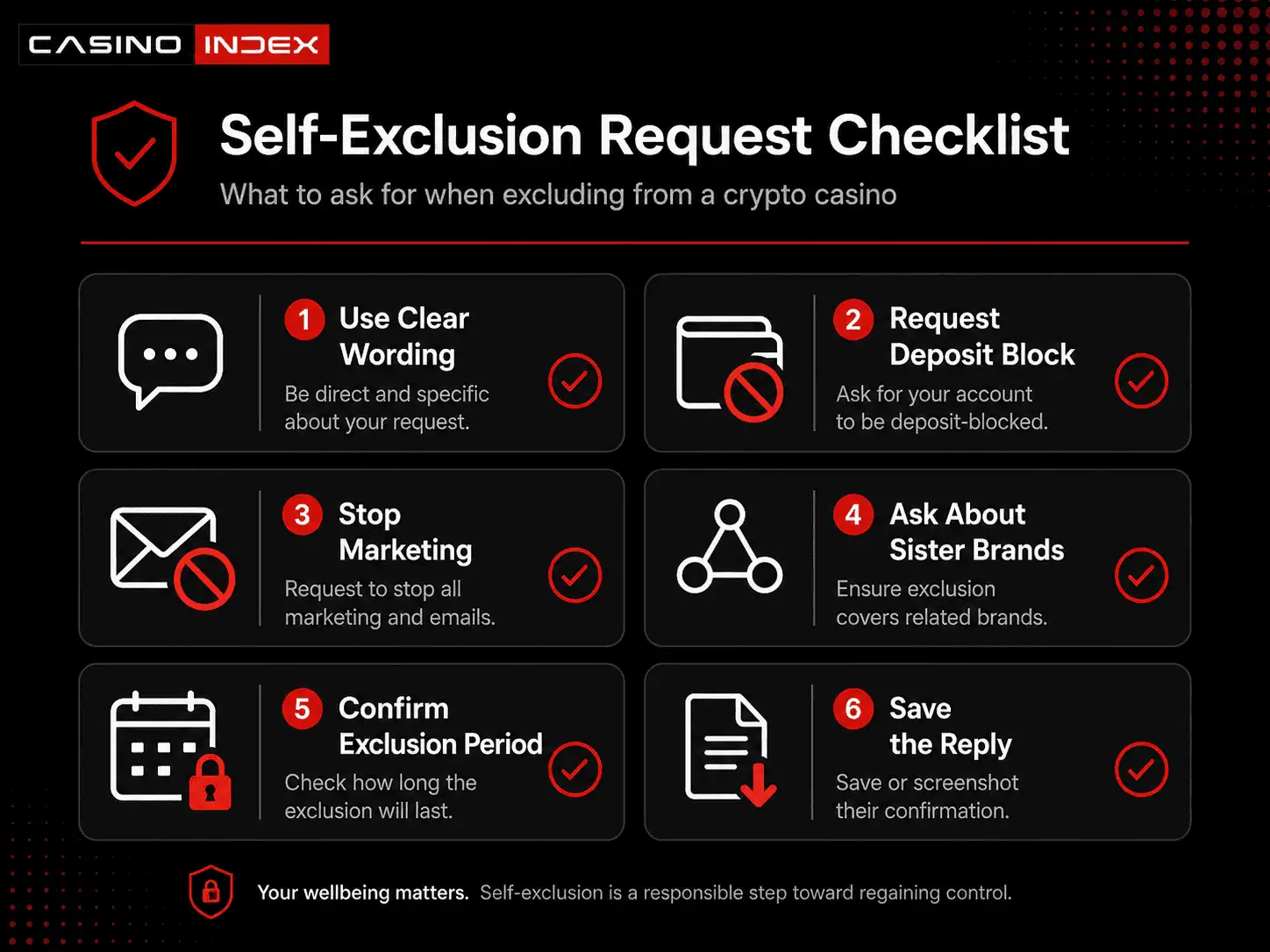
Do not only write:
“Please close my account.”
Use clearer wording:
“I want to self-exclude for gambling control reasons. Please block my account, stop deposits, stop marketing, and confirm whether this exclusion applies across related brands or only this website.”
Then ask:
- How long does the exclusion last?
- Can it be reversed early?
- Will marketing stop?
- Are sister brands included?
- What happens to pending withdrawals?
- Can a new account be created?
- What data will be used to prevent re-registration?
Save the casino’s answer.
If the response is vague, treat that as a warning sign.
A serious operator should be able to explain the process clearly.
What to do if self-exclusion fails
If self-exclusion fails, stop using the account and document what happened.
Save:
- the original self-exclusion request
- casino confirmation
- emails received after exclusion
- deposit records after exclusion
- new account records, if any
- support replies
- account reopening messages
- sister-brand evidence
- withdrawal or balance records
Then contact support with a factual complaint.
Ask why the block failed, which account data was used, whether related brands are included, and what happens to any balance.
If gambling feels hard to control, safety comes first.
Block access. Remove payment routes. Use device blockers. Contact support organisations. Tell someone trusted. The casino dispute can come after the immediate risk is under control.
Bottom line: weak self-exclusion is not real protection
Self-exclusion at crypto casinos often fails because the system behind it is too easy to bypass.
A button is not enough. A support promise is not enough. A closed account is not enough if the player can reopen access, create another account, use a new wallet, or move to a sister brand.
Real self-exclusion needs enforcement.
It should block deposits, stop marketing, prevent early reopening, recognise linked accounts, apply across related brands where appropriate, and make the decision hard to reverse during a vulnerable moment.
Crypto casinos can offer real protection.
But players should not assume all operators treat self-exclusion equally.
The standard is clear.
If a casino makes it easy to bypass your own exclusion, it is not protecting you well enough.
FAQ
What is self-exclusion at a crypto casino?
Self-exclusion is a responsible gambling tool that blocks a player from gambling for a set period. At crypto casinos, its strength depends on identity checks, account controls, sister-brand rules, and reopening policy.
Why does self-exclusion fail at some crypto casinos?
It often fails because of weak KYC, no central exclusion system, easy reopening, poor sister-brand controls, or limited account matching across emails, wallets, devices, and documents.
Is account closure the same as self-exclusion?
No. Account closure may simply deactivate the account. Self-exclusion should be stronger, time-based, harder to reverse, and designed for gambling-control reasons.
Can I self-exclude from all crypto casinos at once?
Usually not across the entire offshore crypto casino market. Some regulated markets have central schemes, but many offshore crypto casinos rely on internal tools.
Can a no-KYC casino enforce self-exclusion properly?
It can offer some controls, but no-KYC structures make enforcement harder because the casino may not reliably identify the same person across new accounts, wallets, emails, or devices.
Does self-exclusion apply to sister casinos?
It depends on the operator’s policy. Safer operators explain whether exclusion applies across related brands, license groups, or white-label networks.
Can a casino reopen my account after self-exclusion?
A safer casino should not reopen a self-excluded account before the exclusion period ends. Easy reopening is a major warning sign.
What should I write when requesting self-exclusion?
Use clear wording: “I want to self-exclude for gambling control reasons.” Ask the casino to block deposits, stop marketing, confirm the exclusion period, and explain whether sister brands are included.

Maria Hoffmann has worked in cryptocurrency content and digital publishing since 2017. She is a co-founder of Freecoins24 and CryptoMutant and has covered blockchain projects, crypto platforms and emerging industry trends for several years. She has also been active as a cryptocurrency investor since 2019. At CasinoIndex, Maria combines content research and SEO experience with a focus on casino trust, platform security, withdrawal processes, payment risks and user protection. Her work looks beyond bonuses and product features to examine how gambling platforms handle player funds, verification and account-related risks.