How to Tell if Two Casino Brands Share the Same Operator
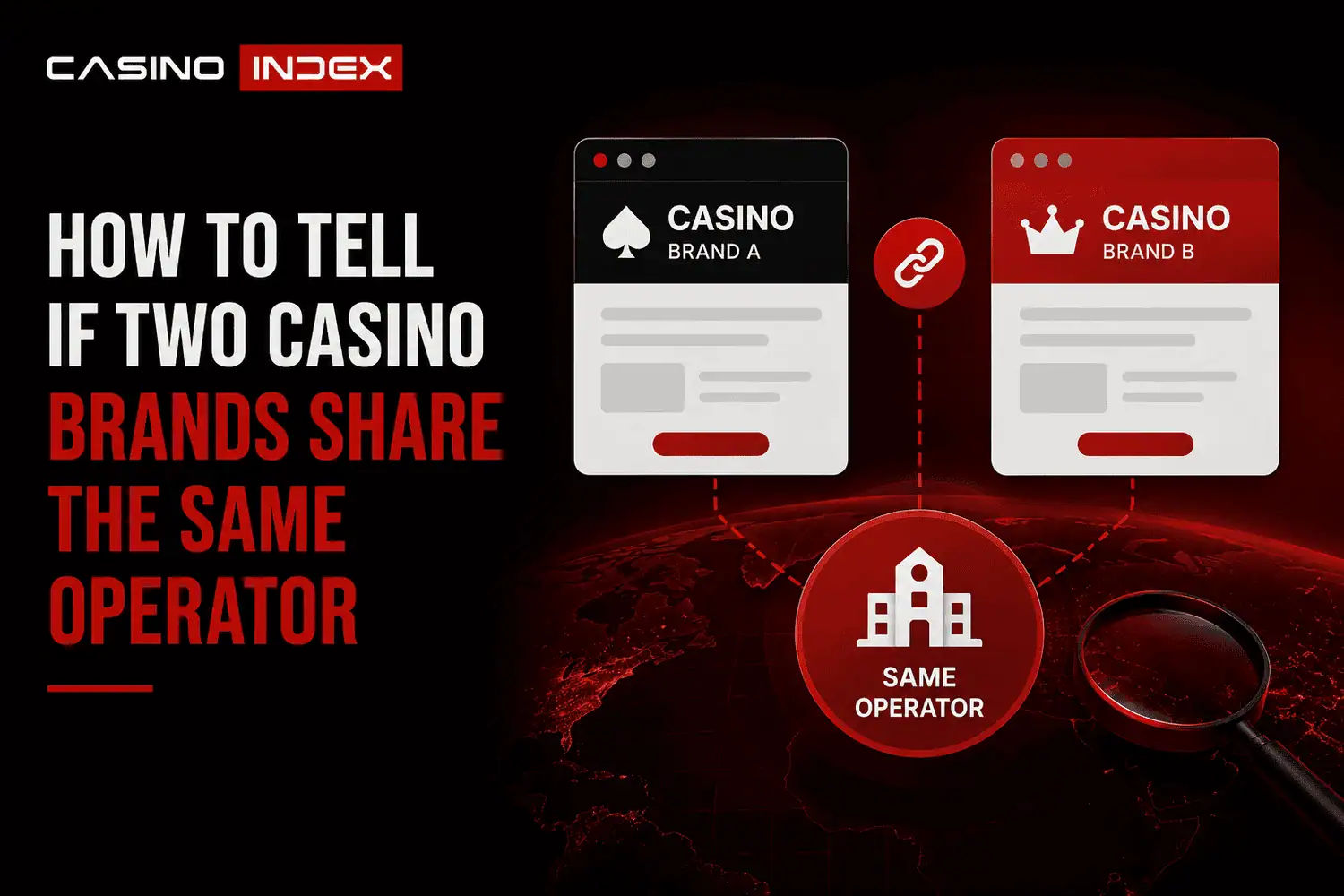
Two casino brands can look unrelated and still be connected where it matters most.
A different logo does not prove independence. A different bonus page does not prove a separate operator. Even a completely different website design can hide the same legal company, license holder, white-label provider, cashier system, support structure, or compliance team behind the scenes.
For players, this is not just a technical detail.
Shared operators can affect withdrawals, KYC checks, account linking, self-exclusion, bonus eligibility, account blocks, and complaint handling. As a result, a second casino may not be a fresh start if the same company, license, or platform sits behind both brands.
This guide explains how to tell if two casino brands share the same operator, which signals matter, which clues are weak, and why sister-brand checks can protect players before real money is at risk.
Quick answer: how do you know if two casino brands share the same operator?
Two casino brands may share the same operator when they list the same legal entity, license holder, registered address, authorised domains, platform provider, complaint route, responsible gambling policy, or payment structure.
The strongest proof usually comes from legal pages and license records.
By contrast, the weakest clues are similar design, game providers, payment methods, or bonus styles. Many unrelated casinos use the same software, slots, affiliate wording, and cashier tools.
| Signal | Where to check | Strength | What it can show | Player risk if ignored |
|---|---|---|---|---|
| Same legal company | Footer, Terms, Privacy Policy | Strong | Same operator or group entity | Linked account history may matter |
| Same license holder | License seal and regulator record | Strong | Brands may operate under one license | Shared rules or complaint route |
| Same authorised domains | Official license record | Strong | Domains are connected under one license | Self-exclusion or restrictions may carry across |
| Same registered address | Terms, company details, privacy policy | Medium to strong | Shared company or group structure | Harder to treat brands as fully separate |
| Same white-label provider | Footer, terms, platform wording | Medium to strong | Shared backend or compliance layer | Similar KYC, cashier, and account checks |
| Same complaint route | Complaints page, terms, support policy | Medium | Shared support or dispute process | Same escalation limits may apply |
| Same bonus or KYC wording | Bonus terms, AML/KYC page | Medium | Shared template, group rules, or platform | Bonus-abuse flags may overlap |
| Same design or games | Website layout, providers, lobby | Weak | Common software or supplier | Not proof without stronger signals |
The safest approach is simple: never rely on one clue. Instead, look for a chain of evidence.
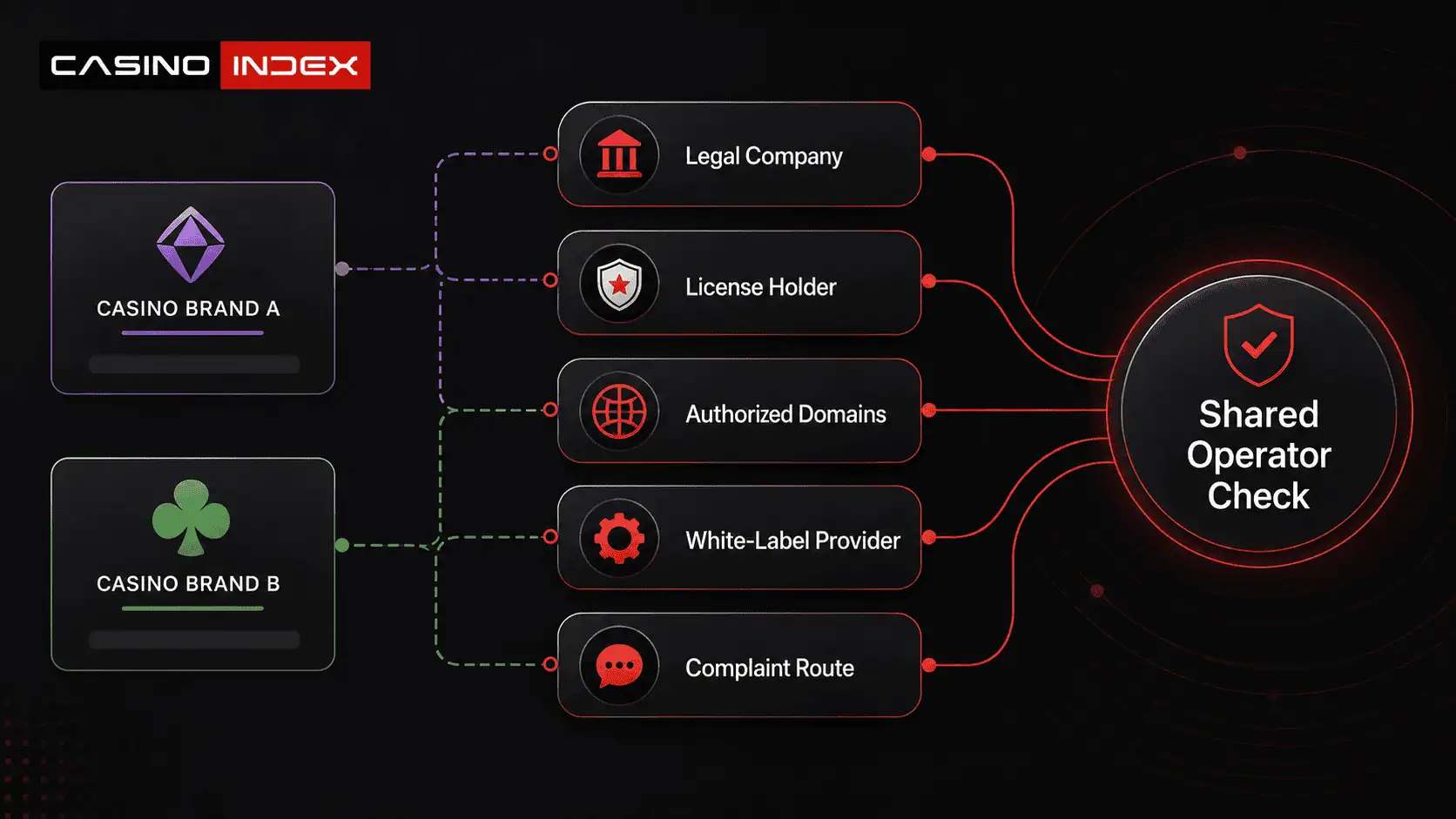
How CasinoIndex checks shared-operator signals
CasinoIndex does not treat one matching detail as proof.
Two casinos can use the same game providers and still be unrelated. Similar bonuses can also appear because casino promotions often follow the same structure. In addition, many gambling sites use the same payment processors, cashier tools, and front-end templates.
The stronger question is not whether two brands look similar.
A better question is whether the same company, license holder, or platform could control the player account when something important happens.
CasinoIndex checks shared-operator risk through five layers.
First, the legal layer includes the company name, registered address, license holder, and authorised domain record.
Next, the operational layer covers the white-label provider, platform provider, cashier, support process, and complaints route.
The compliance layer then looks at KYC wording, AML policies, responsible gambling tools, self-exclusion wording, and account-review rules.
After that, the commercial layer checks bonus restrictions, welcome-offer rules, linked-account wording, and bonus-abuse clauses.
Finally, the complaint layer reviews public complaints, withdrawal disputes, account blocks, support behaviour, and repeated patterns across brands.
A shared operator is not automatically a problem. However, the risk rises when the connection is hidden, the rules are broad, and the same complaints appear across several brands.
CasinoIndex explains the first part of this check in its guide to finding the real company behind an online casino before depositing.
Why shared operators matter for players
Shared operators matter because casino accounts are not always treated as isolated.
A player may register at a second brand after having an issue at the first one. For example, the first casino may have delayed a withdrawal, blocked an account, rejected documents, limited bonuses, or closed access after a dispute.
If the second brand sits under the same operator, that history may not disappear.
The operator may connect accounts through identity details, payment methods, devices, IP history, wallet addresses, documents, self-exclusion records, or bonus-use patterns.
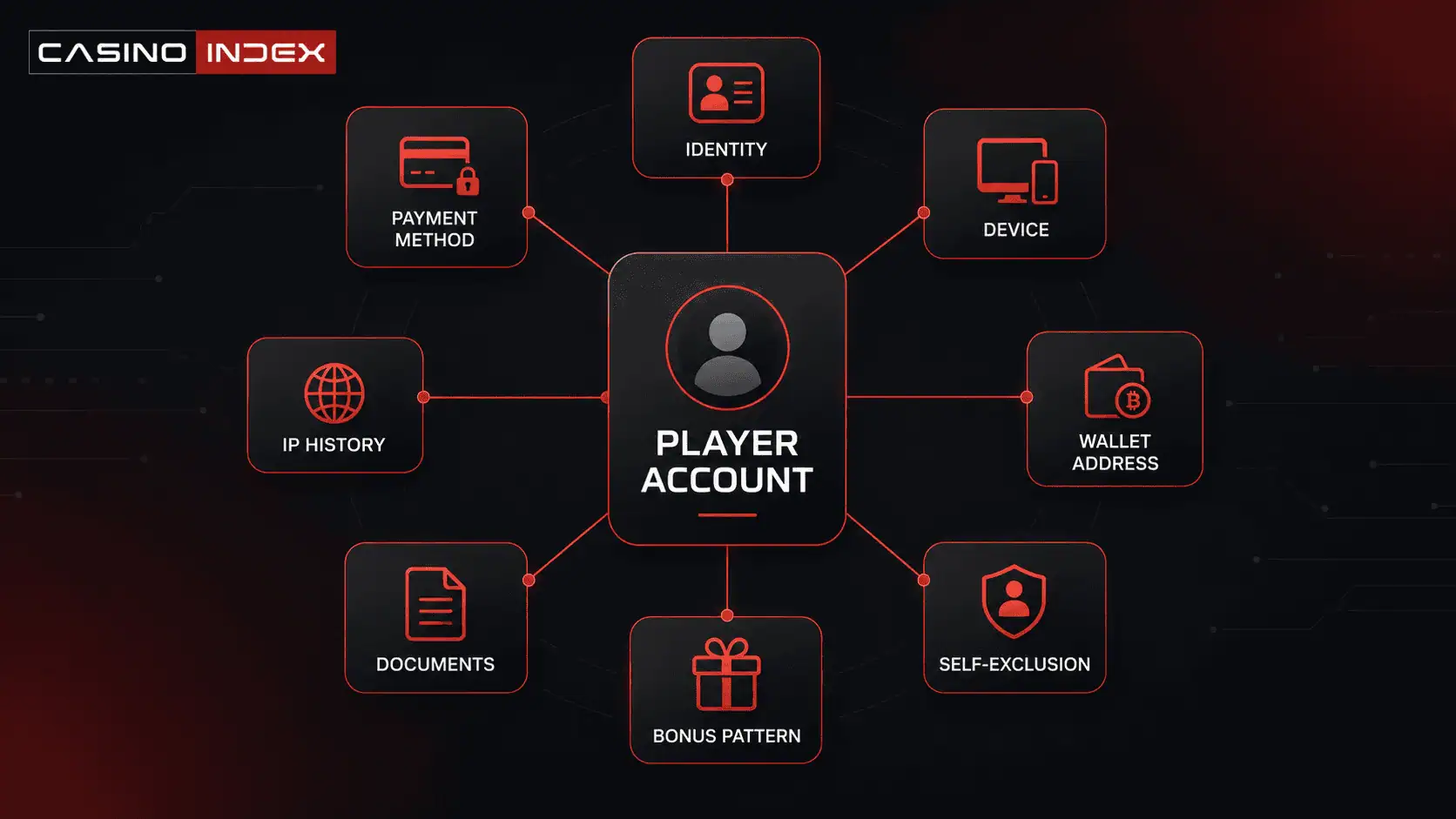
That can affect:
- withdrawal reviews
- KYC checks
- bonus eligibility
- duplicate account detection
- self-exclusion enforcement
- account restrictions
- payment ownership checks
- complaint handling
- risk scoring
- blocked account decisions
This does not mean every shared operator acts unfairly.
Still, players should not assume a different logo means a different backend.
The real question is whether the same company can make decisions about the account when money needs to leave the platform.
Signal 1: both brands list the same legal entity
Start with the footer and Terms and Conditions.
Scroll to the bottom of both casino websites. Then look for the legal company name, registered address, license number, regulator name, and operator wording.
After that, open the terms.
Useful phrases include:
- “This website is operated by…”
- “The services are provided by…”
- “The agreement is between the player and…”
- “This brand is owned and operated by…”
- “The operator of this website is…”
When both brands name the same legal company, that is a strong signal.
The public brand may differ, but the player contract may sit with the same operator.
Also check whether one brand names a parent company while the other names a subsidiary. In practice, that can still indicate a shared group, even when the wording is not identical.
The aim is not to jump too fast. Instead, map the relationship clearly.
Signal 2: both brands use the same license holder
The license holder is one of the strongest clues.
Many operators run several casino brands under one license. Because of that, the regulator record may show multiple domains, trading names, or brands connected to the same licensed company.
Check both sites for:
- license holder
- license number
- regulator name
- authorised domain
- operating company
- license status
- registered address
A license badge alone is not enough. The important question is whether the official license record connects the two domains.
If both brands appear under the same license holder, they are likely connected at license or operator level.
That connection can affect complaint routes, responsible gambling rules, and how account restrictions are handled.
For broader context, CasinoIndex explains the difference between surface-level license claims and real protection in its casino licensing guide for checking operator trust.
Signal 3: both brands use the same white-label network
White-label casinos make shared-operator checks harder.
In a white-label setup, the visible brand may not control the full operation. Another company may provide the license framework, cashier, compliance tools, support systems, game integrations, or account management.
As a result, two brands may look separate while using the same white-label backend.
This does not automatically make them unsafe.
However, responsibility becomes harder to read.
A white-label provider may influence:
- KYC workflows
- payment routing
- withdrawal approval systems
- bonus enforcement
- account-risk checks
- responsible gambling tools
- complaint handling
Look for wording such as:
- “powered by”
- “operated under the license of”
- “platform services provided by”
- “managed by”
- “white-label solution”
- “payment services provided by”
A shared white-label provider is not always the same as shared ownership. Even so, it can still mean the player experience and dispute route are connected.
CasinoIndex explains this structure in more detail in its guide to what white-label casinos mean for players behind the brand name.
Signal 4: the terms and policies are nearly identical
Casino terms often expose hidden connections.
Compare the Terms and Conditions, Privacy Policy, AML Policy, KYC Policy, responsible gambling page, bonus terms, and complaint policy.
Look for:
- identical headings
- same unusual phrases
- same rule order
- same withdrawal-limit wording
- same KYC escalation language
- same bonus-abuse clauses
- same complaint process
- same responsible gambling wording
This signal is not proof by itself.
Many casinos use templates. Some copy legal text from other sites. Others share a compliance provider.
However, identical policy language becomes more meaningful when combined with the same license holder, legal entity, payment rules, or support route.
Pay special attention to unusual wording. Generic terms are weak evidence, while unique clauses repeated across two brands are stronger.
Signal 5: self-exclusion rules may connect brands
Responsible gambling wording is important.
A self-exclusion at one brand may affect other brands under the same operator, license, group, or self-exclusion scheme. The exact impact depends on the jurisdiction and the operator’s policy.
Therefore, players should check this before opening a second account.
Look for phrases such as:
- “all brands operated by”
- “across our group”
- “all websites under this license”
- “associated brands”
- “sister sites”
- “within our network”
- “same operator”
This wording may mean the brands share responsible gambling controls.
That matters for player safety and account access.
A player who has self-excluded from one brand should not try to bypass that restriction through another related site. Doing so can lead to blocked accounts, rejected withdrawals, or serious gambling-harm concerns.
If self-exclusion is involved, the safer move is not to search for another connected brand. Instead, stop and use support tools.
Signal 6: bonus rules may link accounts across brands
Shared operators often connect bonus systems.
A player may believe two welcome offers are separate because the websites look different. However, the operator may see the accounts as linked.
This can trigger bonus-abuse reviews.
Common linked-account signals include:
- same name
- same address
- same device
- same IP history
- same payment method
- same wallet address
- same household
- same document set
- same banking details
- similar bonus pattern
- previous restriction at a related brand
Not every match proves abuse.
A shared household, repeated IP, or same device can happen for normal reasons. Still, casinos often reserve the right to review linked accounts, especially when bonus winnings are involved.
The risk usually appears at withdrawal stage.
A player may be allowed to register and play. Later, the problem starts when bonus winnings need approval.
That is why operator checks should happen before claiming bonuses across related brands.
Signal 7: account linking can affect withdrawals and blocks
Shared operators can connect player history across brands.
This may involve identity details, payment records, device data, wallet addresses, documents, self-exclusion status, previous disputes, or bonus activity.
The issue is not account linking by itself.
Operators may need tools to detect fraud, duplicate accounts, self-exclusion breaches, chargeback risk, payment mismatch, or bonus abuse.
The risk is unclear enforcement.
Players often learn about linked accounts only after a withdrawal request. By then, the casino may already be reviewing the account.
A block can mean different things.
The operator may return deposits, pay real-money balance, void bonus winnings under clear terms, request extra KYC, or close the account entirely.
Those outcomes are not equal.
CasinoIndex explains this risk in its guide to what can happen when casinos block accounts during review.
Signal 8: complaint patterns overlap across brands
Complaint patterns can reveal operator-level risk.
Search both casino names with terms such as:
- withdrawal delay
- KYC problem
- account blocked
- bonus confiscated
- payment pending
- complaint
- same operator
- sister casino
Then search the legal company name and license holder.
Do not treat one complaint as proof. Instead, look for repeated patterns.
| Pattern | Why it matters |
|---|---|
| Similar withdrawal delays across brands | Payment risk may sit at operator level |
| Repeated KYC loops | Compliance process may be shared |
| Bonus winnings voided under similar wording | Group-level bonus rules may be strict |
| Accounts blocked after large wins | Risk review may follow the same policy |
| Support uses the same unclear responses | Complaint handling may be centralised |
| Same legal company appears in disputes | Brand risk may point back to one operator |
A clean sister-brand network can support trust.
By contrast, a repeated dispute pattern across several brands should make players more careful.
Weak clues that do not prove shared ownership
Some clues are too weak on their own.
Do not assume two casinos share an operator only because they have:
- the same slot providers
- similar bonus sizes
- the same live casino supplier
- similar design blocks
- the same payment methods
- similar affiliate wording
- similar country restrictions
- the same chat widget
- similar Trustpilot complaints
These signals may support a wider check, but they do not prove ownership.
Many unrelated casinos use the same games, cashier tools, templates, and marketing language.
Weak clues become useful only when stronger evidence also appears. For example, similar design alone is weak. Similar design plus the same legal company and license holder is much stronger.
A practical 10-minute sister-brand check
Before depositing at a second casino, use this process.
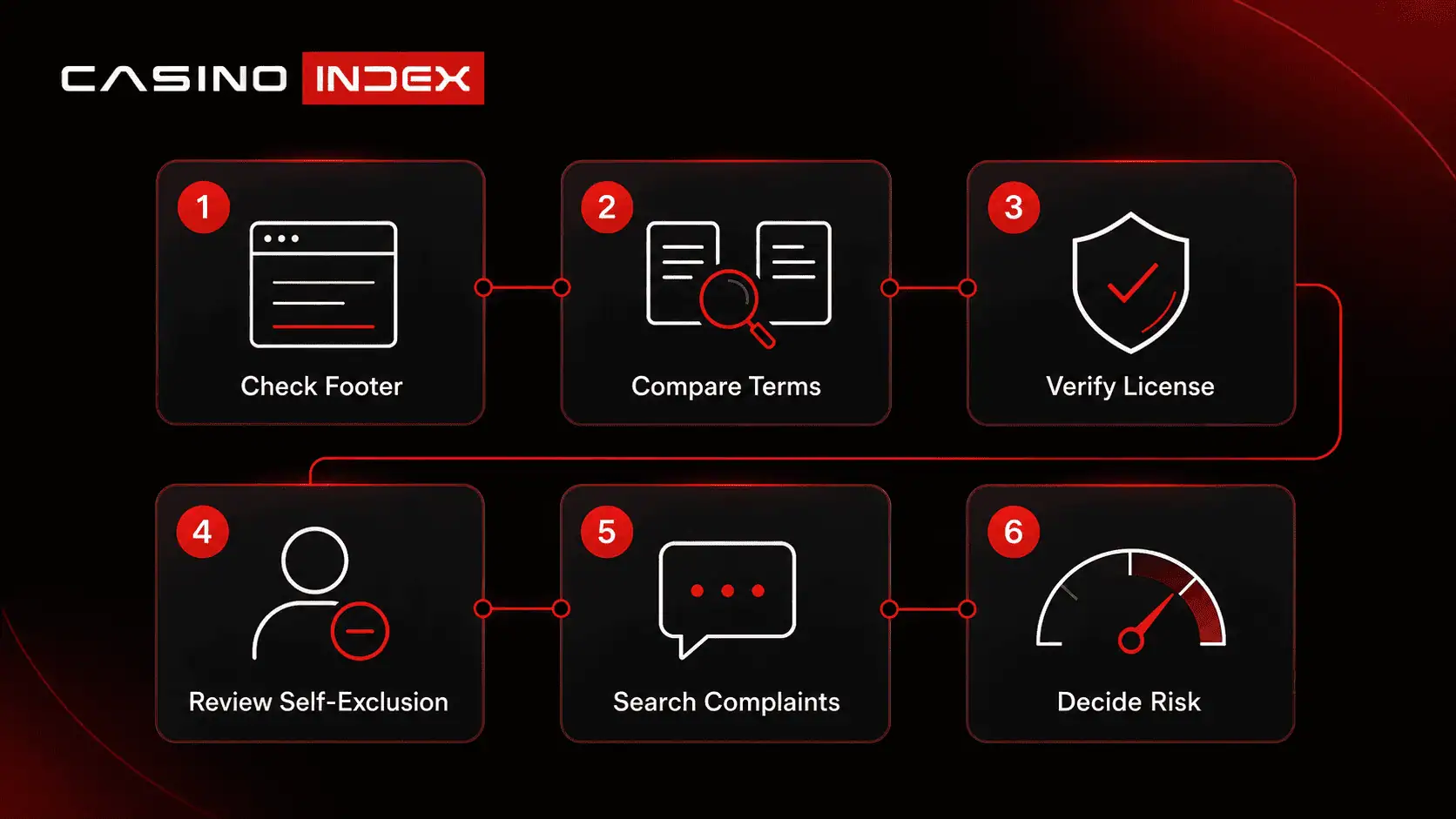
- Open both casino footers and copy the legal company names.
- Open both Terms and compare the operator wording.
- Check both license numbers and license holders.
- Search the regulator record for authorised domains.
- Compare responsible gambling and self-exclusion wording.
- Compare bonus terms, KYC policy, and complaint route.
- Search the legal company name plus “casino brands.”
- Search both brand names with “complaints” and “withdrawal.”
- Check whether the same payment company or support route appears.
- Decide whether the connection changes your risk before depositing.
This check is not complicated.
It only requires reading the parts of the site most players skip.
When shared operators are not a problem
Shared ownership can be positive.
Some casino groups run multiple brands with clear ownership, verifiable licenses, stable payment systems, transparent terms, and reliable withdrawal handling.
In that case, sister-brand knowledge helps players understand the network.
Shared operations are less concerning when:
- the legal company is clear
- the license is verifiable
- authorised domains are listed
- terms are consistent and fair
- self-exclusion rules are clearly explained
- complaints receive real answers
- withdrawals follow predictable rules
- account restrictions are explained
- support gives specific responses
The problem is not that two brands are connected.
The problem is hidden connection plus weak payout behaviour, vague rules, or repeated complaints.
Red flags when two casino brands may share an operator
Be more careful when several warning signs appear together.
| Red flag | Why it matters | What players should do |
|---|---|---|
| Same operator hidden behind different branding | Players may not understand the real relationship | Check terms and license before depositing |
| Same license but unclear disclosure | Transparency is weak | Verify the authorised domain |
| Same broad bonus-abuse wording | Bonus winnings may face group-level review | Avoid claiming multiple welcome offers blindly |
| Same self-exclusion wording | Restrictions may apply across brands | Do not try to bypass an exclusion |
| Same complaint email without clear operator name | Accountability may be unclear | Ask who handles formal complaints |
| Similar KYC complaints across brands | Risk handling may sit at operator level | Test with small deposits only, or avoid |
| Account blocked after using a related brand | Cross-brand linking may be involved | Request the exact term and balance decision |
| Same company appears in repeated disputes | Pattern may matter more than one brand | Treat the group as the risk source |
One red flag does not prove misconduct.
Several together should change how much trust you place in the second brand.
Bottom line: a different logo does not always mean a different operator
A second casino brand is not always a clean restart.
The design may change, but the operator, license holder, platform provider, self-exclusion rules, bonus restrictions, and complaint process may stay connected.
That is why players should check the company name, match the license, review authorised domains, read the responsible gambling wording, compare bonus rules, and search the legal company behind the brands.
Shared operators can be fine when the group is transparent, licensed, and reliable with withdrawals.
However, the risk rises when the connection is hidden, the rules are broad, and the same complaints repeat across brands.
Do not judge casino independence by design, bonus size, or homepage style.
Judge it by who controls the account when withdrawals, KYC checks, bonuses, complaints, or account blocks start.
That is where the real operator usually appears.
FAQ
How can I tell if two casino brands have the same operator?
Check the footer, Terms and Conditions, license holder, registered address, regulator record, complaint policy, responsible gambling page, and Privacy Policy. The strongest signals are the same legal company, same license holder, or same authorised domain record.
Are sister casinos always unsafe?
No. Sister casinos can be safe when the operator is transparent, licensed, and reliable with withdrawals. The risk rises when the shared operator is hidden or complaint patterns repeat across multiple brands.
Does the same game provider mean two casinos are connected?
No. Many unrelated casinos use the same game providers. Shared slots, live casino games, or software suppliers are weak clues unless they appear with stronger legal or licensing evidence.
Can self-exclusion apply across sister brands?
Yes, depending on the operator, license, group policy, or self-exclusion scheme. Players should read the responsible gambling terms before trying to use another brand connected to the same operator.
Can a casino link my account to another brand?
Yes. Operators may link accounts using identity details, payment methods, devices, IP history, documents, wallets, or previous account records. This often matters during bonus review, KYC, withdrawals, or account restrictions.
Can I claim welcome bonuses at sister casinos?
Sometimes, but it depends on the operator’s terms. Some groups restrict bonuses across related brands or review linked accounts before paying bonus winnings.
Why do casino complaint patterns matter across brands?
If several brands under the same operator show similar complaints, the issue may be operator-level rather than brand-specific. Repeated KYC delays, unpaid withdrawals, or bonus confiscations across sister sites are stronger risk signals.
What is the strongest proof of shared casino ownership?
The strongest proof is the same legal operator, same license holder, same authorised domain record, or direct wording in the terms saying the brands are operated by the same company or group.

Maria Hoffmann has worked in cryptocurrency content and digital publishing since 2017. She is a co-founder of Freecoins24 and CryptoMutant and has covered blockchain projects, crypto platforms and emerging industry trends for several years. She has also been active as a cryptocurrency investor since 2019. At CasinoIndex, Maria combines content research and SEO experience with a focus on casino trust, platform security, withdrawal processes, payment risks and user protection. Her work looks beyond bonuses and product features to examine how gambling platforms handle player funds, verification and account-related risks.