Shared Household and Duplicate Account Risk at Online Casinos
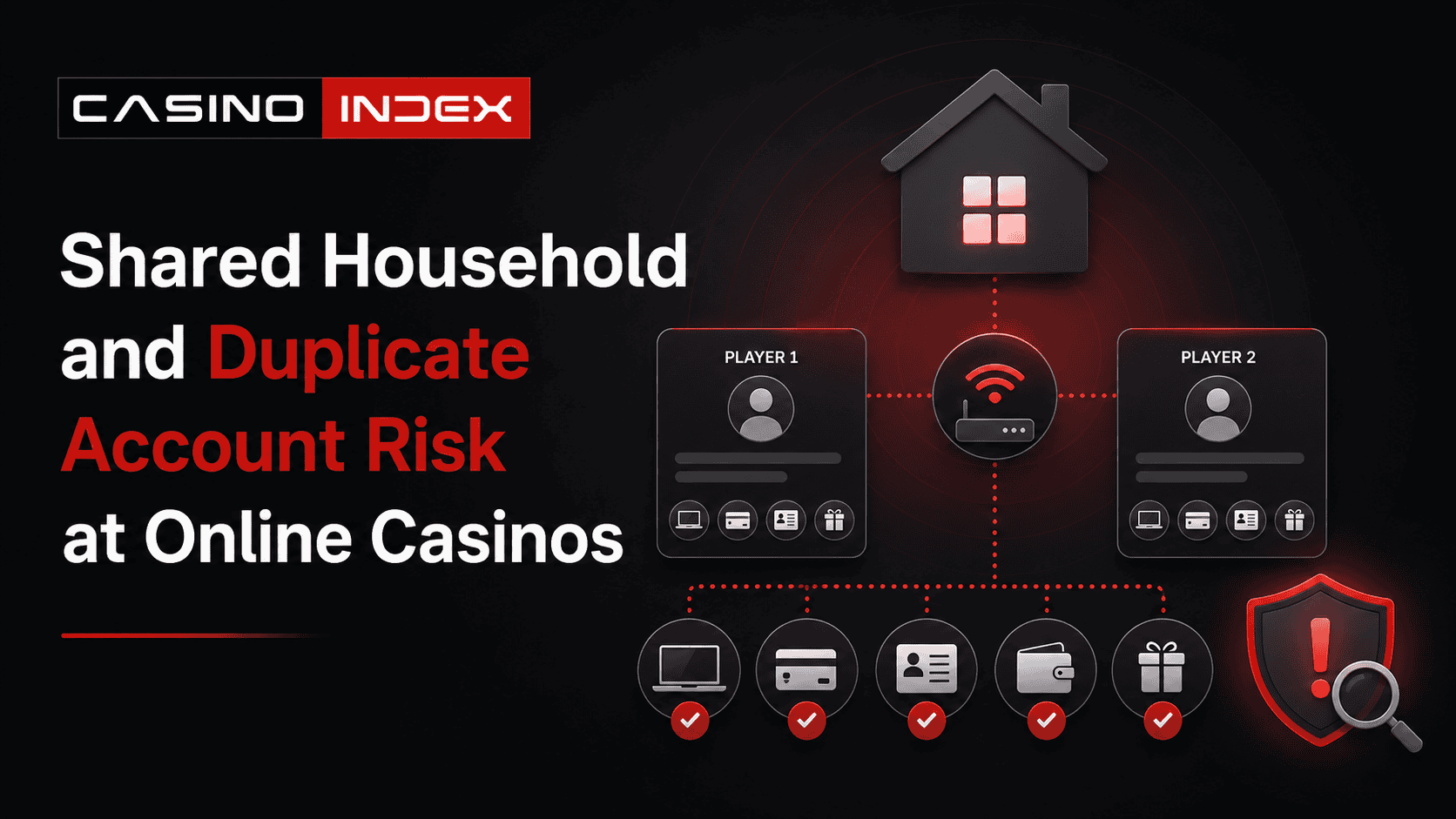
Two people in the same home can create a casino risk without meaning to do anything wrong.
A spouse opens an account. A roommate uses the same Wi-Fi. A sibling plays on the same laptop. A partner deposits with the wrong card. Someone else in the house claims the same welcome bonus.
At first, the casino may not react.
The accounts may open normally. Deposits may work. Games may load. Bonuses may even activate.
The risk usually appears later.
It appears during bonus review, KYC, withdrawal approval, account security checks, or complaint handling. That is when the casino may compare IP history, device records, payment ownership, address proof, KYC documents, bonus use, and linked-account behaviour.
Suddenly, a normal household can look like duplicate account abuse.
This guide explains shared household and duplicate account risk at online casinos, why same IP and family accounts can trigger reviews, how bonus abuse accusations happen, and how legitimate players can reduce risk before depositing.
Quick answer: can people in the same household use the same online casino?
Sometimes, yes. But the casino’s terms decide the risk.
Many casinos allow separate adults in the same household to hold their own accounts. However, they usually expect each person to use their own identity, own payment method, own email, own documents, and accurate account details.
The risk rises when accounts share too many signals.
| Shared signal | Risk level | Why casinos check it | What can happen | Safer player action |
|---|---|---|---|---|
| Same household address | Medium | May show related accounts | Bonus review or account check | Read household rules before claiming offers |
| Same IP address | Low to medium alone, higher with other signals | May suggest linked accounts | Duplicate-account flag | Keep accounts clearly separate |
| Same device | Medium to high | May look like one person using multiple accounts | Security or bonus review | Use separate devices where possible |
| Same payment method | High | Payment ownership may be unclear | Rejected withdrawal or extra KYC | Use only your own payment method |
| Same crypto wallet or e-wallet | High | Financial link between accounts | AML or bonus review | Keep wallets separate by player |
| Same KYC documents | Very high | May suggest duplicate identity | Account block or closure | Never reuse documents |
| Same welcome bonus pattern | High | May look like promotion abuse | Bonus winnings voided | Check household bonus limits first |
| Same account-block history | Medium to high | May show linked risk | Wider account restriction | Ask support before playing |
The safest rule is simple: one real person, one account, one payment method, one clean set of documents.
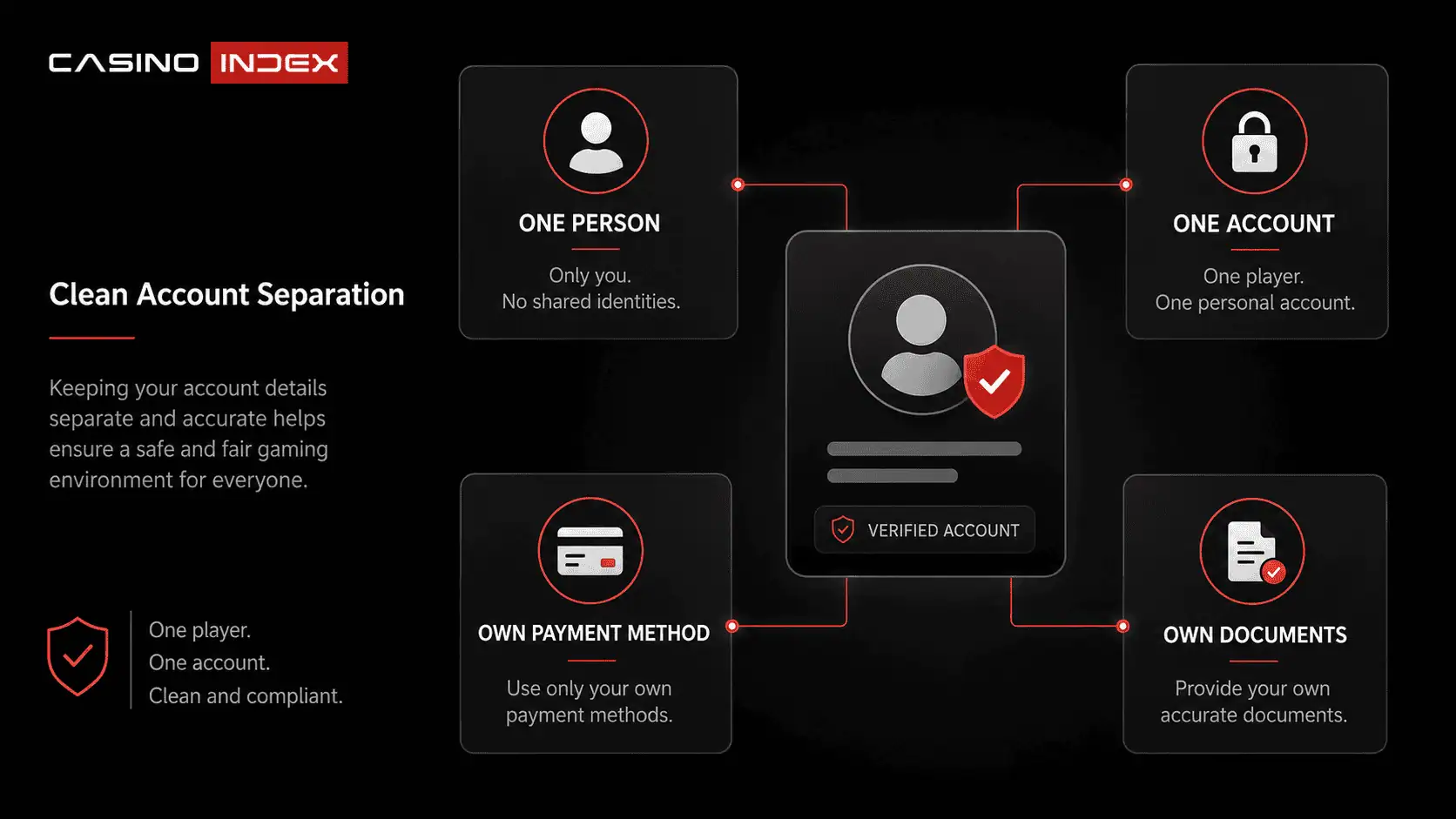
If two people in the same household want to play at the same casino, they should check the terms before depositing and avoid claiming bonuses until the household rules are clear.
How CasinoIndex evaluates duplicate account risk
CasinoIndex does not treat every shared household as abuse.
People live together. Families share addresses. Roommates use the same internet connection. Couples may enjoy the same casino games. None of that proves misconduct by itself.
The real question is whether the account structure is clear enough to defend during a review.
CasinoIndex evaluates duplicate account risk through six layers.
| Layer | What CasinoIndex checks | Why it matters |
|---|---|---|
| Identity layer | Name, date of birth, ID documents, phone number, email, proof of address | Shows whether each account belongs to a real separate person |
| Household layer | Shared address, IP history, device use, physical location | Helps separate normal household overlap from suspicious coordination |
| Payment layer | Card ownership, bank details, e-wallets, crypto wallets, source of funds | Confirms who owns the money and whether payment rules are followed |
| Bonus layer | Welcome offers, free spins, wagering behaviour, max bet rules, bonus timing | Shows whether multiple linked accounts may have abused promotions |
| Behaviour layer | Login timing, gameplay patterns, device switching, withdrawal timing | Helps detect account sharing or coordinated use |
| Enforcement layer | KYC request, bonus decision, account restriction, balance treatment | Shows whether the casino handled the case fairly and clearly |
This framework matters because a single shared signal is rarely enough.
Same IP alone is common. Same address alone can be normal. Even two adults in one household playing at the same casino may be legitimate.
The risk becomes serious when several signals overlap with bonus claims, payment mismatch, duplicate documents, or unclear account ownership.
That is why CasinoIndex separates normal household activity from true bonus-abuse risk. The bonus side is explained in more detail in what counts as bonus abuse at online casinos.
Why casinos care about duplicate accounts
Casinos care about duplicate accounts because one person could use several accounts to gain an unfair advantage.
That may mean claiming multiple welcome bonuses, bypassing account limits, hiding previous restrictions, avoiding self-exclusion, manipulating promotions, or using linked accounts to reduce risk.
From the casino’s side, duplicate accounts can raise concerns around:
- bonus abuse
- payment fraud
- identity misuse
- chargeback risk
- self-exclusion breaches
- AML checks
- account sharing
- multi-account promotion farming
- linked withdrawal behaviour
- blocked-account evasion
A shared signal does not prove abuse.
However, several shared signals can create a strong review trigger.
A shared address may be easy to explain. A shared address plus same device, same payment card, same welcome bonus, similar wagering, and similar withdrawal timing is much harder to defend.
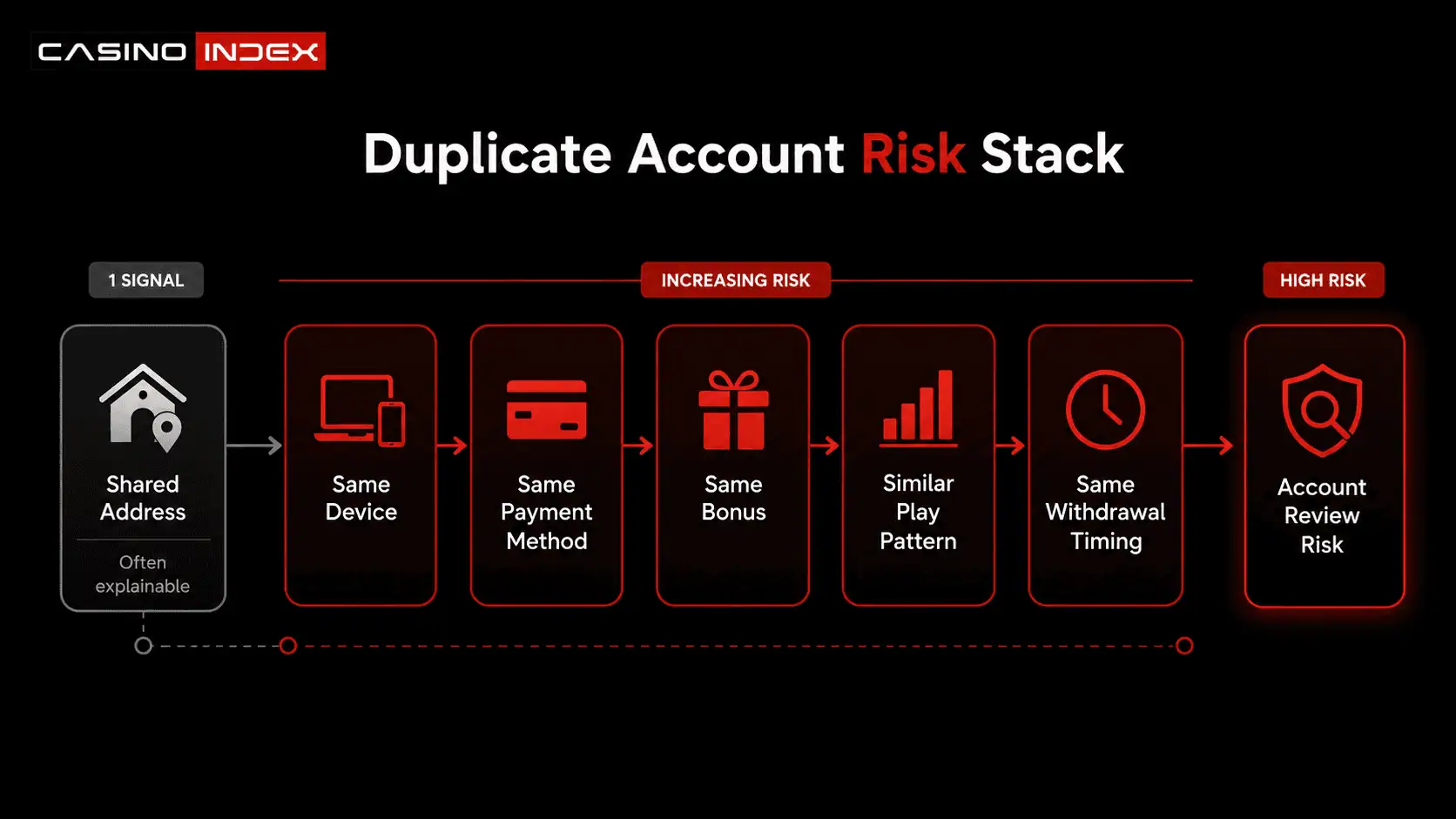
Legitimate players should keep account ownership clean from the start.
Same IP address: common but still worth managing
A same-IP match is common.
Families, roommates, students, office workers, hotel guests, and people using shared Wi-Fi can all appear under the same IP address.
On its own, same IP is usually not the strongest duplicate-account proof.
Still, it can trigger review when other signals appear.
The risk rises when the same IP is connected to:
- multiple new accounts
- several welcome bonus claims
- the same device
- the same payment method
- similar betting behaviour
- same withdrawal timing
- repeated login overlap
- shared KYC information
A legitimate household should avoid making the pattern look coordinated.
For example, two people signing up on the same day, using the same laptop, claiming the same bonus, depositing from the same card, and withdrawing soon after wagering will look risky.
The better approach is cleaner.
Keep each account easy to separate: use different devices where possible, individual payment methods, accurate personal details, and avoid bonus stacking unless the terms clearly allow it.
Family accounts and household rules
Some casinos restrict one account per person.
Others go further and restrict one bonus per household, IP address, device, payment method, physical address, or family group.
That difference matters.
A casino may allow your spouse, sibling, parent, adult child, or roommate to create an account. Yet the same casino may still refuse multiple welcome bonuses from the same household.
Players should search the terms for wording such as:
- one account per person
- one bonus per household
- one bonus per IP address
- one bonus per device
- one bonus per payment method
- linked accounts
- associated accounts
- duplicate accounts
- family members
- shared computer
- shared internet connection
- bonus abuse
These clauses often decide what happens during withdrawal review.
A player may be allowed to play with real money but not allowed to claim the same promotion as another household member.
That is why terms need to be checked before deposit, not after a win. CasinoIndex explains this habit in its guide to reading casino terms before depositing real money.
Shared devices can create stronger risk
Shared devices are often more sensitive than shared IP.
A family may share a laptop. Roommates may use the same tablet. A couple may log in from the same phone. That can happen without bad intent.
Even so, device overlap can look suspicious when combined with bonuses or withdrawals.
Casinos may review signals such as:
- browser fingerprint
- cookies
- operating system
- device ID
- saved login behaviour
- location data
- payment tools
- session patterns
Players usually do not see these checks.
However, the casino may use them during fraud review, bonus review, or account verification.
A shared device becomes especially risky when several accounts use the same bonus, same payment method, or similar gameplay pattern.
To reduce risk, each player should use their own device where possible. At minimum, each person should keep separate account details, separate payment methods, and clean KYC records.
Same payment method is a major warning signal
Using the same payment method across multiple casino accounts is one of the clearest risk triggers.
Most casinos expect the deposit and withdrawal method to belong to the account holder.
That applies to bank cards, bank accounts, e-wallets, prepaid tools, crypto wallets, and sometimes exchange accounts.
A shared payment method creates several questions:
- Who owns the funds?
- Who controls the casino account?
- Was one payment source used to fund several accounts?
- Were multiple bonuses claimed through one financial source?
- Can the withdrawal legally return to that method?
- Does the payment name match the KYC documents?
The player’s case becomes weaker when the deposit method belongs to someone else.
Even if the relationship is genuine, the casino may treat this as a payment ownership breach.
The safest rule is direct.
Each player should use only their own payment method, in their own name, with records that match their KYC documents.
Duplicate KYC data and document overlap
Duplicate KYC data is one of the strongest duplicate-account signals.
This includes overlapping identity documents, address proof, selfies, phone numbers, email patterns, payment records, or source-of-funds documents.
A casino may flag the account when:
- two accounts upload the same ID
- one document appears with different names
- the same proof of address is reused incorrectly
- payment proof belongs to another player
- two accounts use the same phone number
- documents look edited or recycled
- one person appears to control several accounts
Some overlap can be normal in a household.
For example, two people may share the same address. They may also appear on the same utility bill or bank statement in some cases.
Still, each account should show clear personal identity and payment ownership.
KYC is where many duplicate-account disputes become serious. A casino may accept registration first, then only discover overlap when withdrawal documents are reviewed.
CasinoIndex explains this payout-stage risk in its casino verification guide.
Bonus abuse accusations and shared households
Shared household disputes often become bonus disputes.
A casino may argue that several related accounts were used to claim promotions unfairly.
This can happen when household members:
- claim the same welcome bonus
- use the same IP and device
- deposit similar amounts
- follow similar wagering patterns
- use the same payment method
- withdraw after completing wagering
- focus mostly on bonuses rather than normal play
Some players do this intentionally.
Others simply do not realise the terms restrict bonus use by household, device, IP address, or payment method.
Either way, the result can be serious.
The casino may remove bonus funds, void bonus winnings, restrict accounts, request extra KYC, or close accounts.
This is why bonus fairness matters. Safer casinos explain household bonus limits clearly before players deposit. CasinoIndex’s guide to casinos with fairer bonus terms focuses on this kind of clearer bonus structure.
When legitimate players get flagged
Legitimate players can still get flagged.
This is one of the most frustrating parts of shared household risk.
A couple may both play casually from home. Two siblings may use the same Wi-Fi. Roommates may each have their own accounts. A parent and adult child may share an address.
None of that proves abuse.
However, the casino’s risk system may not see the full context at first. It may only see linked signals.
For example:
- same address
- same IP
- same device
- same bonus
- similar deposit size
- similar withdrawal timing
At that point, the player needs a clean explanation and clean records.
Useful proof may include separate IDs, separate payment ownership, separate email addresses, separate phone numbers, source-of-funds records, and a simple explanation of the household relationship.
The stronger the separation, the easier the case becomes.
A legitimate player should not panic. But they should also not make the case worse by opening another account, editing documents, deleting records, or giving inconsistent explanations.
What happens when duplicate account risk is detected
Duplicate account risk can trigger several different outcomes.
| Casino action | What it usually means | What the player should ask | Risk level |
|---|---|---|---|
| Extra KYC | Casino wants to confirm account ownership | Which documents are required? | Medium |
| Bonus review | Casino checks promotion eligibility | Which bonus rule is being applied? | Medium to high |
| Withdrawal delay | Payment is paused during account review | Is real-money balance affected? | High |
| Account restriction | Casino limits access while reviewing risk | What triggered the restriction? | High |
| Bonus winnings voided | Casino believes bonus terms were breached | Which exact clause was broken? | High |
| Account closure | Casino ends the account relationship | What happens to deposits and cash balance? | Very high |
The key issue is balance treatment.
A casino may have stronger grounds to void bonus winnings if clear bonus terms were breached. Real-money balance should still be handled according to the terms, facts, and applicable rules.
Players should ask for the decision in writing.
CasinoIndex explains this broader account-risk process in its guide to what happens when casinos block accounts during review.
How legitimate players can reduce risk
Legitimate players should reduce duplicate-account risk before depositing.
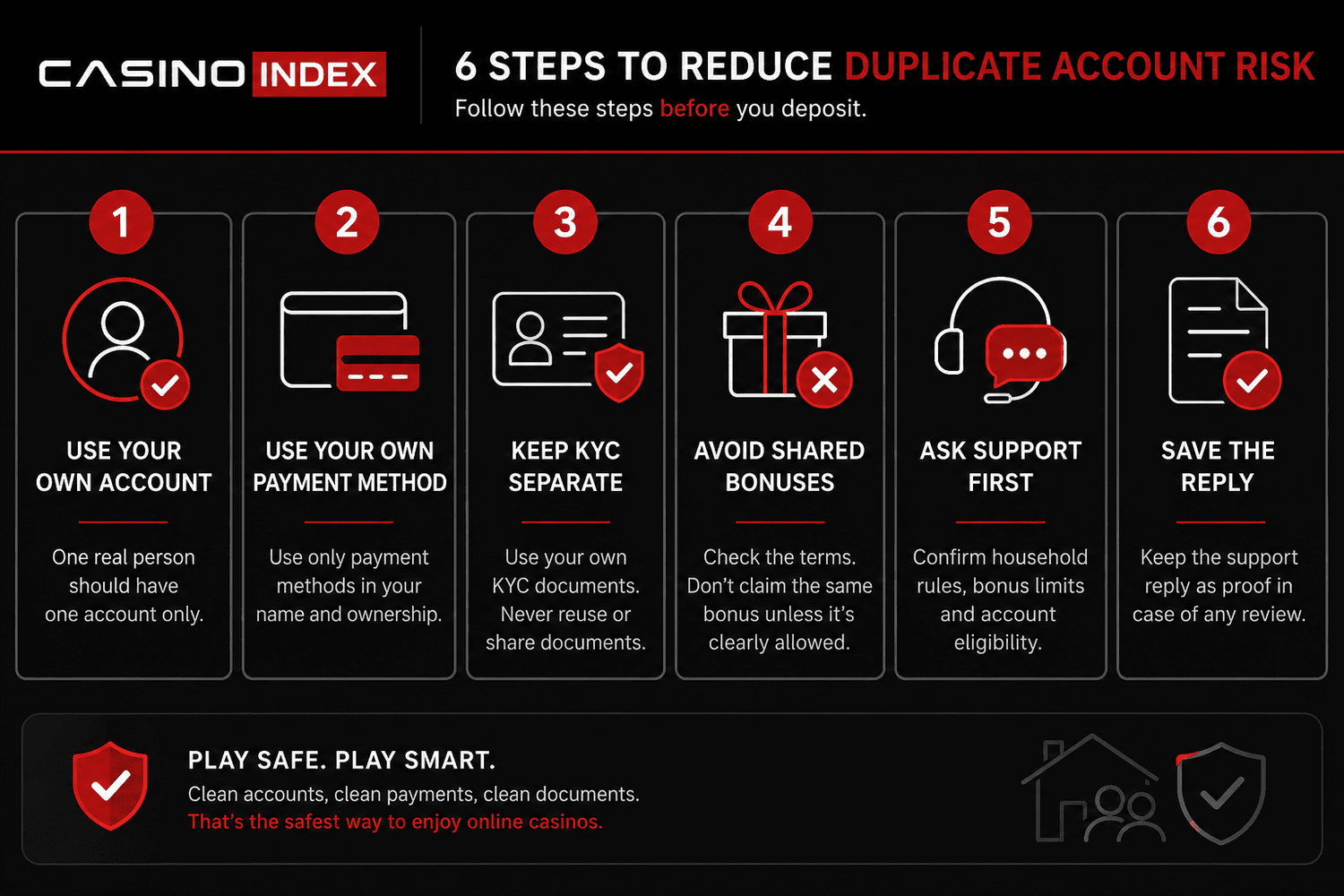
The aim is simple: make each account clearly separate and easy to verify.
Use these rules:
- Each person should create only one account.
- Every player should use accurate personal details.
- Each account should have its own email and phone number.
- Every player should use their own payment method.
- Household members should avoid sharing devices where possible.
- Do not claim the same bonus unless the terms clearly allow it.
- Save proof of payment ownership.
- Keep KYC documents clean and consistent.
- Ask support before a second household member claims a bonus.
- Save any support reply about household eligibility.
This does not guarantee no review.
However, it makes the account easier to defend if a review starts.
What to ask support before a second household account
If another person in your household wants to register, ask support before depositing.
Use a direct question:
“Can two adults from the same household each hold their own casino account if they use separate personal details, separate payment methods, and separate KYC documents? Also, are welcome bonuses limited to one per household, IP address, device, or payment method?”
Save the answer.
A support reply may not override the terms. However, it can help show that the player tried to follow the rules.
Avoid vague questions like:
“Can my wife play too?”
Ask about accounts, bonuses, payment methods, devices, IP address, and household restrictions.
That creates a clearer record.
Red flags in duplicate account terms
Be careful when casino terms use broad language without clear examples.
| Red flag | Why it matters | Player response |
|---|---|---|
| “Associated accounts” not defined | Casino may apply the rule broadly | Ask for clarification before depositing |
| One bonus per household hidden deep in terms | Bonus winnings may be at risk | Read bonus rules before claiming |
| Same IP treated as abuse automatically | Shared homes may face unfair review | Avoid bonuses or choose another casino |
| Payment ownership rules are unclear | Withdrawals may be delayed | Use only your own method |
| Broad confiscation wording | Balance treatment may be uncertain | Treat as higher risk |
| No real-money balance explanation | Account closure outcome is unclear | Ask before deposit |
| Support gives vague answers | Player cannot rely on guidance | Save replies or avoid |
One broad clause does not always mean unfair treatment.
Several unclear rules together should make players cautious.
Bottom line: shared households need clean separation
Shared household play is not automatically abuse.
But overlap creates risk.
Same IP may be normal. Same address may be normal. Even two adults playing from one home can be legitimate.
The problem starts when too many signals overlap: same device, same payment method, same bonus, same documents, same wagering pattern, or similar withdrawal timing.
That is when a normal household can start to look like a duplicate-account case.
The safest approach is simple.
Use one account per person. Keep payment methods separate. Do not reuse documents. Avoid claiming the same bonus unless the terms clearly allow it. Ask support before a second household member deposits or claims an offer. Save the answer.
If the casino later reviews the account, clean records matter.
A legitimate player should be able to show who owns the account, who owns the payment method, which documents belong to whom, and why two people share an address or IP.
That is the difference between a normal household and a duplicate-account problem.
FAQ
Can two people in the same house have casino accounts?
Sometimes, yes. It depends on the casino’s terms. Some casinos allow separate accounts for separate adults, while others restrict bonuses or accounts by household, IP address, device, or payment method.
Is using the same Wi-Fi a problem at online casinos?
Same Wi-Fi alone does not always prove duplicate accounts. However, it can trigger review when combined with same device, same payment method, same bonus use, or similar account behaviour.
Can my spouse or roommate claim the same welcome bonus?
Only if the casino’s terms allow it. Many casinos restrict welcome bonuses to one per household, IP address, device, or payment method.
Can I use someone else’s card to deposit?
This is risky. Casinos usually expect the payment method to belong to the account holder. Using someone else’s card or e-wallet can lead to rejected withdrawals or account review.
What happens if a casino says I have a duplicate account?
Ask which account or signal caused the issue, which term applies, what documents are required, and what happens to real-money balance and bonus winnings.
Can shared devices trigger casino account blocks?
Yes. Shared devices can create linked-account signals, especially when multiple accounts use the same bonus, payment method, or login pattern.
How can I prove I am a legitimate separate player?
Use your own account, own payment method, own documents, own phone number, own email, and clear KYC records. Save support confirmation if you asked about household eligibility before playing.
Are duplicate account rules mainly about bonuses?
Often, yes, but not always. Duplicate account rules can also involve fraud prevention, self-exclusion, payment ownership, account security, and blocked-account evasion.

Maria Hoffmann has worked in cryptocurrency content and digital publishing since 2017. She is a co-founder of Freecoins24 and CryptoMutant and has covered blockchain projects, crypto platforms and emerging industry trends for several years. She has also been active as a cryptocurrency investor since 2019. At CasinoIndex, Maria combines content research and SEO experience with a focus on casino trust, platform security, withdrawal processes, payment risks and user protection. Her work looks beyond bonuses and product features to examine how gambling platforms handle player funds, verification and account-related risks.