What Counts as Bonus Abuse at Online Casinos?
Bonus abuse is one of the most common reasons casino winnings suddenly disappear.
It is also one of the most misused terms in online gambling.
Casinos need rules to stop fraud, multi-accounting and fake promotion claims. That part is fair. But players also need protection from vague abuse clauses that only appear after a withdrawal request.
The problem is the grey area.
A player may think they used a bonus carefully. The casino may decide the same play looks like “irregular play,” “bonus manipulation” or “promotion abuse.” When the terms are unclear, the dispute becomes difficult.
This guide explains what usually counts as bonus abuse at online casinos, what does not automatically count as abuse, and how fair players can avoid bonus-related withdrawal problems.
Quick Answer: What Counts as Bonus Abuse?
Bonus abuse usually means breaking a clear promotion rule or using a casino bonus in a way that creates an unfair advantage outside normal play.
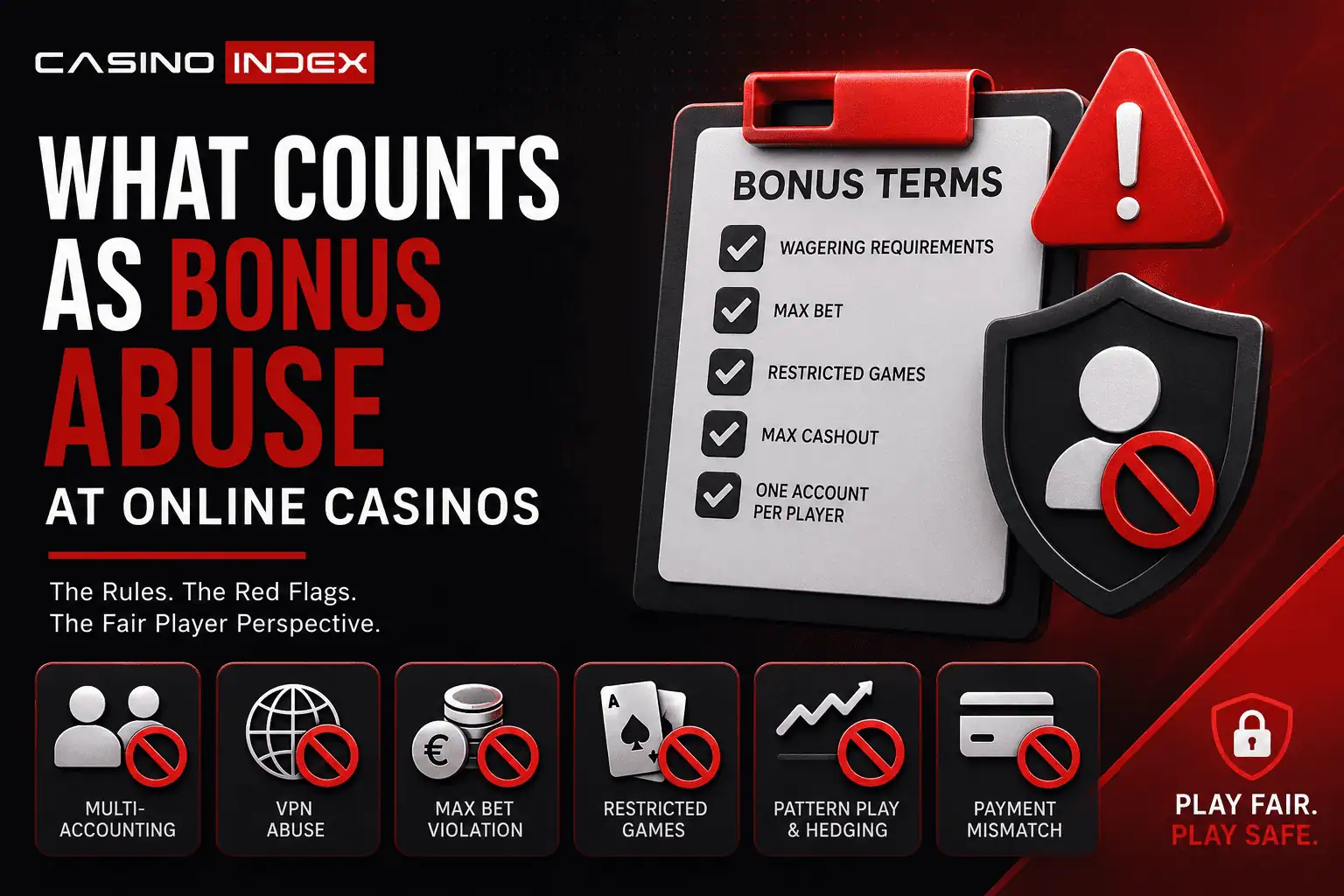
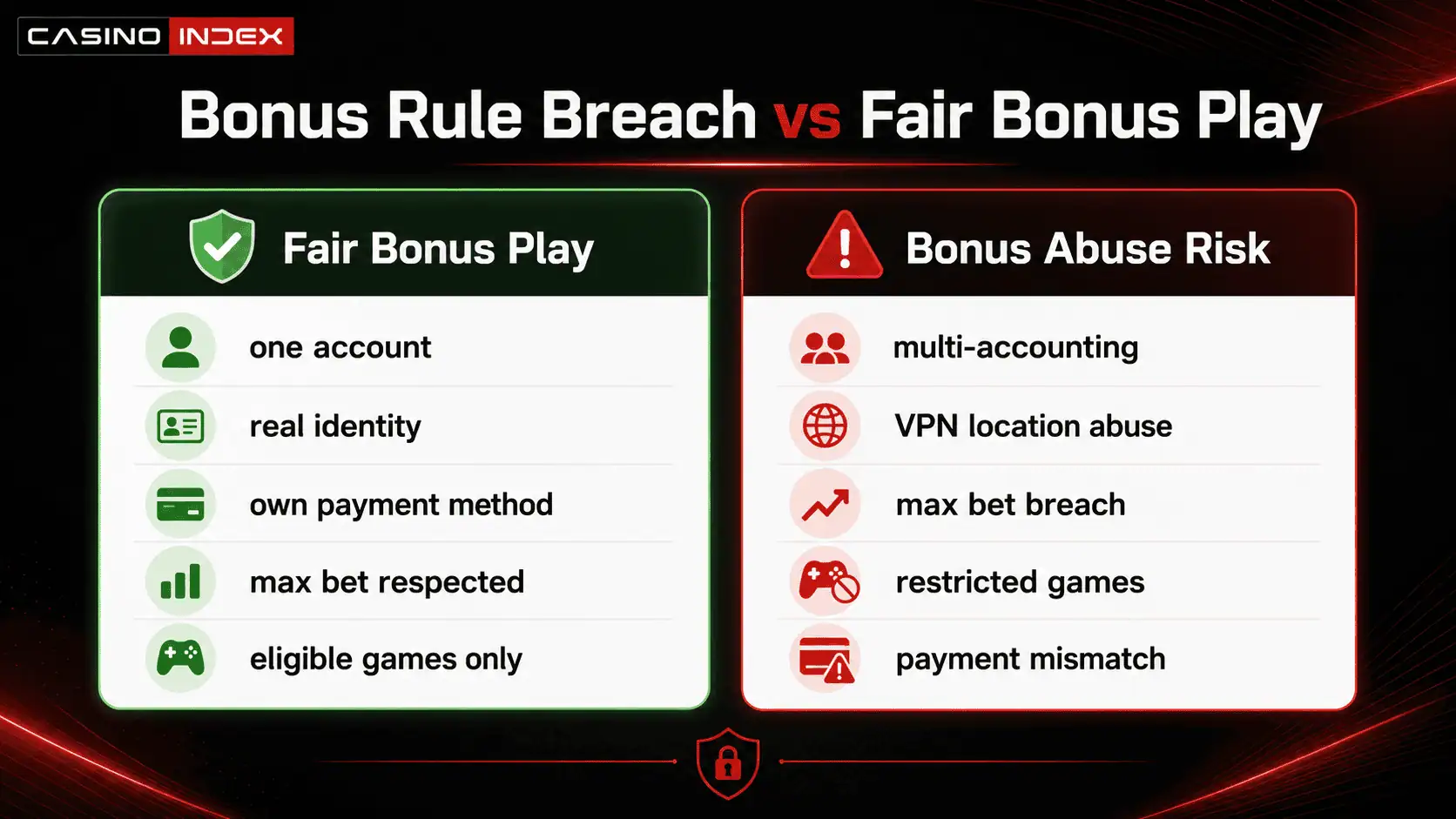
The most common examples are multi-accounting, VPN location abuse, max bet breaches, restricted-game play, identity mismatch and coordinated pattern play.
| Type of Issue | Severity | Typical Consequence | Example |
|---|---|---|---|
| Multi-accounting | High | Bonus removed, winnings voided, account closed | One player opens several accounts to claim the same welcome bonus |
| Fake or mismatched identity | High | KYC review, withdrawal block, possible account closure | Using someone else’s name, card, wallet or documents |
| VPN location abuse | High | Bonus voided, account restricted, withdrawal review | Hiding a restricted country to claim an offer |
| Max bet violation | Medium to high | Bonus winnings reduced or voided | Betting above the allowed stake while wagering |
| Restricted-game play | Medium to high | Winnings from bonus play may be voided | Using bonus funds on excluded games |
| Pattern or low-risk play | Grey area | Manual review, bonus removal, dispute risk | Hedging or using banned low-risk strategies |
| Bonus stacking | Medium | Promotion cancelled or winnings adjusted | Combining offers that the terms do not allow |
Not every smart bonus decision is abuse.
Reading the terms, choosing eligible games, staying within the max bet and withdrawing after completed wagering should not automatically be treated as suspicious.
CasinoIndex explains the wider bonus structure in its guide to how casino wagering really works.
How CasinoIndex Evaluates Bonus Abuse
CasinoIndex separates real abuse from normal player behaviour.
That distinction matters because casinos and players often view the same bonus session differently.
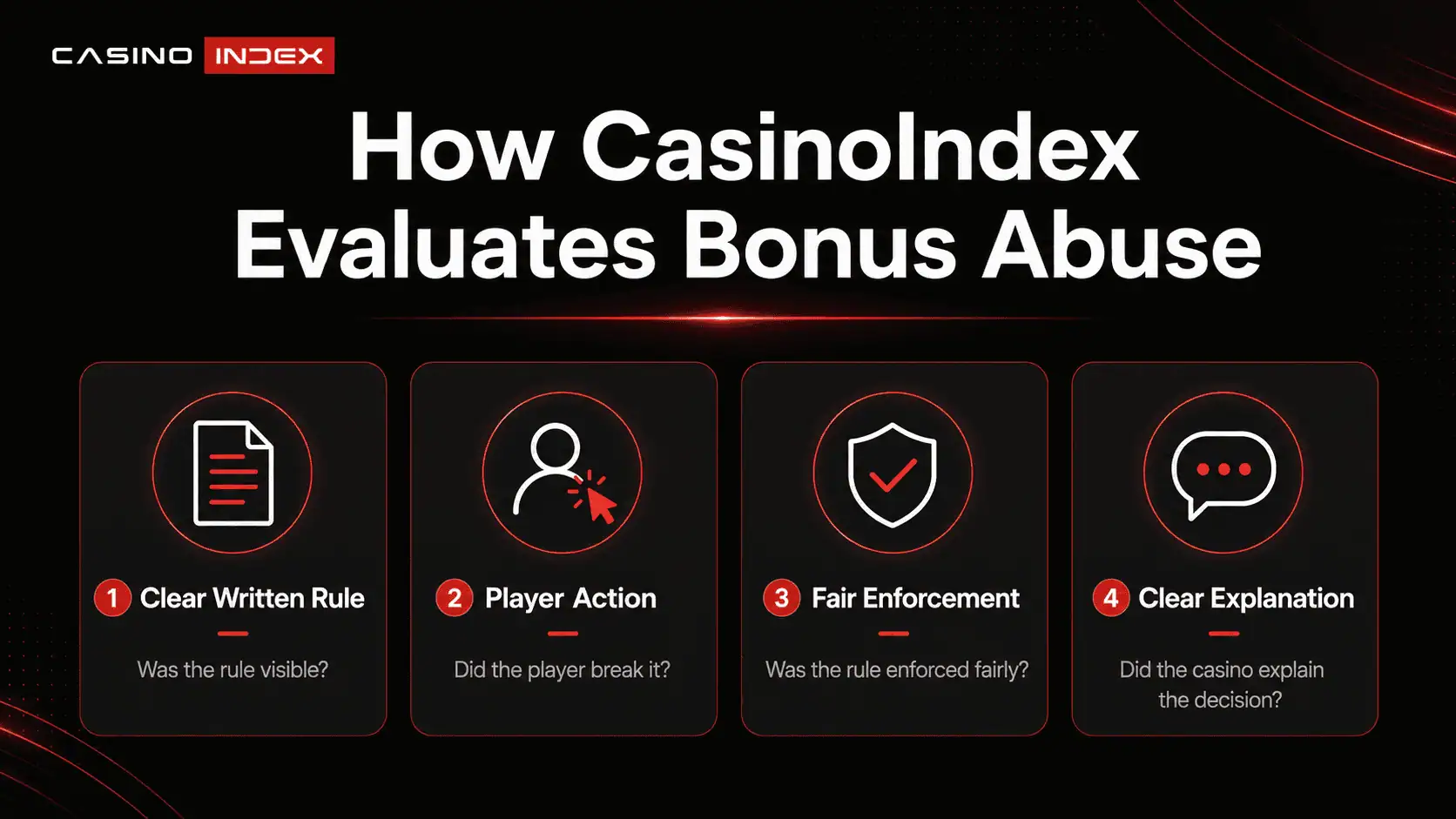
We look at four questions:
Was there a clear written rule?
A casino has a stronger case when the rule was visible before the player deposited.
Did the player break that rule?
Multi-accounting, fake identity use and max bet violations are much clearer than vague “irregular play” claims.
Did the casino enforce the rule fairly?
The best casinos block restricted games, show max bet limits and make wagering progress clear before the player makes a mistake.
Did the casino explain the decision?
A fair dispute should include the rule, the affected bets and the reason for the outcome.
A vague accusation is not enough.
A serious casino should be able to explain exactly what happened and why the bonus decision was made.
Why Bonus Abuse Is Hard to Define
Some forms of bonus abuse are obvious.
Multi-accounting is a clear breach. Fake documents are a clear breach. Using someone else’s payment method can trigger serious account and withdrawal problems.
Other cases are less simple.
A player may use a bonus, choose high-RTP slots, follow the max bet rule and stop after wagering is complete. The casino may dislike that behaviour because the player did not keep playing after the bonus. But dislike is not proof of abuse.
This is where wording matters.
A strong casino defines the line before play starts. It tells players the max bet, wagering requirement, restricted games, max cashout, expiry time and excluded strategies.
A weak casino leaves the terms broad, then uses “bonus abuse” language after the player wins.
That is a trust problem.
Players should treat vague bonus terms as a risk signal before depositing.
Multi-Accounting: The Clearest Form of Bonus Abuse
Multi-accounting is the most obvious form of bonus abuse.
It means one person creates or controls more than one casino account to claim bonuses more than once.
This can include:
- opening several accounts under different emails
- using friends or relatives to claim extra bonuses
- returning under a new account after closure
- using false identity details
- creating duplicate accounts from the same household when the terms ban it
Most casinos allow only one account per person. Some also limit accounts by household, device, IP address or payment method.
The risk is serious.
Multi-accounting can lead to bonus cancellation, confiscated winnings, account closure and deeper KYC checks.
A fair player should use one account, one real identity and one clean payment profile.
If an old account exists, contact support before opening a new one.
VPN Use and Location Abuse
VPN use is a common bonus-risk area.
A VPN is not automatically abuse at every casino. Some crypto casinos are more relaxed about privacy tools.
The problem starts when a VPN is used to hide a restricted country, bypass bonus rules or access a promotion that the player is not eligible for.
That becomes location misrepresentation.
A casino may apply bonus rules based on country, license, payment method or KYC region. If your IP address, documents and payment details do not match, the withdrawal may be reviewed.
This often happens late.
A casino may allow registration and deposit first, then raise the location issue when a withdrawal is requested.
That is why players should never assume that access at signup means full approval at cashout.
If VPN use is not clearly allowed, do not use it to claim a bonus.
For account-risk context, CasinoIndex explains what happens when casinos block accounts.
Max Bet Violations During Bonus Play
Max bet rules cause many bonus disputes.
A casino may let you use a bonus, but only up to a fixed stake while wagering is active. The rule may say €5 per spin, €10 per round or a percentage of the bonus amount.
Breaking that limit can void winnings.
The frustrating part is that some casinos do not block oversized bets automatically. The game still accepts the stake, the player continues, and the issue appears only after a withdrawal request.
That is bad UX.
But the player still needs to check the terms.
Before using a bonus, confirm:
- max bet per spin or round
- whether feature buys count as bets
- whether gamble features are allowed
- table-game stake limits
- whether the rule applies to real-money balance while a bonus is active
A max bet rule is not a minor detail.
It can decide whether a win is payable.
Restricted Games and Bonus Contribution
Not every game is allowed during bonus play.
Some games are excluded completely. Others count at a reduced percentage toward wagering.
Common restricted or low-contribution categories include:
- live casino games
- table games
- jackpot slots
- crash games
- Mines, Plinko, Dice and other Originals
- roulette and blackjack
- some high-RTP slots
- feature-buy games
This creates two different risks.
First, the game may not count toward wagering. The player thinks progress is moving, but it is not.
Second, the game may be banned for bonus funds. In that case, winnings can be voided.
The safest move is to search the bonus terms for “restricted games,” “excluded games,” “game contribution,” “0% contribution” and the exact game name.
CasinoIndex covers this in more detail in its guide to restricted games in casino bonuses.
Pattern Play and Low-Risk Betting
Pattern play is the greyest area.
Casinos may use terms like “irregular play,” “low-risk betting,” “hedging,” “opposite betting” or “bonus manipulation.”
These terms often refer to behaviour that appears designed to clear wagering while reducing real gambling risk.
Examples include:
- betting both sides of a market where possible
- using roulette-style hedging
- coordinating with other accounts
- using banned scripts or automated systems
- switching stakes in a way the terms clearly prohibit
- exploiting delayed bonus features when banned
The issue is not cautious play.
A player using small bets and staying within the rules should not automatically be accused of abuse.
The line should come from the written terms.
If the casino bans a specific pattern, avoid it. If the casino uses vague language with no examples, the player faces more dispute risk.
CasinoIndex’s view is simple: normal bankroll control is not abuse. But obvious hedging, coordination or rule-bending can give the casino a stronger case.
Bonus Stacking and Duplicate Claims
Bonus stacking means combining promotions in a way the casino does not allow.
This can include:
- claiming two deposit bonuses together
- using multiple promo codes
- combining cashback with a restricted bonus
- claiming the same offer twice
- using a welcome bonus after already receiving one
- claiming country-specific offers from another location
Some casinos allow certain offers to overlap.
Many do not.
The rule should be visible before the player deposits.
A good casino system blocks ineligible offers before play starts. A poor system accepts the deposit, lets the player wager, then raises the issue only after a win.
Players should never assume that two promotions can be combined unless the terms clearly allow it.
Payment and Identity Mismatch
Bonus abuse reviews often overlap with payment checks.
A casino may investigate when the account, payment method and bonus claim do not line up.
Risky examples include:
- using another person’s card
- depositing from a friend’s e-wallet
- using a shared payment method across accounts
- withdrawing to a method not in your name
- linking several casino accounts to the same wallet
- using payment details connected to a closed or banned account
This may not always be intentional abuse.
Sometimes it is a mistake.
But casinos treat payment ownership seriously because it connects to fraud, chargebacks, AML rules and duplicate bonus claims.
Before claiming a bonus, use your own payment method. Keep wallet records clear. Avoid mixing accounts with other players.
CasinoIndex explains why payment matching rules can delay cashouts in more detail.
How Casinos Detect Possible Bonus Abuse
Casinos do not usually rely on one signal.
They look for patterns across account data, payment history, gameplay and verification.
Common signals include:
- linked accounts
- shared IP addresses
- device fingerprints
- matching payment methods
- repeated KYC details
- linked crypto wallets
- unusual bonus-only behaviour
- restricted-game activity
- sudden stake changes
- VPN or proxy use
- suspicious referral patterns
One signal does not always prove abuse.
Two legitimate players may live in the same household. A player may travel. A shared IP can happen in hotels, campuses or offices.
The risk rises when several signals point in the same direction.
That is why communication matters.
A fair casino asks for clarification and explains the issue. A weak casino jumps straight to confiscation without giving the player a meaningful chance to respond.
What Is Not Automatically Bonus Abuse?
This section matters because “bonus abuse” can be used too broadly.
A player can be careful and still be fair.
| Player Behaviour | Should It Automatically Count as Abuse? | Why |
|---|---|---|
| Choosing eligible high-RTP games | No | Players are allowed to choose better games if the terms allow them |
| Using small bets within the max bet limit | No | Conservative staking is not the same as manipulation |
| Stopping after wagering is complete | No | A completed bonus should not force continued play |
| Withdrawing after a legitimate win | No | Winning is not abuse by itself |
| Refusing future bonuses | No | Players are not required to keep accepting promotions |
| Asking support to confirm unclear rules | No | That is responsible behaviour |
| Playing only eligible games | No | Following the rules should not be punished |
A casino may prefer players who keep depositing after a bonus.
That preference does not change the agreement.
If the player followed the written rules, the casino should not rely on vague “spirit of the promotion” wording after the fact.
CasinoIndex covers this wider issue in its guide to whether casino bonuses are actually worth it.
When Bonus Abuse Clauses Become Unfair
Bonus abuse clauses can protect casinos from fraud.
They can also be used unfairly.
The risk rises when the casino:
- does not define abuse clearly
- waits until withdrawal before raising the issue
- accepts bets that should have been blocked
- uses “irregular play” without examples
- refuses to show which rule was broken
- gives changing explanations
- confiscates winnings without a clear audit trail
- changes terms after the player started wagering
This does not mean every casino decision is wrong.
It means the casino should show the rule and the breach.
A fair decision should include:
- the exact term
- the affected bets
- the date or session
- the reason for the decision
- what happens to the deposit, bonus and winnings
Without those details, “bonus abuse” becomes a label instead of an explanation.
What to Do If a Casino Accuses You of Bonus Abuse
Stay calm and ask for specifics.
A useful support message is:
“Can you confirm which bonus term was breached, which bets or actions triggered the review, and whether the decision affects the bonus, bonus winnings or full balance?”
Then collect your records:
- bonus terms from the date you claimed the offer
- screenshots of the promotion
- wagering progress
- game history
- bet history
- deposit and withdrawal records
- support chats
- KYC emails
Opening another account can make the dispute worse.
Changing payment methods to get around the review creates another risk signal.
Claiming a second bonus while the first dispute is active can also weaken your position.
A clean record gives you the strongest position if the case needs to be escalated through a complaint platform, regulator or licensing contact.
How Fair Players Can Avoid Bonus Abuse Problems
The safest bonus strategy is simple.
One account, real details, a payment method in your own name and terms checked before deposit. That removes most avoidable bonus-abuse risk before play starts.
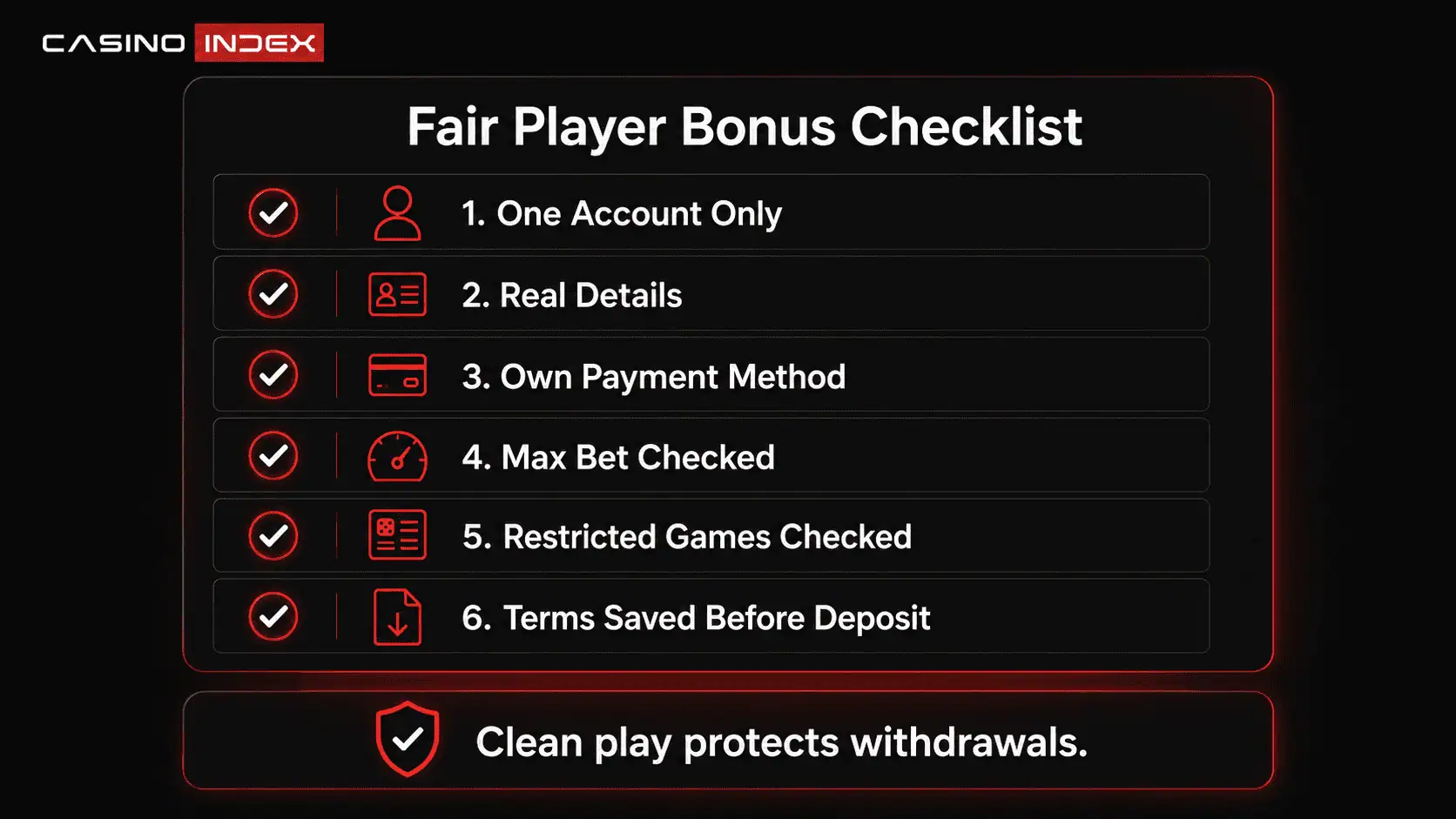
Before playing, check:
- max bet
- wagering requirement
- restricted games
- contribution percentages
- max cashout
- expiry time
- VPN rules
- country eligibility
- promotion stacking rules
Avoid hedging, duplicate accounts, payment mismatch and unclear VPN use.
Ask support before playing if a term is unclear. Save the answer.
A bonus that creates unclear cashout risk is not a good bonus.
For a deeper pre-deposit checklist, CasinoIndex explains how to read a casino’s terms before depositing.
Final Verdict: The Safest Strategy Is Clean Play
Bonus abuse is real.
Multi-accounting, fake identity use, VPN location abuse, max bet breaches, restricted-game play and coordinated pattern betting can all give a casino a valid reason to review or void a promotion.
But the term should not become a convenient excuse.
A casino should not label a player abusive just because they played carefully, completed wagering and withdrew.
The safest strategy is clean play:
- one account
- real identity
- your own payment method
- no VPN rule-bending
- no restricted games
- no max bet breach
- no unclear bonus stacking
- saved screenshots before play
If a casino cannot explain its bonus rules before deposit, do not rely on that bonus after a win.
The best bonuses are not the biggest ones.
They are the ones where the rules are clear enough that a fair player knows exactly where the line is.
FAQ
What is bonus abuse at an online casino?
Bonus abuse means using a casino promotion in a way that breaks the rules or exploits the offer unfairly. Common examples include multi-accounting, VPN location abuse, max bet breaches and restricted-game play.
Is using more than one account bonus abuse?
Yes. Multi-accounting is one of the clearest bonus abuse violations. Most casinos allow only one account per player, household, device or payment method.
Can VPN use count as bonus abuse?
Yes, especially when a VPN hides a restricted country or helps claim a bonus the player is not eligible for.
Is exceeding the max bet always a problem?
Usually yes when a bonus max bet rule applies. A single oversized bet can put bonus winnings at risk.
Are restricted games bonus abuse?
They can be. If the terms ban bonus play on certain games and the player uses bonus funds there, winnings may be voided.
Is careful bonus play abuse?
No, not by itself. Playing eligible games, using small bets and completing wagering should not be abuse when the terms allow it.
What should I do if accused of bonus abuse?
Ask for the exact rule, affected bets and reason for the decision. Save the terms, screenshots, game history and support chats before escalating.

Nina Kanu has worked in cryptocurrency content and blockchain research since 2016. She is also known within parts of the crypto community through CryptoMutant, where her work has covered emerging projects, market trends and developments across the blockchain ecosystem. At CasinoIndex, Nina focuses on crypto casino reviews, platform comparisons, player experience, game ecosystems and bonus fairness. Her research examines how casino products perform beyond their marketing, including usability, payment options, promotional terms and the overall experience players receive after signing up.