Casino Rankings Were Broken — Why a Trust-First Model Is Redefining How Crypto Casinos Are Evaluated
Article OverviewCasinoIndex ranks casinos using a trust-first principle: Trust > Withdrawals > Reputation > Product > Bonus. Licensing and ownership establish accountability, withdrawal evidence shows how operators handle real player funds, and complaint patterns add longer-term context. Product quality and bonuses still matter, but they cannot compensate for weak trust. Scores can change when meaningful evidence changes, and no rating guarantees that every withdrawal, verification process or future player experience will be problem-free.
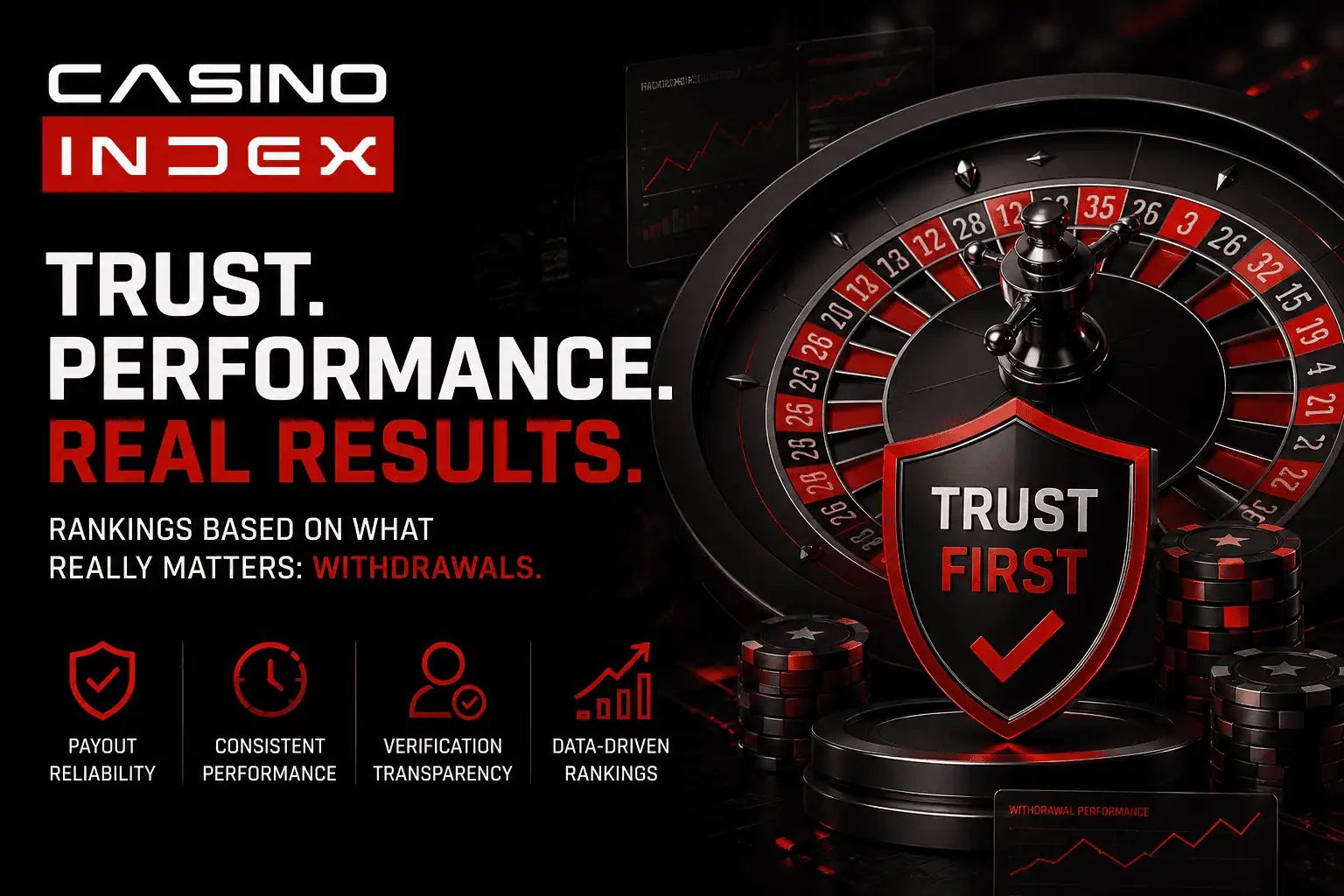
CasinoIndex uses a simple principle when evaluating casinos: the factors that can cost a player money should matter more than the factors that make a casino look attractive.
That is why our priority order is:
Trust > Withdrawals > Reputation > Product > Bonus
This page explains why the system is built in that order. It is not the page for category weights, scoring formulas, or the step-by-step review workflow. Those belong to How We Rank. It is also not the detailed evidence handbook. The CasinoIndex Trust Methodology explains how evidence, complaints, verification, payout risk, and uncertainty are judged in practice.
The purpose here is more fundamental: to explain why a large bonus, polished interface, or huge game library should never be allowed to overpower weak evidence around ownership, withdrawals, or player treatment.
Why CasinoIndex Uses a Trust-First Ranking System
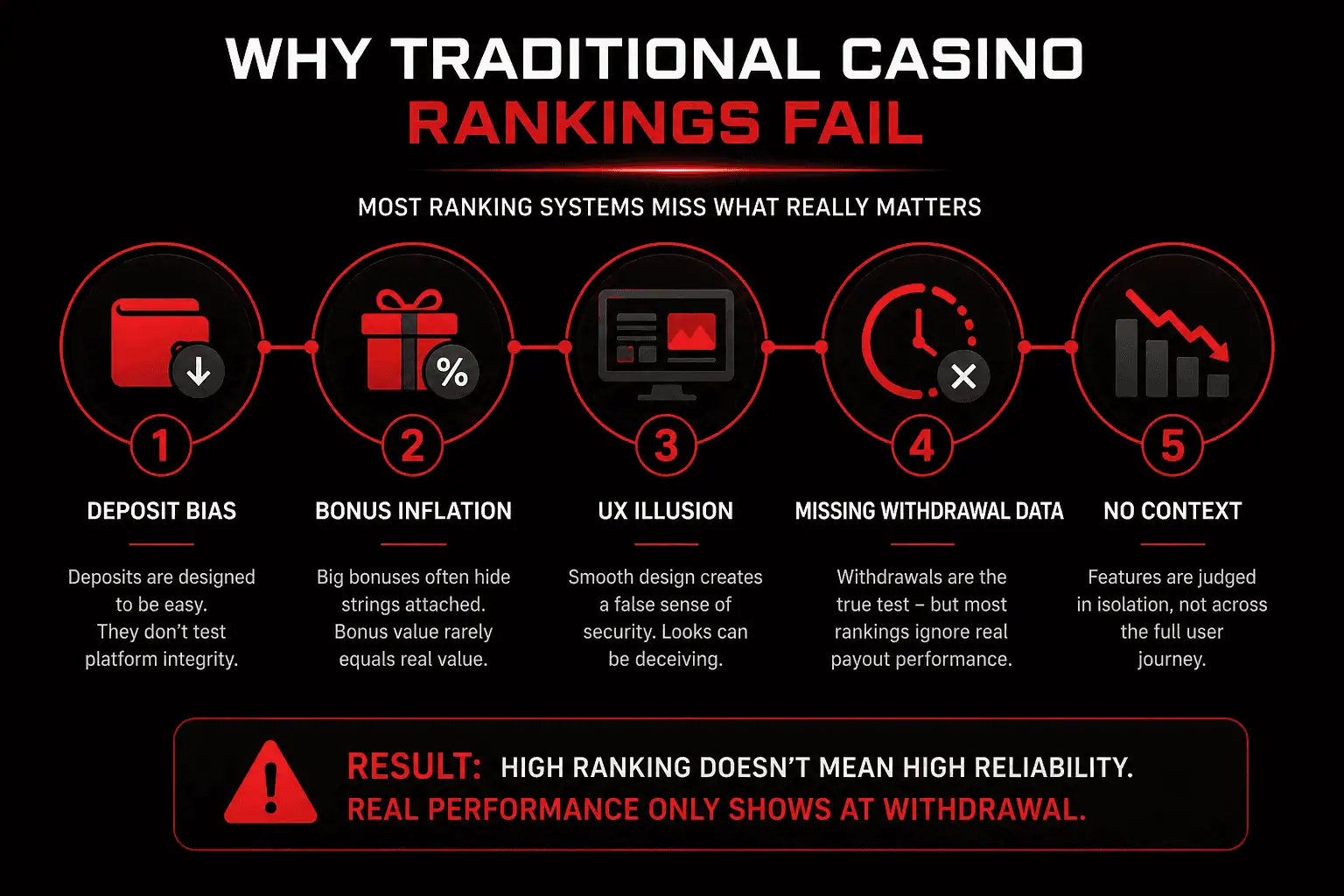
Casino rankings become misleading when easy-to-measure features dominate hard-to-measure risks.
Bonus percentages are easy to compare. Game counts are easy to display. Payment logos fit neatly into a table. A mobile interface can be judged in minutes.
Trust is harder.
You have to ask who operates the casino, whether the licence claim can be verified, how withdrawals work, when KYC can appear, what happens when a payout is delayed, how complaints are handled, and whether the same problems repeat over time.
Those questions take more work, but they matter more when real money is involved.
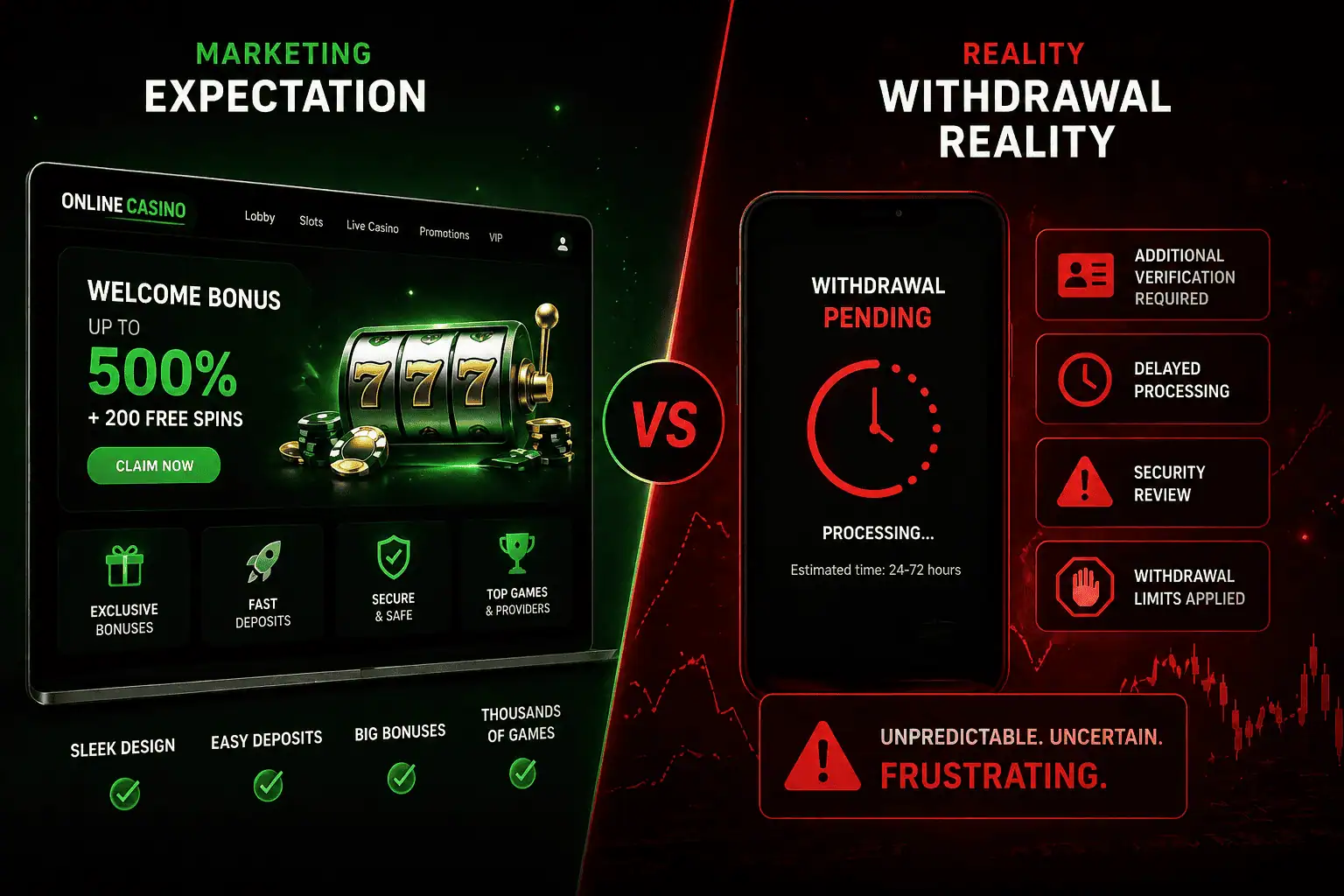
A fast deposit tells us that the casino can accept money efficiently. It says very little about how the operator behaves when money needs to leave.
A large welcome offer tells us that the casino is willing to spend money on acquisition. It does not prove that the bonus terms are fair or that legitimate winnings will be paid predictably.
A strong game library tells us that the product has depth. It does not establish who owns the platform or whether disputes are resolved properly.
The ranking system therefore starts with risk and only moves toward product value after the trust baseline is acceptable.
The Priority Order: Trust > Withdrawals > Reputation > Product > Bonus
The order is intentional. It is also more important than any individual feature score.
| Priority | Main question | Why it comes here |
|---|---|---|
| 1. Trust | Can the operator be identified, verified, and held accountable? | Everything else depends on knowing who controls the platform and how much confidence the evidence supports. |
| 2. Withdrawals | Does the casino return legitimate player funds predictably? | Withdrawals reveal how payment rules, KYC, approval checks, limits, and support work under real pressure. |
| 3. Reputation | What pattern appears across public history, complaints, and community discussion? | Reputation adds time and outside context to what a single review cannot show. |
| 4. Product | Is the casino useful, stable, and competitive once the trust baseline is acceptable? | Games, mobile quality, payments, UX, sportsbook depth, and rewards matter to long-term use, but they cannot repair structural risk. |
| 5. Bonus | Does the promotion add fair, usable value? | A bonus is optional value. It should improve a good casino, not disguise a weak one. |
This is the core CasinoIndex rule: positive features are additive, not corrective.
A strong product can improve the rating of a trustworthy casino. A fair bonus can improve the value of a reliable casino. Neither should rescue a platform with unresolved payout problems, unclear ownership, or a serious complaint pattern.
Trust Is a Gate, Not Just Another Feature
Traditional scorecards can create a strange result when every category is allowed to compensate for every other category.
Imagine a casino with excellent games, a polished app, generous rewards, and fast deposits. If the same casino has unclear ownership and repeated unresolved payout complaints, a simple average can still make the final score look respectable.
CasinoIndex rejects that logic.
Some weaknesses are not ordinary weaknesses. They change how the rest of the score should be interpreted.
Unclear ownership matters more than a missing mobile feature. A repeated payout pattern matters more than a limited game category. A serious licence problem matters more than a mediocre welcome offer.
That is why trust can act as a ceiling on the rest of the rating. A casino should not reach an elite score simply because it is excellent in low-risk categories.
What Information Can Actually Change a Casino Rating?
A CasinoIndex score is not supposed to be a permanent label. It should move when the evidence changes.
Not every new piece of information deserves the same reaction. A new promotion may change bonus value. A redesigned cashier may improve usability. Those can matter, but they usually do not transform the risk profile.
The information most capable of changing a rating is information that changes what we know about accountability, access to funds, consistency, or player treatment.
| New information | Possible rating effect | Why it matters |
|---|---|---|
| Verified licence or ownership change | Material increase or decrease | Changes who is accountable and which regulatory framework applies. |
| Repeated new withdrawal complaints | Potential downgrade | May indicate a developing operational pattern rather than an isolated event. |
| Previously unresolved payout cases are credibly resolved | Can improve confidence over time | Resolution quality matters, especially when the operator explains and fixes the underlying issue. |
| Withdrawal rules, limits, or KYC terms change | Can change payment-risk assessment | These rules directly affect access to legitimate winnings. |
| Longer clean operating history | Can gradually increase confidence | Time creates evidence that a new casino cannot manufacture at launch. |
| New high-quality product features | Usually moderate positive effect | Product improvements add value once the core trust profile is acceptable. |
| Larger welcome bonus | Limited effect | Bonus value is secondary and cannot compensate for weak trust. |
The key word is evidence. A casino saying it has improved is not the same as evidence that the underlying problem has improved.
Likewise, one new complaint does not automatically justify a downgrade. The context, severity, source quality, operator response, and whether similar reports appear elsewhere all matter.
Withdrawal Evidence Deserves Extra Weight
Withdrawals are not the entire trust model, but they are one of its most revealing operational signals.
Why? Because a withdrawal forces several systems to work together at once.
The casino may need to confirm account eligibility, bonus status, payment ownership, verification status, limits, fraud controls, source-of-funds requirements, and the actual release of the payment.
That makes withdrawal behaviour much more informative than deposit speed.
But “withdrawal evidence” does not mean one fast cashout screenshot.
One successful payout proves only that one payout succeeded.
Stronger evidence appears when the same basic behaviour remains visible across different situations: ordinary withdrawals, larger withdrawals, repeated cashouts, verified accounts, bonus users, different payment methods, and cases where support needs to explain a delay.
The system also separates casino processing from external settlement. A slow blockchain confirmation is not automatically a casino failure. A bank transfer can take time after the casino releases it. Conversely, a fast blockchain does not excuse a long unexplained internal approval delay.
The principle is consistency, not perfection.
A trustworthy casino may still perform legitimate checks. What matters is whether the rules were knowable, the checks are proportionate, and the operator communicates clearly when the normal payout path changes.
Licensing and Ownership Form a Separate Evidence Layer
A licence badge is not a complete trust score.
It is one part of the accountability layer.
CasinoIndex separates licensing and ownership from withdrawal performance because they answer different questions.
Licensing asks: which regulator or legal framework is connected to the casino, and can the claim be verified?
Ownership asks: which company controls the brand, and can that company be connected to the licence, terms, and operating history?
Withdrawal evidence asks: how does the operator actually behave when players request money?
A casino can have a real licence and still deliver a poor player experience. A casino can also process some withdrawals quickly while remaining difficult to evaluate because the operator behind it is unclear.
Neither signal should replace the other.
This is why CasinoIndex does not treat “licensed” as a shortcut for “safe,” and does not treat “fast payout” as a shortcut for “trustworthy.”
Complaint Patterns Need Context, Not Panic
Complaints are useful, but only when they are read carefully.
Every meaningful casino brand can attract negative reviews. Some complaints are serious. Others result from misunderstood bonus rules, blocked countries, third-party payment use, failed verification, duplicate accounts, chargebacks, or terms the player did not read.
So one angry post is not enough to define a casino.
The stronger signal is a pattern.
A complaint pattern becomes more important when several conditions line up:
- different users describe the same underlying problem
- the issue involves access to funds, account restrictions, or verification
- similar cases appear across more than one source
- the operator gives vague, inconsistent, or no meaningful responses
- the problem continues over time rather than disappearing after one incident
Resolution matters too.
A complaint that ends with a documented payment after a clear verification process should not be treated the same as an unresolved confiscation claim with no useful explanation.
That distinction is one reason CasinoIndex avoids turning community sentiment into a simple popularity score. The Trust Methodology is where the detailed evidence and risk interpretation belongs; this page explains why repeated patterns matter more than isolated noise.
Reputation Is Broader Than Review-Site Ratings
Reputation is not the same thing as a Trustpilot score, Reddit sentiment, or the number of followers a casino has.
It is the accumulated public record around the operator.
That can include operating history, how long the brand has been visible, whether ownership changes are transparent, how the casino responds to disputes, whether community concerns repeat, and whether the public story matches the operator’s own claims.
A large brand can still lose reputation strength when serious issues repeat.
A new brand can have a clean launch and still remain unproven because it has not existed long enough to build a meaningful record.
This is why reputation sits below direct trust and withdrawal evidence but above product features. It gives the score historical context.
Why Bonus Can Never Rescue Weak Trust
Bonuses matter. They simply matter later.
A fair promotion can make a strong casino more attractive. Clear wagering, reasonable max-bet rules, transparent restricted games, realistic expiry, and no abusive cashout cap are all positive.
But the bonus category should not be powerful enough to cover structural risk.
Consider two casinos:
| Casino A | Casino B |
|---|---|
| Large 300% welcome bonus | Smaller or no welcome bonus |
| Repeated payout complaints | Stable withdrawal record |
| Unclear ownership | Verifiable operator |
| Vague KYC language | Clear verification rules |
| Strong game library | Strong game library |
A marketing-first model can make Casino A look competitive because the bonus is easy to quantify.
A trust-first model should prefer Casino B.
The reason is simple: the bonus is optional. Access to legitimate winnings is not.
Players who want to compare casinos from their own perspective rather than from the scoring-system perspective can use How to Compare Casinos Beyond Bonus Size. That page is a decision guide for users; this page explains the principle behind the CasinoIndex ranking order.
Product Quality Still Matters — After the Trust Baseline
Trust-first does not mean product-blind.
Once the core risk profile is acceptable, product quality becomes important.
A casino with reliable payments but a broken mobile site, poor support access, unstable games, confusing navigation, or a weak cashier is not a great casino simply because it pays.
Product quality helps separate acceptable casinos from genuinely strong ones.
That can include:
- mobile usability
- game and provider quality
- sportsbook depth where relevant
- cashier clarity
- account controls
- support access
- responsible gambling tools
- platform stability
- usable VIP, cashback, or rakeback systems
The difference is that product strengths are evaluated after trust weaknesses have been considered, not instead of them.
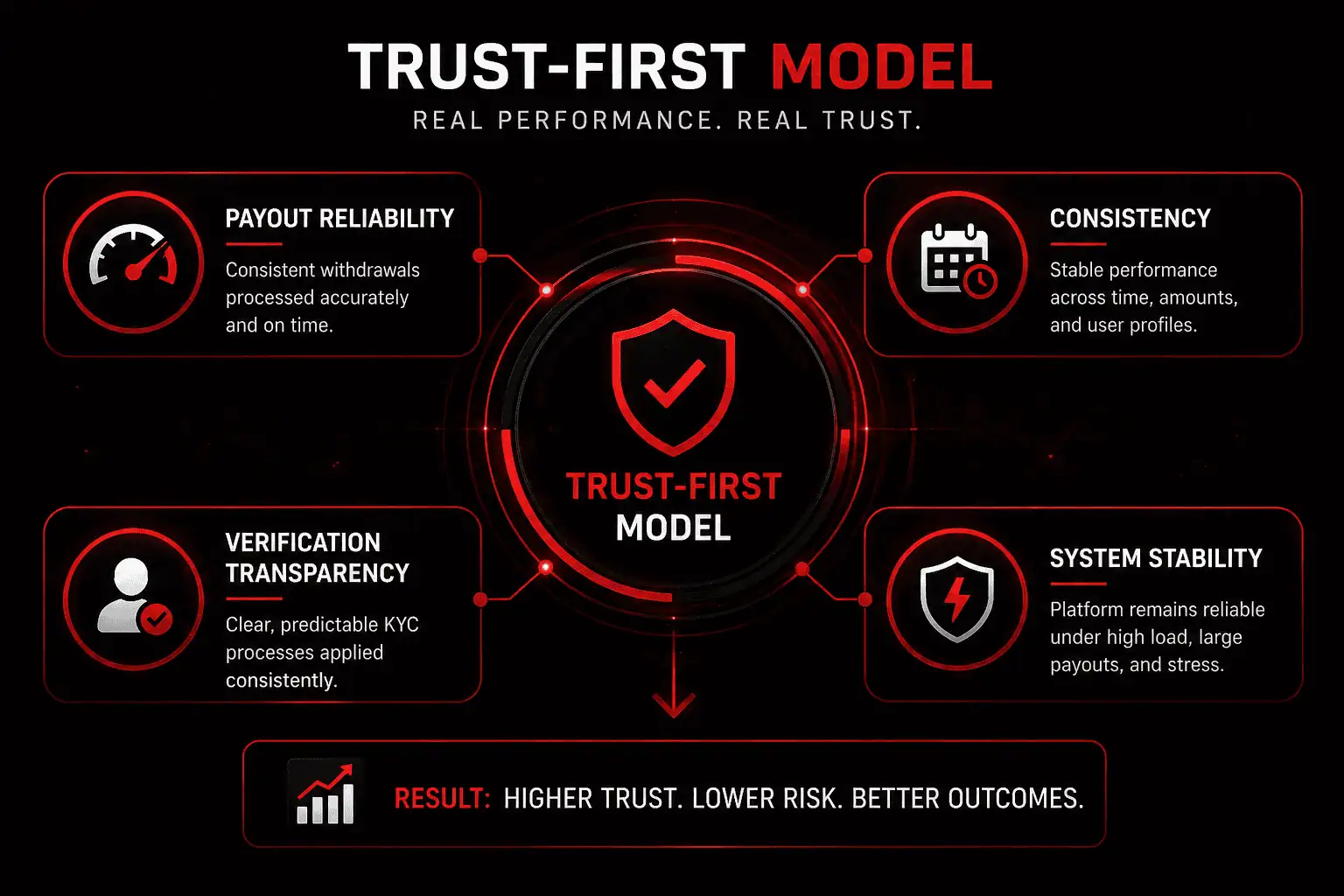
What a Score Can Change — and What It Should Not React To
A useful rating system needs enough flexibility to respond to new evidence without becoming unstable.
If every negative post changes a score, the ranking becomes emotional.
If nothing changes a score once a review is published, the ranking becomes stale.
CasinoIndex tries to sit between those extremes.
Material evidence should matter. Noise should not.
Examples of information that can justify reassessment include a regulator action, ownership change, new licence status, a sustained withdrawal pattern, major terms change, repeated account-block reports with similar facts, a resolved dispute pattern, or a longer operating history that changes how much uncertainty remains.
By contrast, a new homepage design, one influencer partnership, one unusually fast payout, one angry review, or one larger bonus usually does not justify a fundamental change by itself.
This is also why the quality of the underlying review matters. A reliable review must separate what is verified, what is reported by users, and what remains editorial judgment. CasinoIndex expands that idea in What Makes a Casino Review Actually Reliable.
What the CasinoIndex Score Does Not Prove
A rating is a structured judgment based on the evidence available at the time. It is not a guarantee.
A high score does not prove that:
- every withdrawal will be instant
- every player will avoid KYC
- every dispute will be resolved in the player’s favour
- the casino will never change its terms
- the operator will remain equally reliable forever
- a licence guarantees recovery of funds in every dispute
- every bonus is automatically good value
- gambling at the casino is financially safe or profitable
A low or cautious score also does not automatically prove fraud.
Sometimes the issue is insufficient evidence rather than confirmed misconduct. A new casino may be too young to demonstrate long-term payout consistency. Ownership may be technically disclosed but difficult to verify. Complaint evidence may be mixed. The correct response in those situations is uncertainty, not certainty disguised as precision.
That is why score caps and cautious ranges exist in the wider ranking process.
The score should be read as a summary of relative confidence and risk based on current evidence, not as a promise about every future player experience.
Three Methodology Pages, Three Different Jobs
CasinoIndex separates the philosophy, the scoring process, and the evidence framework so that each page can answer one question well.
| Page | Primary question | What belongs there |
|---|---|---|
| Trust-First Casino Ranking System | Why is the system built this way? | The principle behind putting trust, withdrawals, and reputation ahead of product and bonus. |
| How We Rank | How does the ranking process work? | Categories, weights, scoring logic, score caps, review process, and how the final number is produced. |
| Trust Methodology | How is evidence and risk judged? | Evidence quality, payout risk, licensing, KYC, complaints, payment rules, uncertainty, and interpretation. |
Keeping those roles separate makes the methodology easier to understand and prevents one page from trying to answer every possible question.
Why the System Starts With Downside Risk
There is a broader reason for the order.
Casino rankings are not the same as ranking headphones, hotels, or streaming services.
The user is depositing money into an account controlled by an operator. The quality of that operator affects whether the player can verify, withdraw, resolve a dispute, and understand the rules that apply to the balance.
That makes downside risk more important than promotional upside.
A $2,000 bonus cannot repair a $5,000 withdrawal problem.
A premium interface cannot repair an operator identity that cannot be verified.
A huge game library cannot repair inconsistent confiscation rules.
That does not mean every delay or complaint proves wrongdoing. It means the ranking order should reflect the seriousness of the possible consequence.
A Better Ranking Should Explain Its Uncertainty
One of the easiest ways to make a rating look more precise than it really is is to hide uncertainty.
Some casinos have years of public history, thousands of player reports, clear ownership, visible licensing, established payment rules, and a long operating record.
Others are six months old.
Those two casinos should not receive the same level of confidence simply because both websites work well today.
Trust-first ranking therefore treats missing history as missing evidence, not as proof of quality or proof of failure.
The same applies to mixed complaints. If the evidence is genuinely conflicting, the score should show more caution rather than forcing a definitive conclusion.
This principle is important because a ranking should tell the reader not only what we think, but also how certain the available evidence allows us to be.
From Features to Evidence
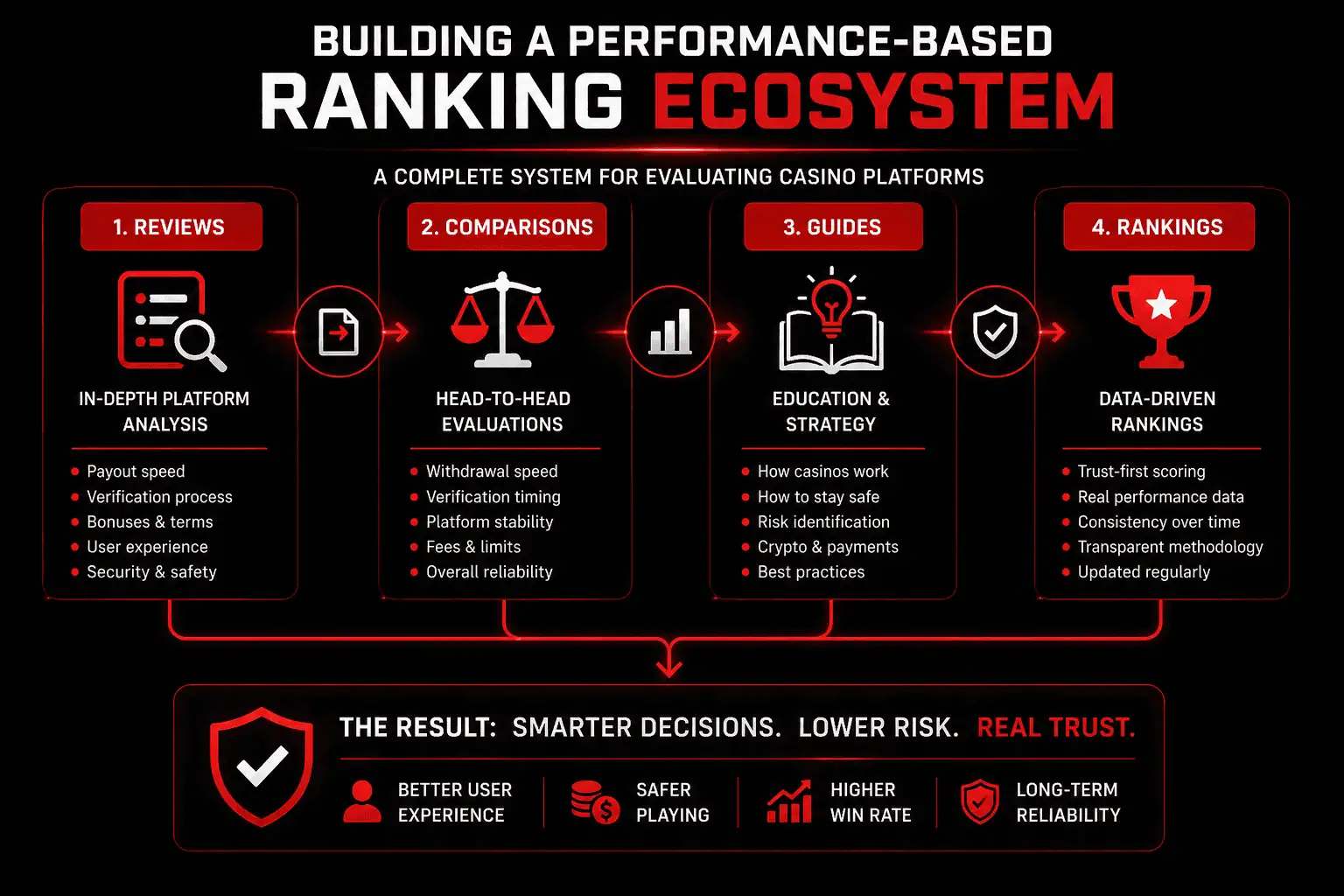
The central change in a trust-first model is not that bonuses, games, design, or rewards disappear.
They move into the correct place.
The system first asks whether the operator can be identified and held accountable.
Then it asks whether legitimate withdrawals are handled predictably.
Then it looks at the public record and whether problems appear isolated or repeated.
Only after those questions does product depth become a major differentiator.
Bonus value comes last because a promotion can improve an already credible casino, but it should never be allowed to manufacture credibility.
Final Principle: Trust Before Attraction
CasinoIndex does not use a trust-first model because bonuses, games, or design are unimportant.
We use it because those features are easier for a casino to improve than the systems that matter when something goes wrong.
A casino can redesign a homepage quickly.
It can launch a larger promotion tomorrow.
It can add more providers.
Building a credible operating history, maintaining predictable withdrawals, applying verification fairly, resolving complaints properly, and keeping ownership and licensing transparent takes longer.
That is the difference the ranking system is designed to capture.
Trust > Withdrawals > Reputation > Product > Bonus.
Not because the last two categories do not matter, but because they should never be powerful enough to hide failure in the first three.
FAQ — Trust-First Casino Ranking System
What does “trust-first” mean at CasinoIndex?
It means the ranking starts with risk and accountability. Trust, withdrawals, and reputation are considered before product quality and bonus value.
Why do withdrawals matter so much?
Withdrawals combine payment rules, approval checks, KYC, limits, support, and the actual release of player funds. They therefore reveal more about operational behaviour than a fast deposit alone.
Can a large bonus increase a weak casino’s score?
A fair bonus can improve the bonus component of a rating, but it should not override serious trust, ownership, licensing, withdrawal, or complaint concerns.
Does one complaint lower a casino’s rating?
Not automatically. CasinoIndex looks at severity, context, source quality, operator response, and whether similar complaints repeat across users or sources.
Can a casino’s score change after publication?
Yes. New evidence such as ownership changes, licence updates, withdrawal patterns, terms changes, complaint resolution, or a longer operating history can justify reassessment.
Does a high CasinoIndex score guarantee fast withdrawals?
No. A score summarizes current evidence and relative confidence. Individual withdrawals can still involve legitimate verification, payment-provider delays, network conditions, or account-specific review.
What is the difference between this page and How We Rank?
This page explains why CasinoIndex puts trust and withdrawals ahead of product and bonuses. How We Rank explains the practical scoring system, categories, weights, caps, and calculation process.
What is the difference between this page and the Trust Methodology?
This page explains the philosophy behind the ranking order. The Trust Methodology explains how evidence and risk signals such as licensing, withdrawals, KYC, complaints, and payment rules are interpreted.

Talha Aydin has been active in cryptocurrency since 2017 and is a co-founder of Freecoins24 and CryptoMutant. Over the years, he has worked with crypto projects on community growth, giveaways, user acquisition and digital strategy while gaining hands-on experience across blockchain platforms and crypto markets. At CasinoIndex, Talha focuses on crypto casinos, withdrawals, payment systems, platform trust and the risks players face when moving funds between wallets and gambling platforms.