Shuffle vs Gamdom for Crypto Players: Which Platform Holds Up Better After Signup?
Article OverviewShuffle and Gamdom offer crypto casino gaming, sportsbook access and loyalty rewards, but their account rules and reward structures differ. Shuffle's terms provide for an ID check before the first withdrawal, alongside possible additional verification. Neither platform guarantees faster VIP payouts or unrestricted withdrawals. This comparison examines KYC, withdrawal conditions, loyalty programs and trust risks.
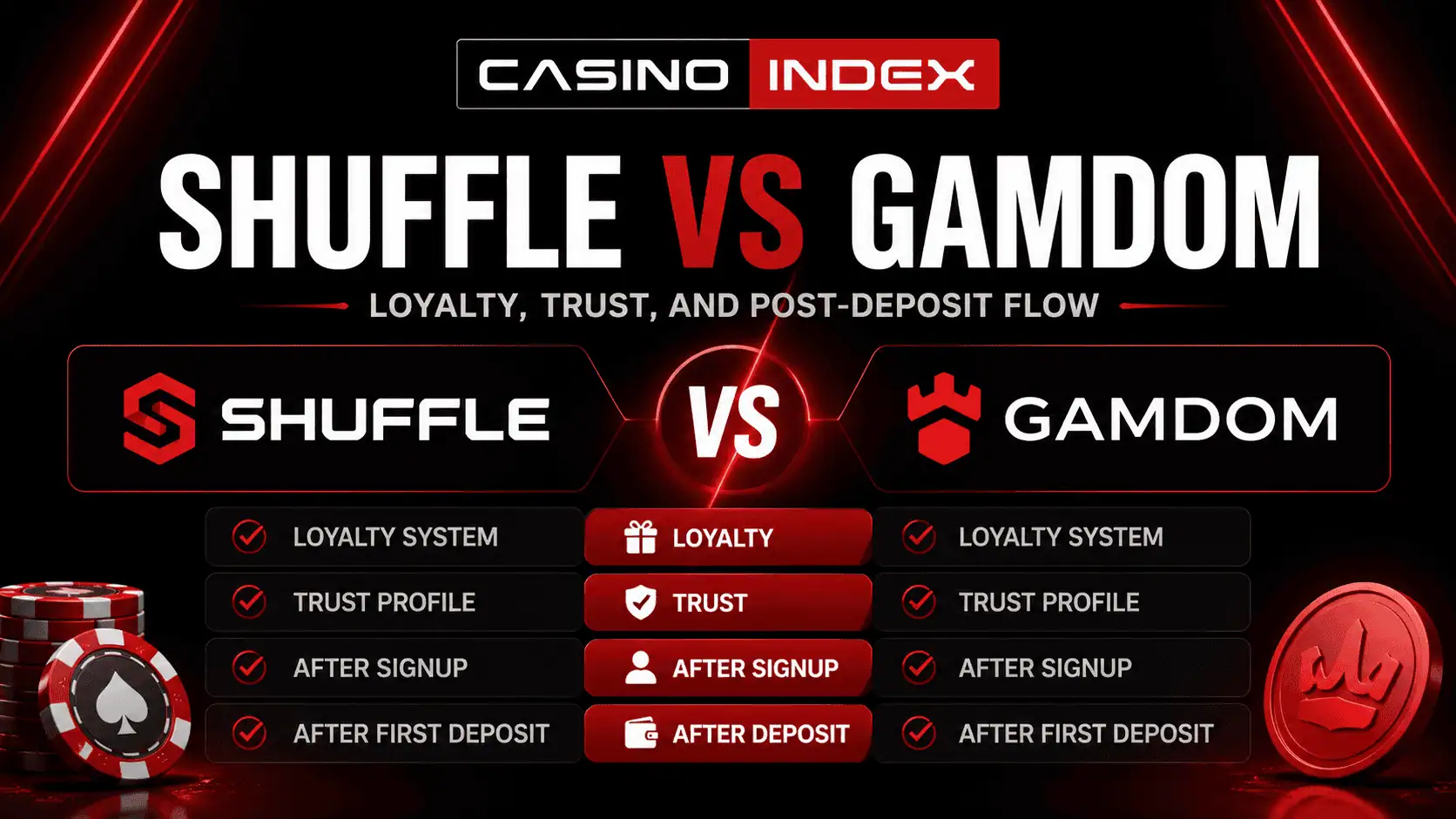
Shuffle vs Gamdom is mainly a comparison of verification rules, withdrawal conditions and reward transparency—not a contest over which casino promises the fastest payouts. Both offer crypto-focused gambling and recurring rewards. Neither can be judged safer simply because its interface feels smoother or its VIP program looks more generous.
The most consequential documented difference appears at cashout: Shuffle’s Terms of Service, Section 5.2, provide for a government-issued ID check before the first withdrawal, with further risk-based checks possible. Gamdom’s help centre says players can typically withdraw without completing KYC unless the operator requests it. That is a difference in published policies, not proof that one casino approves payouts faster or more reliably.
This comparison looks at what the two operators actually publish, what remains unverified and which questions matter before committing money. It does not present independent withdrawal tests, audited service times or guaranteed VIP advantages. Read CasinoIndex’s casino evaluation methodology for the trust-first approach behind the analysis.
Quick Verdict: Shuffle or Gamdom?
Shuffle offers more publicly described VIP progression and a clearer published first-withdrawal ID requirement. Gamdom documents personalised rewards and says KYC is requested when needed, rather than automatically for every withdrawal. Both operators retain the ability to review accounts and apply restrictions.
For a reader comparing the two, the useful distinction is not “Gamdom wins early, Shuffle wins later.” That old conclusion depended on unverified claims about better long-term limits, faster VIP payouts and premium handling. There is no comparable public evidence here to establish those performance advantages.
If avoiding unexpected identity checks is important, Shuffle’s specific first-withdrawal rule deserves attention. If a transparent VIP formula is important, compare the published XP thresholds at Shuffle with Gamdom’s personalised rewards, whose exact calculation is not fully disclosed. Neither difference establishes superior withdrawal safety.
Shuffle vs Gamdom Comparison Table
The table separates published operator rules from editorial observations. It does not score cashout success or processing speed without independently documented results.
| Comparison point | Shuffle | Gamdom |
|---|---|---|
| First withdrawal and ID | Terms §5.2 provide for a government-issued ID check before the first withdrawal. | Help centre says KYC is not normally mandatory unless specifically requested; a withdrawal can trigger a request. |
| Additional checks | Identity, location, payment ownership and source-of-funds evidence may be requested under its terms. | Published KYC levels include ID/selfie and, in some cases, proof of funds or address. |
| Reward structure | Public VIP levels, XP thresholds, rakeback and recurring bonuses. | Personalised instant, weekly and monthly rewards; progress and reward calculations can vary. |
| VIP support | Higher tiers may unlock a dedicated VIP host. | Invitation-only VIP program advertises personalised support and promotions. |
| Higher payout limits | VIP marketing mentions higher limits, but tier-specific figures and eligibility are not established here. | No verified like-for-like public VIP limit schedule established for this comparison. |
| Faster VIP payouts | Advertised as a possible VIP benefit; no independently verified processing advantage or binding time guarantee established. | No comparable independently verified VIP processing advantage established. |
| Withdrawal conditions to notice | First-withdrawal ID check, further reviews and payment-method verification. | KYC when requested; official FAQ states deposits and free-spin winnings must be wagered at least once before withdrawal. |
| Full casino review | Read Shuffle Review | Read Gamdom Review |
Source distinction: Contractual verification clauses, operator help-centre explanations and VIP promotional claims are different types of evidence. None of them, on their own, proves consistent real-world approval times. Sources: Shuffle Terms §5, Shuffle VIP program, Gamdom KYC help and Gamdom FAQ.
KYC and Withdrawals: The Most Important Difference
Shuffle: ID Check Before the First Withdrawal
Shuffle’s Terms of Service, Section 5.2, say that a government-issued identity document check may be required when a threshold set by the operator is reached and, in any event, before the first withdrawal. The acceptable examples include a passport, identity card or driving licence. Supplementary electronic, payment or selfie checks can also apply.
This is more precise than saying that Shuffle “might request KYC at any time.” Section 5.1 allows checks more broadly, while Sections 5.4 and 5.5 cover source-of-funds evidence and verification of payment methods. A straightforward signup does not remove the first-withdrawal requirement.
Practical implication: Do not classify Shuffle as an operator where the first cashout can safely be assumed to happen without identity verification. This rule applies regardless of how attractive the VIP program appears.
Gamdom: KYC When Specifically Requested
Gamdom’s official verification guide says customers can typically deposit, play and withdraw without completing KYC, unless the operator requests it. That is an operator description of its normal process, not a guarantee that a particular player will avoid checks.
Gamdom publishes different levels of verification, including basic personal details, government-issued ID and selfie, and—in some situations—proof of funds or address. The operator says withdrawals may be disabled while required checks remain incomplete.
The relevant distinction is therefore Shuffle’s explicit pre-first-withdrawal ID provision versus Gamdom’s request-based verification description. Whether an individual withdrawal is approved, delayed or subjected to additional checks cannot be reliably predicted from this wording alone.
Withdrawal Speed, Limits and VIP Claims: What Is Actually Supported?
Shuffle’s VIP promotional page includes higher deposit and withdrawal limits and faster withdrawal processing among potential VIP benefits. Those are genuine operator-published marketing claims. However, the material checked for this comparison does not establish specific tier-by-tier cashout limits, a binding approval deadline or measured faster processing relative to Gamdom.
Consequently, this article does not award Shuffle a withdrawal-performance advantage for those statements. The same standard applies to any Gamdom claim about speed or preferential support.
Gamdom’s official FAQ describes typical payout processing of around five minutes to one hour, with some bank methods taking longer. That is the operator’s published estimate, not an independent measurement or a guarantee for accounts under review. It also says deposits and free-spin winnings have a wagering condition before withdrawal. Players should read the applicable current terms rather than assume that an estimate covers every payment type.
For either casino, it helps to distinguish three separate stages: an account or KYC review, the operator’s approval of the withdrawal, and the transaction moving through the chosen payment network. A fast blockchain does not shorten a pending internal review. Read CasinoIndex’s withdrawal approval checks guide for the distinction.
Loyalty Programs: Documented Rewards vs Assumed Long-Term Value
Shuffle’s Published XP and VIP Structure
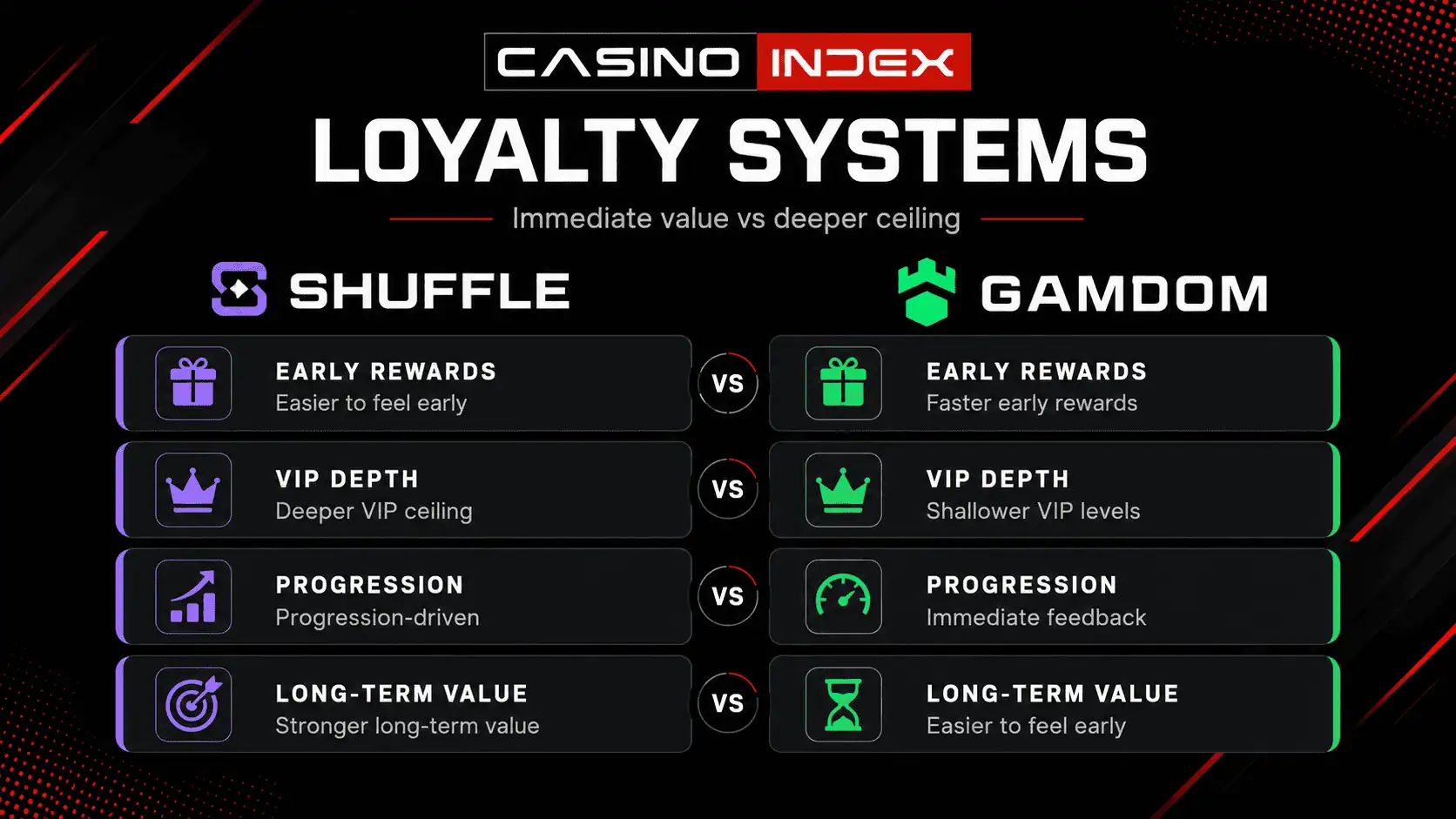
Shuffle describes more than 50 VIP levels, along with rakeback, daily bonuses, weekly and monthly rewards, reloads and higher-tier host services. Its VIP help article publishes examples of XP thresholds, such as 10,000 XP for Silver, 100,000 XP for Gold and 450,000 XP for Platinum. Those are useful disclosures because a reader can see some progression requirements in advance.
That does not establish that a higher VIP rank makes withdrawal approval safer, bypasses KYC or creates an automatic entitlement to a larger cashout. The first-withdrawal rule still matters, and higher-risk checks can still occur. Nor should readers increase gambling activity solely to reach a reward tier.
Gamdom’s Personalised Rewards and Invitation-Only VIP
Gamdom’s rewards guide describes instant, weekly and monthly rewards, with amounts influenced by wagering, game RTP or house edge and other factors. Its exact formula is not publicly disclosed in full. The same guide explains rank progression and a time-limited boosted instant-reward offer for eligible new users; readers should verify the offer in the current account before relying on it.
Separately, Gamdom’s VIP guide says the additional VIP program is invitation-only and advertises dedicated support, tailored promotions and fee-free withdrawals for eligible VIP members. Fee-free does not mean guaranteed instant approval, and an invitation is not the same as a published entitlement for every account.
Comparison: Shuffle gives readers clearer public VIP progression milestones; Gamdom documents personalised rewards and a more discretionary VIP invitation system. That is a comparison of published program design, not evidence that one returns more money to every player.
Rakeback and bonuses offset only part of the cost of gambling and do not remove the house edge. Uncertain future rewards should never justify wagers that exceed a player’s planned spending limit.
Trust: Rules Matter More Than First Impressions
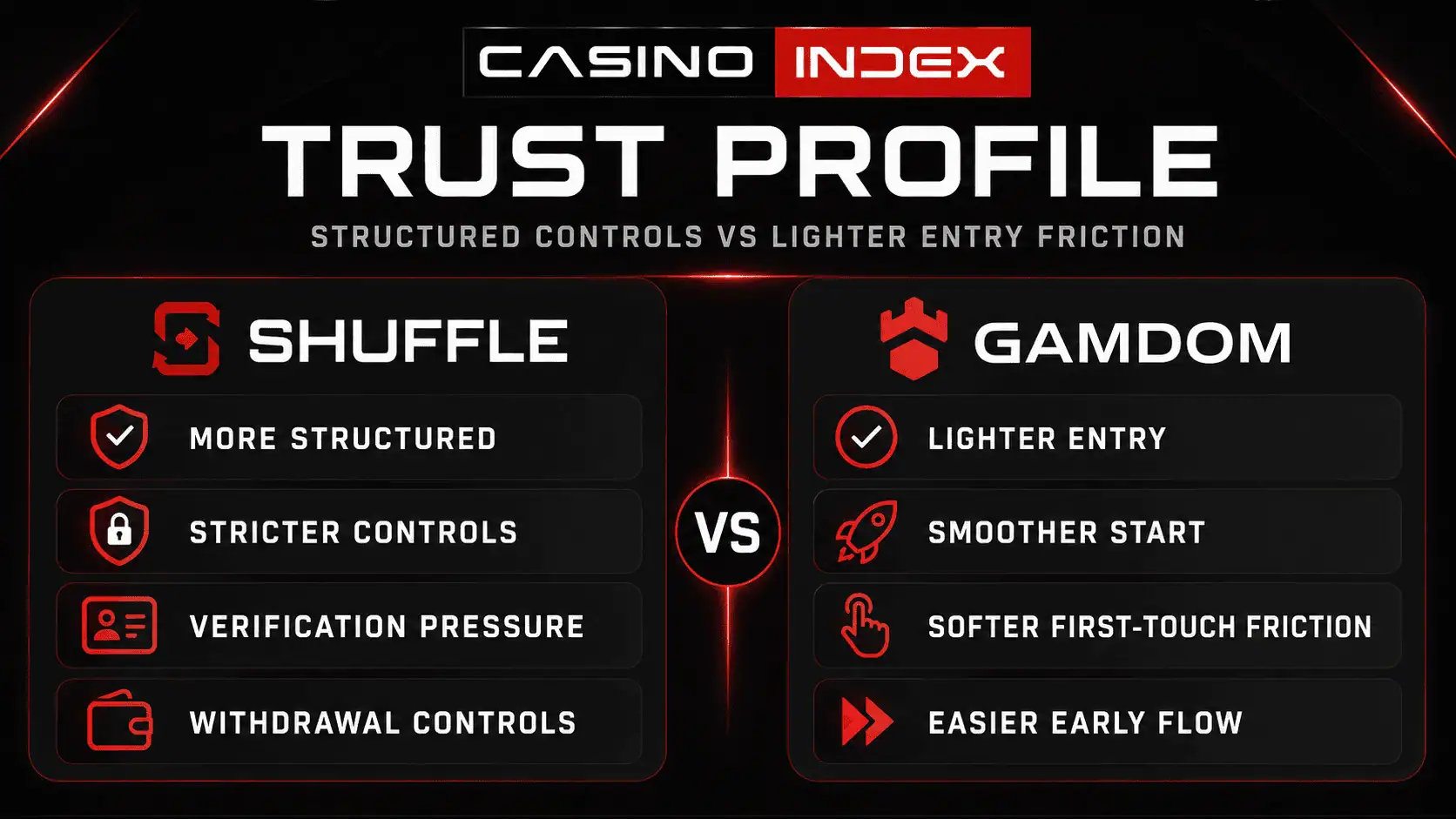
The older comparison treated Shuffle as more structured and Gamdom as easier at entry, then turned those impressions into a trust verdict. That was too much of a leap. A visible VIP ladder does not prove stronger financial controls; a convenient signup does not prove weaker controls.
A trust-first comparison gives more weight to the operator’s identity and licensing record, geographic restrictions, terms for withholding funds, the clarity of KYC requests and documented complaint outcomes. These checks must be supported by current evidence. This page is not presenting a controlled audit of account restrictions or a comparable sample of paid and unpaid withdrawals.
For the reader, the relevant questions are concrete: Will identity verification be required? What further records might be requested? Do the advertised reward conditions create restrictions on withdrawals? Is the casino permitted to serve your country? Can the operator explain a delayed payment? The safe casino KYC guide helps assess whether verification requests are appropriate and clearly explained.
After Signup and the First Deposit: What to Compare
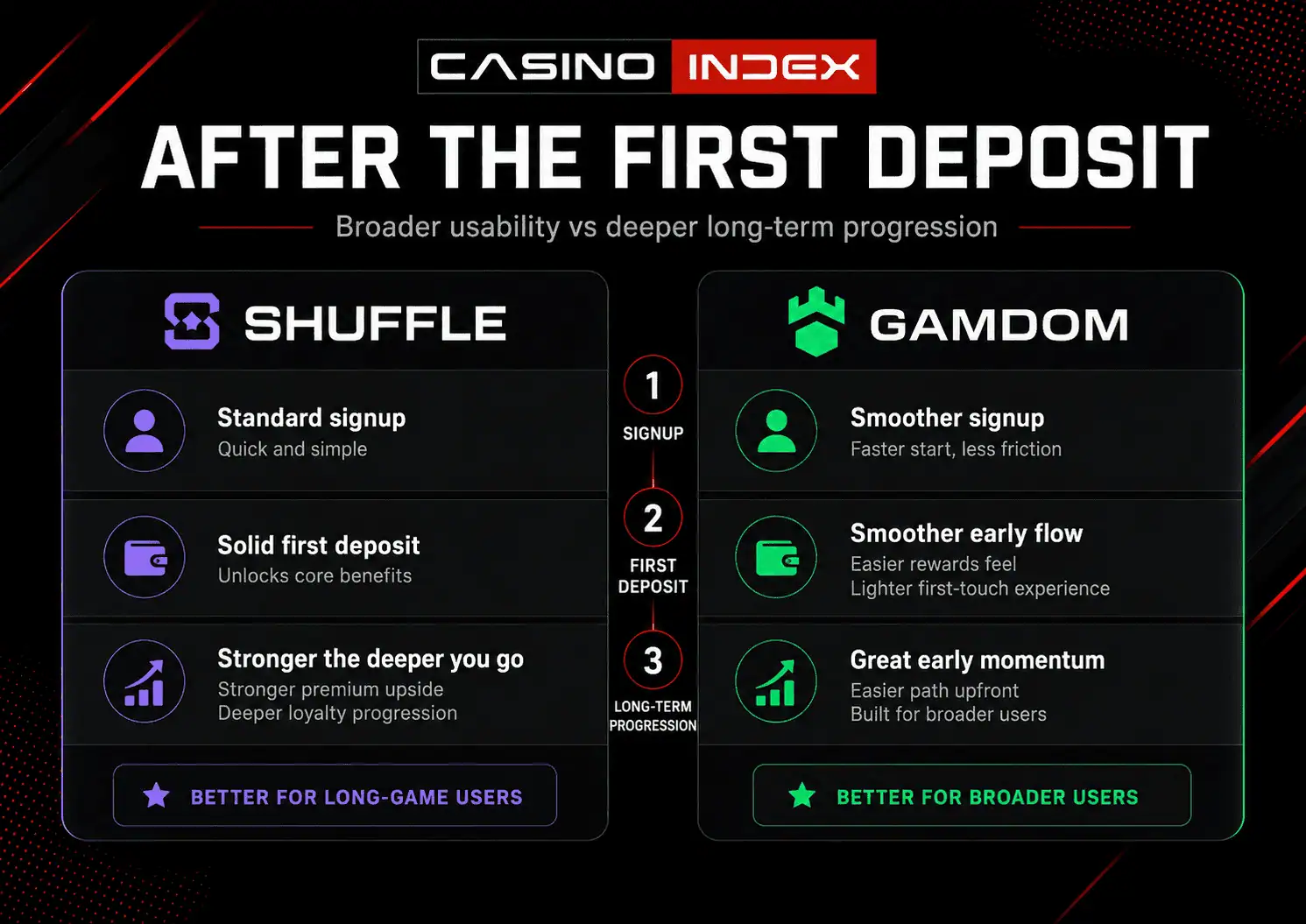
Signup experience alone is a weak basis for choosing a casino. A fast registration process says little about withdrawals; an attractive loyalty dashboard says little about the conditions attached to funds.
Before depositing at either brand, check the legal status in your country, the operator and account details, the permitted payment route and any restrictions on deposits, bonuses and cashouts. At Shuffle, specifically plan for the ID check described in Section 5.2 before the first withdrawal. At Gamdom, read the current KYC request rules and the FAQ’s wagering condition for deposits and free-spin winnings.
If you decide to use a casino, avoid holding an unnecessarily large balance on-site and keep transaction records. A successful smaller withdrawal can confirm that one payment route worked on that occasion, but it does not prove a later high-value request will be processed the same way.
Never interpret difficulty withdrawing as a reason to gamble more unless an applicable, legitimate wagering condition is clearly documented and you have independently considered the risk. If a payment is delayed, ask for the specific contractual reason and retain written responses. CasinoIndex explains this process in why casinos delay withdrawals.
Who Might Prefer Shuffle or Gamdom?
Shuffle may be easier to assess for someone who values published VIP thresholds, provided they are willing and able to meet the first-withdrawal identity check. Its documented progression structure does not by itself justify choosing the casino for payout safety.
Gamdom may appeal to someone comparing personalised ongoing rewards and a published request-based KYC model. However, its partially undisclosed reward formula means projected benefits are difficult to compare with precision; verification and withdrawal restrictions can still apply.
Neither receives an evidence-based win for large withdrawals or preferential VIP treatment in this comparison. Without comparable records showing actual approval outcomes, deciding that Shuffle has the better “long-term ceiling” or Gamdom has a reliably smoother cashout would be speculation.
Shuffle vs Gamdom FAQ
Is Shuffle better than Gamdom?
Not across every category. Shuffle has published VIP progression milestones and an explicit first-withdrawal ID provision. Gamdom documents personalised rewards and request-based KYC. Those are useful differences, but they do not prove one operator consistently pays more quickly or safely.
Does Shuffle require ID before the first withdrawal?
Shuffle’s current Terms of Service, Section 5.2, provide for a government-issued ID check before the first withdrawal. Additional identity, payment-method and source-of-funds checks may also apply.
Does Gamdom require KYC to withdraw?
Gamdom’s official help centre says KYC is not typically mandatory unless requested. The operator may require verification to complete withdrawals or for other compliance reasons, and it may restrict withdrawals while required checks remain outstanding.
Do Shuffle VIP members get faster payouts or higher limits?
Shuffle advertises those as VIP benefits. However, this comparison does not have verified tier-specific thresholds, guaranteed processing times or independent evidence establishing a faster or safer outcome than Gamdom. VIP status does not cancel applicable KYC requirements.
Which casino has better rewards?
Shuffle publishes XP thresholds and several recurring VIP rewards; Gamdom uses personalised calculations and offers a separate invitation-only VIP program. Actual reward value varies with eligibility, activity, game terms and the currently available offer. Neither program guarantees profit.
Are withdrawals instant at Shuffle and Gamdom?
No instant payout can be assumed in all circumstances. A casino may need to approve the request, verify the account or check the payment route before sending funds. Operator speed estimates and VIP marketing are not evidence that every withdrawal meets the advertised timing.
Final Verdict: A More Evidence-Based Choice
The original case for a clear Shuffle long-term advantage relied too heavily on claims about higher limits, faster VIP handling and premium treatment. Shuffle promotes such possibilities, but without comparable, specific and verifiable payout evidence they are not an adequate basis for recommending it over Gamdom.
The supported conclusion is narrower and more useful: Shuffle is more explicit about first-withdrawal identification and public VIP progression; Gamdom describes request-based KYC and personalised rewards. Both can apply reviews that affect access to funds. Which account fits a reader’s needs depends on the terms, jurisdiction, payment route and tolerance for verification—not an unproven promise of preferential payouts.
For the operator-level picture, continue with the Shuffle review and Gamdom review. For account and payout protections, consult CasinoIndex’s rating methodology and responsible gambling guide.
Related Crypto Casino Comparisons
Evidence reviewed: 26 October 2026. Terms, eligibility and offers can change. CasinoIndex distinguishes published operator rules and promotional claims from independently observed payment outcomes.

Nina Kanu has worked in cryptocurrency content and blockchain research since 2016. She is also known within parts of the crypto community through CryptoMutant, where her work has covered emerging projects, market trends and developments across the blockchain ecosystem. At CasinoIndex, Nina focuses on crypto casino reviews, platform comparisons, player experience, game ecosystems and bonus fairness. Her research examines how casino products perform beyond their marketing, including usability, payment options, promotional terms and the overall experience players receive after signing up.