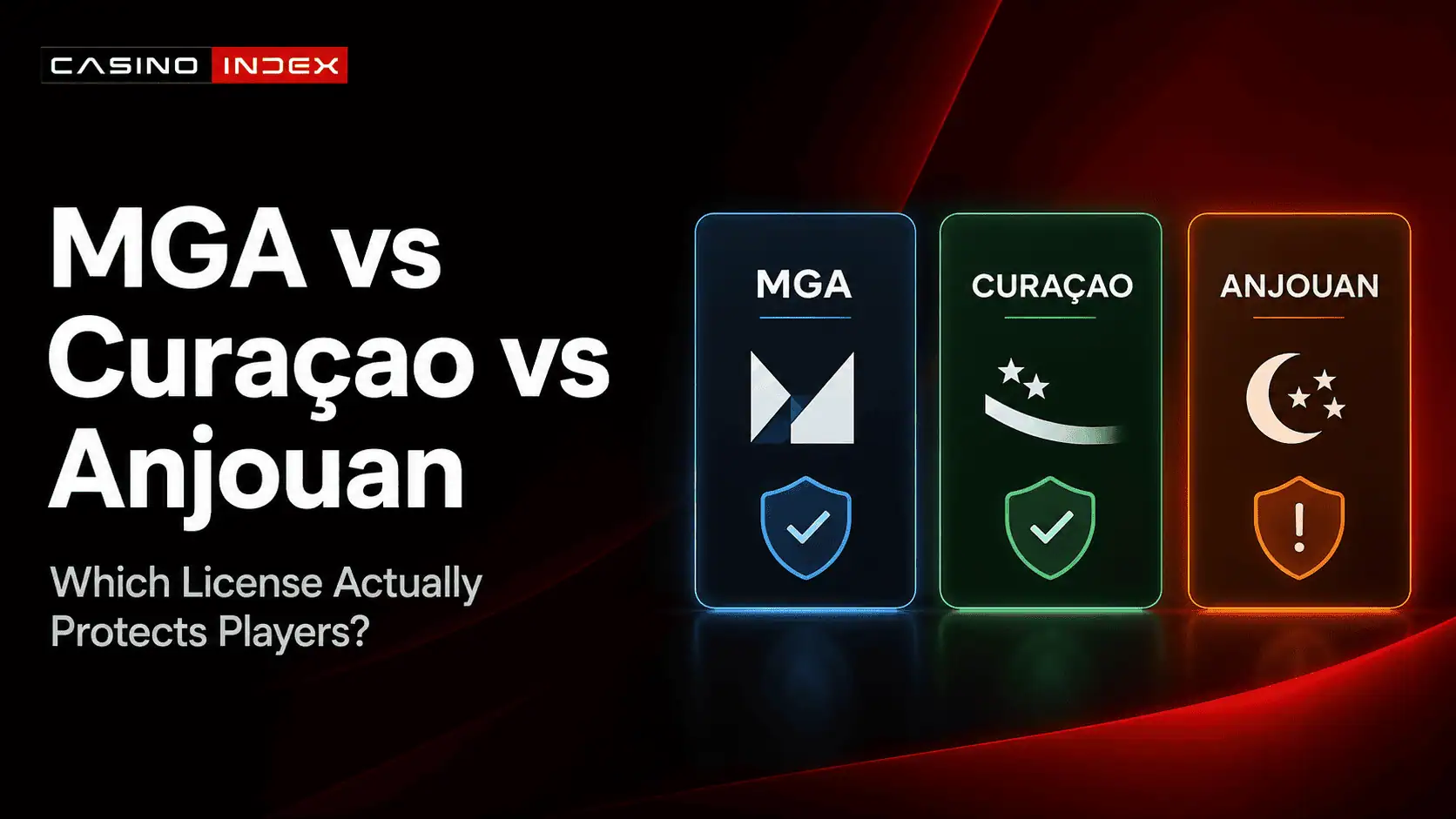
MGA vs Curaçao vs Anjouan — Which License Actually Protects Players?
A casino license in the footer can make a site look safer than it really is.
That is the problem.
Players often see “licensed and regulated” and assume the casino has strong oversight, fair complaint handling, and reliable withdrawal protection. In reality, MGA, Curaçao, and Anjouan do not protect players at the same level.
The license name matters. But the operator behind the license matters more.
A strong regulator can give players better complaint routes and more pressure on the casino. A weaker offshore license may only prove that the operator has some form of authorization, with limited help if a payout dispute appears later.
The real question is not:
Is this casino licensed?
The better question is:
What happens if the casino delays my withdrawal, blocks my account, or applies unclear terms after I win?
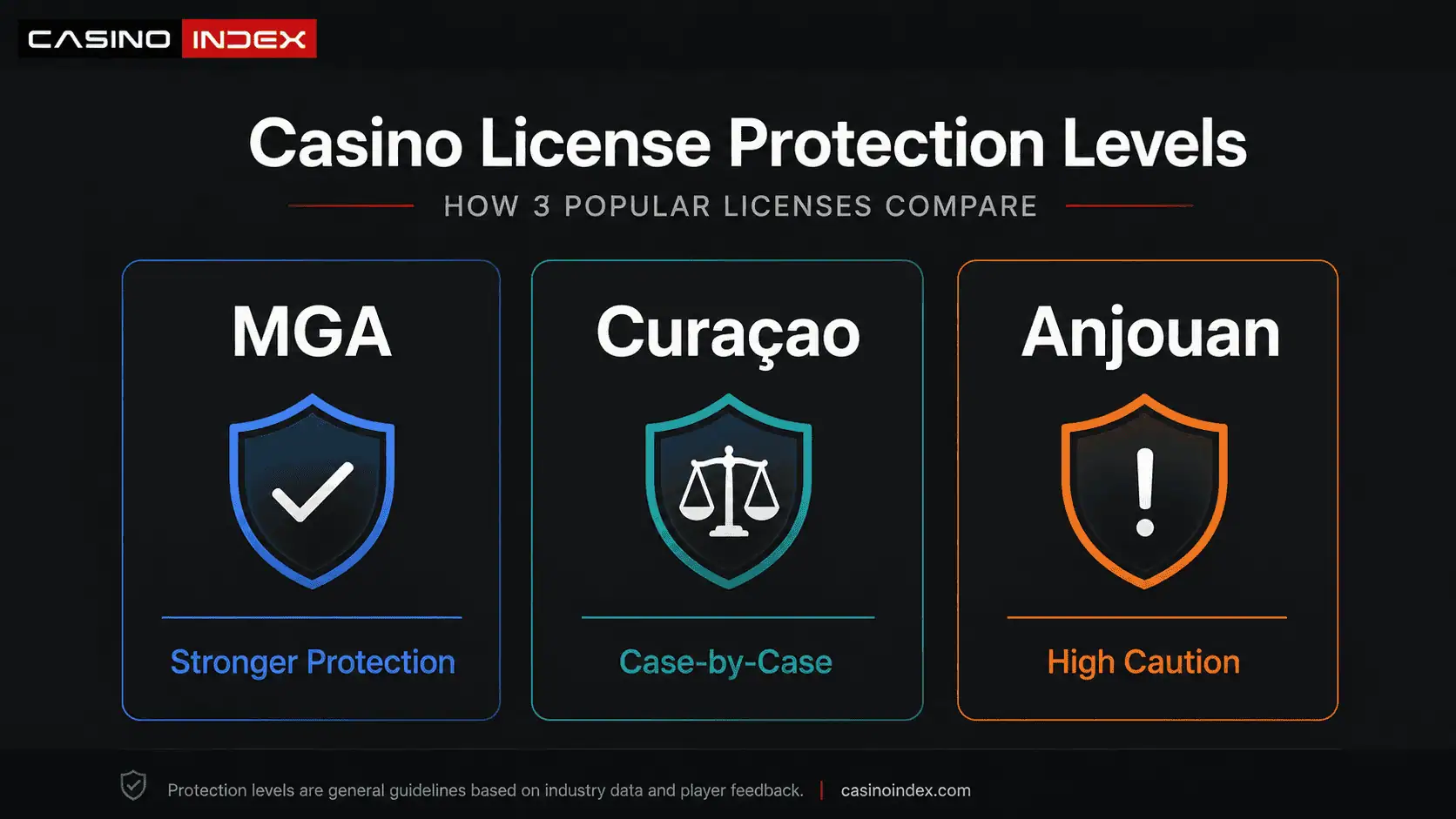
From a player-protection view, MGA is the strongest of these three. Curaçao sits in the middle and depends heavily on the operator. Anjouan needs the most caution because complaint handling and enforcement pressure are weaker from the player’s side.
This guide compares MGA, Curaçao, and Anjouan by enforcement, complaints, withdrawals, transparency, offshore limitations, and real player risk.
Quick verdict: MGA vs Curaçao vs Anjouan
| License | Protection level | Best strength | Main risk | CasinoIndex view |
|---|---|---|---|---|
| MGA | Strong | Better oversight, complaint structure, and compliance pressure | Still does not guarantee fast payouts | Best player-protection signal |
| Curaçao | Medium | Improving framework and wide operator coverage | Legacy offshore risk and mixed operator quality | Case-by-case trust signal |
| Anjouan | Weak to medium | Visible offshore license trail for some casinos | Limited complaint realism and weaker enforcement pressure | High-caution signal |
The order is clear:
MGA first. Curaçao second. Anjouan third.
That does not mean every MGA casino is safe. It also does not mean every Curaçao or Anjouan casino is unsafe.
A license is only one trust layer. The casino still needs clear ownership, fair terms, reliable payouts, honest support, and a complaint pattern that does not show repeated unresolved problems.
How CasinoIndex compares casino licenses
CasinoIndex does not compare licenses by reputation alone.
A license matters only if it gives players more clarity before they deposit and more leverage when something goes wrong.
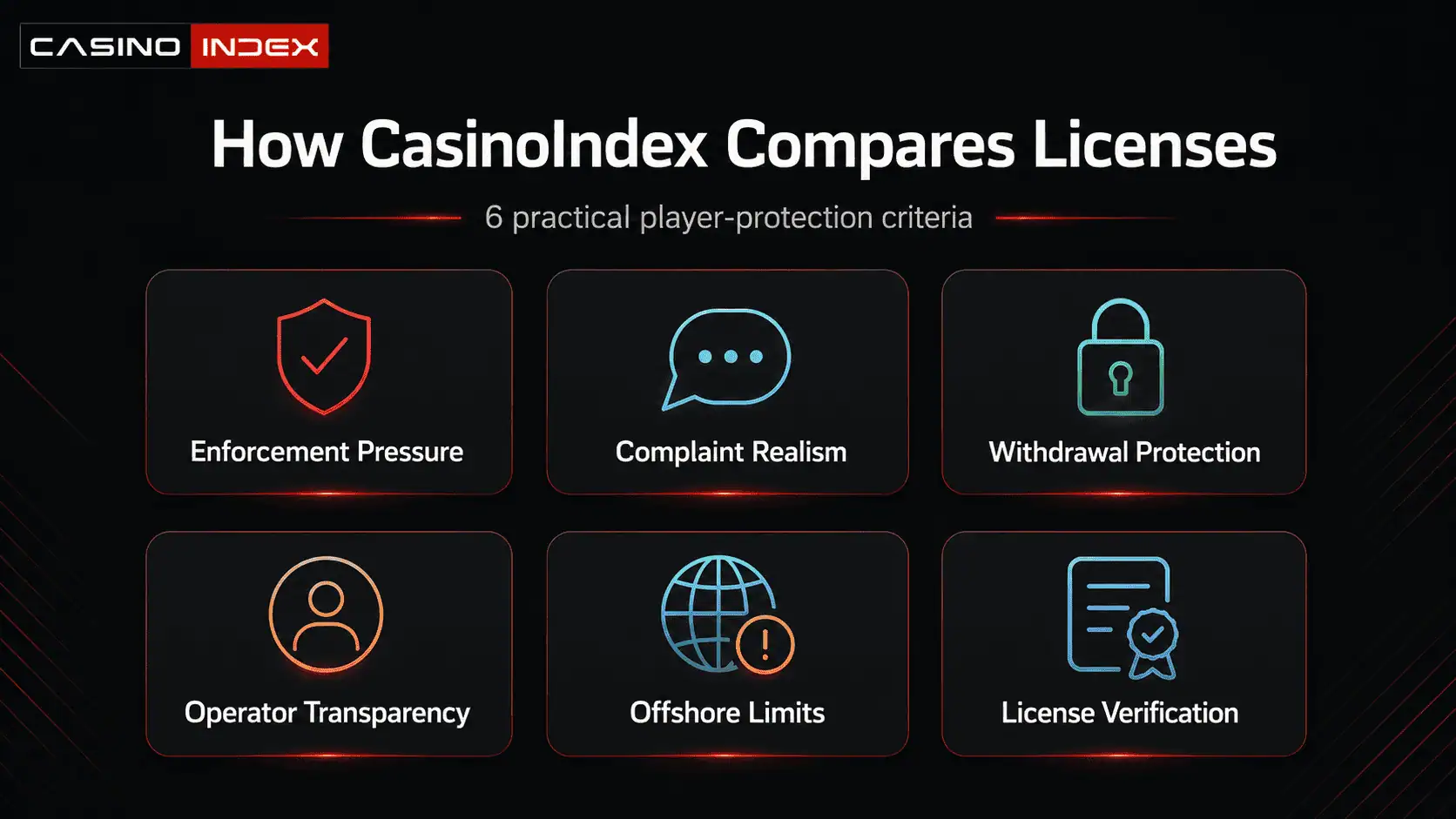
For this comparison, CasinoIndex uses six practical criteria.
1. Enforcement pressure
A useful regulator must create real pressure on operators.
That includes licensing standards, compliance checks, sanctions, reporting duties, and consequences when operators behave poorly.
2. Complaint realism
A complaint process only matters if players can actually use it.
The strongest systems give players a clear path after support fails. The weakest systems push players back to the casino or rely on vague external processes.
3. Withdrawal protection
No license guarantees instant payouts.
Still, stronger regulation makes vague withdrawal delays, unclear KYC requests, and unfair payout rules harder for operators to defend.
4. Operator transparency
Players should be able to identify the legal company, license number, approved domain, and complaint route.
If the legal trail is unclear, the license is weaker in practice.
5. Offshore limitations
Offshore licenses can be useful, but they often offer less direct protection than stricter regulators.
The weaker the license, the more carefully players need to check the operator.
6. Verification quality
A license should be easy to verify.
The company, domain, license number, status, and terms should match. CasinoIndex explains this process in its guide to checking whether a casino license really matches the operator and domain.
MGA license: strongest player-protection signal
The Malta Gaming Authority is the strongest license in this comparison.
It has a more mature regulatory structure, clearer compliance expectations, and a stronger player complaint framework than Curaçao or Anjouan.
For players, that matters most when money is already inside the casino.
An MGA license can create stronger pressure around:
- operator accountability;
- responsible gambling controls;
- complaint handling;
- player fund procedures;
- transparency standards;
- regulatory reputation risk.
That does not mean MGA casinos are risk-free.
Players can still face KYC checks, payment reviews, bonus disputes, account investigations, or delayed withdrawals. A strong license improves accountability. It does not remove every problem.
Where MGA helps most
MGA helps most when a dispute becomes serious.
If a casino delays a withdrawal, refuses a payout, or applies terms in a questionable way, players usually have a more credible escalation route than they would with lighter offshore licenses.
That does not mean the regulator will automatically side with the player.
Disputes can involve bonus rules, identity checks, payment ownership, restricted countries, duplicate accounts, or source-of-funds questions.
Still, MGA gives the player a stronger starting position.
For CasinoIndex, MGA is the best license of these three when all other factors are equal.
Curaçao license: improving, but still operator-dependent
Curaçao is more complicated.
For years, Curaçao was known for offshore casino licensing, crypto gambling, international sportsbooks, and flexible operator structures. Many casinos used Curaçao because it was accessible and widely recognized in offshore gambling.
That history still affects player trust.
Curaçao is now moving through a stronger regulatory framework, with more centralized oversight and clearer licensing expectations. That is a positive change.
But players should not treat every Curaçao casino the same.
Some Curaçao operators are serious, established, and transparent. Others still show older offshore weaknesses: unclear ownership, vague complaint routes, broad account terms, and slow support during payout disputes.
Where Curaçao can be acceptable
A Curaçao license can be a useful trust signal when the operator is clear.
Stronger Curaçao casinos usually show:
- visible legal company details;
- current license information;
- matching footer and terms;
- clearer withdrawal rules;
- responsive support;
- fewer repeated payout complaints.
That is why Curaçao should be judged case by case.
CasinoIndex covers this in its guide to Curaçao casinos ranked by real player risk.
Where Curaçao still creates risk
Curaçao becomes weaker when the casino uses the license name but fails the practical checks.
Be careful when you see:
- unclear company names;
- old or vague license wording;
- no exact domain match;
- weak complaint information;
- broad account-blocking rules;
- repeated withdrawal complaints;
- support that avoids legal questions.
Curaçao is improving. But the player should still verify the current operator, not trust the license label alone.
Anjouan license: useful visibility, weaker protection
Anjouan is the weakest of the three from a player-protection view.
An Anjouan license can show that a casino has offshore gambling authorization. It may also give players a visible license number or basic legal trail.
That is better than a fake badge or no license at all.
But it should not be treated as strong protection.
The main weakness is complaint realism. Players have less direct regulatory comfort if a withdrawal dispute, account block, or KYC conflict becomes serious.
Anjouan also appears around newer casinos, smaller offshore brands, and some white-label structures. That does not automatically make those casinos unsafe. It means players need to check who controls the account, payout process, and complaint route.
CasinoIndex explains this higher-caution approach in its guide to Anjouan casinos ranked by real player risk.
Where Anjouan can still matter
Anjouan is not meaningless.
A visible Anjouan license can help players confirm that a casino is not completely anonymous. If the company name, domain, license number, and terms all match, the license creates at least a basic legal trail.
That matters.
But it is only the starting point.
Players still need to test withdrawals, read KYC terms, check complaints, and confirm who operates the site.
Where Anjouan becomes risky
Anjouan risk rises when a casino uses the license as a trust shield.
Watch for:
- badge-only license claims;
- unclear company names;
- no exact domain match;
- vague withdrawal rules;
- weak complaint process;
- large bonuses with strict hidden terms;
- little payout history;
- repeated complaints across related brands.
The weaker the operator trail, the less useful the Anjouan license becomes.
MGA vs Curaçao vs Anjouan: compact comparison
| Player-protection area | MGA | Curaçao | Anjouan |
|---|---|---|---|
| Enforcement pressure | Strongest | Improving, mixed | Limited |
| Complaint route | More structured | Operator-dependent | Weaker from player view |
| Withdrawal protection | Stronger policy pressure | Depends on operator | Test very cautiously |
| Operator transparency | Usually clearer | Variable | Needs deeper checks |
| Offshore risk | Lower | Medium | Higher |
| License verification | Usually clearer | Must check current status | Must verify carefully |
| Best use case | Stronger trust signal | Case-by-case selection | Small-test only |
| Main warning | Not a payout guarantee | Legacy risk remains | Weak complaint leverage |
This table should not replace a casino review.
It shows the starting position. The operator still decides how the casino behaves in practice.
Which license is best for withdrawals?
MGA gives players the strongest withdrawal-protection signal among these three.
That does not mean MGA withdrawals are always fast. Casinos may still delay payment for:
- identity verification;
- source-of-funds checks;
- payment ownership;
- bonus review;
- suspicious activity;
- restricted country issues;
- responsible gambling checks.
The difference is accountability.
A stronger regulator makes unclear payout behavior harder to justify.
Curaçao can be acceptable when the casino has a serious operator, clean terms, and a strong payout record. But players need to check current license details and complaint patterns.
Anjouan should be tested most cautiously. Do not build a large balance before seeing how the casino handles a small withdrawal.
Which license is best for complaints?
MGA offers the strongest complaint position.
Players usually have a clearer process if the operator does not resolve the issue directly. That does not guarantee success, but it gives the complaint more weight.
Curaçao sits in the middle. The newer framework may improve expectations, but the practical outcome still depends heavily on the operator and current license status.
Anjouan is the weakest. The player may have a legal trail, but direct complaint leverage is more limited.
Which license is best for operator transparency?
MGA generally creates stronger transparency expectations.
Players are more likely to find clear legal entity details, responsible gambling information, complaint procedures, and license references.
Curaçao is improving, but players must still check the exact operator, current licensing route, and domain match.
Anjouan requires the most caution. Some casinos show clear details. Others make the structure harder to understand, especially when offshore companies, new brands, or white-label platforms are involved.
This is why CasinoIndex treats licensing as one part of a wider trust check. The deeper issue is explained in what makes a casino license trustworthy in real payout situations.
Why “licensed” does not always mean safe
“Licensed” is one of the most overused trust signals in online gambling.
A license can show authorization. It does not automatically prove:
- fast withdrawals;
- fair KYC timing;
- honest support;
- clear ownership;
- fair bonus terms;
- strong complaint handling;
- safe access from your country;
- low account-blocking risk.
A license also does not fix a weak operator.
If a casino hides its company details, delays payouts without clear reasons, uses broad bonus terms, or has repeated unresolved complaints, the license should not carry the whole trust score.
The practical rule is simple:
The weaker the license, the stronger the operator evidence needs to be.
For wider context, CasinoIndex explains how casino licenses differ in quality, oversight, and player protection.
What players should check before depositing
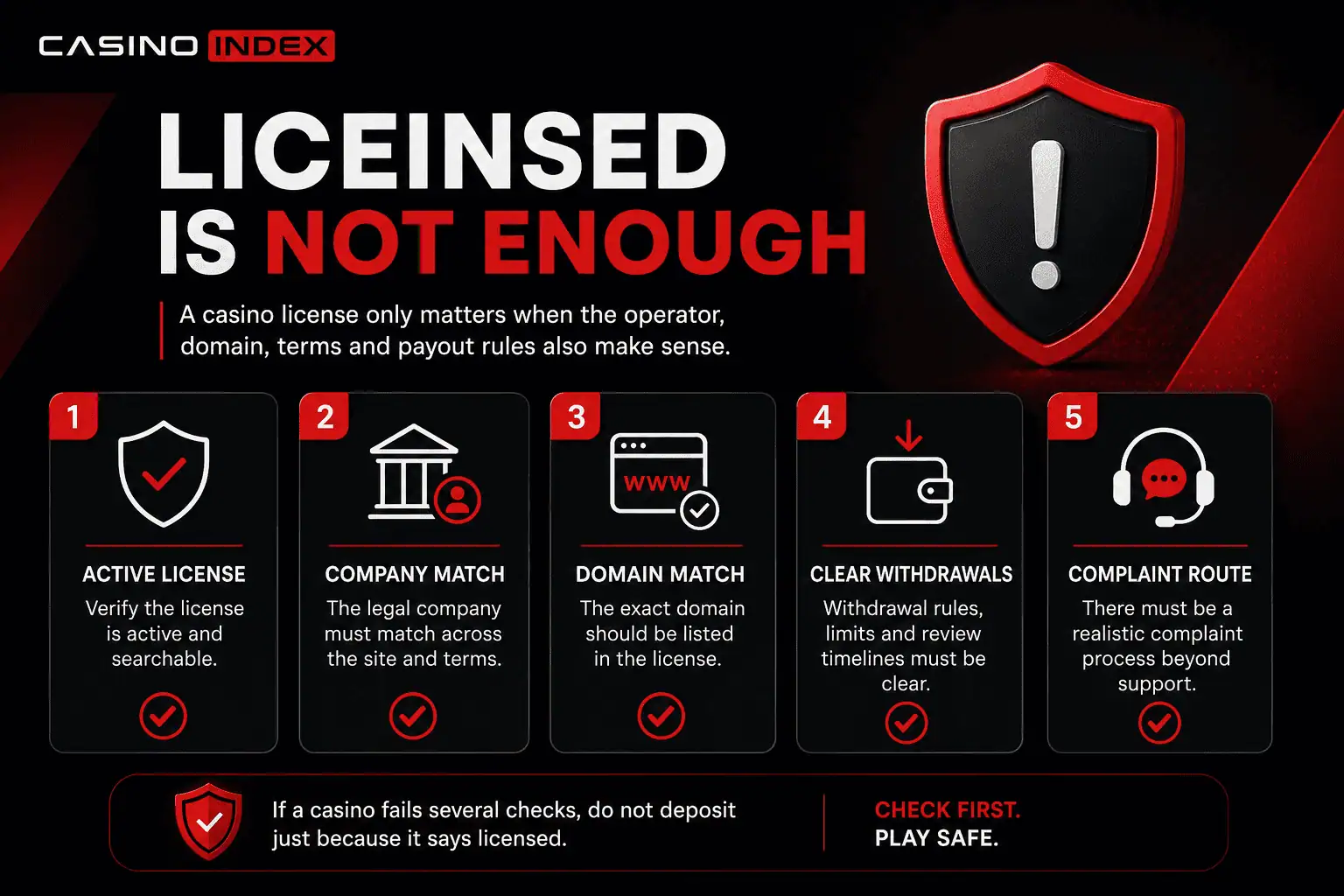
Before trusting any casino license, run this check.
| Check | What to confirm | Stronger signal | Red flag |
|---|---|---|---|
| License | Status, number, regulator | Active and searchable | Badge only |
| Company | Legal operator | Same name in footer and terms | Different entities |
| Domain | Exact casino URL | Listed or validated | Similar domain only |
| Withdrawals | Limits and review rules | Clear timelines | Vague “internal review” |
| KYC | Verification timing | Explained before deposit | Surprise cashout KYC |
| Complaint route | Escalation path | Clear process | Support only |
| Reputation | Complaint pattern | Isolated issues | Same problem repeats |
If a casino fails several checks, do not deposit just because it says licensed.
Final verdict: which license actually protects players?
MGA protects players best among these three.
It has the strongest oversight, clearest complaint structure, better compliance expectations, and more pressure on operators to behave transparently.
Curaçao comes second. It is improving, but players still need to judge each casino by its current operator, license status, payout behavior, and complaint pattern.
Anjouan comes third. It can provide a visible license trail, but it offers the weakest practical protection when withdrawals, complaints, or operator transparency become serious issues.
Use this priority list before depositing:
- Prefer MGA when all other factors are equal.
- Treat Curaçao as case-by-case, not automatically safe or unsafe.
- Treat Anjouan as high-caution unless every detail verifies cleanly.
- Always match the company, domain, license, and terms.
- Read withdrawal and KYC rules before bonus terms.
- Check complaint patterns, not just review scores.
- Test small before trusting offshore casinos.
The strongest rule is simple:
Do not trust a casino because it says licensed. Trust it only when the license, operator, domain, withdrawal rules, complaint route, and real player record all make sense.
FAQ
Is an MGA license better than Curaçao and Anjouan?
Yes. MGA is the strongest of the three for player protection, complaint structure, and regulatory pressure.
Is Curaçao safer than Anjouan?
Usually, yes. Curaçao is improving and generally offers a stronger framework than Anjouan, but the operator still matters.
Does an MGA license guarantee withdrawals?
No. It improves accountability, but withdrawals can still be delayed by KYC, payment checks, bonus reviews, or account investigations.
Are Curaçao casinos safe?
Some can be usable. Players should check the current operator, license status, domain match, payout rules, and complaint pattern.
Are Anjouan casinos safe?
Anjouan casinos need extra caution. The license may provide a legal trail, but it should not be treated as strong player protection.
Which license is best for complaints?
MGA offers the strongest complaint position. Curaçao is improving. Anjouan gives players less direct leverage.
Why is “licensed” not enough?
Because a license does not automatically prove fair withdrawals, clear ownership, strong support, or safe bonus terms.
What should I check before depositing?
Check the license status, legal company, exact domain, withdrawal rules, KYC timing, complaint route, and repeated player complaints.
Is a weak license better than no license?
Usually, yes, if it can be verified. But a weak offshore license should only be treated as a basic signal.
Which license should players prefer?
Players should prefer MGA where possible. Curaçao can be acceptable with careful checks. Anjouan should be tested cautiously.

Maria Hoffmann has worked in cryptocurrency content and digital publishing since 2017. She is a co-founder of Freecoins24 and CryptoMutant and has covered blockchain projects, crypto platforms and emerging industry trends for several years. She has also been active as a cryptocurrency investor since 2019. At CasinoIndex, Maria combines content research and SEO experience with a focus on casino trust, platform security, withdrawal processes, payment risks and user protection. Her work looks beyond bonuses and product features to examine how gambling platforms handle player funds, verification and account-related risks.