How to Verify an Online Casino License Before You Deposit
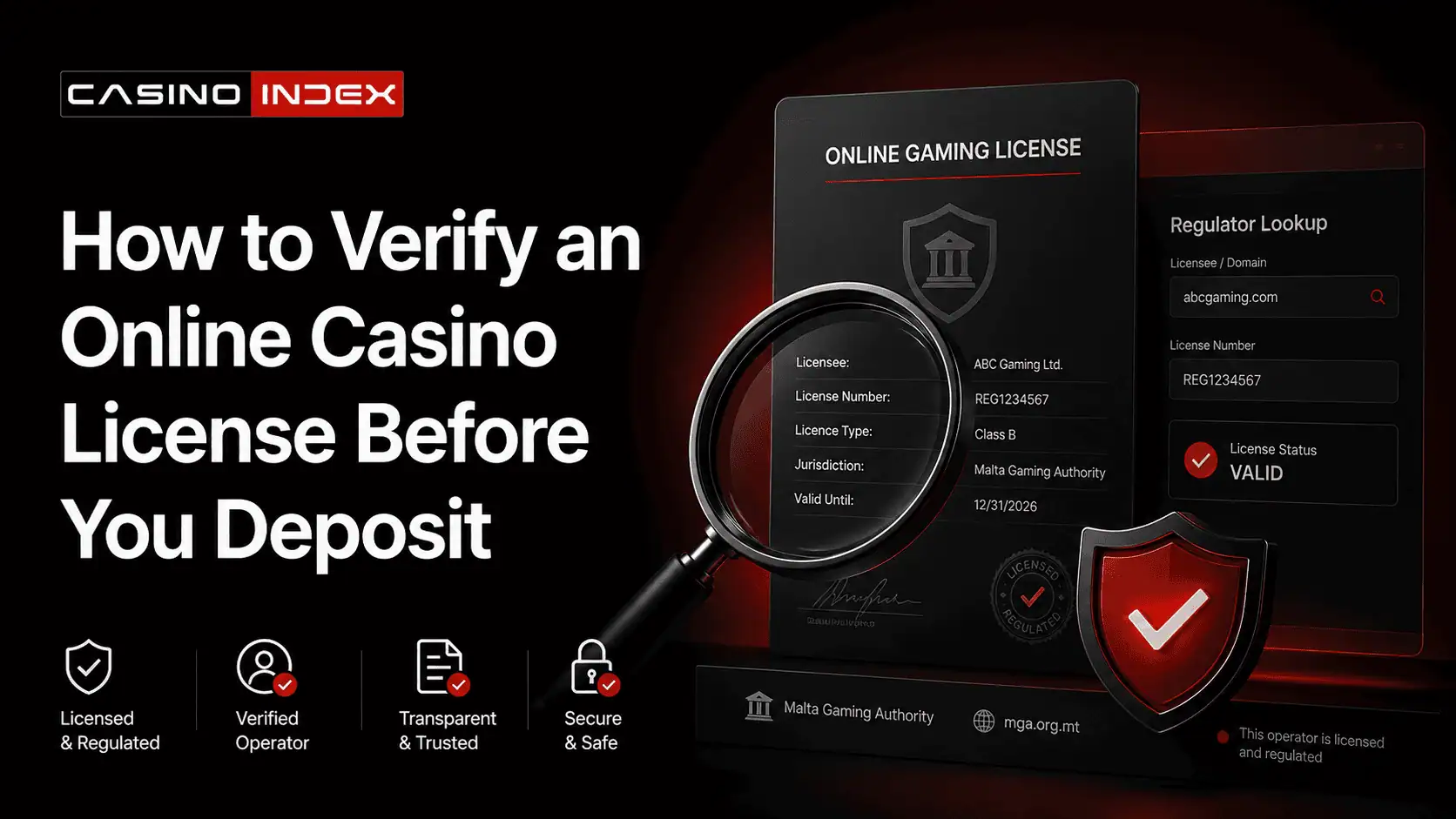
Seeing a casino license in the footer is not enough.
Many players trust the badge, the regulator logo or the words “licensed and regulated” without checking what sits behind them. The problem often becomes visible later, when a withdrawal is delayed, an account review begins or the listed license does not cover the casino domain the player actually used.
A proper license check takes only a few minutes, but it needs more than a footer scan. You must confirm the regulator, the legal company, the license type, the current status, the exact domain and the terms that apply to your account.
That process does not make a casino risk-free. A licensed operator can still have slow withdrawals, strict KYC, weak support, unclear bonus rules or a mixed complaint record. However, verification helps you avoid one of the most basic risks in online gambling: depositing with an operator whose legal identity or regulatory status cannot be proved.
Before depositing, ask one direct question:
Can I prove who operates this casino, which license covers the site and who is responsible if something goes wrong?
If the answer is no, the license should not influence your decision.
This guide explains how to verify an online casino license, match the legal entity, check an official regulator register, identify domain mismatches and recognize warning signs before money enters the account.
For broader context on regulatory strength, start with the casino licensing guide.
Why License Verification Matters Before You Deposit
A gambling license should show that an operator has passed a defined level of regulatory review. Depending on the jurisdiction, this may include ownership checks, anti-money-laundering controls, responsible gambling rules, game standards, complaint procedures and ongoing supervision.
Still, licenses are not equal.
A stricter regulator may give players clearer legal protection, more visible enforcement and a stronger complaint route. An offshore license may confirm that a company is authorized to operate while offering less practical help during an individual dispute.
In some cases, the license itself is real but does not cover the casino domain being used. Elsewhere, the company shown in the terms differs from the entity listed by the regulator.
That is why players should avoid two common mistakes:
- trusting a casino because its footer contains a regulatory badge
- assuming every license provides the same level of protection
A useful verification should answer six questions:
- Which regulator issued the license?
- Which legal company holds it?
- Does that company match the casino terms?
- Does the license cover player-facing online casino activity?
- Is the exact domain listed or validated?
- Is the license currently active?
If those questions cannot be answered clearly, the casino has not passed the first trust check.
What Strong License Evidence Looks Like
The strongest license claims form a consistent trail from the casino website to an independent regulator record.
| Check | Stronger Evidence | Weaker Evidence |
|---|---|---|
| Regulator | Recognizable authority with an official website and public records | Vague “internationally regulated” wording |
| Legal company | Same entity appears in the footer, terms and regulator register | Different or missing company names |
| Domain | The exact casino URL appears in the record or validator | Only a similar brand or different domain is listed |
| License type | B2C, remote casino or player-facing gaming authorization | Supplier-only or software license presented as operator protection |
| Status | Active or valid | Expired, suspended, revoked or unclear |
| Terms | Ownership, country rules, KYC and disputes align with the license record | Terms contradict the footer or hide the responsible entity |
No single row proves that a casino is trustworthy. The value comes from the full match.
Step 1: Check the Casino Footer and Legal Pages
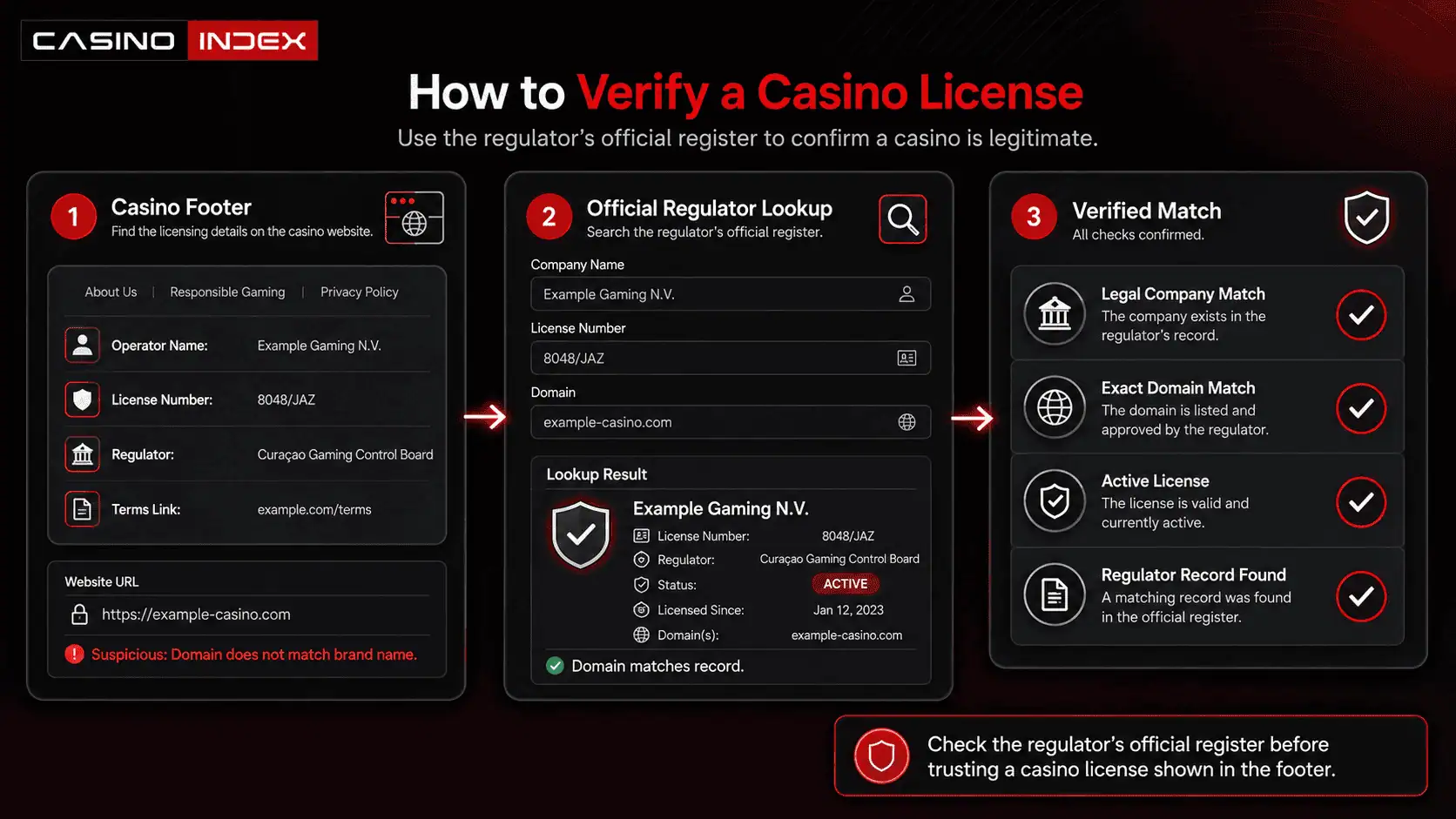
Start at the bottom of the casino homepage. The footer usually provides the first licensing clues, but it should only be treated as the beginning of the check.
Look for:
- regulator name
- license or authorization number
- legal company name
- registered address
- terms and conditions
- privacy policy
- responsible gambling information
- complaint or dispute details
- a clickable regulatory seal where available
The most important detail is the legal company. The public casino brand is not always the licensed entity, and that is not automatically suspicious. Many brands operate through registered companies with different names.
What matters is whether the entity in the footer matches the company named in the terms and the official register.
Footer wording that proves very little
Be cautious when the site only uses phrases such as:
- “licensed and regulated”
- “internationally licensed”
- “operated under gaming laws”
- “fully certified”
- “regulated casino”
These statements are marketing claims until they connect to a company, license number and independent record.
Step 2: Match the Legal Company and Ownership Trail
The brand is what players recognize. The legal company is normally the entity that controls the account, signs the terms and holds the license.
Write down:
- the casino brand
- the exact website domain
- the company named in the footer
- the company named in the terms
- the license number
- the regulator
- the registered address where shown
Then compare those details with the official regulator record.
A clean match normally means:
- the company appears in the regulator database
- the authorization is active
- the brand or domain is connected to the entity
- the license covers player-facing gambling activity
- the terms identify the same operator
A weak match looks different:
- the company exists, but the domain is missing
- the number belongs to another operator
- the terms name a different company
- the casino links only to a generic regulator homepage
- the ownership trail ends with an unexplained shell or unrelated brand
When the legal structure is unclear, use the CasinoIndex guide on how to check who owns the casino.
Step 3: Search the Official Regulator Register
Do not rely only on a validator page supplied by the casino. Open the regulator’s official website independently and search the public register yourself.
Depending on the authority, you may be able to search by:
- company name
- trading name
- domain
- license number
- authorization status
- gaming service or license category
Useful official starting points include:
- Malta Gaming Authority Licensee Register
- UK Gambling Commission Business Register
- Curaçao Gaming Authority License Register
- Anjouan Gaming Licence Verification
Search the company first, then the exact domain. Where the regulator provides an enforcement register, warnings or sanctions, check those records as well.
Do not trust copied or misleading seals
A weak seal may:
- redirect only to the regulator homepage
- open a broken page
- show an unrelated company
- validate a different domain
- use a lookalike regulator website
Always inspect the destination URL. A misspelled, unfamiliar or casino-controlled verification domain should not be treated as independent proof.
Step 4: Confirm the License Type
A license can be real and still fail to prove that the operator is authorized to hold player accounts.
Regulators may issue different permissions for:
- remote casino operations
- sports betting
- B2C gambling services
- B2B platforms
- software supply
- game hosting
- payment or technical services
A supplier or software license is not the same as a player-facing casino authorization.
The key question is:
Which licensed company is legally responsible for the player account, balance and withdrawal?
Provider logos, testing certificates and payment brands can support the wider trust picture. They do not replace an operating license.
Step 5: Match the Exact Casino Domain
Domain matching is one of the most important parts of license verification.
Do not assume that similar URLs belong to the same authorized site. For example:
- casinoexample.com
- casino-example.com
- casinoexample.io
- playcasinoexample.com
- casinoexample.bet
These can lead to different operators, regional versions, mirrors or clone sites.
Check:
- the complete spelling
- the domain extension
- whether the URL appears in the register
- whether the terms refer to the same website
- whether the certificate or seal validates that exact domain
If the register lists one domain but the casino uses another, pause before depositing. There may be a legitimate regional or migration explanation, but the operator should be able to prove it.
Step 6: Check the Current Status and Regulatory History
A valid license needs a current status.
| Status | Meaning | Player Response |
|---|---|---|
| Active / valid | The authorization is currently in force | Continue checking the operator, terms and reputation |
| Suspended | The license is temporarily restricted | Avoid new deposits until the issue is resolved |
| Expired | The authorization is no longer current | Do not treat the casino as actively licensed |
| Revoked / cancelled | The regulator has removed the authorization | Avoid the casino |
| Pending / unclear | The current protection cannot be confirmed | Wait for verifiable status before depositing |
Where available, review enforcement actions, public warnings and sanctions. A licensed operator may still have a poor compliance history.
That does not automatically prove the casino is unsafe today. However, it should affect how much money the player is willing to expose and how quickly the first withdrawal is tested.
The deeper standard is explained in what makes a license trustworthy.
Step 7: Compare the License With the Casino Terms
The footer, regulator record and terms should tell one consistent story.
Before depositing, check the terms for:
- legal company name
- governing law
- restricted countries
- KYC and document rules
- payment ownership requirements
- withdrawal limits and processing
- complaint and dispute procedures
- bonus restrictions
- account closure rules
- dormant account fees
The company named in the terms should match the licensed entity or have a clearly explained legal connection.
Country eligibility matters
A casino may allow registration or accept a deposit even when the player’s country appears in the restricted list.
That does not prove intentional misconduct, but it creates avoidable payout risk. Country eligibility may be reviewed only after a withdrawal, document submission or location check.
Never treat successful registration as proof that the account is allowed under the terms.
Casino License Verification Checklist
Use this checklist as a quick pre-deposit filter.
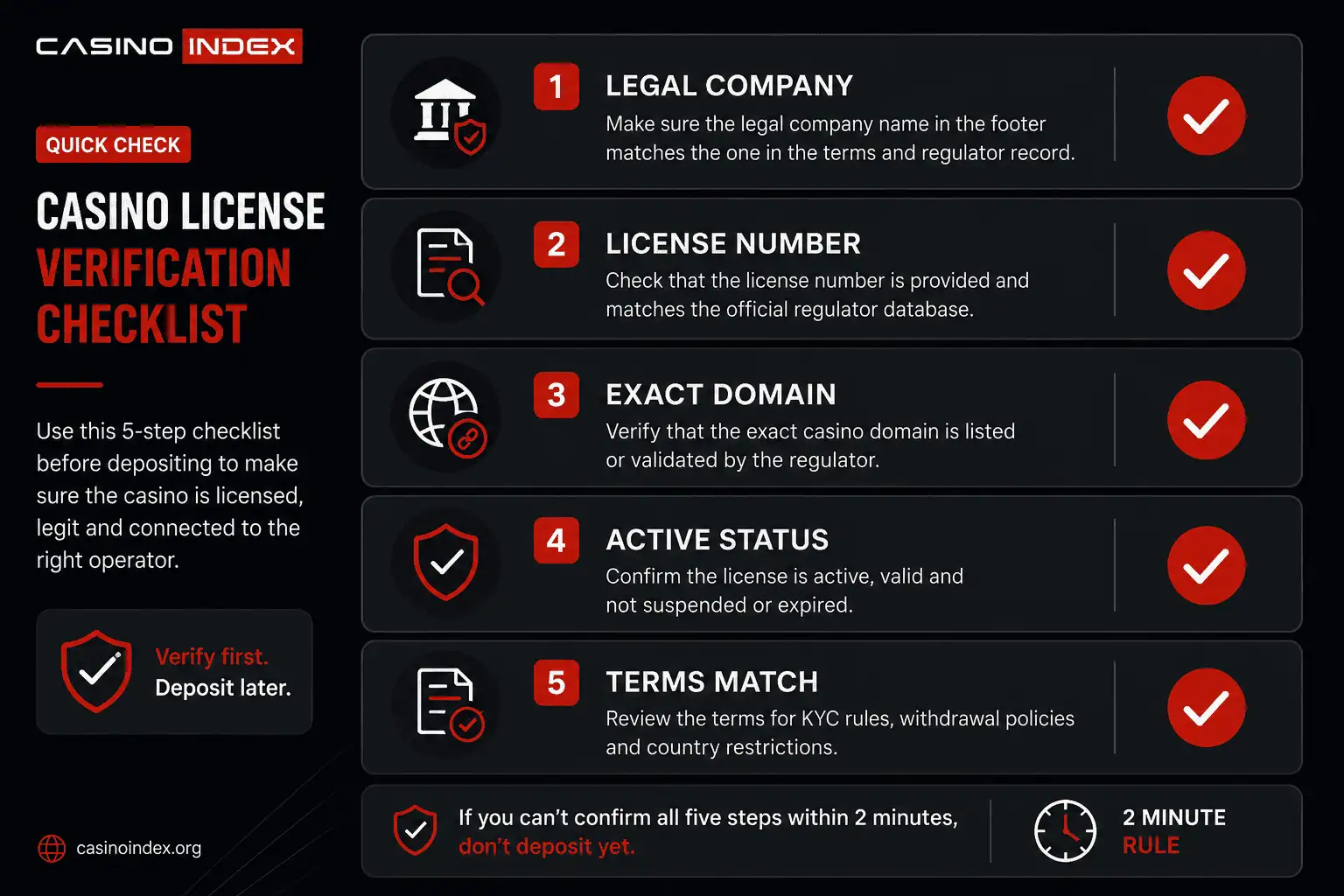
| Check | What to Confirm | Main Red Flag |
|---|---|---|
| Footer | Regulator, number and company | Only vague licensing language |
| Company | Same legal entity across the site and register | Different or missing company names |
| Register | Independent official record | No matching license |
| Domain | Exact casino URL is covered | Only a similar domain appears |
| Type | Player-facing casino or B2C authorization | Supplier-only permission |
| Status | Active or valid | Expired, suspended or revoked |
| Terms | KYC, withdrawals and country rules align | Contradictory legal information |
| Reputation | No repeated unresolved licensing or payout pattern | Similar complaints across several sources |
The checklist is a fast filter, not a replacement for a full review. A casino that fails several basic checks should not receive a deposit.
Fake or Misleading Casino License Signs
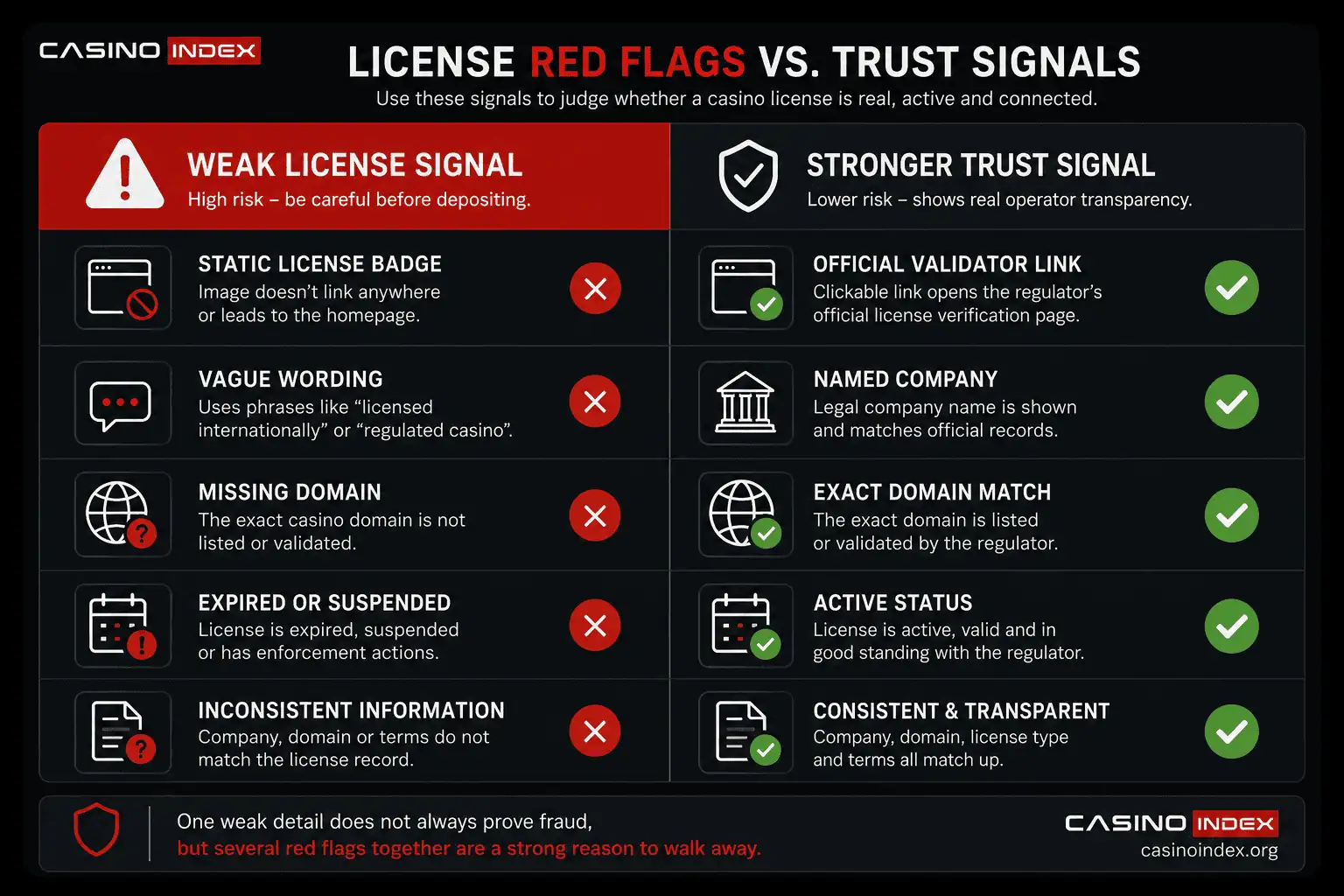
One weak detail does not always prove fraud. Several inconsistencies together are far more serious.
| Warning Sign | Why It Matters |
|---|---|
| No legal company | You cannot confirm who controls the account |
| No license number | The claim becomes difficult to verify |
| Static or broken seal | The badge may be copied, outdated or invalid |
| Company mismatch | The licensed entity may not operate the casino |
| Domain mismatch | The authorization may not cover the website being used |
| Wrong license type | A supplier authorization may be presented as player protection |
| Inactive status | Past licensing does not prove current authorization |
| No complaint route | The player may have little practical recourse |
| Restricted-country conflict | Eligibility may become a problem during withdrawal |
The strongest warning sign is inconsistency. The brand, company, domain, number, status and terms should support one another.
What a Verified License Does Not Prove
A successful license check confirms a legal and regulatory trail. It does not prove every part of the casino experience is strong.
A license alone does not guarantee:
- fast withdrawals
- fair KYC timing
- clear bonus conditions
- responsive support
- low withdrawal limits
- fair account restrictions
- strong complaint handling in every case
- eligibility in the player’s country
The better question is:
How much accountability does this license create when the operator is under pressure?
That is why CasinoIndex reviews licensing together with payment behavior, KYC, public complaints and real withdrawal risk. The broader evaluation process is explained in how CasinoIndex ranks casinos.
What If the Casino Has No Visible License?
A casino with no visible or verifiable license should be treated as high risk.
Crypto payments, provably fair games or fast deposits do not replace external accountability. Players still rely on the operator to:
- hold account balances
- approve withdrawals
- apply terms consistently
- review documents fairly
- protect account access
- resolve disputes
Before using an unlicensed or unclear casino, ask:
- Who owns and operates the site?
- Which company controls player funds?
- Which law applies?
- Who handles complaints?
- What happens when a withdrawal is delayed?
- When can verification begin?
- How can an account restriction be challenged?
If the site does not answer those questions, it should not be treated as a low-risk platform.
How License Checks Connect to Withdrawals and Disputes
Licensing matters most when money needs to leave the casino.
Deposits are usually processed quickly. The stronger trust test starts when the player requests a payout and the operator reviews:
- identity documents
- payment ownership
- country eligibility
- bonus activity
- betting patterns
- source of funds
- duplicate accounts
- possible terms breaches
A stronger licensing setup can create documented procedures and a clearer route for escalation. A weak or unclear authorization may leave the player dependent on the casino’s internal support team.
Before depositing, ask:
If this casino delays or refuses my withdrawal, who can review the decision?
Players should also understand what casinos check before approving withdrawals and how online casino dispute resolution works.
When You Should Not Deposit
Do not deposit when the basic licensing trail does not make sense.
Avoid the casino when:
- the regulator register contains no matching record
- the license belongs to another company
- the exact domain is not covered
- the authorization is expired, suspended or revoked
- the footer and terms name different operators without explanation
- the site presents a supplier license as a casino operating license
- support cannot explain the legal entity
- your country is restricted
- the validator uses a copied or broken seal
- public complaints repeatedly describe unpaid withdrawals or unexplained account blocks
A serious operator should make its legal and regulatory position reasonably easy to verify.
For a broader pre-deposit check, use the safe online casino guide.
Final View: Verify the Operator, Not Just the Badge
A casino license is useful only when it is current, independently verifiable and connected to the exact operator and domain being used.
Before depositing, confirm:
- the regulator is real
- the legal company is named
- the license type covers player-facing gambling
- the authorization remains active
- the exact domain matches
- the terms do not exclude the player or create an obvious payout conflict
If several details remain unclear, do not deposit yet.
A trustworthy casino should not force players to guess who operates the site, which authorization applies or who handles a dispute.
Verify the regulator, company, domain and terms before money enters the account.
FAQ: Verifying Online Casino Licenses
How do I verify an online casino license?
Find the company and license number in the footer or terms. Then search the official regulator register and confirm the company, license type, status and exact domain.
Is a casino license badge enough proof?
No. A badge can be copied, outdated or linked to the wrong entity. Verification should happen through the regulator’s official records.
What is the most important detail to check?
The legal company and exact domain are the most important match. A real license offers little protection when it cannot be connected to the casino website being used.
Can a casino copy another company’s license number?
Yes. Misleading sites may display details belonging to an unrelated operator. Company and domain matching help expose this problem.
Does a license guarantee fast withdrawals?
No. A license can improve accountability, but processing speed still depends on the casino, payment method, KYC, limits and account review.
What is the difference between a B2C and B2B license?
A B2C license generally covers services offered directly to players. A B2B or supplier license may cover software, hosting or platform services rather than the casino account itself.
Should I deposit when the license is expired?
No. An expired, suspended, revoked or unclear authorization should not be treated as current player protection.
What does it mean when the casino has no visible license?
It means external accountability cannot be confirmed. That creates higher risk around withdrawals, account restrictions and complaints.
Is a Curaçao license enough to trust a casino?
No license name is enough by itself. Check the current authorization, company, domain, terms, payment behavior and complaint history.
Why do the casino terms matter during verification?
The terms identify the operator, restricted countries, KYC rules, withdrawal conditions and dispute process. Those details should align with the regulator record.
What should I do when the company matches but the domain does not?
Pause before depositing. Ask the casino to prove that the domain is covered and confirm the answer through the regulator where possible.
When should I avoid a casino immediately?
Avoid it when the company, license number, license type, status and domain do not form a consistent and verifiable record.

Maria Hoffmann has worked in cryptocurrency content and digital publishing since 2017. She is a co-founder of Freecoins24 and CryptoMutant and has covered blockchain projects, crypto platforms and emerging industry trends for several years. She has also been active as a cryptocurrency investor since 2019. At CasinoIndex, Maria combines content research and SEO experience with a focus on casino trust, platform security, withdrawal processes, payment risks and user protection. Her work looks beyond bonuses and product features to examine how gambling platforms handle player funds, verification and account-related risks.